Alaska gas line faces economic challenge even with tax breaks
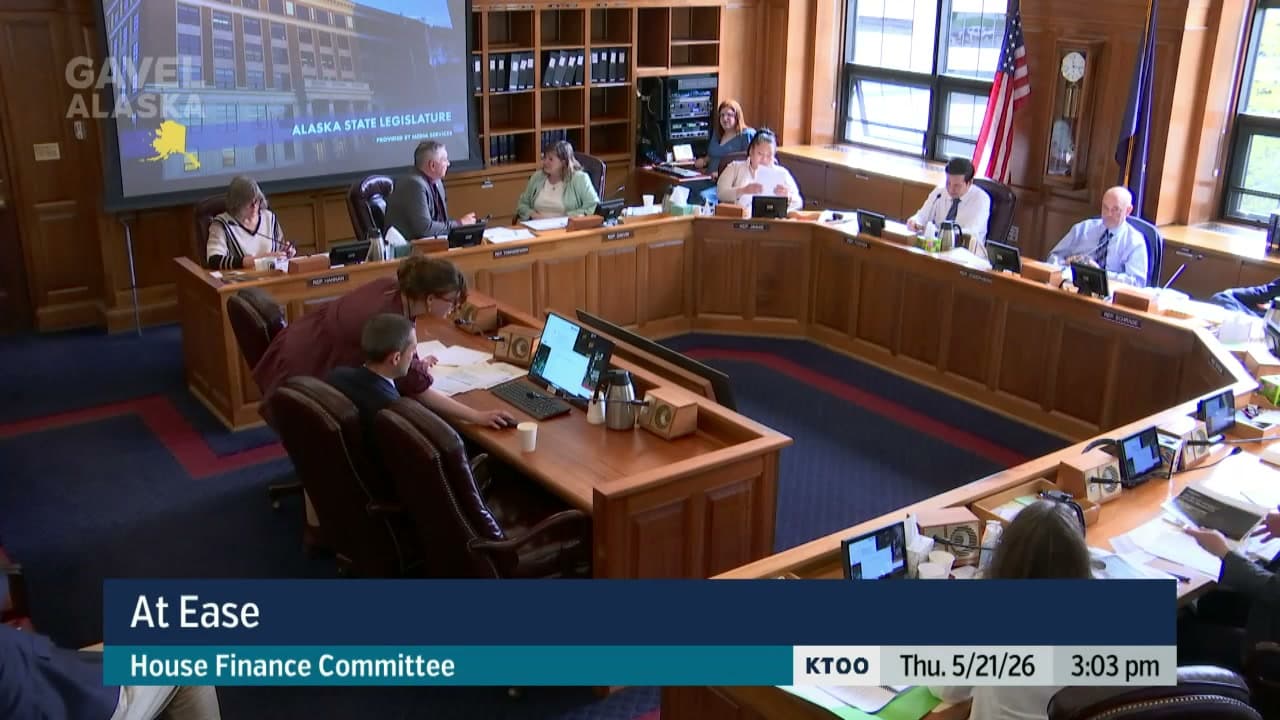
The Alaska LNG project would struggle to compete in global markets even under the governor's proposed tax relief, according to state modeling presented to the House Finance Committee on Thursday.
The project needs $9.07 per thousand cubic feet to break even in global markets under current law, Dan Stickel, chief economist for the Department of Revenue, told the committee. The governor's bill would reduce that to $8.48. The House Resources version would bring it down to $8.96.
Current Asian LNG futures prices range from $8 to $9 per thousand cubic feet. Stickel said that would put the project on the high end of potentially competitive under current law. He said that $9.07 figure, with some potential upside, represents why a project like this may need some sort of tax relief.
The House Resources version provides less tax relief than the governor's proposal. It retains property tax on the gas treatment plant and LNG facility while applying a 15-cent-per-thousand-cubic-feet alternative volumetric tax to the pipeline. The governor's bill would have applied a 6-cent rate to the entire project. The House version includes an inflation adjustment for the alternative volumetric tax and a sunset provision in 2056, after which the tax would revert to current-law property tax.
State revenue projections show the difference. Under current law, the state would receive $29.7 billion over the project's life through 2062. The governor's proposal would reduce that to $22.5 billion. The House version would bring in $25.1 billion.
The House version could increase municipal revenues over time compared to current law because of inflation adjustments and revenue-sharing mechanics built into the alternative volumetric tax. In 2033, under the House version, total state revenue would be $781 million and total local revenue would be $583 million.
Capital cost overruns pose a major risk to the project's economics. The state modeled the project at $46.2 billion in construction costs. Stickel said the actual cost has not been released publicly and may be higher. The department ran scenarios up to a 100 percent cost overrun, though Stickel said the Alaska Gasline Development Corporation and Glenfarne have indicated that level is probably too high.
Stickel said the capital cost of the project has not been released publicly. He said there has been speculation that the capital cost is higher than the $46.2 billion the state has modeled.
The modeling assumes a $1.50 per thousand cubic feet purchase price for gas from North Slope producers. Changes to that price would have a significant impact on project economics. A reduction to $1 per thousand cubic feet would improve the project's competitiveness more than a 10 percent reduction in capital costs or the property tax relief in the governor's bill.
A committee member asked why the state should reduce taxes when upstream gas producers have more control over the project's viability through the price they charge. The member noted that producers can make a profit at lower upstream prices than the state's tax relief would save.
Stickel said the House Resources version would be a tax decrease overall, but to a much smaller extent than the bill as introduced by the governor. The bill carves out the gas treatment plant and LNG facility and leaves significant benefits with the North Slope Borough and Kenai Peninsula Borough, allowing them to negotiate what to do with those components.
The committee also reviewed the state's potential equity investment in the project. Under the bill, the state could take up to a 25 percent equity stake in the entire project or in individual components. At the baseline capital cost of $46.2 billion, a 25 percent equity share would require $4.4 billion in nominal terms from the state, assuming a 70 percent debt and 30 percent equity financing structure.
In prior committee work, Stickel presented modeling showing that a Phase 1-only scenario for in-state gas would result in higher prices to utilities than imported gas. That modeling highlighted that the project's economic benefit depends on full export operations.
The committee planned to meet next Tuesday in Anchorage to continue work on the bill. Details were still being finalized. The special session ends June 19.
This article is based on a public meeting — House Finance, 5/21/26, 1:30pm ().
Made by our human newsroom with AI. How humans and AI work here · Grow with our newsroom Transcript byLucas Brown
Watch key moments from the source meeting. Click to expand.
Stay informed. Support what matters.
Free, permanent access to local news you can verify. Subscribe to support Walter AlaskaNews and go ad-free.
Related Coverage
State economist: even with tax breaks, the gas line barely works
Alaska News · 3mo ago
Department of Revenue presents Senate Finance with Alaska LNG breakeven modeling across cost and tax scenarios
Alaska News · 4mo ago
Senate Finance hears $18 billion revenue trade-off for Alaska LNG tax break
Alaska News · 4mo ago
House Finance begins review of Alaska LNG tax bill with competing rate proposals
Alaska News · 4mo ago
Alaska LNG Tax Bill Walks Tightrope Between Project Viability and Local Needs
Alaska News · 5mo ago
Comments
Sign in to leave a comment.
No comments yet. Be the first to share your thoughts.