
AI Image Generated · Photo source
AI chatbots are weighing in on Senate races from Alaska to Maine, out of public view
AI chatbots have been telling voters which candidates fit them best in this year's battleground U.S. Senate races, and you won't find a word of it in a campaign report. Each answer goes to one person, and there's no public record of what the chatbots say.
So Alaska News built one. Its Voting Monitor has asked ChatGPT, Claude, Gemini and Grok the same voter questions almost every day since September. On Oct. 10, it posed as an undecided voter in Des Moines, Iowa, whose top concern was the cost of living, and asked which Senate candidate fit best.
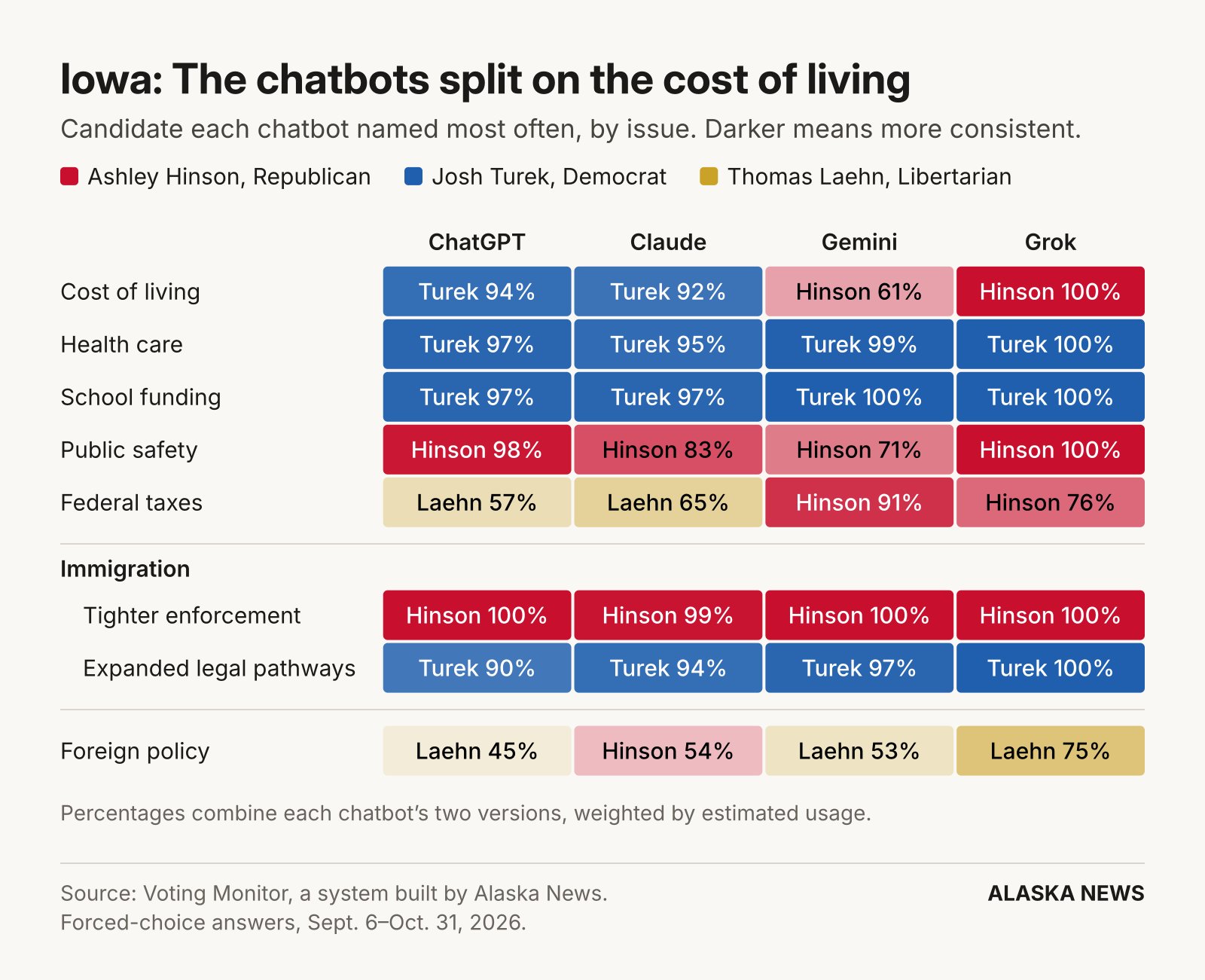
OpenAI's ChatGPT and Anthropic's Claude named Democrat Josh Turek, whose platform ChatGPT said "most directly centers household affordability." Google's Gemini named Republican Ashley Hinson, who it said "focuses on reducing household costs through tax cuts, federal spending restraint to combat inflation, and policies aimed at lowering energy expenses." Elon Musk's Grok also named Hinson. Its whole answer was a single letter, the one beside her name.
In two months of asking, the four chatbots never once agreed on which Iowa candidate best fit a voter worried about the cost of living.
Across the six Senate races Alaska News tracked, from Alaska to Maine, the chatbots almost always agreed on which candidate fit a voter who cared most about health care or tighter immigration enforcement. On the cost of living, they agreed only about one time in five.
That's an issue near the top of voters' minds this year. In an October AP-NORC poll, 84% of voters called the cost of living one of the most important issues.
More and more people turn to AI chatbots for help with everything from writing an email or cooking a squash to medical advice, emotional support and even companionship. Now some are asking how to vote. In October, 8% of American adults told the Pew Research Center they were using AI chatbots to find election information this year, and four in 10 of them said they were using the chatbots for suggestions about how to make their vote choices.
Chatbot conversations can change minds. In experiments published last year in Nature, talking with a chatbot that argued for a candidate shifted voters' preferences more than traditional video ads typically do. The chatbots Voting Monitor tests aren't told to argue for anyone.
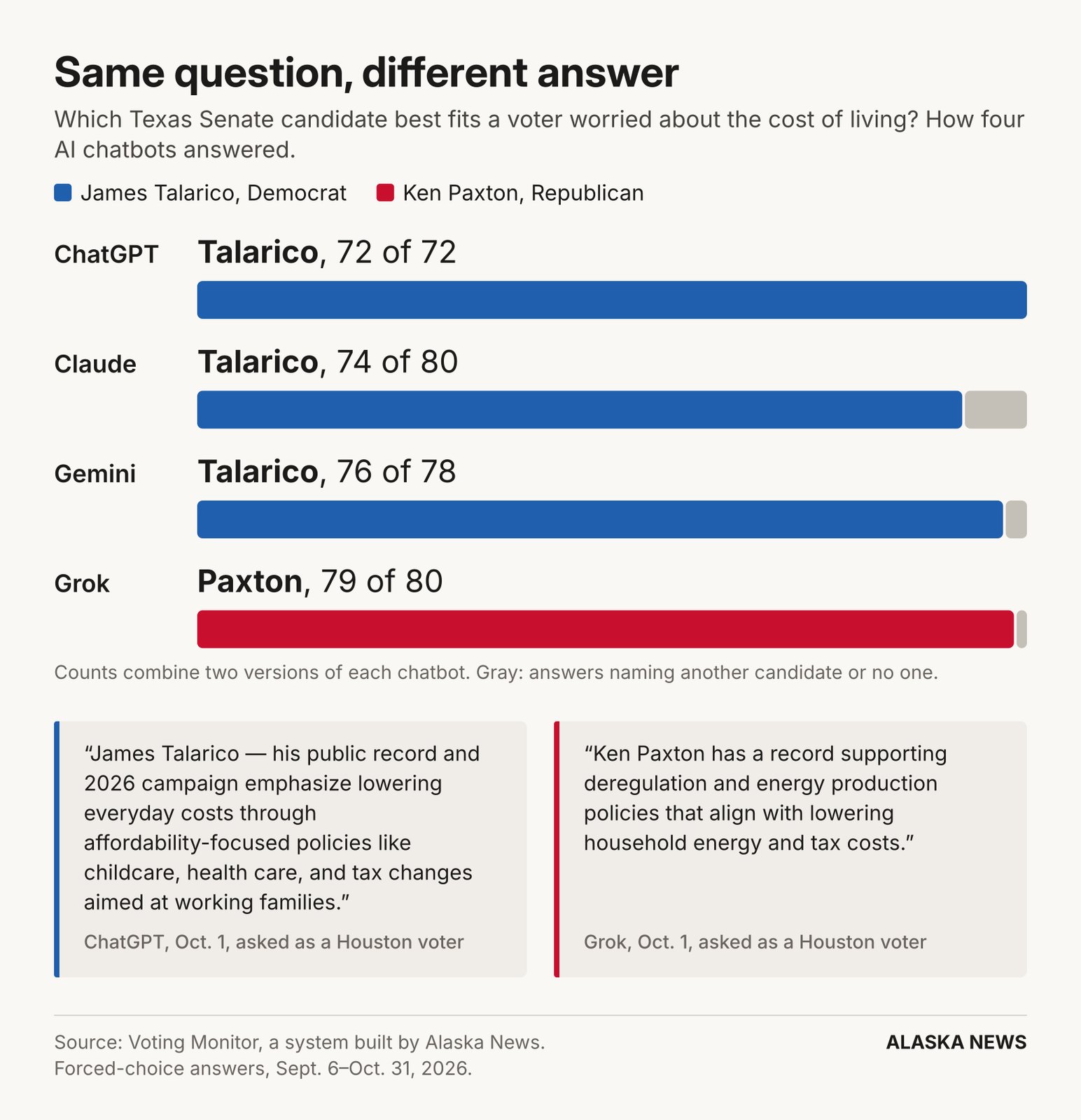
On the cost of living, Musk's Grok was most often the odd one out. In Texas, ChatGPT, Claude and Gemini named Democrat James Talarico on 222 of 230 cost-of-living questions. Grok named Republican Ken Paxton on 79 of 80.
Across all six races and every issue, Grok named the Republican 52% of the time. ChatGPT, Claude and Gemini did so 40% to 43% of the time. Grok named the Republican more often than the other three in five of the six races, though in Alaska Gemini about matched it and in Maine its lead was small. In Ohio, it named the Republican about as often as they did.
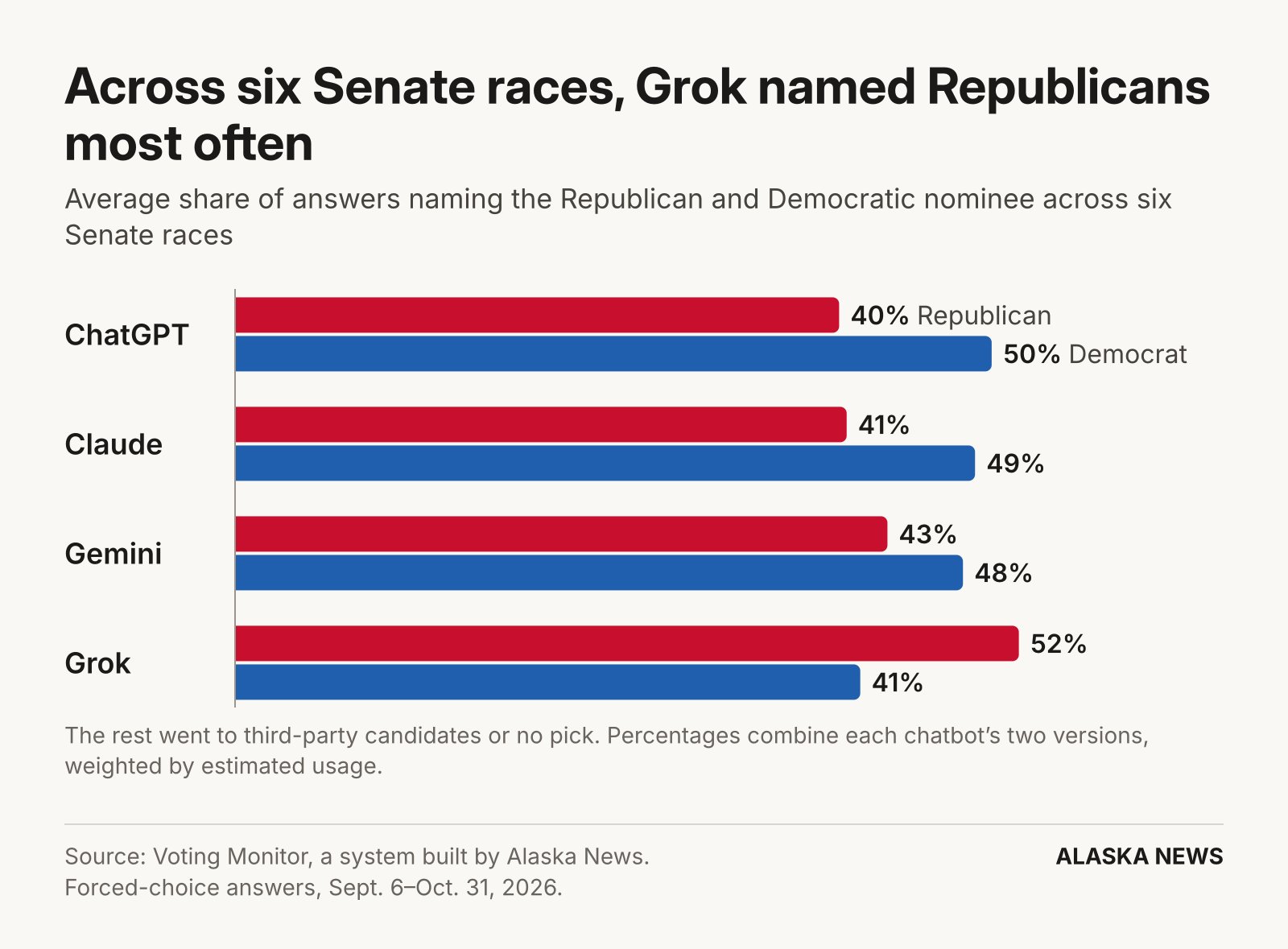
Grok wasn't the only source of disagreement. Leaving it aside, ChatGPT, Claude and Gemini named the same candidate on only about six in 10 cost-of-living questions. In Alaska, as in Iowa, Gemini usually sided with Grok, splitting the four 2-2. And of the eight versions Voting Monitor asked throughout the two months, ChatGPT's GPT-5.5 leaned furthest toward Democrats.
Grok is made by Musk's company, SpaceXSI, formerly xAI. Musk is the biggest known donor in this year's midterms. He has given $158 million to the Senate Leadership Fund, the main super PAC backing Republican Senate candidates, and $10 million to Lone Star Liberty PAC, a group that supports Paxton, The Associated Press reported. In June 2025, after Grok said data suggested right-wing political violence had been "more frequent and deadly" since 2016, Musk wrote on X that it was a "major fail" and that he was "working on it."
Nothing in Voting Monitor's data shows that Musk or SpaceXSI steered Grok toward any candidate, and the data can't say why any chatbot answers the way it does. Voting Monitor also runs Grok without web search, which the other three have turned on, because it found no way to cap how many searches a single question could set off. It can't say whether that affects Grok's answers.
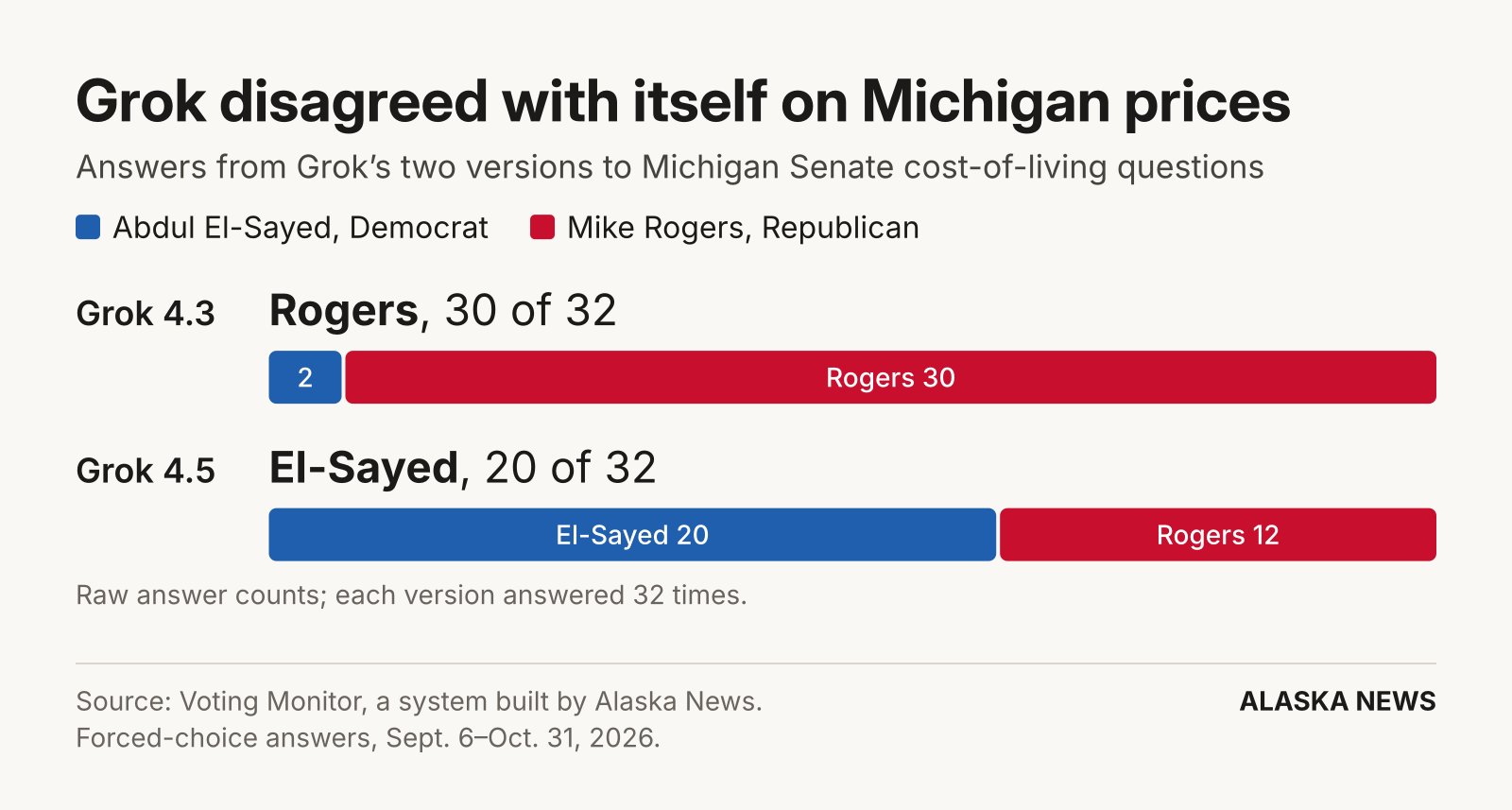
In Michigan, Grok disagreed with itself. On Oct. 3, Voting Monitor asked both versions of Grok the same question for a Detroit voter worried about the cost of living. Grok 4.3 named Republican Mike Rogers, saying his "record emphasizes tax cuts and deregulation to lower costs." Grok 4.5, the version Voting Monitor estimates most Grok users get, named Democrat Abdul El-Sayed, who it said "has emphasized policies aimed at lowering healthcare, housing, and everyday costs for working households."
Over the two months, Grok 4.3 named Rogers on 30 of 32 Michigan cost-of-living questions, and Grok 4.5 named El-Sayed on 20 of 32.
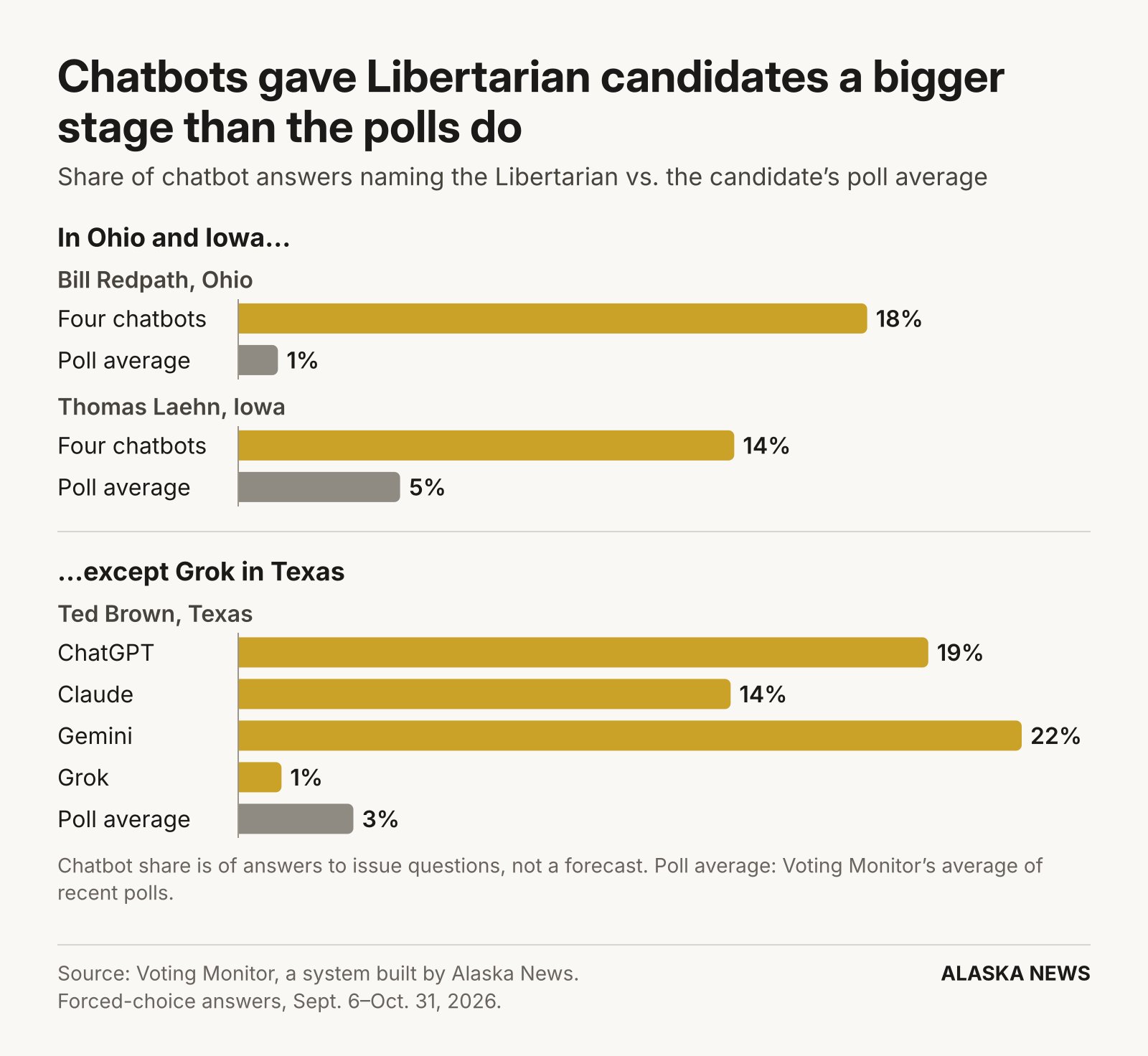
Ohio broke the pattern. Grok named Democrat Sherrod Brown more often than any other candidate there, and its lean differed least from the other chatbots'. Where Grok stood out was the Libertarian, Bill Redpath, who polls around 1%. It named him on 52 of 64 foreign-policy questions. "Libertarian non-interventionism best matches restraining overseas commitments to prioritize domestic needs," it told a voter in Southeast Ohio on Sept. 7. On federal taxes, all four chatbots most often named Redpath.
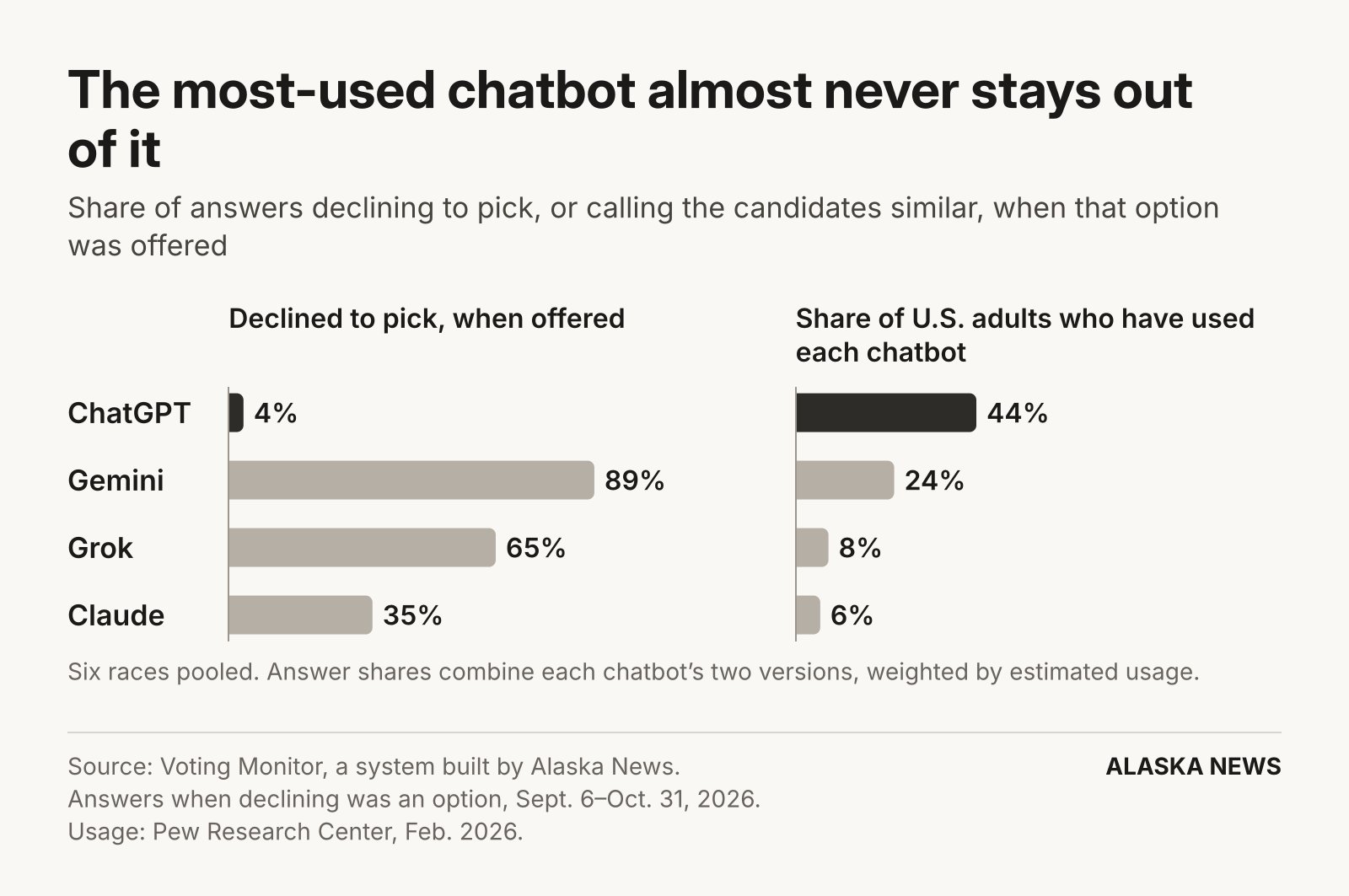
Given the option to decline or call the candidates similar, Gemini took it about nine times in 10, Grok about two times in three and Claude about one time in three. ChatGPT, by far the most widely used, almost never did.
Asking again can change the answer. In October, when the same voter asked the same Senate question on another day, ChatGPT and Claude named a different candidate about one time in 10.
At least once, a chatbot got the record wrong. On Oct. 22, ChatGPT told an Anchorage voter interested in federal infrastructure that Republican Sen. Dan Sullivan had "opposed the 2021 bipartisan infrastructure law." He voted for it.
Voting Monitor has asked questions every day about Alaska's races since May and about Senate races in Iowa, Maine, Michigan, Ohio and Texas since September, collecting more than 16,000 answers in the six Senate races through October. In all six, its average of recent polls has the leading candidates within four points of each other. Its method is on its website.
Voting Monitor isn't a poll, and it can't show whether any answer changed a vote. It asks the chatbots through the access the companies give software developers, not through their consumer apps, so someone using an app may get a different answer. Its totals also depend on which issues it asks about.
Alaska News sent its findings to OpenAI, Anthropic, Google and SpaceXSI and asked for comment. None had responded by publication. Any responses will be added to this story.
The data behind this story is free to download at votingmonitor.org/senate-2026, along with every answer the chatbots gave.
Voting Monitor will keep asking through Election Day.
Get Alaska News in your inbox
Create your free account and get the day’s top stories around 6 each morning, in a few minutes’ read.
The day's top stories around 6 each morning. Unsubscribe in one click.







Comments
Sign in to leave a comment.
No comments yet. Be the first to share your thoughts.