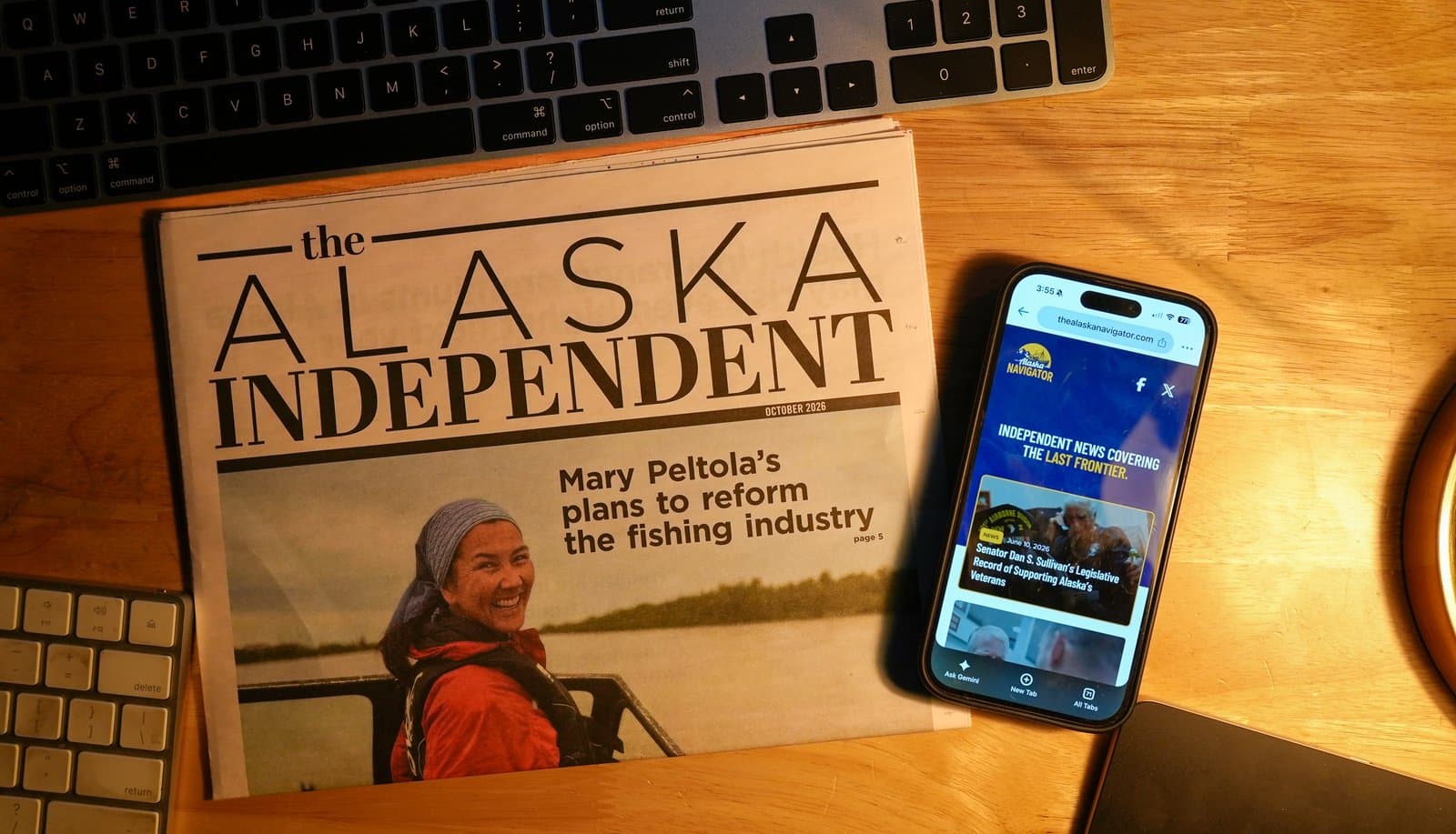
The October print edition of The Alaska Independent, run by a national progressive nonprofit, and the Alaska Navigator website, paid for by a Republican super PAC.
In Alaska's Senate race, political ads are borrowing the look of local news
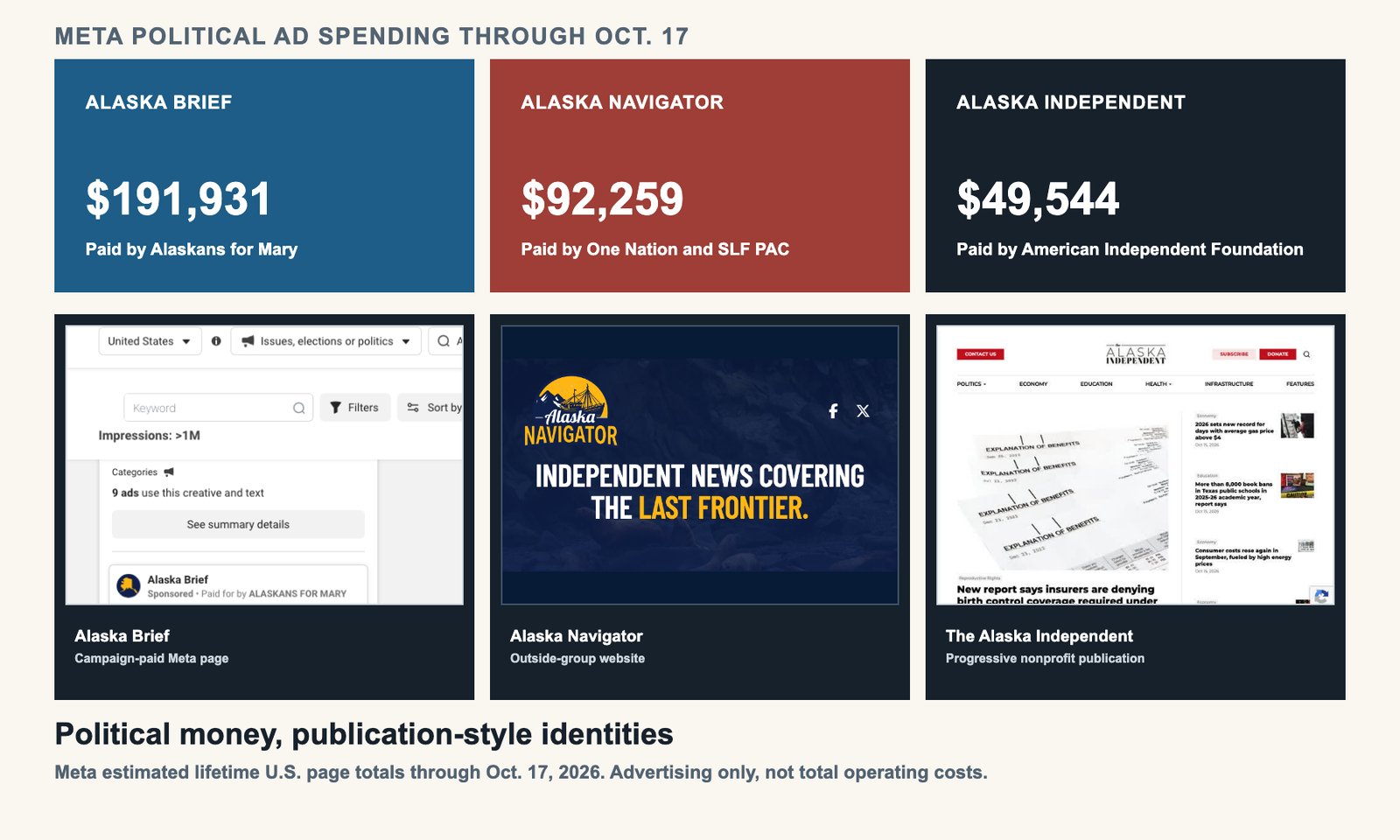
One Facebook page calls itself "Alaska's Newsroom." A standalone website promises "Independent News covering the Last Frontier." A third publication arrives in Alaska mailboxes with recipes, puzzles, community stories and election coverage.
None of those identities begins with the organization behind it.
Each is set up differently. Alaska Brief's ads are paid for directly by the campaign of Mary Peltola, the Democrat challenging Republican Sen. Dan Sullivan. Alaska Navigator is paid for by Republican groups supporting Sullivan. The Alaska Independent is run by a national progressive nonprofit, with an affiliated charity paying to advertise its stories.
Together, they illustrate a cross-party election tactic: giving Senate-race material the voice, design and distribution habits of local reporting. The payer is generally disclosed, but in an advertising label or website footer that is less prominent than the publication identity.
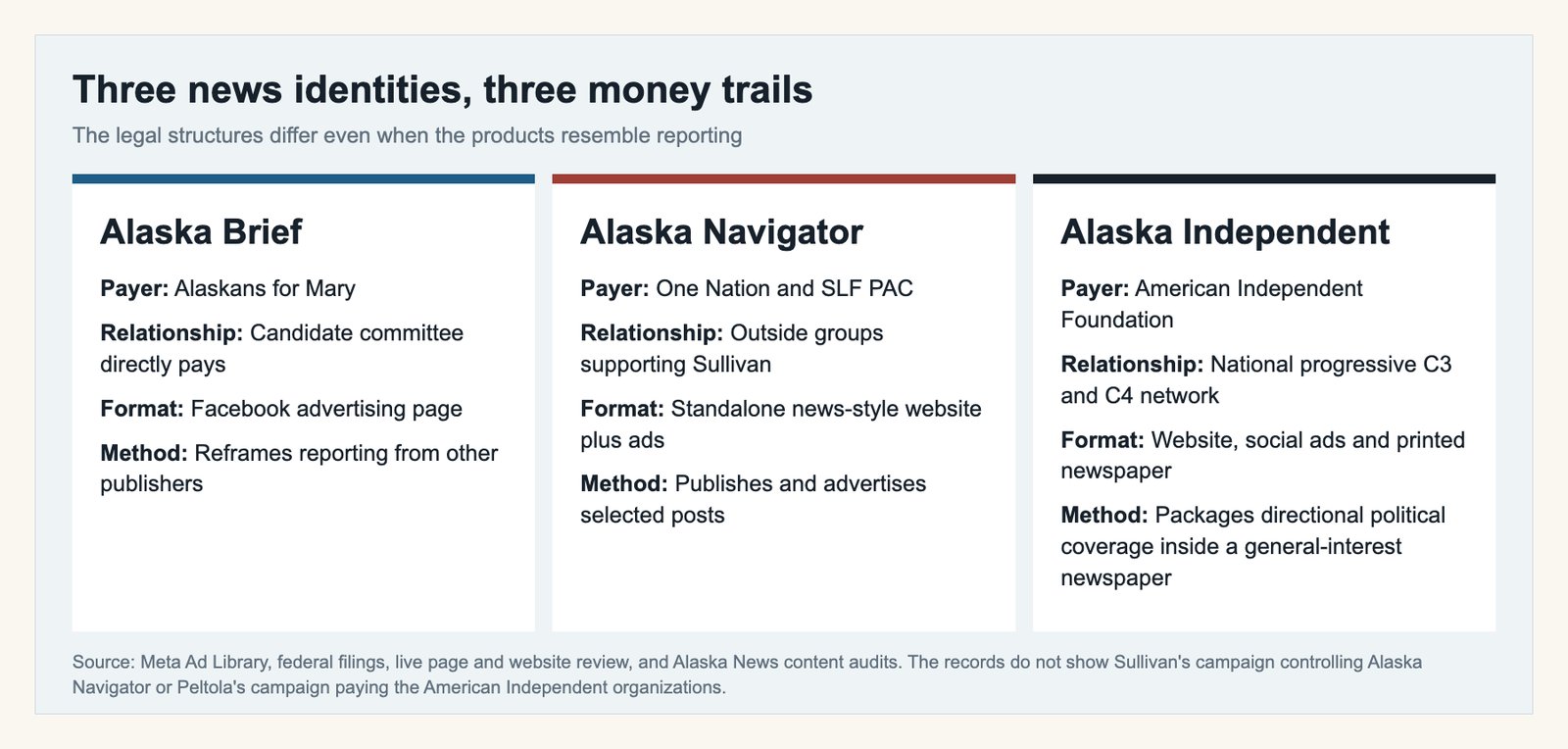
Through Oct. 17, Meta attributed an estimated $191,931 in political and social-issue advertising to Alaska Brief, $92,259 to Alaska Navigator and $49,544 to The Alaska Independent. Those totals cover only Meta ads tied to the three pages. They don't include writing, website production, printing, postage, mailing or advertising on other platforms.
Peltola's campaign has the largest Meta ad total through a single publication-style page and the clearest line of responsibility. The groups backing Sullivan funded and promoted a standalone news-style website. The progressive nonprofit network publishes a full newspaper.
Peltola's campaign pays for news-style ads
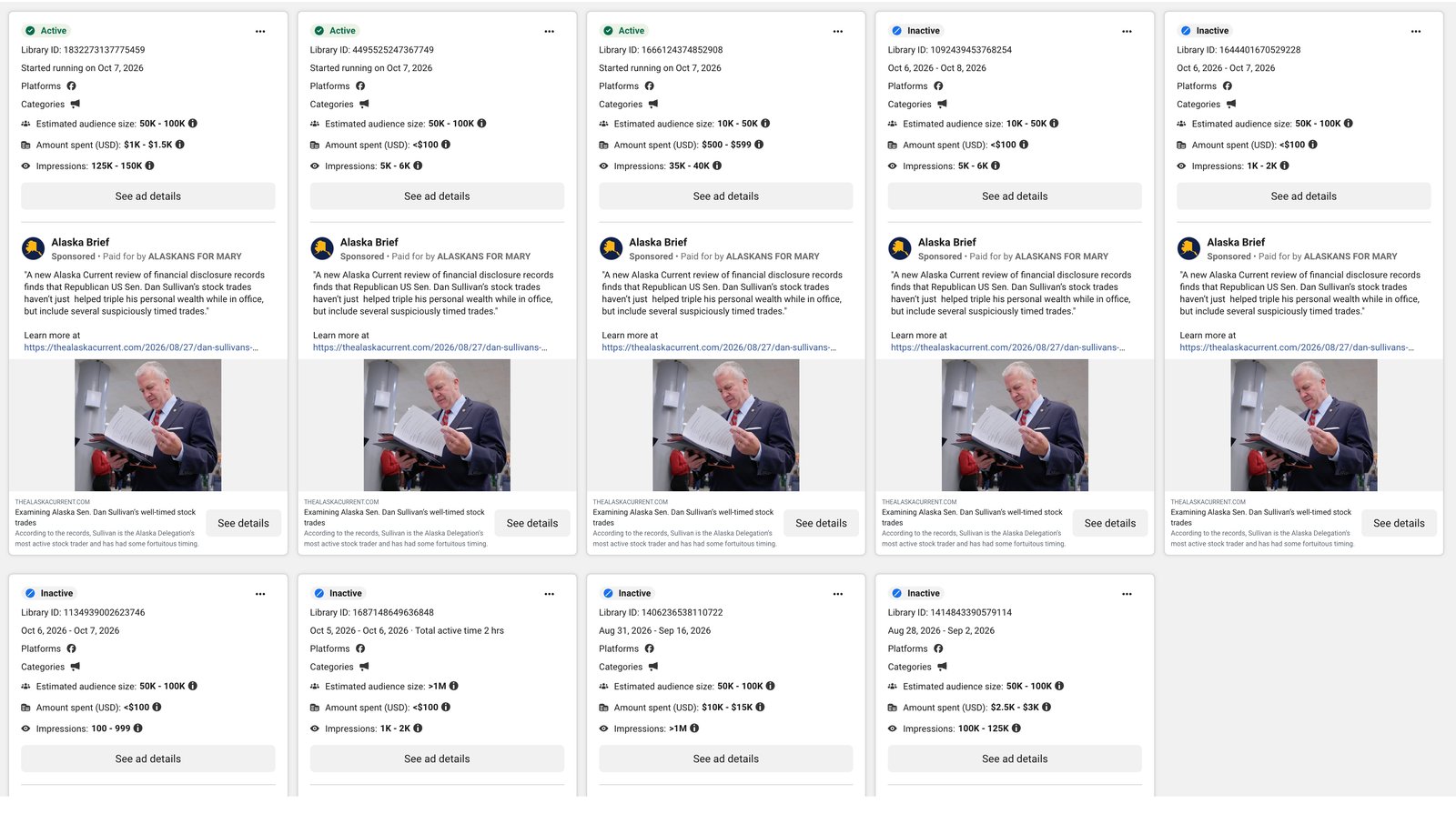
Alaska Brief calls itself "Alaska's Newsroom," but Alaska News found almost no original reporting on the page. Its central product is paid advertising that wraps the campaign's framing around stories from Alaska and national publishers, consistently favorable to Peltola or critical of Sullivan. The ads Alaska News preserved pointed readers to 44 different web addresses.
Every ad Alaska News reviewed carried Meta’s required “Paid for by ALASKANS FOR MARY” label, the name of Peltola’s campaign committee, in smaller gray type beneath the Alaska Brief name.
In an emailed response, Alaskans for Mary defended the operation as transparent political advertising. The campaign said the ads comply with Meta’s rules, identify their payer and cite the original outlets to direct Alaskans to their reporting. It did not say who created or operates Alaska Brief, or whether the campaign had permission from the publishers.
Alaska Public Media, the Anchorage Daily News and the Alaska Beacon, whose stories appeared in Alaska Brief’s ads, each said in emails that they learned of the page only when Alaska News asked.
"We never get any compensation from any campaign or candidate," said Lori Townsend, Alaska Public Media's chief editor.
Alaska Beacon editor Claire Stremple said no one connected to Alaska Brief had asked the Beacon for permission, and republishers rarely contact it before using its work, which is published under a Creative Commons license. The Beacon doesn’t accept compensation from republishers or work for campaigns, she said.
Anchorage Daily News editor Vicky Ho said the paper doesn't authorize the paid presentation of its work by any political organization, including Alaska Brief and Alaska Navigator, and receives no compensation from political entities for its coverage or for their paid placement of it. "We know Alaskans value our independence and our news judgment, and political campaigns seeking to leverage our coverage to advance their messaging can create confusion where, within our newsroom, there is none."
Republican groups funded the destination too
Alaska Brief repackages links inside Facebook ads. Alaska Navigator is a destination of its own, with a standalone website, a news layout, article archives and the slogan "Independent News covering the Last Frontier."
Of the 12 news posts listed in its sitemap through Oct. 20, eight favored Sullivan, two criticized Peltola and two addressed general policy or military subjects. None clearly criticized Sullivan or positively covered Peltola.
The site's footer says it is paid for by SLF PAC, a Washington, D.C.-based super PAC that registered with the Federal Election Commission in 2015 as Senate Leadership Fund. Its website says it is dedicated to "maintaining and growing the Senate Republican Majority." By Oct. 12, it had reported about $12 million in independent expenditures in Alaska's Senate race this year, nearly all of it against Peltola, Alaska News reported.
Earlier Meta ads named One Nation, a 501(c)(4) nonprofit, as Navigator's payer. Meta's Alaska report attributed $37,965 in a recent 90-day window to One Nation's Navigator ads and $32,518 to SLF PAC's.
Sites like it run in other states with Senate races this year. Iowa Voice and Maine Policy Updates carry "Paid for by SLF PAC" footers, and Georgia's Peach State Post says it is paid for by One Nation. The newsletter Popular Information reported in August that One Nation operated at least six such sites.
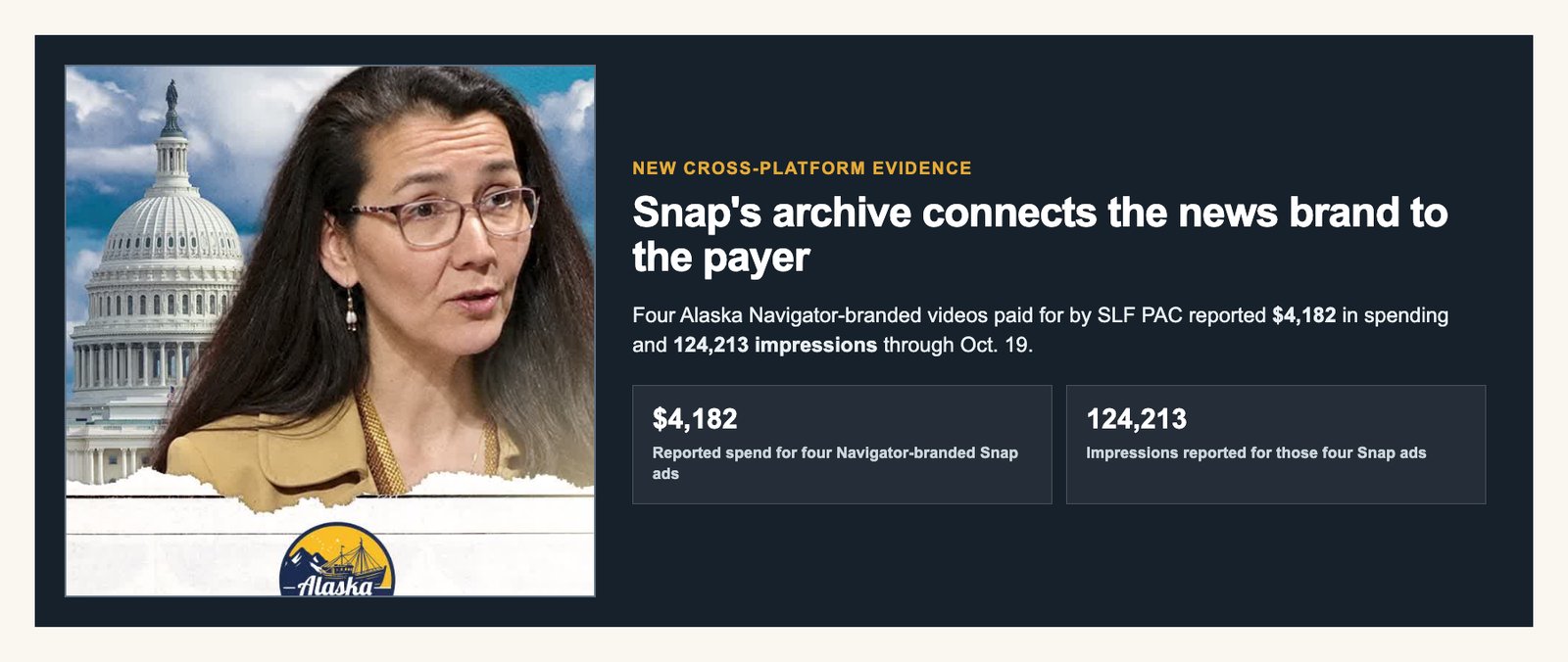
Snap's archive made the relationship especially clear. Four Alaska Navigator-branded videos paid for by SLF PAC reported $4,182 in spending and 124,213 impressions through Oct. 19. The news identity was Alaska Navigator. The payer preserved in the archive was SLF PAC.
Nothing reviewed by Alaska News establishes that Sullivan or his campaign requested, approved, paid for or controlled the site. SLF PAC and One Nation did not respond to questions.
A progressive network built an Alaska newspaper
Unlike the other two, The Alaska Independent is a full newspaper. Beyond a website with named writers, it is printed and mailed to Alaskans, with recipes, a crossword, community features and election coverage.
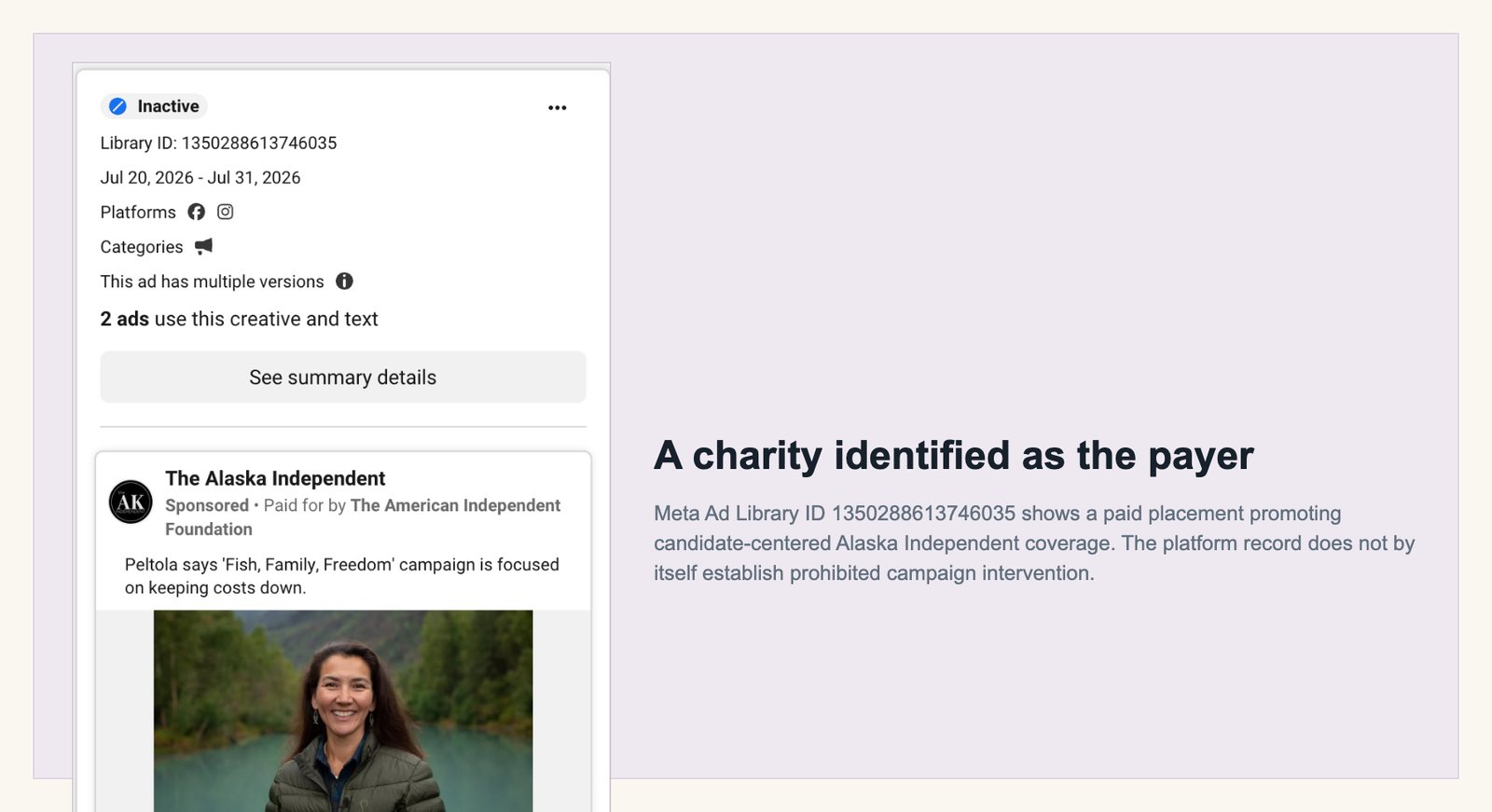
Its footer calls it "a project of American Independent Media," a Washington, D.C.-based 501(c)(4) that describes itself in federal filings as a progressive media organization. An affiliated charity, the American Independent Foundation, applied in July to trademark the Alaska Independent name and receives tax-deductible donations through the publication's website. The foundation has also applied to trademark Independent-branded names in 11 other states, from Michigan to Florida. Meta's Ad Library identifies the foundation as the payer for ads promoting Alaska Independent stories. Federal tax records show the foundation transferred $34.86 million to the media organization from 2022 through 2024.
One of those ads, Library ID 1350288613746035, ran from July 20 through July 31. It showed Peltola, included her "Fish, Family, Freedom" campaign slogan and linked to an Alaska Independent headline saying she "vows to curb inflation in Senate bid."
Across the 67 Alaska Independent articles Alaska News found from June 4 through Oct. 16, the paper repeatedly covered Medicaid cuts, tariffs, abortion access, school funding and criticism of the Trump administration. It also published general-interest and service stories about museums, wildlife, the state fair and voting logistics.
Among 11 candidate-centered headlines preserved by Alaska News, six favored or promoted Peltola, three criticized Sullivan, one compared the candidates and one announced Sullivan's bycatch legislation. None clearly criticized Peltola.
Nothing reviewed by Alaska News establishes that Peltola or her campaign requested, approved or controlled the paper, and the records show no payment from her campaign to either American Independent entity through Sept. 30.
American Independent Media and the American Independent Foundation did not respond to questions sent through The Alaska Independent’s contact form.
Four linked TikTok accounts, but no known owner
Alaska News identified at least four Alaska-branded TikTok accounts that appeared this election season and share the same production style: Alaska Local Desk, News From Alaska, Alaska News Roundup and Alaska Daily Brief.
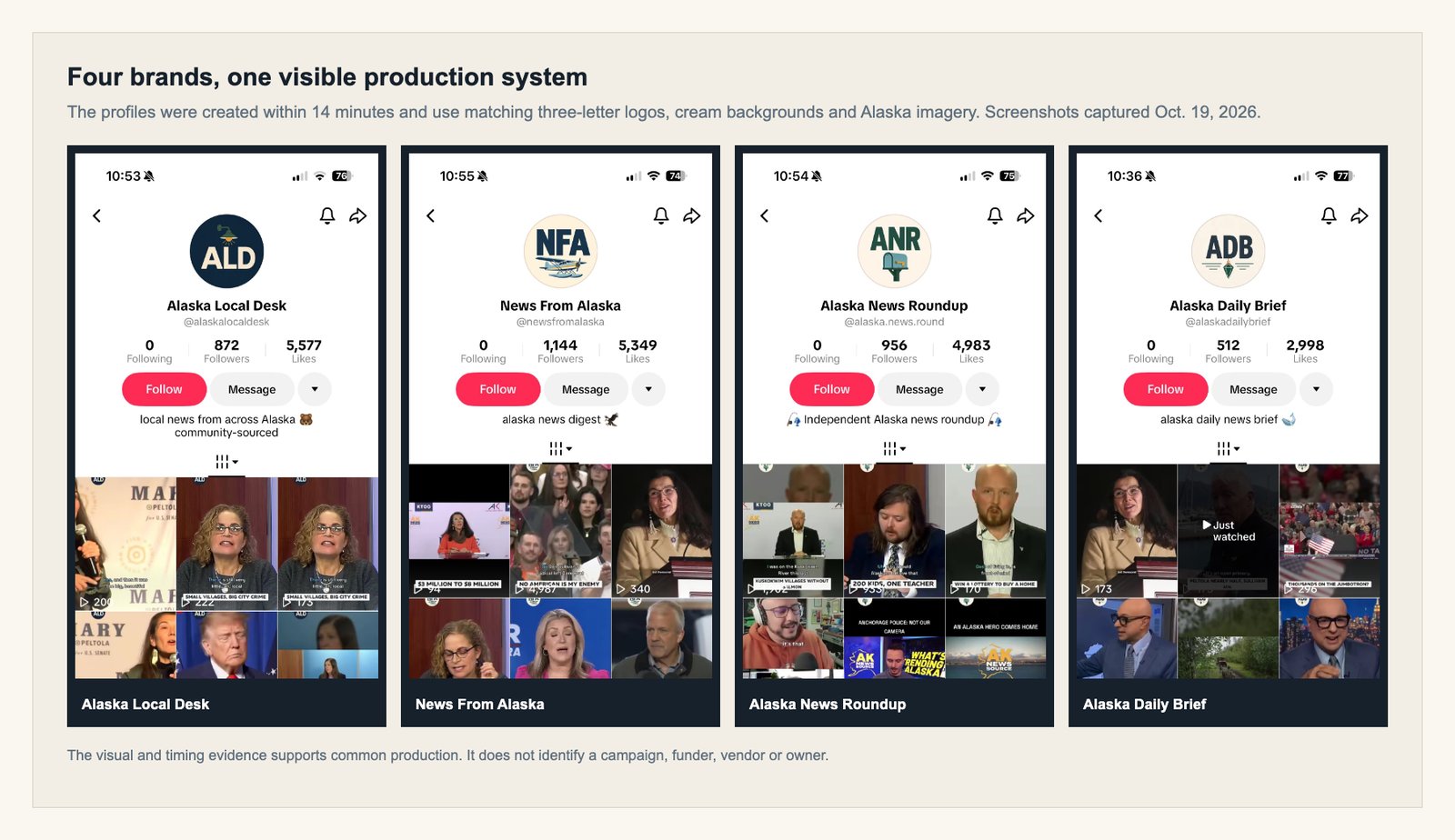
TikTok's profile data says all four were created Aug. 17 within 14 minutes. They began posting Sept. 5 within three hours of one another. Their logos, backgrounds, Alaska imagery, caption templates and source material indicate a common production system. When checked Oct. 21, the four accounts displayed 454 videos.
Their posting schedules overlap too. All but one of the 454 videos went up between 7 am and 10 pm Alaska time, and posts on different accounts went up within a minute of each other six times, once in the same second. The timing doesn't show whether people or scheduling software did the posting.
The accounts post clips from broadcasters, national television and campaign events. Their visible feeds contain substantial election material, but Alaska News has not completed a full direction-of-coverage audit. The evidence supports calling them a linked publishing network. It does not support calling them campaign accounts or attributing them to either side.
The available records also do not identify the owner or show that TikTok was paid to boost the posts. Unlike paid ads preserved by Meta and Snap, apparently organic accounts can distribute political material without leaving a public payer receipt.
What the public records don't show
The ad totals in this story come from Meta and Snap, which keep public archives of political ads. Those archives show who bought each ad, not what anyone spent writing, filming, printing or mailing the material.
TikTok bans paid political ads, including payments to creators for political content. Nothing shows the four Alaska TikTok accounts paid for promotion, and whatever it took to produce their 454 videos leaves no public record tied to the accounts.
Campaigns and PACs report their spending to the Federal Election Commission, but a payment to a vendor doesn't show which pages or posts it paid for. Nonprofits such as One Nation and the American Independent groups report to the IRS once a year. Those filings generally aren't public until well after an election, and they don't break out spending by state.
So no public record shows the full cost of putting Senate-race material under local-news brands in Alaska.
What remains unanswered
The records Alaska News reviewed don't show who built Alaska Brief, wrote its copy or selected its source stories, or who writes Alaska Navigator's stories. Nor do they show The Alaska Independent's print budget, distribution list, grant agreements or advertising invoices, or who created or paid for the TikTok network.
Voters are receiving election messages from brands that look and sound like local news, but the financial and political relationships behind those brands are often visible only in a footer, an ad label, a separate archive or not at all.
Source: In Alaska's Senate race, political ads are borrowing the look of local news.
Made by our human newsroom with AI. Reviewed by Cale Green. How humans and AI work here · Grow with our newsroom
Stay informed. Support what matters.
Free, permanent access to local news you can verify. Subscribe to support Cale Green and go ad-free.
Related Coverage
National money is pouring into Alaska's two big races, on every side
Alaska News · 2mo ago
Record outside money floods Alaska's Senate race from both sides
Alaska News · 2mo ago
Outside money keeps flowing into the Alaska Senate race — mostly against Sullivan
Alaska News · 2mo ago
Alaska's Senate race is on pace to shatter spending records — before a primary that decides nothing
Alaska News · 2mo ago
Money floods a dead-even Alaska Senate race
Alaska News · 2mo ago
Comments
Sign in to leave a comment.
No comments yet. Be the first to share your thoughts.