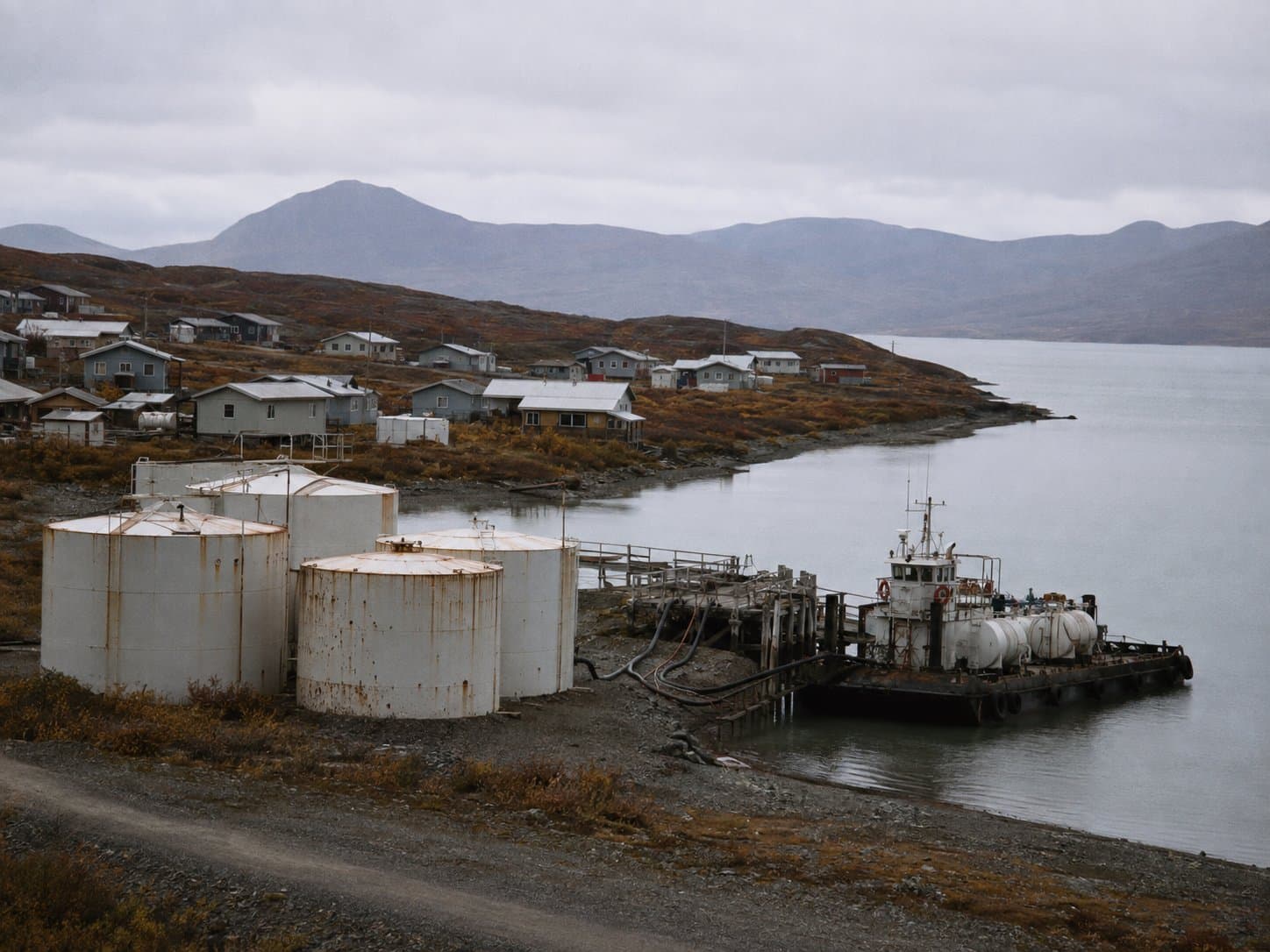
Photo by Cale Green
A war half a world away is about to freeze into rural Alaska's winter fuel bills
When Tanana Chiefs Conference urged families across Interior Alaska this week to prepare for winter "sooner rather than later," it was naming the local edge of a much larger problem.
A price shock that began in the Persian Gulf last spring is now being loaded onto barges and pumped into village tanks across the state — and because of how rural Alaska buys its fuel, that shock is about to freeze in place for an entire winter.
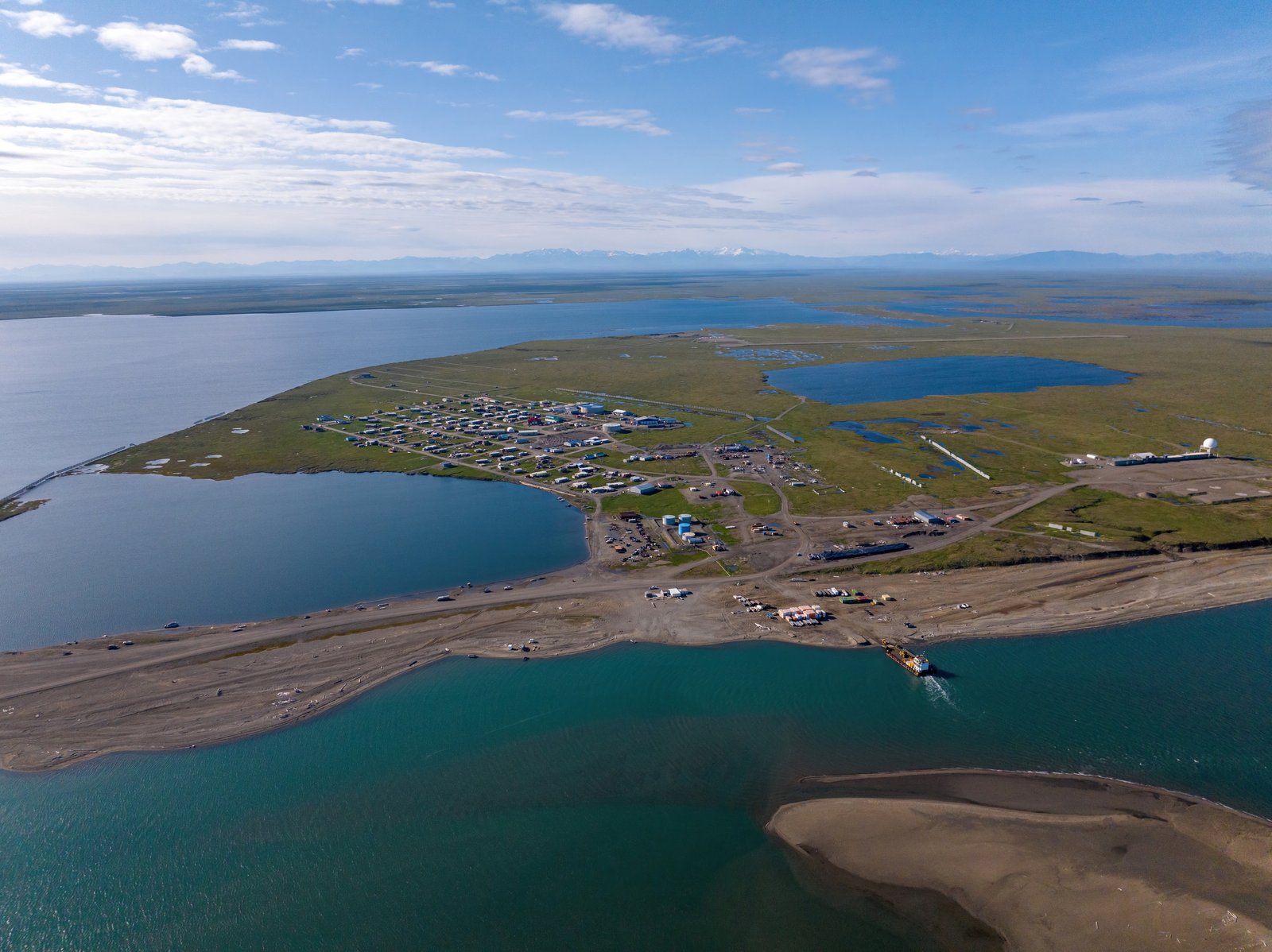
Most of rural Alaska lives off the road system, along coasts and rivers that freeze solid by fall.
Fuel reaches these communities by barge, in a narrow summer-and-early-fall window, often in a single annual delivery. A village fills its tank farm once — the diesel that runs the power plant, the stove oil that heats the homes — and that fuel has to last until the ice breaks up and the next barge can reach the dock, sometimes a full year later. Whatever price a community pays at delivery is locked in for the whole winter, even if global oil prices later fall.
The barges arriving now are setting the price of survival through next spring.
The spike traces to the war between Iran and its adversaries, which through the spring shut down tanker traffic through the Strait of Hormuz — the chokepoint for roughly a fifth of the world's oil.
The International Energy Agency called it the largest oil supply disruption in history and released a record volume of strategic reserves to blunt it. It wasn't enough. U.S. heating oil futures surged past $4.26 a gallon, their highest since 2022 and up more than 50% from late February. Western Alaska is especially exposed, since much of its fuel arrives in tankers from the Asian refineries hit hardest by the closure.
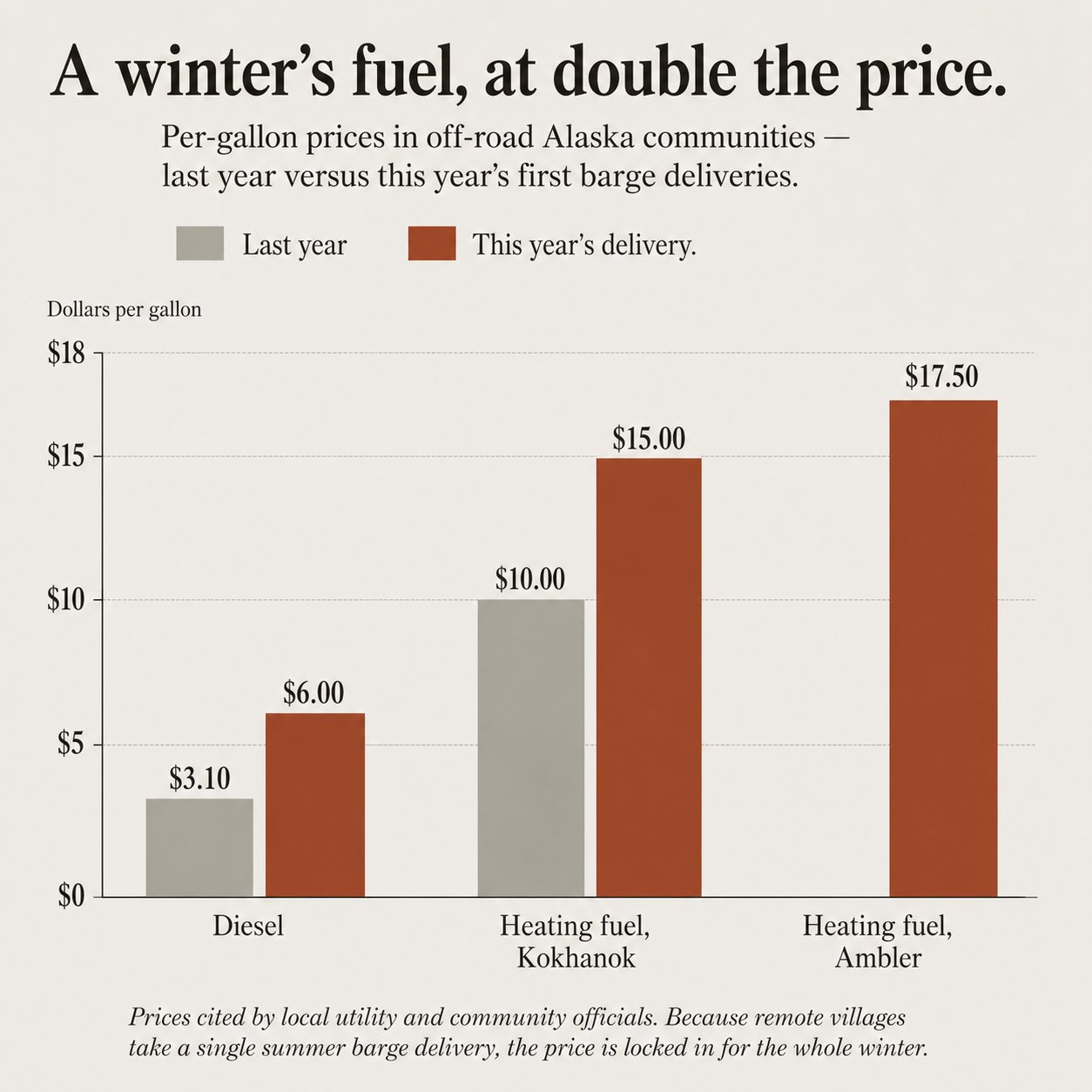
The numbers coming off the first barges are stark. In the Northwest Arctic Borough, the energy manager was told by vendors to expect increases of about 50%.
One utility manager said the diesel that cost his community $3.10 a gallon last year could arrive above $6 this year — nearly double. In Kokhanok, on Iliamna Lake, the village expected to charge around $15 for a gallon of heating fuel, up from $10. In the Northwest Alaska village of Ambler, gas and heating fuel have run $17.50 a gallon.
These are prices for fuel people cannot choose not to buy.
At 40 below, heat is not optional, and there is no backup delivery system if the money runs short — only wood-gathering trips by snowmachine in sub-zero cold, which residents in some communities already describe as routine. "This is something that could completely wipe out rural Alaska," Kokhanok tribal president Nathan Hill told reporters this spring.
Alaska does have a program meant to cushion rural energy costs, but it was built for the wrong half of the problem.
Power Cost Equalization, created in 1985, subsidizes electricity in nearly 200 mostly diesel-powered communities, reaching about 82,000 Alaskans and bringing rural power rates down toward the urban average. But it covers only the first 750 kilowatt-hours a household uses each month — and nothing at all for heating fuel, which is where the largest and most dangerous share of a family's winter spending goes. A household can receive the full electricity subsidy and still face a stove-oil bill that has doubled.
Because the base rate is pegged to urban electricity prices, the subsidy doesn't automatically widen when rural diesel spikes.
Lawmakers appropriated roughly $100 million in energy relief this year, a figure that includes the existing PCE program — but against a doubling in the underlying cost of fuel, spread across the vast geography of rural Alaska, it goes only so far.
TCC's letter reflects the Interior, but the same structure governs the Bering Strait, the Yukon-Kuskokwim delta, Bristol Bay and the Northwest Arctic — every off-road community that fills its tanks once and waits. And the hit doesn't stop at household bills: the Alaska Municipal League has warned that local governments will absorb high fuel costs in their own budgets too.
In rural Alaska that burden falls across a layered set of institutions — city and borough governments, tribes, and the Alaska Native village and regional corporations that in many communities own the tank farm and run the fuel utility itself — raising the prospect of service cuts or higher costs in places that can least afford either.
A tribal consortium's advice to buy early, in that light, reads less like household counsel than an early warning about the affordability of the winter ahead.
Source: Tanana Chiefs Conference ().
Drafted with AI. Edited by Cale Green (1 revision). No full editor review is on record. Who is accountable.
Stay informed. Support what matters.
Free, permanent access to local news you can verify. Subscribe to support Maggie AlaskaNews and go ad-free.
Related Coverage
Rural Alaska faces fuel crisis as prices surge, shortages loom
Alaska News · 4mo ago
Murkowski: War-price fuel barges lock rural Alaska into costly winter
Alaska News · 3mo ago
War-driven oil prices are filling Alaska's treasury while straining its households
Alaska News · 5d ago
A remote Alaska island is paying $7.55 a gallon to heat its homes
Alaska News · 4w ago
Remote Alaska villages pay $6.63 per gallon as fuel costs strain budgets
Alaska News · 5mo ago
Comments
Sign in to leave a comment.
No comments yet. Be the first to share your thoughts.