Whittier: 11.10.2026 Port & Harbor Advisory Commission Meeting
Alaska News • • 54 min
Articles from this transcript
Whittier harbormaster withholds acceptance of new floats over concrete damage
Whittier's new harbor floats are shedding bits of concrete, and the harbormaster hasn't signed off. He doesn't want the state asking for $4.6 million back.

Whittier to hire design firm for new DeLong Dock, with construction years away
Whittier will hire a design firm to rethink its 70-year-old DeLong Dock, now drawing interest from LNG projects and the military. Shovels are 2 to 3 years out.
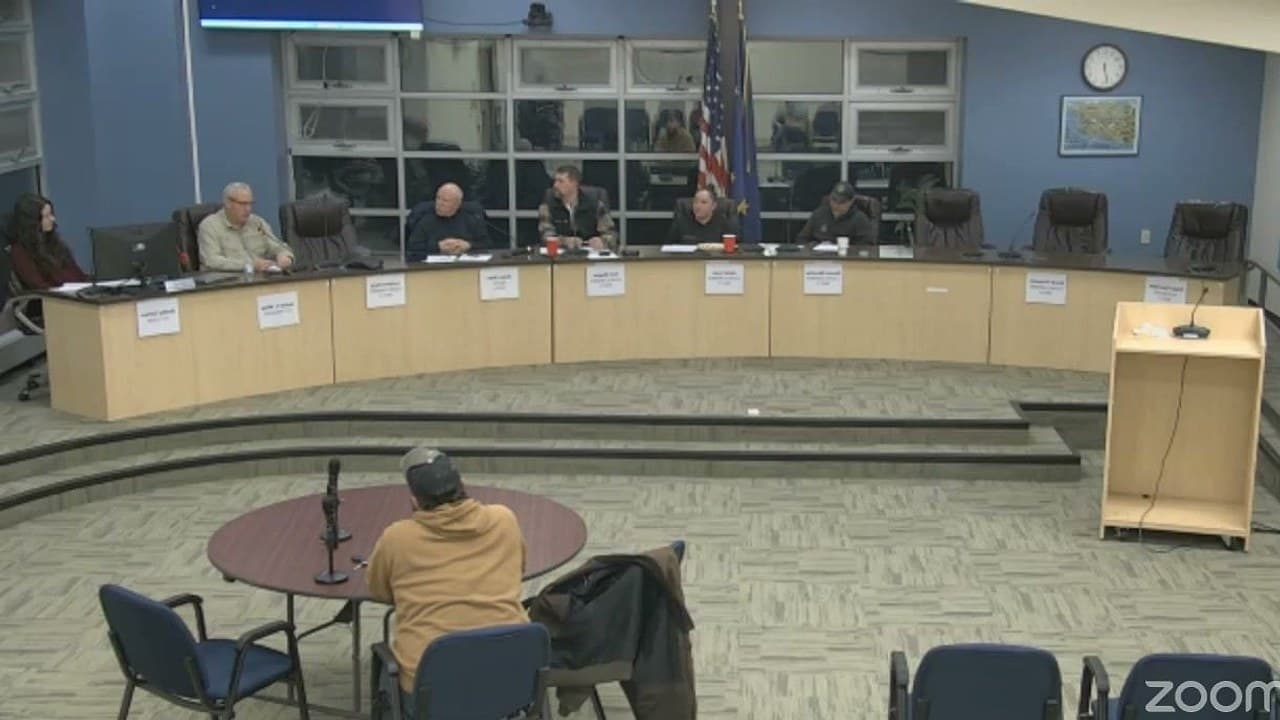
No, that's just our last regularly regular meeting was this meeting a year ago. Yes, indeed, that is correct. Wow, good on us. It's just our last regularly—. Sorry.
Okay, we are live. Vice Chair, I am ready.
All right, I call this, uh, to order, uh, the November 10th, 2026 regular meeting of the Whittier Port and Harbor Advisory Commission at 6:03 PM. Would you please rise for the Pledge of Allegiance?
Indivisible with liberty and justice for all. All right, thank you. Before we begin tonight's meeting, please note that the digital copies of tonight's meeting packet are available on our website. A QR code is provided just outside that door. Open your phone's camera to scan the code and you will be able to easily access the packet.
At this time, I think we're going to swear in of new appointed commissioners. Um, we would, uh, Mr. Chair. However, our newly appointed, or newly freshly reappointed commissioner is, has not yet joined us. Oh, Jamie, I'm sorry, Mrs. Loan has joined us.
So, 1 second.
Yeah, me too.
Thank you, Miss Sloan. Would you please raise your right hand and repeat after me? I, your name, do solemnly swear— do solemnly swear that I will support and defend— that I will support and defend the constitutions of the United States—the constitutions of the United States—and State of Alaska—state of Alaska—and the laws and ordinances of—in the laws and ordinances of—the City of Whittier, State of Alaska—the city of your state of Alaska—and then—I will faithfully and honestly—that I will faithfully and honestly perform the duties—perform the duties—of the office of Whittier Port-and-Harbor Advisory Commissioner of the Office of Whittier Port and Harbor Advisory Commissioner. So help me God. So help me God.
Thank you.
Thank you. All right, uh, Madam Clerk, uh, roll call please. Thank you, Mr. Chair. Mr. Osenek.
Here.
Mr. Hill. Here.
Mrs. Loan. Here.
Mr. Carlson. Here. Mr. Goldstein. Absent.
You have a quorum.
All right, well, I I'm going to pass this gavel to the clerk for the election of our officers. It's okay, you don't have to actually pass the gavel.
Okay, um, in front of you— I apologize, I did not include it as part of the packet, um, mistake on my part— but, um, you have in front of you a memorandum. Oh, apologies, Mr. Olsenak, I haven't sent this to you either. It is the same as the one that's in the council packet for the October meeting, if that's helpful, or in our last November, um, 2025, uh, Port and Harbor meeting. So, um, I will go over the procedures just so that, uh, for everyone's benefit since it wasn't included in the packet. So, um, the memorandum says that these procedures for nomination and elections are described in Robert's Rules of Order, newly revised, 12th edition.
Essentially, um, first we have to adopt the procedure for the election. This isn't established by an ordinance per the City Council, so each year we have to re-adopt it. Of course, if you have an amendment that you'd like to make to the procedure, you are free to do that. Um, then we will— I will call for nominations. Um, a commissioner will make a nomination for the chair position first, and then we will follow with Following the same procedure for the vice chair, I will ask if the nominated person accepts the nomination, and then if there are no further nominations, I will close the nominations.
Then we will vote via secret ballot, which I have here.
Uh, I will collect the ballots, the secret ballots, and tally the results, and then I will announce the winning candidate. If no one receives a majority of the votes, then we will proceed with another round of voting until someone ends up with a majority of the votes. We will repeat that process for the election of vice chair, and in the case that there is only one candidate nominated, um, it will be considered, uh, nomination, or I'm sorry, an election by acclamation. Any questions about the procedure?
Okay, hearing none, um, I would like to ask for a motion and a second to adopt the procedure as outlined for the election of chair and vice chair. I'll make the motion. I'll second.
Any discussion?
The only discussion, I suppose, is how do you want me to vote, or do I not vote because I'm not in the room? Nope, you can vote. I'm gonna have you, um, send a message through Zoom if that works for you. Oh yeah, we got this. Okay, any further discussion?
Hearing none, voting on the motion to adopt the election procedure. Mr. Carlson? Yes. Mrs. Loan? Yes.
Mr. Hill? Yes. Mr. Olszenek? Yes. Mr. Goldstein?
Apology. Yes. Thank you. Motion passes, and the nomination procedure is— or the election procedure is adopted. I will now call for nominations from the floor for the position of chair.
Mr. Carlson nominates Mr. Olsenak. Mr. Olsenak, do you accept? I do. Thank you, Mr. Olsenak. Are there any other nominations?
Hearing none, Mr. Olsenak, congratulations, you have been elected by acclamation.
Moving on to Vice Chair. Nominations are now open for the office of Vice Chair.
Okay, Carlson. Oh, whoa, slow down, friend. Okay, Mr. Carlson nominates Mr. Hill. Mr. Hill, do you accept the nomination? Yeah.
Yes. Okay, thank you. And then, Mr. Hill, you nominate Mr. Carlson.
Okay, thank you. Are there any further nominations?
Hearing none, nominations are closed. Mr. Hill, you are elected by acclamation. Congratulations.
Thank you all for a very straightforward process and, um, Due to the chair's physical absence, the gavel will be returned back to Vice Chair Hill.
All right, thank you.
Absolutely. Let's go ahead and—. My chair way over. I'm sorry.
Okay, Mr. Goldstein, can you please raise your right hand and repeat after me? I, your name, I, David Goldstein, do solemnly swear, do solemnly swear, that I will support and defend, that I will support and defend, the Constitution of the United States The Constitution of the United States. The State of Alaska. The State of Alaska. And the laws and ordinances of—.
And the laws and the ordinances of Whittier. The City of Whittier, State of Alaska. City of Whittier, State of Alaska. And that I will faithfully and honestly—. And I will faithfully and honestly—.
Perform the duties of the office—. Perform the duties of the office—. Of Whittier Port and Harbor Advisory Commissioner—. Of the Whittier Port and Harbor Advisory Commission. So help me God.
So help me God. Congratulations. Thank you. Thank you.
Okay, I'm going to keep moving along here. Citizen comments, uh, citizen comments on any agenda item except those scheduled for public hearing are welcome at this time. Uh, those who have signed in will be given the first opportunity to speak. Please note, this is not a time for dialogue. It is a time for you to speak and the Commission to listen.
Madam Clerk, we have anybody signed in or online?
Nobody has signed in.
Okay, hearing none, we'll, uh, move on to the approval of the agenda and consent agenda.
Mr. Chair, I would move that we approve the agenda and consent agenda.
I will second that.
Okay, hearing none, we'll, uh, move on to presentations and, uh, reports. Uh, wait, hang on, Mr. Hill. Oh, are we— oh, anybody opposed?
Hearing none, we'll move on.
2 Presentations and reports. Uh, Chairman Olsnak, do you have anything to report this evening? Sorry, Vice Chair, totally unprepared, but here in spirit.
Very good. On to Vice Chair, which is myself. Uh, I have nothing at this time.
Resolutions? None. Harbor Master?
Absolutely. All right. Thank you, through the chair. So we haven't had a meeting in quite some time. So thanks for— I guess we just have to have a huge feed and then everybody shows up.
So bring food.
Let's see where to begin. I think we're going to talk a little bit about where we're at with the harbor phase 3 here shortly with new business and about power billing, so I'm going to skip past that. I was going to let everybody know our winter preparations are about complete down in the harbor. We're as ready as we're going to be. We survived 60 knot winds last night very well.
Everybody stayed where they were supposed to stay, thankfully. I woke up this morning and was happy to see that because it was a, it was a rough one. But yeah, winter preps are done as far as administratively. The Admin staff have gotten all the waitlist notifications out, and we've actually gotten a majority of them back for the year 2027. They've also sent out the entirety of preferential and annual mortgage agreements.
So that's— those will have a deadline of January 15.
Let's see, there's just a whole myriad of things that we've got going on, but a majority of that I'll cover under the rebuild and the Phase 3 portion. As you all, I hope, know by now, we are the recipients of about $55 million of federal grant money from MARED, PIDP, Port Improvement Development Grant, and that is directly for the DeLong Dock, and we have everybody to thank from Senator Sullivan, basically all of our federal delegation. They did, did a heck of a job for us.
So that we are in the very, very, very early stages of. I've gotten no less than 100 emails from every company in the country looking to help us spend that money. But first things first, we will be doing an RFP to hire a design firm that will help us kind of gather what we want to do, much like what we did with the WEDP. We will be hiring, we'll be putting an RFP out for an engineering firm, a design firm to help us design what we want to do. And that, for that, that 4 point, what was it, 4.1?
Yeah, so we got $4.1 million for just that. And part of that process will also be looking at hiring somebody to help manage the grant because these grants are very technical, time-consuming, and finicky, I guess I would say. They take a lot of attention, and it's very not uncommon for municipalities to hire somebody just to manage that grant as we move forward. So there's two separate grants. There's the $4.1 million for the design, and then there's the $50.6— yeah, $50.6 million for the actual construction.
So the fact that we've got both of those ready to go, Shelby Carlson's done a lion's share of the work to get the 4.1 going. We've actually gotten approval for that, right? Okay, so that one's ready to roll, and then we'll be working on some other things down the road for everything else. But that is a huge thing for us. I'm sure you guys all understand how big this is, but I mean, we're looking at great things down the road for the port or for Whittier Harbor.
Anybody have any questions shy of water?
And no, yeah, like I said, we'll talk electrical in Phase 3 during new business. So, yes, sir. A couple of minor questions. When I'm thinking about a dock, especially replacing the DeLong Dock, I'm not sure if that really incorporates cranes, if it incorporates lifts, if it's going to be a fixed dock, I'd take it. And will it be about the same size do you envision, or—.
We are so early in the stages of this. There are, you know, we've had a couple of design concepts that we worked with back in 2022, maybe '23. P&ND came up with a couple of different options for us when we were writing the original grant the first time we went out. And we've, so we've got a couple of design concepts, but we've had a lot of interest and a lot of things have changed in Alaska. We're talking LNG projects, we're talking just a lot of things.
So I think what, instead of saying, well, we're gonna go with what we drew up in 2023, we really need to refocus and talk to all our partners and kind of say, where do we go from here? How do we meet the needs of all the users out there? You know, at one point with the dock that we had kind of designed in '23, it had floating docks in the outboard side, you know, on the river, on the passage canal side of the dock. That doesn't make sense to me to have a, you know, and it's a 560-foot dock. To have floating dock on the outside of that and burn up that much big moorage space with floating docks that you have to pull out in the wintertime.
So maybe we start looking at what are some different options to have that face that we could tie big ships up at, temporarily offload, do whatever we need to do. We've had interest from the military about roll-on roll-off access out there. We've had, of course, we were always going to have the fisheries that we have to, you know, we need to meet the needs of our legacy partners as well. We are so early in the planning stages of this. That's why we need to hire somebody that can come in here, sit down with us, do a comprehensive review of what our needs are, what our partners need, and then say, okay, give us 5 different options and then we'll go from there.
And I just— a follow-up question here. Obviously, this is a lot more money than we originally anticipated spending on the dock, so I would assume that it will serve multiple uses. I'm just wondering, I know the railroad had plans to utilize the marginal wharf area, and is that— have you heard anything about that? Interesting you bring that up. I have not seen anything.
I know they got like $1.25 million a couple years ago from— and they had hired R&M as part of the design. They actually came and gave us a presentation on what that might look like. And then I haven't heard anything since, so I don't know. I'm, I need to do a little homework and see what they've got going on with that. But yeah, Marginal Wharf, their entire yard really was going to be, you know, then we also have the DOT transportation plan.
They also have a transportation plan. We, you know, so there's a lot of things that kind of come into play, and it would behoove us to work together and kind of see, you know, what what we're doing. Of course, we also have tideland issues that we have to look at. We have easement issues that we have to look at. We have right-of-way issues that we have to look at.
There's a lot of different things that we have to really, you know, kind of just suss out, you know, just— and that's why I say we're in the very early stages.
I'm excited. It's going to be awesome. I really am. I'm excited to get moving with this project. Yeah, so I'm making the assumption as things move along and those, those plans start coming forward, will they be coming to the Commission and given presentations?
Absolutely. So how these generally work is once we find a design team based off our request for proposals, we'll have what we want kind of stages. We'll want to see where they're at, at 30% design, 65% design, and, you know, kind of 75% design and then 100% design. That's when we say, okay, that's what we're going with, fly it. And, you know, there can be 2 or 3 months in between each one of those phases.
I've done many of these in my past life. And so, you know, we had talked a little bit about maybe doing a design-build. I think because we have so many players in this that we would be best to hire somebody to kind of, you know, help us through the design process with all the different partners instead of just saying this is kind of what we like and then just putting that out on the masses. And then all of a sudden we get a bid back and they can do it, but we realize that is not really what we wanted. Or like I said, you know, we're not going to see breaking ground 2 years, maybe 3.
I mean, it'll take us probably 18 months just to get the permits. And that's another thing. We have to do another RFP for the permitting process. And that's, you know, that alone will take probably, well, heck, it took us 18 months to get the ones for the harbor. And that was easy.
So, you know, when we're starting to talk about a scale of this large, then there's the demo, you know. I mean, there's a lot of things that we really have to look at and how we're going to move forward. So it's not going to be lightning fast, and I, I don't want to be lightning fast. I want to be very detailed and methodical on how we move forward, but making sure that we move forward with— in the timelines that were required. But yeah, you guys will be part of it every step of the way, as will the council, you know.
Yeah, I think that's great. I think the process getting to that final design concept is going to be the most important process getting to that. So anyways, thank you. Just to give you an example, when we did the cruise ship dock in Juneau, we called that 16B. There were 16 variations of that cruise ship dock for the city.
So it took that long, 16 different variations, and probably 15 years before we finally got the funding and were able to do it. So it just gives you an idea where, how things change with the, with the times. You know, things will change between now and 2 years out, you know. So hang on, buckle up.
Well, great. Well, thank you for the report, uh, Harbor Master Borg. Um, we'll move on. Uh, there are no resolutions tonight, uh, so we'll just keep on going down to, uh, other business. Um, First will be the approval of the November 6, 2025, uh, those were approved by consent, so you can skip that one too.
Okay, very good. I see there's an asterisk. Uh, okay, update on the harbor rebuild phase 3. All right, thank you. So phase 3, we are what I would say significantly complete.
Um, power's in, water's in, docks are in, pilings are all in. The harbor looks amazing. Looks great, looks clean, looks modern. I'm very happy with Harris Sand and Gravel. I will say that we've got some possible performance issues with the float system.
I don't know if you guys have gone down and seen, but about mid-December last year, we started seeing some little, what they refer to as pop-outs in the concrete surface. It looked like there was some freeze-thaw issues with the docks early on. We did, we have done some, we did some core samples, had those analyzed, found that there were some, maybe some moisture and some aggregate that was below the skim surface, and that's what's causing the popouts.
I have not accepted the project to date. Bellingham has been very, very responsive. You know, they, they're not happy with it either, but they're also trying to figure out, you know, obviously the easiest fix for them and what's going to be best for us. Well, one of the things I had to remind Bellingham Marine is that we are not only dealing with monies from the city, we're dealing with monies from the state, and the state would not accept these docks in their current condition. So I went back to the state and I asked for an extension.
I didn't give them a whole lot of details. I just gave them the— I just requested an extension on our current current grant, uh, because we had that— that grant was actually up in June of this year. Um, I asked for an extension to July of 2027. They did that, no problem. So we have the grant still in play.
Um, right now we've just got to figure out our next steps with, um, how we want to move forward. The reason this is taking so long is Bellingham has come up with a couple of different options. They, they recreated some of the concrete and they sent them to a lab in Michigan, and they have been running the freeze-thaw cycles through the lab, and they're trying to recreate what we've got going on here, which they've been able to do. And then once they've done that, they've been applying some different type of epoxies, some different type of coatings, and some different, different techniques to see if that fixes the problem. Because they're saying it's cosmetic.
I'm not 100% positive it's cosmetic, but that's just me and I'm not a concrete expert. I just, I walk on it. That's about all. So one of the things we have done is we, P&ND Engineering was one of, was a partner in this whole design-build with the docks through Harris. Harris Sand and Gravel met the contract obligations with Harris, or with P&ND, and they released them from the contract.
And we have hired PNND using our bond funds from the Phase 3 bond funds. We've hired them to represent, and I wanted to do that because they have already, I mean, they've seen everything going on. So it didn't make sense to go hire a different firm and try to catch them up to speed when PNND had already been released by Harris and knew from basically cradle to grave what's going on with the situation. I've worked with PNND many years, for many years, and they are one of the contractors' least favorite engineers to work with because they are hardcore. And if they don't like something, they're gonna let you know.
So I have all the trust that they will represent us 100%. They were actually helping us along the way prior to all of this really coming to fruition. So we don't have anything concrete yet, pardon the pun, That just came out. We do have to really kind of let this thing run its course through the freeze-thaw process. Bellingham, like I said, has been extremely cooperative.
They've sent their reps up here. They've had, you know, they've actually done a couple of repair spots. I wasn't here, but I know Kyle was here a couple of, I think they came last week before the weather really hit bad. And they have applied some, um, repair patches to the pop-out areas on H float all the way towards the end. Um, so we'll see how they survive through the winter and then kind of go from there.
But again, it's not a decision that I will make on my own. That will be a decision that, you know, to accept those docks will be a decision that'll be made, um, at a higher level than myself. So You may have said this, what are our protections, right? So usually you have a contractor build you a house and there's some type of like 1-year warranty. If like anything goes wrong, it's their responsibility, their liability.
Is that what they're doing for us currently by coming up here and patching and fixing, or are we getting charged for all that? We're not getting charged. Now here's, here's where it gets really kind of sticky. We don't have the warranty with BMI, Bellingham Marine. Harris Sand and Gravel does, because Harris Sand and Gravel was the primary.
They're the general contractor. They installed floats that they purchased from Bellingham. So, you know, I think this is something that Chris, Jackie, and I, and, and, and even maybe the council will probably be having to have a discussion with. And we've had a few executive sessions to discuss some issues.
But Bellingham has made it very clear that they are willing to do basically whatever we, you know, will make us comfortable. Again, my concern is there are monies that have come from the state. If I accept a subpar product, the state could very well come back and say, That's not what we bid off on. You owe us $4.6 million, and I don't really want to do that. So we got to let this play out a little bit.
I know one of the things I, I— that's been discussed, we talked about this back in August, is, uh, getting, um, finalizing the contract with Harris and entering into a bond-type situation with Bellingham. Of course, we've got to run that through some lawyers to make sure how all that works out. And like I said, we are in the very early stages of that. Um, so more to follow. I, I think we're just kind of waiting to see, um, waiting to see kind of next steps.
I will say Harris Sand and Gravel has withheld to date about $700,000 from Bellingham. They have not paid them. They've basically said, hey, as long as this is going on, we're not going to give you any money. Now, they have given them a majority of it because, you know, they had to build the floats and so forth, but they have held back some money. So there is that slight protection, but floats all told were probably about $2.3 million.
So, you know, if you were to buy them off the shelf, that's not the installed price. That's just, I think if I remember the line item in the, in the purchase agreement, that that's where we were at with that. So there's these same systems in place across the state, right? I mean, BMI's got a few. I mean, they put in the first two phases.
Right. Um, just those concrete floats were also made in Bellingham, Washington. The floats that we got were built California. So maybe we got California concrete. Hmm.
And I mean, I, one of the things that made me feel really good was when P&D looked at what I specced out in the contract, they were like, that's exactly what you should have specced out. So that made me feel good, um, and I'm not certain that that concrete necessarily met that spec, so that's why I think we're having the issues. So not the best, you know, it's like buying a brand new car and having a big scratch across the hood, you know. The only difference is, is the dealership's willing to work with us. So, you know, I will— I rest assured, and I've told the council this, I will not accept floats that are subpar.
I just feel like Whittier has done that kind of thing too many times, and I refuse.
So, so, uh, some good notes. Um, we had some extra monies left over for the Phase 3, and with that money we spent about $45,000 on ladders that will go in every stall in the harbor. Kyle and the crew have already started to install those, the nice big Herky yellow steel ladders that are between all the floats on B, C, and D. Yeah, and then there'll be a couple on the ends of A. And then I've got the smaller up and outs for the smaller float systems just because we just didn't have the room to put those bigger ones in. And they would've, you know, if you've, when you narrow the stalls down, you put those big metal ladders in the middle, And you pull in there with your 24-foot Bayliner, you end up smashing fiberglass, and that just would've caused a whole lot of hate and discontent.
So we got the smaller up and outs. They're not perfect, but we've got 65 of those as well. So, um, they're sitting in the yard now as we speak. We're just waiting to pay the shipping, shipping bill, and they'll be delivering them to us. So we'll be putting those in over the, over the season.
So super happy about that. And that also came with, uh, I also purchased 12 more lifering cabinets and brackets. So we'll have lifering brackets, pretty much 2 on each float. So our actual cabinets, enclosed cabinets. So that is, uh, I'm really excited about that.
So I've never been to a harbor that didn't have them before until I came here. It's like, it's kind of weird. So we got them. I've had patrons comment on that recently, um, the lack of life-saving stuff in the harbor, from the ladders to the rings. So I think that'll make a lot of our customers happy.
And then we also purchased a new fancy new snowblower, so that's pretty excited about that.
Um, electrical power billing has been an issue for about a year, um, and I'm gonna have, if you'll allow me, I'll have, uh, Deputy Harbor Master Kyle Lone give you an update on our harbor power billing, kind of how we where we got, or how we got there, and where we are today. Thank you.
Thank you. So, uh, about a year, about a year ago, when we, uh, we were noticing about half the floats were not reporting the tickers, the analog tickers on the pedestals that report power were not moving even when someone had been plugged into them for months. Kind of a running thing through this whole process that one of the issues is that it goes really slow. You can't go down and say like, oh, this one is working unless you sat there with a, you know, power tool for an hour. Even someone plugged in, it's just hard to tell, people coming and going.
But we determined that about 50% of them weren't working. We decided instead of just replacing the ones that were broken, And when I refer to something broken, let me back up a second. There's a— what I'll be referring to as the brain, which is just a tiny little box that holds a basic computer that takes the electrical readings and transmits, you know, and then runs the ticker, the analog ticker that tells you how many kilowatt hours have been used. So to replace all— we didn't want to just replace half of those brains, the ones that were broken, because then we'd be playing whack-a-mole for the next year as other ones go out because these ones are old. Um, when I say old, I believe it was the 2014 install, um, so about 12, 12 years.
And these things, when I looked it up, have about a 4 to 5 year lifespan on them, or at least warranty. But, um, we were pricing them out, it was about, I think, 30 or 40— I don't have the exact numbers right in front of me, but at 30 to 40% more expensive to upgrade to the system that we ended up going with. So it would have been expensive either way to replace them all. We replaced them with the, uh, Zigbees, which is a wireless monitoring system. So it's the same brain, it's the same box made by the same company, Marine Electrical Equipment.
These new brains also run the analog tickers, so this gives us two redundant systems, um, that are basically independent of each other. One is giving a physical reading right there. I'll refer to that as the analog as I'm talking, and then the digital reading is on a computer that we installed at the harbor inside where we can look at every single slip and what the kilowatt reading is right now.
To make a long story short, over the summer, between them having some staffing issues and internal mixings, we, we were having a hard time getting good numbers, uh, read on our digital meters. They did a bunch of updates and they finally sent their tech up here who helped me reposition some, some, uh, antenna stuff. Um, long story short, we got the Zigbee, these smart wireless reporting meters in all of the, uh, in every, uh, pedestal in the harbor. Um, so now you can go up to the office and look at what it is today. I take a log every single day, and I can pull up a report from any two logs.
So say, as long as we took a log of that day, I can go back to, you know, January— September 5th to September 22nd, and I can tell you how many kilowatt hours every single slip used in that time frame. What I think this gives us is a lot of, one, trust in the voters. I think when they heard about this, they weren't very happy with it, or they were skeptical, skeptical on how accurate it was going to be, but the numbers we're getting now match up with the physical readers much better. I think there's a little bit of pushback from some voters because Like I said, about half of them were broken and people were not getting charged for power. So some people are a little— they're getting charged the correct numbers now, but we have a backup.
We can look at what the physical reader says, and we're still doing monthly checks of those. This hasn't removed the need for us to do those monthly ones. I think I'm going to keep doing them. For the foreseeable future, just so I do have a backup. But now I've got— now we have these logs that I can go back in a day-to-day, tell you exactly how many kilowatt hours were used by every single boat.
And so we have, I think, just this month started billing based on the digital readings because I did like the numbers I was seeing. Again, like I said at the beginning, of this little impromptu talk I'm doing. Um, the hard thing is I have to wait 3, 4— you know, I'd like to wait 2 months before I get good numbers that I like, because the difference between 5 kilowatt hours is like, is that a— you know, is the light pulling a little bit too much, the light bulb on the pedestal? Or it could just be a— anyway, uh, a longer time will give me a better idea of how accurate we are, but everything I've seen so far is, is good. Um, if you'd ask me 6 months ago, I would, I would have been a lot less, uh, sure of, of the system.
But since they did those, uh, software updates and the guy came up here and kind of helped me reposition some stuff, um, we're looking really good. And I think this is going to make it a lot easier for our billing to back up the reason the number is what it is. The price is what it is because we've got the redundant system there. Is there anything else? And that was kind of a history lesson on it, but yeah.
So what happened early on was when we installed before we actually did Phase 3 and had the new— had the ZigBee installed in the new portion of the harbor, we were seeing some power bills were like $7,000. And what was happening was what the tech explained to me. So we had that issue going on and we just didn't trust the system, right? So we just were charging people 30% of their power usage. And, you know, so we figured out what about at 30 amps running 100% power at 30 amps for 24-hour period?
We know there's science behind this and we were charging people 30% of that usage a month. Just because we kind of figured that that was, that was consistent with what they had used in the past. Their issue was in the past we were using these analog readers that were inoperable and they weren't giving us readings at all. So previous administrations had taken and said, well, we're just going to charge you an average of what you've used prior to that. So those numbers were pretty low.
And now when they're seeing their numbers that are more relevant. They're like, well, why is my bill so high? Well, actually it's not. It's where it needs to be. But what was happening with those $7,000 bills we were seeing, or numbers we were seeing, is the— these ZigBee talk to each other.
So from G-Float, they talk to each pedestal and it works its way up to the antenna to the computer. Well, it was going up to B-Float and there it was what they call stacking. It was stacking on one pedestal, and then that pedestal was saying, oh, got a shot, and it was sending it up. That's what the tech was thinking was going on. So once we repositioned the antenna to kind of look out throughout the entire harbor, our numbers went— and he did a bunch of firmware updates, uh, spent about 2 days here, um, and worked Kyle quite a bit.
And we did find a couple that were failed, but he brought some spares with us, um, so we got some free spares and, um, So yeah, I think we're good and we do like the numbers. The numbers we're seeing right now are within 0.1 on the analog reader with what we're seeing with the Zigbee digital reader. So people come in, that's actually— they're actually reading on the analog a little higher by like $3 or $4. So if they want to go with what it says, hey, we'll just charge them $3 or $4 extra. It works for me, but I'm very confident Kyle's confident, Aniva feels really comfortable where we are with the power.
So I think we've put that situation to bed. There was some discussion what— during a council meeting, Councilmember Pincush asked if there we would be crediting people any monies. But what we're seeing is the numbers are pretty accurate with the 30% that we were charging people prior to. So I think we're going to be— we'll be fine. So, but that was a piece of technology that we bit off on over a year ago, and we finally got it working.
So growing pains. At the, uh, at the Harbor Conference, I did talk to, uh, Harbor Master in, uh, Seward where they're doing it. Yeah, yeah. Um, the issue he's having is, is, um, they didn't have marine electrical equipment pedestals. They went from something else to MEE, and they're having trouble meshing They also don't— their local electrical company comes and takes their readings.
We take our own readings, and so that's an issue for them. But the fact that we were MEE and switched to an MEE product, I think, made it work for us. After talking to him briefly, I was scared because they're having a hard time, but I think we've ironed it all out. And Andrew, the tech that I've been working with for for a year. Um, he's really happy with what he's seeing here.
Um, he took a bunch of pictures of our setup. I've got my board downstairs is covered in, in stickers where every single, um, Zigbee chip is stationed. He's like, can I take a picture of this so I can send it to Harbors, be like, this is what you need to do? Because, um, knowing where each one is, is very important. We do have some extras in case something goes out.
One is— one thing I was questioning is, um, before we bought all this, we did get a couple extra, um, tickers just to make sure. I didn't test every single pedestal, but I wanted to make sure that the brains were the, the issue that were dead, not the, um, the tickers, because that would have been a much cheaper solution. What we're seeing now, I've only got 2 tickers that I've replaced out of 234.
So we definitely made the right call on, on the way we went.
Thanks, Kyle. Do we make money on electricity or is it strictly a pass-through?
Pretty much a pass-through. I could— I'll feel more comfortable next year being able to answer that question. But, you know, we have a lot of other things that pull power down there. We have the cranes, we have the lighting. We are saving.
We've seen our power bills go down significantly because of getting, you know, with the LED lighting, it's gone down significantly. Now we're not burning sodiums down there that we've— I have seen that come down a little bit. So, but yeah, it's— power is always a killer.
Well, at the very least, we should start getting more accurate, you know, pricing and buildings. Yeah, we do have the, the maintenance fee, which is $13, some change. And that's adjusted by CPI as well. So, you know, that kind of covers a couple of breakers here and there. But when those breakers are $300-something for a 30-amp, and, you know, 50-amp will run you almost $800 if you, if you get them on sale.
And we do, when we see them on sale, we get them on sale.
Anything else on the Harper billing? Any questions?
All good. All right, well, thank you guys. Next up is commissioner comments. Anybody got anything they want to say or address?
Dave? Thanks, Mr. Chair. Just one thing here. I wonder if it would be possible to get an update on the Worda.
Projects here, uh, over maybe at the next harbormaster's meeting. I would volunteer some time, and maybe some of the other commissioners can volunteer some time on that too, uh, to help. I, I know you've got a lot of stuff on your plate, so I don't want to saddle you with more stuff, but, but I, I think it's really overdue for an update on where we are with that. Yes, sir, I can do that.
Thanks for not putting me on the spot today.
It has been a little crazy. I can make a comment. Yeah, go ahead, Dick. I just wanted to, uh, thank you, Kyle, for pushing through on that electrical project. Um, you know, I spent a lot of time on the harbor and I stopped boarding boats, hey, come on over for a cocktail, or come over for an early dinner, because I would just get beret, you know, whatever, barraged with what the harbor was doing to the users.
And through some helpful dialogue from Dave, I was always able to keep them at bay. But I just appreciate the fact that you guys were able to sort of hold fast to that and get that thing resolved and get to the end of it versus taking the easy way out and appeasing, just appeasing folks, you know. I mean, it's such a— you're working with such an antiquated system, I guess, and to push through and updating that and actually getting it through to the end, I just really commend you for that because I know, I know I only heard what I heard. I can't imagine what you guys were going through there in the office. So thanks for, you know, putting the effort through with that.
That couldn't have been easy.
Yeah, Neva got beat up pretty well.
One other comment I've heard from our customers this summer is, and you're probably not going to like this, the bull rail for the carts. I know we've spoke about this in the past and discussed linking it or whatever, but that was Quite a few remarks I received over chit-chatting with the harbor users over the season. Any comment? No.
Okay, noted. Kyle, take for action.
Yeah, I just wanted to say that the harbor does look really great. I have a few friends that have boats that I check on them in the winter, and even walking down there tonight, like it's clean. It's like you said, it looks nice and it's safe and the ladders and every— yeah, it's really awesome. And then I'm sure Mr. Braun from Dive Alaska has reached out to you guys, but a reminder that the harbor, I think it's the 4th or 5th annual now, dive cleanup will happen in February. So Yeah, February 6th.
Yeah, so I'll be there. Um, it's really cool to see, and I think last year there was over 200 people there. So it's really cool that they're— and most of the divers obviously are not Whittier residents, so it's really cool to see people coming down and like, um, helping us clean up and do things that not all of us could do. So if you guys want to show up, it's really cool to see.
Well, thank you. Any more commissioner comments? Okay, seeing none, we'll move on to citizen discussion. We've had a few more folks show up, so if anybody's signed in, you're limited to 5 minutes per speaker on any subject over which the commission has control. Madam Clerk, has anybody signed in?
No one has signed in. Okay, seeing none.
Is there anyone in the audience that would like to say anything?
Seeing none. I'm just happy we have an audience. It's a first.
Okay. I'd add something, Trey, before you get out of— I guess I know we're past commission comments, citizen comments, but I would add one more thing if you didn't mind.
Yeah, go ahead. I'm just gonna, just gonna piggyback really quick on Jamie. You know, I just spent, um, my family and I just spent quite a bit of time from California all the way to Seattle and many harbors, more than I probably would care to have seen in a week. And a lot of the time that I was walking up and on the docks, I was wishing that I was walking up and down the new docks and floats in Whittier. It was, uh, it was awesome to know that you know, here back home, all the work that has been put in has really brought the Whittier Harbor up to like some pretty cool national standards.
It was, it was really cool to see. So just, just to piggyback on Jamie, there's very proud to travel around and see that we're doing as good or better than a lot of other places around. So good job to you guys.
Thanks, Nick. Okay, well, is there any further business? Yeah, I'd like to thank you guys for all your volunteerism, and I know, you know, you get to take your time off and come down and join us here. So I really appreciate you guys, the efforts you put forth. And of course, I want to thank my staff for just being rock stars.
I've been doing this— Phase 3 went swimmingly well. There's a lot of— a lot of— we haven't had a meeting since we started this project. So I just want to say that, you know, we move pretty much every boat by hand in Harbor to make sure that they were safe from the swinging piles and everything else. They were working in some— they were working in some less than ideal conditions, and my staff did a fantastic job. So my hat's off to them, and admin folks held it together.
And yeah, it was just— I really appreciate their support that I get from them. So hats off to them. So thank you. Yeah, well, thank you, Dave. We certainly appreciate you and your team and your staff and all the work you guys do, and extend that out to our city administration for everything you guys have done and are doing.
Yeah, like everybody said here tonight, the harbor's in a great place and it's only getting better and better with just even the little details from the life rings to the ladders to— it's in the details and, you know, we certainly appreciate that and we look forward to the DeLong Dock project moving forward, which is very exciting. So we'll keep, Keep doing what we're doing and moving forward and making progress and keeping Whittier on the map.
Seeing that there is no further business, the meeting is now adjourned at 6:56 PM. Good job.
See you next—.