Anchorage Assembly: Second Worksession re AO 2026-108 amending Anchorage Municipal Code Section 7.15.040 to clarify...
Alaska News • • 59 min
Articles from this transcript
Anchorage Assembly member proposes writing police surveillance limits into city charter
Anchorage Assembly member Keith McCormick wants police surveillance limits locked into the city charter, where only voters could change them, including warrant rules for tracking and biometric data.

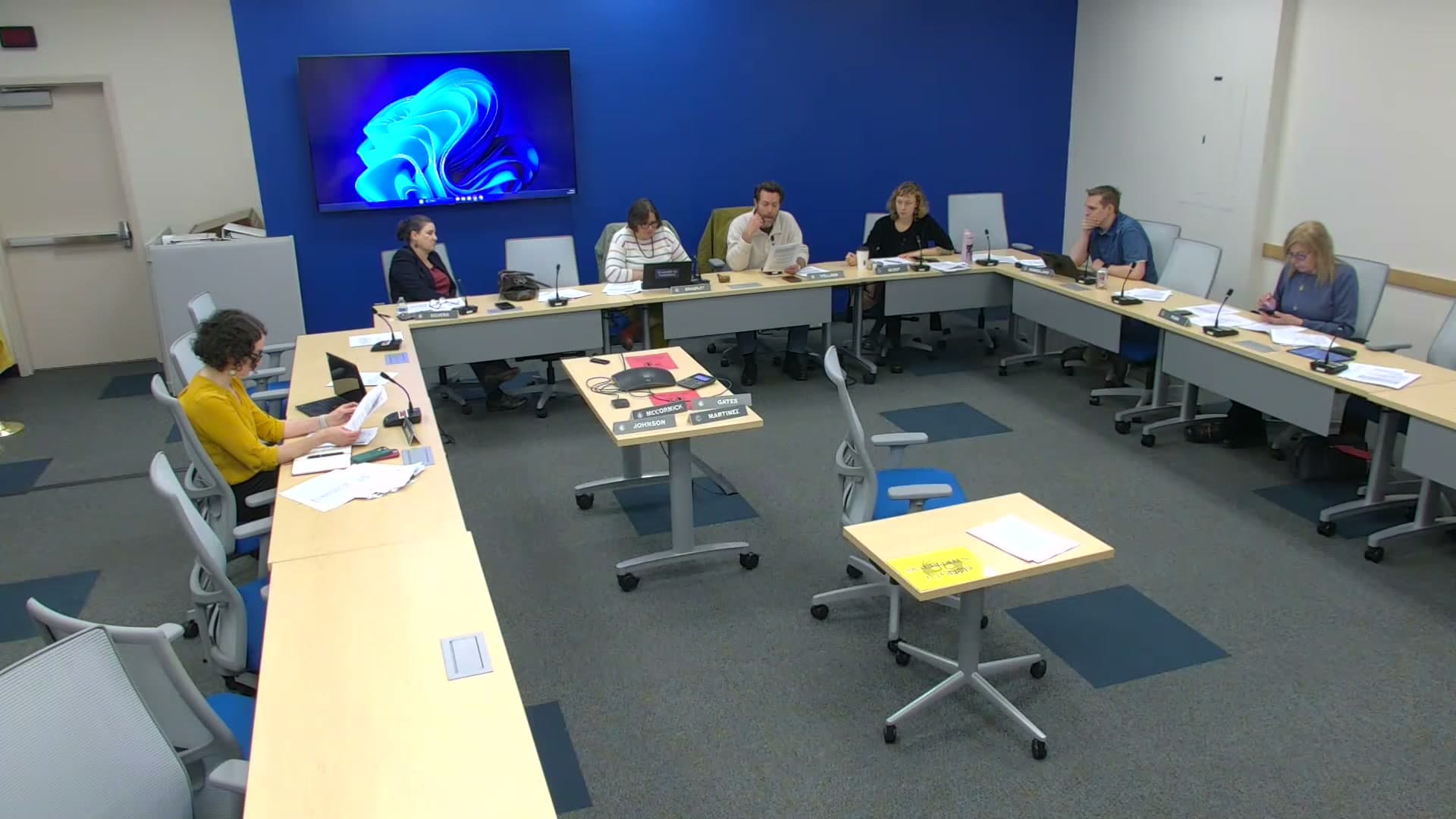
Okay everyone, let's get this work session started. Today is Wednesday, October 14th. We are noticed from 2 to 3 PM. Uh, if we have a long discussion, we might go a little bit longer, but we'll, uh, deal with that when we get there. Uh, this is a work session on AO 2026-108.
Uh, there is an S version, S1 version, some amendments. We're here to discuss, uh, those versions and amendments. I will turn it over to the sponsors after we do, uh, introductions. So starting with members in the room. Donald Handlin.
Sydney Scout. Daniel Voland. Anna Brawley. Yarrow Silvers. And then on the phone, I see Mr. Martinez.
Yes, thank you. Mr. Johnson. I'm here, Chair. Mr. McCormick.
Here. And then so that's everybody here. So we have members in the administration, Assembly Council, Clerk's Office. And a couple members of the public in the back, and then I'll just note, I know a couple members are out of town. Um, so hello, as you are probably going to be listening to the recording in the future.
Uh, so with that, so again, we are here to discuss AO 2026-108 and its various versions and amendments. Uh, this is regarding, uh, restrictions on surveillance technology and, uh, uh, things related to, uh, APD technology and such, a long title. Title has been changing, but we'll see that in the ask questions. So first I'm going to turn it over to the underlying ordinance sponsors, just if you want to kind of set the table. And then my understanding is today we're going to be talking through questions on any, any of these versions as well as amendments.
And then we had a work session on this, don't remember the date, but it was a couple weeks ago. So I will turn to members McCormick, Mullin, and Scout to kick us off. Okay, thank you, Chair. Yeah, so we thought we would just have the opportunity here today.
You know, I think recently we have had some large proposed policy changes on other matters where there's been a slew of amendments coming in at the last minute, and sometimes folks feel a little bit caught off guard or frustrated that they don't have time to process those things in advance of a decision point. So we just wanted to preview, preview some amendments that we may be bringing forward, we being myself, Member Scout, Member McCormick, but also allow others to do so as well if there's ideas that they want to bring to the table or amendments that they want to preview, that they also can do so.
I guess I'll speak to a few. You don't have printed copies in front of you, but there's 4 amendments that myself and Member Scout and Member McCormick are going to be bringing forward to the S version that would essentially more closely align it with the S1 version. So if the S version, which is the mayor's version, is the one that ends up getting moved. Amendments that we plan to bring forward would be an amendment that would require warrants for sharing of information with other entities. Sort of talked about that when we had the work session and were able to contrast the different versions.
That would be our first amendment. The second amendment would be to put in the, in the S version also the language around when DMV integration would be allowed, Department of Motor Vehicles.
We also heard some feedback from the public. Something that wasn't in our original version but is in neither the S nor the S1 was having a codified retention limit, how long data can be stored if it is not, you know, pertinent to an active investigation.
And then lastly, removal of the language in the S version, knowingly and willingly, that, that be a sort of a predicate to allow suspension of the system when there is a violation. We believe that language, that qualifying language, is a little bit too high of a barrier for the Assembly to say, hey, let's take a pause on this if there is a misuse or a violation of this technology. So those are the 4 that we will sort of collectively be bringing forward. And then Member McCormick, if you're on the phone, I thought maybe if it's okay, Chair, he could share next his amendment, and then we could turn it over to other members as you see best. Yeah, sure.
And I'll note I have a few moments as well, so, so I'll just For everybody's awareness, so there's, well, there's multiple packets here. There's the 3 versions, and then there's 2 sets of amendments. One is actually one, it's McCormick Amendment Number 1. That's the one we'll talk about next. And I'll turn to him in a second to speak to that.
And then I have a set of amendments and there might be others in here as well. Oh no, these are mine. So we'll come back to those. And then I'll also note that Ms. Silvers will wanna be in the queue, but first we'll turn to Mr. McCormick, go ahead. Thank you, Chair.
Yeah, talking about this amendment is a— adds a charter change. It does sit inside of a previous version, so this would go inside. It would not replace.
This adds a layer of adding the charter amendment so that these are further added to the charter, can't be changed by just a future body or future mayor, police chief. It adds in the requirement for a warrant being required to track a person over time from the surveillance data. It prohibits the city from joining outside surveillance networks or purchasing bulk data. It also adds in the previous biometrics that I believe Member Voland was a part of that, uh, code change in 2023, facial recognition, adding that into charter as well, along with other biometrics that can be collected at a distance, meaning like gait tracking, lip reading, voice, but does not touch like, I guess, close proximity biometric data like fingerprints or DNA being collected from a person as police typically do during admits into custody.
This charge change does not touch the license plate readers that can still track off of a hot list. It just adds that warrant for going back through historical data that was collected.
It also leaves out retention periods because I, you know, I don't think that that's would be something that should be part of a charter. That should be something that the Assembly is able to, to ratify or change at a later time. And that's my overview of the 4th Amendment there. Thank you.
Okay, thank you. So I'll turn to just questions, comments from members, and I'll start with Ms. Silvers.
So I wanted to just kind of ask about your amendment a little bit.
Proportionate penalties. So I think that's important. Like, if you have the amendment that strikes that language about it being—. I can't think of the word off the top of my head, but knowingly and willingly. Yes.
I think if you strike those— that language, you have to have a proportionate penalty, because I think the question in my mind is like, what happens if they accidentally keep the data for 15 days, right? Does every person in Anchorage get to sue, or, you know, does the penalty apply for, you know, everyone whose rights were violated by that? And so I think seeing that developed maybe a little bit more into a separate proportionate penalty track. So I don't think that the ordinance or our amendment is going to envision a penalty per se. It's just it would allow the assembly as a body to suspend the technology for a time being, likely by resolution.
So Yeah, I don't think it's necessarily a punitive thing. It's more like, whoa, something happened, we need to address that before this continues on and make sure there's not the potential for abuse or going outside of what is in code.
And essentially, yeah, have time to shore up whatever that is. Is and prevent it from continuing happening. Okay, and then my next question is for Member McCormick.
I kind of want to get to the bottom of like what you are trying to address with policy because I've been trying to follow along and I'm a little confused, quite frankly. So like I've watched some of your videos on Facebook and I saw the one where you used dashcam footage that had been redacted to blur the scene, but show the officer's movements, voter-approved dashcams, you know, and redaction. And I'm wondering, is that the type of stuff that you are trying to write policy around? Because like that's what you're showing in your videos. And so I'm just, I'm confused, and I'd like a little bit more information on what you're actually trying to write policy for.
Are you trying to regulate dashcam and bodycam footage? Are you trying to regulate redaction or redaction software? Or is it something else that you're trying to do?
Yeah, software of all types is able to track people, um, and used in all different sorts of ways. And showing tracking is very viable to people's privacy and what they're concerned about. So we're looking to limit technology that would allow police to track individuals. They released video showing them tracking individuals. And when you talk about FUSIS, FUSIS is an incredibly large data set.
And you can use that technology across that large dataset to then do what we're talking about, which is tracking individuals, developing a mosaic of their life, seeing where they go, where they come from, who they talk to, and where they spend their money, and use that in ways that people find unacceptable invasion of their privacy. So, do you consider body camera footage and dashcam footage that has been redacted to protect the privacy of individuals or the scene within that footage, do you consider that person-tracking technology that you are trying to write policy around?
Yeah, again, so tracking of people can be used in multiple different ways. It can be used to redact everything outside of that individual. But it shows that there's technology that is being used to do that. And it can be used in other ways. It can be used across body cameras, license plate readers, cameras set up in Town Square Park.
Again, the same technology that tracks people can be used to redact the area outside of them, and it can be used to track them as an individual across multiple different areas of collection. So do you want to limit APD's ability to redact footage to protect the privacy of certain individuals within that footage?
I think people are very interested in the protection of their privacy and don't want to be tracked across multiple different mediums, and that is what this policy and charter change is looking to do.
I don't think you understand my question or you haven't answered it. I'm talking about—. Okay, I think maybe we have an impasse then because I've answered your question multiple times. What do you want to do with redaction technology?
Do you want to allow—. I want to make sure that we protect people's privacy and that we're not tracking people across multiple different data sets that's being congruent. Congr— ah, consolidated into FUSIS that then would allow police to track people across multiple different, uh, mediums, methods, technologies. Okay, so from what, what I'm hearing, what I'm understanding is that you don't want APD to be able to redact the scene or other individuals within a video, um, a body cam or a dash cam video, because that involves allowing, like, the officers' movements to be tracked. That's kind of what I'm understanding.
Thank you. Okay, and then I think Mr. Bullen also wanted to respond to that. Yeah, so I'm not a sponsor of this particular amendment, at least not yet, but I think what might be helpful is for us to be grounded in the language of the charter amendment, and what it does is it defines biometric surveillance So it says that it means an automated or semi-automated process that identifies or verifies an individual, tracks an individual, or infers the identity of an individual based on physical or behavioral characteristics, including face, gait, voice, body shape, movement of the lips, whether applied to live or recorded images, video, or audio. And I also think I want to back up even further, zoom out even further off of this particular amendment, and just bring it back, you know, to the amendments that I spoke to, but also the underlying ordinances, and just make it clear that the guardrails— at least I think I can speak for myself and my co-sponsors— the guardrails that we are hoping to see put in place in order to protect people's privacy rights while we simultaneously need to address public safety issues in our community. This is not reactive to current practices, to current personnel, to current leadership at the department, to the current administration.
This is proactive legislation that, if it is reactive, is more so reactive to what we are seeing in other jurisdictions. The level of privacy interference, the evolving legal landscape. There was just a court case that found that the use of surveillance tracking was unconstitutional, and I can have the clerk circulate that case to my colleagues. This is also about protecting the municipality against litigation on Fourth Amendment grounds.
And so, you know, I guess I've heard some— I want to make sure I'm not venturing into debate here. I've heard a concern about, you know, certain technology that we do or do not have currently. You know, we have really bad traffic cameras as it is, you know, and that may be true now, but technology evolves over time. And so this is really trying to put guardrails in place that says, you know, if we were to upgrade our cameras, if we were to bring on new technology, what do we wanna have in a base level of code that is not just changeable internal policy that can be changed on a whim, right? And where, how do we strike that balance?
So that's what we're after. And then also there is that added piece of, you know, the Real Time Crime Center. If we are able to access data from private cameras. I know folks will have seen recently that Lowe's had a flock camera and I guess some folks tore it down. And anybody who's listening, we do not endorse that.
Please don't be vandalizing or destroying private property. But, you know, that opens up a whole nother series of questions. And I think I'm sort of toying with the idea for an amendment of, you know, If we are able to— if there's a Flock camera or an Axon camera or a Motorola camera, the cameras that have this sort of tracking technology capability, then when— what does accessing that data look like? We might have protections in our own contracts with Axon, you know, where we say for our own cameras, for our own technology that we own, you know, We're not going to give you access to that, or we protect everything. But what about the third-party cameras and the third-party technology, and how does the municipality make use of that in a way that also protects citizens' privacy rights?
And I think it's a complicated, tangled question. But yeah, that might be another thing that you see come forward for me. Thank you, Madam Chair. Thanks. So next I have Mr. Handlin in the queue.
Also note we were joined by Member Park about 208. Mr. Handlin. You have a couple questions for Mr. McCormick on— so is the purpose of moving this to, or portions of this to a charter amendment, is just to kind of, in your view, kind of raise the bar to make it so that it's more difficult for a future assembly or to kind of make any tweaks to that?
That's correct. That's kind of what I've been hearing from the community of what level protections they're looking for. Okay, and then also kind of on that, it's only moving, I guess, some portions of it, uh, if I'm reading this correctly. Is that right? That's correct.
Um, like I was saying, retention policy stuff is, is not appropriate for, uh, charter-level, uh, protections. That, that, um, is something that a future assembly, uh, could, uh, modify. Okay, so yeah, I guess as I am understanding this, it's, it's kind of putting the main pieces there and so that if a future assembly wanted to change that, it would just have to go back before the people.
Correct. Okay, thank you. Okay, thanks. Next back in the queue, Miss Silvers.
Um, I guess I just want to kind of direct the same question to Eva. Um, have you had a chance to look over this yet and see how this, or if it would affect using redaction software or redacting voter-approved dashcam and bodycam footage in order to protect the privacy of individuals other than the officers? Thank you. Thanks for the question. Do you mean specifically the proposed amendment that would turn into a charter amendment?
Yeah, that— I mean, any of it, actually. But I'm just looking at this definition of biometric surveillance, and I apologize, I didn't get this— a lot of this in time to read through it ahead of this. And so I apologize if I, you know, it's in here and I don't see it. But yeah, I just— I want to ensure or know if any of this, this charter amendment or any of the other stuff, affects the ability to redact voter-approved dashcam body. And this question comes up because this is the kind of stuff that I see on, in videos on Facebook and stuff, and that we're talking about restricting.
But I think we need to Okay, I'm going to stop now because I think that's getting into debate, but I'm just going to go with my question. Thanks. Sure. And I will say caveat, I got these when I walked into the room and picked up, picked them up off the table. But just looking at the McCormick Amendment number 1, I do think that there are some unintended consequences of this draft, whether it were put into code or into charter.
And one of them is that it does put very, very broad prohibitions on the use of surveillance technology. And if you look back at the First, third page, that's the definition under N. Surveillance technology is defined as any device, software, or system operated by or for the municipality that collects, records, or processes image, video, audio, etc. That's essentially anything that collects— as an example, anything that collects video data. And then there are prohibitions on the next page, Section 22.02. And these prohibitions are very broad and very specific.
It says no municipal agency officer, employee, or contractor shall use surveillance technology to monitor a person or vehicle over time, or query, search, or analyze retained surveillance data to identify, locate, or monitor a particular person or vehicle. And then there's some specific listed exceptions, like, oh, you have pulled the information, you know, in a specific reported incident. But the exceptions are very, very narrow. And this would, for example, the situation you're describing is APD. Let's say they get a public records request for, or traffic gets a public records request for some footage and they need to redact sections of it to protect the privacy.
Let's say there are children in the frame, right? And somebody, you wanna redact the children out of there to protect their privacy.
This would actually— that's being pulled and provided for public records reasons. Public records are not on this list of exceptions, and so this would actually prohibit anyone from pulling that retained surveillance data, right, which is anything that can collect video or audio of individuals. So you would not be able to pull that retained surveillance data and analyze it for the purpose of identifying, locating, or monitoring a particular person or vehicle. So if you're like, I know there's these 3 minor crime victims in this footage, I don't want to reveal their identity, you'd be pulling that video, that video footage, analyzing it, and then processing it for redaction to protect the identity of those individuals. And that would technically be prohibited under this.
And again, this is just my first take at looking at it. But I do think that when you have a broad definition and very narrow exceptions to prohibitions, on how you can use the technology broadly defined, you will end up with unintended consequences. And I guess just in a follow-up, like, so the clip that brought this to my attention was from an officer-involved shooting, I believe. And so they redacted the scene to not show, you know, the scene, but they showed the officer's movements. Because the voter-approved dashcam and body camera footage, you know, is for more public transparency into these types of events.
And so having that footage out available to the public to see, is that the type of thing that would also be affected by this? Yes, in the specific example of your referencing my recollection of that footage, the public footage, is that it reveals certain parts of that scene. It reveals the officer, maybe a vehicle, I don't recall, but it clearly— APD personnel went in there, identified the officer, right, which is definitely identifying, locating, or monitoring a particular person using retained surveillance data, right, from this technology. And then redacted around it. So I mean, this would technically prohibit that type of activity because in order to redact the rest, you have to identify the individual they're trying to show in the footage.
So it would essentially render voter-approved dashcam and bodycam footage kind of useless for the public being able to see in a lot of instances. Um, APD, I know that their records personnel are very strict about protecting privacy of individuals who are not, you know, individuals who are kind of bystanders or victims of crime or incidents. And so I think that it would be difficult for them to responsibly and in accordance with their policies and privacy laws release footage publicly if they were not able to redact.
Okay, thank you. Okay, thanks. Um, next I have Mr. Bowen, and then Mr. McCormick, did you want to be in the queue to respond to that, or Just generally in the queue.
I'll say after Member Volland and see if I need anything to add. Okay, thanks. Go ahead, Mr. Volland. Yeah, thank you. I feel like we're kind of going down a rabbit trail with this redaction thing, but I would say, again, this is an opportunity.
I know that sort of performance law on the fly is part of the job of the municipal attorney, but now these are live, and so we all have an opportunity to have offline conversations and to dig into these things and digest them after this work session and before we take action on this item. I will say that I disagree with the reading of the municipal attorney. As I read this, biometric surveillance, surveillance means an automated or semi-automated process that identifies or verifies an individual, tracks an individual. It is absolutely possible to do redaction in post-processing of video. It may not be automatic, it might add a little bit more time and effort.
You might need someone who knows how, who has those skills to be able to do video post-production. But you don't need— it doesn't need to be automated or semi-automated. So I don't think that, as I read this, that it would prohibit post-processing redaction. Thanks. Okay, thanks.
Next, Mr. McCormick, and then Ms. Park. Sorry, Eva wanted to respond first. Yeah, I agree with Member Boland. I had a different reading in that, different—. Well, who's in the queue?
Because I don't think it's turning again and again if other folks are in the queue.
Yeah, okay. Yeah, Mr. McCormick, and then Miss Gardner will respond, and then I'll go to, um, Miss Park.
Thank you. Yeah, sorry, I'm on a little delay. Um, I, I had a different, uh, interpretation and reading, uh, of that, but I welcome, uh, an amendment that makes sure that it is clear the intent of this is the surveillance and tracking of individuals, not redaction of privacy for public transparency. Thank you.
Thanks. Ms. Gardner. Thank you. Just a quick clarification in response to Member Mullen's comment. So if you look, I was talking about the definition of surveillance technology, and I was specifically referencing the prohibitions on the use of surveillance technology in Section 22.02.
There is a separate section on restricting the use of biometric surveillance, which is the definition you were referencing, that's on the next page in subsection C. But there are some very broad prohibitions on accessing, using and accessing and analyzing surveillance, anything from surveillance technology itself. So I think we're talking about slightly different pieces of the, of the proposed legislation.
Okay, thank you. Next, Ms. Park, and then also note we do have a few other amendments to talk through. I know this one is a substantial one, but if we get to about 2:40 or so, then I'm going to suggest we switch topics. So Ms. Park, and then I think Mr. Hanlon. Thank you, Chair, and I know this reads that it's specific to signals surveillance technology at Amendment Number 5.
Sorry, Ms. Park, we're only on McCormick Amendment Number 1 right now. Oh, okay. So we'll come to the— so if you want to ask questions, that's okay. Okay, thank you. Next, Mr. Handeland.
If I'll get back in later. Okay, um, any other questions right now on Amendment 1? Mr. Handeland. Sorry, I guess so my question is maybe for the attorneys on this. So I mean, look at looking over this.
This seems— I mean, now that we're switching from an AO to a charter amendment, is that allowed to be through just a normal amendment, or does this now kind of kick it up into we've changed enough of it that I guess the public can, I guess, comment on these changes separately compared to when we're, I guess, making minor tweaks versus major? Um, yes, if the amendment were approved, uh, we would say that the nature of the ordinance would have changed to a degree that you would need to reopen the public hearing and, um, re-notice the AO. However, you can debate and discuss the amendment itself and vote on it without doing that. It's only if you approve it that that requirement would be triggered. Okay, and then is the public hearing for this Still open?
It's closed. It's closed at this time. Thanks. And also note, um, there's also the ability to introduce a separate ordinance, um, so that doesn't preclude us doing what the path that we have, but that's another option. Thanks.
Uh, any other questions, Mr. Handeland? Okay, then Miss Scott. Thank you. Um, I'm curious for, um, Member McCormick. On this amendment, knowing this, that it would reopen public hearing if we approve it.
Um, and yeah, just thinking about the two different tracks here of guardrails now versus charter amendment going to voters. Um, I'm curious for your thinking on why you chose this pathway of proposing an amendment to the AO that's moving versus a separate charter amendment proposal on the same topic.
Yeah, thank you. I did explore that with the attorneys and sounds like they answered members handling about that and some of the things we discussed. We had public comment on this, on the technology regarding surveillance. I feel like we had robust conversations on it. I would like to see what, where the body is at, um, on it.
And then yeah, if this is something that is going to move forward, we'll open back up for public comment and, um, can have further public input on it as well.
Thanks. Um, I'm wondering, maybe Matthew, you can help me understand, um, the pros and cons of amendment that puts this, that kicks this current AO up a notch versus separate amendment pursuing a charter change separate from this ordinance? Uh, so it generally just comes down to the member's preference, um, how they want to introduce a proposed amendment, whether it be through a substitute ordinance or whether it be by floor amendment. Typically, floor amendments are usually for smaller individualized changes, but that doesn't preclude a member from Bringing one like this, I think. Okay, I don't know if my question is making sense or not.
Can you—. Yeah, Mr. Vaughn, go ahead. Yeah, so if the amendment passes, we have to reopen public hearing. Yeah, if we bring a separate project forward, we would also have to have a public hearing, and we would also have to introduce it. Um, so it would— so anybody who could, who wants to, could bring a separate item forward, but they would just have to follow our required Introduction timelines and public notice timelines.
Mr. Antolin. Just kind of follow up on that, I guess, for the, for the process, because I've never seen that before. Is it essentially at the same meeting we sit there and we just essentially reopen public comment at that thing? Or, I mean, isn't, I guess, kind of the point of us introducing us and having that notice is so that, hey, the public has a certain amount of time to hear about stuff beforehand and have the opportunity to testify, kind of get organized somewhat, rather than just, hey, we're going to do it, open it. If you weren't there, then too bad, so sad.
That is correct. If you were to approve the amendment, then the next appropriate motion would be to postpone to the next regular meeting so that the ordinance as amended basically met the charter requirement for 7 days' notice for a new ordinance. So I guess the distinction then really does come down to whether or not— and if, if this were introduced by substitute version, then we would advise the body to just postpone everything to the next meeting to allow for this new substitute version to be properly noticed to the public and then reopen the public hearing and have debate. Vice this, where the substance of the proposed amendment is before you and the requirement to notice and postpone would only occur if you approved it. Okay, and so if this goes forward, the amendment is approved, essentially before we are voting on that final approval, we would sit there and have that break.
So the public— okay, that answers my question. Thank you. Okay, well, and let me just add to that as well. So I think that the key thing is that, just to dig into this a little more, that the public— all the public notices for every single ordinance, every single public hearing we have for every meeting shows up on our— if you go to the public notice where it has all our meetings. And so that happens at least a week beforehand.
That's the difference would be if that was already done and then we closed a hearing, say we went to another item, then we came back to that, that first item, and that had already been noticed, we could reopen the same hearing in the same meeting because it's been noticed. In this particular case, and it's on our agenda now under the 11s, which is the unfinished business, no public hearing. So that's the distinction too. So I just, I just want to be clear in case it's not clear that if it— if a hearing had already happened in the same meeting and it had been noticed as such, we could close and reopen it. We don't usually do that, but it is possible.
This is a different situation. Um, and then Miss Silvers, you had a point of information. Is it 8 votes for a charter amendment to pass? Okay, that is correct. However, that doesn't attach to the amendment.
It would still be a simple majority to approve the amendment. That heightened majority— the supermajority is only required to approve the AO if it were amended. Okay, so by bringing it as an amendment rather than as a separate version, it lowers the bar for approval of a charter amendment? No, no, no, just the amendment itself. If you argue and approve the amendment, it only takes a simple majority to amend the AO with this amendment, but then afterwards there's the heightened requirement to approve the AO as amended.
Okay, yeah, so it's essentially being voted on twice. Okay, thank you. Okay, so I know we've got about 20 minutes left or so. I'm going to ask one more time, and I know we're— this is good that we're sorting out procedure with this particular amendment. Is there any other questions on this amendment in particular?
Check the phone one more time. Okay, I don't see any right now, so then we are going to switch gears, and I'll remind folks too, I know Certainly my intention was to get my amendments out earlier. That didn't happen. But also I think this is common where this is really introducing ideas, and we'll go through this with the budget amendments as well. Just note that the expectation is not that we've all kind of deep, deep dived into them, but it's an opportunity to explain what they are, not debate, but certainly ask questions.
So, so with that, I'm going to switch to the other ones, and then I'm going to briefly I guess what I'm going to suggest I'll do is I'll talk through these 4 amendments that I am bringing, and then we'll just— if we can just take questions together on them just to make sure we don't run out of time. And then I'll just also preface by saying I am bringing these— I had some good conversations with community members, so thanks to those folks who helped, uh, help me think through this. And then I am bringing these for discussion and consideration in case there is another version, or, or I just want to also signal I am not necessarily directing the attorneys to put all 4 of these on the debate agenda for Tuesday. So just really wanting to kind of get these out there as ideas, gauge questions, or if there's ways to refine them. And then also they are certainly open for others to consider.
So I'll run through them in order that we have them. First is Brawley Amendment 2. The purpose of this one is to really more narrowly tailor the allowed use. And these are, I should say also, these are all code changes. So they don't, they don't deal with the charter amendment.
This one narrows the allowed use of ALPR's license plate readers to a more kind of specific list, and then calling back to the discussion about the contract approval last fall, you know, this was, this was kind of the priorities that were given as far as, you know, what this technology would be used for. So that's, that's really what it does. And as I said, I'll run through them and then we'll go through the queue. Amendment 3 requires essentially— it's got two pieces. It requires assembly approval, as the existing ordinance says, not just for contracts.
It also adds demonstrations with vendors, as well as requiring disclosure of marketing materials. And so it does that piece of it. So it says, for example, if I participated in a demonstration last year with Axon, so rather than that being something the department can just do, and I know that is not a typical— I should say, you know, a lot of departments probably engage with discussions with vendors. This would require prior approval for consideration of that demonstration, and then it also requires a public hearing for approval of the contract itself. So not for the demonstration.
There's two pieces of that approval, but it just heightens the requirement for that. So that's for consideration. And then I should have said before I did the first one, all of these, there's two sets of the same language essentially because it's noting where the S or the S-1 would be amended, just for clarity. So rather than having our attorneys draft two separate sets, and that would get cleaned up depending on where we go from here. So that's number 3.
Number 4 is that it would specify the word judicial warrant. And I do know in the Amendment 1, I did see there was description of warrant in a court. This really just adds the word judicial to distinguish between administrative warrants. And I don't know if that was the sponsor's intent, but I think that's worth considering being specific there. That's Amendment Number 4.
And then the last one, the fourth of mine, Amendment Number 5, addresses and prohibits the use of signals surveillance. I know that was— it sounds like Ms. Park had a question on that. But essentially, And I think it's similar to this idea of biometric data and these other pieces where there's, you know, a lot of our devices. I'm holding two cell phones right now. Both of them are emitting a signal of some kind that that data can be used essentially to compile a very, you know, detailed profile of someone's movements and their activities and habits and so on.
And so also adding that to the list of things that are prohibited for municipal use and also limiting the the extent to which it can be used for evidence. And so, so there's a few pieces there. It does also mention in required reporting, that's the last piece of that, that there's a detailed log of access to that or use of that signal surveillance technology. This is it. Like many other things, we know that this type of technology is being used in the private sector, it's being used elsewhere, but this is limiting municipal use of that.
So, so those are the amendments. I'm happy to take questions. And so, Ms. Park, it sounded like you had a question.
Thank you, Chair. My question about that is whether we can choose to omit evidence of— choose not to admit evidence of a crime if that's been given to us and that may be more appropriate for more appropriate for Ms. Gardner. Yeah, certainly more appropriate for Ms. Gardner. And then I would note, before she answers, you know, that my understanding is that if something was collected illegally, it cannot be admitted as evidence. But question to Ms. Gardner for that.
Thanks for the question. I think I need a little more clarification on the question, or which part of the amendment here. Well, it says the municipality shall not accept or use evidence of crimes committed provided by a private company. Any landowner or third-party vendor from signal surveillance technology. So first of all, are we saying that specifically separate from other technological evidence like a video, a recording, um, or whatever other kinds of evidence that we could use?
This is considered first of all a separate kind of evidence, is that correct? So this would require it to be treated differently, and looking at this section, I think that there are a couple different answers. So your first question was, can we— do we get to choose which evidence we use? I think if we never accepted, right, evidence, if we didn't receive anything, we wouldn't have it, we wouldn't be able to use it. I don't think we'd have a duty to use it.
However, if we get something and then it gets requested from us, right, in criminal prosecutions, we do have a requirements to hand over discovery material. And so if we have something in our records and we got a request for it, we would have to hand it over. It could then be used. I don't know if that would count as us using it, but I think this has a little bit, has a little bit of an implementation issue because this doesn't have any knowing requirement, and we may not always know that the information we're being provided, you know, maybe the private retailer got it from their security contractor. Who, you know, contracts with a third-party vendor that uses facial recognition technology or signals surveillance, and we may not know by the time the information gets to us, and this is drafted actually, it wouldn't necessarily have to be the signal surveillance, signals information itself, it just, it was derived from, so maybe they were able to identify an individual and provide a name to APD as a suspect, for example, and maybe that was derived from the use of this technology, but we would have no way of knowing that.
But this is drafted kind of as a strict prohibition without any awareness requirement.
Thank you. And I guess the separate part of that question is whether that— whether signal surveillance technology would be considered a separate kind of evidence from, as I said, a video. You know, a crime is, you know, an assault is committed in the parking lot and it's recorded on a video camera. I'll say legally, I don't know that there's a distinction between different categories of evidence, uh, like this, but this is the first time I've seen signal surveillance technology come up in this context. I'd have to probably circle back and get some more information before I could give any more detailed answers.
Thank you. Okay, other questions from folks? Oh yeah, that's right, I'm a— Summers, go ahead.
Okay, um, let's see, on Amendment 2, do we have a definition of violent crime?
Isn't that in state law?
Uh, I don't know that there is a definition of violent crime in state law. I'd have to check. I think there are a lot of crimes that are defined in state law, but if there's a broad definition of violent crime, I don't know. I would say if there is, we'd want to explicitly cross-reference it to ensure that that definition is captured. Did you— do you know if we have that?
I'm not familiar, but that is a good follow-up. I can look into that. Okay. And so I'm wondering, would this cover, like, theft above a certain amount? Major acts of vandalism, arson— I don't know if there wasn't a weapon involved, you know, things like that— would it restrict the use of ALPR in those types of crimes?
Okay, that's a good question. I'm gonna do a follow-up and figure out what definition or what kind of categories, if it can be more specific, Okay, and then I have a question on Amendment Number 5.
Do you know, do we use any of this type of data now, signals surveillance data? And if so, how do we use it? I do not have an answer to that right now. I think we would need APD to respond to that question. Okay.
And then I don't— I, I follow some of the current stuff online, and I've followed the Lindsay Clancy case a little bit, and they did actually use like location and digital data from cell phones, computers, and other types of technology like that. Would that kind of investigatory work be limited under Amendment 5?
I mean, just looking at the terms of the amendment, it does look like it would encompass digital signals coming out of cell phones and things. I don't think that it would apply expansively. I don't know specifically. Okay, thank you.
Other questions from members?
Check online one more time. Yeah, Mr. Poland. And so maybe this— sorry, did Council help you draft this? Can I turn— if I turn to Council, will they know sort of how this fits in the rest of the—. I can't speak for them.
I brought these mostly fully drafted. Okay. I guess my question is, so whereas a couple versions of the underlying item or an amendment that myself and my co-sponsors intend to bring forward have a threshold where, you know, some surveillance would be allowed, right? If you had a warrant, there was an active criminal investigation, missing person. Could Amendment Number 5 be so structured where there would be, in some instances, an opportunity to use this type of surveillance provided certain conditions were met?
Is that envisioned by this amendment, or would it have to be tuned a little bit? Good question. I think, I mean, as written, I think this is the maximalist version. It says we should not be using this. We obviously cannot preclude private companies from using it.
But at the same time, part of my purpose, especially today, is to raise these questions because they have not been fully raised, I think, in the discussion so far. Obviously, we haven't debated yet, but also just to call attention that this is another form of surveillance. And so I think I'm always interested in what's practical. And so I would say as written, this is a broad prohibition on it, and then I'm interested in what's realistic as well. Thanks.
Okay, and Ms. Silvers, another question.
I think this question is for anybody that would like to answer it, or maybe nobody does and just something to think about. How much privacy protection do we believe that criminals who have committed crimes should have when we're trying to investigate and bring them to justice? Thank you. I mean, I'll take a crack at it. Go ahead.
Um, so those who have committed crimes and, you know, uh, have had the commensurate penalty, um, you know, and are— and then are no longer the subject of a criminal investigation, active criminal investigation, they have the same constitutional rights to privacy as you and I do. So I guess that would be my answer.
I have a response and then I have a question too, but I'm happy to break those up.
Yeah, I'd echo what Vice Chair Follin said with the addition that our justice system is predicated on the assumption that people are innocent until proven guilty. And so if somebody is accused of a crime, that does not mean they are a criminal yet, and they're duly protected under the state and federal Constitution. Um, my question— and then I have a question later, I can get back in queue for that. Yeah. Um, and yeah, I know we have a few minutes.
Um, I wanted to respond to Ms. Park. Did you have a separate question, or did you want respond. Thank you, Chair. I wanted to clarify Member Silver's question as to whether she meant during the investigation period.
Yeah, I guess I mean in the investigation of crimes, you know, with warrants and stuff like that. So if we're prohibiting— making overall prohibitions then you're not even able to get the data with a warrant. Generally, you have a warrant when there's probable cause. And so I'm just wondering, like, how far do we want to go to protect criminals from being investigated and brought to justice?
Thank you. Okay, and I have a brief response, then we can go to Ms. Skow, I think. My I'm going to go real philosophical and real broad. And that is that I would say things like crime, criminal behavior, antisocial behavior, really that sanity, mental health, or mental illness, all of those are socially defined and they have changed over time. They're different in different societies.
And so I guess that's the lens that I look at everything, and which makes it really difficult to get practical sometimes. But I do see that, that It's hard to come up with a hard and fast definition of what a criminal is and what a crime is when you really get into the, the broad strokes of where it could go. So next I have Ms. Scout, and then we just have a few minutes. We can extend if we need to.
Yeah, I think I also just sort of have a big picture question that I'd love my colleagues to think about with me.
The Brawley amendments, particularly the one about the signal technology, does bring up something we've talked about in this category of policy in the past. It's just, how do we keep up with the changes in technology? So we talk about signal technology now. I don't— what will be the equivalent of that in 10 years? Will we be trying to prohibit everybody's, like, personal AI bot from giving away information?
I really I don't, I can't predict where we're going. And so I'd be really curious to think about and explore ways that we can ensure if this policy is passed and/or as we're deliberating it, ways that we can put in some sort of housekeeping mechanism, regular updates, regular updates on internal policy that we can then embrace at the municipality. Um, so yeah, really just wanted to pose that bigger picture question because I, I appreciate the amendment on, um, on the signal techno— whatever it's called— the signal technology. And that made me think about all of the other technologies we can't even anticipate at this time.
Thanks. Other questions from members?
And it looks like we got, um, one more, Amendment Number 6. So I'm going to actually—. Chair, these are the amendments that we spoke to earlier, um, that have now been distributed in paper form so y'all can, um—. Yeah, do you want to just—. Yeah, those were the ones that I mentioned at the top of the meeting.
So Amendment Number 6 is the requirement to only share surveillance data with non-municipal individuals or entities if there's either for criminal justice law enforcement purposes and when required by law warrant or court order. Member Brawley's amendment that she put forward would change that to judicial warrant.
Proposed Amendment Number 7 is the additional language restricting the sharing of ALPR information with the Department of Motor Vehicles without prior assembly approval by resolution. So at some point, a future— this assembly or future assembly could do a resolution to say, yeah, we're okay with that, we can share that information. Amendment number 9 is the removal of the knowingly, materially, consistently language. Okay, thank you. Okay, one last call.
Is there any, any additional questions, comments on these? Ms. Park? Maybe Ms. Gardner could tell me that in the, um, where it states, um, whether can be accessed by a court order, or would that include subpoena power? It's, for instance, in a civil, uh, case. The thing that comes to mind immediately would be, um, an auto accident where the victim, where the insurer wants information relevant to that accident.
Okay, and I also see Mr. Hurt wanted to answer. Oh, okay, sorry, go ahead. Yeah, we understand law to refer to valid court orders, so a subpoena would be a valid court order. Um, the— and we get this type of request in civil, you know, third-party civil cases all the time. We get a subpoena to the municipality and we provide records.
I will say we are still careful to ensure that we are producing only the records that are necessary, and we'll seek a protective order, right, or an agreement with the other side about what redactions we are going to make or where— whether the information we're providing needs to be kept confidential. But yes, law would include subpoena. Thank you. Thanks, Mr. Hurt. Oh yeah, I just wanted to clarify, um, something with regard to Amendment 9, the knowing materially consistently.
Um, the point of that amendment, as I understand it, is not to create some sort of strict liability offense for the municipal government, but rather the The effect of this amendment is to bring any violation to the assembly's attention, allow them to have a public hearing, and then decide based off of the nature of the violation whether or not to suspend the use of the technology. So it's not like there's a violation and instantly, like, the hammer comes down, right? And, and also, um, pinging back to Member Silver's earlier question about a a penalty. Again, this does not— this section doesn't envision a penalty. It just envisions, as Mr. Hertz just said, the assembly to have an option if they desire as a body majority to suspend the technology until whatever the issue was can be figured out, and then they can reactivate it, so to speak.
OK, so I'll check one more time. So we're just, just after 3. Is there any further discussion on this item? Questions? OK, so with that, thanks everyone.
So I will note again, this is amendments and a little bit of discussion about the versions for AO-2026-108. There is an S version and an S-1 version and several amendments. This is back on our agenda for Tuesday, October 20th. I will note also that In terms of expectations for the public, this is a— the public hearing on this item has been closed. Currently, it is one of the first items on the agenda.
We may need to change the order of the day because we also have our budget hearings. And so I wouldn't anticipate that this is necessarily the first thing we talk about, but the intent is certainly we know that this is going to be a significant discussion. So leadership is working on making time for that, and then we'll be— we'll let you know more about the changing of the order so that we also have time to accommodate our budget public hearings. So with that, this is the last meeting for today. So have a good day, everybody, and we'll see you tomorrow for some committee meetings.
Thanks.
Speakers in this transcript

Anna Brawley
Vice Chair, Anchorage Assembly · Anchorage Assembly

Daniel Volland
Assembly Member · Anchorage Assembly
Donald Handeland
Eva Gardner
Municipality of Anchorage
Janice Park

Keith McCormick
Assembly Member · Anchorage Assembly
Sydney Scout
District 1 North Anchorage · Anchorage Assembly

Yarrow Silvers
Assembly Member · Anchorage Assembly