11-5-2026 RDC/AMA Breakfast Forum
Alaska News • • 51 min
Articles from this transcript
EPA has drafted a rule on leather work gloves as hazardous waste, regional head says
EPA has drafted a rule clarifying whether used leather work gloves in Alaska's oil fields and mines count as hazardous waste, EPA's regional chief says.

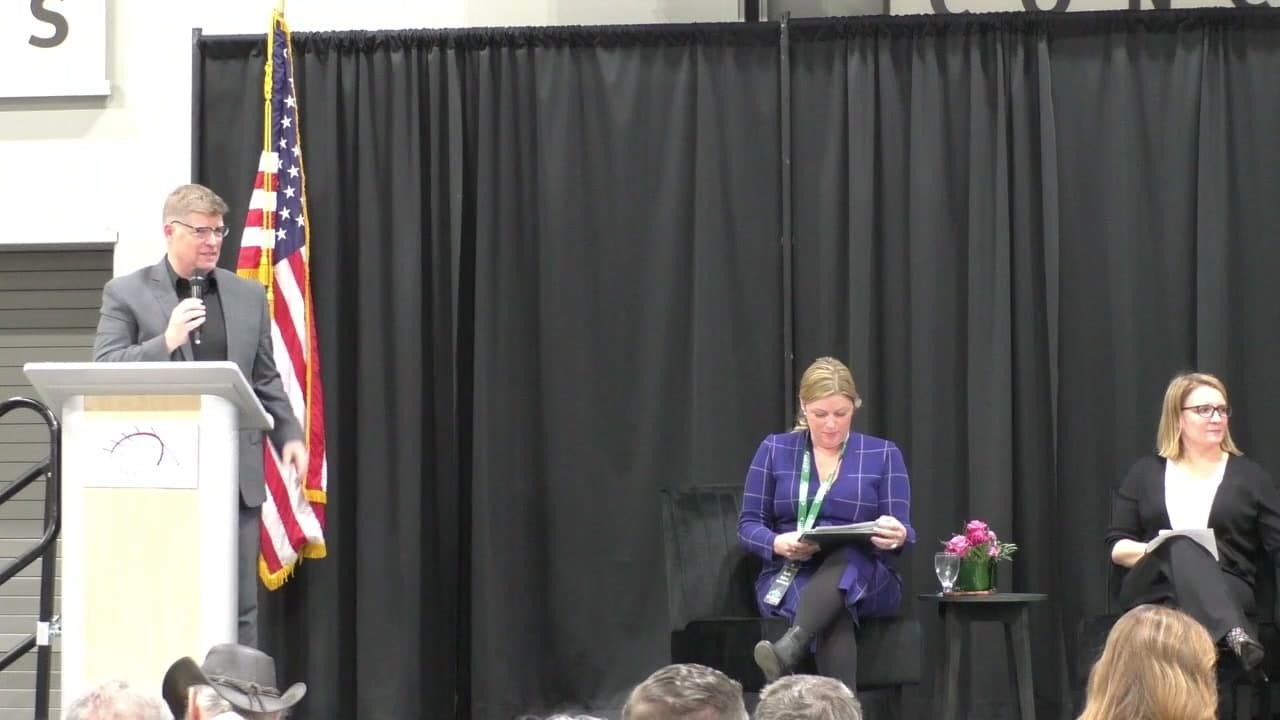
Everyone ready to rock? Thank you, Eddie. I appreciate that.
I actually am not smart enough to make that pun. Good morning. My name is DeAndra Skubinski. I'm with the Alaska Miners Association. Really happy to welcome you all today to our co-hosted breakfast with the Resource Development Council.
Very briefly, I want— we will kick off this session and discussion, but some brief announcements for you related to our safety inside of this building. You have heard many of us say, and it remains paramount safety is a priority in our industry, and we want to make sure it's a priority here today at the DeNino Center. Um, in the event there's an emergency, the building's alarm and strobe lights will activate, and an automatic voice will give us directions. If evacuation is necessary, there are multiple exits in this room. Please look around and make yourself familiar with them.
Uh, find the closest one and exit and proceed to City Hall parking lot on 7th Avenue over there by Humvees. That will be our muster point. Um, and as soon as the present situation is corrected, we'll be readmitted and the continuation of this event Okay, so before we get to our conversation with Regent Tenn and Administrator Pokon, I would like to ask Scott Habberstad, the president of the board of RDC, to come give some remarks. Here. Thank you.
Though I probably don't need it.
Alrighty, good morning. For those of you who don't know me, I think I know most folks out here, but I'm Scott Habberstad, managing director Alaska market for Alaska Airlines, and I'm the current RDC board president. Now I'm here to say, the last 2 years, it's been a great 2 years, but I'm looking over at Joe Balash, and I always continue to remind him every time I get the opportunity that he's the incoming chair, and he will take over at our RDC conference next week. So thank you very much, Joe. Let's hear it for Joe.
I gotta do a little shimmy into it to make sure you'll do it. He does, right? Looks great. I'd also like to thank AMA. This has become an annual tradition for the joint AMA and RDC morning breakfast.
I would like to give a huge shout out to DeAntha and her team. This has been an amazing conference. I think it's one of the biggest they've had, and it's not easy. It looks easy, but it's not. Can we give a big round of applause for DeAntha and her team?
You know, there's a lot of momentum across Alaska. There's a lot of good things to be excited about. It's conference season, and I love conference season. The Alaska Visitors Industry and ATIA held their conference up in Fairbanks last week, and they had some great things to announce. We've seen seeing growth in tourism, not only in the summer, the shoulder seasons, but also the winter seasons, which is adding hundreds of millions of dollars to the state's coffers in tickets and fees.
We had the State Chamber right after that. The State Chamber is doing a fantastic job representing Alaska and Alaska businesses, trying to make sure that everything works smoothly. And then here we are today with AMA's conference and talking about the great things that are coming forward, that have come past and are coming forward.
I'd like to— we've seen a lot of momentum across Alaska's resource industries in recent years. You can feel it just looking at the attendance and enthusiasm at this conference and around the state. We're also seeing important changes at the federal level, including efforts by the EPA to better recognize Alaska's unique geography and logistical challenges when developing and applying federal policies. I'm looking forward to hearing from our good friend, the administrator, this morning and the discussion between Connors and the ANTA. Well, mining's focus today, and mining will always be the focus.
We're going to hear about a whole bunch of different industries, the industries that also make up RDC's 5 pillars, which are tourism, timber, mining, energy, and the seafood industry. If you want to learn more about those industries, like I said earlier, it's conference season. Next week's RDC's conference, the 11th and 12th, will be right here at the Denina Center, and it too has a record registration and turnout. I reviewed earlier this week the agenda, and it looks fantastic. I don't want to take any more time, but I look forward forward to seeing you there as well.
And with that, I'm going to turn this back over to Amy. Thank you so much, Scott. We really appreciate you and Connor and your whole team for all of the things we do, not just today but all year long. Okay, so let's get into this. Very excited to introduce— that's your part, I'm sorry.
No audio detected at 4:10
That's my part. Connor's supposed to do this. This is going really well. I mean, I've been angling off script this morning, so—. Good morning, everyone.
I'm Connor Hajdukovich, the Executive Director of RDC, and happy to be here this morning. And thank you to the— for hosting. I'm going to introduce Emma Pogon this morning, EPA's Region 10 Administrator. Emma was appointed the Regional Administrator for Region 10 by President Donald Trump in February of 2025. As Regional Administrator, Pogon oversees EPA's work to protect human health and the environment across the states of Alaska, Idaho, Oregon, and Washington, and 271 tribal nations.
Prior to joining EPA, Pokon served as Commissioner for the Alaska Department of Environmental Conservation since December 2003. She joined ADEC in February 2020 from the Alaska Department of Law, where she most recently served as a Senior Assistant Attorney General assigned to support DEC. In her time with the Department of Law, she worked as a special assistant to the Attorney General and worked closely with the Department of Natural Resources and Regulatory Commission of Alaska. Previously, she represented the North Slope Furrow in Natural Resource and Environmental Matters, and she served as a law clerk for the Fairbanks Superior Court. And finally, she earned a bachelor's degree in history with a minor in chemistry from Hamilton College.
She also achieved a J.D. And master of studies in environmental law from the Vermont Law School. Um, all a long bio, but it's important to know how much you've done and the experience that you have, and we really appreciate having you here. So please, uh, help me welcome Emma today.
With that, we will get into some of our questions. So given your previous experience leading the Alaska Department of Environmental Conservation, you certainly understand the challenges facing both regulators and industry. And we're just curious what lessons you've learned from your time at DEC and how are you bringing that to your role at Region 10? Thank you. And thank you for the introduction.
I do like to— when I'm in Alaska, I just wanted to highlight that I have had the privilege in working a lot of different places around the state, working in Fairbanks and on the North Slope and time in Anchorage and time in Juneau for legislative session. It is a big state with a lot of very different distinct communities, and each one of those experiences gave me an additional layer of understanding about the state and the layer of understanding that there's going to be things that I don't know about and that it's important to listen and hear what people have to share because, you know, my experience as broad as it has— I've been fortunate to have in this state, it is still limited. The experience at DEC, I think, you know, a lot of the pieces that I have drawn from that, you know, one, there's a lot of really great folks and great experts at DEC. The state has incredible subject matter expertise. From Region 10, there isn't necessarily going to be a need to second-guess the state's decisions.
That, you know, having that respect for the ability that the state has to implement the programs, that is what Congress intended in the first instance, was for these federal programs to be taken up by state agencies where they want to do that and implement. You know, I saw over time instances of some, you know, pretty robust dialogues between the agencies, and sometimes, oftentimes, there's a gray area, right? And I think part of the value of about having the state and sometimes local agencies implement federal programs is that they are bringing to the table an understanding that is challenging to really develop if you haven't been in that region, if you haven't been in those communities. We've got a lot of great people in our Seattle office and a lot of great people in D.C. at EPA, but I don't think there's any substitute for having that office in Fairbanks or having people who have been in Alaska for a long time and have had an opportunity to really develop that understanding. So that is actually one of the reasons why it's been really gratifying to come into Trump EPA and have Administrator Sullivan really highlight cooperative federalism as a priority for the agency nationwide.
I think my own sort of sentiments about how the state agencies have a lot of great people and a lot of great expertise is echoed in that. It is affirmed that we want to view the states and state agencies implementing the federal laws as partners. We're not the big brother, we are the partner. And so it has been, I think, a good fit for me to be able to come in and help implement that perspective in working with the state agencies. Yeah, thank you.
I think over to you, Diantha. Yes, thank you. You touched on this a little bit, Emma, but we kind of dig into it a little more. It will be no surprise to you that this question is about permitting reform. Obviously, we are very optimistic and hopeful that things at the statutory level will advance.
But there are a lot of things that are happening within agencies to do permitting reform. So can you talk a little bit about, you know, how Region 10 is working to advance permitting reform between improving coordination between federal and state agencies? And I know you dug into that a little bit, so feel free to high-level that one. But reducing duplicate reviews and unnecessary delays and just providing overall greater certainty in the permitting process. Yeah, I think that this— I mean, everybody knows that this is a big issue.
I think across the aisle there is consensus that there needs to be some rethinking of the permitting system. I think AMA— sometimes I've heard you all speak to taking 40 years to get a new large mine permitted. That is some patient capital, right? And when we have a need for those resources and we have a need for domestic production of those resources. 40 Years is— that is a long wait.
No audio detected at 10:20
No audio detected at 10:30
So I think there's a lot of people nationally that have kind of taken up this challenge for how do we make this permitting system work more efficiently. And there are some big, broad, more sweeping efforts. I think we have seen great progress through the FAST-41 initiatives and things like the transparency dashboard. And seeing a lot of those permitting processes accelerated. Turns out sometimes all it takes is some direction to like put some focus on a thing and get it done, to not just let it sit on a desk.
I think for EPA, one of the places where we are seeing some substantial shifts is in our NEPA implementation. For EPA, there is both our direct implementation of NEPA when we're doing something that requires a review, and then we have a responsibility under Section 309 of the Clean Air Act to review other agencies' NEPA documents as well. I think NEPA has a little bit of a reputation. I think the public policy behind it is great, right? Like, we want decision makers to be informed about the potential environmental impacts of their decisions.
That is good information for a decision maker to have in hand before they launch with something. But it also has become a source of significant delay, litigation, and controversy, really. So I think we've had some recent Supreme Court decisions that have also been helpful in narrowing the scope, focusing the scope of what we're looking at. So that it has been helpful to have that guidance from the courts, and I think the federal agencies have really taken up that challenge to say, okay, what do we really need to focus on here for our NEPA analysis to ensure that the policymakers, the decision makers have good information in front of them as they make those decisions, but also to not have this document that is so large and cumbersome that it becomes— it becomes challenging for somebody to digest all that, right? So we want it to be something that is focused and really can perform that purpose better.
For purposes of our— over our responsibilities under Section 309, we've gotten some good guidance from the Deputy Administrator as well. NEPA is not meant to be a catch-all, here's our wish list of environmental mitigation. It is meant to inform decision makers Project proponents can include mitigation, that's good, but it isn't something where it's meant to be leveraged to require more than what the law requires. Our regulations, our laws are protective of the environment. From time to time those get renewed because we want to make sure that they remain protective, but NEPA isn't meant to be this thing that pulls in everybody wish list of what to include.
And so we really have been focusing our review of other agencies' NEPA documents as well to make sure that we are focused on what is the actual legal requirement, what is the authority that we have, what is the expertise that we have, recognizing that we have partner agencies out there that have expertise that, you know, if it's an issue for the services, it's better for the services to speak to that, right? They have the better expertise. So really focusing our reviews as well to help, I think, be a partner in that overall effort to focus the NEPA reviews. To have good information, to have relevant information, but not have it be so broad and cumbersome that it loses its value. And that, just an observation, that leads over to the public too.
This has made the entire process much more transparent for the general public. There's a lot of nerds in this room, and I call myself one of them, that do delve into very large permitting documents, but what this has done is really improve the way that the public can participate in these processes. So thank you for that. Yeah, and I would also add to that, just from the outside looking in, permitting reform also just seems to be so important to all the industries beyond mining, and I've certainly noticed a change just in the way that the comments are being asked for, like a lot more focus. We want things that are actually applicable to what is being studied in these EISs and whatnot.
So, hats off to you, and I'm sure you will continue to try and make efficiencies and focus on those decisions. Let's shift to another favorite topic, which is WOTUS. Wait, how much time. Do. We have?
So recently, a supplemental notice for the proposed definition of waters of the US WOTUS was published and comments sought to be consistent with the US Supreme Court's ruling in Sackett v. EPA. So what are the next steps we can expect for the updated definition, and what should Alaska's resource developers be watching for? And will we hear anything about permafrost? That is the popular topic on WOTUS in Alaska, I think. When the initial proposed rule came out, I heard from many of you about wanting clarity on that front.
There's a sense that permafrost is one of the things that makes Alaska very different, and does it make sense for something that is that distinct to be wrapped up in the broader federal regulatory program? So it's an interesting question. I think there was some narrative in from the preamble for the initial proposed rule that spoke to, you know, having an upland area where we have those mosaic wetlands, if you will. If there's something where the continuous surface connection is severed, that that would sever federal jurisdiction. I also want to emphasize in the context of the conversations around ODIS just because the federal government isn't involved does not mean that there's not going to be some regulatory program addressing water quality concerns.
I think that the state has broad authorities, and different states are going to make different decisions about what they think the relative level of protection should be that makes sense for for their states, for their jurisdictions. And that again is part of the spirit of viewing states as partners, right? We don't, from the federal government, always need to be the entity that is providing all of the answers. Having that engagement with the experts at the state agency, respecting the prerogatives of states to make those policy determinations for their residents and for their jurisdictions, jurisdiction, I think, is an important principle. And I think it's a principle that was reflected in, in the second decision as well, that traditional state authority really need to have some direct, very explicit guidance from Congress in order to overcome the presumption that the states maintain their authorities within the scope of what's classified as a traditional state authority.
So, it has been a long conversation. I think folks are impatient. I think the agency is impatient. I think we all want to see a final rule get out the door, but it's also really important that to everyone, I think, frankly, that one, we adhere to what the Supreme Court's guidance was in a sincere way, that we produce something that can withstand a litigation challenge, and maybe even something that can help resolve some of this pendulum swinging that we've been seeing over time. I think it has generated confusion for the regulated industries.
No audio detected at 18:40
It has generated confusion for the state agencies that need to move forward with their decisions. And so getting that resolved is absolutely a priority, but it's important that we get it right as well. I know folks at headquarters are working hard on that. And it was actually good to see a little bit more of that thinking in the supplemental notice, right? I think the decision is not final until it's final, but it did reflect some evolution of thinking potentially that was responsive to even some of the feedback that I heard here in Alaska.
So, I know folks are impatient. I think we all are, but also it is really important to get it right. Yeah, I think we've definitely appreciated certainly the opportunity to provide feedback, but also your willingness to take that in. And of course, having your background in Alaska, I think, is just so valuable for those processes because of how unique WOHAAD is. Is treated in Alaska.
So. Yeah, it is a very important topic for the state and for folks operating here because there is so much of the sort of acreage of the state that is either a water body or a wetland. And so that question about how many— what wetlands are included within federal jurisdiction can inform what ends up being the complexity of the permitting process, right? And so a So also in this context of this conversation around permitting reform and the desire to really streamline and rationalize that overall framework for permitting, you know, where we land on MOTUS can be an important component of that as well. That is exactly what is written here and how to ask my next question to you.
You couldn't have teed that up better. Thank you. And it's funny, when I was writing this question to talk to you about wetlands mitigations, it's so great to have a Region 10 administrator from Alaska because a Region 10 administrator from somewhere else's question would be very more high-level and more formal. But I just want to dig into, you know, you are very acutely aware of the limited restoration opportunities we have for wetlands mitigation. And I know this is predicated on getting that final WOTUS rule across the floor, but post that, what kind of opportunities do you see for more flexibility applied across the board to resource developers looking at compensatory mitigation?
There are so many opportunities out there, I think, and I think a lot of those ideas, they're not new ideas coming from me. They are ideas that have been part of the public policy dialogue in Alaska for a lot of years. It is not just Region 10 and it's not just EPA that would be involved in a conversation about broadening compensatory mitigation opportunities. But there are things that are really interesting to think about and look to see if there's something that we can actually accomplish a better environmental outcome that we aren't capturing with just setting more acreage off limits. There's a lot of the state that's in some kind of conservation unit, state or federal.
I think, you know, over the years I have heard things from even other state agencies, that it can be really challenging in some areas of the state because there is so much of the state that is already under some kind of protective status. It is very hard to meet that in-watershed, in-kind requirement because you have to have something that is actually at risk, right? So there are some unique challenges in that context. But I think about things that are that are posing a potential risk to water quality in the state. Things like legacy mines that need to be cleaned up.
We have good environmental standards now, but that has not historically always been the case, and there are some things out there that could use a little work that are affecting water quality in a localized area. We have a lot of communities that could potentially benefit from additional support on managing their wastewater systems, and that would have a positive impact on water quality. And this even feeds back again into that conversation about the balance between the state and federal authorities. There is, I think, personal perspective, it can be very hard to write a national rule that is going to work perfectly everywhere. And there's going to be different public policy balances in different jurisdictions.
So if you're in an area where the wetlands have been decimated, you're not getting the ecosystem services that you would get from those wetlands. It's generating other risks, other impacts, you know, that that need to protect the remaining wetlands or to expand wetlands that may be different than what we see in areas of Alaska where we just have these expansive landscapes that are wetlands.
And again, many of them are already under a protected status of some sort. So this is not a Region 10 alone conversation. It is not an EPA alone conversation, obviously. The Corps of Engineers has a lot to say on this front.
And so that will be hopefully an ongoing dialogue. I do think that there are opportunities out there, but they have to be opportunities that fit within the scope of what the law allows for. For me, the bottom line would be, is this shift going to actually provide a benefit to water quality that we can identify and have a good reason basis behind? Why it makes sense for this option to be available to folks.
All right, we'll maybe broaden this up a little bit. I think we're staying on the theme though of Alaska uniqueness and how do you wrap your hands around that from the regional and national side. But how will Region 10 ensure that EPA decisions, you know, affecting, you know, Slope and Cook Inlet development, how can you ensure that they're based on Alaska-specific data and, you know, on-the-ground operating experience, the things that people see and feel here, rather than maybe some of the national assumptions or models that may not reflect Arctic conditions? And if you're, you know, if the data is difficult, which I'm sure is, how can industry better help help you in that space? Yeah, this is— it's a bit of a chronic issue in Alaska, right?
I think there is— there probably still is a workgroup that is like a number of both state and federal agencies that are all focused on what are the mapping needs in this state, right? This is a longstanding group just because we don't have the data, we don't have the information in Alaska that you have available in the Lower 48. State. And we need to have good information to inform regulatory decisions, right? We don't want to have something be arbitrary.
We want to have good supporting information. So part of that is collecting data where that data is needed for a decision, for a permitting decision. I think in our exchange earlier too, it sort of got at the Wheels training a little bit about— we know that there is going to be data limitations in Alaska. We know there's a lot of folks out there that have been gathering a lot of data over time, but we're also having this permitting reform conversation, right? So is there a place where there's a more pragmatic approach that could be taken in a particular permitting regime?
There's a lot of smart people out there doing this work, a lot of those smart people in the room today, And so if there are thoughts around how we can address those data shortage issues in a, in maybe a more streamlined way, as always, the door is open to have those conversations.
And yeah, there really are issues around having good data in Alaska because it is such a big area. A lot of ground to cover, literally.
So yeah, sometimes there isn't any substitute for gathering the necessary information under the current permitting regimes, but if there are thoughts about how we can make that system work better for Alaska, I'm all ears.
We're going to broaden it out even further and talk about leather gloves. Not something I thought I would work with in this particular role. Is that broader or narrower? Actually, yeah.
It's very specific, isn't it? This is really out of context. So background for those of you that are not familiar, many of my members and Connor's members have shared concerns about the requirement under RCRA to treat leather gloves as hazardous waste. A surprising topic, if you can't tell. So can you give us an update on that?
I know you just had a hazardous waste roundtable. Was that just yesterday? Day before? It was sometime. Sometime recently.
Sometime yesterday? Day before yesterday?
It sounds like you might have a timely update on a lot of hazardous waste discussions, and if you can include leather gloves in your answer, I'd appreciate it. Yeah, so, so leather gloves. This topic first hit my radar when I was at DEC, actually, and I think that that was because there were some enforcement matters surprising some of the oil and gas operators and some of the mines with the this idea that these, you know, pretty standard work gloves that you see everywhere should be managed as hazardous waste. I think something that somebody said at the roundtable the other day that resonated was, you know, we have employees that are wearing these for 8+ hours a day and then you tell us that they're hazardous. There's some tension in there.
So, you know, It's been a topic of discussion for, well, years now. The first time I heard about it was when I was at DEC. I have learned since coming to EPA that actually there are some states that implement the Federal Hazardous Waste Program that don't classify these gloves as hazardous waste. And so if you have that kind of variability in implementation. In theory— well, not in theory, legally— these state programs need to be at least as stringent as the federal program.
So if there's some variation among states and how they're implementing that, it suggests at a minimum there's some gray area, there's some ambiguity there.
And we raised the issue with headquarters, with the Office of Lands and Emergency Management. For those of you who were here yesterday for Stephen Cook's address with Stephen. And had a good conversation. He had some takeaways from that conversation. And then a couple of weeks ago, somebody made an offhand comment to me about, oh, the regs are with OMB.
I was like, wait, we had the conversation. I hadn't heard anything for a little while. And now suddenly there's like a regs package that's been drafted and is waiting to get out for public comment. Like that kind of responsiveness that we've heard that there's this issue, we've picked it up, we've examined it, and yeah, there's something that isn't rational here. We should clarify this in the regulations so that, you know, our industries understand what the rules of the road are.
You know, I think most operators want to comply, right? And so it's that lack of clarity that becomes really a— problematic and dangerous for operators that are looking to comply. So something on the horizon soon, and I know I can share that now because Steven shared it at the roundtable earlier this week, but it's actually turned into this broader conversation, and that's what the roundtable was. I see some of our friends from that conversation here in the room today as well, but it is this— it's a broader application of that concept of, you know, we're hearing from folks, we're getting these data points, there's something in implementation of this program that doesn't make sense at the end of the day. And looking at that carefully and figuring out, okay, is this just somebody that, you know, doesn't like what the rules are, or is it, yeah, there's something that's irrational here.
So that conversation was about hazardous waste program implementation in Alaska, which DEC is now authorized to implement, so congratulations to that team. Again, it was very exciting to see that come to fruition this summer. But there are things that I think everybody in this room knows probably, but that when you have people writing those federal rules in DC, it's not something that they have in front of them. The idea that limited hold time are going to be challenging for communities off the road system to meet. That, you know, we have challenges getting hazardous waste out of communities in general.
There is, you know, a pretty substantial backhaul effort to address that, but this is an issue for a lot of communities. Like, if you have a 90 or even a 270-day limitation on how long you can hold hazardous waste, that in practice that's going to be genuinely challenging for communities to meet and some industries as well because you are isolated, because you don't have access to barges every day. I think we heard at the roundtable that sometimes it can be, you know, you need to plan 2 years out in order to make sure that you have access to barge capacity to get out some of these materials. So really sitting down and hearing from folks that have worked with communities, hearing from various generators and industry, and trying to get our heads around what is different about Alaska that implementation of this program, we should consider some adjustments. So no, no final determinations.
It was sort of a, I think, a fact-gathering conversation to suss out what are the technical types of topics we should be thinking about. And I think that signal that we have that, you know, Steven got the rulemaking already underway for the first issue that was raised gives me reason for optimism that that conversation will be worth folks' time and that we'll have something concrete come out of it.
That's always good to hear. My time in the in the federal government, I never saw speed that quickly, I don't think, before, where you mention something and then you forget to check in and there's already a rulemaking happening. So usually it's you check in with the person about 10 times and you finally get some action. Yeah, it's— the headquarters offices have been working very hard. The Office of Air in particular has been really cranking out a lot of rulemakings.
Yeah, there's a lot of folks working really hard to actually get things done, not sit and talk about what would be nice to get done, but to actually execute on that. Yeah, that's great. We'll move over briefly to some Clean Air Act stuff. You know, Alaska's oil and gas and mining projects frequently operate in remote work sites. We've certainly been talking a lot about that today.
You know, to include limited infrastructure and few nearby emission sources. With that in mind, how is EPA Region 10 approaching air quality permitting and the Clean Air Act requirements for these remote projects, particularly where federal modeling assumptions, background concentrations, and permitting thresholds may not accurately reflect the conditions on the ground? I feel like this was a trick question, Connor. Do we have anybody from the state in the room?
Yeah, so genuinely I would expect that the state's air quality team would be picking up a lot of those air permitting questions and evaluating them. Of course, I think that, you know, there are some exceptions to that.
There's the class of— permits on the North Slope, for folks in the room that are in the loop on that, where EPA has the permitting authority at this point.
So we are involved in some permitting decisions directly in the state and we're in the background providing support to DEC where issues like this come out. If there's inadequate information or the model's not performing, or, you know, really, you know, a tricky question to address. I think it's not an air permitting thing specifically, really it was a broader, but we saw with the Fairbanks PM experience and looking at the effort that went into really trying to figure out what that sulfur chemistry is in a cold weather climate. The model that was available based on lower 48 conditions wasn't performing, it wasn't working for what we were actually seeing in Fairbanks. So the model would predict one thing based on a certain set of conditions, and then when those set of conditions actually happened, the model wasn't accurate.
Accurately predicting what the outcome was going to be. So there was really a tremendous effort on the part of DEC, EPA, and others. I think one of the DEC employees had actually been invited to a conference in like Polanski, Poland, because there was this such a broad effort with different folks at universities to really figure out this chemistry. And there was a lot on the line for the community of Fairbanks, right? That was something like $250 million worth of pollution control technology that was at issue for the utility.
GVA is a cooperative, right? So that meant for the residents, that wasn't somebody's profit line getting reduced. That was going to be direct cost of energy for people in Fairbanks. And since energy. Is super affordable,.
There's that, right? And where there's, you know, lots of redundancy, you can get different sources of energy. Yeah, there's the whole sort of utility sector question in Alaska is a beast. It was kind of neat to see the announcement from the Vice President recently. But yeah, so there's a— we know that there's places where the existing models from the lower 48 just don't work.
And it took a tremendous effort on the part of a lot of really smart people to figure it out for the sulfur precursor issue with the Fairbanks Sanitation area. They got there, but it took a lot of effort. So we know that that's an issue that the models don't always perform. I am assured that we work with the applicants to sort of figure out if we can get some site-specific data to plug in that will help the model perform better, that when decisions are made that there is an accounting for the fact that we know that models don't perform as well or aren't necessarily reflective of of those cold weather conditions always. That is not a gratifying answer.
It is not a, like, we know what the answer is and we have a solution and it means more work on the part of folks involved with that, but also it is important that where we know we have uncertainty in the regulatory programs that we account for that in our decisions. And I would ask folks in the room that, you know, this is another area where if what you're seeing in practice isn't actually consistent with that principle, please have the conversation with us. There may be very good reasons why, you know, you're getting a preliminary decision on something, and it's okay if I'm the one that has to deliver that news, but there also may be instances where staff haven't been assured that they have flexibility or there's additional resources that we need to bring to bear to support them. So again, Alaska can be different and we want to make sure that we're appropriately accounting for that. Yeah, we appreciate that and appreciate all the collaboration and cooperation you do with state agencies as well.
Dee-Antha. Yeah, so Connor and I cast a wide net to the partner organizations that we work with across all of our resource and business sectors and asked them to provide us with some topics they wanted us to talk to you about today. More than one of them responded with a request that we ask for an update on where EPA stands on the diesel engine debate issue. I know there's a recent proposed rule. This is not something I track, so I personally benefit from an update on that for new engines.
And what is the plan for trucks and equipment that's already in use in Alaska? Yeah, man, so this was another one that we heard about about while we were still at DEC and that we've had the opportunity to dig into a little bit. It turns out that while I was hearing about cold weather issues with diesel in Alaska, the administrator was hearing about challenges with the diesel emission systems nationally.
So there was a broader concern about the performance of these emission control systems. I don't think anybody wants to pollute, and we want to have good emission controls on vehicles, but also if they're not working and they are generating situations that are affirmatively dangerous, or where the compliance mechanism is outsized to what the issue is, again, this is something where you hear there's an issue, you pick it up, you examine it, take some connection. So there has been first, I think, over the summer we heard the, the right to repair, the freedom to fix decisions that allow first for existing vehicles and for new vehicles, and then also for existing vehicles, really telling the manufacturers that we know that there's issues and is you need to provide the information to allow garages to fix these vehicles that, you know, in some areas there's not going to be a manufacturer's associated or affiliated garage for people to get to. And I don't know how much folks in the room know about this, but the mechanism is that the, you know, if you have a sensor that malfunctions or if the emission control system isn't working the way it's supposed to, the vehicle derates. It actually stops working.
You'll be stuck going 5 miles an hour until that issue is fixed. And, you know, obviously if you're on the Haul Road, you're hundreds of miles from nowhere, like, that's going to generate some challenges for people, especially when it's very cold. But it's generating challenges for farmers that are out in their fields trying to, you know, harvest or plant crops, and they're dealing with that heavy equipment. Generates challenges for, you know, DOT, I think, is engaged on the issue. It generates challenges for rural communities that rely on that heavy equipment to clear runways as, you know, the lifeline to get to medical providers, to have, you know, everything that comes in and out of the community in the winter especially.
You know, we need the diesel equipment to operate. We need it to operate reliably. And we know that the sensors are malfunctioning. We know that there are other issues in cold weather with the emission fluid freezing and crystallizing and causing damage, or the particulate filter getting jammed up. Um, so, so that, that's the broader issue, um, and we have, uh, the guidance to have manufacturers provide information to other garages so that vehicles can be repaired.
There is a data call out to the manufacturers to understand, okay, concretely what's happening here. Technically, what is the issue? We're hearing from people that this is their experience, so what actually is happening technically with these emission control systems and how can we fix it? There is room for the DRAVE to be lengthened, so instead of it being, you know, 4 hours until you can no longer drive, it being 36, so you have a bit more time to get to a garage.
And then there's the rulemaking proposal, I think, that will allow for NOx sensors instead of the existing depth sensors, with the expectation that that one is going to more directly measure the pollutant of concern, but also they'll be a little bit more robust for heavy equipment and big trucks that get knocked around out in the field for doing the work that they do. I would say it is an ongoing conversation. I think I was gratified when we had the administrator in Fairbanks in the winter and he met with a number of the garages there, that he heard directly about some of those cold weather specific issues issues that hadn't yet been raised by folks in other areas where the deaf issue had been a topic of conversation. His reaction to hearing about those was, "Oh, this is news," and put them in a room with the experts in Michigan to, again, try to sort out what technically is actually happening with this equipment that's causing these issues and how can we solve it. So hopefully more to come on that front, but again, I'm seeing very concrete actions from our leadership in D.C. to be willing to pick up a question when it's raised and examine if there's something that needs to be adjusted, and then taking concrete steps to make those adjustments in response.
There's going to be sideboards on what we can accomplish under our existing statutory authority, but lots of good stuff happening. That's just fantastic, thanks. Yeah, I appreciate you your attention to that issue and appreciate our friends at the Trucking Association who have led a lot of that charge. And, you know, in a place like Alaska where efficiency is tough to come by, it's tough to get regulations that make it that much harder to do your job and of course, you know, can risk lives in some, in some cases. So appreciate your attention to the issue.
Yes, it's another one where there had been enforcement that had happened and so really brought it to a head. So hearing from the congressional offices early on was good to sort of flag the issue and make sure that we knew that that was out there. And appreciate all the time from folks that have helped educate me on that topic. Bartley, thank you. Black Gold Truckers, getting in the room with them and hearing from them about their experience.
It's much gratitude to the folks that have taken the time for that. Alright, I think I'm closing the question period out with one more, making sure I can hit some more of my industries. The cruise industry, for instance, which is a massive part of our economy here in Alaska, but under the Vessel Discharge— Incidental Discharge Act, EPA set national discharge standards and the Coast Guard is now putting enforcement rules in place. So how do you see the EPA and the Coast Guard and the state all working together cruise lines face one clear predictable set of rules in Alaska waters. Yeah, that's been a conversation certainly for the state for a little bit knowing that there are residents out there that have concern and wanting to make sure that there are appropriate oversight mechanisms in place.
This is another place where, you know, I think about The state's got a great team that has been taking up the question about ensuring good practices with the cruise industry and the cruise industry taking time to educate us as well. I was really pleased to see on one of our tours that actually the cruise lines have tertiary treatment systems on their vessels, which is actually, I think, beyond even what many of our communities have, certainly. Some good pollution control systems on those vessels. I appreciate that having sort of multiple regulators can generate some confusion and a need for deliberate and thoughtful coordination. You know, we see that on the 404 front with EPA and the Corps of Engineers needing to coordinate as well So I think, you know, I— there will need to be some level of coordination.
I am not certain exactly where the Coast Guard is with their piece of this, but it will be another one of those dynamics where when things start coming into practice, into implementation, that we're going to want to make sure that those feedback loops are open, that where the cruise lines are seeing something that isn't isn't quite working or where the state is seeing something that isn't quite working because we've got both EPA and the Coast Guard involved in this system ensuring that that feedback includes both agencies will be important. But yeah, I appreciate that water quality is important to Alaskans and appreciate that there's been a lot of work done by the industry and by the to ensure that that interest is met. Well, just as I suspected it would be, this has been an awesome conversation today. Thank you so much. Please help me thank Emma Pocan for her involvement in this design, but also everything you do in the system-wide engineering.
No audio detected at 50:20
Thank you so much for a chance to be here. It is always a wonderful feeling to be able to come home for a little bit, and I hope I will be seeing a number of you at RDC. Yes, keep inviting Emma to things so she can come home, okay? Everyone got that? Well, thanks again Connor, Jen, Lauren, Scott, and team for partnering with us today.
This is, like Scott said, a great tradition to be able to do this every year as part of our convention. For those of you that are here that are RDC members and just visiting, please feel free to stick around. We've got great exhibitors here, we've got talks starting upstairs. We'd love to have you as our guests all day long. And again, thank you.