Sealaska Heritage Institute: NAHM Lecture Series: The process of rematriating a collection of Tlingit images | Sealaska Heritage
Alaska News • • 47 min
Articles from this transcript
Sealaska Heritage to become permanent steward of Tlingit photos from Canadian archive
Sealaska Heritage Institute will permanently house tens of thousands of historical Tlingit photos from a closed Canadian university archive, a Simon Fraser professor said in Juneau.

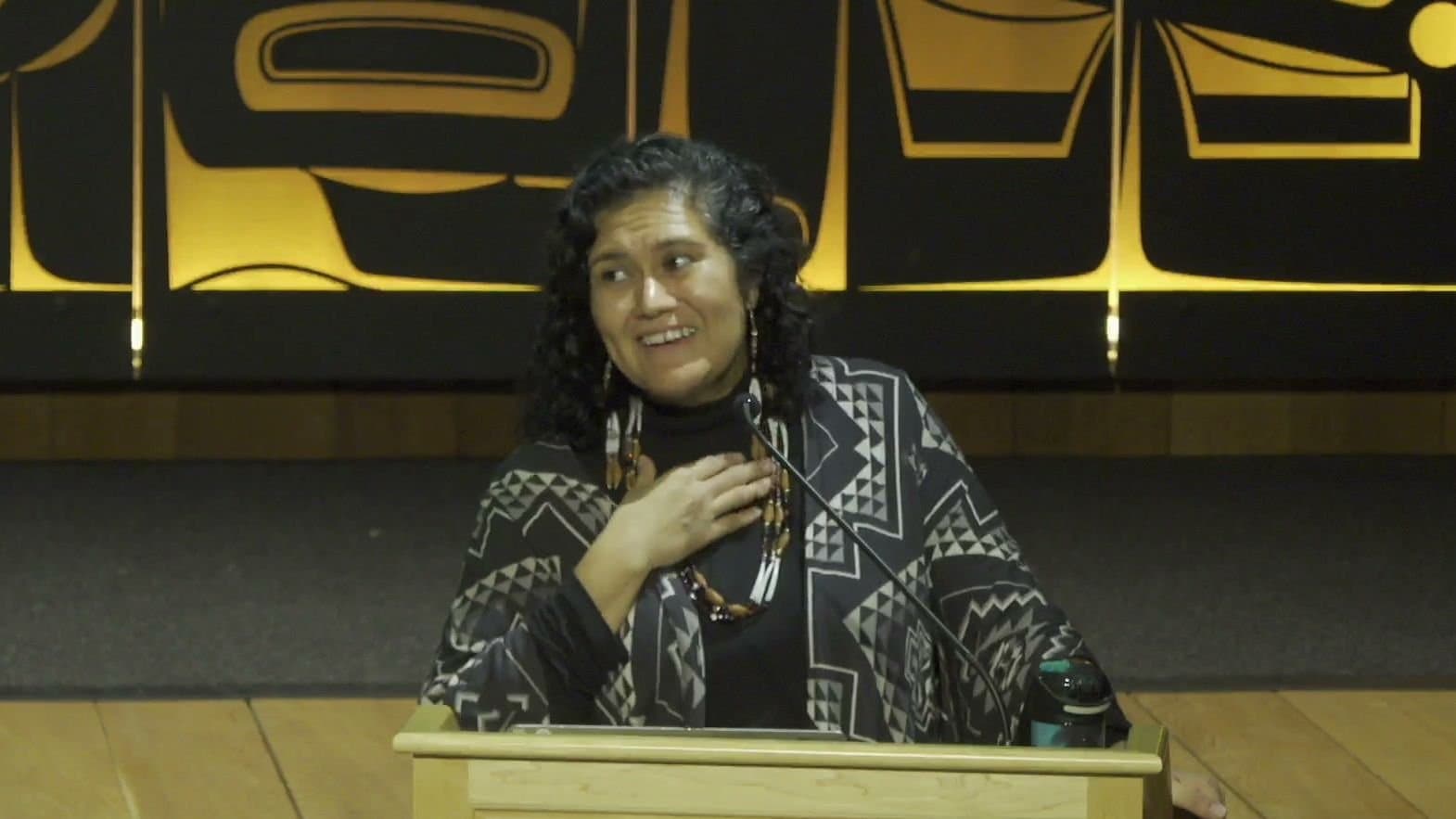
SHI's 2026 Native American Heritage Month lecture series. We also ask that you silence your cell phones and refrain from bringing food and drink into the space. It is my pleasure today to introduce Dr. Naadahee Wynder, a Duckwater Shoshone citizen and first descendant of Navajo, Pyramid Lake Paiute, and Southern Ute Nations. Dr. Wynder grew up on the Southern Ute Reservation and spent the summers visiting family in Duckwater and Pyramid Lake. She is a proud mother and an assistant professor in the Department of Indigenous Studies at Simon Fraser University.
Dr. Wynder was the 2020— 2015-2016 Henry Rowe Cloud Fellow at Yale University. She completed her PhD in sociology at the University of Western Ontario. Her dissertation is a comparative analysis of the residential school history of Canada and the United States based on the perspectives of indigenous university students using Photovoice. Her research interests are health and well-being, indigenous education, ethnic and race relations, community-based patriarchy— or sorry, community-based participatory research, indigenous research, and qualitative research. In her lecture today, Dr. Weinder will describe the process of rematriation of the Tlingit images in the George and Joanne MacDonald Collection from the Simon Fraser Bill Reid Centre to Sealaska Sandra Kowalski Heritage Institute.
She will then talk about the importance of relationships when conducting rematriation efforts. With that, please join me in welcoming Dr. Wynder to SHI.
Good afternoon. Dara, thank you so much for the warm welcome. I appreciate that. And I am just really Enjoying this, this, you know, being in this, you know, Tlingit house, clan house. It's this really good feeling.
Like, this is the first time that I'm here at SHI, and just to come in into this space just has such good energy and feeling, feeling around it. And it makes me feel good. It makes me feel that I have a lot of joy. But before I get started, I just want to say that I'm glad to be here on the unceded traditional territory of the Atawana Khan and Taya'ku Kwan of Juneau area, and also for SEA Alaska Heritage Institute working with Tlingit, Haida, and Tsimshian cultures. So I'm really excited, and I'm excited to talk about my talk, The Importance of Being a Good Relative Through the Rematriation of Tlingit images.
And what else could I add on to myself? Let me see, my mouse got away from me.
So who am I? I'm also a mother, so this is my little boy. He is 6 years old, he's in the first grade, and this is us. We were back at home in Ute territory. Southern Ute is in the south western corner of the state of Colorado, and we just finished this color run, and so he was just really excited.
We had a good time. And so when I think about being here and I think about being an indigenous researcher, Shoshone, Ute, Navajo, Paiute research, I think about what are we putting forward for like the next generation, and I think, and I wanted to bring my son into this picture just because I think about these images that I'm going to be talking about, the photographs that I'm going to share from the George and Joanne MacDonald Collection, is that many, you know, Tlingit youth may not have seen these images before, or they've seen them across different museums, but with this collection, they have it here at SHI. They have an opportunity to reconnect with their ancestors, family members, community, looking at the different carvings in this collection. And so when I think about my son too, like, this is also being away from him to come up here, but he knows that I'm here for a good reason and a purpose. He knows I'm an educator, and he's always talking about when does he get to go to take one.
He's like, "When do I get to take a class with you, Mama?" And I was like, "Well, you have to finish, you have to graduate first." So I have some images here. This picture On here where the mouse is, this is Duckwater Falls. So this is on the Duckwater Shoshone Reservation, which is present-day central Nevada, where I'm a citizen of. It's within Duckwater territory. It has the highest level of geothermic activity in the state.
So there's cold pools, and there's also hot pools. So I wanted to take a picture of that, just rooting me a little bit to home. This next picture right here is up by the San Juan La Plata Mountains in Ute territory, which I primarily grew up on. My dad is a Southern Ute tribal member, and I go home pretty frequently in the summers as well. And then this looks— this other picture on the bottom here is of Pyramid Lake.
This is on my Paiute side. So on my mother's side, I am Shoshone and Paiute, and on my father's side, I am Navajo and Ute, and I primarily grew up on the Southern Ute Reservation. I have gone back and forth to these three different communities. I primarily was fostered with a Ute-Shoshone identity. All three of these communities are very strong Sundance communities as well.
We have the same family language. I'm a trained sociologist, and I also have a bachelor's degree in Sociology with an emphasis in social welfare and Native American Studies with an emphasis on nation building and leadership from the University of New Mexico. And I'm excited to be here. And I've also am the former director of the Bill Reid Center at Simon Fraser University. So I just also wanted to acknowledge the traditional territory of where I currently work at Simon Fraser is also the unceded traditional territory of the Kwikwetlem, Musqueam, Tsleil-Waututh, and Squamish people as well.
This image here On the top, this was something that was done with Swallowtooth and Squamish community members led by Dr. Brian Miles, who was a former associate director of the Bill Reid Center, and Dr. Rudy Reimer, who was— he's Squamish, and he was also one of the Bill Reid Center directors as well. So they did a different naming here around the inlet here around SFU. Okay, so what is the Bill Reid Centre? So the Bill Reid Centre, it was created by George MacDonald, Dr. MacDonald, who is a really well-known anthropologist in Canada as well. He was also the president and CEO of the Canadian Museum of Civilization, now known as the Canadian Museum of History.
He was really known for his use of embracing different multimedia technologies, and he envisioned virtual museums long before it became popularized now. His interest was in looking at coastal First Peoples, lifelong— was one of his lifelong studies as well. He had different relationships with the Tsimshian and the Haida as well. He was also Bill Reid, he considered to be Bill Reid one of his friends, the Haida sculptors as well. So over his career, he collected a lot of records of visual and materials held in different galleries, and so this is what I'll talk more about, the Bill Reid collection and just the George MacDonald collection in just a moment.
But he went around the world taking pictures of pictures just to make sure that he had it. He had it preserved, and he wanted to make sure that community members had a space where if they couldn't go to these museums in person, that at least they could go to one centralized place, which would be the Bill Reid Center. So this was created in 2005, and it ran until 2025 is when it ended. And so the mission of the center was to support truth reconciliation through vibrant collaborative spaces and He really had this admiration for Bill Reid because at Bill Reid, at his gallery on Granville Island, it was a place that was, you know, lots of people were coming in and out, different Haida artists, First Nations community members, just a way to look at how Haida artwork, Haida art was being revitalized, the contemporary usage of that as well, and so there's just so so many people, so many things is happening in and out of his Granville Centre. And so George MacDonald is the one that he wanted to create that something, that same vibe, that same energy to be at this research centre which had, you know, hundreds of thousands of Coast Salish photographs as well.
No audio detected at 8:30
And so if you don't know who Bill Reid is, you know, he's a Haida artist as well, he's a reclaimed master goldsmith, carver, sculptor, writer, broadcaster, mentor, a community activist as well. And so what he really did is he started to explore his Haida roots at the age of 23. And so his discovery of relearning Haida carving is something that lasted over a lifetime as well. And so he has over 1,500 artworks over his lifetime. And so because he was his friend of George MacDonald.
He really wanted to, you know, again, as I said earlier, create this space where people would come. And so the center at SFU has done a lot of different things, like as I showed you in the previous picture with the Squamish and Tsleil-Waututh names, this is a mobile app that was created. I know different people have requested different images from the MacDonald collection as well. It's mostly of— he collected Coast Salish photographs from Washington, BC, Alaska, that's the majority, that's how this is collectioned, and so he, because of his relationships, because he was a director in his work, he had a lot of connections with different directors and different museums, you know, around North America and also within Canada, so he went in and he took these pictures again with the goal to create a space where people could come in under one house that they didn't have to go far and they could look at these images of their ancestors or some of the houses or some of the artwork as well. So that was his goal.
No audio detected at 10:30
But sadly, when the center closed in 2025, there was a decision made from myself, the steering committee of the Bill Reese Center, is that we were going to decommissioned the center and the images, the collection was going to be given to different areas. So the Haida took theirs, so all the images in the George MacDonald collection went to the Haida Gwaii Museum and the rest of the images went to the SFU Archaeology Museum. And what I also had noticed is that there was a collection of Tlingit villages in the collection. And for me, I knew that they were just— SFU is working on reconciliation, we have a small museum, but I just didn't want these images of Tlingit just to go into a closet and to not be looked at, so I had reached out to Dr. Maria Williams here Juneau, a professor at the University of Alaska Anchorage, and I bring her up because this is what I think about what it means to be a good relative. So Dr. Williams and I have a long-term relationship.
I also was one of her undergrads when I was at the University of New Mexico, and Dr. Williams was my favorite professor. So I emailed her and I asked her if she would be interested in taking these these images of the Tlingit villages. So there's over 20 villages in the McDonald collection. It has a variety of different photographs, different mixed media, copies of other images, there's negatives as well, and I asked if like the university would be interested in taking these images maybe to be taught at a class, and so You're probably thinking, what is this sociologist doing with these images and running this center? And so for me, you're right, I had no idea what I was doing, but I did not want these images just to be, you know, in a closet somewhere or on a shelf somewhere.
I knew that they needed to be brought back to life because there's so many things within the collection. I was thinking about myself, like, if I found out there was a collection that, you know, my community would like to have access to, like, it needs to return home, return home. And so I emailed her, I was like, I have no idea what area this is from. And so Dr. Williams, you know, I sent her, I worked with Dr. Miles as well, she got sent the link and she identified them that they were from Southeastern Alaska.
And so this became on this journey of how to bring this collection back here, and we reached out, Dr. Williams reached out to SHI and asked if they would be the permanent stewards of this collection, and so this talk is talking about what it means to be a good relative, and I think about as an educator in Indigenous studies, when we think about When we think about repatriation, what does that mean? We always think that it's like these, you know, the physical sacred belongings of our ancestors or our ancestors' remains, but when we think about the process of repatriation, we don't really think about images, right? We don't really think about photo— photographs, but this is also a process of rematriation or repatriation. And so I— for me, like, you know, just because like there's things that are digitized, but sometimes they don't have enough information of where the villages are, or who the photographer is, or very limited descriptive data, but this is a bigger— this is bigger, bigger, bigger than me.
And so these are some of the images here from the collection. And so I'm not a trained in— I don't have any training in museum studies. I don't have any training in archaeology or anthropology because I'm a sociologist. And as you heard earlier, my research is looking at how residential school or boarding school survivors' descendants, so their grandchildren or their children, talk about these colonial institutions, but how have they been empowered to maybe learn their language, maybe return back to dancing, how have they healed from these institutions, and how have they been empowered to embrace their indigenous identity. So that's where my work is looking at, is this healing and empowerment process.
But as many indigenous scholars at university, we wear different hats. And to support different communities in our roles, whether it's students that we serve, community members that come to the different events going on, on campus. And so when I think about being an Indigenous scholar and when I think about the importance of doing Indigenous research, we always talk about what does it mean to have relational accountability. And so when I think about relational accountability, it's not just to the local community, the host nations. It's not just to the indigenous students that we serve, but also community members.
And also, when we're thinking about, for, with this, with the George MacDonald Collection, is that I know the collection is known in Canada, but it's not really known in the United States, even here in Alaska. And so what does relational accountability mean? It means, for me, it means being a good Indigenous relative, as an Indigenous scholar, someone who really practices what it means to have relational accountability. And so when I was thinking about the center being closed and with these images, you know, I didn't have a good feeling that it was just, you know, going to be tucked away and maybe SFU would start the rematriation process of these images. But me being the director at the time of the Bill Reid Center, with the center sunsetting as well as that, I was thinking about, well, what is my responsibility, you know, to the Tlingit communities, to the overall Tlingit Nation to have these?
And, you know, because I knew Dr. Williams, that's how I reached out. So when I think about relational accountability and making sure that things are being done in a good way, So that's what I see as being a good relative and not just turning something away because you don't have time or you don't have access. It just means to— how do you create that connection and see what goes from there? So after that, you know, Dr. Williams brought on SHI. She brought on Dr. Judith Ramos onto the project.
And so now we're on this This is just the beginning stages of going through this collection, looking at some of the images, and yes, some of the images are held at different museums across, like for example, this image right here, a Tlingit woman in Sitka, as well the photographer Effie Forbes found in, this image was found in Glenbow, Alberta, Institute Calgary. So I'm not sure if a lot of people had had seen these images of these women, so when I was looking through this, Iris was like, "Well, who are these women? Like, what are they doing? Like, they look like they're smiling, they're having a good time, they're in this canoe." And going through here, I was thinking like, well, you know, their families probably would want to see this image and want to know what these women are doing, but like, there's not that much information within this this collection of, you know, even who their names were, but when we think about museums, like, you know, they were done in a time of just getting as much information as possible because they thought that indigenous peoples, that we were, you know, a vanishing and dying race, and they weren't always done in a good way, they were just done, you know, quick and fast, and so now we're in this period of decolonizing and creating a traditional labels for different images as well. Here's another image here as well.
The photographer is not identified, but it's Chief Snake's house in Regal, or— oh, oops, sorry about that. And it's credited to the George McDonald Collection. And so I'm over here, I feel, you know, excited to be here, I have a lot of joy to be here, I think about Haida Dr. Lucy Bell and her work of repatriation, of bringing the joy. And so I'm sitting up here looking at the joy of these pictures to bring it back, but I'm also a little bit nervous because, like, you know, I don't have any relationships besides Dr. Williams with any of the Tlingit communities. And so for me, you know, I knew that the collection had to come back, but at the same time, I was a little bit terrified, like, what if I get it wrong or Who am I going to meet with?
And I think there's that additional pressure. But, you know, going back to relational accountability, it's also you have to get over that fear and do what is right. Here is another image from the collection as well. And this is housed at the University of Washington Libraries as well. It just says Indian Village.
Near Juneau. And so again, you have, you know, some men out here, you have some children out here, a canoe. This is all the information that's on this, but, you know, the goal of this project is bringing it here to SHI and to see, you know, if people are interested in looking at this collection, browsing through this, and giving— breathing life back into these images as well, because these images You know, they also, they have individual stories that we need to unlock as well. They have a lot of energy, even with them, I feel that this is going along with George McDonald's vision of giving communities access to a collection, because not all community members have the time, not everyone has the financial ability to go to museums across across the country to look at these images. Depending on how these images are showed in the display, there might just be a couple and the rest are in the archives.
But I think that this is bringing it back to his idea of having community members able to access these images. And the best way to do that, it was to bring this collection back here to Alaska and reaching out to CHI to be the permanent stewards of this collection as well. And so this is another image from the collection as well, and so some of the collection in here, they have different images, have different metadata labels assigned to them as well, and for me, you know, just seeing like this, looking how beautiful this carving is of this woman, I learned today that this is actual, you know, of a funeral home, and I wouldn't have known that, like I wouldn't have known that going into this project. But, you know, this is at the Geological Survey of Canada.
No audio detected at 23:00
Here's another one of a Tlingit man doing a carving right here as well. Again, the photographer is not identified, or the location. And so it's just in here, but I just think of like, you know, the time and the effort to build these totem poles as well. Here is another image as well from the collection as well of a totem pole at the Field Museum in Chicago. So this is a picture of the totem, this is a duplicate copy of an image.
This next one as well. So let me talk about what it means to be a good relative again. So with this, there's, since there's over 10,000 images of this collection, some of the collection is digitized. There is a link at the libraries at SFU, and some of them are not. And so I'm working with the two classes that I'm teaching.
So I'm teaching on a class on Indigenous research methods. This is a first-year undergraduate course, and I'm also doing— teaching a class in Indigenous policy. This is an upper division in the Department of Indigenous Studies. And so I'm having my students going through the MacDonald Collection and looking at these images. And what I'm wanting them to do is that I'm wanting them to create new descriptive labels for these images.
And what I think is so powerful about this, and talking about, you know, the importance of relationship building. So Dr. Williams did come in and give a Zoom lecture to the students about Tlingit and Alaska Native history to give them more context of what they were working with, with the collection as well. That was recorded. And then Dr. Ramos came in and gave a lecture on ethics in terms of collections as well and some of the different projects here that took place in Alaska. So this way they would provide the students, you know, with the tools of when they're looking at the collection to look for the University of Simon Fraser, their library archivist did give a lecture to the students of talking about how to create metadata and looking at different things in the archive and just with different examples of how some of the postcards may have labels on it, some of them have the year, some of them don't, but how to create a meaning out of these images.
So with the students in my classes, they're, you know, being— I told them, and I truly believe it, it's a part of them doing history. They're part of this process of, you know, bringing the returning back of the Tlingit images collection here to Alaska. And so this one is from the McDonald Collection as well, and On here it just says, "Question: Juneau, Alaska?" So I'm not sure if anyone recognizes this picture, but you have the different houses along the river as well. This is also from the Glenbow Alberta Institute in Calgary. And so what the students are doing is that they're taking this older version of this label, reading it, and then they're also creating more descriptions of it, and they're also asking questions.
Some of the students with the collection, they're asking like, who should have access to this? Who should be looking at this? They're also looking at how the collection was stored, their initial feelings on this. Also talking about, they're trying to do some other research as well, if they can find this image in different areas or looking at the area. They might be, they're adding more, like this is like houses along the river.
There's, you know, how many? 1, 2, 3, 4, 5, 6, 7, 8, 9, 10, 11, 12, 13 Houses. So they're creating more data like that. So then that way, at least there's more descriptions on there to help others. So this is a way that, you know, I'm teaching and practicing relational accountability.
And so along with this process, like this is being led, and I'm saying it's a process of rematriation. And so, let me turn back to this other slide. But when I think about rematriation, so rematriation was first coined by the late Stolo scholar writer Lee Maracle, where she talks about it being indigenous feminist concept as an aim to restore matriarchal authority over the restoration of male responsibilities. To these matriarchal structures to reinstate respect, support for women within them. And I know she writes in the context of looking at healing in terms of violence that has been done against women.
But most likely, what she goes on to a little bit further, and this is also coming out in Dr. Gray's work as well, is that rematriation is grounded in indigenous law, means of any movement to Recover and discern ancestors or stolen, misappropriated, or commodified belongings from state subjects and institutions must go beyond repatriation to achieve true repatriation and redress. And so thinking about these images, so if we're thinking about rematriation of these images, like I think about because it is rooted in an indigenous feminist paradigm, the practice of recovery and return, The social-political mode and resurgence of refusal. I think about, you know, this whole process of returning these images from the McDonald Collection back to CHI is being led by, you know, 3 Indigenous women, 2 Tlingit scholars, who I see as advisors in this process to bring this back. So what we're really engaging upon is these 6 different principles of Indigenous research. You know, this is from Kurtis and Branhart.
No audio detected at 29:00
Kurtis is a Cree scholar. Sean Wilson is also Cree. Well, I guess they're all Cree scholars at COVADH now that I'm thinking about it. Respect, revenance, reciprocity, responsibility, relationship, and relational accountability and relationality of this wouldn't have been done if it wasn't for the connections that I had with Dr. Williams to bring this. And so this is just the start of— this is just the start.
If we're looking at the base of a mountain and you're gonna climb it, this is just the start of it, of thinking like, well, how are we going to climb up this mountain as a team? And how are we going to look at, you know, the wisdom of our elders, traditional knowledge, to get us to the top? And so that's what I think about when I think about these Tlingit images, is that Everything that's in this collection is, you know, stories, people who are going to revitalize those different stories, bring life into them. They might see one of their relatives in these images and they were like, "Oh, I didn't even know, you know, he took a picture or she took a picture." There's images of— I didn't feel— I know that there was a couple people, pictures of children, but there's other just self-portraits of children. I didn't feel comfortable showing that being live streams just 'cause these children are probably grown up now and they might even not remember or recall that their picture was taken by a photographer, but what are their thoughts now thinking back?
And it could be also thinking about the relationship that they've had with different researchers as well within their community. And so with this whole process, this is something that's new, this is a new journey that I'm on. Where I'm learning as I go along the way. But for me, like, it was very important for me to return this collection back here to Southeastern Alaska, and I'm really thankful that SHI has, you know, made a commitment to be the permanent stewards of this collection. I brought some of the collection here today with me.
The other half is at SFU that my students are currently working through, and there's so many different aspects of this process that still need to unravel. And so what my talk today was just to show that these— this collection is being brought back home, and that this process is something— when I think about rematriation, it's also a process of of healing, bringing back joy, bringing back, you know, health and wellness to communities as well. Because when we're looking at these images, you know, from people from communities, the Tlingit community, even myself looking at these, I, you know, I have such, you know, I'm thankful that there were pictures that were taken even though they were pictures of pictures to create this collection, some of them are original pictures as well, but for it to be brought back with the intention for community members to have access, for also other researchers who might be researching Tlingit as well can have access to this as well. So this is, I feel like this process is bigger than me, and this is just a small role that I had in a relational accountability. So I can open— do you guys take questions on these?
Do people take questions online too? Is that how this works? Oh, okay, sorry.
If there are questions, I'll just pass around the mic.
So I was just wondering if you could give everyone an idea of the scope and size of the collection in that you know, the process that we're working with SHI to bring scholars together and community people and different organizations. Yeah, so thank you. Yeah, so I could do that. So first, I just want to say that I'm at the start of my relationship with SHI as someone that's new. And when I think about doing indigenous research or community-based research, it's also about who you bring into the project.
No audio detected at 34:30
So I had brought in Dr. Mariria Williams, Dr. Ramos onto this project, and so it was their connections with CHI that led me here to bring the collection. So this project of returning And bringing home the Tlingit collection is something that's going to take, I feel like, you know, at least 2 years or more because there are tens of thousands of images. And I have one of my student research assistants is scanning these images, so then we also have a digital archive of it as well that could be available. There is an archive at SFU, but it's not complete in its entirety. And so when I think about this, you know, I really take to heart is the importance of relationships, and I think of that, you know, I can't— couldn't just say like, oh, here's these images, thank you for being willing to steward this collection, and adiós, that's me being a helicopter researcher.
And so with the scope of this, this is there, it's creating new metadata, it's reaching out to community, creating those relationships of making community members aware that this collection is now at CHI, getting people excited about the collection, what's in them, eager to talk about the stories. And so this is, this is— a whole— I really feel like this process of returning the collection here to CHI is like, we're starting off like bringing the team together. I had a conversation with the archivist from here this morning, and then the two Tlingit scholars on here, I feel— I'm laughing to myself, I'm trying to find the right words, but it's probably going to come out dumb, but I feel like We're in the process of giving birth to this collection, so it's a way of like, we came together, we know that we're going to be having a baby in like 9 months, but it's creating a relationship and how to get people aware that this collection was repatriated or rematriated to the center, so I feel like we're on this You know, we're watching to see how it's going to grow, and there's so many different ways of how we can see this project gets bigger and works exciting. And, you know, we're working on— going to be on a grant for this, but there's so many different, different layers. But that's what I feel like.
I feel like we're— we came together, we decided, like, it's we decided to make a baby together of returning this collection, and now we're moving forward. Hope that answers your question.
Thank you so much for your talk, and I think we overlapped at New Mexico, but I was in the anthropology department. So I'm not sure we saw each other. Oh,. I was at UNM at the same time. I'm wondering if anyone's looked to see if these photos exist elsewhere, because that image you showed of the people in front of the house, the white building with the canoe in front of it, that's in the State Archives in the Winter and Brown collection, as are several of the photos you've shown.
Yes. OK, so there's overlap. There is overlap with these. But with George McDonald, what he wanted to do is he just wanted to create a big old massive repository of images, you know, Tlingit, Coast Salish, and put them all in one place. He didn't want people to be, you know, going to Washington, D.C. or Chicago.
Or Calgary. Yes. To the Glenbow, because they have an amazing collection. I love that it's in there too. Yes.
That's great. And so it was because, you know, his connections that gave him access to these and the way they trusted him, like, okay, well, this is a great idea. And now, you know, even though the center's closed, and he wanted that to be the hub, now I feel like because, you know, there is more indigenous-led pushes in rematriation processes, like, okay, that was a great idea, but now, like, we have our own system of how to do it, and we have to look to the direction of the community, in this case, you know, the Tlingit community, of what do they want to do with these images, how do they see it, how do they want to give life, I don't know, and also because some of the photographs have photographers, some of them we can give credit to the photographer.
No audio detected at 39:30
It is like a hodgepodge of a blanket that everyone's weaving together, but we also have to say we have to give credit to others, but how are we going to make this new? And there's so many different things. Is it we're taking a picture of a picture, continuing his legacy of doing this and creating something new or creating short stories around it. Like, there's so many different atmospheres, so it's not like this collection is unique, but it's unique in its way of the intention of bringing people together, but now it's here, and this is like, it's here, so in a sense, his vision of having it housed in one area is still the same, but it's housed within the community. If that makes sense.
Great, thank you.
So maybe you answered this, but if photographs aren't labeled or there's no. Credit given, can they still be shown or released?
Or would they just be like in a separate—. So for educational purposes, I mean, you can't make money off of these images or this collection because that's commercial, because you have to give credit to the photographer for doing that, and then there's the copyright issues as well.
So like that, I feel like the intention of this collection was good, but I think back then there wasn't that many stringent laws, which complicates our process to this day. Thank you. Can you say, are those on a website now? Some of them are on a website at the SFU Libraries, but it's not managed, but it's on there. Are you taking some old pictures like that we might have in our— yeah, like I've got old pictures I'd love to donate.
Are they taking any? I feel like that's a CHI question, not for me. Okay. Yeah, I've got some really old ones, like of great-greats, and thank you.
Um, but, but with that, like, I'd be happy to chat, like, to chat with you. And, um, I know, um, Dr. Williams and Dr. Ramos and I, like, we're— because we're, you know, creating something new, like, I don't want to speak for them, but like, I think talking with you would help us as well with the direction.
Any other questions in the room? Online?
I don't have a question, but I just want to say, first of all, Dr. Windert, welcome to Hlinka Ani, and Gunaschiiš for taking the initiative to seek out a proper home for this collection. 10,000 Images would be as if, you know, we had an ancestor taking one photo every year for as long as we've been here. I do know that, you know, just having the opportunity to glance through some of the images that you brought with here today, it will certainly add to the opportunities for our artists who come here to study some of the old pieces You know, for clan members that are doing research or looking for crests or previous clan members, ancestors. A lot of the images of the communities and clan houses absolutely will have, you know, value for our community, historic value for a lot of our community members. And then Also, SHI is engaged in multiple levels of educational programming.
One includes photography, and I know we were discussing this could be also a pretty neat opportunity for those middle schoolers and high schoolers who are learning photography and learning creative expression to perhaps incorporate, you know, this collection into the work they do. And then of course, lastly, I look forward to, you know, us building a relationship with Simon Fraser, our relatives across the border, you know, also the opportunity with expanding with the University of Alaska Southeast. And as I mentioned, we have a very robust internship program and scholars who come here.
Thank you for bringing this to us. Koonchiiishh.
Taweyak. I think that was an excellent closing, unless there are any last-minute questions. Okay. Well, thank you, Dr. Winder. This has been excellent.
Thank you for having me.
No audio detected at 46:00