Kodiak: November 4, 2026, Work Session
Alaska News • • 75 min
Articles from this transcript
Kodiak council members tell staff to pursue plan raising city pay to market average
Kodiak council told staff to move ahead on raising city pay to market average, costing about $303,000 in year one.

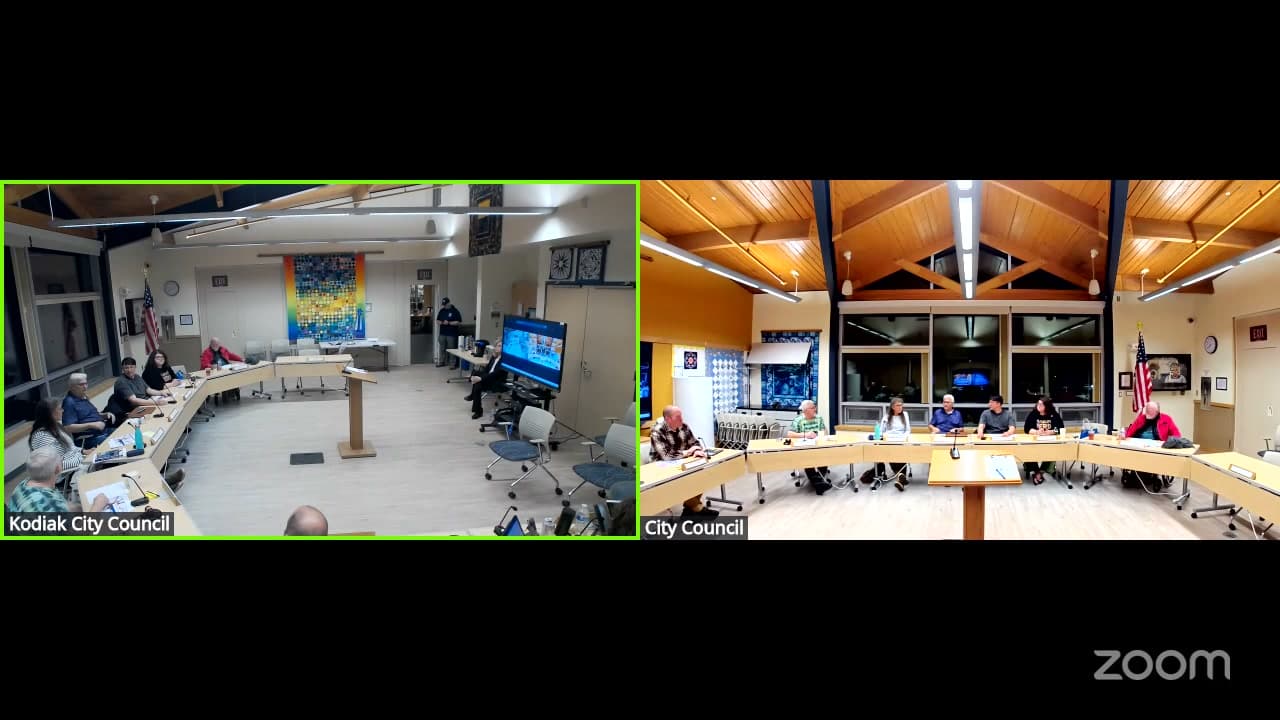
The November 4th, 2026 work session will now come to order. This work session is open to the public. For those who are listening, meeting agendas and packets are available online on the City of Kodiak's website. Public members are encouraged to web stream from the city's website portal. Audience and council members, please silence your phones, and council members, please put your phones away for the duration of the meeting.
The first item on the agenda is public comments, which will be limited to 3 minutes each. If there is anyone who wishes to address the council as a whole, Please approach the podium or call in at 907-486-8610. And please note that this is the only opportunity to comment during this work session. Due to the slight delay in broadcasting, I will be pausing a moment to allow some time for public members to call in.
And hearing none, the next item on the agenda is a presentation of the classification and compensation study final report with McGrath Home Human Services Group. And I'll turn it over to Interim City Manager Tim Putney to introduce Melania Halverson. Thank you, Mr. Mayor. City contracted with McGrath Human Resources Group to conduct a comprehensive classification compensation study to evaluate evaluate the city's existing pay structure, job classifications, and compensation practices. We have Malena Halverson here tonight from McGrath to give a presentation.
Good evening to the mayor and to the council. My name is Malena Halverson-Mays. I am a senior consultant with McGrath Human Resources Group. Can you hear me okay? Sometimes.
Okay, very good. I, first of all, I want to thank you for the opportunity to come visit Kodiak Station, and I always look forward to coming into the communities that I do compensation studies. I think that there is a much better connection that we can have when we get to experience the community and we get to see everything. And it's been a real pleasure working with your city administration and all of your employees over the last several months. I met with your employees this morning, and I have prepared a slide deck.
That slide deck is going to walk through the 38-page final report that you have. So your employees, they heard all of this information. I used the exact same slide deck for you that I used with them. And I will say that we had a good spirited conversation and that is, that's all part of this process. When we are looking at compensation as your consultants, we are looking at it from maybe a little bit of a different lens or a different perspective perhaps than your employees might.
And so that's, you know, just absolutely part of the process. Just please know that there may be some deviating viewpoints on, on parts of our, on parts of our study. And there are going to be a couple of areas that I'm going to point out here for you this evening. So with that, let me just go ahead and get started. When I want to just kind of show, maybe frame a couple of major topics here, because my goal here this evening is to not only walk through the project and what my recommendations are for, for the city, but there are also some big policy items that as elected officials that your administration team is going to be working with you over the course of the next couple of months and determining what, you know, where you want to go as, as an organization.
So let's get a little bit of foundational information, and if you have any questions along the way, I'm absolutely open to talking about them. I want to make sure that you have the information that you need in order to have the, the conversations necessary after, after tonight. So let's first talk about classification and compensation and really what, what this project is. And we break it down into, into two very different elements. The first part is your compensation.
What we did was we developed a compensation system. The compensation system identifies what the market range from minimum to maximum, or what the value, the financial value for your positions are going to be. That is going to be driven or steered by what we call a compensation philosophy, and that compensation philosophy I'm going to be speaking with you about here this evening. We then overlay what we call classification, and that is your job titles. Okay, so the job titles are, or those, the positions with the city, they are based upon what their duties and responsibilities are, what the education and experience and other qualifiers that may be.
So we're looking at, we're looking at developing really structured objective systems in which to compensate your employees so that they are aligned with the market. We, when we are studying this, we're not necessarily looking at your individual employees, okay? And this is sometimes can be very personal for your employees because compensation, it is very personal. But as we're building the system, we're looking at it from a, a greater, a greater perspective, a, a kind of a bigger picture lens. You can, sure, if that's okay.
Is that okay? Yes. Okay,. Thank you. So I just want— I think I know, but I'm not real sure because I don't do this all the time.
Okay. When you say the minimum midpoint, that is that minimum being start— starting new, starting in a particular classification, the minimum market, and then you talk about midpoint, maximum. Can you just explain those to make sure I understand what you mean when you say market minimum, midpoint, and maximum? Sure. So what we, well, depending on, on what part of the report you're looking at, when we study the market, okay, when we study the market, We are studying very specific data points that we collected from your comparable organization.
So when we talk about the minimum, we're talking about what that— what the lowest rate of pay that the organization is willing or will— has published in terms of that, of the rate of pay for a specific position. In the market? In the market. And they're in— yes, in the market. And so we look at those data points.
We're looking at the beginning, We're looking at that middle point and then we're looking at the top. We're looking at the top end of it. Okay,. Thank you. All right, now, so we have classification and compensation, and then we're going to overlay really what it becomes more policy items for the elected officials.
And that is going to be number one, your compensation philosophy, and number two, your compensation strategy. Your compensation philosophy is as an organization where you want to position yourselves against the comparable market. We're going to talk about what the comparable market or who your comparable market was here in just a moment, but this really becomes the very first policy item for you because organizations— that's how you determine how aggressive or assertive you, you want to be or you need to be in order to be able to retain your personnel and re-recruit them when you lose them. And it really helps your administration know— I call it the big blue arrow— what's the direction that the city wishes to go with this. And if so, if you establish— we're just going to use, for example, average compensation or an average compensation philosophy— then your administration knows that, that all future compensation recommendations are going to be based upon that philosophy.
And the question really then is answered for you. The structure or the, the strategy really ends up being the structure and the policies that you that you incorporate to carry out the compensation philosophy. So for example, you have a step model and we have other models that are available, but we created a step model for you. So those types of items really are that which I created for you within the system. Now what we'll be looking for from the council is guidance on within that structure, where do we want to establish your compensation philosophy?
And this is, you know, there's a lot of conversation to be had with this. You are in a very unique position. You're in a really unique area because you are Kodiak, Alaska. You are on an island right off the mainland. You have a higher cost of living.
We heard about that from the employees this morning. But you have some other, you know, very unique nuances, and I listed just a couple up on the screen. The first one is your location. You are in An island, you have to either take a boat or you have to take an airplane to get here. And if you don't have the human capital on the island, those individuals who are qualified to hold the positions, are you open as an organization to bringing people from outside the community in?
And, and this is very much an individual decision whether or not you want to do that. And if you want to do that, then we need to make sure that your compensation is aligned appropriately according to what's happening on the lower 48, per se. All right, we have to make sure that you are aligning with Oregon and Washington and some of those other western states so that people are feeling like, yeah, I want to go north and I want to experience Kodiak, Alaska. So that is number one. But we also know just by looking at, you know, some of the some of the other topics that you as a community have had in recent history.
You've been taking a look at the training gaps that you might have with the human capital, with the potential applicants that you have on the island, and spending time building and then also marketing those career opportunities that you might have. If you're going to grow from within your community, What are you going to put in place to make sure that individuals can gain a very specific skill set in order to be able to do the jobs that you're asking of them? The jobs that are, that are part of municipal government are not necessarily always entry level where you can come in without experience. You have licensing and certifications that are required. You have ongoing training that is required.
You have specific degrees that might be required, and what are you— are you helping support that for your candidates and for your employees? Your economy is also very, very specific, and sometimes, you know, that can cause you some challenges because that is also who you're competing with. And some of the skills that you are hiring as an employer may be, you know, very transferable to that other industry. In other cases, maybe not. But then what you have are applicants and employees who are making decisions.
Do I want to work for the City of Kodiak, or do I want to go do XYZ? And so that is always going to be conflicting. And so we, you know, really for us, we want to make sure that, that we are positioning you competitively enough where you can draw in the same human capital because you're all fighting for the same people. We know that you also have other, other considerations. Just two of them that I threw on the screen because they end up being, you know, sometimes the top two is affordable housing.
It's expensive to live on the island. Childcare sometimes is viewed as a barrier to employment for individuals as well. And so you've got, just like I said, you've got a whole lot of unique challenges that you are facing when you talk about— when you're talking about compensation for your employees. So with that, then let's talk for a minute about your actual employees, okay? Just to understand what your— the profile of your employee base looks like.
And this is all in the final report. I hope that you've had an opportunity to take a look at it, but if you haven't, these graphs and charts are available. So what we did was we plotted all of your employees and we plotted them by age and also by the years of service that they have, that they have given to the city. And this is really kind of interesting. Your average tenure here at the city is 5.4 years, and nationally public sector tenure is also 5.4 years.
5.4 Years. And so right now you are right at the average. We can, we can tell you that on a national level that tenure has been dropping for the past decade. And so right now you are absolutely neck, neck and neck. Now there's a little bit more information that I'm gonna provide to you, things that I want you to be aware of that, you know, almost might be concerning about the, the employee demographics.
But the, this is important for, for for— I'll get to, I'll get to why this is really important in the next slide. So when you look at the demographic profile of your employees, 23% of, of your folks, they are age 55 and over, which means in the course of the next decade they're going to decide to retire and go do something else with the rest of their life. What that means then is that you've got about 1 in 4 of those employees that you have here today are probably not going to be here and you're going to want to or need to backfill those positions. You're going to need to make sure that you have competitive compensation in order to be able to do that. I do have a little bit of worry about your turnover rates.
We're going to talk about that here because, and this actually came up in the meetings this morning with your employees, you have a high amount of turnover. You're not keeping your employees very long. So what you're doing is you are investing in them. You're training them and then they're leaving. And what that means then is as an organization, as a city, you're letting those resources walk out the door when you're letting your employees walk out the door.
The other part of the demographics though is what's happening on the left-hand side of, of those graphs, and that is going to be the age profile of people who are under the age of 40. Now this is a very mobile part of, of the workforce, and they are not necessarily dedicated to the organization like maybe a person who's been there for 15, 20 years is. And so they are a little bit more willing to leave for, you know, if it's only 50 cents an hour, they're going to go leave for that 50 cents an hour. Almost half of your employees are in that category at this point. And what that means for you then is, is not only do you need to worry about the re-recruitment, but you really do need to worry about the retention because those folks are the ones that are going to very, very quickly decide that they're going to leave.
Yes,. Through the chair, please. Sorry.
Oh, Council Member Calderón. Yes, can I comment? Can I make a question? Yes,. Go ahead.
Thank you. Yeah, when he calls your name, then you can. Oh, copy. Okay, thank you. Um, the, uh, the data that you're showing us right now, um, when was that?
Is that like recent data that you just— or was this somewhere, something that you've done be— like something that you studied before? Um, how recent is this data? So, um, when we started the project, do we remember? It would have been this spring when we would have gotten that report. So yeah, it would have been— it would have been within the past 6 months.
Copy. Thank you. Council Member Charles Davidson. I have consistent theme about that you discuss with these employees that why they might walk out the door usually, because having joined the process for quite some time, we've trained a lot of people, and as soon as they get trained on TSA, they walk out the door because we can't offer them, you know, what is a fair compensation here. So what, what was the major concern that you've learned from our employees now as to why they always want to leave?
I, I understand probably cost of living here. We didn't actually survey the employees with that information. I would say that that question would be better posed towards your HR department to see if they've done stay interviews or if they are doing exit interviews. What is that continuous feedback that they're receiving to see if there is a, you know, is there a pattern? Yeah, I don't know the answer to that question.
Okay, here's where things get interesting when we're talking about your employees and what we— that what we did then was we took the same, the same number of employees, the same demo, and this is all of your full-time and part-time. No, no seasonals or anything were included in this. And interestingly enough, 49% of your employees have less than 2 years with the city. Okay, that means that you have had a tremendous turnover rate. Less than 1 in 5 have, have 10 years or greater.
Okay, so that in and of itself tells you that people are walking out the door and all of the training that you've put into them all the time and the resources are walking out the door with you. So you have a high concentration of new employees and you really do need to be thoughtful of, you know, from the perspective of are we worried about recruitment or are we worrying about retention? In your situation, we're worrying about both. Okay, and then the second graph is the years in position. So the— your employees, because they might move into other positions, they might be promoted, and that's a wonderful thing.
You have 3/4 of your employees that are in new positions, you know, and we're talking about less than 2 years. So you have a very inexperienced organization as well, which means as a city, you are going to want to think about your succession planning. How what can we be committing into, you know, putting into professional development dollars for our employees so that we can grow and develop them? So that is a, you know, a bigger picture conversation that you can be having with your administration in the future. So then, so we talk about the major components of a comp and class study.
We talk about your demographics, and then before we get into your study, the last big item here to talk about, just bigger picture, is your compensation philosophy. And again, that becomes The, the big policy question for you of where do you want to— where, where do you feel that you need to position yourselves against the comparable market? And organizations have really 3 different options. You can position yourself average to the market, and what that means then is that if within all of your comparators you're going to be right around the middle, it does not mean that you're going to be the highest paid. And I told that to the employees this morning that the goal of this project was not to make sure that Kodiak is the highest paid.
Now, if that is the direction that the council wishes to take, then you'll have to talk with your administration about that and we'll help support you in that. But that was not how we, how we derived our recommendations. An organization can say that you want to be above the average, more, more aggressive in the market, and for an example would be the 60th percentile. And when we say the 60th percentile, what that means is that we're trying to position you at or higher than 60% of the other comparable organizations. That still means you've got a couple out there that are going to pay more than you.
And then you do have the— you know, it's on the table to lag the market. If you lag the market, you will continue to have the turnover. You will continue to be paying out dollars, you know, in some of those costs. And that certainly is not recommended. So when we put together the recommendations, we started this conversation either at the 50th percentile or the 60th percentile, and my recommendations are built on the average.
Okay, and so that is your starting point. If you would like to see things a little bit more aggressively, let's say the 60th percentile, that information— we do have some of that information available, not here tonight for the meeting, but it was something that explored with your city administration. Um, I, I do think that probably our first hurdle is going to be the cost that's going to be associated with the average, and then more of a long-term plan to get you a little bit more aggressive in the market at that, um, something above the 50th percentile. All right, so now let's talk about, uh, specifically the project, um, for the city of Kodiak. Uh, what we first do when we do projects is, uh, we meet with your administration and we meet with all of your departments.
We gain an understanding of your operations at a real high level. We do that because when we go out to the market, we want to make sure that we are studying the correct positions. For example, sometimes public works all look a little bit different in every community, and we want to make sure that we understand what those operators are doing, just as one example. And so we met with all of the departments, we talked about each of the positions, we collected job descriptions, your your current compensation policies, your current compensation structure, so that we could really start analyzing it. We also then asked for your employees to complete what's called a position questionnaire, and this gives us a little bit more information about what their position responsibilities are, and that helps us run analysis.
It's also going to help us build job descriptions when we're done, when we're done with this project. That'll be the next step that we take. Then we go out to the market, we collect multiple different data points, much to Councilmember West's question earlier, and we collect the minimum, the midpoint, and the maximum so that we can understand really what the, what the totality of the market is doing because it's 3 different data points. We're going to talk a little bit more about really what our findings are, and from all of that, that was how we were able to build our recommendations. When I built my recommendations, I first met with your administration team, and then I met with each of your department directors, and they— I introduced to them what my recommendations are to give them an opportunity to give me some feedback.
If they disagreed with me, they told me, and if we needed to talk through something, we did. I feel, you know, that's part of our quality control check process. You know, some, you know, certainly we can misinterpret something off of a position questionnaire, and so we like to have just that extra double check before we are in front of the elected officials. You will see in your, in the body of your report, a list of comparable organizations, and you've got a pretty large list. List.
What we do when we meet with all of your departments is at the beginning of the project, it was— we asked them who they felt the comparable market for Kodiak was. And so we built that list collectively with the department directors, and then we finalized that list with our recommendations, gave it over to the city, and let the city approve that. So the majority of the comparable organizations are public, and they are on We also did include the state, and we, we did collect information from the Coast Guard because they are, you know, on the island and they are a competitor. But then we went a little bit further south as well. We wanted to know what in the world is going on in the lower 48 so that we can understand what some of those influences might, might be.
So pretty, pretty comprehensive review of, of the market. And when we do that, then we collect data for all of your positions, or as many as many positions as possible. And then each of your positions ends up having its own data set where we take a look at for each of your positions, the minimum, the midpoint, and the maximum to understand what the market is paying for each of those positions compared to the city of Kodiak. And then what we do is we put that into what's called a comp ratio. It's a comparison ratio between Kodiak to the rest of, to the rest of that, that data set.
And when we, when we do that, it helps you visually be able to see the health of your current structure right now and overall what our findings are. Now, in the PowerPoint presentation, I abbreviated this. You're going to see some charts in the final report. And what I'm going to just tell you really quickly about the charts in the final report is if you're— the comp ratio is too far under the market, It's in orange. That's not a good number.
If it is in white, it means that it's very, very close to the market. It's within about 5% of the market, but we want those numbers to be in blue. Those numbers that are in blue mean they are absolutely aligned to the average market. And this is what we found. The vast majority of your positions is under market.
Okay, not probably surprising. And this might be because you have not been able to or have not applied economic economic cost of living to the current ranges, or they just haven't been studied over the course of, of, of a few years. So what we're finding is that the majority of the positions really do need to be moved. And again, this is against the average. If the city determines that it wants to take a more aggressive approach, then we're going to have a little bit more ground to cover financially to get those ranges up to the 60th percentile.
So the other thing that we do, not only do we study the market, but we also take a look at the current structure that you have, because the big question always ends up being, is the structure working for you, or do we need to make some changes? Because if it's not broke, let's, you know, then there's nothing to fix. But we did indeed find that the structure that you have right now probably isn't really working for you in the, in the current environment, um, the current work environment that you have. So right now you have a 15-step model, and the percentage of, of step that your employees receive it starts at 2.5% and then it reduces down to 2%. And what happens here is that there are almost— there's too many steps.
And by the time your employee gets to their market point, too much time has passed. They get frustrated and out the door that they go. So they need to be able to see the progression a little bit better to get them to what I call the sweet spot in the market, because the The, the faster you can get them to that spot in the market, the more they are going to, you know, you're gonna hold on to them a little bit longer. Okay? So you have, you have 30 pay grades, probably a few too many for the size of the organization that you are, and you had so many pay grades that there wasn't enough separation between them.
And so we call that compression. Just simply not enough separation. And so, you know, what we developed for you was fewer pay grades with a better separation between them so that if you do have some leveling, a Level 1 to a Level 2 to a Level 3, it becomes more meaningful for the employee to want to gain that extra certification or experience to get them up into the next level. So overall, what did we recommend? The first thing that we did Number 1, step system continues, right?
So like that structure, strategically, we're going to keep the structure. It's just that we're changing the structure. You have fewer steps, and that actually was asked of us today of, you know, why did you give us fewer steps? Well, the reality is, is that your overall, you know, your folks are staying about 5.5 years, right? And so with a 10-step model, You know, we are, we're hoping that we're still going to be able to, we're going to beat that number.
We're going to grow that number and, and we've got an opportunity at the maximums end of for your employees because just because they might be maxing out does not mean that they're going to be stagnant with their dollars. It really was more important for us to really be focusing on the percentage of step that we wanted to give the employees, especially on what I call the left-hand side of the model, which is really where the employees are gonna, are gonna be progressing quickly to try to get to the market point. So the market point, the true market point is in Step D, which is the 4th step, and each of those steps are 3.5%. So we want their progression to be pretty fast, and then they will keep getting the 3.5% thereafter up until you get the 7 the, the 10 steps. Now, there is a 7% separation between pay grades.
What this means is, and what we've done is we've changed things around a little bit. Every pay grade has a tag, it's got a label, and it's a number. So it might be 5, 10, 15, 20, 25. So when I say that there's a 7% separation, it means that there's a 7% separation between pay grade 40 to 45 as an example, or 45 to 50. $50,000.
The step is the ABCDEFG from left to right where the employee progresses through that, you know, during their annual evaluation process. Okay. Yeah. Council Member West. All right.
I came from a military pay scale. Excellent.
So I just want to clarify. Yes. The steps are within the pay grade. Yes. It just sometimes when you're talking, it's like, wait a minute.
So the steps are within the pay grade,. Correct? And then the 7%, is that from, you know, I'm just going to throw it out there. E— no, GS. Yeah.
Like, like G-7 to G-8. Yeah. 7%. So GS-7 step 10. And then they go, oh, you've done a real good job.
You got all your training. We really like you. We're going to give you now GS-8. So from GS-7 step 10 to GS-8 step 1, is that our 7— where? GS-7 step 10 to GS-8 step 10, 7%.
Why does it go 10 to 10? Well, that because it's 7% separation from each pay grade in totality. It doesn't matter if you're looking at between step 1 to 1, 2 to 2, 3 to 3, it's 7— it says it's 7% separation.
Can I ask more questions? Yeah. Okay. That's not how we move though. And then, right.
So I, from like 70 to 75 is 7%. If you look at the, if you look at that side. I agree. Yeah. Yeah.
So,. But I would assume, and I make an ass of myself often, but if you're GS-7, Step 10. All right. You know, it took you a little while. You weren't catching on.
Finally you caught on. They're going to move you to GS-8. Do you not go to Step 1? Not necessarily, no. So,.
Oh, okay. You would stay at 10 unless you got promoted. No, you got promoted. Let's say you, you were GS-7, Step 10, and then you got promoted. To 8.
Okay, to the chair. Go ahead.
That would be, that would be the PR&R, that would be our personnel rules and regulations would kind of would dictate how that works on how much of an increase you could receive if you got promoted. Would you automatically go to that grade or would you, would there be a percentage? Cap and how far up you can move into the next one. That's how it is right now.
So your PR&R has specific compensation policy in it that talks about how to bring in a new hire, how to promote, how to transfer, how to demote. And so your— the individual right now, the recommendation is very close to what your PRNR currently reads. So on page 21, we have recommendations, and so the individual who goes to a higher pay grade is going to be placed at the same step held in the previous position or the first step that provides at least a 15% increase, whichever is us. Thank you. If that's okay.
Happened, happened. Jun Davidson, clarify anything you say in the report with page 39 of our packet. The step A, is that where we're at now for entry-level positions, or is that above where we're at now for entry-level? Um, so you're talking about page 39. Yeah,.
Sure. So on page 39, and so let's talk about the recommendations. What we've done is we have your general pay grades and then we took your fire pay grades and we've separated them. Okay. So, and we're gonna talk about that one specifically because what you are looking at on page 39 is the fire grades.
The fire grades annualized are exactly the same as the general, but what you're seeing different is the annual divisor differs because general employees are on 2080 and the fire employees are a different number from their 7K exemption. That's why it looks a little bit different than what you're used to. And we'll, we'll talk about that some more.
I don't have page number. Okay. It's still helping. Okay. Or it actually page 37.
Oh, 21. Thank you. No, it's actually page 37, uh, append— the beginning of Appendix A. Yeah, that's not what I'm talking about. Um, so, so in this Is step A where we're currently at? No, that's what my recommendation was.
That's what I thought. I just wanted to make sure. Thank you. Yeah, you don't actually see your current. This is just the recommendation.
Okay. And our current is lower than this. In many cases. Yes. Yeah.
Okay. Thank you. You're welcome. Okay, so right now these— so if you go to Appendix A, which depending on the report, mine is on page about 37, so it's going to be somewhere around there. There.
Step D, that's where I'm anchoring you to the market. That would be a little— what I'm calling a little bit more that sweet spot of the market. We want your employees to get there as fast as possible. And if they start out at Step A when they're hired, they should be to Step D within 2 years. Okay?
And then everything after that will be annualized after that. Your employees continue to progress based upon documented performance. And all of this now, just to kind of reiterate, is based upon a compensation philosophy of average. Okay, it's based upon a compensation philosophy of average. When you look at this, if you are— if you really study the positions of the city, you might find some title changes, a few title changes.
Those title changes are not intended to cause a termination study or anything like that with the retirement system. It's simply just purely is a title change, not a duties change. Okay? Now, to what we were— what we were talking about, McGrath has put the fire positions onto— it's— they're part of the schedule. Their annualized is the same, but because the fire runs a 24/7 operation, their schedule requires their employees to work something other than 20/80.
Okay, so what we have done is we— the annualized then is calculated why we divide that into their hourly. So their hourly looks a little bit different. I will say that this is likely going to be— it could be, I shouldn't say likely, it could be a conversation that comes back up at a later time after I'm gone. And that is completely fine. I've already talked to city administration about it.
In the last study that the city did, this, um, the city took the hourly rates and, um, used 2080 for your fire. That would not necessarily be our recommendation, but I think it's probably going to end up being a conversation point. But I at least want you to know this is why you're seeing it look a little bit differently, because that's how we are presenting it. Your temporary rates are also tied to the General Schedule, and they are listed on the T levels at the very, very end. They're tied to the insurance rates of very specific pay grades earlier in the salary ranges.
I think long term, when you look at these rates, because there's a lot of questions about cost of living, you know, your turnover rates, things of that nature, is the 50% percentile going to be a strong enough position for you in the market? I think that's really a very good question, and one of the things that we like to— what we like to recommend is let your metrics tell you the answer. Your HR department can and does— they keep track of their turnover, and there are other metrics that you can have the— have your HR department monitor for you, and that turnover and some of those other metrics are going to be a very good indicator of whether or not these ranges are working for you or not. That is sometimes what I would consider to be a very conservative approach. But what I'm going to be asking for here, or what I'm going to— well, I'm not really asking today, I'm just reporting today— the cost of this is, you know, this does not come without any cost.
Okay. And so it's okay for you to take more of a conservative approach and to be thinking about, all right, maybe what we need to do is be planful for the 60th percentile. Can we get there in a year? Maybe, maybe not, but maybe we need to be looking at it over the course of maybe like 2 years, 3 years, something of that nature. Okay?
And we'll get to that. All right. So one of the things, and just because I want to give you the same information that I've given the employees, sometimes we get questions about how in the world did you develop our— the recommendations? We disagree with you. That happens.
So imagine that we disagree with you, and that's absolutely okay. We use 4 primary indicators. We use the market information that, that we collected. We use the position analysis process with that information that the employees gave us about their position, and those, those were reviewed by the supervisors, by the way. We also will take a look at internal comparability.
So an example of internal comparability is we've got 2 positions. They are very similar, but they might have two very different markets. And how are we going to— how are we going to navigate that to make a determination that they have to be close together? Okay. An example of that, like I told— I talked to your employees this morning, is let's pretend that you have a golf course here.
Okay. And you have a landscaper. Well, you might have a landscaper in the Parks and Rec Department too, but— and they come from two different areas. And so you might have two different rates of pay coming from two different industries, but they still are doing a very similar job. And so that would be an internal comparability, like we've got to marry that information together to try to come up with one reasonable rate of pay.
And then we have the final item that we use is compression. So again, we go back to kind of the bigger picture lens where we say we're looking at building a system. We don't look at the employees here. This becomes very personal for your employees because they are feeling like, well, you might be viewing me as more valued or less valued, and that is not, that is not the case. We're looking at what is the position, what is the market telling us to make sure that Kodiak can be able to re-recruit and retain the folks that, that are, that, that hold that position.
All right, with this now, we've spent all, we've spent quite a bit of resource getting you a new model, and now becomes the conversation of how to maintain that in the future, because this should not be a static model, okay? It is organic. It needs to be reviewed and adjusted on an annual basis. The rest of the world and the economics are going around you, and it is happening on the island as well. So you need to be, or you should be responsive to that.
So the first thing that we are going to recommend for you is get an economic indicator indicator and let that economic indicator really drive what you need to do for a cost of living adjustment on an annual basis. If you don't do that, what's going to happen is these ranges are going to fall behind the market and it's probably going to take probably no more than 2 years and you're going to be already feeling like you're behind the market again. Okay, so, so that is something that, that we recommend that you try to do very consistently. What kind of economic indicator do other communities use? So it is a little bit of a mixed bag.
You can use, you can use the CPI, you can use the, you know, the Alaska, you know, specific to like the Anchorage area. But a lot of times our, our clients might go out and just make contact with the comparators and find out just who, you know, the local comparators that we used, what are they doing? And then you take an average of that and then you apply that. Okay. And because that is what's going to help you keep that 50th percentile compensation philosophy that, and so you don't have to use a national economic indicator if you are not comfortable doing that.
We just ask you to be consistent. Yep.
Mayor. Oh, sorry, Councilmember Djuna Davidson. Thank you, Mr. Mayor. And when you say compares, you mean like, uh, like in the list you have of like other cities and boroughs in Alaska and things? Correct.
Okay, thank you. Yep, that's correct. Okay, so make sure that you have that economic indicator. And so the first thing that we're going to recommend that you do is on an annual basis that you're moving those ranges by that economic indicator, and then to make sure that the employees have the ability to step each year. Now, the question was asked, what happens when I get to my maximum?
We do have a recommendation in the policy area that if an employee is sitting at the max, we still want them to be engaged. And so it's okay for you to give them a non-base lump sum equivalent to the 3.5% step that they would be getting if they were to qualify. So it allows them to get the equivalent but it does not compound or keep adding to their base. They just get the, the COLA will add to their base, but nothing more. Okay.
All right. We do want you to take a look at this every 3 to 5 years. And you're in a little bit of a difficult situ— you know, difficult area, right? I mean, you, you've got, you know, just geographically, you, you are unique and you can let your metrics tell you if you can go a little bit longer than 3 years. But I would say really be paying attention to those metrics.
Metrics. They will tell you if you are falling behind in the market. If you suddenly start to see the turnover is happening, our time to hire is slow, things of that nature, that is a clear sign that maybe something's going on with your ranges that, uh, need to get addressed. Again, this, what we did for you was an absolute reset of everything. A market update is faster and it's not nearly as comprehensive.
They, um, they're not also not nearly as expensive. And, um, you know, we can usually get through these about 12 weeks for you, just to let you know how you're doing against the, the greater market. And then we do have those policy recommendations that are going to— would have to be updated in your PRNR. How much is this going to cost? Well, there is a cost that comes with it, and part of the conversations that you are likely going to have with your administration is going to be what the methodology of implementation is going to look So I'm offering two different options for the organization.
The first one is what I would say the majority of our clients go with, and that is because it is the least costly at the time of implementation. Okay? And that is to place all of your employees on the step within their pay grade closest to what they were earning in an hourly rate of pay without a decrease. No employee gets any cut in pay. Okay, that is your least expensive option, and that least expensive option at this point is coming with a price tag of about $300,000 plus your benefit roll-ups.
Okay, so it's It's a, it's a pretty big lift. Okay, the other option that you've got is to be looking at how your employees and where they are at within the range. You've got folks that we are going to be moving the ranges, and in some cases pretty significantly. And what that might mean is that you've got some long-term employees, and you might even have some short-term employees that are going to be really close in this, in the range together, and that's what we call in-range compression. And what we need to do is push your longer-term employees further up into the range.
That comes with an extra $200,000, so you're talking about a $500,000 cost for a full year. Okay,. Council Member Callahan. Thank you. Do you think the alternative of Phase 2, do you think that might change the pricing in the— can it be more than $512,000?
It could be more, yes, because what that is is purely putting people into the step based upon what their years of service are, or years in position, excuse me. And within that, then you have to take a look at is there any additional little like rank changes, right? You know, let's go from firefighter to the next rank, and is there enough space there? And so we might have to push some other people a little bit higher up to make sure that we've got better separation within some of those positions. So I would say that this is your base number.
It's gonna probably just go up. Okay. It's gonna go bigger. Thank you. And if now keep in mind that these numbers are based upon the 50th percentile, and this is part of the reason why.
Why I'm not presenting 60th percentile to you at this point, because if, if, let's just say for the sake of saying that you're gonna, you know, you're gonna take on the 50th percentile and you're going to do it in phases, you're going to get everyone onto the model first year, it's going to cost you $300,000, maybe the next year you work on the end range, that's going to be an extra $200,000. Now after that, let's take a look at, should we be approaching the 60th percentile? What is that delta that you have to make up the difference? And so this could end up being a 3, 4 or 5 year process for the city. Council Member West,.
Thank you. Um, you answered pretty much my question. So the first, um, recommendation, which you're not, not calling Phase 1, but alternative is Phase 2. At first I thought you were saying that we're going to put everybody from whatever scale we had to this scale. But I hear you say that would put them at 50%.
Is that correct? Um, can you reask your question in a different way? I'm not following. Okay, so, uh, we're, we're changing systems, right? We're changing systems.
Changing systems. When we change system, no one's going to get get a reduction in salary,. Correct?
But I wasn't sure if that is going to put these employees— when we put is at 50%, will it— it will not necessarily.
In some cases, it's going to put some people at Step 8, okay, which is Step 1. Step 8, yeah. And so there's not a guarantee to get your employees to Step D, right? Right,. Right,.
Right. And, um, that is because the goal here is the most minimal decrease, which is get them on the step closest to what they were earning without a decrease. Everyone has to at least get to Step A, but you might find that person who gets to Step A has actually been with the organization for 5 years, and they're going to say, now how fair is that? Because the next person hired in is also coming in at Step A, which then leads us into— that's probably going to be why, even if you don't do it right away, you're going to want to talk about Phase 2, which is some of that in-range movement. It's a matter of what you can afford and at what phases.
I can't tell you that employees are going to be satisfied. I'm— you can expect that they will not. What I will say, though, is if they understand the big picture plan, you— they will understand at least that we're working on the bigger picture plan. But I can't— I can't promise you they will be satisfied with that. And I appreciate that slight clarification that no one's going to get a reduction because I can't handle that one.
Nope. But we do have another goal here to, um, when we can get, um, our collections, then we'll be able to go to, um— so they're not all going to be at 50% necessarily, uh, to Phase 1, but at Phase 2, a little bit closer, or—. Yes, a little bit closer. I mean, I'd love the goal to be at 60%. That'd be great.
Guys, you know, you're great. We can't afford to pay you what you're worth, but we'll do the best we can. But anyway, thank you. We have a step here and then another step and a goal, and I super appreciate that. Thank you.
Okay. All right. Now, the last thing, if you have had an opportunity to look at the report, and I don't want to put a lot of attention onto this unless you have questions, is benefits. Because we do know that benefits make up the employee experience. And it's— we look at 5, we, you know, we consider HR professionals, we consider there's 5 elements.
It's wages, it's benefits, it is the well-being of your employee. How are you taking care of your employee? It is the professional development. Do they have the opportunity to progress? And it's the recognition for the work that they do.
This is a thankless job. Working for the government is, you know, most people are coming into City Hall not for positive things, right? And they're being told no, or you can't do this. And it's absolutely thankless. And so they need to hear from the organization that they are valued as employees.
We are going to, at this point though, just focus on the benefits part of it, which is the second biggest to wages. Congratulations, your health insurance is amazing. OK. Absolutely. And I have to say that because for the employees listening in, I think that, you know, the feedback that we did get from the few employees that we were able to talk through during the employee meeting or during the management meetings, you know, they said that they appreciate the health insurance.
And really, when we look at how you are doing against the comparables, you're doing very well. From an opportunities, and this is really from a benefits perspective, I'm looking at the opportunities for you. Employee choice is big. Employee choice matters, and you have one plan. And so if you have the opportunity to give people a couple of plans, that way they can select, this is going to work better for our household.
That's going to be— that's going to go a long ways for you. So think about that when you get to your renewal process. Your benefits or your time off benefits is the next area. Your holidays, you're doing okay. But when we look at your holidays and your floating holiday, you're falling behind just a touch in the market.
It's your floating holiday that is causing you to fall behind a little bit. So that would be the area that we want you to focus on and to see if you can get your folks one more holiday there. The other area that we're seeing is that with the vacation, the longer-term employees in the market, they're not they're not being afforded the same vacation opportunities that other organizations have. And so we're offering you some suggestion, and really the focus is for those longer-term employees at the— getting them an extra level. With that, I will say that, you know, you don't have very many long-term employees, right?
We know that you statistically, 1 in 5 has been there for 10 years or greater. And because of that, you are absolutely right type for paid time off, PTO program, which is one form of time off, and that will balance the vacation and the sick time. In some cases, even the bereavement time gets rolled into that. The new workforce coming in, they don't understand traditional sick and vacation time, and so PTO may be beneficial for you because you have had, you know, a lot of turnover in your staff. I would actually suggest that you might do an employee engagement process to see what's important to your employees.
I personally look at PTO as it's really easy. There's one bank of time. You don't have to be the sick time police and making sure that everyone is following all of the rules of these various balances. But if your current employees say, nope, we want to leave things alone the way that they are, then let that employee engagement process speak for itself.
Council Member Charlie Davidson, we have such a large turnover. I just want to put this caveat in there because the Coast Guard changes, uh, families every 3 or 4 years, whatever it is. And I know in the past we've hired quite a few of our professional or, you know, well-qualified people from the wives and The, what are the wife that's in the Coast Guard and the husband,. Right? So that's one interruption that I guess that we should consider, right?
On our—. And that actually came up in our, in the meetings. We talked a lot about that because you, you do have the station that's here and what that will— that results in people coming and going because they get stationed elsewhere and that you are hiring the house. That goes into your compensation philosophy category then of all of the reasons why is the 50th percentile, is that going to be strong enough for you? On the other hand though, you aren't really in control of that.
A stronger, a stronger compensation philosophy isn't going to change the fact that your human capital option is only going to be here for 3 to 5 years because of the, you know, because of the station, because they're going to come to the island and they're going to be looking for any employment that is going to work with the skill set that they have. So that one's kind of a— it's a trade-off. I think it's more of an acknowledgment that maybe you're going to continue to have turnover and it's not because you're doing anything wrong. It's because of, you know, people are coming to the island and they're looking for that employment and they know that they're only going to be here for 3 to 5. And it just, it might just might be something that you as an employer are always going to be kind of fighting that battle for sure.
All right. Last couple of items. Your deferred comp. We do have employers that are starting to do the match. We know that you've got the Alaska Retirement System and that's really great.
Right, but there are employers that are adding a little bit of a match on their deferred comp to help sweeten the pot. And that might just be an opportunity for the city in the future. And then the last area in your report, and I'm not going to spend a lot of time on this, is emerging, emerging benefits. And I will say that we see everything from pet insurance to time off for your pet for, you know, like you would be amazed as what we see here, all the way to long-term care insurance and everything under the sun. And really, it is the wellness area that is— and when I talk about wellness, I'm talking about yoga, and I'm talking about nutrition, and I'm talking about sleep, you know, sleep patterns, and you name it, all of that is being studied.
And, you know, you could offer your employees a lot. And I would say, if you're going to explore that, and that really is a new, an up-and-coming area for benefits, benefits, probably you want to spend some time engaging your employee workforce to find out what's important to them so that you're not putting money into a benefit that no one's going to use. Your benefits, you know, you can come up with some low-cost options that— and then there are going to be some that are very high-cost options. And so if you're going to put any dollars into your benefits, you want to make sure that they are really important to your employees. So I would say engage your employees in a survey before you really, um, before you really explore some of these.
But you've got a lot of options in the report. So that's what I have for you tonight, folks.
Any further questions from the council?
Councilmember Coldren. Sorry, um, I just want to thank you. Thank you for your time and your dedication to this process. Thank you. You're very welcome.
It's a great project, and I appreciate the opportunity to work with the with you. Councilmember Djuna Davidson. Thank you, Mr. Mayor. Um, I also want to say thank you, and not just for doing the work, but like, I felt like your presentation was super easy to follow. Um, I do have some experience in HR already, so that is helpful for grounding, but, um, it made sense.
It was very well laid out, so thank you for that. Welcome.
Well, I agree with all that. Thank you very much, and it certainly was a lot of hard work, and we certainly appreciate that it came to such a concrete conclusion. The report itself was an easy read for these— that kind of thing. I would— I start reading his reports, I immediately, uh, you know, but it wasn't— it wasn't bad. I really kind of sailed through it.
It went from one subject to the next very nicely and really left me feeling a lot better informed at the end. And I think you left us with a— with a good structure to move forward with, and we have to move forward. We really don't have a choice. Unfortunately, this happens every single time we have a classification and compensation study. We find out that we really haven't kept up between the two studies, and we're caught with the— with the— we have to do something to catch up and to be competitive.
And so, you know, I can't help but think, you know, we never quite have the staff capacity. It's kind of a catch-22 situation here. You know, we have a hard time keeping competent staff staff. The staff that we have are all very busy and doing other important things, and to have that capacity to be able to continue to tweak this, this, uh, to essentially engage this, uh, this structure to try to bring us back up to snuff, it's going to require staff to do it. So I mean, it will be a commitment, but I do think that we have to do that.
Um, going towards 60% might be something we need to think about, but right now just getting to 50%, I think, is our, is our goal goal for the near term. Yep, I agree. Council Member West. Thank you, Chair.
Um, my understanding is it's been 15 years since we had the last one.
Um, I think we did a— would you call it a market update maybe in 2021, 2022? But the last time we did a comprehensive evaluation of the structure and looked at job descriptions, it was like 2011. And. So what can we do, um, to make sure that we, uh, are on this? Because I don't want to forget it, and I don't want it to go too long.
I think all we have to do is follow these recommendations, and we won't let this happen again. But it, as I said, it will require staff time, and for that job to be done every year, it sounds like, is, is what the recommendation was. We keep this this workup on a year-by-year basis, we won't fall behind as we have. That is correct. And so if you can, if you can apply that economic adjustment each year, it's going to help you stay closer aligned to the market.
Will it be perfect? No. But that's what those market updates every 3 to 5 years, then I consider them the true-ups, right? And so if you're doing those economic adjustments each year, it should help minimize any kind of impact that those market updates do, right? People get scared to do compensation studies because they're afraid of the big cost.
If you're doing a little bit each year, that cost should be very nominal when it's time to do the market update. We have clients who have chosen to write into their PR&R, the equivalent of the PR&R, that they're going to do the market update every 3 years or every 4 years. So that by policy it's just done. And I know that you're tying the hands of the future councils, but then, um, you know that your administration— it, it is for them to make sure that it gets done because it is simply a matter of policy that that's how you're going to do it. Council Member Charles D.
Yeah, thank you, Madam. Mr. B, bound to happen. Uh, on this one-day floating, how have employees from your experience received that? Because it seems like that's a fairly reasonable thing that you could do that would be pleasing, and maybe even a 2-day floater that would be— I mean, it's something, but I mean, it's something that is not very costly, I wouldn't think.
No, it normally isn't very costly. And the nice thing about a floating holiday is, is that you only have so many observed holidays, and not every observed holiday is important to every employee, and there may be a holiday that they want that they can't have off because you're working or the, the government is open. And so that floating holiday gives them that ability to take the time off to observe the holidays that are important to them, or frankly, they just want to go celebrate their birthday, whatever it may be, right? It's their, it's their day to take and, and to use. I like the term floating holiday rather than birthday yard,.
Right? Yeah. Thank you. Any more questions or comments from the council? One more.
Council Member West,. Maybe. Um, what's the next move, staff, mayor? Well, we give clear direction for the staff to move forward on these recommendations.
In that case, we give clear direction that we make sure we address this every year, every year? Look, I mean, the CPI or how can we make sure that we are on it so that when we do a market update in 2 to 3 years, we're not so far behind, sir? Through the chair. Please. A couple of years ago when we introduced the PR&R, we included 3 a year's worth of a salary schedule, and then that included a little bit of a— we didn't quite know what the CPI was going to be, but there were small little increases in there so that we were trying to keep up with inflation.
Maybe this could be part of our budget calendar going forward. Council Member Walker, putting that 3 years on there really was a big help. You know, we, we had some pretty nice discussions back then and talked about that. And my question is, maybe do you, Chief, is, you know, for your right now at your position, what are you noticing? Anything, any, anything coming out through the employees, or they pretty well all kind of know how it's structured and what they're, you know, doing, you know, like for this,.
For what we just went over tonight? Yeah. Uh, so this morning was the first time that they saw it too. So, um, we've asked them to give their feedback to their directors, and we're gonna have a meeting next Thursday with the directors to see what kind of feedback we get and see what kind of common denominators there might be. Yeah, we— I, I, I think that's a great idea.
I mean, everybody in the loop.
Yep. Any further comments or questions? Council Member Calderón. Thank you, Mr. Mayor. Um, I— we do have one, um, holiday, right?
One floating holiday. I think that's what she recommended was just one day as at the I don't believe we have one now. No. Okay, um, I was wondering if maybe we could even just do two dates instead of just one.
Yeah, so we can kind of in tandem with whatever ends up happening here, we'll probably— we'll have to bring the PR&R back before the council, which is approved by ordinance, and we can discuss the kind of the changes, do a survey with employees, talk to you about our proposal pool and just— and certainly discuss something of that nature. Okay, thank you.
Thank you, Terry. Is this the time that we're talking about what kind of changes and what kind of ideas we have with this? Are we having another work session, or is this— I'll say it anyway. For the PR&R? Well, uh, yeah, I suppose.
But are the benefits— just along with the benefits— PR&R part of benefits is similar but So. I think the PR&R would cover a lot of the leave and wellness-related programs and benefits. The health insurance is probably another conversation. We usually have to do that renewal in May every year, so that's an internal discussion we're having right now. Exactly what the recommendation is, is to give employees options the next time we have to do a renewal.
Yeah, thank you. I do like that idea of giving them health and other benefit options. And I like the idea of 2 days floating. I also want to bring up to the council consideration for just more bereavement leave.
Anyway, that's just my personal— when things get rough in your family somewhere, it's Um, I don't know that it's a big expense, and, and it's one of those things that no one wants to use, but when it happens, I, I would, um, I just don't like it when people have to, uh, come back when they're not ready, use all of their sick leave, use all of their vacation leave, um, when they just need some bereavement time. So, um, I'd like that to be a consideration for the council.
Thank you, Council Member. Council Member Djuna Davidson. Thank you, Mr. Mayor. Um, I'm really excited that we're doing this because, um, it cannot be overstated how important our staff are. And I am not surprised by the information we received, uh, of where we are at statistically.
I am not pleased with where we are at statistically, but I'm not surprised. Um, and I know that we're gonna have to figure out, you know, how to absorb that additional cost, whether we take Option 1 or we dive right into Option 2, or we come up with something in between. Um, but I think it is probably one of the best financial investments we will make because As stated, you know, these high levels of turnover and, and these long drawn-out hiring processes only harm us. So I'm just perfectly delighted to move this forward and provide more sustainable salaries for ourselves. Councilmember Charles Davidson.
Thank you, Mr. Mayor. I, I just, being a long-term sitting in this seat, I can assure you this city has spent a lot of money on, on, uh, exits, like you say, the open door policy. And we've trained people like in our fire department or police department, and the next thing you know, they're gone. So it's just something we have to live with. And that's why I think that we can make as liberal a policy as we can to keep our workforce here, because without it, it's just going to cost you money.