Kodiak: November 10, 2026, Work Session
Alaska News • • 103 min
Articles from this transcript
Kodiak council members back interim manager Putney for permanent job ahead of Thursday vote
Five of six Kodiak council members back interim manager Tim Putney for the permanent job, skipping 27 other applicants. The council votes Thursday on a draft deal paying $200,000 a year.

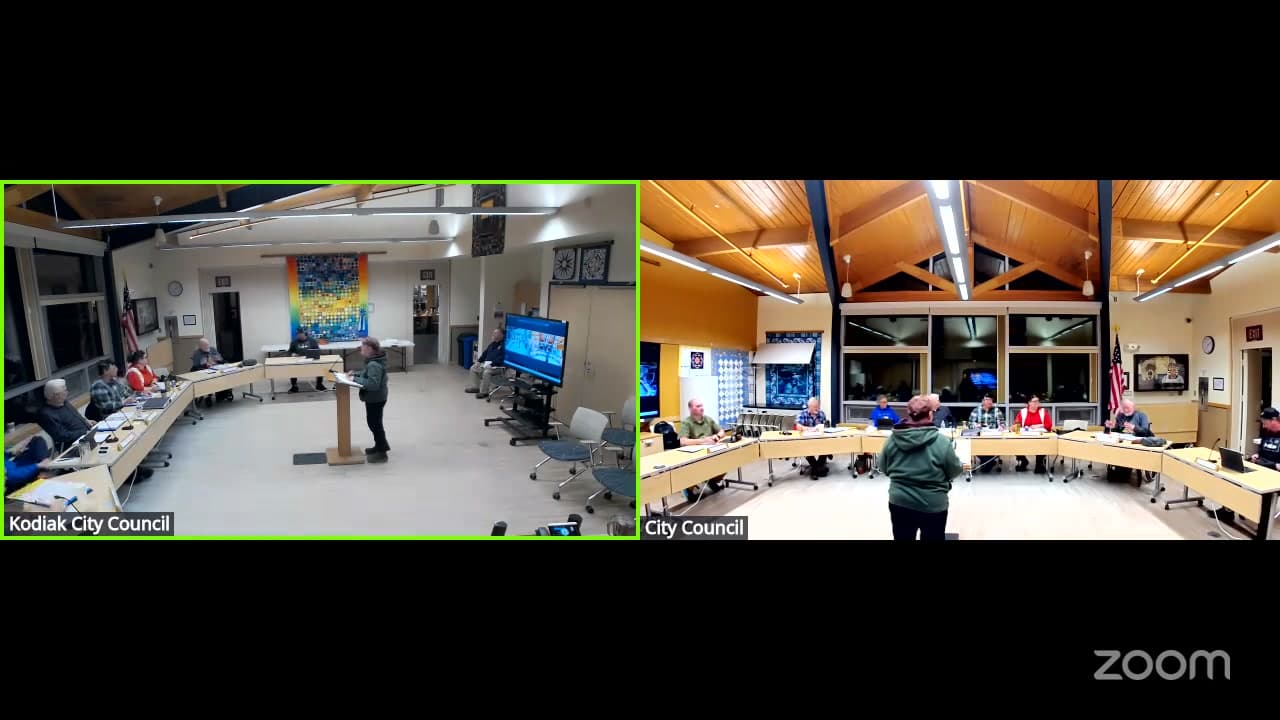
The November 10th, 2026 work session will now come to order. This work session is open to the public. For those who are listening, meeting agendas and packets are available online on the City of Kodiak's website. Public members are encouraged to web stream from the city's website portal. Audience and council members, please silence your phones, and council members, please put your phones away for the duration of the meeting.
The first item on the agenda is public comments, which will be limited to 3 minutes each. If there is anyone who wishes to address the council as a whole, please approach the podium. Or call in at 907-486-8610. Please note that this is the only opportunity to comment during this work session, and due to the slight delay in broadcasting, I will be pausing for a moment to allow some time for public members to call in.
Hi there, my name is Seema Garoutte and I am a resident of the city of Kodiak. I'm here today on your agenda item 2E, review city manager applications and process. As a voter for the city of Kodiak, we I feel like you guys spent a lot of money putting this issue on the ballot this year again for the second time. And when you guys put it on the ballot, the city of Kodiak residents knew exactly why you did it. For you guys to now take the time to go through 28 applications when we voted Tim, we voted like this is approval for you guys to just give him the job because we voted as citizens of the city of Kodiak like you asked us to to let you know that we want Tim as the city manager, and that I don't think that you guys need to waste your time with the other 28 applic— applicants.
There's lots more to do for you guys. Thank you. Thank you. Thank you.
Would anyone else like to address the council?
And there are no calls.
The next item on the agenda is Discover Kodiak Quarterly Update McKinley Research Group study results, and I would like to turn it over to Interim City Manager Tim Putney.
Thank you, Mr. Mayor. Uh, Discover Kodiak is here tonight, Sabrina, and I Do we have anybody on Zoom? No? Okay. Sabrina is here to report, uh, on their update with the findings from McKinley Research Group.
Sorry. So hello, my name is Sabrina Hicks. I'm the executive director of Discover Kodiak Station. Unfortunately, Heather Holland, who led the study with the McKinley Research Group, was unable to make it tonight, so I'm going to do my best to share our results of our 2025 tourism study. The full report will be on our website tomorrow morning.
You can look at that. I believe we'll be posting it as a blog post with the entire report so anyone can view it, and if there are any questions, you can always send an email to [email protected]. And if anyone wants a copy of the entire report, they can always come into our office too, and we are more than happy to print them one. So with that, um, um, we wanted a clear picture of what visitors contribute to our community beyond what we see just during the 3 months of summer. Um, because of that, we needed to go through Um, and it was suggested that we do the calendar year of 2025.
We decided to go with McKinley Research Group, who has studied Alaska tourism and the economy for decades. Uh, one thing that mattered to us was including the entire year and visitors from within Alaska, not just out-of-state tourists, thinking of people flying in to work and also coming in for deer hunts. And other excursions. The researchers spoke with 15 local tourism businesses and combined that information with transportation, fishing, wildlife, and municipal data. They also took on some previous Miss Kinley Research Group tourism projects that they had.
Many of the information— much of the information that they had were already from clients that they currently have. That made it a lot easier for them to get that data.
Mckinley estimated that about 87,000 visitors came into Kodiak in 2025. Roughly 60,000 arrived by air, 25,000 by cruise ship, and 2,000 by ferry. Air travel makes up nearly 70% of our visitors. That was an important reminder that our visitor industry extends well beyond just the cruise ship.
Season. Of these markets, fishing and hunting are two of the strongest. There is a huge range from one-day fishing charters to remote lodge stays and from deer hunting trips to high-value guided bear hunts that could range anywhere from up to $50,000. Those visitors also support air taxis, boats, guides, lodging, outfitters, restaurants, and other local businesses.
One thing that Heather did want us to know is that even though the sport fishing numbers may be higher, the hunting per person generated higher spending.
Cruise ships are a very visible part of tourism here in Kodiak. In 2025, Kodiak received about 25,000 cruise ship passengers across 29 calls. What makes Kodiak a little bit different is that most of these calls are medium-sized ships. We also see big swings month by month, month by month, especially peaks in May and September, partly because of the ships repositioning between regions.
One thing that we wanted to note on that was that because we can see that there are high numbers in May and September, we wanted to just recognize that this may create some difficulty with supply for our local businesses and also our communities since that is a high amount of people coming in just in May and September. We do plan on talking with these businesses to see if there's anything that we can do to support them.
Here is one of the most important findings— or sorry, I'm skipping over one of them.
There are also other reasons that people come to Kodiak: bear viewing, wildlife viewing, our museums, cultural experiences, hiking, kayaking, special events, business travel, and visiting family and friends, or as in this report, we note as VFRs. Heather specifically pointed to events such as Crab Fest and Calm Fish, as well as Coast Guard-related visitors and medical professionals such as traveling nurses that we see quite often in our office. These markets help support business throughout the year.
Now, here is one of our most important findings. Visitors spent an estimated $102 million in Kodiak in 2025. Sport fishing and hunting each accounted for about $30 million. Business travel and VFRs, $28 million. Wildlife viewing and other activities, $11 million.
And cruise passengers, $3 million. Cruise brings a substantial share of visitors, but overnight and longer stay markets account for much more in spending.
That $102 million does not stop with the first business receiving it. There are always the indirect costs. Businesses buy supplies and services, and employees spend their wages in our community. When McKinley included those additional effects, the estimated total was $130 million in economic activity, supporting 850 jobs and $45 million in labor income. The study estimated visitor-related employment represented about 9% of the borough employment in 2025.
McKinley also wanted to note that because Kodiak has so many sole proprietors, that number was harder to track.
The numbers were harder for them to track how many sole proprietors were— yes, were within Visitor activity also contributes to public revenues. McKinley estimated nearly $3.93 million in combined city and borough revenue in 2025, primarily from sales tax, lodging tax, cruise ship fees. Of that, approximately $3.78 million went to the city $148,000 to the borough. This helps show how the visitor industry supports more than just tourism businesses alone.
For Discover Kodiak Station, the value of this research is having a more complete understanding of our visitor economy. It helps us explain why we market Kodiak to different types of travelers and why supporting tourism benefits a wide range of local businesses. One of the main reasons that we felt it was important to have this study done was because we have never had one done before. There was a broader Alaska tourism study that McKinley did come to Kodiak for years ago, and that was done at our airport only. But we have no way to see where the growth is going to come, and we have seen that there have been so many different businesses even this year that have popped up, whether it's Kodiak Discovery Tours, Alaska Nuna Adventures, and On the, the larger report, you'll see where cultural tourism isn't maybe as high as what I thought it would be, but we never had a baseline to even compare it to.
And I think for us in our office, we'd like to see these other sections that maybe aren't as big grow. And now we would be able to track it. So I would hope that in the future, I'm not sure what that means yet for our organization with funding, but I would hope that we'd be able to do this again, whether it's even 5 years now, um, just to see where everything is going, but also for the city, the borough, or community, um, to just see where these numbers are coming from and how it affects our community. Um, and if there's any questions, I do— I can hear to answer as best as I can. Um, any questions for Sabrina?
Councilmember West.
Thank you, Sabrina, and I really appreciate this information, you said you have the full report. Yes. Because my curiosity is, how do they know? Where'd they get these numbers? So I'm assuming the full report will tell us more details.
Yes. And I mean, I—. And that's on your— on Discover Kodiak website, or how can we access that? We are going to be sharing it tomorrow. So it's going to be shared as a blog post, but it's also going to be on our website.
Okay. And the entire PDF will be on there. And like I said, anyone is more than welcome to come into our office. We can discuss it with you, print it for you, send it to you, email it to you, right? But the report, it will be— have— yes, it will be those little details that I probably also won't understand, but I will read them 3 times and try and figure it out.
Anyway, thank you. This is good information, but I, you know, still— it's great. Thanks, Councilmember Djuna Davidson. Thank you, Mr. Mayor. Um, I don't really have a question actually, but I just wanted to comment.
Um, so this is my second time seeing this presentation because I attended this summer Kodiak annual meeting this year, and it's no less, um, interesting data tonight than it was then. And I just want to thank you guys for undertaking it because it's a huge thing, like you said, for Kodiak, having never had this before, to have some sort of barometer to measure against as we move forward. And it really struck me Which didn't surprise me, but struck me how substantially lower our cruise ship income is in Kodiak, particularly comparative to the number of people who come to Kodiak for— well, I shouldn't say for, they come to Kodiak through cruise ship, the cruise industry. It's just such a significant difference when you look at, you know, this handful of 5 hunters that come and they spend vastly more money in Kodiak. Than 5 cruise ship passengers.
So I think that's important for us to think about, but I'm glad that you are just working so hard to reach out to businesses, so thank you. Councilmember Calderón. Thank you, Mr. Mayor. I have just a comment as well, and maybe, maybe it's a question, comment/question. So When we're thinking about our resources that we have here in Kodiak or the Last Frontier, as in Alaska in general, which is the fish, deer, bears and stuff, when those resources become so low, what can we do?
I mean, are we taking a look at the resources, the fish, the deer? Are we making sure that these rich people who come to spend their money to go hunt, and, you know, make money and stuff, are we also aware of the resources, I guess, is the question. I will say that is not my expertise. However, I do really value our partnership with Fish and Wildlife, Fish and Game. We have so many extremely qualified people in our community who are managing that, and I think they're doing a great job, and we are always working with them and Anything that we do at Discover Kodiak, we want to make sure that we're doing it responsibly and sustainably.
Even when it comes back to our salmon derby, we are working on that and we are so excited to bring that back and we're going to make sure that we bring it back in a way that is sustainable and responsible for our community. Even if that means it's not king salmon, there's going to be a derby of a sort and we're going to look to the experts in those fields to make sure that we listen to them, because I think that's one of the reasons that Kodiak— people come back to Kodiak. People love coming here because they are looking for something authentic. They are looking for untouched Alaska. And that's really what we have.
We have a beautiful place here and we just want to manage that responsibly to be able to keep continuing to share it with people that visit. And of 87,000 people, that's a lot of people that are coming here. And, um, and we're just trying to do what we can, and we love working with the borough and the city and our community to just listen and make sure that we do it in a way that our community, um, wants. Because overall, we are here working at the visitor center, but everyone who lives in Kodiak, we are the true ambassadors of tourism because we are the ones that people interact with.
I hope that answered your question.
Thank you, Mr. Mayor. Um, what— I'm just sorry, but I want to know how much it costs, because if we're going to do this in, in 2 years and in 4 years, so that I'm curious about. Yes, this, um, this entire study was $35,000. And, um, Councilmember Djuna Davidson. Thank you, Mr. Mayor.
Um, What Jose, Councilmember Calderón, had brought up made me think too, the page that showed the number of passengers from specifically cruise ships that are here in May and September, which I am personally well aware of. While we were doing the budget in May, I was also helping with 13 cruise ships, and it was crazy. But I really appreciate that you guys are reaching out, talking to businesses about resource needs during those times, because you look at those numbers and like, yeah, Not all 8,107 cruise ship passengers in May came to Kodiak and got off the boat and bought groceries and like taxed our resources that are important for me to be able to go buy milk at the store. But I think that is a really good thing to think about and ponder, and I'm not really asking you to answer this right now, but I'm just wondering, like, the cruise ship trend in Kodiak seems like, and you might know more than me, that typically we're going to continue to have the most passengers in May and September. It's not likely that we're going to have a leveled-out field of cruise ship passengers or that it's going to go much higher in any of the other months because where we are on the sort of path.
So I think it's really good for us to think about the resource management, not the natural resources that are being pillaged, but just like the daily resources that the community needs And, like, I don't really know exactly where I'm going with this, but it just really makes me think about, like, like, do we need to see if there's a way to get more of something in May and September so that the people in the community are not negatively impacted because there happens to be more people walking around downtown? You know what I mean? Yeah. And, you know, that's something Heather thought was interesting with our community specifically is that our small community for cruise ships is so unique because we are more of that repositioning port, but also with our tourism season, as you would say, it extends a lot longer than other parts of the state because of the hunting. And she just said, you know, she's like, this was so— this was interesting from the McKinley Research Group too, because they had never really done a study on a community like Kodiak.
And yeah, I mean, I think we're pretty special in that way.
Council Member Walker. Thank you. Uh, you know, I've been around you guys ever since we started getting started with the program. You guys have done a lot of good work in town. Uh, go down to the Fish Expo, you know, you get around.
And, uh, my question is, is there anything more that the city can do to help promote discovery? Well, I think we are— I mean, we really thank you for the support that you have given us. Um, I know we're working on the downtown wayfinding signs. That's, you know, we're getting very close to the end of that. Um, that is going to be a significant help.
And, um, other things that we just would love to maybe discuss more in the future is just Finding a more, you know, between July 1st and September 15th, we had 7,800 people walk through our office doors. We have a very small space and that's a lot of people and we don't always have enough, even with us 3 employees, we are all out there talking to people and there's not always enough space to welcome visitors into the visitor center. I wish we had more space, and, um, I wish that there was a more inviting public bathroom. Um, we are very thankful to partner with, um, work with the ferry terminal. They allow us to open their doors as long as we stay in there.
But like I said, we are an office of 3 people, and to stay in while someone uses a public bathroom is difficult and maybe doesn't seem as welcoming as what I would envision in the future.
Council Member Walker, follow up. Anything else that you guys can project, anything more the city can do to help in what you're describing Kodiak, other than federal? Yes.
You know, we, um, a couple years ago we were very thankful to have an increase in our funding, and after all the discussions, um, the city council had voted to go down back to $150,000 in funding. And, um, that has played a significant impact on our budgets. Um, I know everyone is struggling to make their budgets work. Uh, we really just want to try to market Kodiak as best we can. We are trying to utilize what we have, one of those being our partnership within the Alaska Tourism Industry Association, which is thankfully also a requirement from our contract with the city to maintain that membership.
And we have benefited so much from cooperative marketing with them. Something— I just came back from the Alaska Media Roadshow this past weekend where I met with vetted journalists and influencers, content creators, vetted by Alaska Tourism Industry plus Thompson& Co., which is the PR agency that works with them. And, you know, one thing that Ruth Krimmer of ATIA noted was that of this summer, 87% of the people that they hired independently requested to come to Kodiak. And even at the Alaska Industry Association, the convention, we see Kodiak throughout all of their marketing and their materials. They use it I know we don't always see it here in Kodiak.
A lot of us don't have cable or commercials, but ATIA and Travel Alaska use it all over and we can pinpoint right there. There's Kodiak, there's Pillar Mountain, here's Sultry, here's Kodiak, um, Brown Bear Center. And people are seeing these places and, um, they're wanting to come and visit. And that has helped us tremendously with stretching our our dollar, as you would say, for the marketing, but we would love to do more of that. Um, I feel like that's what Discover Kodiak is truly here for, is to market Kodiak to outside of Kodiak City, to bring people here.
And that was part of why we wanted to do the study, just so that we can see what the economic impact of visitors coming to our island does for our community.
Any further comments or questions?
Council Member Calderón. Thank you, Mr. Mayor. Uh, so for the June and July and August and April loss, um, that we have lost, or what we consider as loss, um, is there a way we can kind of pick up that number, those numbers again by doing something else, creating something else? Or if is it like—. Oh, in June and July for the cruise ships not coming in?
No. Um, you know what I would say is those were the amount of cruise ship passengers coming in during that time, but for our office, we busiest with people walking in through our doors who are staying here for 3 to 10 nights. That is when we see the true numbers come in. June, July, August, even into September, we, we have so many visitors staying in our hotels. Um, and I think that's part of— even with McKinley Research Group, they reached out to the Aleutic Museum, they reached out to the Best Western, all of the major hotels, and, um, those are their peak seasons.
They are fully booked. Our vacation rentals are fully booked. So I think, you know, when we know we see so many visitors in our town during that time when cruise ship passengers are not walking the streets. And then can I add another question? Yes, go ahead.
Um, and so yes, um, it has— any of the people who are coming into Kodiak, have they expressed any concerns of, oh, I think this should be better if, you know, we do it this way, or if I come in and there's already set apartment, or you know what I mean? Like, what is it? How is it? How can we make it easier for people coming in, uh, to Kodiak to, to just come in and just, I mean, house them, I guess, is what you call them, or like, um, you know, people are not coming to Kodiak. I mean, some are maybe with, in a week's notice, but overall, people, this is a bucket list trip for people.
They are planning 10 years out. We even hear this is their dream vacation and they are planning out a year in advance. Most of our fishing charters are already getting bookings now, our lodges are getting bookings now, and especially into January, February, we are getting so many emails and phone calls that we are sending people out, where are they going to stay, what are they going to do, what can they plan. Even with cruise ships, cruise ships are already, they have their ports already sent out to their passengers and they're saying, hey, I'm going to be here on August 3rd, what can I do, is there going to be bear viewing still, am I going to be able to go out here, Do you have any maps? I want to get excited and plan.
So, um, it's, it's not— it's something that I think there's plenty of time for people to find. It's maybe when there is a last-minute visit to Kodiak where they might struggle to find a place to stay, but, um, we have not heard of anyone not finding. Perfect, thank you. Well, Council Member Mangini and then Council Member Davidson. Yeah, thank you, Mr. Mayor.
Um, I just, uh, remember when Discover Kodiak was just a little shack out there on, on the spit. And so I think this is just a great example of an organization the city can support that's bringing us real answers with revenue. I mean, these numbers are pretty outstanding if you ask me, and it's really educational, this information too. So I personally fully support, you know, a follow-up report like this because I thought personally that the cruise ships were a lot bigger percentage of our tourism than it actually is. So I mean, I know that hunting's big, but I didn't realize it was that big.
So, um, Please take kudos back to your team. You guys are doing a great job and appreciate you. Thank you. Council Member Charles Davidson. I, I just curious, how do you calculate the amount of monies to the cruise ship?
Do you have access to the city sales tax following the day that they've been here? That maybe give some indication of the, the percentage of monies that are being fed into a You know, I don't think the McKinley Research Group was—. I don't think they looked for an exact day of the cruise ships, and I'm not— I guess suppose we could speak with the city and find out if that is something that we could see, but I think because businesses report quarterly, it would be more of that quarter than a specific day. We could potentially see if we could work with businesses downtown that we know cruise ship passengers are visiting and maybe inquire, like, off record, just say, hey, can you let us know how much your— what revenue you brought in today on a specific cruise ship day? That could be helpful.
Councilmember Djuna Davidson. Thank you, Mr. Mayor. One, I agree with Nick. I'm very supportive of future studies. I think this information is helpful for us in the context of Kodiak's tourism industry and brings us meaningful data, and that Discover Kodiak is helping stimulate our economy through tourism income.
I think I also wanted to just share anecdotally that, like, yeah, people are already planning. I received an email today from someone who's going to show up on a cruise ship in May that comes on a Monday and we're closed, and she wants to know if we are going to open specially on this day in May, which frankly, we're too busy to even know if we're going to have staff for that day. But I'm going to answer, you know, but like, yeah, people definitely plan ahead to come to Kodiak Station. And while we at the museum get a lot of foot traffic on cruise ship days and we do have a lot of good sales days, you know, comparatively because of the number of people that come in is higher. But again, those are not the tourists that are buying typically the most expensive and like the nicest— no, I don't want to say not nicest, but like, you know, they're spending less money.
Hunters are coming and buying fancy jewelry to bring home to their wives, and cruise ship passengers are buying keychains and magnets and stuffed animals and small jewelry. And that's fine, like, that's great. I'm not saying it's it's bad, but we are at an interesting time. And this is like for us as a council to be conscientious of because Kodiak has always been a place that people romanticize. And as Sabrina has noted, that is only increasing.
And so we're at this special place where we get to sort of control what tourism looks like in Kodiak instead of letting tourism control what Kodiak looks like for it. So just want to remind us of that. And thanks for your hard work helping that be positive for Kodiak, what it looks like. And I know I've said this before, but not one person comes into our office who's visiting where we don't ask everything.
Why are you visiting Kodiak? What brings you here? What are you planning on doing? Where are you from? And, and one thing that they all take away is they tell us how often they go to other parts of the state, and they always say how much they love Kodiak and how much they love the community, how welcoming we are, and how they'll continue to keep coming back just because they love the community that is here.
So, Councilmember Calderón. Thank you, Mr. Mayor. Just a comment, and I want, like, I want everybody to be aware that climate change does exist, and that also reduces our resources and So my idea is just, you know, yeah, we do love visitors, but I also do love the planet, right? So that's my last comment. Thank you.
Any further comments or questions? Well, you used up all my comments. Thank you very much, Sabrina. Thank you. I appreciate all of you guys for your time and everything that you guys do.
The next agenda item is overview of the Lift Station 5 and Forest Main Replacement Project. That's PN 11-06/7524. I'll turn it over to Interim City Manager Tim Putney for a review. Thank you, Mr. Mayor. Lift Station 5 is the city's largest sewer lift station, pumps directly into the wastewater treatment plant on Spruce Cape.
Lift Station 5 and Forest Main were installed as part of a mid-1970s construction project of the interceptor system as the city's wastewater treatment plant was being designed and built. The station's electrical controls, pumps, equipment have reached the end of life. Approximately 20 years ago, Lift Station 5 had a catastrophic failure in the force main pipe, which caused direct discharge of sewer effluent into Mission Lake. In May 2019, a similar failure occurred that cost the city over $250,000. Alaska Department of Environmental Conservation is aware of both events and will likely levy heavy fines against the city.
If another failure were to occur at Lift Station 5 or the Forest Main Pipe leading to the wastewater treatment plant. The city's under a State of Alaska mandate to have the replacement lift station complete no later than December 31st, 2027. This overview is being provided ahead of the regular meeting on Thursday, where staff is recommending council approve a resolution to increase the loan amount through Alaska DEC Clean Water Fund by another $10 million. This will bring the total not-to-exceed amount of this loan to $17.4 million. Mr. Mayor, in addition to, uh, the material in the packet, we also have Chris Lynch here tonight, uh, and we are both available if there are questions.
And Ms. Lynch is available for questions from the council. Uh, Council Member Junie Davis. Thank you, Mr. Mayor. Um, so given that we approved the additional funding, would we be on track to meet that deadline of no later than December 31st for completion of 2027 for completion of the project. Is that realistic?
We are trying our best. I'm sure it's hard. So, so I can tell you that I'll give you a rundown of the things that we have been doing since we, we got the bid, and the bid was, was so much more than the engineer's estimate. The supply chain issues are real since we bid this The first time electrical components, valves, shipping costs, everything has skyrocketed, let alone it takes forever for anything to get here. Generators are a year out, motor control centers are a year out.
It's, it's really amazing to watch all of that. Right away we started to, we realized that we had to contact DEC and ask about the consent order. So we were able to get an extension of 1 year right away. We, um, we began working with the— our contractor that bid the job and issued a notice of intent to award, which allowed us to have the ability to negotiate a little bit on some costs prior to awarding. The biggest cost of this project, because of its proximity to the lake, is the shoring that's required and the soldier piling.
It's— there are locations where we have to put piling in 41 feet deep. That takes us below the, the lake. The, um, so what we did is ask the contractor what was the biggest cost and how can we try to reduce that. They had hired an engineer to design and be able to better get a price for the shoring. And so we went to that engineer as well as the engineer that designed the project and said, how can we better our geotech information?
How can we make it so that we know more specifically what we're going to run into? And so what we did, and, and the council approved a $159,000 contract for that additional geotech. We drilled additional holes. We picked the key points where we thought the stress would be the greatest. And we were drilling 75 feet deep before we could find competent bedrock, which is amazing.
And so, but by doing this, we received a report that it is sure that we will be able to reduce the size of the piling. And so with that, we will be able to reduce the cost. The, um, we have also approached adjacent property owners to see if they would entertain the idea of allowing us to put rock anchors along the property lines to reinforce the soldier piling, thus again helping to, to reduce the, the size of the steel that has to go into the ground. The biggest thing is, now that we have all that data, we need to get to a point where we can approve the contract because the city has taken on this additional risk and we need to put that back on our contractor. So So, um, the reason that we are requesting the additional loan funding is so that we can get to where we can award this contract.
Once awarding, the contractor will be able to work specific with the design of the piling and get an actual design. But what we're hearing is that that's going to take about 3 months to complete. Once we have that design in hand, then it could be anywhere from 4 to 6 months to actually get piling. So we're trying. It's, um, the capsular unit is in town, and so that's, that was a big scare early on, is that we wouldn't, we'd have all this big hole ready and not have the equipment there to place it.
That is here, but everything is, your guess is as good as mine. And the, um, but we have been working with DEC, the SRF program, how can we reduce lead times on things. There's things that you can ask for because we are held to high standards and must be made in America. All the steel— there's an American-made steel requirement due to our funding. So yeah, there has been an enormous amount of hurdles, but I feel like we're taking the appropriate steps even though they're small.
And I feel like doing this upfront work, we've been able to provide some value engineering that I think that even though we will award a amount contract, we will be able to reduce that. So that's my goal, and that's what we're working for. And so in front of you, you have the, um, picture of how much land this covers, and then you have our monster. So, um, it's pretty impressive to see that capsule unit. It weighs 79,000 pounds, and there is a crane in town only big enough to lift it up high enough so the trailer could drive away.
So, so yes, it's been, it's definitely a monumental feat.
Council Member Mangini. Thank you, Mr. Mayor. Is there any kind of penalty for not spending all of the Alaska Clean Water Fund in the event that we don't spend it all, or would it just automatically go into another project? Because I know we have a number of them on our public works.
You have to, through the loan program, it's specific to that project. So you spend what what you use, and then because you'd pay interest on it. We have a number of SRF projects that we've asked for funding for. So timing. Gotcha.
Thank you.
Councilmember Charles Davidson.
Excavations. LS stands for what? Lump sum. Lump sum. Why is there such a discrepancy there?
Because I, I'm under the impression unclassified excavation means that maybe there is some—. Is that unclassified excavation is more like, um, overburden and things that you can't reuse.
So, um, no, there's definitely that.
This is, this is, uh, this 6 where this is a $1,435 difference. That means that Breckenridge, uh, disposed of the contaminated soil.
Which line item are you on?
So, um, that is unclassified excavation. They will dig the hole for that much money. The, the problem that we have in Kodiak is that we have, um, we have professional estimators that estimate everywhere but don't necessarily understand construction in Kodiak, so it gives a false a false fake number. The number's always a little bit lower. They don't— if you tell people in the rest of the state that we pay $600 a yard for concrete, they say, what?
And so, but that's the reality. And so when you have only one person, one contractor providing certain materials, that's not always taken into consideration in the engineer's cost estimate.
The, uh, I mean, are you required to, to make sure that the C on that is, is, uh, passable, or do you have to apply for the exceptions when you get foreign products or material? Is that your job, or will that be the contract? That we have to do that ahead of time. So I've been meeting with DEC, and there's all of the rebar, all of the valves, everything has to be American-made. There are variances for things that take too long to get here that we could ask for, but what DEC said is that it's a really high bar that, that you have to prove that.
And from what I can figure out so far, the dollar amount might not be worth it to, to ask for that. But there are— we are trying to do that ahead of time. And then as the project progresses, there is— I wrote it down— a de minimis value that we, we can fill out a form. So say they came short of a manhole cover and the only one they can get is made in China, then we fill out this sheet of paper and fill and send that, and they say, oh, okay, we'll let you slide on that issue.
Yeah, and that's the position we're in.
The, um, we're hoping right now that we have, um, accounted for most of that in the timeline that we have. Example, the force main associated with this project we started last August. It was 58 weeks to get the valves. So we were just able to do the road crossing 2 weeks ago for a project that was over a year ago, just trying to meet the Made in America requirement. That's me.
So yeah, we started.
Yeah, we started in 2024 with the design, went several iterations with them, and then they're in another part of the United States and they don't even understand it has to get trucked across and go on a barge. And then, yeah, it's, it's been very interesting. So you're, you're a—. Yes. Thank you very much.
So we've been trying to keep up on all that.
Any further questions for Chris?
Well, thank you, Chris.
Next agenda item is review Port of Kodiak MARAD fiscal year 2024 PIDP pre-award checklist for the St. Herman Harbor recapitalization project. And I'll turn it over to interim city manager Tim. Thank you, Mr. Mayor. During the city's pre-obligation phase for our MARAD PIDP 2024 and 2026 professionally directed spending award, which totals $16,250,000 for Phase 1 of St. Herman Harbor Replacement Project. There were several concurrent tasks that must be completed prior to execution of a grant agreement.
Those included completing the NEPA, the National Environmental Policy Act review that was just completed on September 10th, complete Section 106 of National Historic Preservation Act consultations, which was completed last April. Title VI and ADA compliance plan, that's estimated to be completed by December 3rd and will, uh, with council approval. Recipient's letter of funds availability, this was a requirement of the grant application, saying that yes, we have a match for this grant. And then executing the grant agreement, so we're providing all this information, this overview ahead of December 3rd meeting, which is where we hope to bring council a resolution to formally accept a resolution for accepting this grant, in addition to moving some money around that shows where our match comes from. Recipients of MARAD financial assistance are obligated to recognize Title VI of Civil Rights Act of 1964, which prohibits discrimination based on race, color, national origin, and which includes English proficiency.
So that is one of the items that's in the attachment That's our draft plan right now that's been submitted to MARAD for approval.
The draft city Kodiak Title VI ADA compliance form will need to be adopted by City Council to affirm its commitment to non-discrimination. Adoption of this plan as official guidance will direct city staff, departments, contractors, subrecipients to comply with the procedures, responsibilities, and public access commitments. That are described in the plan. The fund certification letter in your packet was required to be included in the initial grant application. Again, our, our local match, the city match, uh, for the 2024 applications, $5.443 million.
There's a summary, uh, towards the end of the summary and discussion, uh, 5 different areas where we intend to, uh, bring that money together.
Uh, in summary, purpose of this discussion is to provide council with an understanding of the scope of the project, the next steps, which will include acceptance accepting a grant award and adopting a resolution that transfers enough money to cover our local match. Council will also need to accept Title VI and the ADA compliance plan. And this is again Phase 1 of the PIDP 2024 and the CES money. We will be— we are still working with MARAD on the 2026 award. We'll have to complete some of these same steps with them, but since most of that work is done, we should just be able to update it and get it back to them and have a quicker turnaround than this application.
Uh, once again, Chris is here and so is our harbormaster, Mr. Anderson, if council has any questions for any of us. Any questions from the council? Councilmember Calderón, or comment? Thank you, Mr. Mayor. My comment is just that I like that we're working with the, um, MORAD, right?
I like that we're working with MORAD and we're keeping things— we're keeping our history, we're keeping, you know, the, you know, supplies and natural resources that we have still intact. Um, so thank you for that. Thank you, Council Member Mangini. Um, my comment is more about the phased approach. I've talked to this with— about— to the— to our city manager, acting city manager Also talked with it to Monty about it as well.
I just worry that if we wait too long on the small boat side of the harbor that we are going to not have a small boat side of the harbor, or at least the first 3 fingers. So I, I just hope as this funding comes through and we start actual planning that we take that in consideration, because, um, I spend every day of my life going up and down that ramp, and there's nobody using One Finger right now because it's not really usable goal. So that's, that's my biggest fear. Time definitely is of the essence.
Any further questions? Council Member West, and the hard questions go to Chris. Okay, I, I want to say thank you to staff for, um, finding the match. Um, we're broke, we don't have money, and they went and found match. Pretty— I mean, I know we, we took it from Peter and Paul, but I'm impressed and I wanna say thank you because we can't do this project without it.
So I just wanna say that you have the EA in your, in your packet and that EA we paid for last year and we will be able to ask for the pre-award money be reimbursed. We're not guaranteed that it's going to be reimbursed, but we are going to ask for it. And that we have this completed now within the year, that's huge. And so we will be able to use this for no matter what phase we do, and we'll be able to use a portion of the EA as part of our RFP to go out for the consultant. So I just wanted to say that We're a lot further along than what it appears.
So that's pretty exciting. And Monty's staff, they're awesome. Oh my gosh. They have made that whole place.
So I'm sorry. I have the gift of gab, so I had to just say that.
Any further questions or comments? Councilmember Mangini. I just wanted to clarify, I didn't mean that as in any other way that I'm—. I feel for your staff because I see them on that side of the harbor every single day, you know, fixing something. And so that, that's, that's my biggest worry, is that, you know, I'd like for you guys to get back to work and staying ahead of things rather than catching up.
So thank you. Councilmember Charles David Is your microphone on? I was just asking Chris, from your best estimate, what would be the project possibly completion for Phase 1? Because it's so critical right now. And from what I gathered from reading all this after long involvement, it looks like it's going to be 2 years before we can That's going to be our next discussion because that becomes part of the formal application that we have to fill out tomorrow.
And they specifically ask you because the clock literally starts ticking the minute we give them that document back. And so we only have short periods of time. What the— I think it says 27, October of '27 is when we would do construction, but that would be a reasonable time. Well, like, we're completed— we've completed, right, the NEPA and the NHPA?
We've completed the NEPA portion, yes. 5 To 20 months. So I mean, we're—. Yes. And so that was what we did all of last year.
And so that is done.
Thank you, Chris. Way huge because there are so many agencies and they all have to talk to each other. And yeah, it's, it's a pretty large process. So yeah, well, that's what I found. Never mind.
Any further questions or comments? Well, you don't often hear applause at city council meetings. Is. But I do think it's well earned, you know, looking at all this material, over 100 pages here, and it really shows how much, how in-depth it is, how much work it is. And, and Merad is tough.
I mean, they are one of the toughest guys up there. And when we went to meet with them in DC, it was a whole room full of people. It was more people than we ever, than we met for it, met with at one time the whole time we were there. And like I say, they are tough. But that, it really is a testament to our staff and the amount of work that they have to do and in conjunction with each other to just get one of these grant applications submitted, much less one that would be successful someplace like MARAD.
It really speaks to the good hard work and effective work of our staff. And to get two of them now, this second one was a real victory for us. Thank you, Council Member Charles Davidson. I just want to make a comment that anybody in the public arena out there that thinks we're taking too long, I ask them to please come to the city clerk's office and see what the application is of these MARAD grants, and then they'll understand why it's taking so long.
Any further questions or comments? Well, thank you. The next item on the agenda is review and update of City of Kodiak state and federal prioritized capital improvement lists for FY 2028. And again, I'll turn it over to interim city manager Tim Putney. Thank you, Mr. Mayor.
Each year, the city council adopts resolutions setting the city's capital project priorities and support issues for state and federal legislative sessions. These resolutions guide the city's lobbyists and are shared with governor's office, the legislature, and Alaska congressional delegation to support funding requests. On February 12th, 2026, Council adopted two resolutions, 2604 and 2605, respectively, where our state and federal priority lists to prepare for the FY 2028 resolutions ahead of the next legislative sessions. Staff asked Council to review the prior lists and give direction on whether projects or issues should be added, removed, reprioritized, or updated. Staff will use Council's input to update project descriptions, cost estimates, funding status, this and bring a draft resolution back for your discussion in December before we can formalize resolutions in January.
Um, some ideas towards the bottom of the summary and discussion are included, uh, for any input, and I'm ready to take notes. Councilmember Djuna Davidson. Thank you, Mr. Mayor. I don't know what state row vacation on Rezanov for future port development means.
Do you? Yes, I bet you do. So, uh, the state right-of-way on Rezanov, uh, in the dip is, uh, in my humble opinion, quite large. It seems like once you get out of town and you're going out towards old DOT and Dead Man's, uh, it gets pretty wide. And even into the water in some areas.
So the request would be to ask DOT whether or not they'd consider vacating part or portions of the right-of-way there so that we could potentially consider a new pier someday and between Piers 2 and 3, increasing our ability to— for more ships and more commerce and more cruise ships and all the above. So that That would be a consideration for the legislature. Uh, thank you, Council Member Mangini. I just want to say thank you for thinking forward like that.
That's a think tank in our office.
Council Member West.
Thank you.
So much here. There's just so much here. So, um, on your list, um, of the legislative issues to consider, capital projects to consider, Phase 2B of the, um, St. Herman Harbor. This is the next one, correct? So right now I guess I could look at it.
We've just been asking for Phase 1. Is that— or did we— we've been asking for the whole thing, right? All along? Mr. Mayor? Please.
So the 2024 MARAD, we asked for Phase 1. Phase 1 is the big boat part of the harbor with the M and new N and moving the, you know, the MNO floats. Phase 2A, as we've kind of started calling it during the 2026 PIDP application, that's basically the seiners in the middle of the harbor that off the Ramp 2, and then Phase 2B or 3 or whatever, you know, Phase 2B is kind of what it started being called, would be the rest of the harbor that Council Member Mangini is talking about, the front of the harbor. And our next application period for getting that funded will be the BUILD grant. Which should get released here in January or February.
That'll be our next grant target to target for the harbor. All right, so just to clarify again, we would rephrase our St. Herman Harbor ask? Correct. To be, to be or not to be? To be or not to be.
Yeah. Got it. Okay, so I got that one. I do love the new Testamino Ferry Terminal, or the— what they call it— Testamino Replacement, uh, on Near Island, because, um, we're also going to ask them to add, uh, City Hall on top of their ferry terminal building, and then that will give more room for Discover Kodiak. So we, we have plans, we have big plans for, um, everybody else's money.
The right-of-way vacation will go into my other priority, which is the Kodiak Station. So if we vacate, I mean, right now, that's something that greater minds than mine, people that have been in DOT maybe longer, we could have discussions with. The DOT is planning on coming in and doing the plan. They've got it in the STIP to do planning for the short trail from Pier 2 to the Rendezvous. And that will be within this great big right-of-way that they're claiming.
So I don't want to take too much of it. I mean, if it's theirs, then they'll plan it and they'll build it. I hope they're not listening, but if we say we want this, then Doug is going to give it to us and they say you can build it, then we have to build that part anyway. Those are my concerns. I don't know if that makes, makes sense.
I do want to keep the Kodiak Short Trail on our CIP list. And I'd like to hear more ideas on Gibson Cove.
Industrial park. And I know we've, we've talked about it, but I would just like maybe, um, a town hall or whatever we call it, community discussion, um, several, because people want to be involved. And, um, so I like that it's on there, but those are my thoughts. Thank you.
Council Member Charles Davidson. Thank you, Mr. Mayor. Two things I'd like to see is one would be the looking at BLM access to Gibson Cove because that's going to affect our ability to develop it. So that's one thing we should definitely work on. And the other thing I want to bring up is the fact that for the getting some priority for that land out at Fort Abercrombie that is across from the actual Fort Abercrombie.
We tried to get that land and the money went to the— it was like a $14 million grant or something that went to remodel the museum. But that access, we definitely, I think, need to work with the Congress to get this done now because it's going to take some time. And by getting on it now, we'll have it ready when we to move forward with our projects, you know. So one would be the, uh, access to that, getting a deed restriction removed from the Fort Abacarmi land. That's— I'm not talking about Fort Abacarmi itself, that's where the Graham site was.
I'm talking about the one that's on the whatever direction that is across the highway. And then the, the access for the other thing. Thank you, Council Member Calderon. Thank you, Mr. Mayor. How many phases are we talking about, um, in general, in total?
How many? Um, sorry. Yeah, 3. Only just 3 phases? Yeah, 1, 2A, and 2B now.
Okay, okay. Yeah, all right, let's get it done.
That doesn't sound so bad. Council Member Mangini. I just—. I, I guess I'm—. And this is out of my norm, being more of a realist here—.
Some of these phases, I, I just worry that we're— if we add much more to our capital improvement projects, that we're going to be trying to take on much more than we can actually possibly do. I mean, these are giant projects, every single one of these on this list. For borrowing money for a lift station. And the harbor is like no small task. It's the largest harbor almost in Alaska.
And, you know, I just worry about adding too much here. I love all of the ideas, but I think we just got to be a little cognizant of that. Well, that's the wonderful thing about grant funding. Of course, the St. Herman Harbor is our number one priority. Council Member Charles Davis.
Yeah, I just want to mention that the, uh, the two things I mentioned, the access to the Reed restriction and that, those are non-cost items, you know. So keep that in mind. But I can tell you, I don't know how many years ago, but the cost of that, uh, uh, St. Herman's Harbor was, I think at one time was $40 million. So you can, I can understand why you're concerned about you know, overdramatizing what we need and, and provide. Anyway, Council Member West.
Thank you, Mr. Mayor. I wanted to point out one other, um, just information, especially, I don't know, for the public. So at the bottom of page 4 or 5 for the state, um, it says, uh, supported state issues. And number 2 is the support for legislative change to the state statute for additional restaurant eating place licenses. Um, the mayor and I, when we were in Juneau for the AML, we talked to Representative Stutes, and she said if we are interested in this— and I believe it's Ketchikan that also has the same concern, we clarify what the city and the borough want, that there is a restriction because we provide police, they don't.
They provide personal zoning, zoning, and we don't. So, um, if she says we write that up and we bring it to her She's got a new job now, but she has people that will put that into law and they will present it. So I don't know how to do that, but she said that that is something that she could work on. And then we just haven't— I think I mentioned it when we came back, but since we're looking at a list of things we want to do if we If anybody, somebody, community wants to do that, she was open to it. So I think that's an opportunity I didn't want to miss, and it's on our list.
Well, having it on the list is a nice first step.
Any further comments or questions? Oh, go ahead. And just maybe to get some input, I mean, one conversation we've had internally is with the St. Herman Harbor as we rewrite this ask for Phase 2B and update the narrative, asking for— just asking for what we need to finish this. Not, not $10 million, but asking for a bigger chunk. I know, and, you know, sitting in these discussions over the years in the audience, there's always like the, you know, you want to have 5 or 6 items, you want to have a spectrum of asks so that, you know, if they've got $1 million that year, great, you've got something close to that.
If they got $40 million, great, great you've got something close to that too, so we can kind of have a variety of projects and amounts.
Council Member Djuna Davidson. Thank you, Mr. Mayor. I think that's great, Interim City Manager, uh, Putney. Yes, let's ask for all the money.
I agree. Councilmember Charles Davidson. Charlie, if you're— lovely thing.
These funds, you know, we draw from them as we need the money, and it stays in there. It doesn't go back to the state. Like, if the— correct me if I'm wrong, Mr. Acting Manager— if the money is not used up for the project, then that's it, right? We don't— we just draw from that fund what we need to complete the project. And it's also advisable to use these funds because they're at 1 to 2% interest and go for up to what, 30 or 50 years for financing this?
For the state revolving fund? Yeah, right. Yeah, usually they're around 2% right now. I think maybe just a little over 2% interest. And generally, yeah, they are 20 years, upwards of 20 years depending on the agreement.
Yeah, I just point that out because people think, oh, $17 million. Oh my God, you know, but not necessarily going to use it. Hopefully we don't. Correct. We'd only draw down what, what we needed to pay for it.
Then what we apply for, that way, that's the end of the grant, right? We don't get any, any other funds from it once that, that project is completed. But we can also charge 10% of the application of the loan, can't we? Or administering of it. I'm not sure what I mean by that.
That. But yeah, oh, never mind, withdraw that.
Any more questions or comments? Now, Tim, is it— is it a different ask for the Aleutian Homes this time around? Would it be a different number? So I mean, that might be something, uh, we bring back in a draft, uh, Hopefully we hear soon how this next round of congressionally directed spending goes. Murkowski put in to give us about another $4 or $5 million.
So with what we already have through the ordinance we just accepted the last couple of meetings, we would be probably two-thirds of the way there. So we could, we could decide whether or not we wanted to ask for another, you know, $4 or $5 million to finish it, or, or put a bigger— another project, move on kind of down the list. So that would be a discussion.
Looking—. That sounds like a hard question. So, Allusion 7 is probably going to be divided into 3 phases. So I would see us asking for money a little bit every year. It could be one of those projects that is a smaller dollar amount depending on funding.
The reason we divide it into 3 is so that we can get a better choice of bidders. More manageable for some of our, um, smaller bidders in town that could do a smaller project perfectly fine but couldn't do a $12 million project. So that's what— yeah, that's what we're hoping for. Okay, thanks, Chris. Council Member Charles Davidson, are they, uh, on these federal-funded projects or state projects, can we still use the 10%, uh, present to the local contractor, those are— but not on federal contracts.
Am I correct on that?
You don't understand what I'm saying? Right ahead. No, I'm not sure about the federal. That's why I was asking. Yeah, I think we're kind of beholden to the federal procurement guidelines, so we'd have to— okay, it's a good question.
Any further questions or comments?
Councilmember Calderón. Thank you, Mr. Mayor. Um, I— so I guess my question would be, will we be hiring— well, you, you kind of already answered my question. We'll be hiring locals when it comes to multiple phases, um, especially when it comes to the, um, rebuilding the homes, right? So like, we want to go to local— sorry, water and sewer.
But when we do any construction work in general, we do hire our locals first before hiring anybody out of the island, correct? So we go out to competitive bid, and then we go with usually not necessarily the lowest bid, but the most qualified bidder. Depending on what we're bidding, there is a local preference that's built into the city code that does afford a local bid. Consider, like Mr. Davidson's talking about, that 10% variance to kind of give them the preference.
And I think what, what our contract engineer was talking about is the, like, with the Solutions Project, there's a, there's a big cost in bidding a big project when you have to buy the bonds that goes along with that. So the smaller, you know, smaller companies can do the work just fine. Uh, so, but so if we break it up, it makes it easier for us, more affordable for us to kind of manage, and then it opens the playing field too. So there's a lot of work that's going to be starting in Kodiak, and not only so many contractors available, so that'll also—. Thank you for making that clear.
Thank you.
Any further discussion?
That brings us to the next item on the agenda, which is to review the city manager applications and process and I'll turn it over to City Clerk Brandy Warnecke to provide a review.
Thank you. So the city of Kodiak currently has 28 applications for the city manager position. Um, this item is before the council to review and discuss the received applications in a public setting. All applications received for the manager position are posted on the city of Kodiak's meeting, uh, website portal. Um, and I'm mostly looking for direction Um, the attorney and I— you met with the attorney and I at the October 29th work session, um, and it— you guys wanted to review the application.
So, um, I'm looking for direction from the council on where collectively you want to go next. We do have, um, the item on the Thursday meeting that is dependent on your conversation here tonight. Thank you. What is the council's pleasure? Council Member Djuna Davidson.
Thank you, Mr. Mayor.
Um, I have thought about this carefully for a long time. Um, like my fellow rolling over council members, we've been looking at these applications for, you know, 8, 9 months or whatnot. For our newer council members I realize that it's a lot to try to take in and process in just a week or so, um, but I am just going to say, after re-reviewing, um, I really think that interim manager Tim Putney is really the best of the applicants that we have, and I personally think that it is not a best investment of our time to draw out the process further. When we already have a highly qualified applicant who, um, has already been tested in the position because of being appointed the interim manager. Um, I do though want to address something that was mentioned during public comment.
Um, I appreciated the ideology that the voters voted because they support Tim to pass that. Um, but I also just want to say that passing the expansion of the boundaries where the city manager can live is about a lot more than this hiring decision and a lot more than Mr. Tim Putney, who is a highly qualified— our best applicant that we have. And I just want to reinforce that it has a long-standing positive impact for future hiring in Kodiak that voters passed that. And I just think it's important to note that while Tim is far and away, I think, the best candidate for the job, I don't agree that that vote was just for Tim. No offense.
That was Member Mangini. Yeah, yeah. And to further back that up, that, that like was in motion before he was an interim manager, so we had been talking about this before— that was before he was ever in the position. So although it may have seemed that way to the public, we were trying to expand our horizons by being able to offer more to an incoming manager before he had ever even taken the position. So I also stand with Djuna.
I, I've reviewed these applications more times than I would have liked to at this point. Right. Um, number 2, uh, I've spent a lot of time with Tim both here and in DC. I think he's the right man for the job. I think that he's doing a great job, and we're seeing that through his forward-looking into the future for Kodiak, and it's more than about just this year.
And I think that's all the things that we wanted out of a manager. So I think we'd be really remiss to pass up on this opportunity or waste any more time on it. But I also understand that, um, not everyone was here during this hiring process, and I appreciate that too. Council Member Whiff, totally, totally agree with everything that, uh, my fellow council members said. Um, Tim shines far and above, um, the other applicants, and you're here.
I like that part. You know us. You know us. So that's very, very important, and I do appreciate that we have changed the ruling so that we can start reaching out a little bit more. And in the end, um, I just would like to hire Mr. Tim Putney as city manager.
Thank you. Councilmember Charles Davidson. Thank you, Mr. Mayor. I, uh, Is your microphone on, Charlie? I, uh, I didn't mean to delay this, but I, I did go through all the applications and say there were some that were passable, but none of them that I thought would be possible had municipal experience, nor—.
And one of the things you need to remember in this small community of, what is it, 5,200 people, we have 2 airports. We have 3 docks. You know, this, this is an immense job for a small town of our size. So people have to realize that, that they don't come a dime a dozen with that type of background. And Tim has been here for most of his adult life, and, and I've known him since he was in junior high.
I can't think of a better person who has a better knowledge of this community. Because when you hire a new manager that's from out of town, they've got a lot of learning to do, especially in this town. But I, I intend to propose that we hire him at our meeting on Thursday night. So that's my opinion. Thank you.
Council Member Calderón. I want to thank everyone, especially the people who are watching, um, to giving me a chance to read through the applications. I was always raised to kind of look for evidence, make sure that you know what you're voting for or what you're choosing is the proper, you know, proper person, proper thing. So especially when it comes to like everybody, and I don't, I'm not a, I don't just go where the herd goes, if that makes sense. So I went over the applications.
Yes, Mr. Punney, you are, I mean, he has one of the most, actually he's like one of the the first, like the one, only one, I think. Other people, I would look at their resumes and stuff and I was like, oh cool, you know, this person has this experience, you know, and they want this for this. And then at the end of their agenda it goes, we want to go ahead and sell lots of our, like, you know, sell or, or just auction stuff in Kodiak. Or there was other worse scenarios where like once you investigate who the people were who knew how to do the mayor role, you end up seeing they're connected to pipelines. They want— they want money.
They want, you know, they want to sell, sell, sell, sell, sell, sell. And that's not what I want. So as what I've read, I think you are the best candidate for this position. So, and I also want to thank again everybody for giving me the time to go over the applications. Well, thank you for your work.
Any further comments?
Does that provide clear enough direction?
Uh, you have to ask. Yes, sir.
Yes, I was wondering, Rich. I feel let's move forward. Thank you, Council Member Walker.
The next agenda item, understanding items, is to discuss city revenue and finance, and I'll turn it over to interim city manager Tim Butney. To provide a review.
Thank you, Mr. Mayor. In the packet tonight is another copy of the draft budget calendar for FY 2028. Um, I think this might be the second time it's in the packet, so just if there's ever a conflict with the date, uh, let the clerk know. Um, we still have some time to, um, adjust some of those dates, but trying to get it out there, um, maybe try to propose a January meeting, whether that's a Tuesday or a Saturday, but just try to do some budget goals for at least this next budget, maybe a 3-year resolution, and then get a— you get a start on all the work sessions and budget talks and, and kind of wrap it up hopefully at the end of May. So we'll have that 30 days to implement it before July 1st.
Um, the first, uh, FY27 year-to-date, uh, is in the packet tonight. Um, after the first quarter, I think the city's on, uh, on target. Uh, we are roughly about 21% spent or encumbered. Um, so just kind of benchmarking that against 25% for a year. Um, so far not too many surprises.
Um, budget is always a, a guide, but definitely something we try to stick to. Revenues do look low if you've had a chance to look at it this first quarter, though that's, that's pretty typical for our first quarter. And then there are some reporting still going on since the first quarter just kind of ended on November 2nd. So if there's any questions, I can try to answer them. Councilmember Djuna Davidson.
Uh, thank you, Mr. Mayor. I actually don't have a question at the moment, but I just want to say I appreciate the draft budget calendar, and I appreciate that we've sort of bumped things up just a teeny bit earlier, and we've got some work sessions planned in April instead of May this year. I think that that will help prepare us, um, better for planning for the next fiscal year. So thank you. Any further questions or comments?
Well, I certainly agree. I, I love this format of the, the budget calendar. It looks kind of like a pathway. You can go along from paving stone to paving stone, and I appreciate that. It looks like we have a lot of goal, budget goal setting in the January area, and then some nice hard work getting it all hammered into a real budget in April.
People. So appreciate the format. Thanks for all the hard work from the staff.
The next item under standing items is elected official travel. Is there any request to travel on behalf of the city?
Council Member Calderón. Thank you, Mr. Mayor. Um, no, well, no request. I just, I, I thought I was like like we were volunteering ourselves to go. I was like, heck yeah, I'm going to take— well, we are budgeted for full attendance at the AML meeting, and I know Council Member Calderón, um, oh, did you have something?
I just wanted to bring up the AML. So it's not on the calendar, but the, um, we will put a quorum ad in the paper, but 5 of 6 council members will be attending, um, AML. I believe it's 7 through 11. That— we'll add that to the calendar for the council. But AML is an amazing organization.
I'd say they're the best municipal league in the state— in the country, because they, they kind of have to be. Um, but I think you'll, you'll find the, uh, newly elected official training to be invaluable They do such a great job. It's only— there's a couple of days and they really give you a lot of useful information on just being a council member.
Thank you, Mr. Mayor. Well, now I've lost— the next item on the agenda is packet review for the November 12th regular meeting, and we have this before us in our giant binder.
And first is approval of minutes from the October 22nd, 26th regular council meeting and October 29th, 2026 special council meeting. Next, persons to be heard, including public hearing on transfer of controlling interest for license number 174 for Safeway Incorporated, doing business as Safeway number 2522, and also a public hearing on the transfer of controlling interest for License number 2509 for Safeway Incorporated, doing business as Safeway number 1090. Next will come reports of boards, commissions, and committees, and there is no unfinished business. Under new business, we will begin with ordinance number 1478, authorizing the city manager to convey Lakeside Subdivision Block Lot Block 1, Lots 1 to Kodiak Jax LLC. B will be Resolution Number 2026-38, increasing the amount that may be borrowed from the Alaska Clean Water Fund to an amount not to exceed $17,400,000 to pay for the cost of the Kodiak Station 5 Enforced Main Replacement Project, PN 11-06/7524.
Next, under C, will be Resolution Number 2026-20— 39, supporting full funding for the State of Alaska Municipal Harbor Facility Grant Program in the FY 2028 state capital budget in the amount of $20,636,306.
No, whatever that number is. Authorization of a consent to sublease a lease agreement number 267246 Pillar Mountain lease site number 9, GCI Communications Corporation. Under E will be consideration of the transfer of controlling interest for package store license number 174 for Safeway Incorporated, doing business as Safeway number 2522. Council Member West. Thank you, Mr. Mayor.
Um, Brandy, I think You got the message that on Safeway's application, um, their schools and churches that they listed, 3 of the 4 are, um, not exactly operating as in those locations, and they threw out the same number of feet between the package store downtown and the school and church that they listed, and the same number of feet between the Safeway at the grocery store and the churches and school that they listed. So that to me, like, they're just coming up with a number and throwing it in there. I looked it up, state law is 200 feet, has to be more than 200 feet. But I just, um, I balked look at it not being accurate information. And I don't think anybody in Pleasanton, California that works for Safeway corporate or Albertson is aware that these schools aren't there, churches are not meeting in that same place anymore.
I don't think anybody in Juneau knows that, but I know it. And just when they're throwing out those numbers, I feel like maybe we should say do a better job safely. Can we do that? How do we do this? I can notify Amco that they're correct, but, um, that they're incorrect, or I'm sorry, yes, that they're incorrect.
Um, no guarantees. I—. Who cares? They're not within 200 feet of the liquor store, so I don't think that Amco's gonna, um, going to make them change it. But we can notify Amco, and Amco can or we can notify, you know, we can get them notified that their numbers are incorrect.
I just don't think for this application it's gonna change because they're not— even with the new numbers, they're still not within the 200 feet, right? It's not necessarily— I mean, the reason that it flagged for me, first off, I don't know that Karluk School meets in the Chamber of Commerce building, so that's what they're putting down there, and they're throwing out the same numbers for both applications. They're making it up. And for us to say, oh, this is good, you know, you don't have any police reports, you don't— it is not to me good. That's all.
So I'm whining, bitching, moaning, complaining. Thank you. No, we'll definitely reach out to Safeway. And please reach out to Safeway and have them at least make up different numbers.
No, but point well taken. Accuracy is important.
Next comes F, consideration of transfer of controlling interest for package store license number 2509 for Safeway Incorporated, doing business as Safeway number 1090. And then G, appointment of council members to the Investment Committee. And while I have you all here tonight, is there any interest to serve on the Investment Committee? Council Member West? Council Member Davidson, you would also like to serve?
Council Member Mangini? I mean, it's open meeting, like if we want to attend, even if we're not a part, we can do that. Okay, yes.
All right, well, that was easy. Sorry, just to confirm, was that Charlie or—. Okay, next will come H, authorization to cancel the November 26th, 2026, advance to the December 10th, 2026 council meeting to December 3rd, 2026 and cancel the December 24th, 2026 council meetings. And then next will come the offer of city manager position upon the terms of an employment agreement. After that, we will have staff reports from city manager and city clerk, mayor's comments, council comments, and audience comments, then an executive session discussing with the city attorney the city's position in city manager contract negotiations.
After which we will adjourn. Council Member West, I'll let the clerk go first. Miss, I do want to offer a point of clarification. And, and for the executive session, that was placed on the agenda if the council needs it. So if the council— if an agreement can't be reached in the— not agreement.
So there's an offer in front of you for an employment agreement If selected city manager applicant doesn't agree and negotiations then take place, that item is presented for you to enter into executive session with the city's attorney to discuss your stance. That's not where negotiations are taking place. That's where council is determining their stance. Stance on, like, if you say, uh, it was It was in the memo from Charles at the last— so it's basically like if you're saying, you know, this is our salary range, that's where we want our salary range to be. Does that— am I making any sense?
Yes, Member West. Council doesn't have to enter executive session if they don't want to. Okay, thank you. Um, so with the agreement, if I have questions, shoot, you want Mr. Mayor, do you want to do that now or wait till Thursday? I just have questions about, uh, Ms.
Branecke. If I may, the city's attorney will be present or on Zoom for the Thursday, so I would, I would recommend we wait. We save questions till Thursday. I don't want to take his time. I think it's just the math, some of it.
I don't know. Okay, what do you want to do? Council Member Davidson-Charles. Question. Thank you.
Do we need to go to executive session to discuss the parameters of the benefits and the cost of his contract, or— well, I know it's laid out, but we, we haven't discussed it at an executive session. I would— I don't know, I'm just being new on the board here for this, I'm asking if, if, if we— unless all the agreements have already been agreed to of what's being offered in the contract. But I, you know, I know I haven't voted on them.
Council Member West. Um, Charlie, I— we have kind of gone over it for, um, when did we go— I think, I think we've gone over it. I just had a few details that I want to talk about. Did you have it? I mean, I'm asking, do you have anything that in this contract that you wanted to change?
Or—. Well, I'm, I'm not having— well, I don't know what, what's there yet, you know. I mean, it's, uh, it could be some changes if— well, I, I don't know, I'm getting into the high grass here. I better withdraw. What I'm trying to say here.
I, I'm— I just want to know if, if, if in fact we, prior to the, uh, what am I trying to say here, we make the proposals to hire him, then you've already established what his benefits and that are. Is that— Council Member Djuna Davidson. Thank you, Mr. Mayor. I do not remember the date of it, but yes, at a previous council meeting we did discuss what we wanted Like, we had a whole big discussion about, do we want to raise what the offered salary was for the listing? What did we want the benefits to be?
I don't remember when it was, but it was quite a while ago, which I'm guessing that that's where the information in this contract came from.
Yes, please. Yeah, so the council discussed the job posting and announcement under interim city manager Chris Hladick. Back, um, back in, I believe it was March or April, and the city's attorney drafted your, your baseline draft employment agreement off of those discussions. This is your baseline. Thank you.
Council Member West. All right, I'm gonna chat about it, if I may, since you— so, uh, Compensation performance evaluation. I guess if the performance evaluation on B, on Section 3B, it's— this is where it says, is that where I had the 18 months? Anyway, evaluation. No, that's not where I put the note down there.
Hang on, I'll find it.
I have— it was about evaluation and if we can do evaluation in 6 months, I think that it— performance evaluation conducted accordance to Section 12. Okay, that's what it is.
I go down here to 12, and it says employee shall receive an initial 6-month evaluation and then annual evaluations thereafter. And so my goal— my question is, 6-month evaluation, and then do we go 18 months till the next evaluation, or do we go another 6? So it, it would be 6, then another 6, then 12. Okay. Then you go 12.
Okay, thank you. And the other one was, um, when I looked at we provide a car, I had a question. Do we provide gas?
The detail, but I'm just curious. Those are all details you can work out with, with the candidate in a Okay, right. And then there's only one typo where it says we can hire the employee. It says a him and it should be a him or a her. I'll have to find it on here, but that was the only other detail I had on there.
It's like, open up, you know, because they— because I remember this, that was the problem we had, Randy. Is that, um, the contract was the same that we've been using for 20 years, and I have a problem with that. So that's why I want to go through it a little bit more. Thank you. Well, it's not exactly the same because there were changes made after our last discussion.
Yes, and I do want to point out that this contract, you'll notice on the first page, does state it's an agreement between the City of Kodiak and Tim Putney. Um, so, and that was based on the conversation that Charles and I heard from the October 29th. You guys still wanted to review applications, but pending the results of tonight, he would be your final applicant. So this— so that's— they, they do say he, because it is addressed to Tim Putney. Councilmember Calderón.
Thank you, Mr. Mayor. And that's when we can discuss, um, everything else, right? Okay, okay, because I'm also confused a little bit, so I was just making sure. Um, thank you. So we can still provisionally offer Mr. Putney the position, um, on Thursday with the understanding that certain details might still have to be negotiated and worked out?
Yes, and Charles will be there to assist in that us, and that's what we would do in our executive session directly after.
So the negotiation will not occur in executive session unless that's the desire. That's my understanding. Opportunity to, uh, uh, define our position, right? Yes. For a further negotiation waiver.
Yes, if it comes. And yes, that's where you're discussing your position in the negotiation. I think that—. Council Member West, should we have this agreement the way we want it before Thursday? Or, uh, I mean, we're offering Tim the job and saying, well, we might give you gas or you might have to ride your bike.
I mean, well, we still have to final— that we'll still have to finalize it, but details. Well, when do we do the details?
On Thursday? Okay, thank you.
Any further discussion? Then that— after executive session, we will reconvene and adjourn.
Speakers in this transcript
Brandy Warnecke
City Clerk · City of Kodiak
Chris Lynch
Threshold Services
Djuna Davidson
Council Member · Kodiak City Council
Jim West
Fire Chief · City of Nome
Nick Mangini
Council Member · City of Kodiak
Rich Walker
Council Member · City of Kodiak

Seema Garoutte
Assessing Department Director / Acting Borough Manager · Kodiak Island Borough