Anchorage Assembly: AssemblyRegular: Live
Alaska News • • 434 min
Articles from this transcript
Anchorage Assembly passes budget cutting child care grants and making victim aid one-time
Anchorage Assembly passed its 2027 budget 9-2, keeping a $1 million cut to child care grants and shifting victim-services nonprofit funding to one-time grants.

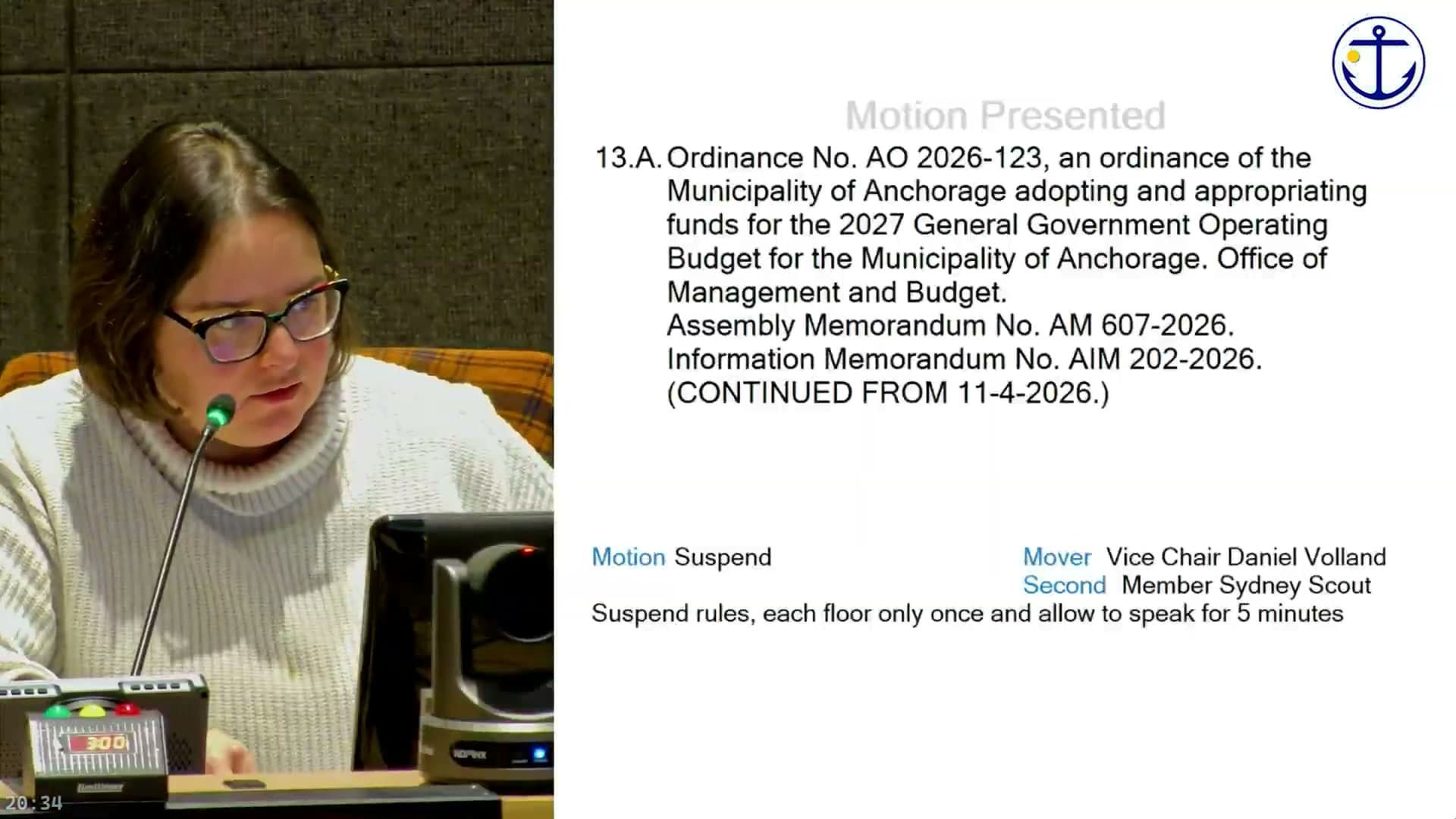
No audio detected at 0:00
No audio detected at 2:00
No audio detected at 4:00
No audio detected at 6:00
No audio detected at 8:00
No audio detected at 10:00
We will get started in a couple minutes, everyone.
No audio detected at 12:30
No audio detected at 14:30
Okay everyone, we're going to call this meeting to order. Good evening. Today is, uh, Tuesday, November 17th. This is our regular assembly meeting. Uh, we are gathered here for that business, so I will turn to the clerk to call the roll.
Member Handeland. Present. Member Martinez. Present. Member Girdwood.
Here. Member Silvers. Here. Thank you. Member Perez-Verdia.
Here. Chair Brawley. Here. Vice Chair Volland. Happy to be here.
Member Baldwin Day. Present. Member Scout. Present. It's my understanding that Member McCormick is excused.
Yes, he wanted folks to know that he is currently with a family member at the ER and apologizes that he can't be here this evening.
Member Park? Here. Member Johnson? Here. And Student Representative Ali?
Here. Chair Brawley, you have a quorum. Thank you. Next, we will do the Pledge of Allegiance. Member Johnson, will you please lead us in the pledge?
It is my honor, Chair.
I pledge allegiance to the flag of the United States of America and to the Republic for which it stands, one nation under God, indivisible, with liberty and justice for all.
Thank you. Next, Ms. Baldwin Day, will you please read the land acknowledgment? Yes, Chair. A land acknowledgment is a formal statement recognizing the indigenous people of a place. It is a public gesture of appreciation for the past and present Indigenous stewardship of the lands that we now occupy.
It is an actionable statement that marks our collective movement towards decolonization and equity. The Anchorage Assembly would like to acknowledge that we gather today on the traditional lands of the Dena'ina Athabaskans. For thousands of years, the Dena'ina have been and continue to be the stewards of this land. It is with gratitude and respect that we recognize the contributions, Innovations and Contemporary Perspectives of the Upper Cook Inlet. Dena'ina.
Thank you. Next, we'll move on to minutes of previous meetings. We have two sets of minutes tonight. That is the regular meeting of October 6th and also the continued regular meeting, which was continued from October 6th to October 7th. Is there a motion?
Move to approve the minutes. Second. Motion to approve both sets of minutes by Mr. Bowen, second by Ms. Baldwin Day. Any further discussion or changes to the minutes?
Any objection to adoption of the minutes as printed?
Seeing and hearing none, uh, both sets of minutes have been approved. Next, we'll move on to the mayor report. Uh, Madam Mayor. Thank you, Chair Brawley, and good evening everyone. Tonight, assembly members, you have an important job ahead of you, setting the municipal budget for the coming year.
We all know we are budgeting in a fiscal constrained environment. We have limited revenue and we are responsible for providing critical services that sustain our community. The cost of providing these services continues to rise and the needs of our community have changed over time. I want to remind members of the public that our tax cap limits how much the municipality can collect in property taxes and is adjusted each year based on inflation and population growth. However, inflation is calculated using a 5-year rolling average.
Costs often change more quickly than that. Today, many of our expenses are increasing faster than inflation. Healthcare costs alone are expected to increase by at least $3.6 million next year. When fuel costs rise, every ambulance, patrol car, fire engine, and snowplow becomes more expensive to operate. Tariffs and broader economic pressures have also increased the cost of construction materials, equipment, and supplies.
In many ways, the municipality is facing the same financial pressures that families and businesses feel every day. It's also important to remember that when Anchorage adopted its tax cap in the 1980s, the municipality received tens of millions of dollars annually from the state of Alaska for community revenue sharing and capital projects. That support largely disappeared over time, but it took an especially sharp drop in the mid-2010s. I think all of us wish we could go back in time and change those budgets coming out of the legislature to restore revenue sharing to the municipality. As a result, we find ourselves facing difficult fiscal choices.
We have already made tough decisions this year, and there will be more ahead. But I believe they are challenges we can work through together as a community. My proposed 2027 budget included targeted reductions to vacant positions and adjustments to contracted services, while also relying on one-time funding to close a large budget gap. Tonight, our S version of the operating budget would reduce funding for the mayor's community grant program and instead use those funds to provide public transit service and support the Anchorage Senior Center. Assemblymember Martinez originally proposed funding transit service on 7 holidays.
While we would love to provide that level of bus service, doing so would cost more than half a million dollars annually. Instead, we're directing this funding to public transit to keep routes operating on 3 holidays, prioritizing days when many municipal employees are off. But many private sector employees are still expected to be at work. Though the final days have not yet been selected, our goal is to focus on holidays that currently create barriers for residents trying to get to work. With such high gas prices right now, this is especially needed to help keep our community affordable for all residents.
Tonight you'll also see an amendment to strengthen emergency medical services across the municipality. From Girdwood to Chugiak, demand for EMS has grown a lot over the past decade, and our first responders are being asked to do more than ever. This proposal would fund an additional ambulance and the personnel needed to staff it around the clock while also providing support for improved emergency services for residents across our entire community. It would create a dedicated funding source to replace ambulances on a regular schedule rather than relying on bond financing. Specifically, the amendment would shift ambulance replacement from a bond-funded model to a voter-approved levy, creating a predictable replacement schedule and allowing us to pay for routine replacements as we go rather than financing those purchases through long-term debt.
I want to recognize Director Ona Brause and her phenomenal OMB team for all their hard work during this budget process. And I also want to thank the assembly for their hard work and partnership as well. After the budget is our proposal for a new property tax incentive to encourage mixed-use multifamily development, improve housing affordability, and create new jobs in both construction and operations of these new developments. This tax incentive will help encourage developers to turn underused commercial properties into vibrant mixed-use buildings.
Lastly, with the election results all but in, we are preparing to say goodbye to Member Johnson as he begins an exciting new chapter serving as our next Lieutenant Governor. Zac, it has been a pleasure working alongside you. You have done an outstanding job representing the residents of District 6 on the assembly. You show up, you listen, you do the work, you legislate from a place of service to community and helping people. I appreciate your unwavering commitment to transparency, honesty, and integrity.
You've done a lot of good here at the municipality, and your absence will be notable. But since we're losing you, I'm glad it's to service to our state, because you'll be able to have a greater impact and do more good for more people. Thank you for your service to Anchorage, Zac, and for your commitment to your constituents. Congratulations. We wish you all the best and look forward to working with you in your new role.
That's all for now. Back to you, Madam Chair.
Thank you. Next, we'll move on to the chair's report. First, I, uh, because it's Timely, and I certainly know there's, um, we'll have a lot of feelings by the end of this meeting for sure. But following up on the mayor's remarks just now, and for the good of the order, I'll note for everybody that we will be taking up, uh, Member Johnson's resignation letter tonight and, uh, talking about the next steps, uh, related to, uh, filling that seat. Uh, so you, you won't hear me read it into the record until later this evening, but we do have a resolution related to that letter, and so we plan to get to it.
No audio detected at 26:00
But first we have to get through the budget and some other critical business items, uh, while Mr. Johnson is still a member. So, um, so just to note, uh, we will come back to that, um, and I want to underscore the mayor's remarks, but we will have a little time for that at the end of the meeting. Um, if we are getting to, uh, 11:15 or 11:30 or so, or really toward the end of the meeting and we're still in the middle of an item, uh, and we have a number of things on our agenda, I'll ask folks to please, um, uh, set us— we'll be setting other business aside so that we can make time for this before the meeting ends, because of course at at most we go till midnight, uh, if not, uh, earlier. So just as a heads up for that. And then I'll also note, again, we'll talk about this at the end of the meeting, but we do anticipate a special meeting to be scheduled for Friday, December 18th, um, mostly related to this, uh, topic, but also if there's any time-sensitive contract approvals or year-end business that we have to get to that we aren't able to do by the end of our last regular meeting of the year, which will be December 15th.
So more on that soon. Um, so turning back to our business in the meantime, tonight is the final public hearings on the 2027 budget. That's 11 items, 11A and then 13A through G on the agenda. So after those hearings, the assembly will be debating and voting on amendments primarily to the operating budget and then the capital budget, and then we'll be voting on each of those items. As a reminder, the budget is actually 8 items on our agenda, uh, although most of the focus will be on again the operating budget, which is 13A.
And that's what we'll start with. This will take up a big portion of the meeting tonight, or at least a significant chunk. It's one of the most impactful things we do as assembly members is tonight. So I want to thank all the members for your thoughtful engagement during this process, especially during our budget amendment work session and all the legwork you've been doing over the last several weeks. And I also want to echo the thank you to the administration, the OMB team, department directors, and others for putting together in-depth presentations.
Helping answer member questions. And, uh, just to note that, uh, you've put a lot of time and energy into this process as well, so we appreciate your, uh, professionalism and dedication to this process. Also want to say once again a shout out to our budget analyst, uh, Miss Molly Rochet, who is going through her first budget process, uh, is not new to budgeting but is, uh, taking on a big job with this. So, uh, thank you again to Molly. And then finally, I want to thank everyone who from the community who has participated in this process by testifying submitting emails and attending, uh, events like our Fiscal Future Summit and the budget education, uh, workshops that I know my colleagues have been holding as well.
I know it's not easy to navigate our budget process, but it is much more effective when residents get involved and give us feedback. Uh, so a couple other things about tonight's agenda. We do have our long list of business items. We do anticipate that this will be the case through the end of the year. We have two regular meetings after this one, and as I said, one special meeting, uh, that will be short for shorter and focused on a couple time-sensitive items.
As was previewed to members earlier today, we plan to prioritize the budget first, then address a few time-sensitive items and items, uh, that are marked for postponement, and then we'll continue through the rest of the agenda as printed. I don't anticipate that we will get through all these public hearing items, so if something is toward the end of the list, it's likely to go to December 1st, or sponsors of items can ask for postponements further out, which gives a little more certainty to the public. But we will get as far as we can as quickly as we can. So I'll also share next week is the Thanksgiving holiday. So the municipality will be closed on Thursday and Friday of next week during business hours.
I hope everyone has a restful break and it's filled with quality time with friends and family, good food, and maybe some playtime in the snow. Now that we have snow out there, if you're looking for a volunteer opportunity or a way to share resources, there are several groups organizing dinners for people who need extra support around the holidays. And of course, financial donations or physical donations to food service agencies are always welcome to make sure that everyone in our community gets to celebrate this holiday and has a good meal on Thanksgiving. So with all that, I'll do my best to move us through tonight's agenda so we can conclude at the most reasonable hour possible. This is a business meeting.
We're here to do the work of the municipality. Please help create a climate of respect in the chambers. Please refrain from personal attacks, speaking out of turn, shouting, clapping, and pacing. Please keep signs to 8.5 and 11 inches by side in size. Please keep the aisles clear except when you're lined up to testify.
Please don't approach the dais directly. If you do have something to share with members, please hand it to the clerk at the lower dais for distribution. Please stop speaking if a point of order is called so that I can rule on the point of order and the record is clear. And if rules are not followed, I may interrupt speakers to call for compliance. If compliance with the rules doesn't occur, then I may have to pause the meeting.
If there's an actual disruption, I will give a warning, and if this disruption persists or happens again, the person will be asked to leave. And then I'll save the, um, notes on public testimony when we get to hearings. But lastly, I'll note, um, that if there's any students in the audience here for a class, um, I know there's often folks out there during the school year, uh, if you want to stick around till our dinner break, uh, in an hour, a little more than that, uh, then, uh, you can come up and, uh, we'll ask you to share your name, your school, uh, what class you're in And then if you do need a signature to verify that you were here for a class, you can find us during the break and we can take care of that as well. So I believe that's all the items in our report. And as I said, we'll deal with agenda order a little bit later.
So next we'll move on to committee and liaison reports. So I will start this evening with Mr. Handeland. Nothing to report. Okay. Mr. Martinez.
Thank you, Chair. The next meeting of the Housing, Community and Economic Development Committee will meet Thursday, December 3rd, so we will have a meeting before then. And tomorrow I'll be sitting on a conference call with the Large Urban County Caucus of the National Association of County Organizations as they start to gear up some education around climate resiliency, particularly with respect to El Niño and La Niña and what the impacts would be to some of our— the western region. Thank you, Chair. Okay, next, Mr. Girdwood.
No items, thank you, Chair. Uh, Ms. Silvers. No items, thank you. Mr. Perez-Verdia. No items tonight, thank you.
I didn't mean no items, no report tonight, thank you. Yeah, I was just following along. Uh, so no, no, no committee items. Uh, okay, next, uh, Vice Chair Volland. Thank you, Chair.
The Budget and Finance Committee, previously scheduled for Thursday, November 19th, uh, has been canceled. Um, but fear not, we will be discussing a lot of budget things this evening. Thank you, Chair. Okay, Miss Baldwin Day. Thank you, Chair.
Uh, the Audit Committee that was scheduled for tomorrow, uh, it will be rescheduled actually, or where we will not be having an Audit Committee meeting this month. Um, the next Audit Committee meeting will be the 16th of December. Um, that is due in large part to the fact that I'm, uh, traveling to the National League of Cities conference and will be leaving tonight very, very late. So thank you. That's all for me.
Okay. Next, Ms. Skarbek. Yeah. The Energy Enterprise and Utility Oversight Committee of the Whole met on November 12th from 10:00 to 11:30. We reviewed our agreements regarding Eklutna, plus updates on the study and public meetings about pump storage hired hydro.
We also discussed progress on the stormwater utility and the energy security and resilience plan. Our next meeting is on December 10th from 10 to 11:30 AM. We'll discuss waste-to-energy and opportunities for intergovernmental collaboration across Southcentral Alaska regarding the energy cliff. I also got to attend my first Visit Anchorage board meeting as a liaison to that board on behalf of the assembly. We had a great conversation about all of the wonderful work they're doing to advance tourism in Anchorage and had a good discussion about their thoughts around the TIPS funding that we will probably discuss later tonight.
Thank you.
Okay, and next, Ms. Park. Thank you, Chair. Um, the legislative committee met on November 6th. Um, we discussed the upcoming legislative year. We are submitting our legislative program this evening, and the next meeting will be Wednesday, September— December 2nd from 1 to 2.
Okay, and next, Mr. Johnson. No report, Chair.
Okay, that takes us through reports. Um, then we'll move on, uh, the addendum to the agenda, which includes our late on the table items. We have several this evening, so we will take care of that, and then we will incorporate the addendum.
Okay, uh, so I will read, uh, there's a number of essentially supplemental items. There's a couple items for introduction, and then there's two resolutions, uh, that need, uh, seven votes. So I will do the supplementals first, which just require reading, then we'll do the introduction of one item, and then we'll do the resolution. So the first one that I have is the S version of AO 2026-123. That is item 13A and is the S version of the operating budget.
We will come back to that one soon. Uh, next I have an AIM unnumbered 2026, uh, associated with 13K, which is AO 2026-130, an ordinance of the Anchorage Assembly submitting to the qualified voters of the Municipality of Anchorage a ballot proposition amending home rule charter to provide for the election of school board members by district. Uh, it's a couple of items attached there. And, uh, next we have, uh, the S version for item I believe it's— hold on one second.
I think it's 13P. Yes, item 13P. So this is AO 2026-139 S version, an ordinance of the Anchorage Municipal Assembly amending Anchorage Municipal Code Section 28.30.030 to require residency disclosure and verification for candidates for mayor, assembly, and school board offices. I believe those are the supplemental— oh, and then there was also unnumbered AIM 2026, which will be 10F5, and that's administration and municipal clerk's answers to Assembly questions.
So that takes care of the supplemental items. The next item I'm going to read into the record is for introduction. Make sure I have it. So that is unnumbered AO 2026, unnumbered. It is an ordinance of the Anchorage Municipal Assembly waiving the policy restriction in Anchorage Municipal Code Section 1.80.020 to naming or renaming a public place in honor of a person no earlier than 36 months posthumously for certain naming recommendations.
No audio detected at 37:00
So that one is for introduction, so it just needs a first, second, and third. Is there a motion? Move to introduce. Second. Third.
Okay, there's a motion by Mr. Bowman, second by Miss Baldwin Day, and a third by Miss Scout. So that one has been introduced, and then that one, the public hearing is set for December 1st.
And I'll also note that's related to an item that's already on the December 1st meeting, and that was the rationale for timeliness. So it needed to be introduced ahead of time. So then we have two additional resolutions for introduction that are not currently on our agenda. So the first one is AR-2026 unnumbered, a resolution of the Anchorage Assembly adopting the 2027 state legislative program for the Municipality of Anchorage. Anchorage.
So is there a motion? And to note, this is a move to lay on the table, and then because it's a resolution, it needs 7 votes, and it would be included in the consent agenda so it can also be pulled for further discussion. So moved. Second. Madam Chair?
Yes, Mr. Girdwood? I may have a disclosure to make on the legislative program. Should I do that now or do that later? Yeah, please go ahead. Okay, um, so I work So, oh, one second.
Okay, the clerk advised that we should do the disclosure when I believe this item will be pulled, so we can do it at that time. But this, it would be in order for you to lay it on the table. Okay, so we have a motion by Ms. Park, second by Mr. Vohland to lay this on the table. Mr. Perez-Verdia. Yeah, if I could just have a rationale for why it needs to be laid on the table tonight.
Yeah, thank you. I can provide that. So this is our annual legislative program. The code requires that we introduce this item before the budget is voted on, and then it must be passed by December 10th. And for whatever reason, that's what's in the code.
And so the intent was to get this on the addendum this evening, but we were not able to do that, and we are legally obligated to introduce this before we vote on the budget. Thank you. Okay, thank you. Um, so I'll ask, is there any objection to laying this item on the table?
Okay, I don't hear any. So this will be item— so this is, uh, laid on the table. This will be item 10B3, and again, it can be pulled from the consent agenda, and I believe that's the intent for this evening. So, uh, then, then we'll move on to the next item, which I also can speak to. So that is AR 2026, unnumbered.
This is a resolution of the Anchorage Assembly approving the establishment of an official sister city relationship between the Municipality of Anchorage, Alaska, and the City of Recife, Pernambuco, Brazil. Move to lay on the table. Second. Okay, there's a motion to lay this on the table by Mr. Bullen, second by Miss Baldwin Day. And then I can speak to the timeliness.
Ms. Brawley. Thank you. So this item is being laid on the table. The intent is to ask the body to actually postpone this until February. So this is not necessarily for action tonight.
This is a longstanding multi-year effort by some folks to, to recognize this as a sister city. However, the person, uh, so the person who is named in this resolution is actually traveling to, traveling to Brazil I committed to at least attempting to get this introduced. We meant to get it on the addendum and didn't, but then also the intent is not necessarily to take action, but to take this up in the winter when, when this individual is back in country. So the rationale is to at least lay on the table. If we are not wanting to lay it on the table tonight, then I'll submit it through the regular meeting process for a future meeting for introduction.
Okay, seeing and hearing none, then this will be item 10B4. Um, and as I said, um, the intent is to pull this item as well. So I believe that is all of our items for laid on the table.
Checking one more time, and then as I said, there is one additional item that we will take up later in the meeting that is— that members have a copy of, but we will not read into the record at this moment. So with that, then we will move on to incorporating the addendum to the agenda including late on the table items. Is there a motion? Move to incorporate the addendum to the agenda including the late on the table items.
Okay, motion by Mr. Bowen to incorporate, second including late on the table, and I heard a second by Ms. Park. Um, is there any further discussion on this?
Any objection to incorporating the addendum, uh, as presented?
Okay, seeing and hearing none, then the addendum has been incorporated and the late on the table items into the agenda. And again, some items have been put in the consent agenda and can be pulled for further further action. So next we will move on to appearance requests. We don't have any appearance requests, uh, noticed for this evening, so we'll move next to the consent agenda. So we will start, um, and have folks pull items on the consent agenda.
So I will start this evening with Mr. Johnson. No items, Chair. And next, Ms. Park. 10B3. Okay, 10B3.
Uh, next, Miss Scout. No items, thank you. Miss Baldwin Day. 10A3, please.
Okay, 10A3. Uh, Mr. Volland. Thank you, Madam Chair. 10B4 and 10E5. Okay, 10B4, Mr. Volland, and 10B5, Mr. Volland.
Yeah, E5, sorry. Um, Okay, uh, next, Mr. Perez-Verdia. Thank you, Chair. No items tonight. Okay, Miss Silvers.
No items, thank you. Mr. Gerker. 10 Alpha 1.
10A1.
Okay, and Mr. Martinez. 10F2. Okay, 10F2. And Mr. Handeland. 10D4.
Okay, 10D4. Madam Chair? Uh, yes, Mr. Johnson. I, I did actually have an item to pull, 10A2. Okay, thank you.
Just checking on that one. Okay, thank you. So 10A2, Mr. Johnson. So I will read the list back. So I have 10A1, Mr. Girdcker, 10A2, Mr. Johnson, 10A3, Miss Baldwin Day, and then 10B3, Miss Park, 10B4, Mr. Boland, 10D for Mr. Handeland, 10E5 Mr. Boland, 10F2 Mr. Martinez.
Uh, am I missing any items?
Okay, seeing and hearing none, um, then, uh, consider those items pulled, and then, uh, then I'll ask for a motion to approve the consent agenda minus the pulled items. So moved. Second. Okay, motion by Mr. Bohlen to approve the consent agenda minus the items that have already been pulled. Second by Mr. Gerker.
Any further discussion on this?
Any at all? Okay, any objection to adoption of the consent agenda minus the pulled items?
Okay, seeing and hearing none, then we will consider the consent agenda adopted. As a reminder, um, uh, for any— anyone who was here for any item that was not pulled from the agenda, um, then you can consider this item unanimously adopted, and so we will not be taking it up further this evening. So next, let's move on to our recognition resolution. So that is 10A, the 10As. So starting with 10A1, Resolution AR-2026-332, a resolution of the Anchorage Municipal Assembly recognizing November 20th through December 20th as Survivors of Homicide Victims Awareness Month.
This item was pulled by Mr. Girdwood. Move to approve.
Second. Okay, motion by Mr. Girdwood to approve, second by Mr. Handeland. Is there any objection to— or I guess, is there any discussion on this item? Any objection to adoption? Okay, seeing and hearing none, then we will consider this unanimously adopted.
And I believe we have Mr. Girdwood reading and Mr. Handeland presenting, so please proceed. Okay, a resolution of the Anchorage Municipal Assembly recognizing November 20th through December 20th as Survivors of Homicide Victims Awareness Month. Whereas, um, I don't know if we have anyone receiving this evening, and I'm going to ask if Mr. Handeland, if you wouldn't mind reading this item. Thank you. Yeah.
No audio detected at 46:00
A resolution of the Anchorage Municipal Assembly recognizing November 20th through December 20th as Survivors of Homicide Victims Awareness Month. Whereas losing a loved one to homicide is one of the most traumatic events a person can experience. And whereas homicide victims are loved and grieved by family members, friends, neighbors, classmates, colleagues, and communities across the country. And whereas the people negatively impacted by the trauma of homicide go beyond the family and friends of the victims to include bystanders, public safety, and court personnel jurors, and journalists. And whereas homicide may also lead families to incur expense they can ill afford, such as funeral costs and lawyer fees.
And if the victim was a breadwinner, families may have to deal with the financial insecurity, housing insecurity, or homelessness. And whereas, according to the Department of Public Safety Crime in Alaska 2025 report, A total of 44 murders were reported in Alaska, down from 51 in 2024. And the Anchorage Police Department reported 51 homicides in Anchorage in 2025, down from 56 in 2024. And whereas Alaska's Homicide Memorial in, um, Chugach State Park currently has 571 names engraved of innocent victims of homicide throughout Alaska, whose names are read at an annual ceremony that include families of the victims; and whereas survivors, advocates, and providers are working to implement equitable and effective community-based responses to homicide victims; for justice, a statewide organization established in 1985 served hundreds of individuals each year; and whereas Victims for Justice provides a homicide grief group open to anyone who has lost a loved one to homicide in Alaska, regardless of where the family now resides, which meets on the second Tuesday of every month from 6 to 7:30 via Zoom. Now, therefore, the Municipality of Anchorage honors Survivors of Homicide Victims Awareness Month and expresses support to survivors of homicide victims.
No audio detected at 48:00
To all survivors of homicide victims in Anchorage, you are not alone. Your community joins you in your pain. Passed and approved by Anchorage Assembly this 17th day of November 2026.
Yeah, thank you. I know it's a heavy topic and I don't believe we have anyone here to receive it, but if— oh, I'm sorry, I'm sorry. Please come forward.
Yeah, thank you for being here.
And I'll say, Miss Miller too, if you would like to say any words, you're welcome to. You're not required to. And sorry for not realizing you were here earlier.
And then the microphone, you just need to turn the button on, and when it's green, then you can speak.
There you go. Mayor LaFrance and Assemblymembers, thank you so much for reading the proclamation. At Victims for Justice, we are so grateful to be able to walk beside the survivors of homicide victims, and the proclamation really just reflects that these homicide victims really create a wake in the community. It's not just the homicide victims themselves, but their family members, their classmates, their colleagues, and It really impacts the entire community when one person is killed as a result of homicide. Thank you so much for reading the proclamation every year.
At Victims for Justice, we really appreciate your support for crime victims across the Anchorage municipality and being able to provide services for them in terms of burial relief and emergency relocation in case they're— they need to relocate due to the crime. So thank you so much for recognizing this every year and your support for victims and the Anchorage residents. Thank you. All right. Thank you.
Okay. Yeah. Important, important, heavy topic. Next, we will move on to our second recognition resolution, and that is AR 2026-333, a resolution of the Anchorage Municipal Assembly recognizing November 20th as Transgender Day of Remembrance. This item was pulled by Mr. Johnson.
Move to approve. Second. Motion by Mr. Johnson to approve, second by Miss Erin Baldwin Day. Um, is there any, uh, further discussion on this item?
Any objection to adoption of this item?
Okay, seeing and hearing none, this item, uh, has been unanimously adopted. I believe we have Mr. Johnson reading and Miss Park presenting, so if you're here for this resolution, please come forward.
Whereas, Transgender Day of Remembrance is an annual observance on November 20th that honors the memory of transgender, non-binary, and gender-expansive people around the world whose lives have been lost to anti-trans violence. And whereas, Transgender Day of Remembrance was established by Gwendolyn Ann Smith in 1999 to honor Rita Hester, a transgender woman of color who was killed in 1998 Erin Baldwin Day, and other transgender people whose lives were lost to anti-trans violence. And whereas, Transgender Day of Remembrance provides a forum for the transgender and gender-expansive community and allies to raise awareness of the threat of violence faced by transgender people and the prejudice and discrimination that they face in their daily lives. And whereas, since 2013, at least 400 transgender and gender nonconforming persons have been victims of fatal violence in the United States, at least, because deaths often go unreported or misreported. 70.4% Were people of color, 82.3% were transgender women, and 59.4% were Black transgender women.
No audio detected at 52:30
These numbers do not include deaths by suicide, poverty, and the many other ways that transgender lives can be cut short. And whereas violence against transgender people, particularly Black, Indigenous, and Latina transgender women, is a systemic and societal issue that we must collectively commit to acknowledging and ending. And whereas transgender persons frequently experience discrimination and are disproportionately affected by hate crimes, violence, high levels of unemployment, homelessness, and barriers to accessing adequate quality healthcare. And whereas we recognize and honor the bravery and resilience of Anchorage's transgender and gender-expansive community, our family, friends, neighbors, and colleagues who live, work, and play in Anchorage as their authentic selves, desiring nothing more than to be treated with the respect and dignity that they deserve. Now, therefore, the Anchorage Assembly resolves to recognize November 20 2026 as Transgender Day of Remembrance, passed and approved by the Anchorage Assembly this 17th day of November, 2026.
No audio detected at 53:30
No audio detected at 54:00
Thank you. And I know we have a big group, but I'll ask if anybody would like to make brief remarks, please feel free. Probably not everybody. Sorry. Yeah.
And then if you want to press the microphone button when it turns green, you can speak. So please go ahead and make sure to put your name on the record.
Hello, my name is Jessica Kusner-Klarczyk, and I would just like to address the assembly, Mayor LaFrance and Assemblymember Johnson, for this is a huge and brave thing that you guys are doing. We're seeing people in the trans community being targeted by, you know, in Alaska and around the country. And it is not a small thing.
And I on behalf, I think, of everybody behind me and hundreds of people that are afraid to come forward. Thank you. And this is no small thing, and it is appreciated by the greater community in Anchorage and Alaska.
Hello and good evening. My name is Gray Day. I'm a proud lifelong Alaskan and a member of the transgender community here in Anchorage. I'm also a proud drag queen. Even more proud to say, the first trans masc empress of all Alaska with the Imperial Court of All Alaska, which for those that don't know, is the eldest nonprofit LGBTQIA2+ fundraising organization here in the state.
Today I want to take a few— I don't want to say minutes, but a few moments to talk about something that I believe that deserves just more than a moment of silence. It deserves our attention, our compassion, and our continued commitment to one another. Knowing that November 20th is Transgender Day of Remembrance, We also need to know it's a day where we pause to remember transgender and gender diverse individuals who lives lives who have been because or who live lives who have been lost because of anti-transgender violence, hatred, and discrimination. It's a day to say their names, remember their stories, and acknowledge that their lives were taken far too soon. But I also think it's important to talk about why this day matters beyond the act of remembrance itself.
TDoR, or Trans Day of Remembrance, is a reminder that Behind every name is a person, someone who had friends, family, dreams, ambitions, and a story that deserved the opportunity to continue. They weren't just statistics. They were members of our communities. They were people who deserved to feel safe, loved, accepted, and valued for exactly who they were. And while TDoR is about remembering those that we've lost, it's also about recognizing those who are still here.
It's about the transgender individuals who wake up every day and continue to navigate a world who does— that doesn't always make room for them. It's about those who are still finding the words to understand themselves, those who are afraid to be open and about— or open about who they are, and those who simply want to exist without having to defend their identity. We cannot allow remembrance to be something that we only practice once a year. If we are going to honor those we've lost, we also have the responsibility to stand up for those who are still with us. That means challenging discrimination—.
Oops—. That means challenging discrimination when we see it, speaking up when someone's identity is disrespected, creating spaces where we feel safe and welcomed, and making sure that our actions reflect the values we claim to stand for. And perhaps most importantly, it means understanding that acceptance should never be conditional. Nobody should have to earn the right to exist, to be respected, or to feel safe in their own community. As an assembly and as members of the larger community, we have the opportunity to be a part of something bigger than ourselves.
We can be the people who make others feel seen rather than invisible, supported rather than isolated, and celebrated rather than simply tolerated. So this Tidor, we remember those that we have lost. We honor those who continue to fight for the right to live authentically, and we recommit ourselves to making a world where future generations of transgender folks have more reasons to celebrate their lives than to fear for them. May we remember their names, honor their stories, and never forget the work of remembrance is also the work of creating a better tomorrow. So thank you so much.
We appreciate you.
I'll make my remarks really quick. My name is Odd Plez, And I just want to thank Mayor LaFrance and the assembly, uh, for bringing attention to this. I've had the opportunity and the privilege and honor to be in community with each and every one of you and in the various capacities that I serve. And I just want to say that I appreciate you for always curating and making a safe space, because it makes it easier for others to come out and know that they matter and that their life is valued and that you guys will do everything you need to do to protect them. So thank you for your service, um, and I'm always in your corner, as I know you're always in ours.
Thank you.
All right, thanks everyone for being here. Next, we'll move on to our third recognition resolution, and that is 10A3 AR 2026-341, a resolution of the Anchorage Municipal Assembly recognizing November 2026 as Family Caregivers Month in the, in the municipality of Anchorage. This item was pulled by Miss Baldwin Day. Thank you, Chair. Move to approve.
Second. Okay, motion by Miss Baldwin Day, second by Mr. Martinez. Um, is there any further discussion on this item? Also ask, um, I know we, uh, is there anybody who would like to be added to this item?
Okay, or I guess I'll ask, does anybody object to being added to this item?
Okay, I don't hear any objections, so we'll get that updated. And then if you are here to receive this, please come forward, and then I'll ask, is there any objection to adoption of the resolution?
Okay, seeing and hearing none, this resolution is unanimously adopted. And so we have Miss Baldwin Day reading and Mr. Martinez presenting.
Thank you, Chair. A resolution of the Anchorage Municipal Assembly recognizing November 2026 as Family Caregivers Month in the Municipality of Anchorage. Whereas nationally, an estimated 59 million family caregivers help an adult family member, neighbor, or friend with daily activities, providing more than 49.5 billion hours of care during the year, exceeding a total economic value of $1.1 trillion. And whereas Anchorage's family caregivers are among the approximately 96,000 Alaskans who provide an estimated 88 million hours of care each year, unpaid care valued at more than $2 billion. Whereas the extraordinary efforts of these remarkable Alaskans sustain families, strengthen communities, reduce pressures on our health and long-term care systems, and improve the lives of thousands of our fellow Alaskans.
No audio detected at 1:00:30
And whereas family care— caregivers can face significant financial, emotional, and physical challenges. They do it all, from bathing, dressing, managing medications, preparing and serving meals, arranging transportation, coordinating appointments, and undertaking medical and nursing tasks, often with little or no training. And whereas nationally 9 in 10 family caregivers pay out of pocket to help meet the needs of those they are caring for, averaging $11,508 annually, about 31% of their household income, often while trying to balance paid employment and caregiving. And whereas family caregivers deserve our respect and gratitude and should expect common-sense solutions that save them money and time and connect them with support programs such as the Alaska Family Caregiver Support Program and the Anchorage Health Department's Aging and Disability, Disability Resource Center, which helps older adults, people with disabilities, and caregivers understand long-term care options, apply for benefits, and connect with services. Now, therefore, the Anchorage Municipal Assembly recognizes and celebrates November 2026 as National Caregivers Month.
Passed and approved by the Anchorage Assembly this 17th day of November 2026.
Yeah, and the microphone's already on, so please proceed.
Thank you. My name is Teresa Holt. I'm state director for AARP Alaska. I want to thank the assembly for this wonderful recognition of our family caregivers.
You saw the numbers in the resolution. That means we have probably over 60,000 family caregivers here just in Anchorage. But tonight, I'd like to think a little bit beyond those numbers and recognize the person who takes their mom to their appointments.
The neighbor who checks on an older friend, the spouse who manages medications, and sandwich caregivers who are trying to balance a job, young children while caring for a parent. These are Alaska's caregivers. In our lifetime, chances are we'll either be a caregiver, need a caregiver, or we will have been a caregiver. So thank you for this proclamation. And thank you to all the caregivers throughout Anchorage and for saying we see you, we value you, and the work that you do matters.
I'd like to invite all of you to attend a free caregiving event tomorrow at the Anchorage Museum, a showing of Ticket to Paradise, so people can— so caregivers can escape for a few hours. It opens at 6:30. Folks can come and learn about caregiving resources. And meet caregiving experts, and then leave the snow behind for a couple hours and escape to Baraga— Paradise, excuse me. And there will be special caregiver gift bags.
Um, thank you again for this resolution.
All right, thank you for being here.
Thank you. Uh, next we'll move on to, uh, our, uh, resolutions for action. So the next item is item 10B3, pulled by Ms. Park. Thank you, Chair. This, this is a resolution to adopt the legislative program for the municipality.
Before we get into the business, we'll just need a motion. A motion. Move to approve. Second. Thank you.
OK, there's a motion to approve this item from Ms. Jessica Parks, second by Miss Baldwin Day. Um, I'll ask, is the intent to postpone this item? It is. Okay, then I would recommend a motion to postpone. Move to postpone to the, the meeting of December 1st.
Second. Okay, um, and then I know, uh, before we proceed, so there was a motion to postpone this item to the meeting of December 1st, second, um, but Mr. Vohland, second by Miss Baldwin Day. Before we speak further to this item, I know Mr. Goecker also needs to give a disclosure. Yep, thank you, Madam Chair. I work for a nonprofit that has taken policy positions on some of the items broadly included in this legislative program that advocates at the state level, doesn't really do anything here in the city, but just want to clarify that, you know, I do work for a company that, that has contrary positions to some of the things in this program.
No audio detected at 1:05:00
Thank you. And so, I know— so you're full-time employed by this organization. Yeah. And so generally, we have— there's two types of conflicts. There's if there's a financial benefit or if you work for an organization that has taken positions on items.
And so I'm going to rule that this does constitute a substantial interest and therefore a conflict because of your relationship with the organization and the nature of their— taking positions. So, um, so then you would have a conflict on this item. Um, so if you don't mind stepping away just for a moment, and then I'm going to turn back to, um—. Madam Chair, I believe I also have a disclosure to make. Oh yeah, that is an excellent point.
Um, yeah, so, um, and, and so Mr. Johnson, if you can also describe, were you involved in the, the preparation of this? I was not. Okay, and then if you can just describe the nature of your conflict, as if we don't already know. Yeah, yeah, thank you. I, I will be moving into state office, uh, here shortly, and as this directly relates to, to the policy and the budget direction that the municipality is advocating for at the state level, I believe it has been the practice of this body that, um, it is best if people in that role recuse themselves from these decisions.
Yeah, thank you. And I'll just note, um, just for the record so it's clear also, uh, first that Mr. Johnson does have a substantial interest in this, so in a conflict, so So if you don't mind stepping away as well. And then I'll also just note for the record so it's very clear, this item has been discussed multiple times in the legislative committee, and both the members who are recused have also not at all participated in that process because these were known conflicts at the time. So with all of that, then I guess I'm going to turn back to Ms. Park because I know if you can speak to it. Thank you, Chair.
The intent of the legislative committee in bringing forth this program is to help Anchorage build infrastructure and protect what we have and thrive as a community. A number of these projects are incorporated, including housing, which we know is really important, improving our state road maintenance, for which we absolutely expect some help from the state, providing shelter beds year-round, increasing our natural gas supply, and restoring our defined benefit pensions to our state employees. So I, I would encourage all members to support these goals and Thank you. And if you could speak briefly to the postponement as well. I think the intent was not to take this up tonight.
No audio detected at 1:07:30
Thank you. As mentioned by the chair, it does have to be approved by the next meeting, and it will be postponed.
It has to be passed by the 10th, and it will be postponed.
I'm sorry, I forgot the date you gave.
The first.
Okay, okay. So again, the motion is to postpone this meeting or postpone this item to the meeting of December 1st. I don't see anyone else in the queue, so I'll ask, um, uh, is there any objection to postponement of this item to the meeting of the first?
Okay, seeing and hearing none. And of course, the two members that are recused are not included in that, uh, But otherwise, this has been unanimously postponed to the meeting of December 1st. And then I'll also note that this item, it will show up on our unfinished business. There is not a public hearing on this item, so we will take it up at that time at our next meeting.
OK, so that takes care of 10B3. Now we're back on to 10B4. This item— so this is—. Sorry. This is the— one second.
Okay. So this is 10B4, the still but will have a number AR2026, unnumbered, a resolution of the Anchorage Assembly approving the establishment of an official sister city relationship between the municipality of Anchorage, Alaska, and the city of Recife, Pernambuco, Brazil. This item was pulled by Mr. Boland. Thank you, Madam Chair. Move to postpone to the meeting of February 23rd.
Second. Okay, motion by Mr. Bolland to postpone to the meeting of February 23rd, uh, 2027. Second by Miss Baldwin Day. Do you want to speak to it further, Mr. Bolland? Sure.
Thank you, Chair. As you mentioned, uh, in your earlier remarks, this is something that has been talked about for, for some time. It's a longstanding project. I personally think it's very exciting.
I need to postpone this so I can take a vacation to Brazil first and make sure that— I'm just kidding. No, we want to postpone. Part of the reason we want to do that is to have a fulsome conversation about the process of potentially taking on a new sister city relationship. And I know that the chair has expressed, at least to some of the legislative staff and myself, a desire to have a work session, um, not only on this particular proposal but also just on sister cities in general and how our branch can be supportive of those relationships. So hope my colleagues, uh, will be willing to have that conversation and then take this up at a later date.
Thank you, Chair. Okay, thank you. Any other members' discussion? I don't see anyone in the queue.
Okay, then I will also ask him to discuss, uh, Sister Cities and to have a presentation about this particular proposal. So with that, we will move on to item 10D4, uh, that was pulled by Mr. Handeland. That is Assembly Memorandum AM 767/2026, Retiree Medical Funding Program Trust— Funding Program Trust Board Appointments. Mr. Handeland, move to approve. Second.
Okay, motion by Mr. Handeland to approve, second by, by Mr. Voland. Mr. Handeland. Yeah, I just have a couple questions for the administration on this. It looks like in the resolution it talks about two other individuals for the AFD representative that ran for it, but then a third individual that doesn't look like they won as being the person appointed.
So it says Andrew, I'm gonna butcher the last name, Provellino, and Terry Marquette ran for the AFD representative seat, but then it says we're appointing Richard Pari there, but that person doesn't look like they ran. Okay, and I'll turn to Mr. Falsey. Go ahead. Through the chair to Member Handeland, that is absolutely correct. The trust operates pretty autonomously, and I reached out to its trust administrator, Loren Bretz, earlier today, and he apologized and said, "Yes, that is a cut-and-paste error." He provided an updated certificate, which I circulated earlier over email, and then just ahead of the meeting, he submitted an AIM, which before the meeting is all over, we may also lay on the table to replace this certificate with the corrected item that does not mention Terry erroneously.
Okay. Thank you.
Okay. Thank you. Yeah, I think the intent will be to correct that. We don't have a print version of that item right now. I think we could set this one aside, but I would recommend that we— I guess either way, we can make sure that the record is corrected.
So we could also just say, The corrected version of this memo that I will read into the record later is intended to be the correct memo rather than— Okay. Actually, even better solution. So the unnumbered AIM that was informational and supplemental regarding assembly members to questions, that particular item was attached to it. So I am just going to say that we will associate that with with item 10D4 and consider that and make sure that when we actually get this all packaged up that it will have the correct memo. So, okay, I don't see anyone else in the queue.
No audio detected at 1:13:30
Okay, on a vote of 11 to 0, item 10D4 has passed the body. And again, I will note that the unnumbered AIM assembly— or answers to assembly member questions— includes the corrected memo. And so we will make sure that that is corrected in the record going forward. Listed permanently. Okay, next we have item 10E.5.
That is AR 2026-340, a resolution of the Anchorage Municipal Assembly appropriating a transfer in the amount of $150,000 from the area-wide general fund 101000 to the operating projects committed general fund, uh, 190000 for election costs including special elections, mayoral runoffs, and election equipment, all within the assembly. Assembly. This item was pulled by Mr. Volland. Move to approve. Second.
Motion by Mr. Volland to approve, second by Erin Baldwin Day. Mr. Volland, do you want to speak to it? Uh, yes, thank you, Chair. I pulled this on your behalf. This is your project and just want to give you the opportunity to speak to it, Ms. Brawley.
Okay, thank you. Um, just very briefly, I want to explain to members what this is. So one of the things that is not currently included in the Assembly's budget or in the new version of the budget that we'll take up shortly is a specific funding around the tune of $400,000 to $450,000 typically for a runoff election during what is going to be the mayor's race cycle in 2027. We can't predict at this time if there will be a runoff, but we need to budget for it, and this is not something that we can take up during first quarter budget revisions, which happen at the end of April. If there is going to be a runoff, we will know that well in advance.
No audio detected at 1:15:30
And so rather than trying to fit that into our budget, or rather the clerk's budget, every 3 years, because it is a large amount Um, in the past it's been done as a, a one-time that rolls out of the budget. This proposes two things. First, to create a fund, uh, again, within the clerk's budget for the purpose of administering, uh, special elections, uh, runoff elections that we know happen or, or can happen every 3 years, or, uh, any other major costs related to election, uh, equipment and supplies, uh, which is outside of the normal budget. So it creates that fund and then it appropriates a portion of the fund— of the total funding needed from the existing line in our budget that we do not anticipate using in 2026. And so this is proposing to kind of take the first step in that process, and then going forward, the intent is to make sure that that is cared for annually and that there's a regular way to fund those things every year rather than having to find time every 3 years.
So that is the intent. And then you'll see another appropriation coming forward at the end of the year once we have a better idea, uh, what our leftover funding is going to be in 2026 and working with the administration, OMB, to look at other lapsed funding that we might need to use for that purpose. So that's the idea, and we can have more discussion about that, um, if folks are interested, uh, but otherwise that's the plan right now. Ms. Park. Thank you.
Um, if it, if it happens that that money is not used, does that go back in the general fund or does that stay stay, uh, already appropriated? Good question. So a project fund holds the funding, uh, in a specific place, and I think what we've talked about for 2027, uh, the clerk has, has let assembly leadership know that there's likely going to be a substantial need to replace some equipment by the end of the year. And so I think, um, if, if a runoff is not needed, then we would look to use that funding again for election purposes. And then going forward, um, that is part of the reason to only do partial funding year over year, because they you don't end up with a big chunk of funds that is not going to be utilized all at once.
No audio detected at 1:17:30
Thank you, Chair.
Okay, any other questions? I don't see anyone in the queue, so members may proceed to vote on this item. And how does the youth member vote? Yes.
On a vote of 11 to 0 and the youth member, uh, votes yes, then this item has, uh, passed the body. So we'll move on to our last consent agenda item this evening, that is item 10F2, uh, that is AIM 209-2026, uh, subject contracts awarded between $50,000 and $500,000 through formal competitive processes for the month of October 2026. This item was pulled by Mr. Martinez. Move to accept. Second.
Second. Okay, motion to accept by Mr. Martinez, second by Mr. Voland. Mr. Martinez. Thank you, Chair. I just had a question for the administration.
Someone can answer, uh, around the Northern Gravel Trucking contract, specifically as it relates to the timing of this contract. It, it essentially seems that there were several months without a contract in place. This was brought up at the Basher Community Council as well, and the subsequent contract that went back into effect was essentially the same contract. So what was the pause? What was the reason for the gap in contract services?
Why did it take so long? Where was the— was there a problem there somewhere?
Through the chair to Member Martinez, I'll invite our Public Works Director to field that question.
Through the chair to Member Martinez, it'll be a short answer. I'm sorry, I don't know the answer to that. I will find out, but I can't tell you right now. Thank you, appreciate that. And just to let you know, they're extremely happy that they got the contract back.
They're extremely happy with the work that they get from the particular vendor. I just wanted to— I let them know that I would try to follow up on that as well. I will do that for you and get back to you this week. Thank you. Appreciate it.
Okay, I don't see anyone else in the queue, so members may proceed to vote on this item. This is accepting this into the record. And how does the youth representative vote? Yes.
Okay, on a vote of 11 to 0 and the youth representative votes yes on this item has been accepted into the record. So that takes us through our consent agenda items. And then I think before we break for dinner, we will do two things. The first is take care of order of the agenda. And then as a reminder, we have our student folks come up.
So I'll ask you to do— to come up after that. So Mr. Boland. Madam Chair, I move to change the order of the day to take up items in the following order: 13A through G, then item 11A, 15A, 14A, 13M, and 14B.
No audio detected at 1:21:00
And then the rest of items in their listed order. Second. Okay, there's a motion to change the order of day— the day. I'll read it back as follows, and I see it's up on the board as well. So we've got 13A through 13G, then followed by 11A, then 15A, 14A, 13M, 14B, and then essentially that takes us back to 13H, and we'll move through the rest of them in the order that's printed.
So again, that was a move by Mr. Bullen, second by Ms. Baldwin Day. Do you want to speak to it further, Mr. Bullen? Yeah, I'll just say members have in your email inboxes also a run of show describing this with rationales for why we're moving the various pieces.
One thing that leadership wants to do in partnership with the clerk is to try to— and we may not do this perfectly— but to try to give you similar heads up in the future when we have substantial changes to the agenda. Thank you, Chair.
Thanks. Uh, other discussion from members? Don't see anyone in the queue.
Okay, and then I'll also note for members of the public, um, I know we are moving things around. The budget is the first priority, but, um, we are optimistic that we will actually get through a number of these items, or at least get to the public hearings on these items. So the goal is to move quickly. And at least some of these items are very, um, well, I don't know if they'll be short, but we are thinking they might be, or at least not substantive discussion. So, okay, so I don't see anyone else in the queue, so I'll ask, is there any objection to changing the order as stated?
Any at all? Okay, seeing and hearing none, then we will consider the order changed. And again, the budget will be the priority. So before we break for dinner, then I'm going to turn to our students in the audience and ask if you would like to come up and introduce yourselves. So you're not required to, but it is nice when folks do.
Even if you're here to testify on another item, please come forward.
Way to be brave. Yeah, I can't guarantee extra credit for your class, but thank you for coming up. So if you want to turn the microphone on, that's the button on the bottom. Green, then you can speak. And again, just say your name.
Oh, just press it once and then the light will turn green. There you go. Say your name, what part of town you're in, and then your school and your— what class you're here for. Jeremiah Charek, uh, by South Anchorage High School, Service High School, that's where I go. Uh, seminar, Sogus's class for US Gov.
All right, thank you. Next person. I'm Keaton Dunlap. I also go to Service High School, South Anchorage High School, for Zogas's class and seminar for U.S. government.
I'm Eli Logan. I also go to Service High School. I live on the south side of town. And yeah, this is for U.S. government and Zogas's class. Okay, well, thank you for being here.
And thanks to all of our youth for being here.
Okay, so with that, we have gotten through our business, so we are going to take our dinner break, and I'm going to guess we'll be back about 6:45. And then of course the first priority is going to be item 13A, the budget.
No audio detected at 1:25:00
No audio detected at 1:26:00
No audio detected at 1:27:00
No audio detected at 1:29:00
No audio detected at 1:31:00
No audio detected at 1:33:00
No audio detected at 1:35:00
No audio detected at 1:39:00
No audio detected at 1:41:00
No audio detected at 1:43:00
It's all the same.
No audio detected at 1:47:30
No audio detected at 1:49:30
No audio detected at 1:51:30
No audio detected at 1:53:30
No audio detected at 1:55:30
No audio detected at 1:57:30
No audio detected at 1:59:30
No audio detected at 2:01:30
No audio detected at 2:03:00
No audio detected at 2:03:30
No audio detected at 2:05:30
Okay, let's get ready to come back to order. So I'll ask members to come back up. If anybody wants to continue conversations, I'll ask to just take them out in the hallway.
So I'm going to call us back to order.
Um, okay, welcome back everybody. We are now moving into our public hearings, uh, specifically on the budget. So As folks remember, we changed the order, so we're going to do 13A through 13G and then 11A, which is not a public hearing item, but it's the last item related to the budget. And before we get into our amendments and so on and open the hearing again, I'll do our usual reminders for public testimony. So for anybody who's here to testify on any of the public hearings this evening, when you come forward, please state your name, the community council, or area of the municipality in which you live, the be a district.
Uh, please stay on topic and direct comments to me or other people on the dais. I'll interrupt you if you're off topic. Um, individuals will have 3 minutes, community council representatives will have 5 minutes. Um, and then as a reminder, also public testimony is the public's time to speak. We usually don't answer questions during this period, but you might hear members address topics or seek more information during debate, so someone may ask you to answer a question later on.
But also, I know often folks ask questions and expect an answer, but that is not how our public testimony works. So with that, we will move to our first hearing. So I'm going to reopen the continued hearing on AO 2026-123, an ordinance of the Municipality of Anchorage adopting and appropriating funds for the 2027 general government operating budget for the Municipality of Anchorage. And then I will also note there is an S version of this. As well.
So if anybody would like to testify, please come forward. This is again the public hearing on the operating budget, which includes general government. It also includes alcohol and marijuana tax dedicated revenue. So anybody who's here to testify on any of that, please come forward. So I'll ask you to turn the microphone on, press the button on the bottom, and when the light turns green, it's on.
And then state your name, part of town. You'll have 3 minutes. Okay, good evening, Madam Chair and members of the assembly. My name is Laura Roark. I live in West Anchorage in District 3, and I'm the executive director of Anchorage Montessori School.
I'm here tonight to speak on behalf of the 35 early childhood educators that work for our program, the 190 children we serve, and the 300-plus parents who are confident enough in our care to join the workforce in Anchorage. Um, what am I ask today is that you reconsider allocating the marijuana tax funding, the $2 million, to other programs and keep it intact as it has been for the funding streams and the recommended budget by the ACCEE board. And I'll tell you why I think that is important. Um, we're coming up on 2 years of this funding, and it's already shrinking. Even the, uh, amount of funding has been shrinking, and stabilization— what this was meant for— only works if it is stable funding.
Our margins, as the director of a child care program, are razor thin. 78 Cents of every dollar that we bring in goes to staff salaries and benefits, and we can still not pay them a living wage. We cannot charge the true cost of care because families cannot afford— most families cannot afford to pay it. Public funding helps to fill that gap. But when funding shrinks every year and we don't know until November whether it will be there in January, no reasonable person would make a business decision based on that.
I can't give a raise, I can't hire a teacher or open a classroom on money that I might not have next last year. I'm not alone. Early childhood programs in the city, we do lean on each other. We share resources and ideas and advice whenever we can because we know how hard the work, the work is. Every director and educator that I speak with tells me the same thing, that this funding is essential.
Every day we fight to stay open, to keep good teachers, and to keep tuition within reach for families. And losing funding that we feel like is promised makes it all of that harder. And I want to speak for just the last second on early childhood educators. They're caring for our children during the most important part of their lives. 90% Of brain growth happens in these years.
They teach children how to use words, how to manage big feelings, how to get along with others. They support families. They notice early When a child needs extra help, they meet the licensing and safety requirements, all for wages that do not reflect what that work is worth. The programs have survived this far and are worth continuing to invest in. And if the funding keeps changing, we'll never have the data to show what the investment can do.
So I ask you again to please consider adopting the ACCE board's recommended budget Thank you very much. Thank you for your testimony. I'll also note, um, we had forgotten to start the timer, so we got as close as we could to 3 minutes, so you were still within your time. But sorry, uh, we try to be consistent here. So, uh, next person, please come forward, state your name, part of town, 3 minutes, and microphone is on.
Hello, my name is Kyle Milkey. Uh, I, uh, currently live in the Fairview Community Council. I am previous resident and member of the Eagle River Community Council. And I am also the chair of the Public Transit Advisory Board. I'm here speaking on public transit.
I appreciate all the interest from members of this great body on public transit. There's been a number of amendments and now the mayor's S version that touch in different areas of transit. And it's really great to see all of this interest and all this energy into putting energy and focus into the services that are provided. Provided. It is something that as a member of the Public Transit Advisory Board and also just as a member of the public, I've been long involved in, and it's great to see this renewed interest in, in that.
With the S version that got put forward with the budget, I'm really glad to see that there is funding for the holidays, especially the ones where it can provide that key service to holidays that the municipality observes that other places don't and provide for that, for access to employment, access to socialization, access to services. It's, it's really great to see that. That's something that, um, as a member of the Public Transit Advisory Board that we discussed with our previous resolution, uh, speaking to the resolution just as an individual member and not speaking on behalf of the, the board, um, it is It's really my hope that the proposed amendment that eliminates service to— on Route 92 that services public transit to Eagle River doesn't move forward. I understand that there's a lot of budget shortfalls all through our city and that funding could really do a lot of good for Sebersa. Living out in Chugiak State Park and Eagle River for while my family being from there, I really understand the— especially the asks that have been made for sidewalk plowing and stuff like that and how big of a financial burden that can have.
I've climbed the 5-foot boulders that sometimes pile up in the sidewalks and items like that, and it's, you know, it would make my heart happy to see that there, but it would really break my heart as someone— as a member of the public who lived in Eagle River, experienced 92, and like saw that it wasn't doing that like greatest service to the community members. And I joined the— my community council and then the Public Transit Advisory Board specifically in hopes to try and improve service to Eagle River. And as part of that process through the totem, I really tried to advocate for Eagle River and to get new projects added. And now to finally see what is that 5 years later with our new totem, to try and finally see some of those new projects being finally put before the general public. It would really break my heart if funding and service to that area got cut just in time.
Thank you. Thank you. Next person, please come forward. Microphone is on. State your name, part of town.
You'll have 3 minutes. Hello, my name is Jenny Stucky and I live in West Anchorage. I'm here tonight representing Campfire Alaska, one of the largest child care providers in the municipality of Anchorage. Uh, first I want to thank the assembly for all their work on the fiscal year 2027 budget and juggling the varying needs of our community. I'm testifying tonight to request that fiscal year 2027 municipal budget fully funds the community child care operating grants at $2.4 million, consistent with the ACCE Fund Board's official recommendation.
Campfire Alaska currently operates 18 licensed afterschool child care programs within the Anchorage School District. As one of the largest providers of licensed child care in the state of Alaska and here in the municipality, we are a magnified example of the sector. These operating grants are helping cover the cost of care, the gap between family fees and the actual costs to run programs are widening. Families cannot bear the increased costs for care, and financial assistance requests are up. In 2027, Camp Fire will award nearly $500,000 in financial assistance to families.
We are running a large deficit budget. Over the last month, We have gone through organizational downsizing and layoffs and are currently evaluating program viability. The loss of 47% of the operating grant funding will destabilize our existing child care programs. Nearly half of these programs operate in the red, and if we lose this funding, we will be forced to close programs in the next 1 to 2 years.
The ACCE board was formed to research, evaluate, and recommend the most critical areas of investment. After 3 years of research, community engagement, and evaluating child care investments, the board recommended fully funding operating grants at $2.4 million. The assembly should give significant weight to this recommendation. The proposed cut is substantial. Reducing the community operating grants by more than $1 million represents a 42.5% reduction in funding that helps existing child care programs stay open.
These grants are working. In 2025, nearly 200 Anchorage child care programs received operating assistance. Among 154 survey respondents, 97% said that funding was needed and helpful. Thank you for your consideration tonight.
Thank you. Next person, please come forward. Microphone is on. State your name, part of town. You'll have 3 minutes.
Thank you. My name is Maria Owens. I'm a resident of Mountain View, and I also have family and, uh, my nieces and nephews in Eagle River. I'm here today to ask you to vote no on Amendment 9. That's not because transit is above scrutiny, but that is because scrutiny is exactly what this amendment skips over.
PTAB had to add this— had to add their ask at the last minute because they only had 6 days to consider when— after this was proposed. Um, that's not for lack of opportunity, I believe. We had Transit on the Move staff attend 75 public events in 2025 alone, 3 of those in the Eagle River area. Um, any of those places at any of those times could have been opportunity for conversation, um, to bring this, uh, up about the 92. And Pardon.
No audio detected at 2:21:00
Eagle River's been asking for transit more or less for the last several years. That's through resolutions from their community councils. That's through their leadership, and that's through just regular residents. They deserve to have the same or similar services and to get them into town, especially those who don't have opportunity to ride. We just had the Week Without Driving in Anchorage, Alaska.
We saw really great responses. We had Eagle River riders. We had other riders who were first-time riders. The city has been moving in a positive direction with public transportation, and we've just hit record highs on diesel and gas. So this year alone, I think it would do a disservice to remove the 92 from our service.
And it also skips over what we already have in place through AMITS, through PTAB, through TOTEM. These are all opportunities that reach out to residents, ask for their input, and do studies with transportation. This skips over that and it carves out an amount that doesn't math out. The 92 costs approximately $600,000 or $700,000 to run. That's maybe 2% or less of the, the public transportation budget.
The ask is $4.3 million. I'm wondering where the other $3 million is supposed to go. And to a body that I don't see where they had a voice in this ask, and I don't see how they could use this funding even legally when they're supposed to just be working on streets and sidewalks. Thank you.
Okay, next person please come forward. Uh, microphone is on. State your name, part of town, you'll have 3 minutes. I'm Marie Mahana, I'm East Anchorage District 5. And tonight I want to, uh, congratulate you.
You guys have, have worked hard on this, um, but I, I want to talk about equality and fairness. Looking at the budget, you are actually valuing or disvaluing people by how much money you give them. I mean, this is, is, is what's happening, um, and, and, and it's— that's what you do fiscally. Everyone has needs. Elderly people need transportation.
Children need child— childcare and education. Workers need clean streets to get to work. Grandparents need a safe playground without needles and pills lying around. I actually carry Narcan in my purse in case I go to a park and my granddaughter picks up something that's been in touch with fentanyl.
Business owners need streets that you don't look out their, their businesses.
And see people shooting up on the corner. My point is, everyone has needs. I ask you to look at this budget in fairness with an eye as to how much you are proportioning for each person. I know it's impossible to say, okay, each person gets 20% or 5% or 0.2%, but please make sure that people's pet projects are not being addressed over everybody else's needs. And you are valuing or disvaluing people by where you put your money.
Thank you. Okay, next person please come forward. Um, I think the— press the button on the bottom to make sure the microphone is on so the light turns green. Okay, it's on. Uh, state your name, part of town, you'll have 3 minutes.
My name is James Proach.
I live downtown Anchorage, and this is my first time doing this. So good evening, Chair and Assembly members. My name is James Proach, and I'm testifying on the '27 operating budget and PeopleMover service. Please protect the daily lifeline route 92 and 51 from the proposed $4.2 million reduction. Instead of cutting essential routes or spending $600,000 on system-wide holiday service, we can run a targeted 3-holiday corridor pilot on a core route, capturing the 80% federal FTA match to collate the Muldoon Transit Center and library and fix urgent ADA snow clearing hazards at Brother Francis Shelter.
My full analyze— analysis and proposed PTAB resolutions are in your packet. Please protect People Mover tonight. Thank you. Okay, thank you. Next person, please come forward, state your name, part of town.
You'll have 3 minutes. The microphone is on.
Thank you. Good evening, my name is Randi Brager. I am the executive director of Awake, but also a citizen born and raised here in Anchorage and a resident of District 4. We serve people statewide, but 90% of those are Anchorage residents. I appreciate the conversation about municipal fiscal sustainability and the need to regularly evaluate our priorities.
I'm not asking for permanent funding guarantees for my organization, but I am asking for the funds to be spent in line with the purpose of the taxes that I personally voted yes to years ago, uh, in my previous roles in the nonprofit community. Just earlier this evening, this assembly passed a resolution recognizing survivors Homicide Victims Awareness Month. I'm sure everyone here recognizes the irony that the Assembly is both passing this resolution while also proposing significant cuts to organizations that work to prevent and respond to these homicides. Alaska has historically ranked first in the nation for the rate of women murdered by men. A majority of those victims were wives, former wives or girlfriends of the men who murdered them.
I am asking for the Assembly to fully fund the $225,000 allocation to my organization as presented in the mayor's budget. We hear a lot about the state versus municipal responsibility, and I understand that distinction. I also think Assembly Zac— Assemblymember Zac Johnson will bring a lot of perspective to state government when he assumes his new role about that discussion. However, crime is our community's issue. What we are seeing happening every day in Anchorage amongst the people I love and care about is a municipal issue.
If someone is assaulted in their home, if a child is witnessing this violence, or if a survivor has no safe place to go, the Anchorage residents are experiencing this public safety crisis. And honestly, I'm exhausted. I have been making the case that violence against women, children, and families deserve to be a priority for the last 20 years of my career, and I feel like I keep having to have the same conversation. We cannot recognize the devastating impact of homicide while simultaneously reducing the resources to help prevent domestic violence homicides. This should not be a choice between prevention and crisis response.
These issues are connected and unfortunately require parallel investments from the city until the impacts of prevention can be realized in the future. Thank you. Thank you. And before you walk away, I have one person in the queue, Miss Brager. Sorry, um, one person in the queue, Mr. Volland.
Thank you, Madam Chair. Thank you for being here, and thank you for the important work that you and your organization do. I do have a couple questions for you.
How many years has your organization received alcohol tax funds? We have received the alcohol tax funds since the inception of the alcohol tax dollars. Okay. Um, does your organization have a plan, essentially a business plan, going forward if, say, in 2027 you don't receive municipal support? Uh, we would anticipate continuing to receive municipal support.
Uh, out of our total funding, the municipality represents a rather small percentage of the work we do, even though we serve 90% Anchorage residents. Okay. Um, I, I guess I, I just, I ask because I think it's really important to level set expectations. There's a lot of organizations, a lot of nonprofits, a lot of community partners, and our dollars are stretched thin, so Yeah, I think actually with that, I'll just turn it back over to the chair again. Appreciate you being here tonight.
Thank you so much. I'm so sorry, I couldn't hear that last part. I was just saying thank you. I'm going to turn it back over to the chair. Thank you.
Thank you. Yeah, thank you. No further questions at this time. Thanks. Next person, please come forward.
State your name, part of town. You'll have 3 minutes. The microphone is on. Good evening. Thank you to the assembly.
My name is Keely Olson. I am the executive director of STAR, or Standing Together Against Rape.
Here in Anchorage, and I would like to echo what Randy was just saying as far as preserving our funding for the coming year and then having an opportunity to have this conversation in the, in the next year.
As someone was saying earlier regarding child care, our funding cycles we would have to make serious decisions in December over the holidays regarding these cuts that take effect in January. I don't know how much you realize that STAR is part of the public safety response in Anchorage. So we manage a 24-hour crisis line. We are automatically dispatched to every investigation of sexual assault in the city. We respond 24 hours a day as dispatched with APD or with Forensic Nursing Services of Providence.
We are there for an average of 4 to 6 to 8 hours, depending on how long that investigation takes. We responded to 372 emergent cases last year. That was, you know, these calls don't come in at, 1 o'clock on a Thursday. They come in around the clock, requiring us to have 3 to 4 levels of service available to be called out 24 hours a day. We also do a great deal of prevention work.
We are scheduled currently in 40 schools to provide the Erin's Law portion of the Alaska Safe Children's Act. That is primary prevention in the school that talks to pre-K K through 12th grade, but primarily with pre-K through 2nd grade about personal body safety, bodily autonomy, helping them understand personal boundaries and what would be considered safe as opposed to inappropriate touch. And we help them identify 5 trusted adults that they can talk to that cannot just be solely within their home. Right, we help them identify other people that they can disclose to, and we help provide them with a common language so that when they do disclose to a mandated reporter or any adult who steps in to report such harm that is disclosed, that they're speaking the same language. And we've been doing this for 50 years, and we've been funded by the muni for 5.
Thank you. Thank you. Next person, please come forward. Microphone is already on. State your name, part of town.
You'll have 3 minutes. Hi, I'm Suki Miller. I am in District 4, and I am the executive director of Victims for Justice. Again, um, we are the only organization that provides services to victims of other crimes, so that includes the survivors of homicide victims, DUI hit and runs that result in homicide, burglary and arson. As you guys are aware, there's a number of hit-and-runs over the last year that we provide services to to help those families recover from the crime.
We can't, you know, stop what happened, but we try and reduce the impact, as well as the many arsons that have occurred. A lot of times you have multiple families living in one small apartment complex, and if somebody sets it on fire overnight, they no longer have a place to live. They don't have groceries. They don't have any of their documents anymore. And that's where VFJ steps in to help provide those services so they're not staying in shelter or losing their homes permanently.
We also make sure that all of our clients immediately sign up for Violent Crimes Compensation Board funding. So they get additional funding from the state, which is federal pass-through money. It's an Office of— Office for Victims that comes to the federal government, the fines and fees levied from federal lawsuits. And so that's not taxpayer money, but it's money that we are able to access for our crime victims. By getting funding through you guys and being able to have those advocates go walk through that with our clients.
The funding that you guys provide has allowed us to increase our capacity with the alcohol tax funding. We have 4 advocates that are able to carry about 30 caseloads per advocate. That's about— that's 30 criminal cases that they are walking somebody through. A lot of times our crime victims are, you know, overnight become crime victims. Their loved one has been murdered, and they may have been the main financial person in that home, and they have no idea what to do next.
They don't know how the investigation works. They don't know how to find out when the trial is. Most of our referrals do come from the Anchorage Police Department and the District Attorney's Office because they have clients or they have victims that they need to help coordinate with, but they are sometimes hard to keep track of. But we provide those services. We keep track of them.
We help them sign up for court notifications. So they can participate in the criminal legal proceedings. A lot of times people refer to what our clients do as having to learn a new language on the worst day of their lives. They have to figure out how everything works by themselves. If you commit the crime, you get a public defender that explains everything to you and has you come to your court dates and make sure that you're there and you're wearing the right stuff.
If you're prosecuting the case, you have all the resources of the state. But if you are the crime victim, you get nothing. And that is where, you know, we come in and we try and provide some wraparound services and help them navigate that system. We also provide a homicide grief group once a month so that they are able to have some peer support with other people who have been through similar circumstances. We really appreciate the funding you have provided, and it provides day-to-day direct services to our clients.
Thank you.
Thank you. Anyone else wish to testify, please Please come forward if so.
That's okay. And I'll note we don't have anyone signed up on the phone, so just in the room.
Okay. Jamie Lopez, East Anchorage, formerly Coalish, formerly homeless. So, uh, S version, I think there's some good things here. Obviously the fire department is being spread thin right now and they need additional funding, uh, whether it's for an additional fire station or just boots on the ground manpower. And I think that's good.
I see public transportation, $145,000 increase to restore PeopleMover service for 3 holidays at weekend service level. And I think that's playing in possibly to George Martinez's amendment number 11. That's a good thing. There are any number of people that are poor and they get the day off and then they want to be able to enjoy their day, use something for it, and PeopleMover shut down. And so I think he was presenting 6 days, but this is 3.
So aside from that, you have the amendments. And, you know, Amendment Number 16, I saw that and I was like, the Assembly Against Standing Together Against Rape, the Assembly Against Abused Women's Aid in Crisis, you're trading pre-K for support for people that are abused. Or just to help the poor that are outside. And I think that is a bad trade-off.
You know, there's got to be another way. Obviously, funding's in short supply, but you try to make things work the best as you can and not cut support for people that are traumatized. And so I would ask you to please reconsider. Aside from that, so I— there is no lobby for the poor here. None at all.
And I continue to come across people who have lost everything and are being run into the ground and driven like cattle. And so you have funds for police to go out and traumatize people endlessly. You know, starting pay for a police officer is $100 grand a year. And then there was one last year made over $350,000 a year, more than the chief of police, more than the deputy chief of police. And our sergeants are regularly making $250,000.
Yet you do not have funds for emergency management capacity to go out all the time and to meet people where they are and try to help them and give them a reason to come back to society, or even to keep them alive. And so, you know, I do know there's mobile crisis team out there, but I've come across a couple that literally will not walk 50 feet, and they say, call somebody, 211, to get help. Sorry, we gotta go. And this is not the first time I've come across stuff like that. And so that needs to be improved.
But yeah, I do continue to come across people with frostbite, some that literally have been stripped of shelter as a result of the policies of AO 2025-74-S2. And they are being maimed and crippled for life, Ms. LaFrance. And I know you want safe streets and safe trails, but safe people should be a priority. Before that, uh, because we are all human beings and people should not have to deal with this. Thank you.
Thank you. And would anyone else wish to testify? Please come forward if so. Anyone at all? Seeing and hearing none, public hearing is now closed.
What's the will of the body? Move to approve the S version. Second. Okay, there's a motion by Mr. Bolland to approve the S version, second by Miss Baldwin Day. Do you want to start out, Mr. Bolland?
Okay, then I'm going to first turn to— so I'll note just for awareness and kind of order today. So we've got several individual amendments. What I'm going to do first before we get to those is to have— I think— I don't know if Ms. Brawley is here. Oh yes, there you are. Thank you.
Sorry, I was looking in the audience. If you want to just briefly speak to some highlights in here, I know this does include some assembly member amendments, at least in part. So maybe highlighting that. And then we will deal with any questions on the S version, and then I am going to turn to members to essentially move your amendments. So we can go in order in the packet, or as long as we are keeping track, folks can move in whatever order they would like.
And then also, if anybody has something that they don't intend to move but they want to speak to briefly, that is also an option. And so you may also hear members referring to an amendment saying I am not going to move it or whatever that is. So that is kind of up to— the sponsors of each amendment. So I will turn to Ms. Brause again, and then again, first we'll take questions on the S version, then we'll go into amendments.
Thank you, Madam Chair. Ona Brause, Director of the Office of Management and Budget. The overview of the S version that you have in front of you includes a few changes that the administration needed to make as technical corrections. If we are on page 2 of the AM support in the S version. Looks like this page, uh, how about halfway down through the page you see, um, we made a correction to the assembly budget.
Uh, there had been an error made in the original presentation, and so we restored a position there. There were some net zero changes within Parks and Rec, both in Anchorage Parks and Rec and Eagle River Parks and Rec, that include, um, uh, converting vacant seasonal part-time positions into full-time positions that the departments believe will be, uh, hireable and then increase the capacity there. We were also able to accommodate a number of assembly amendments, all at net zero cost to property taxes. Um, you see the, uh, change from a vacant, uh, traffic engineer position into the transportation planner. That was part of assembly amendments.
The, um, diversion of the mayor's community grants for 2027 to fund a portion of the PeopleMover holiday funding and the senior center funding. That both of those were assembly member amendments. This does not end the Mayor's Community Grant Program, but it is freezing it for 2027 while we have the conversation about fund sources moving forward. I think that it preserves the arts grants portion of the Mayor's Community Grants because there is programming sort of moving in that, on that side of the program. But for The major change, uh, you see the inclusion of the area-wide emergency medical services levy, which is, uh, in line with the amendments that were discussed at the, uh, assembly work session and are the way that we have to operationalize the change of moving from bonding for our ambulance purchases to creating the levy that then races the need to pay debt.
And we have to do that in both the operating budget and the capital budget. So on line 77 on page 2 of the AM support, you see the inclusion of a levy that creates an operating fund source for those ambulance purchases, the 7 additional staff positions for the new ambulance, and the additional funding and ambulance procurement for Girdwood and Chugiak, all as part of the area-wide ambulance service. Ultimately, after a transition period away from bond funding, this is a cheaper way to procure our annual operating demands, particularly around emergency medical service provision in the entire municipality. And this measure means that all of our ambulances are provided for within our community for $8 per 100,000 of assessed valuation. So the change is cheaper than what we currently do, and frankly, it allows us to plan and manage our procurement system much better.
So on the operating side, you see that there, and on the omnibus capital amendment within the assembly action, there are two changes, one that changes one of the projects and the other that blends a project. And so the numbers may seem like there is a decrement into the ambulance purchases, but it is a correction from a bond to a levy fund source. And if there are any questions, I am happy to answer.
Okay, I don't see anyone in the queue for this moment, but I'll just do one more call if there's any, uh, questions or folks wanting additional information there.
Okay, I don't see any right now. Um, so thank you for that overview, and I imagine as other questions may come up, or if folks want to understand what's in there, I'm sure Ms. Brawse will be available. Um, so then, uh, I guess I'll suggest what we can do is just move through the amendments one by one, or as I said, if folks want to get in the queue, um, we will be managing the queue as best we can. Um, so I don't see anybody in there right now, so we will go ahead and turn, uh, first to— and again, it We'll go through the amendments. If you don't plan to move it, that is also fine.
You're welcome to speak to it anyway if you would like. Um, uh, so I'll turn first to Amendment Number 1. So, uh, Mr. Handeland, Mr. Gerker. Uh, Madam Chair, would it be possible to move Amendment 7 first? It's kind of somewhat related, um, but I think that would maybe be better to go first.
Okay, yeah, I think we just need to start somewhere, so, uh, feel free. And then I'm keeping a list of which ones we've gone through so we make sure we don't miss any If there's folks—. Okay. I move Amendment No. 7.
Second.
Okay. There's a motion by Member Handeland to move Handeland Amendment No. 7. Is there a second?
Oh, sorry. Oh, okay. Sorry. I heard— and then seconded by Mr. Gerker. Mr. Handeland.
Yes. Thank you. So the adult people mover fare went to $2 on January 2014. Nearly 13 years later, it still stands at $2. We've updated what we charge people at the landfill.
We've updated employment contract to keep track with wages and how benefits have changed. We should be looking— be willing to do the same with transit fares. In 2014, we budgeted $4.7 million for fare and passes against a direct transportation budget of $23.2 million. For this next year, we're budgeting $3.2 million from riders against a $35.8 million budget. So while the department budget has grown by $12.6 million, budgeted fare revenue has actually fallen by $1.5 million.
Riders were covering about 20 cents of every dollar brought in versus now only 9 cents. My amendment proposes raising the fares from $2 to $4 and adjusting past accordingly. Eligible riders will still pay half the adult rate. People who ride free today would still ride free, and anchor rides fares would not change. We've already heard from the mayor for 2028 what some of these tough budget decisions could be.
The administration showed us a scenario where we would be cutting 21 community service officer positions and 7 equipment officers who plow our streets. These, uh, these cuts are not in today's budgets, but those are the choices we face next year. I don't think we should leave fees unchanged for 13 years out without considering what that impact has for taxpayers. I'm asking riders to cover the share of what fares covered the last time we set them. Taxpayers would still cover much of the cost— or taxpayers would still cover a majority of the cost, but they shouldn't have to absorb a growing share by default.
Thank you, and I ask for your support. Okay, I have in the queue Mr. Voland and Mr. Perez-Verdia. Thank you, Madam Chair. I'm going to urge my colleagues not to support this, um, or Amendment Number 1 for a few different reasons. Number 1, I represent a district that has two neighborhoods that, um, per capita have a lower rate of vehicle ownership.
So a lot of folks that I represent in, in communities like Fairview, Mountain View, this is the way that they get around town. They are dependent upon public transportation. So that's number one, is just I'm going to advocate for my constituents to be able to move freely through the city. Number two is I feel like this is a large policy choice to be making via a budget amendment. I think this would be much more appropriately routed through the AMAPS process, of which member Handeland is an alternate member.
I think that PeopleMover, our public transportation department, needs to be at the table for this type of conversation, and I'd like to see some further analysis, you know, what this would actually do to expand capacity or maintain current operations. And, you know, I'm just seeing this now for the first time. And as a policymaker, this is just not something I can support on the fly like this in an amendment. I don't believe this was previewed at— unlike Amendment Number 1, I don't believe this was previewed at our work session on proposed assembly member amendments. And then also, I think that this is counter to the work that the assembly has done to actually support bus ridership and expand bus ridership.
We have made it free for those 18 and under. We have also added a free day recently for those 65 and older. And I think that there are positives around public transportation that are, that are actually more difficult to quantify than a dollar amount. You know, not only does it make it easier for people to get to their essential destinations, but when more people ride the bus instead of take a single occupancy vehicle ride, it's good for the quality of our air.
You know, we're also doing a lot of work around and trying to build out our transportation network and how that intersects with housing, transit supportive corridors, for instance. And so I just feel like this is sort of counter to the work that the Assembly has done as a body over the past few years, and You know, between this and Amendment Number 1, it just, it feels to me like— let me just think about how to structure my next comment.
I guess I will say I think it's disappointing to see Eagle River representatives move amendments that would make it more difficult for folks in other parts of Anchorage to use the bus. And I will leave it at that. Thank you, Chair. Next, Mr. Perez-Verdia on the amendment. Thank you.
Just a few questions for the sponsor and also for the administration.
First, to the sponsor, can you speak a little bit to how you came up with the $4 amount and whether there was some work that you've done to study that, that we would understand the rationale behind moving it from $2 to $4. Beyond the, the increase in funding, did you learn anything about the impact of that, and, and how did you come up with the $4 amount? Yeah, so when I was looking through the budget, um, kind of some of the history of the, the transit department, that's where I really kind of dug down to seeing it was really that percentage, that fair share from 2014, the last time that it was adjusted. And so that was kind of set as, as the baseline there. And as you can kind of see on that graph, it's been slowly declining over time.
No audio detected at 2:53:00
And so it was to come up with a number that, I guess, brought that share up closer to that 20%. And I'm not sure if we— I mean, this is one of the things where we would still have to, within code, go and adjust those numbers and And so I set that number, and we might have to adjust that number even further up depending on a decline in ridership. But it was just for the budgetary process to— that's how that number came to be. Thanks. And then if I can have a member of the administration who can speak to the impact of this, I'd like to just ask a few questions.
Who would that be?
Yeah, I think— I don't know if we have Mr. Rudolph still here. It makes sense. Or Mr. Valsey.
Thank you, Madam Chair. Took us a moment to find our public transit director. I know. I was debating whether to point that out.
Thank you. Yeah, microphone is on all the way up now. And go ahead. Thanks. You heard my colleague before me speak to what he felt like were some of the potential impacts of this.
Can you speak to that for us? In terms of your understanding of how doubling the cost of fares would impact ridership, would impact people's access to this. Can you give us a sense of, from your experience, what we might expect to see if this was passed? Sure. Through the Chair, Bart Rudolph, Director of the Public Transit Department.
General rule of thumb with fares: for every 10% increase in fare, is a 3% decrease in ridership. So this would be a 100% increase, probably looking at around a 30% decrease in ridership. That's general industry standard, but that does not say that's set in stone. We did a fare analysis study in 2024. It was really geared towards whether or not we should go fare-free.
That was the thinking at the time, or what other demographic groups should ride free. But it did look at 10 peer agencies and what we charge as fair and what they charge. And we were on the higher end of those agencies even today. Okay. Thank you very much.
I mean, I have to agree that— I think that's all the questions I have for you. I have to agree with my colleague that I think the concern I have is the timing of this. That I don't think we have enough time to really understand the impact of it. I would prefer that if we're going to consider raising fares or changing fares, that it be done in a more thoughtful and comprehensive way. So yeah, I'm going to join my colleague in saying that I would encourage folks to vote this down.
But I would really look forward to actually a conversation in the coming year about whether, for those that can afford, whether there's an opportunity for us to increase fares some. That's all I have. Thank you. Okay, and we've got multiple folks in the queue, so just in general, because we're moving through amendments, I will assume you're in for the amendment, but if you were in for the main motion or to be in the next in line, just let me know there. So, Ms. Baldwin Day.
Thank you. I'm on the amendment. So I think my thought process is that something like this is an important thing that needs to go through the Public Transit Advisory Board. I'd be very concerned about implementing this on an overnight basis, only giving the community approximately a month to adjust to a potential new fare. And I think I'm also a little uncomfortable with the idea that we would balance the transit budget on the backs of the folks in our city who are the most economically vulnerable.
I appreciate the percentages that are offered here, but I think another important percentage to take into account is the fact that the increase in real wages over this same period, 2014 to 2026, is only 15%. And I think that's an important piece to take into account is, you know, as the cost of services have risen, wages have not kept pace. And so I think it's really—. It's—. Something I think has to be taken into consideration alongside the fare study that was completed by Public Transit is what is the real impact on folks who use our transit system as the way that they get to work, as the way that they get to services, as the way that they make it to doctor's appointments if they can no longer drive.
And, and I think this is something we need to be, um, really clear-eyed about if we are going to start discussing increases to transit fares. Thank you. Okay, next, uh, Ms. Scout. Thanks.
Um, many of my sentiments have already been said. I do think this raises a worthwhile conversation about ways to raise revenue via transportation. Some of those stakeholders and the spaces where that conversation can happen have already been named, um, but there are mechanisms such as taxes for vehicles that cause the greatest wear and tear on our roads that could also, um, help us to bring in more money to the municipality and be more equitable. I think this is a bigger picture conversation that we need to have. It's also one of, I believe, 10 amendments that we have in front of us, so I'm going to go ahead and call the question on the amendment.
Okay, the question has been called by Miss Scout. Is there a second? Second. Second by Miss Baldwin Day. This is not a debatable motion, so members may proceed to vote on call the question.
And to the youth representative, how do you vote on calling the question?
Yes. One second while the clerk catches up.
Okay, on a vote of 7 to 4, the question has not been called, so I will continue through the queue. Mr. Martinez. Thank you, Chair.
Let me be clear, I'm a firm no on this amendment. I think it's interesting that this amendment was positioned before the first one, and because the irony of raising the fare while proposing to cut a bus line doesn't pass me.
A question to the sponsors would be: free— the landfill cost was referred to as this is a fee that was raised. What are the economic differences between public transportation and a landfill to the sponsors? Is, is there an economic difference between those two things? The economic difference is one is subsidized by taxpayers, one the end user is paying all of the fees for solid waste services. The transit is largely subsidized by taxpayers' money.
As with any question, Chair, there's a variety of ways that people can answer the question. I would think that bus service is a part of economic mobility, would have been connected to people getting to jobs, for example, working families. But an economic analysis was done because, uh, from the vantage point of a cost that was not passed on to others because it's subsidized, and it sounds convoluted to me.
The question that Mr. Perez-Verdia asked the director of BART was really important about the relationship of fares to ridership. And so I'll put this out there really clear. The reason that BART and other folks have had a conversation about lowering the cost is because we understand that increasing ridership brings more federal dollars, but it also creates more opportunity for people to move around, and that creates more economic mobility in a community. So, Chair, I think this is essentially not only misguided, but it underlines a fundamental misunderstanding of the nature of economic development, economic mobility, public transportation, and what working families need. So I'll be a no on this.
I encourage my colleagues as well to vote against this. And I have more to say on Amendment Number 1, Chair, but this is not a good idea at this particular time. And this is an attack on working families from my perspective. Thank you, Chair. Next, Ms. Park.
Oh, Ms. Park, you were in the queue. Thank you. To the mover, did you, did you consider a lower increase and model what the results of that would be? And what was that if you did that? I looked at what it was the last time that it was updated, and that's where we came up with the number.
I cannot speak to why the assembly hasn't progressively been updating this like we do with numerous other fees throughout the municipality. My question was really, did you look at a lesser increase and model what the results of that would be? Well, it, it would just be less of a— we, we wouldn't be at that percent. So I mean, we could split this in half and still not be at that threshold the last time it was increased. Thank you.
Okay, and last in the queue right now, Mr. Handeland. Yes, thanks. I mean, I understand my colleagues here. I mean, as we're looking towards the budget, we've got to make some difficult decisions. We're always sitting here, oh, hey, we've got the tax cap.
This is one of the things that is outside of the tax cap that we are able to put our finger on and actually get more money into the services that people are wanting here. And so if this system of public transit is so great, we want to support it, then we should be asking the people who are utilizing that to just come back up to where it was in 2014. It's not like I'm asking it to say, hey, we're going to completely privatize this thing and get all money out of it. It is still largely funded by property tax users. And so there's still be a process and stuff.
We still have to go through the amendment process for this. But I mean, that's something that— I mean, if the assembly wanted to do a lesser number, that through first quarter budget revisions, we could scale it back. But I think that we were elected to make the difficult choices here. And I think that this is one of the things where when we're looking at here of potentially cutting firefighters and some of these other critical infrastructures that everybody is using, that we need to sit here and make a stand here on some of these things. And so I realize how my colleagues are going, but yeah, I would still urge your support.
Okay, a few more folks in the queue. Ms. Silvers, and then I'll go to Mr. Gerker because he hasn't spoken, and then Mr. Martinez.
Yeah, as some of the other members have said, I do think this is kind of a big policy choice to make on the fly. I do find the argument for this amendment somewhat compelling in a municipality that's stretched for funds, having fares that haven't increased for 12 years. Doesn't really make a lot of sense to me. I do think that doubling of the fare is probably a step too big. I also, I think on an amendment like this, I would like to see as a part of it a plan for where the funds would go.
And so if, you know, you are proposing additional funding, a plan for where that funding would go I think would be an important piece of that. I do want to say that I saw this earlier, you know, just today when we came in, and I started working on an amendment of my own, which I will be bringing later. And what that amendment is going to do is it's going to take this— it's going to cut the increase in half, so there'll be an increase to $3, um, and then it will take that, uh, funding and it will allocate it towards Pre-K and Title I schools, and then it will take the extra funding in the marijuana tax that has opened up and it will allocate that towards the ACE fund. And so I think later I will bring that, uh, and that will be a way to kind of address both of my concerns. But for this amendment here in front of me, I cannot support it.
Thank you. Okay, next, as I said, Mr. Gerker hasn't spoken yet, then I'll go to Mr. Martinez. Thanks. I think I can see the writing on the wall. I'd like to call the question.
Second. Just checking with the clerk. So Mr. Gerker has called the question, second by Erin Baldwin Day. And I confirmed that that is in order because the first one had failed and for this item. And so members may proceed to vote.
And how does the youth representative vote? Yes.
Okay, on a vote of 9 to 2, the question has been called, so members may proceed to vote. This is Amendment Number 7 to the operating budget. And how does the youth representative vote? No.
No audio detected at 3:08:30
Okay, on a vote of 2 to 9, Amendment 7 has failed. Mr. Martinez, I think you were in the queue for the amendment. Is it on the main motion as well, or is there another amendment you would like to move? I'll wait. Okay.
And defer to another time. Thank you, Chair. Okay, I'll clean you out. Okay, so I guess we can either roll back to the beginning, or as I said, any member— we don't need to necessarily necessarily do these in order, so if somebody else wants to get in the queue and move something, they're welcome to. Since it's around the topic, I'll move Amendment Number 1.
Okay, motion by Mr. Handeland to move Amendment Number 1. Is there a second? Second. Second by Mr. Girdwood. Uh, go ahead, Mr. Handeland.
Thank you. Uh, for years, families in Eagle River and Chugiak have paid into an area-wide transit system that has largely not been available to them. If you work downtown and your shift lines up with Route 92, that bus can be valuable. But if you live in Chugiak State Park and work in Eagle River, you have an appointment at noon, you need a ride on a Saturday, no transit option exists for you, but you still pay for it. Route 92 averages 68 boardings per week at a cost of $31 per boarding.
This is more— this is double, over double the next highest per ridership. On average, the bus has 3.6 people on it going up and down the Glenn Highway. The department estimates this costs about $500,000 to operate. This plus $92,000 for the Chugiak State Park Eagle River Senior Center is what we receive in forms of our transit system. Let me put some numbers into perspective here.
Out of $7 million that Anchorage rides budget, District 2 gets $92,000. We account for 13% of the population but receive 1.3% of the funds allocated for anchor rides. And we have a higher than average elderly population.
The estimated share that Chugiak State Park Eagle River is paying into the system is $4.27 million. This is just the operation costs. So this amendment asks the assembly to let our community decide how these funds that local families are paying are allocated for transportation. We're not asking for any share of any federal or state grant money, any fares or past revenue, the capital bonds. We're not trying to touch any of these things.
We will still be paying into the system. It would keep a slim senior center transportation contract funded through our local road service area so that can be expanded. This gives the community that of our elected road board the ability to prioritize our transportation needs and develop the transportation and transit programs that the people of Chugiak State Park, Eagle River want. Just like city government, our, our service areas face raising costs. They're having to reduce snow plowing.
When the board has to put roads first, but some of the other things that has to go is it's snowplowing to critical infrastructure like schools. And these are the kind of things that we are facing. For a family in Eagle River trying to get a child to school in the morning after snowfall, a clear path is a transportation need. This is something that We need— so this is a compromise I'm asking my colleagues to consider. We're leaving the grants, the capital funding, the area-wide— in the area-wide system.
Let Chugiak State Park, Eagle River decide what we are paying for the operations for our ability to do that. And I mean, I get that my colleagues that have this transit system set up in, in their districts and how critical that is, and I'm not trying to discount that in any way, but we don't have that. The average family out in Chugiak, Eagle River is paying $338 for this transit system, and it is a commuter bus line. And so I'm asking my colleagues, all colleagues, to consider this. I mean, it is kind of, I guess for me, from a philosophical standpoint, disappointing that we've got this area-wide tax, this area-wide system for transit, but we've taken and essentially consolidated those routes into particular areas.
If this is truly an area-wide function, it should be shifted so that, hey, rather than having 15-minute routes in other areas and other areas having none, everyone should be covered. And so I'm not trying to shift to kind of break that up because I get the efficiencies. And so to just allow Eagle— Chugiak State Park to be able to utilize those funds how they see fit. Thank you.
Okay. Next in the queue, I have Mr. Voland, and I think we did— just for members' awareness too, if for some reason you're listed as recognized on the bottom left, and then it's— and then you can't get in the queue. It's because it thinks you're speaking. So there's a couple times that I had to clear somebody out. So just to say, so far things are working, but also if you do have issues, let us know.
Mr. Volland, go ahead. Thank you, Madam Chair. Yeah, you know, again, I'd be interested in a more fulsome conversation to go through a process via AMAPS. With participation with the Public Transportation Department about how we might want to reimagine or expand public transportation in the Eagle River area.
However, this proposal, if I understand it correctly— and we talked a little bit about this one, we did preview this one at the work session that we had on Assemblymember amendments— this is not just the cancellation of one route. This is essentially saying Eagle River doesn't need to contribute to public transportation in the rest of Anchorage. And I have a big issue with that, and I think that it is part of this broader conversation that we have talked— we begin— we have begun to, to have some preliminary conversations, but also pass some policies recently about service areas. How do we have this conversation about who pays for what in the municipality and, and who benefits. And I think one of the historic issues that we are confronting now is the way that our municipality was put together, puzzle piece by puzzle piece, where we have service areas, some of which benefit from certain things but don't pay for them, like For instance, we've talked about some of the limited road service areas on the hillside that aren't in the Park Service area.
So they don't pay for parks in the Anchorage Bowl, although they are able to enjoy them. Or areas that are outside of the fire service area.
Folks in certain parts of town who don't pay for the roads that we all use to go to Costco. And so this again is one little hamlet in our city saying, you know, we don't want to pay for the thing that benefits everybody else. And that to me is just not the right way to run the city. I mean, what if I were to bring a budget amendment forward? I live in South Addition, so we don't want to pay for Kincaid Park.
You know, I live in such a part of town I don't want to pay for the transportation over there, for the public safety response over there. I only want to pay for what benefits me and my neighborhood. And I think if we did things like this again and again, we would really have some, some dangerous breakdowns in our city fairly quickly. Another thing about this route, it is focused on commuting, yes, from the Bull to Eagle River, back and forth. But it also is one of the lines that stops at the Veterans Outpatient Clinic.
So I just want to say that it was mentioned in the discussion on a previous amendment, those essential destinations, one of them can be a visit to the doctor.
So I'm not sure that I would want to take this option away from our veterans. Thank you, Chair.
And I have myself in the queue next. Anna Brawley. Thank you. Just briefly, I do not support this one. In addition to the fact that it would cut service to the VA clinic, which I discovered when looking at the route map because I'm less familiar with this particular route, but also just to the point of service areas, I do not support creating a large precedent of taking area-wide funds and moving it into a service area.
I think that is a little bit meta-technical for what we're talking about here, but I think just in general, um, that is not a good practice. And I think if we're doing that, there's usually a transfer of responsibility agreement where it is a trading of services. It is not just a moving funds from one place to another. So I recognize that we're talking about funding that came from Eagle River, but this is an area-wide service, and I would encourage the bursa of the service area to consider, uh, raising the mill rate, which I know has to go to voters in that, uh, within that service area. Next, I have Mr. Martinez.
Thank you, Chair. I have a couple of questions for our Transit Director as he comes to the stage. And first, a question for the sponsors. I would have asked this on the previous amendment, and I apologize that I didn't. Are the—.
Is the sponsor of this a transit rider? Do you use PeopleMover? Do I use it? No. Thank you.
Mr. Rudolph, one of the points of the conversation today is around who gets what and some degree of fairness.
And it was articulated that there's 15-minute ride service in some parts of town and not others.
What dictates so the public can be made aware. The frequency of bus routes, is it because the politicians say, "I want 15-minute route on this particular road," and that's how it works? Or are these data-driven? And if they are, what is the data that drives the particular routes?
Sure. Through the Chair, through Member Martinez. It's a little bit of both. So in 2017, we redesigned the system, and it is a question of how we describe it as ridership versus coverage, right? And we moved away from a system of coverage, which is everybody gets a little bit of something.
And then we redesigned it in 2017 based on feedback from the public, from the policymakers, from everyone in the community, to move it towards more of a ridership ridership focus. So that's why right now the way that it's set up is it's designed to have the most service in the densest parts of towns where the most people are living and working. And that's where you see the frequent service. Those are ridership routes. And we still have a few coverage routes such as the one through South Anchorage and the Eagle River one that are there solely for the purpose of providing kind of geographic equity service to something as a lifeline, as that it's not frequent service.
It's, uh, you— it's really, you have to have— you have to use it, you know. So essentially, the two types of reasons are going to be coverage. We want to give every part of town a little action, but your demand in that part of town might not compel an actual route that other parts of town, in terms of the ridership density, might compel. Is that—. That's correct.
Okay. Thank you. And maybe you know the answer to this as well. And what the heck is PTAB? PTAB is the Public Transit Advisory Board.
It's a volunteer board that's set up to advise the assembly and the mayor. Advise about what at PTAB? Public transportation. Would this be the type of— or these are the types of conversations that would be had That could happen at the PTAB meeting, for example? Yes.
With respect to AnchorRides, is that also driven by need? AnchorRides is designed by our fixed route bus system. So we're federally required to have AnchorRides within 3/4 of a mile of a regular bus route. So that is our core service area, and then we go above and beyond that, and we provide service through all the Anchorage Bowl with a premium service area.
Thank you. Just one additional note for you before I ask an additional question. Um, are you familiar with the term transit supportive development corridors? Yes. Part of our 2040 land use plan, part of district plans around town.
Um, I don't know the answer to this, but is Eagle River a transit supportive development corridor? There is not one in Eagle River. Okay, thank you. I think with respect to intra-transportation, I think that's a really worthwhile conversation, um, for Eagle River. And I think that there's a really good conversation that we can have, uh, moving forward.
But thank you. I don't have additional questions for you. I do have an additional question for— actually, a comment on this. This is a hard no again, um, but let me be real clear. At the work session Two things were brought up, and I wanted to put them on the record today.
First, it was presented that this is a good idea, it's not really taking from anyone else, and it's just trying to get the fair share for a part of a community. But the reality is, as it was described, is that— oh, maybe I do have a question for you. The reality is that if you take money from one part of the area-wide funding Aren't you essentially cutting service to other parts of town?
Um, in regards to the $4 million budget—. Sure. Would that have an impact on bus routes in other districts? Yeah, we would have to make other cuts, uh, system-wide. So essentially, this is not a zero-sum game.
This is, uh, a request for resources from the area-wide funding mechanisms that would impact other districts to go into this particular corridor? It's not an opinion, it's just as a matter of fact, does it seem like that's what's being asked here? Um, yeah, I mean, any reduction in funding above and beyond Route 92 would have to come from other routes in the system. Thank you. So when that was mentioned in the work session that this would not have— that's misleading.
This is a direct impact to other parts of town, and the value, I guess, is area-wide funding should be equitable but not necessarily driven by need. I'm not sure that I buy that. But let me put one additional finer point on this conversation.
It's interesting that the representatives of an assembly district would also advocate to eliminate the line that connects that assembly district to Anchorage proper, essentially.
And the reason that I would flag that is because I don't disagree with the analysis that the cost is extraordinarily high. I don't disagree that the ridership is extraordinarily low for that cost, but I do disagree that connectivity doesn't matter. And sometimes there's a cost to making sure that people are connected that is not the, the, the, the lowest cost.
But I think that from my vantage point, I appreciate the mayor, and I wanted to give props to the mayor and to the budget director for including holidays PeopleMover transit as part of your budget amendment, part of your package, albeit for 3 days at limited service, because for the price of 92— I put it this way, if we're doing apples to apples and oranges to oranges— for the price of the savings of eliminating 92, we can have holiday service for all holidays at full-day coverage. But I think the compromise that I'm willing to make is following what the mayor's perspective is, which is let's do an analysis of those 3 days that we can start to move closer toward holiday coverage, especially with respect to, um, need and usage. So my critique of this is this is pie in the sky, spaghetti toss, let's see what sticks. But this is not data-driven from my vantage point, Chair. My critique on this is that it's been presented as some sort of equitable distribution of resources, but that's not how the needs are met.
In the first place. And my additional critique of this is that it's been fundamentally misleading because the amendment should be to take bus service from you all to give it to another district. That's what this amendment should be called. And if I think that's what it was called, we would see it clearly and probably have a limited debate. I have no additional comments, Chair.
Thank you. Okay, we have a few folks in the queue. I'll note we started debate at 7:33, so, um, we have about 15 minutes left. Obviously we'll need to extend, but just to remind folks about timing, I'm going to go first to folks who haven't spoken yet. So Mr. Johnson.
Yeah, thank you, Chair. I intend to vote no on this amendment. I believe public transportation is a public good that is to the benefit of the entire— our city is an essential service that we should support. I see its value, but I also— I think the point is, is somewhat well taken here, and I'm glad we're having the conversation. That is also not fairly distributed.
The district I represent, 1/6 the population of Anchorage, gets fairly marginal value from bus service. Like, it just does not come down to that part of town. And so, you know, I think if I was taking a narrow viewpoint of what is, you know, narrowly in the idea of the best interest of my constituents, then maybe I would adopt the viewpoint that I think is put forward here. But I prefer not to go down that route. And I think this in some ways is bigger than just the conversation about this specific amendment, because I hear it espoused by different members on this body at different times, this idea that people shouldn't be paying for things that they don't utilize, and the idea that it is inequitable if we are not evenly distributing all costs across the municipality.
And I think this highlights something that comes to mind for me, that reality is, is We will succeed or fail as an entirety in this city. This is an interpen— interdependent system of different neighborhoods. And I, like I said, I'll be a no on this. And I think outside of this, I just encourage my colleagues to keep in mind or to avoid going down this path of thinking narrowly about the best interest to their districts and think more wholly about what benefits the whole of this community because Even though this may not benefit my constituents to the same degree as others, this is still something that I am proud to support as a service. So that's all I have to say.
Okay, next I have Miss Baldwin Day hasn't spoken on this, and then I'm going to go to our youth representative, and then I'll move back through the queue.
Thank you. I just want to— I want to affirm my colleagues from Eagle River in their desire to advocate for better services for their community. I think that's what all of us are elected to do. We are all elected to represent the needs of our communities and to do that well. And I think the baseline request here for better transit and better plowing and sidewalk maintenance is a worthy ask of municipal government.
So I want to put that on the record.
I think in our Transit on the Move study that just wrapped up, one of the options that was presented and affirmed by the community was microtransit in Eagle River, which I think addresses part of this request, that internal connectivity in Chugiak State Park. And I, for one, would be very interested in figuring out how to fund that microtransit. I think we have other options to do that without, you know, defunding a bus route that would also have cascading impacts on other bus routes and also reduce service to the VA. I think that there are other pathways to address the underlying ask, which is a worthy ask. And I think that, you know, to— to Member Johnson's point, I sat in a community council meeting up on the hillside where the principal of South Anchorage High School said that he cannot find enough paraprofessionals to staff, his classrooms at South Anchorage High School because bus service does not extend far enough into South Anchorage.
And so these are real economic impacts. I mean, I—. And I think this, this is a worthy question. Addressing it in a budget amendment in this fashion, I do not think is the pathway. But I think there is a pathway, and I would— although I am going to vote no on this amendment, I would like to publicly commit that this is something I would like to continue exploring with the members from Eagle River because I think that this is important.
I think this is an important request, and it's one that we— that deserves to be treated seriously. Um, thank you. That's all for me. Okay, Mr. Ali, go ahead. Thank you.
Um, I would like to kind of also echo the sentiment that Miss Baldwin Day had, um, especially when it comes to youth in Eagle River. Uh, what we see is that the number you cited in the amendment, um, I think more or less is actually indicative of the reason that this is a failing of the route system, and so it should be possibly even funded more. Because Route 92 loses— or costs so much more than the next other most expensive route, what we see is that people aren't willing or not wanting to use this route. And so we have to look at to why, and what we see is that this route isn't meeting the demand in that sort of fashion, I would say, possibly. Possibly, um, especially when it comes to, say, living in Eagle River and wanting to do things in Anchorage proper.
No audio detected at 3:32:00
What we see is that very often people are isolated if they're in these kind of fringe communities, especially in South Anchorage as well. I can attest to many of my peers who live in South Anchorage that go to West that their experiences in North Anchorage are so much different than South Anchorage because of the fact that they have greater access to public transit and are able to move around more freely compared to having to be stuck driving a car to get to a lot of destinations. And I think that is very much also applicable to Eagle River because of how far it is from Anchorage proper. And so I would like to see that this amendment push towards better connectivity in terms of Anchorage rather than getting rid of an option that a few people rely on, but more could possibly rely on in the future. Thank you.
Okay, next, Mr. Handeland. Thank you. Just to kind of respond to some of the comments here, I mean, it's— I actually, with Member Vohland's comments about the— I mean, some of these service areas where, hey, they are not paying into the system, but they are able to utilize those services, and I Whenever I hear those comments and stuff, I'm like always on board, like, yes, I completely agree with you. This is the reverse. This is Chugiak State Park paying for a service we do not get.
And so I have a lot of frustration with that when we're sitting here talking about, oh hey, this is, this is, this is so, so critical, but yet we're not going to provide it to one district. And I mean, the comment on, oh, well, just go and adjust your mill rate. Yeah, we can go do that. I mean, the municipality here can up our tax cap, but voters don't wanna do that. And so that's something where us as a municipality and SBIRSA's board has to work within those constraints.
And when voters are sitting there seeing, well, hey, I'm paying in for this transit system that I don't get, if we want to try to do something out there for ourselves, we've got now to double pay and I guess up that mill rate to go and pay for that.
And then to Member Martinez's point about, oh yeah, hey, we're taking it from one area or the other, right now it is literally taking money from families out in Chugiak State Park to fund the system that is largely not in our area. And this is— this isn't like I'm sitting here saying like, oh hey, for, for the police department, hey, we need to have the exact same number of officers out there. Officers are going to go to where the crimes are happening, but we don't sit there and say, hey, this area doesn't actually get any coverage. And that is what this kind of feels like to me, is that you can utilize the transit system, but you have to have some vehicle to get there in the first place. If you live out in Chugiak State Park, there is no, no way for you to use the transit system unless you already have an existing vehicle.
And if we're sitting here saying that this is something that's critical, then we need to ensure that it's going towards all. And so this is not a case of us saying, hey, I don't use the transit system, so I'm not using it. I'm saying that if I wanted to use the transit system to meet my transit needs, I cannot use it because it is not there. It is an area-wide service that is not actually area-wide.
Okay, I have 3 folks in the queue. 2 Have spoken already, so I'm going to go first to Mr. Gerker. Thank you, Madam Chair. I would just echo a lot of what my colleague from Eagle River has said. We are paying for a service that we are not getting.
There is a serious lack of service for our constituents in Chugiak State Park. We're paying for this. We're putting a ton of money into this system, and we're not actually getting any service out of it. So we're just saying, hey, we want, we want some service for this money that we're putting in. I look forward to the continued conversation we're going to have on this.
I can see, again, I'm something of a card shark, I can count the votes here. I can see where this is going. So I do look forward to the continued conversation we're going to have on this. But I think this is a really important conversation we're talking about when we're talking about tax payer dollars for area-wide services and whether those services are actually area-wide. I would like to call the question as well.
Second. Second.
Sorry, sorry, I lost track. I called the question. Okay, sorry about that. So Mr. Girdwood has called the question, second by Handeland. Mr. Handeland.
So not a debatable motion. Members may proceed to vote. And, uh, Mr. Ali, how do you vote? Yes.
Okay, on a vote of 8 to 3, the question has been called, so members may proceed to vote. This is Amendment Number 1. uh, to the general government operating budget. And how does the 8th representative vote? No.
Okay, on a vote of 2 to 9, Amendment Number 1 has failed. Um, so I'll note if you were in the queue for the amendment, I'll just ask you to clear out. If you want to stay in the queue, please stay in there. Um, and I'll note again, because if I click the name, it prevents that person from getting in the queue. So next, I'll go to Mr. Bolland.
Thank you, Madam Chair. Um, I want to move to extend the debate for this item until 9 o'clock. Second. Okay, motion to extend a debate on this item to 9 o'clock. Reminder, we have a 1-hour limit, but we can extend it.
By Mr. Volland, second by Mr. Gerker. Mr. Volland. I think, well, I have another motion, but if we want to dispense with this one first. Okay, um, okay, then I'll just ask, uh, Mr. Martinez, are you in the queue for motion to extend? No, I was in the queue for the previous item to make sure that the gaslighting didn't go on, but that item is passed now, so thank you.
Okay, and Miss Scout, are you in for the motion to extend? Yeah, thank you. With all due respect to my colleagues, I will vote to extend the debate, but I don't think it should be necessary. The past two amendments we just discussed were pretty clear majorities in opposition. I think I could have said that 2 or 3 minutes into each debate.
I know it's painful when our amendments don't move forward. I know we all also love to yap, but I would like to humbly request that we move a little bit more efficiently through these remaining items. We also have a lot of other public hearing items tonight not related to the budget. So, you know, when we're being card sharks, reading the tea leaves, whatever you want to call it, and it's clear that an amendment is going to go one way or another, I'd ask that we can wrap and move ahead.
Thanks. Okay, I don't see anyone else in the queue for this item, so I guess I'll ask, is there any objection to extending debate to 9 PM? Okay, seeing and hearing none, then debate is extended. Um, and then, so Mr. Martinez, if you're not in the queue, maybe clear yourself out unless you would like to speak again. Um, if I click it, then it, it gums up the system.
So, Madam Chair, I have another motion I'd like to make. Okay, Mr. Bowman. That's appropriate, thank you. Um, so, uh, I guess following up on Member Stout's comments, um, yeah, we have only been through two amendments so far.
I think there's been three motions to call the question. Um, we still have— I count eight amendments to get through, I think. Um, so with that, I'm just going to throw this out there and see how my colleagues respond. Um, I want to move to suspend the rules rules, and, and in doing so propose two new rules as we move through this item. One would— that would be that each member has the floor only once on any amendment, and they would only be permitted to speak for 5 minutes.
I'll second that. Okay, there's a motion to suspend the rules and to impose two rules for the debate on this item. One is members only speak once per amendment, and then that it would be for 5 minutes max. And one second.
And the clerk confirms that would be in order. Mr. Handeland. I was just going to ask a question that to the clerk and to legal there. Isn't this in code for that, and are we allowed to suspend that?
I can turn to the clerk, but yeah, I think the assembly can waive this. The rule about the one— I think one hour for debate may be in code. We obviously can extend that. There isn't procedural rules as far as who speaks in what order. A lot of that's left to the chair.
So I'll turn to the clerk if there's any additional commentary and just confirm if you would see this is in order. I can defer to counsel, but, um, it's my understanding that the code allows you to—. Allows, um, certain things, but you're also—. Robert's Rules does allow you to suspend the rules. And so on a vote of the body, you're—.
You can—. You can impose or remove rules that are not in conflict with the code.
Okay, and unless council weighs in, then I'm assuming that would be in order. Um, so, uh, okay, so any further discussion on this?
I'll ask, is there any, uh, so I'll ask, is there any objection to, uh, suspending the rules with those particular rules laid out? And if so, then we can take a vote.
OK, not hearing an objection. So then just for clarity, we will continue moving through amendments, and that means each person can speak only once to each of these amendments. And I would say 5 minutes is a long time, so I would consider much shorter as we go through in practice. So there is no one in the queue right now. And so I think we can go back to moving through our general government amendments.
Madam Chair, I want to move Amendment Number 2. And I'll second that one. Thank you. So this is a Brawley Amendment, uh, number 2 of— to general government, moved by Mr. Bolland, seconded by myself. And moving it on your behalf as well.
So, uh, I will turn it over to Ms. Brawley. Okay, thank you. Just very briefly, uh, this is a very— basically, uh, the amendment that I brought forward in the work session with 2 considerable changes. One of them is instead of proposing 4 seasonal positions specifically focused on an invasive species task force. This would be for 2 positions.
It's 0.3 FTE. There's no benefits. So the number looks very small for a position, but these are really only summer seasonal and this would be a recurring basis. And the idea here is that this is not just a nice to have, but invasive species, particularly chokecherry, bird vetch, and a couple of the other ones are having really detrimental effects on our ecosystem, our parks. And of course, what stays in Anchorage may not stay in Anchorage forever and can impact outside of our region, especially as climate change means species that didn't survive further north are moving north.
The other difference here is it is proposing funding this as a net neutral, and it would decrease the general government operating budget for police overtime by $40,000. The rationale is in the amendment, but I will speak to it briefly. Certainly we know we need police service, we know we need everything, and we are working separately on how to fund downtown patrols, which was funded last year in a different— or for this year, actually, in a different fund source. And then I'll note that the, uh, budgeted overtime budget is $4.9 million for APD. Obviously, a lot of that is shifts and, and other things in addition to covering actual overtime, which often gets over $10 million, which is done through covering for vacant positions, or covering through the funding that we have for vacant positions for officers we don't have yet.
No audio detected at 3:45:30
I don't think it's realistic to assume that we are going to have 100% police staffing as much as we would want to by the end of 2027. And so this is a small change, but it also really begs the question, are we able to put money into other departments, many of which have been cut significantly over years and years? This is the ask. This is not against any department. It is to say that if we are truly serious about shifting priorities or thinking about priorities, that this is one tiny way that we can consider doing that.
Thank you.
And I don't see anyone else in the queue, so again, we will keep our rules, but please still continue using the queue. I don't see anyone else, so members may proceed to vote. And how does the youth representative vote? Yes.
You're gonna have to tell me how you voted because it's not showing up on my screen.
Not sure, it seems like the system is slow for a second.
I'll say it's up on the board on a vote of 9 to 2. The amendment number 2 has passed. I'll note for members to if we have serious issues, we might need to take a pause with the system. Knock on wood. Um, but it looks like that part of it is working.
So, um, next we will move on. Um, I believe next we would have number 3. So I'll ask Miss Baldwin Day, do you intend to move that? I do. I move Baldwin Day Amendment number 3.
Second. Okay, motion by Miss Baldwin Day to, uh, move Amendment number 3. Second by Mr. Bullen. Miss Baldwin Day. Yes.
Um, so this is $30,000 under the cap of the $34,245 that we have remaining to appropriate, or allocate, I should say. So we have essentially— if I had to choose a redheaded stepchild of the municipality, it would be Anchorage Animal Care and Control. And we've essentially handed them an unfunded mandate in code that says that any dog or cat over the age of 4 months that's adopted out of Animal Care and Control dogs should be spayed or neutered, but we have not actually given them appropriate funding to be able to follow that mandate in code. So what I'm proposing is that we partially fund this mandate. Right now, the operating budget allows for 500 spay and neuter procedures, and over double that is the number of dogs and cats that they adopt out.
No audio detected at 3:48:30
So this would buffer that just a bit. It would fund 333 additional spay and neuter surgeries. This ends up being cost neutral because adopters reimburse reimburse the cost of the procedure at the time of adoption. So we're essentially adding more money into a revolving fund. I urge my colleagues' support.
Thank you. Okay, Ms. Parker on the amendment. Yes, thank you. Um, I— this is something that's really close to my heart as well because I know that a lot of animals that go unadopted are because the, the possible adopter can't afford to pay a veterinary bill. But I know it's not in code, and I remember the, the furor over bunny legislation in the past, but I'm wondering whether we can include spay and neuter for the rabbits that are proliferating all over town, as was testified last week in assembly and if that could be incorporated in this amendment.
No audio detected at 3:49:30
Thank you. Is that a question to a department or to the sponsor? To the mover. I would absolutely have to defer to the health department on, on that one. I have no idea what the, what the feasibility of that would be.
Okay. And I see. Director Rash is coming up to respond to the question.
Kimberly Rash, Anchorage Health Department. Through the chair, that is a great question that I do not have an answer for.
We, we, we track really great numbers with dogs and cats. The rabbits are definitely an issue within our community, but I don't have those exact numbers of spays and neuters for bunnies. It is a little bit more of a delicate process. I do know that to spay and neuter rabbits—.
Is there anything that would prohibit this money from being used for the rabbits if they're brought into animal control? No, nothing. Thank you.
Okay, thank you. I'll just note, uh, I am not in the queue for this amendment. Um, Miss Brawley—. Sorry, I'm not—. Oh, you're not?
Okay. Yes, I was just specifying. So I don't—. Sorry, uh, thank you for being, uh, responsive. Uh, so I don't see anyone else in the queue, so members may proceed to vote.
And as you noticed, we have IT folks hovering, so if you have issues, then we'll do a voice vote.
Student representative on the middle. Yeah, I'm sorry, how does the youth representative vote? Uh, yes.
Uh, has everybody voted? Okay. Member Martinez?
Yes.
Member Girdwood?
Yes. Member Perez-Verdia? No. Uh, I just assumed that you guys all voted and It didn't take. So, Member Volland?
Yes. Member Scout? Yes. Member Park? Yes.
Member Johnson? Yes.
It's correct.
It's correct. Okay. Okay. On a vote of 9 to 2, Amendment Number 3 passes.
I'm in the queue next. And now Ms. Brawley. Thank you. One second.
I—. We're either going to have to continue like this.
Okay, I've been advised we're going to need to take a 5-minute break because the system seems to not be working, and so I think it's better if we reset it. So I'm going to say that we are pausing the meeting at 8:44, which means unless anybody objects, then we'll add about 5 minutes to our debate. So it's 9:05 instead of 5— or sorry, instead of 9. And then hopefully this reset will prevent us having to do voice votes the rest of the night. So, so we'll take a quick 5-minute break.
No audio detected at 3:54:30
No audio detected at 3:55:00
No audio detected at 3:57:00
No audio detected at 3:59:00
No audio detected at 4:01:00
Nothing at all.
I hope it was not.
Okay, everyone, system's back on, so I'm going to ask folks to come back to order. I know I ain't a superhero, my eyes on laser beams, and I can't jump over buildings.
No audio detected at 4:05:00
Okay, members, please come back to your seats. Uh, if folks are having conversations, please take them outside. I think our— knock on wood— our system is back.
Just moving through as best we can.
So I believe the last thing we did is we voted on Amendment 3. And so the system seems to be cleared out. And so there's— we're back on the main motion. And in the queue, I have Ms. Baldwin Day. Thank you, Chair.
I'd like to move Brawley, Baldwin Day, and Perez-Verdia Amendment Number 8. Second. Okay, motion by Miss Baldwin Day to move Amendment Number 8, and seconded by Mr. Volland. Miss Baldwin Day. Thank you, Chair.
I am— I take absolutely zero pleasure in bringing this amendment forward, but I think, I think it is the beginning of a very important and very necessary conversation about how we are using our alcohol tax funds and how we have structured allocations from the alcohol tax. And to some degree, this is going to bleed into a conversation about the marijuana tax as well. But the purpose of this amendment is not to make any changes to any of the allocations that were proposed in the mayor's budget, but to simply move the, um, each of these line items from being a recurring allocation to being one-time funding. And what this does is it opens up a conversation, which I think will take the better part of next year, to really have a candid conversation about how and where we are using alcohol tax funds and how that should be structured going forward, understanding that we are playing not just a zero-sum game, we are playing a negative-sum game. At this moment in the municipality.
No audio detected at 4:07:00
Um, the alcohol tax is not enough funding to do the work of violence prevention, abuse prevention, and also address the downstream impacts of, of violence and abuse. Um, $15 million is not enough to do that work in a community the size of Anchorage, um, and to also fund homelessness services, which again are downstream impacts of trauma. And abuse. So that is the substance of this amendment. Again, it is not a change in funding.
It is simply a change from recurring to one-time funding with a very clear commitment to the community and particularly the entities who are named here that we will all be coming to the table to have a more fulsome discussion about what the future looks like. Thank you. Okay, next I have Mr. Bond. Thank you, Madam Chair.
Yeah, I think it is really important to do some expectation level setting. Um, we heard tonight from some organizations who have received municipal taxpayer funding since the inception of the alcohol tax, and that was the 2021 budget cycle when we first started doing these types of grants. And so some of these organizations have received $1 million or more in support from taxpayers. Meanwhile, there's a laundry list of other nonprofit community partners who would love to receive this type of funding. And in fact, we have other budget amendments that do exactly that, that take from some of the named organizations here and give it— give some funding to other organizations like Recover Alaska.
Who I don't believe has ever received alcohol tax funding, or the Alaska Children's Trust, right? There's a lot of important entities doing very important work in our community, and it is not fair to say, you know what, we're gonna make sure that these nonprofits, they get funding year after year after year after year, um, and we're going to really stand them up, but not be able to support other community partners. In addition, it takes away, you know, as the alcohol tax now is beginning to flatline and even decrease those revenues that are brought in, it takes away from our ability to fund municipal responses. For instance, the mobile crisis team that we know has great outcomes was piloted through the alcohol tax. And so I think we, we need to think about this holistically, but I will just say part of that expectation setting, if you are a community partner, if you're a nonprofit, if your business model depends on alcohol tax dollars on a recurring basis, you may need to change your business model.
As important as the work that you do, is in our community, no one organization is entitled to receive taxpayer dollars year after year after year while the other ones go hungry. And so I just, I think it's really important to say that. So with that, I, I do hope that we can make this simple change to go from recurring to one-time funding and look forward to the conversation about how we do the most good with, again, dollars that are not continually increasing. Thank you, Chair. Okay, next I have Ms. Park.
No audio detected at 4:11:00
Thank you, Chair. I think I have a point of information as touched on by Vice Chair Voland that it strikes me that it might be inconsistent if I vote yes on this while it's saying to make these items a one-time funding when I'm also asking later, as, as the Vice Chair mentioned, to make some changes to that one-time funding.
Yeah, I think if that was a procedural question, um, it seems like it's conflicting. They aren't mutually exclusive. And then I would say because of the Whenever something happens, if this is voted on and it's amended, then you may want to adjust your amendment potentially if it does conflict. So, but yeah, I think sometimes there are mutually exclusive choices also. Thank you.
Okay, next, Mr. Perez-Verdia. Thank you. Just a couple comments. I'm on this amendment for a couple of reasons. One is because, you know, I want to make sure that we have this conversation.
I think we need to have it. The other comment that I wanted to make is, is I don't agree with my colleague that, that if you are depending on these funds that you need to change your business model. I think the voters voted to ensure that these services were provided, and I think there are in some cases very few organizations that can provide these services. So these become core services for our city that really can't be done by anyone else at this time. Now, if there's a an organization that comes up in the future, and, and there's an opportunity for that, sure.
But, um, I— what I want to see happen is I'd like to see some of these organizations that are providing these core services move into a different position as it relates to the, the city, so that we're not having competitive grants each year, that we think about whether that's a multi-year grant or whether that's a contract. Some of these services we absolutely need to continue to fund. And so I am, I'm in favor of this because we need to have this conversation. We need to change the stance of some of these and look at how we're going to do it next year. But I want to just put on the record that, that I believe that many of these services are vital to our community and that they need to be funded by the municipality.
So I encourage my colleagues to support this amendment, and then I will look forward to the conversation that will come in the, in the coming year. To really talk about how we can rearrange this in a more productive way, in a way that invests in those core services, but also ensures that we're not giving funding on a competitive basis to organizations that have many other choices. That those, those need to be not named in here, but the type of work that's being done needs to be put in there. Thank you. Okay, next, Ms.
Scout. Thank you. Agreeing with my colleague's prior comments, and I want to speak to how my proposed Amendment 9 relates to this, and I do not plan to move that amendment, but do think this surfaces a very important conversation that has been referenced a bit already. My intention with Amendment 9 in relation to Amendment 8, which we are speaking of, is to name a structural issue that we at the municipality have created. Um, in 2023, voters including me approved $5 million to dedicate to what at least I as a voter assumed was new additive programming towards childcare and early education starting in 2025.
$2 Million of this was moved from the alcohol tax to the ACE fund, which is the marijuana tax, which freed up $2 million, give or take, from the alcohol tax that nonprofits have now come to expect from us. I think that is a very unfortunate situation now that we find ourselves in. I appreciate I really appreciate the sponsors of this Amendment 8 for bringing forward a sort of middle path here that gives us a year to sort this out, but want to express my commitment and dedication to working with you all to sort this out. This is not a sustainable situation.
The ACE Fund was not intended to fill gaps in existing programming, and 2 out of the $5 million of those funds have been used for that. And that's also, I think, cuts to the core of some of the public trust issues we continue to experience. And when we go to voters and ask for funding for specific programming, um, we need those voters to be able to trust that we will follow through on our commitments and bring new programs into the city. So I I'm supportive of this amendment. I plan to vote yes.
I appreciate the start of this conversation and look forward to participating in it as it continues. Thank you. Next, Mr. Handeland. Thank you, Madam Chair. Oh, sorry, what's your point of order, Mr. Girdwood?
Where are we at on debate time? Yeah, so because we had paused, we said we were going to stop debate, uh, basically 9 o'clock plus whatever minutes we were on break. Okay, I thought it was 5. Okay, yeah, but we are— we just have a couple minutes left, so I would also entertain a motion to extend debate. Okay, uh, move to extend debate an hour.
Second. Okay, there's a motion to extend, uh, debate by an hour, uh, second— or by Mr. Girdwood, second by Ms. Silvers. Um, any objection?
Okay, then debate has been extended to, uh, 10:07, or yeah, 10:07. Uh, so go ahead, Mr. Handeland. Thank you. A couple questions for the sponsors, uh, on this. So is this kind of essentially for this thing, it's almost like zero-based budgeting where every single year we're going to go and kind of reallocate these funds?
Is that your kind of vision for that? I can speak to that. So essentially everything in our budget is either recurring or one-time. These things have been recurring for several years, and so the function of a one-time is in the continuation budget it is removed And then there's been multiple times that we've done this in the alcohol tax with other funding that you can put it back in. Essentially, you could rename it, you could bucket it out in a different way.
So yeah, essentially this would make by default those grants be removed, but that's during the continuation budget, not the— it doesn't preclude them from being put back in. Okay. And then I guess for these organizations, have you guys, sponsors, thought of, I guess, for programming and stuff for some of these, does that impact their ability to do long-term, I guess, programs and stuff where you, I guess, have to every single year kind of go back and kind of fight for that funding? Yeah, good question. My experience with the alcohol tax is even if something is expected to be in there multiple years, all of our funding is essentially pending appropriation by the assembly, and we budget on a calendar year.
And so there's Essentially no expectation unless something has been put in a dedicated fund such as a project fund or a contract. And so these— if these folks have grants or contracts, there is a provision in them that says that this is pending appropriation for future years. Okay, thank you.
Okay, next I have Mr. Martinez. Thank you, Chair. A couple of questions.
For the sponsors.
Help me square off Public Media News and Anchorage Coalition to End Homelessness. Are they functioning? Are they an actual organization, or did I see a news report recently that they are— that they lost their charter?
No? Thank you.
I think— I don't know that any of the assembly sponsors has visibility on that. I'm familiar with that news item, but I believe they still have a function. So I don't know if folks from—. So I'll flag that for the administration, um, and we don't have to have that answer right now, but just to track that, I just heard that it was a public media story around something having to do with their charter or their ability to function and the state. And so I just wanted to make sure we flag that.
Additionally I think I agree with my colleagues. I will be supporting this. I also agree with the comments from Member Scout regarding the other amendment that they will not be advancing Amendment 9 with respect to keeping the intentionality of the funding mechanisms to what the public's interest and intent was when they voted on these voter-approved funding, and I do not believe that backfilling programmatically from one fund to the other is something that should be part of the program— modus operandi moving forward. I do understand why there was some shifting to the funding in terms of dollars didn't get out of the door, and it was some— it seemed like there were extra dollars in one year and earlier, and so— there were some additional resources that went to backfill or support programming in a different bucket. But I would not encourage that.
No audio detected at 4:20:30
I would also push back on this concept of the idea of one-time funding and recurring. With respect to these types of programming, I think we should be really focused on data-supported programming. I think we should be support— the language is very specifically, we should be funding what works And so evidence-based funding should be part of our mechanism when we think about reauthorization of funding. And so I would encourage the— both community partners who do this remarkable work to think about what that looks like for us and help us understand measures and mechanisms as we move forward, especially in years out where this funding moves from recurring to one-time. And I think our our bar of analysis should be higher with respect to evidence-supportive programming and proving what works.
We've been funding concepts as well, and there's some degree of sexiness to funding new concepts, but there's also a really important thing with respect to protecting taxpayer dollars and evidence-based programming, funding what works. So I'll be supporting this, but I'll I want to encourage those aspects moving forward. Thank you, Chair. Next, Mr. Gerker. Thank you, Madam Chair.
You know, functionally, I guess I don't really see a whole lot of difference as far as whether it's recurring or it's one-time, because we make the decision to appropriate money, you know, every, every year. We can make this decision next year if we want to do something different. What I worry about though is the posture it puts these providers in It puts them in, I think, in a position of instability where they're trying to do some really critical work in the community right now. I mean, all of these organizations, they're all doing important stuff. And we're saying to them, you might not be you as an organization, your mission, or just you as an organization, you might not get funds next year, you might not be a priority to us next year, there might be something else we decide decide to do.
If you are one of these organizations and you are trying to decide expanding programming, trying to get more people connected to help and services, the instability and the lack of predictability this infuses, I think, actually undermines the goal of these funds to begin with. So I will not be supporting this amendment. Just purely for that. If we decide we want to move money around next year, we can always do that. It doesn't really have to be whether it's recurring or one-time.
But I just, I don't like the posture this puts us in heading into next year. And I think we need to lead with the chest a little bit more so that we support the work these groups are doing. Thank you. Okay, I don't see anyone else in the queue, so members may proceed to vote. This is Amendment, Brawley, Baldwin Day, Kameron Perez-Verdia, Amendment Number 8.
Uh, how does the youth representative vote? Yes.
On a vote of 8 to 3, Amendment Number 8 has passed. And I was hoping that you—. Next, Ms. Brawley. Thank you. I'm just going to very briefly speak, but I'm not planning to move Amendments 4 and 5, but I just want to point members and the public to those in the packet.
The intent here is really to point out this essentially a thought exercise. We've heard from some in the public to say we're using $15 million total of one-time funds to make sure that we're keeping our budget whole is a choice, and it is a choice that's been made in the mayor's budget and in the S version of the budget. The alternative being taking some of those one-time funds, putting them in savings, and then looking at small cuts now. So what these amendments would do— again, my plan is not to move them, although if another member is interested in having a discussion, we could further— but Essentially, the point being, these are some of the one-time funds that are being used. One of them is $8.4 million.
The other is $1.9 million. Those are two specific pieces of that total funding. And essentially, if those were removed from the budget, we would have to make cuts to those amount. This amendment does not make those general operating cuts. It says they would need to be figured out in first quarter budget revision.
So it is an unallocated cut. However, it also means zero property tax relief. These are not replaced by property taxes. These are plugging holes so that we can keep the budget where it is this year, essentially into next year. And so I wanted to point these out.
Again, this is a choice we can make. It means more discussions between now and April. Totally happy to have that discussion. I personally do not want to make this move, but also I just wanted to point out that this represents zero property tax relief because it is not funding that is part of the property tax that's being collected. This is out— inside the cap, outside of that amount.
So that was just what I wanted to say, um, on those items. Again, another member can choose to move them. Uh, so next I'll see, is there another amendment people would like to move?
I'd like to move Amendment 10. Second. Okay, um, Ms. Park moving, um, Park Amendment number 10, second by Mr. Bolland. Ms. Park. I'm glad that we're having this discussion because as to the last amendment, this reflects that there are some, some categories that have received the bulk of the alcohol tax.
I'm looking at distributions over the last few years from— in 2021, $1 million went to homelessness. And in '23, $15 million, in '24, over $13.5 million.
This amendment proposes to fund an alcohol prevention plan through Recover Alaska. And in support of that, I would like to quote Addiction Magazine in an article from November of last year stating that Kaiser Foundation in a 4-year study found that brief intervention in patients with alcohol use disorder resulted in long-term savings over the next 6 months for the majority of them and also further as, as those patients were followed. I think prevention always saves us money, and we would like to see some alcohol prevention strategies that might decrease the number of people who are homeless and need the more extensive services down the road. So I ask my, uh, ask my, um, uh, other members to support this amendment.
No audio detected at 4:27:30
Okay, Mr. Volland. Thank you, Madam Chair. I will be supporting this amendment. I'm happy to see it come forward. Um, to me, this is yet another example of an important community partner that is doing really good work in our community.
Member Park used the term prevention, and a word that I think the Assembly has used also in regards to the alcohol tax is upstream, that we want to make targeted upstream investments that prevent the types of community harms which the alcohol tax seeks to mitigate. And, you know, I— a couple points for me. I think many families are touched by addiction, and it's a real problem in our municipality. I also think that alcohol abuse— we have a high rate of alcohol abuse in Anchorage, and that is directly tied to myriad other public safety issues. And I'm particularly thinking in this moment of traffic deaths.
And, you know, kind of putting my AMATS hat on, my Transportation Committee hat on, I think we are in a position right now as a city to where we need to be doing whatever we can to prevent more traffic violence. And I think this planning effort described here is one way that we could do that. And so, um, again, looking at how we can expand the programming of the alcohol tax, make sure that many community partners who do important work, that their mission is able to be furthered, and that we can stretch our dollars as far as they can. I believe that this is one way that we can do that, and I appreciate Ms. Park bringing this forward. Thank you, Chair.
Okay, next, Ms. Scout. Thank you. Um, I will be voting no on this amendment, and I would urge my colleagues to do the same. I have met with, um, the organizations involved here, including Recover Alaska, and also, um, spoken with staff at the Health Department, and I think the intentions of this amendment are good.
Um, the implementation is has not been thought out as far as I can tell. Policy and planning work has already been done in the Alcohol Tax Strategic Plan. I think Anchorage's new motto could be, we have a plan for that. And personally, I'm ready to get started on implementing.
Recover Alaska, when I spoke with them, told me that there's already a website called City Health Safer Alcohol Sales Policies that could provide a roadmap for us into looking into some of these policies and ways that we could approach this work. I believe this would be— and I think related to the last amendment conversation we had where the municipality is in the position of being a funder basically for a nonprofit, that's— this expands our breadth of funding that we then have also talked about needing to reassess moving forward. So I just— I don't think that this proposal makes very much sense. I'm a huge fan of the work that Recover Alaska does, like most Alaskans. I've been close with folks in recovery.
I've seen the very hard path that, that is. I think, um, advocacy groups like Recover Alaska are absolutely essential. I don't know that we need to get ourselves in the position of being a funder to yet another nonprofit while also skimming the top off of nonprofits that were already in this position, and especially when the need has not been identified for the exact deliverables that are being named here. So I just, I don't think this is a strategic move for us, and I'll be voting no. Thank you.
Next, Ms. Baldwin Day. Thank you, Chair. I'm gonna hearken back to a comment that was made by one of my colleagues from Eagle River regarding the instability and predictability that the previous amendment might be injecting into the community. And because we've, we've essentially created a scenario in which this funding is something that's anticipated and built into the budgets for Awake and STAR and Victims for Justice, I'm very wary of creating more turmoil in their fiscal year '27 budgets by removing funding and reallocating it. I think that if this is— if there is further work to do on the alcohol tax strategic plan, then I think that's something that we ought to discuss at 1Q.
No audio detected at 4:33:30
I think that if we determine that there is a need for us to create more specific strategies for implementation of that strategic plan, fantastic. I think there are other mechanisms by which we can fund this particular need.
And I think it just bears repeating that the conversations that are happening up here on the dais are not a referendum on the value of any organization or any of the work that's being done in this community. There are so many nonprofits in Anchorage who are in many ways picking up the slack because municipal government is not providing some of the services that, quite frankly, cities provide elsewhere.
And the—. For example, the services that Victims for Justice provide is often provided inside of police departments in other jurisdictions. And because we have not adequately funded our police, we have a nonprofit that is picking up the slack. That is the story of Anchorage in many ways. It is the story of Alaska.
And so I just, I think it is, again, I think we just need to make it very clear that none of this is a referendum on the value that these organizations provide. And it is not fun to have this discussion at all. And to sort out who are the winners and who are the losers. That is not a position that I relish. And I hope that we are in a very different place in a year or two.
Thank you. Okay, next I have myself in the queue. Miss Brawley. Thanks. Um, just very briefly, I, I appreciate this amendment, um, and again, difficult choices for everybody up here, I think tonight is the theme.
And for me, this is an organization I've worked with. I do not have a relationship with them, haven't for a while now, um, but I do understand the value of their work. Um, at the same time, uh, I have been involved in the alcohol tax since the beginning, and I feel strongly that we need to take another holistic look at it. And so I'm reluctant to put another direct named grant into the fund, and I do appreciate and understand the, the trade-offs that are being presented here and with all of these things. So I'm not going to support this one at this time, or the, the following one if that's also moved that's on a similar theme.
Again, not because the organizations are not doing good work. I do think we need to look at how we can increase behavioral health funding within the alcohol tax, recognizing that there are organizations that are caring for that as well. But I think that's something that we know that there's a clear nexus with alcohol use and alcohol misuse. And so that's something I hope to continue exploring in 2027, but won't be supporting this one at this time. Thanks.
Next, Mr. Gerker. Thank you, Madam Chair. I echo a lot of what I think my colleague from downtown has said about this is that Recover Alaska— I'm sure they're doing tremendous work, I'm sure they're wonderful people— but taking funds and infusing more instability from providers who are already doing really important work. You know, I had the opportunity to do a visit with Awake last year. I'm not terribly familiar with STAR.
I am very familiar with victims Victims for Justice. You know, an advocate from Victims for Justice sat with my family through a trial where we watched a man walk into an office building and murder my brother in cold blood and stand over him and mock him while he died. So I'm very, very familiar with the work that Victims for Justice does, and I'm incredibly thankful to them because it's incredibly important. So no, I am not going to be supporting this amendment that takes money from these organizations. Tough decisions have to be made for sure, but this isn't the way to do it.
I'll be no vote.
Okay. And per the rules, Ms. Park has already spoken once. I'm going to go to Mr. Martinez. Thank you, Chair. I too think it's unfortunate that we find ourselves with limited resources pitting organizations who do good work against each other.
But I would like to make a pitch for evidence-supported funding, particularly as it relates to long-term strategy.
I would like us to be certain that the programs we're funding are both evidence-based and we can see that evidence before a budget night so that it's demonstrable earlier on and we know that they are clear for certainty about our rubric so that if we are funding because of evidence-based and we need certain results based on that evidence, it's called pay for play essentially, pay for success model that we, we've used in government before. I think that makes sense, and I'm— I just want to advance that as well. Again, I'll be voting against this particular item now, but I want to advance the concept of evidence support of funding so this way we create certainty of our rubric, certainty for the funders, but we also create the urgency for the funding to be able to deliver what the public expects because we're juggling a variety of interests. And I think that could be extremely helpful. Thank you, Chair.
Okay. And again, the rules that we adopted for this are that everybody speaks once. And so there's no one new in the queue. I'm sorry, Ms. Park. And so members may proceed to vote on this amendment.
It is number 10. And how does the youth representative vote? No.
Okay, on a vote of 2 to 9, Amendment Number 10 fails. Um, we have, I think, a few more amendments, uh, that— so we'll just see if anybody's going to move them. Yeah, I want to move Amendment Number 11 because I'm not done with this conversation.
Okay, motion by Mr. Bohlen to move Amendment Number 11. Is there a second? Second. Second by Ms. Park. Mr. Voland.
Thank you, Madam Chair. So I guess I want us all to realize we are picking winners and losers, and yeah, that's an uncomfortable position to be in, but that's part of our job. This is the night that we do this. This is the budget process. So telegraphing uncertainty— the way that this works is the mayor proposes the budget, no assembly members brought forward the proposal to say, hey, we should fund this again at these amounts, other than the— than to say these are recurring.
No audio detected at 4:40:30
So I'm glad we adopted the other amendment to telegraph clearly that these are not going to be recurring anymore. But it is well within the scope of this budget process to say, you know what, we want there to be other winners. As well. Because some of these winners have been the winners now for 5 years. And again, have been supported to the tune of over $1 million.
Meanwhile, organizations like Alaska Children's Trust, Recover Alaska, many others have not seen the same type of support. So I believe by saying, you know, we're gonna— I actually think it's a big mistake to use the rationale that we need to somehow create some type of certainty that again and again the same shortlist of organizations will receive the same level of support. Because then what we're also saying to the rest of the community is you can be certain you're not going to get alcohol tax dollars.
Despite how important the work is that you're doing. And so that's why I think Again, it is important to set an expectation here. Please, if you are a nonprofit who does very important work and you're listening to this conversation, do not assume that you're going to continue to get alcohol tax funding on an ongoing basis. Don't plan for that when you're planning your financial future for your organization.
Because we don't even know the turnover of the assembly and 3 years from now, this body could look entirely different, and you could have a body with an entirely different set of priorities. So it, it is just a mistake, I think, to, to— for any one organization to assume that they can continue to rely on this funding.
And I say that because I want you all to succeed, but I know that the municipality cannot always continue to foot the same bill.
And meanwhile, there are very— there are very deserving organizations in our community that also could make good use of the funding. I, you know, I also, I guess I want to highlight that somehow, or that sometimes it's difficult, and this is One of the things that we've talked about in the strategic plan for the alcohol tax, which I was a part of that team, is that it can be difficult for smaller organizations to get support, to break through, to get through the municipal bureaucratic processes to access funding. So if again and again we are giving to the more established organizations, what about those smaller entities that are doing really good work?
So, you know, I guess I came here tonight prepared to say, hey, you know, there's some other deserving winners out there, knowing this is when we do this. We do pick the winners and losers tonight, and we have to own that. That's our job as a legislative body that does the appropriations, that passes the budget. So I guess, I don't know, maybe we'll have this conversation in a year and we'll decide, okay, who's the next list. Of winter is going to be.
We can, we can defer till then, I guess, but tonight is the night. This is the process when we make our amendments as the assembly, and we say, here was the proposed budget, here's the actual budget. That's what we're in charge of. Thank you, Madam Chair. Okay, next, Ms.
Scout. Thank you. My comments on this amendment are similar to the last one. With some added context, the Anchorage Health Department does not currently do gun violence prevent— prevention work, and so starting a new stream of grant funding, um, into a new program area essentially would take some time. There would need to be staff people educated on this and able to follow up on deliverables and implementation that currently are not focused on this work.
And Director Rasch, feel free to jump in if I'm getting any of this wrong. Um, it is absolutely necessary work. It's something— gun violence prevention. I'll just say in a moment of personal privilege, my own nephew was in a school shooting last month in Bend, Oregon. This is near and dear to my heart and very important to me.
This approach, $75,000 in a new stream of funding that we are also saying is a one-time $75,000, to me is far less impactful than the continuation of multi-year funding for the existing organizations that we are supporting. I think we're spreading these funds too thin as it is already. Um, adding a new funding stream and a new focus area is just not a strategic way to get at this issue, and I actually worry that it would make us feel like we are doing something, um, really impactful about this issue when the scale of our approach needs to just be so much larger. And I think we can and should absolutely have conversations with the health department across the municipality about how we can be proactive and smart about how we do gun violence prevention work. But right now, I think we're kind of putting the cart before the horse here, proposing a small drop in the bucket while taking some other drops away in a way that just, I don't think, helps anybody in the end.
So again, I'll be voting no. Next, Ms. Barton. Thank you, Chair. Um, first of all, this, this program is directed through ASD as an educational program and not through the Health Department. It would involve distribution of gun locks, literature, and possibly having PSAs with information on gun violence prevention and specifically on self-harm.
No audio detected at 4:47:00
This is a state where we have the highest incidence of suicide by gun among teenagers in the United States.
The stated goal of the Roadmap for Safety and Well-Being Anchorage Alcohol Tax Strategic Plan 24 to 29 states We think long term. We know big problems won't be solved quickly. We prioritize prevention and long-term well-being and invest in making a better future. When we talk about winners and losers, the agencies are not the winners and losers. The people affected by these policies are the winners and losers.
Kids that are left behind without, without the educational tools that they need for preventing violence or preventing addiction.
When we invest in preventive care on many levels, we are creating a future in which we do not have to spend the additional money that these agencies might lose. So it is conceivable that in spending that prevention money, the budgets of those agencies is not as robust as it would have been because there are fewer people who have lost sight of their future and have been helped before they take an irretrievable action.
I think $25,000 from each of 3 fairly large agencies that could prevent the death of one person is a valuable preventive investment, and I urge the members to vote in favor.
Next, Mr. Martinez.
Thank you, Chair. First, I want to thank the member Park for bringing this forward and for your compelling rationale.
I want to offer a couple of comments.
I too disagree in using the language of winners and losers. I prefer recipients, just because we're dealing with funding and to de-escalate from the competitive nature of the world, I think more accurately I would describe recipients. I'd encourage colleagues to think of it in that way as well.
But this is critical work, and this— the nature of this work is critical. And I would only— I'm not going to be supporting this today primarily for reasons that this is piecemeal, and I want the city to take a public health approach on solving gun violence. So I want the administration to hear loud as can be, gun violence is a problem. It's a public health problem. And then I would hope— I looked over here, I was hoping the APD chief was here too, because I want to encourage that law enforcement use their grant writing capacity to find resources to support this work as well.
Because there are other dollars that people need to be entrepreneurial about in terms of bringing it to solve and to challenging some of the problems. That we have in our community that we do have some resources for, but those resources are limited, and we do have a good amount of recipient potential that can receive those resources. And so I think this is really important work. Gun violence reduction in our community, I think, is important. I, I, but I want to encourage that we find law enforcement resources to buttressing some of the civil resources that we're bringing to bear on this.
I think it was mentioned earlier that law enforcement is not necessarily as funded as others, but I do know that they have a grant writer on staff. And I think that from my vantage point, I have worked with governments to find additional resources through law enforcement specifically relieving the pressure of taking money from civil society programs and then bringing them together in a complementary nature. So I think more can be done on this. I'm committed to working with you on this, uh, Member Park, and the administration. Thank you for bringing it public today, and, uh, I won't be supporting it today, but I will be supporting moving forward.
Thank you, Chair. And Youth Representative Ali. Thank you. Um, I would just like to say that there— this is some— this is a really hard decision to make, um, in terms of whether or not funding should be allocated to this preventative measure of, uh, really curbing violence and suicide amongst Alaska's youth. As someone who is representative of Alaska's youth, I think that it's very, very important to have this be I guess, put in and for the children of Alaska and Anchorage to be educated on this matter.
And so I think this is a really a step in the right direction, being able to put in, like, create new PSAs, having a tangible effect of distributing gun locks and really fostering a connection between school staff, people that are able to intervene in crises, and students is very important. As such, I would be voting yes on this. I think that it really is just very important that this issue is addressed and addressed in a place that you spend 6 hours a day in, their schools. As such, yeah, I will be voting yes on this.
Okay, don't have anyone else in the queue, so members may proceed to vote. This is on Amendment Number 11.
And how does the youth representative vote?
Yes.
Okay, on a vote of 2 to 9, Amendment 11 has failed. Um, we're back on the main motion. I have Miss Silvers in the queue.
Yeah, I would like to move, um, floor amendment number 12. Second.
Okay, motion by Miss Silvers to move, uh, floor amendment number 12. Um, just to note, that was not in the packet, but it was passed out during the break. Uh, and second by Mr. Handeland.
Miss Silvers, go ahead. Um, yeah, so what this amendment does is it, uh reopens the conversation about fare increases. And it looks at another way that we could allocate that funding if we decided to make that policy choice. And so the amendment itself reduces the increase that was earlier proposed by Member Handeland by 50%. And then it takes those funds and it allocates them to the Title I Pre-K funding, which then frees up the money in the marijuana tax to divert towards the ACE fund.
You know, we've spent a lot of time tonight talking about the importance of the ACE fund and the voter intent behind the marijuana tax. We also spent a lot of time earlier discussing the previous amendment on the increase of fares. So I'm not going to really spend a lot of time rehashing all those points, but I did want to offer this as one way that we could address the many needs that we have across the municipality and just, you know, a different way that we could allocate funding if we were to make the policy choice to make the first public transportation increase in 12 years.
Thanks. Okay, next to Mr. Volland. Thank you, Madam Chair. Um, appreciate the on-the-fly creativity here, but I, I do think it is probably still a little bit too on the fly for my comfort level. Um, I wonder if I might ask Director Rudolph to come up to the podium again for a question or two.
So remind me, you mentioned the fare study earlier that you looked at some other jurisdictions. Anchorage was kind of high even at our current rate compared to some other jurisdictions. As part of that study, was there a recommendation to increase the fare in the future here in Anchorage? Through the chair, no, no increase in fares. There was a recommendation to perhaps look at the Anchorage fare but not the fixed route.
Okay, Director Rudolph, do you see between now and first quarter budget revisions Would that allow time for a conversation around a potential fare increase, or is it possible that there's any sort of like federal grant processes that we would run afoul of? What would the typical process, I guess, look like to increase or decrease the fare, the fee? Through the chair, there is no federal process for fare increases of a system of our size. It is recommended but not required to do an equity analysis to see if it disproportionately affects certain demographics. So that is what happened in 2014.
There was an equity analysis done, so it would be the recommendation of the department and the FTA to do one of those before you look at fares, but it's not required. Okay, that's interesting. Um, could that be done before first quarter budget revisions? I know this is really putting you on the spot, but the amendment is kind of on the spot too. Like, what is—.
I guess, what is the realistic timeline for that to happen? Um, well, this is something typically we would hire a consultant for, um, which is a very lengthy process. We could do it in-house, I'd say, in 6 months if we prioritize it. Okay, okay, thank you. I think that's all my questions for you at the moment.
Appreciate that information. Um, I guess just my last thought, um, is, you know, the ACE fund being used to support child care, in some instances to subsidize child care.
And I guess I'm, again, I'm just thinking about who uses the bus and where are they trying to get to.
And is the population that uses the bus, might they also, some of that population be struggling with affordability of childcare? Do childcare workers use the bus to get to their job. So I just don't know if this is like quite the perfect solution.
So yeah, I'm not supported to— or excuse me, I'm not prepared to support this tonight, although I do appreciate the the problem-solving nature that my colleague from East Anchorage brings to this work. Thank you, Chair. Okay, um, we have members in the queue, but I see, um, well, it says Bob Doehl. It's not Bob Doehl, it's Miss Brause. So, Miss Brause, if you want to respond.
Through the chair, I will say to, uh, Vice Chair Voland's comment that, um, in the debate process with the earlier transit-based amendments, um, the mayor did say that she is absolutely interested in continuing this conversation and exploring not only the impacts of the changes to the revenue system, but transit adjustments generally. So I think with Director Rudolph and the Public Transit Advisory Board and all of the resources that we can engage in this conversation, resurrecting the information that Director Rudolph has on the previous studies, coupled with anything that we can do looking at The revenue options and the system options will be part of the conversation we have before and with OneQ. Whether or not the federal process has any sort of timing elasticity, I don't know that yet. So this is just to say that this is an avenue that we will continue the discussion on. So this is not the only moment that you will have the opportunity to have this conversation.
No audio detected at 5:00:30
Okay, next, Mr. Handeland.
Thanks. This looks familiar.
I think that— I mean, I'm glad that I was able to kind of, kind of spark the conversation here because, I mean, I think these are the kind of conversations we have and need to have, and I don't think that we need to be looking at it of, hey, we're pulling it out of this pocket and we're putting in this. I mean, I think that For, I mean, talking with Ona and something like these, the adjusting the amount of money that these user fees and stuff on this, I think are valid conversations that we need to be having. And where that money is spent, I think is somewhat of a separate thing. It's not that we're, hey, we're pulling out of public transit and we're putting it into this other one. It's, we are, increasing, uh, for, uh, um, for public transit here, and then that is freeing up area-wide funds, and we are using it on an area-wide service here.
So I am supportive of this.
Next, Mr. Martinez. Thank you, Chair. I wanted to be clear, this is not the same item as earlier. This doesn't seem to pretend to take from other parts of the service area to one particular area. This asks for an increase dedicated.
So my question would be to Director Rudolph. Come on back, Bart. You might want to just sit around the first row for transit stuff.
Could we even divert fare revenue from the bus line to any other program, or are there limitations because it's mixed with federal funding? And the formula is not necessarily municipally owned. Do we have the capacity to divert funding that we— additional fare money revenue to anything other than public transportation? I see a phone-a-friend head shake from the attorneys. I see— or unknowns.
But let's see who from the administration.
Through the chair to Member Martinez, I think the answer we are coming to is that the FTA rules are so nuanced that we do not feel comfortable making this kind of decision on the fly, and we would want to interrogate specifically the limitations around diverting FTA-related funding into a non-FTA program that is part of the process that we would interrogate through the federal conversation and whether or not that is even allowed. Just for the record, what is FTA? Uh, the Federal Transit Authority. Transportation. Transportation.
No audio detected at 5:04:00
Yes. Um, great. So unknown from the administration whether or not the idea of diverting transportation revenue resources from public transit to any other program outside is even possible. It speaks to the additional question that I would potentially follow because it's been described that there's area-wide funding and, and somehow transit resources are part of the normal area-wide funding mechanism and so we can just decide what to do with transportation funding like we decide other things that we have control over. But it seems that there's more complexity because of the federal funding and the obligations that we have to follow there.
Is that a little more accurate, that it's more complex than just saying we collect these resources from the bus and it's citywide, and is it more complex than that? Through the chair, there are more strings attached and more regulations that we have to follow, but I'm not sure how complex it is and different. Are these sorts of conversations that happen at PTAB? They could, yes. So I would encourage the colleagues who I think one of the members that brought one of the items today is a member of PTAB, has been identified.
I would encourage this conversation to potentially continue at PTAB, bring recommendations back to the— to us, but with the guidance of accuracy with respect to federal funding? Because it seems easy to say, let's raise the funding here and let's use that money and very innovative and creative. I would encourage people to think that way, creative, innovative with public-private partnerships as well. But when it comes to federal dollars, let me just ask another final point. Do we get federal money based on ridership?
Is there a relationship to that? Yeah, it is part of the formula that comes through. For federal funding. There's a formula. Yes.
Ridership is a piece of that formula. Ridership is a piece of the formula of which federal dollars come into— so does the average taxpayer pay this— we pay into a system, but the federal dollars come back not based on necessarily where we pay the taxes from, but based on ridership data? It's—. Yes, based on the system and the performance. So ridership, how many vehicle revenue hours we provide, service miles, things like that.
Very helpful. I encourage— I know at this particular time I encourage the administration and PTAB and other folks to kind of dig into some of the larger federal questions that I think we need clarification on with respect to just the investments that we want to make, the equitable distribution of the bus routes, let alone the potential sources of revenue that maybe spin out. Thank you.
Okay, I'll note we have, uh, 10 minutes left, or 9, actually 9 minutes left. The clock just changed on debate. A couple more folks in the queue, and again, this is debate on this item, but we still have other budget items. So next, Ms. Scout.
Thank you. I have a question for the sponsor. So earlier we heard that every, um, let's see, every— there's a— for every 10% fare increase, there's a potential of 30% ridership decrease, or sorry, 3%. Okay, 3%.
Do these projections that are laid out in this amendment take that into account in the overall total? Okay, so the projections that are here 2027 with amendment are likely lower because ridership would be going down, correct? Okay, um, yeah, I'll, I'll be a no vote on this. I also appreciate the attempt to, um, restore funding to the ACE fund, to look at creative ways to raise revenue. I'm not ready to do this tonight, um, but yeah, appreciate the idea.
Thanks.
Okay, I don't see anyone else in the queue, so members may proceed to vote. This is on Amendment 12. And how does the youth representative vote?
No. Member Park, is your machine letting you vote?
Okay, oh, there we go. Thanks.
Okay, and a vote of 4 to 7, Amendment 12 has failed. We are back on the main motion. I believe there's one amendment that hasn't been moved. Um, is the intent to move that?
Yes, so we have one amendment remaining, and then the other amendment is related to the next item, the capital budget.
So, okay, well, I don't see anyone else in the queue, and no one is speaking up to Madam Chair.
Oh, Mr. Gerker, for, um, an exercise in, um intellectual debate, I would actually like to move, uh, Brawley Amendment Number 4, or Amendment Number 4.
Okay, there's a motion, uh, to move Brawley Amendment Number 4. Uh, one second while we— second, and seconded by Mr. Handeland, is that right?
Yep. And I'd also like to move to extend debate 10 minutes.
Okay, so we—.
Second.
So it's 10:01, so that means we would be extending debate to 10:17.
Is there objection to extending debate to 10:17?
Okay, seeing none, then we are extended to 10:17. And this is probably Amendment Number 4, which is— or sorry, yeah, Number 4. Mr. Gerker, go ahead. Yeah, I appreciate that. And to my colleagues, I don't want to spend a whole lot of time on this because I understand, again, I can count votes.
But I do think this is an interesting conversation for us to have, and I do want us to familiarize this conversation a little bit with the public because these are the sorts of decisions we are going to be making very soon. And so if— and we have started already having some of those conversations up here tonight around some of these other cuts and organizations and services we are looking to have to pull back from. And so I just want to have this conversation, kick it off right down the road. If we don't make some cuts, if we don't make some cuts now, if we don't start making some of those decisions now, these are decisions we're going to be making in a year from now. We're just kicking the can down the road by moving patch funding here and there.
I would love to see maybe if the administration wants to weigh in a little bit on this off the cuff. But again, I don't plan to spend a whole lot of time on this. I just wanted to have the conversation, have a vote on this, give the administration a chance to talk about this concept a little bit, obviously, as we have a lot of tough decisions ahead of us in the coming years.
Okay. And then I'll also note Mayor LaFrance switched to phone. So, Mayor, if you want to get in the queue, just text me and I'll keep an eye on my phone. Ms. Silvers.
I move to call the question.
Second.
Okay. Motion by Ms. Silvers to call the question, second by Ms. Scout. That is not a debatable motion.
Members may proceed to vote on calling the question. And how does the youth representative vote?
Yes. Yes.
Okay, youth representative votes yes.
And again, this is on calling the question.
On a vote of 6 to 5, the motion to call the question has failed. It takes 8 votes. We're back in the Q. So, Mr. Boland.
Thank you, Member Brawley.
So, Chair Brawley, rather, I appreciate you bringing this forward, as I believe was your intention, to be something illustrative. You know, I think when I see the language of the amendment, the narrative in the description, And then also, I appreciate you included attached to that the slides from the presentation that we were given about these cuts.
And I will just say, uh, what is laid out here, you know, it's, it's— I think it's easy to say, yeah, we want to cut $8.4 million, um, but then you also describe the effect that the tax cap has, and it's a permanent decrease, it's a permanent ratchet down. And then when you look at what this cut effectuates, if I'm understanding this correctly, this really would be, in my estimation, an anti-public safety cut. That could mean the elimination of 21 community service officer positions and the CAP team from the police department, elimination of the mobile intervention teams, 6 medical officers, and 3 school resource officers.
It would mean reducing the Anchorage Safety Patrol Service contract, reducing Battalion Chiefs, Safety Officers, Technical Rescue Teams, a reduction in snow removal. I mean, I don't know what y'all are hearing from your community councils, but mine would like more snow removal, not less. So potentially eliminating 7 heavy equipment operator positions. With longer plowout times and increased overtime costs. Are your email inboxes asking for longer plowout times?
Because mine— that is not what mine is bearing witness to. And so I just think in having this conversation, and it's good to force the conversation, and— but we have to also be honest about what we are prepared as a community to cut? What are the essential core services that Anchorage residents expect?
For all that reason, all those reasons, I will be a no on this.
But we've got some tough decisions to make in the future, and I think your amendment is getting at that. Thank you, Madam Chair. Mr. Handeland. Yeah, I mean, I agree that we, we do have some tough decisions to be making, and I'm not sure why we just keep on pushing that further and further down the road. I mean, I think there were some opportunities here to look at some other revenue increases that are outside the tax cap that we can look at here to potentially offset the— these big cuts, because we're, we're talking about, oh hey, we're going to do police and snowplowing, and it seems like the The cuts that we're talking about are, hey, how can we have these discussions to tell to the people of the city, oh hey, this is going to be the worst case scenario, when we should be actually sitting down here and looking through the budget of, yeah, I mean, no one's been clamoring to me, hey, cut police, cut plows and stuff, but why is that what we're sitting here focusing on?
No audio detected at 5:16:00
And so I think that we need to have these discussions and we need to, be making the tough decisions now.
Okay, sorry about that. So message from Mayor LaFrance to ask for Ms. Brouse to respond. I know she'll be right back. So in the meantime, we're going to go through the queue, but I will come back to Ms. Brouse. Since it was a request from administration.
So next time in the queue. Miss Brawley.
Thank you. Very briefly, I'm glad somebody moved this actually, because I think this is the kind of discussion that we need to have. I will note, I do not— the original version of this amendment that I wrote, I did think about picking either things from this list for both of the amendments or picking arbitrarily some departments.
But I realized I didn't have enough information to really make that call and then credibly make the case. And I did not want to make it about individual departments. And so in lieu of that, I'll just note that $8.4 million is larger than— I'm looking at the 5% direct cut targets or cut cost targets of 5%, and I'm seeing that half of the departments listed, the full direct cost are less than $8.4 million. So any one of those, if you cut one of those, you would still have to find additional cuts. Obviously, there's also the option to do 5% targets.
I can't add it up, but I will note that even a 5% cut to the police department is still not $8.4 million. So this is actually a large amount, even though it is a small amount in the overall universe of our budget. It is a significant amount that would need to be cut. And the point that this would require that our total budget essentially ratchet down forever because this is plugging money that we don't have other revenue sources to plug at this moment. And so essentially what we would be doing is saying not that— not just are we cutting now, but we were cutting forever.
And I think the total that we found that has been cut under the tax cap over the years is about $72 million. That's in nominal dollars. It does not represent 2026 value for all of those things. But just to say that, that at some point folks have gotten $72 million total of tax relief or that they were not taxed when they could have been. And that's partly why we're here.
And so I'm not going to offer specific cuts at this time. I am certainly happy to go through and scrub all of these departments. I know that's the work that's already happening. But I think there is a challenge, and it is difficult without having to say we are going to cut 3 or 4 entire small departments or take a huge chunk out of one of the larger ones. And then we will have to talk about the service impacts of that.
And then I am going to turn to Ms. Brouse because I see she is back. I think the request was to speak to any color you would like to put around how the administration would approach a cut of this magnitude between now and first quarter.
I'm sorry, through the chair, between now and when?
And, uh, first quarter of 2027. So the way this amendment is written is it would cut $8.4 million that would need to be allocated by first quarter.
And the question is, how would we deal with that? Member Gerker, you could restate your question or request. Yeah. Basically what I'm looking for is some color commentary from the administration about the, I guess, the long-term plan. This funding that we've got here is patching a hole in our budget that we know we're going to have a much bigger problem next year if we don't do something now.
So my question is, what's the administration's thought on that? Do you generally think this is just kicking the can down the road? If we were to make some of these cuts, where do you think they would go? Really, I'm just looking for some color commentary on it, just to get a chance to familiarize the public with some of the decisions that we are weighing as a body and as a city.
Through the Chair to Member Goecker, I believe the answer from my perspective is that this amendment is what we are doing in the sense of we know we are going to have to cut a budget. We are having the conversation to determine what the allocations should be. And so this amendment, if it were adopted, would mean that that is a conversation that we no longer have time for. It is a funding choice. It has been made for us.
We now have to go in and remove $8.4 million from the operating budget. To Chair Brawley's point, that is multiple full departments within the municipality or impacts to some of those larger departments that we are hearing from the assembly and the community they do not want to see. Because we are receiving the feedback that they don't want to see those cuts, we need a longer conversation to determine what the solutions to that are. That is the impact of this amendment if it were to be adopted.
Okay, next I have Mr. Martinez. Thank you, Chair. I think this is an important exercise as well, so I, I'm appreciative of the conversation and just wanted to encourage people in the community to take a look at this and begin to ask yourself what kind of city you want to live in. I think when we— it was mentioned earlier, budgets and budget priorities are really important in terms of establishing values. And I wanted to highlight that public transportation, for example, in this item here that was proposed with the 5% drops in all of the different departments, discontinued— on this particular item, it would have discontinued, if we've moved on this, it would discontinue Route 51, which is the Centennial Village bus.
And I would say we had a conversation earlier around Route 92 from Eagle River, and Route 51, which is on this list, has 3 or 4 times as many riders from my looking at this, um, at the data on the transportation report, where it's over 100 and some odd a day easily versus not more than 60. Um, and so it just raises the question, when we even approach this conversation moving forward, what rubrics are we going to use to determine where the best cost reductions are versus the return on the investments? So I would encourage my colleagues to remember that this body passed an economic development framework with 4 points of the pillar, and return on investments are one of those conversations. And I think this is an important conversation for us to have moving forward. I just wanted to highlight that.
On this particular thing here, I don't— I didn't even understand why Route 51 would have been highlighted, but it was. And it just speaks to the nature of making good decisions, not arbitrarily, and giving the public the ability to see these decisions coming as far in advance as we can possibly give it to them. So thank you, Chair, for the opportunity to speak on that, and thank you, colleagues, for bringing this forward for discussion, and let's dispatch of this quickly. Okay, we have 2 more minutes left for debate. Ms.
Scout. Thank you.
I think this amendment illustrates that not only are we facing a fiscal cliff in Anchorage, but we are facing a moral cliff as well. And we may have fallen off both already, to be honest. We have a convoluted and highly inequitable tax structure, especially with regard to our service areas. We're overly dependent on property taxes, which privilege landowners in critical conversations about the future of our city, and we have hard decisions to make, but bravery is required in our roles. Someone— it's my position that somebody will have to give more to our city in order for us to collectively move beyond this state of barely surviving.
And the question before us will be who, though, will be whether it's those who have more to give or those who barely have enough for themselves. I really appreciate the conversations we've had already about this at the Fiscal Future Summit, um, at our budget conversations in our communities, and I look forward to moving bravely forward to prevent this scenario from happening. Okay, next, Miss Baldwin Day. Thank you. I just, I just want to point out that structurally, as long as the tax cap ratchet down remains in place an $8.4 million cut to our budget in this budget cycle does not actually allow us to save for future expenses.
It never has. And really what it does is it accelerates our fiscal gap, which is already growing larger year over year due to contract labor increases, the rising cost of healthcare, gas prices, inflation. Until— and unless and until we decide to change the ratchet-down mechanism, there is a perverse incentive to save for the future because we functionally cannot, not through the budget process anyway. So I just want to be very clear with the public that that is a mechanism that means that budget cuts now accelerate the gap into the future, and that is also unsustainable. Thank you.
Okay, we are at 10:17. That means we have ended time for debate unless there's a motion to extend, but I think we've moved pretty far through this one. So with that, then we have moved through all of the amendments that have been moved, and members members may proceed to vote on the budget. And this is again the operating budget. No, I'm sorry, you're right, it's Amendment Number 4.
I apologize. But just to note, the debate is on the entire item, not just one amendment.
Okay, and members— uh, sorry, Youth Representative, how do you vote on Amendment Number 4?
No.
Okay, on a vote of 2 to 9, Amendment 4 has failed. Um, so that, uh, again takes us through the end of debate. So we are back on the main motion. Thank you for correcting me on that. Um, so this is AO 2026-123, S version, as amended.
Members may proceed to vote. And again, this is the operating budget. How does the youth representative vote?
Oh my goodness, yes.
No audio detected at 5:28:30
Okay, I'll check.
Okay, um, on a vote of 8 to 2, uh, and I'll just note Member Park was briefly out of the room and did not vote on this, um, so on the vote of 8 to 2, the operating budget passes.
So, uh, so just a time check for folks. Obviously, uh, it is late in the night. We still have budget items to do, uh, so I imagine the rest of them will go faster, um, and the clock will require it if you wish to testify.
Anyone at all? And I'll note, uh, we don't have anyone signed up on the phone for any of the budget items, so I'll just look at in person, uh, So seeing and hearing no one, public hearing on this item is now closed. What's the will of the body?
Move to approve. Second.
Motion to approve by Mr. Volland, second by Ms. Scout. Uh, Mr. Volland.
Thank you, Madam Chair. I move amendment number 1.
Second.
One second.
Okay, sorry. So there was a motion to move the omnibus amendment number 1 by Mr. Volland, second by Ms. Scout. And I will note there's also an amendment to the amendment to make a correction.
So, Mr. Volland, first, do you want to speak to the amendment briefly? Yeah, yeah, as you've said, this is an omnibus amendment that incorporates several of the priorities that members brought to the work session that we had on proposed assembly member amendments.
There's sort of the first page kind of detailing the totals, and then in the packet that our budget analyst put together, more complete descriptions of each project. And then also some of these are adding funding, some of them are just moving them forward in the, uh, the CIP. So you'll also see that description of what is being effectuated there as well. Um, so yeah, urge support for this. Uh, thank you, Madam Chair.
Okay, next, Miss Baldwin Day. Oh, and I'll also note, I know we suspended the rules but that was for that one specific item, so we are back on the regular rules. Miss Baldwin Day.
Thank you. I'd like to move Baldwin Day Amendment to the Amendment Number 1.
Second. Okay, motion by Miss Baldwin Day to move, uh, Amendment to the Amendment Number 1 to the Omnibus, uh, second by Miss Scout. Miss Baldwin Day. Yeah, this is just, um, a— this is a, a cleanup. Um, the amount that's listed in Line 1 of the table is, uh, incorrect.
It is listed properly in the line-by-line descriptions. It should be a $2 million bond for the Coventry Area Drive storm drain improvements. And so this updates the bond total and then updates the CIB total as well. I urge my colleagues' support. Thank you.
Okay, and Miss Silvers, are you on this amendment to the amendment? No. Okay, so I don't see anyone else in the queue for the amendment to the amendment. I'll ask, is there any objection to adopting The amendment to the amendment correction. Okay.
Seeing and hearing none, then that was unanimously adopted. We are back on the amendment as amended. And Ms. Silvers. Yeah. I just wanted to notate that on the Nunaka Valley Park, that is Nunaka Valley Park South.
There are actually two Nunaka Valley Parks. One is North and one is South. And I believe that Jamie told me earlier that you could just note that on the amendment itself. Myself. I don't know that I actually need to move it and vote on it as an amendment.
Yeah, one second while we check with the clerk.
Okay, I'm hearing it is stated in the project description, and I'm hearing it's a clarification, so I don't think there's any additional action. So now that's clearly noted on the record. Okay, perfect. Thank you. Okay, thank you.
I don't see anyone else in the queue, so now we're back on the main motion. So, uh, wait, no, we're on— sorry, we're on the motion to amend, uh, to adopt this omnibus amendment. So, um, so without anyone else in the queue, members may proceed to vote. So this is on the amendment, the omnibus amendment as amended. And how does the youth representative vote?
Yes.
Okay, on a vote of 11 to 0, the omnibus amendment as amended has Passed. And we're back on the main motion, uh, that is AO 2026-124, the 2027 capital improvement budget. Uh, don't have anyone else in the queue, so members may proceed to vote. And how does the youth representative vote?
Yes.
On a vote of 11 to 0, AO 2026-124, the capital improvement budget, has passed the body. Uh, next we will move on to Item 13C, AR 2026-274, A resolution adopting the 2027 to 2032 General Government Capital Improvement Program. Public hearing on this item is now open. Please come forward if you wish to testify. Anyone at all?
Seeing, hearing none, public hearing on this item is now closed. What's the will of the body?
Move to approve. Second.
Motion by Mr. Bowen to approve, second by Miss Scout.
Do you want to speak to it further?
Nothing more for me. Thank you, Chair.
Okay, uh, no one else in the queue, so members may proceed to vote on this item. And how does the youth representative vote?
Yes.
And patience with the clerk as we work through the procedure.
And patience with the system.
Okay, on a vote of 11 to 0, AR 2026-274 passes the body. Next, we'll move on to item 13D, AR 2026-275, a resolution adopting the 2027 to 2032 six-year fiscal program. Public hearing on this item is now open. Please come forward if you wish to testify. Anyone at all?
Seeing and hearing none, public hearing on this item is now closed. What's the will of the body?
Move to approve. Second.
Motion by Mr. Bowen to approve, second by Ms.
Scout. Any further comments?
No, ma'am. Thank you.
Okay, I don't see anyone else in the queue, so members may proceed to vote on this item.
And how does the youth representative vote?
Yes. Member Park. Oh, there you go.
On a vote of 11 to 0, AO 20— or sorry, AR 2026-275 passes the body unanimously. Next item, 13E, AO 2026-125, An ordinance adopting and appropriating funds for the 2027 Municipal Utilities and Enterprise Activities Operating Budget and 2027, uh, Utilities and Enterprise Capital Improvement Budget. Uh, public hearing on this item is now open. Please come forward if you wish to testify, anyone at all. Seeing and hearing none, public hearing on this item is now closed.
What's the will of the body?
Move to approve. Second.
Motion by Mr. Volland to approve, seconded by Miss Scout. Any further comments?
Nothing more. Thank you.
Okay, I don't see anyone in the queue, so members may proceed to vote on this item. And how does the youth representative vote?
Yes.
Members Perez-Verdia and Park.
On a vote of 11 to 0, AR— or AO 2026-125 passes the body. Next, we'll move on, and I'll note we have 3 more budget items, uh, moving quickly now. AR 2026-276, a resolution approving the 2027 to 2032 Municipal Utilities and Enterprise Activities Capital Improvement Program. Public hearing on this item is now open. Please come forward if you wish to testify.
Anyone at all?
Seeing and hearing none, public hearing on this item is now closed. What's the will of the body?
Move to approve. Second.
Motion by Mr.
Bowman to approve, second by Miss Baldwin Day. Um, Miss Silvers, I saw you were trying to get in the queue. Was that on this item?
No, I was trying to get—.
Okay, thank you. Um, so I don't see anyone else in the queue for this item, so members may proceed to vote. This is on, uh, 13F ART. AR 2026-276. How does the youth representative vote?
Yes. On a vote of 11 to 0, item AR 2020, uh, sorry, AR 2026-276 passes the body. Uh, Miss Silvers? Yeah, I would like to move to reconsider AO 2026- 123S, and I'm moving to reconsider this so that Member Park can vote.
Okay, there's been a motion to reconsider this item by Miss Silvers, second by Miss Park, for the purposes of allowing a vote. So then you would urge a no vote, Miss Silvers, or sorry, you would urge a yes vote?
Yeah, and I urge a yes vote.
And just one second.
And one second, the clerk is moving back up the chain to fix this.
Okay. I was just checking procedurally. So reconsideration can only be done once on an item. And so just for folks to note, This would also— if we reconsider this, it would also essentially close the door and not allow another reconsideration later. So just for consider— that's fine.
So we had a motion and a second by Ms. Silvers and a second by Ms. Park to reconsider. So in this case, the ask is a yes vote so that we can revote on the budget to include Ms. Park's vote.
Okay, on a vote of 10 to 1, this item has been reconsidered. So now we are back on AO 2026-123S as amended.
And again, the purpose was to allow for all members to vote.
So I'm gonna— I don't see one in the queue, so I'm gonna go ahead and reopen voting. Um, Sorry, I know it's been a long night. How does these representative vote again?
Yes.
Yeah, yeah. So for clarity, we did reconsider, so we are revoting on the operating budget. So presumably people will have the same vote that they did last time.
Okay, on a vote of 9 to 2, um, once again, AO 2020-6123S as amended, um, has passed. And then I'll note again, um, this item cannot be reconsidered a second time, so this is a closed, uh, door on this particular item. So I believe we were, uh, rolling back to item 13G. Thank you, Clerk. Uh, AO 2020-6126, an ordinance adopting and appropriating funds for the 2027 operating and capital budgets of the Anchorage Community Development Authority Public hearing on this item is now open.
Please come forward if you wish to testify. Anyone at all? Seeing and hearing none, public hearing on this item is now closed. What's the will of the body?
Move to approve.
Second.
Motion by Mr. Bolland to approve, second by Miss Baldwin Day. Any further comment?
Nope.
Okay, don't see anyone in the queue, so members may proceed to vote.
Uh, this is AO 2026-126. How does the youth rep vote?
Yes.
On a vote of 11 to 0, AO 2026-126 passes the body. Um, then, uh, as you recall, the one last budget item we have does not have a public hearing, so I'm not going to open a public hearing. That is item 11A, that is Ordinance AO 2026-127. An ordinance amending Anchorage Municipal Code Chapters 1.35, 3.20, and 3.30 relating to the organization of the executive branch, setting forth the duties and responsibilities of executive branch agencies, amending related code to reflect the new executive management structure. What is the will of the body on this?
Move to approve. Second.
Motion by Mr. Bowman to approve, second by Ms. Scout.
Any further comment on this?
Okay, I don't see anyone in the queue. I'll note just for the public record, this is the reorganization item that is actually effectuated because of the budget changes in 2027. This changes the actual code that reflects our executive branch. So members may proceed to vote. Uh, how does the youth rep vote?
Yes.
Okay, on a vote of 11 to 0, uh, the AO 2026-127 passes the body unanimously. Uh, Mr. Volland. Thank you, Madam Chair. I would like to move to reconsider items 13B through 11A. Urgent no vote.
Okay, um, so there was a motion by Mr. Volland to, uh, immediately reconsider items 13B, 13C, 13D, 13E, 13F, 13G, and 11A. Second. And second by Erin Baldwin Day. Do you want to speak to that, Mr. Volland? Yeah, I'll just say that this sort of sets now the adopted budget in stone, so all of the municipal departments will have the, the surety that they can do all the things with the money that has been appropriated.
No audio detected at 5:45:42
Thank you. Thanks. And also note, just for procedural clarity, um, reconsideration— this move does not preclude the mayor's ability to veto things. I'm not saying that because I've had— I've heard any intention Just that's the obvious question. Does this mean that that can't happen?
That is still can happen. This is only closing the door on this item at this time. So members may proceed to vote. Sounds like the urge is a no vote. So members may proceed to vote on immediate reconsideration of the items listed.
How does the youth rep vote?
No.
Okay, on a vote of 0 to 11, the motion to reconsider has failed, and so that concludes this portion of the budget. I know it is late. I'm going to suggest we take just a 2-minute break so folks can stand up, walk around if you need to, and then I'm going to confer with a couple others about agenda order to make sure that we— we may need to reprioritize a couple things. So stand by, come back at 10:40.
No audio detected at 5:47:12
No audio detected at 5:47:42
No audio detected at 5:49:42
No audio detected at 5:51:12
Okay, everyone, let's come back to order.
So I will briefly speak through. I will remind folks about the change, the order that we did. And again, just ask any side conversations, please take those outside.
Okay. So we have obviously— we are not going to get through everything on the agenda. I think we knew that when we walked in. Reminder to everybody that we reordered. So we got through the budget.
We are going to take up 15A, which is our one license item. Then 14A, then 13M, and then 14B. And so I will also note that 13M and 14B are public hearing items. And with 14B in particular, my understanding is the intent is to continue that to a meeting in January. So for folks, if you're still here to testify, you can consider whether you intend to testify tonight or would like to hold off for a future meeting.
So, and then we'll go as far as we can. And then Also, I will ask if we can extend— motion to extend the meeting. And then I will also note that the goal is, regardless of where we are, as best we can, we will stop at 11:30 so that we can finish the last item of business that we have. And so that is the cutoff.
Move to extend the meeting to midnight.
Second.
Okay, there's a motion to extend to midnight by Erin Baldwin Day, second by Mr. Bolland. Is there any objection to extending to midnight?
Okay. And I will note, of course, that is the ceiling, as we like to say. So the next item, I'll just ask the youth representative to briefly step away because this is a licensing item, but we'll deal with that and then we'll come back to our other items. So this is item 15A. This is Resolution AR-2026-329, a resolution of the Anchorage Municipal Assembly stating its conditional protest regarding a new beverage dispensary tourism license No.
60542, With restaurant endorsement and hotel/motel endorsement for Anchorage MC Holding LLC, DBA Courtyard by Marriott Midtown at 4960 A Street. Public hearing on this item is now open. Please come forward if you wish to testify. Anyone at all? Seeing, hearing none, public testimony on this item is now closed.
What's the will of the body?
Move to approve. Second.
Motion by Mr. Bowen to approve, second by Miss Baldwin Day. Any discussion?
No, ma'am.
Okay, not seeing anyone in the queue, members may proceed to vote on this item, AR 2026-329. On a vote of 11 to 0, uh, that item passes the body. Next, we are rolling to item 14A, AO 2026-137, An ordinance of the Anchorage Assembly authorizing withdrawal and transfer of Heritage Land Bank Parcel 6-057K, legally described as Tract B5, Girdwood Industrial Park Phase 2. Public hearing on this item is now open.
Please come forward if you wish to testify. Anyone at all? Seeing and hearing none, public testimony on this item is now closed. What's the will of the body?
Move to approve.
Second.
Motion by Mr. Bolland, second by Miss Baldwin Day. Any further discussion? Oh, sorry. And sorry, the second was by Member Scout.
I misspoke. Any further discussion? Don't see anyone in the queue, so members may proceed to vote. And I neglected to say the youth representative may come back to their seat.
Yeah, or recognizing it is a school night for many folks, and so she may head out. So members still may proceed to vote.
Okay, on a vote of 11 to 0, uh, AO 2026-137 passes the body unanimously. Uh, next item, when we changed the order, we are rolling to item 13M. So that is AO-2026-93, an ordinance of the Anchorage Assembly enacting Anchorage Municipal Charter 12.100, Tax Incentives for Mixed-Use Multi-Unit Housing. I'll note there's an S version and an S-1 version, and the public hearing was reopened for our— for this meeting. So the public hearing on this item is open.
Please come forward if you wish to testify. Anyone at all? Seeing and hearing none, public testimony or public hearing on this item is now closed. What's the will of the body?
Move to approve.
Second.
Aren't there multiple versions? Oh, sorry, the S1 version. Yep. Okay, thank you.
So there's a motion to approve the S1 version by Mr. Vohland, second by, uh, Ms. Silvers. Mr. Vohland. Thank you, Madam Chair. I appreciate the changes that have been brought forward, um, and I think are responsive to some of the concerns that I and others had. Um, particularly, I like the idea— number one, I just like the idea of adding residential to commercial, um, in places that already allow for that.
I think, I think that's smart. Um, but I also like the idea that the property owner who went through the investment of time and treasure and effort to add those residential units can see the, the tax relief. They can see the incentive and not have to, to sell that unit, and then subsequently the tax abatement kicks in. So to me, this is smart, happy to support it. I do think to have really good branding, I've been calling this because it's a mixed-use multi-unit housing.
I'm going to call it MU-MU. M-U-M-U. So maybe I want to see that in the next press release. Okay. Moo-moo.
All right. Thank you, Chair. Are we postponing this? Okay. Next, Mr. Martinez.
Thank you, Chair. I agree with the comments from Member Voland in terms of the updates, but I did want to just flag for the administration and just put it on the record a project that I am working on with the tax assessor to kind of create an FAQ around the different types of incentives, the different types of exemptions, and, um, and products that we offer in terms of economic development and etc. In, in regard to this, because people are confused often. They're not sure what all the different terms mean. And, um, and so this is an important project.
No audio detected at 6:00:12
Thank you for doing work on it. But I think we also have to educate the public a little more on what these mechanisms are, what the cost shifts potentially may be, and give them a square deal. Thank you. Next, Mr. Handeland. Thank you.
Move Amendment Number 1. Second.
Okay, motion by Mr. Handeland to move Amendment Number 1, second by Mr. Volland. Mr. Handeland.
Thank you.
So this is an amendment we've kind of been working on with the mayor's office. It's fairly simple with any of these tax incentives that are, that are put forward. When we're talking about the tax cap, the municipality is always collecting the same amount. It's just kind of shifting who, who is paying that. But for the service areas where they have a set mill rate, every time we do one of these exemptions, that is less money that they are collecting for them to provide service.
And so the idea behind this is that within the, the service area model, in these service areas, that they still need to provide either fire or road service to those areas. And so this just maintains it so that their budgets are not being impacted.
I have myself in the queue at this moment. Yeah, just a question for the sponsors. Is there a rationale for including these two service areas? And I bring that up because I imagine— haven't heard from folks in Girdwood if those are being used down there. Haven't heard from other road service areas.
And of course, some of the service areas are within the whole tax cap. And so even though they aren't area-wide, there is a limit on them as well. So just wondering if you could speak to the rationale for that. So good point out there. So 3A is service areas with an elected board, and then B has the Chugiak State Park, Eagle River Rural Road Service Area, and the Parks and Recreation Service Area, because those are not technically elected.
And so we wanted to make sure that those were called out specifically. And so that's why those ones are. But it applies to all of them, just the elected and then also the non-elected ones.
Boards. Okay, thanks. And just to clarify, so SEBERSA and, uh, the Park and Recreational Service Area are not elected boards, is that right? Yeah, they are, they are technically appointed through the assembly. Okay, thank you.
Interesting.
So next I have Mr. Bowen on the amendment.
Thank you, Madam Chair. Um, yeah, I, I seconded it for really for the purposes of discussion. Um, I have mixed feelings on this one.
Um, I actually think we kind of need to get out of this paradigm that we treat service areas differently, um, or at least we need to be very judicious about when we do that. Um, and it gets to an earlier conversation we had during the budget process about You know, how are we working collectively as a city for the betterment of our entire community? And the housing crisis is not just the Anchorage Bowl's crisis. The housing crisis also belongs to Eagle River, also belongs to Girdwood. Um, and I guess I think it's, it's incumbent on every part of Anchorage, every, every neighborhood to be part of the solution.
Um, and I guess also when I think about this and all the conversations that we've had about zoning reform and housing, you know, and I've championed some of those reforms that have been at times controversial, I actually see this change in terms of the underlying item as being less controversial. You know, if there's an area that's already zoned for commercial and the property owner wants to add residences to it, um, you know, that, that to me, that is potentially part, a small part of the solution. I certainly don't think it's going to, um, be very broad in effect or be, you know, the silver bullet. All of these, all of these things add up over time, but And I guess, yeah, I'm just imagining if there was a commercial property in Anchorage and the property owner wants to bring on extra units, and that means more people living in Eagle River, you know, at the end of that abatement, then that would be added to the tax rolls. Meanwhile, the underlying commercial structure and the land, they are still part of the funding, I think, that Mr. Handeland described for Eagle River.
And so it's not as if we would be removing the funding of current services. It's just that properties that were essentially added on to those additional funds additional revenues rather wouldn't be realized until later. So I think I, I'm disinclined at this time to support this amendment. Thank you, Madam Chair.
Mr. Martinez, on the amendment. Yes, Chair. Um, I guess this is to the administration, uh, maybe to, to Nolan. Um, What do you think of this?
Through the chair to Member Martinez, we don't have an objection to this amendment. I think that the concerns about, you know, certain small service areas, you know, if members from a district want to opt out, I think that that, you know, the incentive can still work for the bowl and for the main part of the— or the largest part of the municipality. And so I think we don't have a major objection to that. I think if the body, you know, wants to decide on it. All right.
For clarity, you mean— so to opt out, what does that mean?
Through the Chair to Member Martinez, there is a feature in state law that actually requires us to allow elected service service area boards to opt out of these incentives within— I think it's within the first 60 days of their enactment. And so that's already an inherent feature in state law. This— and we reiterated that in the AO for elected service areas. This extends it to those appointed service areas. And so it's— it fits into the— there's sort of a spirit of it to allow for that that this fits into.
We understand that concern, but it's up to the body to decide on it. We're inheriting code, so what is the difference between, in terms of the code that we've inherited, the difference between an appointed board and an elected board, and why are they treated differently in our current code? Uh, through the chair to Member Martinez, I cannot— I can't speak to that. If someone— there may be somebody from legal that, that can address—. I saw a lawyer stand up.
In the room.
Through the chair, Assistant Municipal Attorney Ben Bowman, to Member Martinez. Under state law, the current empowering statute that allows the municipality to offer this type of exemption requires that elected service area boards could be given the 60-day window to opt out of the exemption. This amendment simply extends that same power to two of our non-elected service area boards, as, as Nolan just described.
That's just how the state legislature wrote the empowering statute. So then what is the difference between an appointed board and an elected board in this regard? An elected board is one where the board members are selected by the service area during an election, and then an appointed board is one where the board members are appointed through a non-vote-based process. As Member Handeland stated, both of these boards are appointed by the assembly, and there are other boards in the municipality that are appointed by the mayor. But those boards which are appointed as opposed to elected by their constituents are not inherently incorporated under the state statute's requirement.
No audio detected at 6:09:12
And additionally, maybe you'd be able to help me with this, unless one of the sponsors— you can't, the sponsors might be able to.
What is a special service? Taxes levied for special services in the following service areas. What are the considerations of special services. What's the list? It's not a firm list.
It is a different— not higher, lower, but different level of service than is what is provided by the general municipality. And the creation of a service area is a robust process that involves the voters approving as well as this body. And the mayor coordinating to establish what a service area is. And part of the definition of a service area is they provide special services. So essentially, the folks in this part of Anchorage have mechanisms to withdraw, not accept the, the levy.
The additional— or the tax incentive, they can deny that essentially? Yes, they can. Opt out? Yeah, they can say that no one within our service area may take advantage of this exemption.
Okay. Mr. Clouda, can you come back? What the heck is the exemption for again? I want to understand why a a part of the community would say no to an incentive to do economic development. And so help me understand, what does this do?
Through the Chair, Member Martinez, the incentive is to either convert commercial space into residential or to build mixed-use development that has both a commercial component and a residential component for owner-occupied and also amending Sections 1260 for for rental as well. Is it your estimation that these sorts of incentives are good for economic development, or are they on the whole, in terms of the data that we can see from other places, they don't pan out and they tend to be negative? Do they have a depression aspect, or are they additive? Through the Chair, Member Martinez, they are additive to economic development. They are positive for economic development to increase the supply of housing.
No audio detected at 6:11:42
Thank you, Chair. So thank you, Nolan. So I'm disinclined to support primarily because I think that folks have the capacity now, the tools are in place to be able to say yay or nay to these sorts of things. I think those are fair conversations. Communities can have if they have the ability to opt out.
I don't see an additional— I don't see additional special treatment as a good thing from my vantage point, especially kind of codifying the specialty of that difference.
And so I'm disinclined to support this now. I think it is intriguing that the municipality of Anchorage does have these various spaces that could opt out of what the municipality of Anchorage is doing. I think that is intriguing, absolutely. I would love to see economic development happen at all parts of Anchorage, and I would love to see housing and mixed-use economic development happen even in Eagle River. But I think that I'm not prepared to give a special, special provisions for that part of town.
I think that they have the capacity to say no if they don't want something. I see Nolan coming. Would you like to retort? Thank you. Thank you.
Through the chair, Member Martinez, one point that I do want to add that I think is important here, Jermaine, to this is that if a service area opts out, it's only for the portion of their— only for the mill levy that they imposed. The remainder of the property taxes can be still abated. So there's the ASD portion, you know, the, you know, the, you know, police service area portion, other parts of the property tax bill that would still be abated. But that road service area or the parks and recreation service area, those mill levies, that portion of the mill levy could be, could be, would be abated. So there would still be a tax break and a viable tool, but it would just be lessened a little bit for those service areas.
So then what's the— if it's lessened a little bit, what's the difference? I would, through the chair, I would have to look at the actual, you know, rates for those service areas, and I don't know them offhand. But it's— but yeah, so it would be a— it would still be a pretty substantial reduction of the taxes that would be abated for these.
At the end of the day, an abatement is about about catalyzing development. Do you see this as a potential barrier to catalyzing development?
Through the Chair, Member Martinez. It does weaken the tool somewhat, but it does remain a viable tool. Thank you.
Okay. Mr. Handeland has already spoken, so I'm going to move through the queue and then I'll come back So Mr. Bond, on the amendment.
On the amendment, um, I think I might have—.
Oh, that's right, you did.
Okay, sorry. Um, so next, Mr. Gerker. Thank you. Yeah, and Nolan, I really appreciate you coming up and clarifying that. There seems to be some, uh, maybe lack of, um— I think I heard it asserted earlier a couple different times that this is Eagle River trying to not participate or try to not be a part of any sort of economic development.
That's not actually the case. We are actually— absolutely, the other portions of the tax bill besides Subursa, Chugiak State Park, and Parks and Rec are absolutely going to be a part of this conversation as well. We're just saying for these three specific areas, they do a very specific function within the community of Chugiak, Eagle River, and taking that money out of their ability to provide service. Again, this is very localized. This isn't something where if you just take a little bit of money out and it's spread out across the entire municipality.
This is very incredibly localized. And so these dollars have an impact to these boards that are trying to deliver very localized service to Chugiak State Park, Eagle River. So yes, if this amendment passes, Chugiak River is still a part of the conversation, is still a part of housing and economic development. But we're just saying, hey, don't make it so we're not able to plow our roads and we're not able to take care of our parks. Because this has an impact on us and our ability to do those sorts of things.
We've heard that very loud and clear. Member Handeland and I have from the leaders in our community on these boards saying, please, please, for the love of God, don't hamstring us any on this. Give us, give us a fighting chance here. So this amendment, I think, threads that needle where we're still able to be a part of the overall, you know, the area, area-wide tax items are still a part of this. But we're saying these 3 specific areas that have very specific purposes and very localized in our community, please do not put us in that spot.
So I do urge my colleagues to vote yes on this, and so we can move this thing along. Thanks. Okay, next, Miss Baldwin Day. Thank you, Chair. In the interest of time and giving folks who have come to testify on 14B an opportunity to do so before we need to move to Member Johnson's resignation item, I would like to move to postpone this item to the meeting of 12/15.
Second.
Okay, there's a motion to postpone this item to the meeting of December 15th. By, uh, Miss Baldwin Day, second by Mr. Volland. Do you want to speak to that further?
Uh, no, I think I gave my rationale.
I know we've had people who've been waiting a long time to speak to the, the next item, and I just want to be sure we leave plenty of time for that to happen.
Thank you. Okay, um, I'll just quickly run through the queue, um, if anybody wants to speak to the motion to postpone. Uh, Mr. Handeland. Oh, Mr. Volland.
Mr. Martinez. Okay, um, so, uh, motion is to postpone to the meeting of December 15th. So, uh, members may proceed to vote on that postponement. Uh, how does the youth representative vote?
Yes.
On a vote of 10 to 1, this item is postponed to the regular meeting of December 15th. And then again, we will pick it up where we left off in the procedure at that time. So next we will move to item 14B. So under our new public hearings, and this was part of our changing the order, so this is ordinance AO-2026-145, an ordinance of the Anchorage Municipal Assembly amending Anchorage Code Sections 8.30.120 and 8.35.010 to expand prohibitions on unsafe and inappropriate conduct and provide mandatory minimum criminal penalties for certain offenses.
Again, I'll briefly just state my understanding is the sponsors intend to postpone this item, so I'll just remind folks, if you're here to testify tonight, you are welcome to do so. It means that you would not testify a second time if we continue the public hearing unless there is a new version, so folks can choose whether to testify tonight or not. And with that, I will ask folks to come forward. Microphone needs to be turned on with the green button, then state your name, part of town. You'll have 3 minutes.
Hi, my name is Cynthia Gachupin. I live in District 1. I'll testify today. I'm sure you guys will have different versions the next time you come around on this.
Um, so I had a whole thing planned out, but then I saw that you guys, uh, did the Survivors of Homicide Victim Awareness Month, so I'm going to talk a little bit about that as well in terms of what this ordinance does. Um, but first off, this ordinance is basically— we're talking about the war on drugs, and I'm old enough, believe it or not, to know what that outcome looks like. Um, I'm actually a generational product of the war on drugs, and it's quite amazing that I can even stand before everyone today and be where I am at in life, because just statistically, I should not be.
No audio detected at 6:20:12
I can tell you that firsthand, criminalizing, criminalizing people during some of the lowest points in their life only causes more harm for them and their families. This ordinance also would disproportionately affect some of our most vulnerable populations. Let's be real here. If you are outside using substances, you most likely don't have a home. I would—.
I think that's pretty obvious there.
Now with that, because then we did this whole awareness month, right, it made me think, wow, we're talking about violent crime and how that affects people, and then you guys had all these nonprofits talk about violent crime as well, and surprisingly nobody here mentioned the outcome of violent crime, homelessness, substance misuse, and how high that actually is. And I can tell you as somebody who's done this work for about a decade, who has my own nonprofit that works with victims of violent crime, it is incredibly high, the outcome of that, if somebody is a victim of any sort of violent crime or if their family member is. So I'm just gonna read you a couple of, statistics here that I think are important for you to consider. The National Network to End Domestic Violence, which is a national, like, large network here that most of us use that do this work, had a study that said between 22 and 57% of all homeless women report that domestic violence was the immediate cause of their homelessness.
90% Of homeless women have experienced severe physical or sexual abuse at some point in their lives, and 63% have been victims of intimate partner violence as adults. So the overall violent victimization rate is nearly half of people experiencing homelessness, so about 49%, and that comes from the National Healthcare for the Homeless Council. And then we're talking about substance abuse and victimization. Y'all want to know more about that, like actually know, you can ask me. Thank you for testifying.
And again, if you have additional comments, you can email us as well. Next, please come forward, state your name, part of town, you'll have 3 minutes.
My name is Michael Patterson. I live in District 1. I'm just gonna be pretty blunt.
Um, I think the LaFrance administration and the Anchorage Assembly, uh, hate poor people. Like this is the most hostile administration assembly that I think I've ever seen towards poor people, given the camping ban, the unauthorized fire ban, the menacing behavior ban, and now this ordinance. Because in reality, what's been going on in the city is that the government has essentially launched a war on the poor. And this ordinance is just another expansion of that. This ordinance is seeking to use the failed tactics of the war on drugs The war on drugs produced policies that led to mass incarceration, more violence, and human rights abuses.
Mandatory minimums is one of these failed policies. I used to intern at the mental health court, and I saw the therapeutic courts. Courts— there's already diversion programs for folks that are going through this, and they're booked. They've always been booked. And this idea that Well, we're— these aren't mandatory minimums because we're offering away an off-ramp for people.
Yeah, that's just bullshit. The reality is, is that you're trying to disappear people off the streets. You are pushing the most marginalized and the poorest people further and further and further and further and further away. They can't camp. So you see all these folks walking around with their— what they have, their belongings.
They can't start fires in the middle of winter. Menacing behavior for making people uncomfortable. And now you're saying, well, if you're using substances out in the public because you don't have a home, you're probably a victim of trauma, mental illness, and you're struggling with addiction, which literally is a disease that hijacks your evolutionary biology and says you need this substance to survive. Or you're going to die. I don't think it's very easy for people to quit.
But the reality is, is that this administration, this assembly, you just serve rich people. I mean, for the simple fact that we get the bare minimum solutions for housing, the bare minimum. But yet there are over 2,000+ homes that are being used for short-term rentals. We have a housing crisis. A thousand.
We need thousands of houses. And you're telling me that punishing people struggling with addiction is going to solve the affordability crisis in Anchorage when you're allowing people who— to take homes off the market for people that live and work here and then to make profit off of it? And that's the issue that's going to solve it? Assemblymember Silvers and Park is to put struggling with people who are struggling with a disease in jail.
Don't even bring this back up in January.
Okay, next person please come forward. State your name, part of town. You'll have 3 minutes, and I believe the microphone is on.
Uh, my name is River Ramulla. I'm from the U Med District.
Um, I think we should be doing everything in our power to change the narrative about people in our city who suffer from the effects of being poisoned by hard drugs and other extremely addictive substances. It is a bad idea to incarcerate people who use drugs rather than house them in residential treatment facilities where they have a real chance to regain their lives and live with dignity. They need help, not punishment and stigma.
There's a scarcity of such options in Anchorage and limited capacity, and it is disappointing to me that our city can find funding for expensive new equipment and grant licenses to marijuana dispensaries named after hypothermia, but not find a way to house and care for those fighting against life-destroying substances amidst other life challenges. Better outcomes are possible. If this ordinance passes, I believe that individuals who are not involved in more serious distribution or sale of drugs and other intoxicating substances, who are incarcerated for possession or intoxication, should in all cases have their records expunged of those offenses upon successful completion of a court-ordered treatment program. We should make their reentry into society easy, not fraught with the burden of stigma associated with incarceration or prior health challenges that were never in their control. Moreover, whenever psych— psychological or psychiatric assessment is involved in a court-ordered treatment plan, there should be mandatory external audits of every part of that process.
If there is only one or a few physicians evaluating a person for competency or any other factors, that individual may be subject to internal biases, discrimination, or exploitation. We know this to be true simply by looking to the recent past when marijuana possession was illegal and mandatory minimums were used to target and incarcerate people of color and other minorities. Well, we must bring drug lords in this city to justice. Their nonviolent victims deserve compassion, not punishment. And maybe the city can find money to hire seasonal field medics, keep people out of jail, and decrease resentment between law enforcement and the public.
Thank you. Okay, next person, please come forward, state your name, part of town. You'll have 3 minutes. Microphone is on.
Hi there.
My name is Jade Powell. I live in Northstar, and I'm speaking on behalf of myself.
I didn't originally plan to testify tonight, but here I am. I think it's really important for me to testify tonight. I'm excited that this is being extended to January to give more folks an opportunity to testify, but I really need you to think about this over the next few months and the things that I and others have to say. I was frankly really shocked to see this proposed, especially by members Silvers Janice Park. This feels like a relic of the past.
Mandatory minimums, criminalization of the most vulnerable people in our society under the guise of helping them— these tactics are popular, appealing, intoxicating for politicians, but they do not work. We've seen this for decades, decades, the consequences of these tactics playing out in real time. It does not work. It does not.
Nobody feels good about seeing people using in the streets. I don't feel good about it. You don't feel good about it. I live in Midtown. I've administered Narcan to someone experiencing an overdose.
I get it. It sucks. This is not the solution.
I can tell that maybe the sponsors think this won't get enforced and this will be used by a tool, a tool by the police to get people into treatment. That is wishful and completely illogical thinking. Folks experiencing addiction, in the throes of addiction to things like fentanyl and methamphetamine, do not think logically. I had a 16-year-old foster kiddo who lived with me for last summer. He was a meth— meth—.
Meth—. He was a meth and fentanyl user regularly. I saw what happened to him when he tried to detox for fentanyl on his own. He no longer lives with us. I think of him often.
I do not know where he is now. I don't know if he's housed, I don't know if he's living in the streets, I don't know if he's in recovery or if he's still using. This policy puts him and his future at risk. Mandatory minimums, mandatory sentencing, jail time— none of this would help him. All of it puts him more at risk.
It increases the shame, the stigma, the consequences of his disease. None of this would help him. It makes me fear for him more.
It's just absolutely shameful that this would be put forth as a solution. I understand it's a horrible, horrible crisis on our streets, but this is not the solution. This is not caring for people. This is not doing right by our community. It is a failed tactic that we've been grappling with the consequences of for decades.
It is not the solution. There are solutions. There are people, doctors, users, people leading the way on solutions, ways to reduce risk, to reduce harm, things like Narcan distribution, which took a huge fight to get into the hands of our first responders. Things like that are the things we need to be doing more. Thank you.
Thank you. Next person, please come forward. State your name, part of town. You'll have 3 minutes. Uh, good evening, Member Brawley and members of the assembly.
Thank you for being here this evening and running such an efficient meeting. My name is Nate Martin. I'm a District 1 resident, so good to see you guys, District 1. And I'm actually speaking in support of the resolution, or this ordinance rather. And, um, I think our hearts all break at the situation in our city.
No one has seen a huge improvement since we've been here. And the people of the city generally, we want to use our schools, we want to use our parks and our trails and our bus stops without stepping around drug litter and walking our kids past somebody who's strung out or high or being aggressive under the influence at playgrounds. I don't enjoy shopping in areas where I have to worry about altercations with somebody whose mental faculties are impaired by substance abuse. We can all recognize that This is an impairment. People who are under the influence can't think clearly, and that's why it requires compassion.
And at the same time, just over a week ago, I was having to step over pools of blood to get a drink from a Circle K over near Midtown. And at our community picnic, someone tried to come and fight me. I got away from him. He started fighting somebody else. And there was a fight at our community picnic, the Spirit of Muldoon picnic.
Anchorage that we host every year. And so when we're thinking about all these issues, people are leaving the city. Mostly number one reason I hear is cost of living, of course, but then the second is the crime and the substance abuse and the things that people are dealing with on a day-to-day basis. They don't feel safe in our communities, and it's a too common experience with everybody here. So we all want people who are struggling to get help, we can all agree on that, and we all want our laws to mean something for public safety and to be enforced I think that this ordinance is a good start to offer help, an objective way to get off the streets and get out of this situation, not to do it alone.
And if a person continuously is not able to do that, then there's repercussions. I am a career educator. I've taught for over a decade, and I have a master's in education, and it's appropriate that consequences increase in severity with repeat offenses, and there should be off-ramps for people who are willing to make a change in their lives. And I do believe that the research also shows that, at least in Alaska, a lot of our court treatment plans, they do decrease the amount of recidivism among people who successfully graduate those programs. So we can look at what we can do for these people while not forcing the innocent to pay the price when we're trying to live our everyday lives.
And so these people do need an intervention. I think we can think about how we can do that. And it's a good start. I think that this resolution should be a place where there's clearly a lot of community engagement. We can use it as a framework to begin.
I welcome the fact that we've extended it, and I hope to see a lot of research-based discussions. As to some of the research that was opposed to members proposed or shared by Member Scott, appreciate her doing so. We need to also look at research with this kind of work that we're doing. So thank you. Thank you.
Next person please come forward, and I'll just ask if anybody else is going to testify on this item, please come forward so that we can make sure that we're moving forward. So microphone is on. State your name, part of town. You'll have 3 minutes.
Uh, hi, I'm Ron Anderson.
I'm Mid-Hillside. Um, I, I agree with a lot of what's been said so far, but I think, I think part of the issue is that we're not talking about the people suffering from this like they're people. We're treating them as a statistic. And, you know, there's the old saying, death of one man's a tragedy, death of a million's a statistic. But I think it's really important here that in this discussion, we remember that these people who are suffering from a disease that they never asked to get, that they got in situations that they never wanted to be in, are human beings.
They have mothers and they have fathers and they might have children. There's people who love about them and care for them, and the solution is not sending them to prison, a place where they'll go and become more traumatized, have higher access to more drugs and stronger drugs, and come out in worse shape than they were before with none of the solutions that they had, and essentially put back in the exact same situation. There's a lot of solutions, and I'm not sure we have the infrastructure for them right now. I hope and I pray that one day we will, but I fundamentally believe that this will make things worse and this will actually increase the amount of drug users we have in this city, the amount of people who are suffering from addiction. Because keep in mind, addiction is a disease.
It needs treatment, not punishment. Denver Mayor Mike Johnson called fentanyl, quote, homeless survival drug because it keeps you awake. It keeps you aware. If you're homeless, you need to stay awake. You need to stay aware.
You need to feel warm. Because if you don't, if you fall asleep, you open yourself up to things like assault, things like theft, things like rape. That's why people who are homeless use drugs. They use them either like this or to alleviate the pain and the suffering, the mental and physical pain and suffering of homelessness. 'Cause I don't think anyone here would agree that homelessness is a fun thing.
If you were homeless, you'd want to use drugs too to alleviate the pain. And with this, you'd be locked up and set with a mandatory minimum sentence There'd be no room effectively for compassion. I think that we need treatment, and I think we need a better system, but I think even if we don't have that, we shouldn't have a system that hurts human beings, that takes people who need support, who need treatment, who need to be helped, to be cured of their disease, and throw them in a place where they'll be abused, where they'll be more traumatized, where they'll have more and more drugs and then thrown back out onto the street only for the cycle to start again.
No audio detected at 6:37:12
I ask that you think about these people as people, as human beings, not as a statistic. I think that there's a serious problem, but I think that we shouldn't make it worse, and I think that we should care. Thank you. Okay, next person please come forward. Microphone is on.
State your name, part of town. You'll have—. Yeah. Jamie Lopez, Anchorage, formerly Colish, formerly homeless. So, um, tough acts to follow.
I don't think I could say it better, whether the last speaker or Jade. Um, this is not good, not good policy in any particular way. You're compounding cycles of trauma over and over again where people are going to turn harder to drugs. And if you think this is going to fix it, it's not. Um, so you know, if you just have to look at what you've already done, uh, AO 2025-74-S2, you know, you had those reports on anchoragepolice.com, uh, and basically what they had with their presentation was, uh, you know, every subject who accepted services also voluntarily complied.
The two are not separate. Of the 962 subjects who voluntarily complied August 25th through June 26th, 72 also connected with a service option at time of contract. So, you know, basically 7.5% acceptance rate from police. And then if you had True North, maybe you get a couple more percent higher. Uh, no, you're not really going to fix the problem with police.
And then when you throw, you know, essentially the, the book at them, um, it just means that they're going to go to jail and then they're going to criminal records, and then they can't get housed and they can't get jobs. And then it's a vicious cycle of not seeing any future coming forward for you. And so you just turn to drugs even more. So, you know, what you have to do is approach people and show up and act in good faith and do it reliably to give people a reason to want to come back to society or to address the things that have caused some trauma in their lives. But, you know, that doesn't happen when, one, you approach people with a threat, which is police, and then two, you know, you tell them either you do this or you don't do it.
It's like, you know, a teenage rebellion, and it just doesn't work. They have to want to change and have to want to fix the traumas in their life, but you don't do it in the way that you're doing it right now. So thank you very much. I'll hit you on the next one when you get to audience participation.
Okay, next person please come forward, state your name, part of town, you'll have 3 minutes. Thank you. Good evening, um, Chair Brawley and assembly members. I'm Pam Rieger, I'm an Anchorage resident from Region 5, and I have no plans to talk tonight, but I've listened to this and we're talking about human beings. Flawed human beings.
We all are flawed. They are incredibly flawed, and it is not charitable or compassionate to leave them on the streets, to have them continue on a path to their own personal hell and to provide that to others around them. So if we want to keep picking up dead bodies as popsicles in the spring, And we want to continue to pretend as though you can take an addict and turn them around. Then let's continue to be compassionate. Or let's help them to actually see that the only way is to hit bottom.
And any of you who've ever worked with anyone who has been in addiction, They must do that first. So to feed them to continue on a path to their own personal hell is not exactly what I would think that this body would want to do.
As far as being in the city, if you cannot see the outmigration and the lack of people participating openly with one another, then you're blind.
We are now Amazoning everything in because you can't go to the store. Because when you can lock up toothpaste, that means that you do not have any control over your city. You have no police action that is positive, and there is nowhere to actually actually live out your lives.
So perhaps it is unkind to put people in jail. But at that point, they have choices, right? They have a choice. They have to give up that juice that keeps them going on that path to hell.
And then, and only then, can they turn around and find help. And hopefully our court systems will put them in care, in actual treatment, or again, we will keep picking up bodies as popsicles in spring. Thank you for your time.
Okay, would anyone else present wish to testify at this time? I'm going to turn to Ms. Silvers.
I move to continue the public hearing to January 26th. Second.
Okay, there's a motion by Ms. Silvers to continue the public hearing on this item to the meeting of January 26th, seconded by Ms. Park.
Any further discussion? Yeah, um, yeah, we have a work session scheduled for December 4th to discuss this ordinance in more detail. Also, uh, my other sponsor and I have been listening to the feedback, uh, including public testimony tonight. We've had recent conversations with the Department of Law. And so we'll be incorporating some of that feedback into an S version.
I know January 26th is a little ways out. I did want to give the Assembly an opportunity to catch up on its legislative workload and then just, you know, really ensure that some of the policy and implementation details are fully worked out before bringing this back. So, thank you. Okay, then I'll ask, is there any objection to continuing the public hearing on this item to January 26th?
Okay, seeing and hearing no objection, then that item is continued. I'll note we are at 11:35. I'm going to offer the body a choice. There is one more item that we need to do that we will do shortly. If we were back on our— well, we are in our regular meeting order, so we are actually at item 13H.
That item is naming a pavilion in Girdwood. So I will note it is a public hearing item. It is also one of the only items on our agenda that has this member's name that we will shortly be saying farewell to. So I will ask folks, if you have strong feelings and you would like to debate naming this pavilion, I'm going to open the public hearing and I'm going to ask you, whoever has interest in debating it further, to continue the public hearing to January 12th. And if I do not hear that, then I'm assuming that we are going to vote on this so that we have plenty of time to— okay, I'm going to open the public hearing.
So this is— sorry, now I can't even find my agenda. This is item 13H, Assembly Memorandum AM652-2026, recommendation of approval for naming the pavilion at Girdwood Lions Park the John Troutner Pavilion. Public hearing on this item is now open.
Anyone wish to testify? Anyone at all? Public hearing is now closed. What's the will of the body?
Move to approve.
Second.
Motion by Mr. Johnson to approve. Second by Mr. Volland. Mr. Johnson, would you like to speak to it?
I don't think I need to.
Okay. So then I will ask— I don't see anyone else in the queue, so members may proceed to vote. How does the youth representative vote?
Yes.
Yes.
Okay, on a vote of 11 to 0, AM652-2026 recommendation to name the pavilion in Girdwood has passed the body unanimously. With that, I'm going to turn to— again, I need to read one late in the table— late on the table item into the record. So that is AR 2026, unnumbered, a resolution of the Anchorage Municipal Assembly determining a vacancy will exist on the assembly in seat K for District 6, South Anchorage, and initiating the process to fill the vacancy. This item needs to be laid on the table.
It takes 7 votes to do so. So, and I need a motion and a second.
Move to lay on the table. Second.
Okay, motion to lay this item on the table by Vice Chair Volland, second by Miss Baldwin Day.
I will ask, is there any objection to laying this item on the table? And then of course there's a separate vote on it. Okay, not seeing any objection, this item has been laid on the table, and I am going to turn the floor rather than to the movers to Mr. Johnson.
Move to approve. Second.
Motion to approve by Mr. Johnson, second by Mr. Volland. Mr. Johnson.
Yeah, thank you, Chair.
Um, it's kind of hard to believe that this is, uh, my last time up here on the dais. Uh, the hours we spend up here are long, but the time has passed quickly. I'll say it's really hard to appreciate the public, what it takes to do this work, unless you've been up here. I remember when someone first suggested that I consider running for a seat on this body, it was more or less put to me that this was just an every other Tuesday kind of thing. But it is so much more.
The time and the mental and emotional effort it takes to do this job is something that can only be fully appreciated by those of us who have lived it. Together we have faced challenges and at times crises, and I believe truly that we have for the most part, risen to the occasion. We all have our disagreements. Sometimes they are quite spirited, but there is also real camaraderie that comes with being a member of this body. I would also be remiss if I didn't thank all the remarkable, dedicated people who work for this municipality across branches and departments, from directors to the boots on the ground.
You are the ones who make the city work. The support, the cooperation, the questions answered. I have truly enjoyed and appreciated the opportunity to get to know you and work with you. It has really been one of the— my favorite parts of this job. Looking around this room, I see a group of people who dedicate so much of themselves to make this municipality we love a better place.
It would be a stretch to say I've enjoyed every minute of it, But I've loved the challenge and the sense of purpose that comes with this work. So while I do look forward to maybe going to bed earlier on Tuesday nights, I will miss being up here with you. I am so proud to have served with you all. With that, I would encourage your support.
Self in the queue. Ms. Brawley.
Thank you. First, I'll say in terms of— I know there's folks who want to make comments. I think there's two ways we could do this, but I believe it's better if we do it in this item as opposed to member comments, because I know we're going to be running short on time.
So I'll ask folks, if you would like to make comments, please get in the queue. You are not required to. I'm going to say two things. The first is just briefly describing the procedure that's actually in this resolution so it's clear. So first is that Mr. Johnson has provided, provided his letter of resignation.
It is effective. His stepping down from the seat is effective 12:01 on December 1st. So functionally, Monday, November 30th. And then if you look at page 2, it outlines in detail a process both for putting the remainder of that seat on the ballot in April 2027. So part of that is there.
The clerk can answer any detailed questions. And the second part is that it sets out the process for us, the body, the assembly, to entertain applications for interim members for the seat and the process by which we would choose one. So this is the first time most of us will have gone through this, but it is not uncharted territory. We have very good precedent and have been working with staff the last few weeks to make sure that we are all set on that. So, so essentially, that's what's laid out here.
And then we would notice these meetings tomorrow. And so that's on the business. Happy to answer questions as folks get in the queue. And then otherwise, I will just briefly say that it was really an honor to serve with you. And we, we came up together, we ran together, we ran again.
And, and you're getting out a little bit earlier than I am. But, but very happy and very excited. Just very excited about all of, all of the opportunities for our state and to see you flourish in your next role.
So next, Mr. Perez-Verdia.
Yeah, I'll be, be brief.
It's been an honor serving with, with you, um, and I wish you the best in your future endeavors, and I hope to, uh, um, see you again in your new role thriving. Thanks. Miss Baldwin Day.
Yeah, I, um, I count myself really fortunate that one of the first pieces of legislation that I got to work on was with Member Johnson. It's still the legislation I think I might be most proud of to date, and that is the tenant relocation and landlord accountability work that we did. And the reason I'm so grateful that that was my introduction to this work is because it cemented for me how I think we function best as a body, really thoughtfully. Very collaboratively, seeking feedback and input from the people who actually enact the code that we write, the front lines, the boots on the ground, the municipal employees who do this work. And I was familiarized with the way that these ideas and ordinances get socialized with members.
No audio detected at 6:52:12
And I think that experience with Member Johnson really set a pattern for me of how I want to do work on this dais on behalf of this municipality. So I don't think Member Johnson knew it at the time, but he really was sort of mentoring me in the legislative process, and I am so grateful for that, extremely honored to have worked with you and served with you, and, um, again, look forward to whatever comes next in this adventure. So wish you every, every success in Juneau. Thank you. Mr. Handeland.
Thank you. So I'll be brief too. I mean, it's been an honor working with Member Johnson here, and I'm really looking forward to the next adventure there for you as you, as you take on this bigger, bigger role. And one of the, the stories that I constantly heard, I mean was how when you were looking at running for assembly, your wife had said, um, you need, you need to run or stop complaining, which, which implies that if you had ran, you could still complain. But I don't think I've ever heard you complain.
And that's one of the things that I've always valued of buckle down, let's get the work. And I mean, long nights and stuff, you're always fully prepared, ready to go. And so that's one of the things that I've, I've really, really appreciated. I'm losing a colleague here on the assembly, but I'm really glad that I'm going to be one of your constituents. Thank you.
Thank you. Also note, predictably, the queue seems to be frozen. So what I'm going to do is move through— I'm going to move through the folks that are listed here, and then I'm also just going to run down. So we'll do it that way to make sure everybody has an opportunity. So next, Mr. Girdwood.
Yeah, it wouldn't be your final meeting if the queue wasn't acting up a little bit. You're going to miss that. Uh, yeah, Zac, I mean, honestly, working with you has been a tremendous honor. Um, you are a, a man of integrity, and I've really appreciated watching, uh, your process and how you approach problems. And it is very, uh, it's very calm and collected, um, and you're, you're collaborative and how you're, you know, and trying to find solutions and getting the middle ground.
Um, don't always agree necessarily, but I, but I, but I respect the hell out process that you apply to every single problem you approach. I'm excited to see you take that exact same methodology to the dumpster fire, which is Juneau. And Godspeed. We're wishing you the absolute best. It's been an honor serving with you, and I'll see you on the flight to Salt Lake.
Okay, next, Ms. Silvers.
Yeah, I'm not good at this sort of thing, but I thought I'd give it a try.
Yeah, Anna said that you got out before her, but I'm not sure that you're actually getting out. I think you're jumping from the frying pan into the fire. But I'm happy and excited to see you carry the work on in Juneau and at a state level, you know, that you have done at a municipal level. And that piece of legislation that you've brought up a couple times today and that Member Baldwin Day spoke about. I remember I had a little bit of contention around that, and I just want to say again, I think I've talked to you about this before, you were right.
So yeah, we'll miss you on the body, but I'm excited for seeing what you do in Juneau.
Okay, I'm going to switch to just verbal, so I'm going to go. I'll go next to— okay, Janice was next. Sorry, the clerk can see the queue. Go ahead.
So I, I haven't been able to work with you as long as some of the other members, but I enormously respect what you're doing, uh, and your past service. Uh, you've shown a dedication to public service, and I look forward to working with you in Juneau. Semper Fi.
Okay, um, I'll go with Sydney. So yeah, just do this if you want to speak. Go ahead. Yeah, I'll make it brief as well, but Member Johnson, um, was one of the first coffee meetings I had when I was thinking about running, and I just really appreciated, um his— he was very forthcoming about what the role actually is. I did not have any illusions that it would be in every other Tuesday meeting.
So you've righted that and also encouraged me to bring some added value and perspective about the energy work that we're doing. I appreciate that as well. And I can't believe nobody else has mentioned it. This, but please send us money.
For the record, the lobbying has already begun. We'll be watching. Thank you.
Okay. Others wishing to make comments?
Okay. And then also say for admin folks, you are welcome to make a comment if you would like, but you are not obligated to. I know folks have been saying their goodbyes. So there's been a recommendation from our council that we should do the wave on the dais. So I'm going to—.
Is this legal?
Yeah.
All right. Yeah, this is improv. So we've worked it out.
So we will do a quick wave in honor of Mr. Johnson, not particularly because he is big fan of waves or anything like that, but, uh, we are also excited, I suppose. So, um, starting with Assembly Council, and you are free to not participate, but let's go ahead and do it.
Okay, we have up to 10 minutes left in this meeting, so thank you everybody for indulging. So we are— yeah, so we are still on this late on the table resolution. Yeah, so I will ask if there is any objection to adoption Not emotional objection. If there is any procedural objection to adoption of this resolution. No procedural objection.
Okay. Seeing and hearing none, then this has been adopted. And I'll note that Mr. Johnson is still in office for a short time. So knock on wood, there's no emergencies. But this will be his last official meeting.
So with that, we have 10 minutes left. So we are going to move to audience participation. I will just note that all of the items that we did not get to tonight will be carried over to December 1st. And then I will also note that Assembly leadership will be speaking and looking at that list and working to prioritize, recognizing the items that have already been kind of bumped from multiple meetings. So we will deal with that when we get to it.
But in the meantime, let's do audience participation. So please begin. Microphone is on. State your name, part of town. You'll have 3 minutes.
Okay. Jamie Lopez, Anchorage, formerly Coalition for the Homeless. So Congratulations, Mr. Johnson, to your new endeavors. I wish you well. The best thing I think I ever heard you say during the sort of kinetic energy debate of the Zoomer division, you know, basically, um, this was July 30th, 2024, when they were talking about electric assisted vehicles and scooters, and you said force equals mass times acceleration.
Like, that guy gets it. You probably remember that. So anyways, moving on. From the free books cart, "So Damn Much Money: The Triumph of Lobbying and the Corrosion of American Government." The invasive species chokecherry lobby wins the day. The homeless lobby, not so much.
So also moving on, Nancy Drew and the Clue Crew. All right, anyways, we're moving on with this. So yeah, what do we got here? So basically, the Coalition to End Homelessness, has ended homelessness, certificate of voluntary dissolution. And then we move on, certificate of incorporation.
So homelessness has returned, so they must return. And so that was sort of what was going on, is they forgot to file a biannual report. 6 Months passed, and then, you know, the hammer came down. I consider maybe filing for Anchorage Coalition on Homelessness, but I know someone would come after me. With a vengeance.
So no, I can't do that one, to troll. Uh, aside from that, so tomorrow, uh, this is the agenda of the Health and Homelessness Committee meeting. A single Health and Homelessness Data Dashboard report, which has essentially been done ad nauseam for a while. And so compared to the previous one where you had 6 items on the agenda, so I am very, very disappointed, uh, that basically there is not going to be a presentation tomorrow, um, by Mr. George Conway on cold-related injuries. It's a 30-minute presentation.
Basically had any number of things in there talking about, you know, if your body temperature drops 98.7 to 95, the blood essentially receives to protect the body and then you are at risk of exposure. And it takes less than 2 hours to basically get frostbite. And more or less, if it's a combination of wind and, you know, 20-degree weather or 0-degree weather or even freezing rain, uh, it's all hitting you and you're at risk. And so likewise, this slide was in a previous report, uh, for last quarter, and it was a slide on Level 1, Level 2, Level 3 related cold-related injuries. This slide is no longer in that report that is to be given tomorrow.
It's not in there at all. And so I think this response to me saying, hey, presentation existed if you want to come. But the last thing was the time series data, which was in that report, and it basically shows a giant spike in cold-related injuries in 2026. And there's a correlation there between AO2025-74S2 to drive people like cattle, strip them of shelter to the point they can't get out of it. So thank you for participating.
Please have him present. Thank you for participating.
Thank you.
Next person, please come forward. State your name, part of town.
You'll have, uh, 3 minutes.
Hello, Nathan Martin here again from District 1. And I was debating whether I would say anything or not, but I figured it was a good opportunity. I've watched a lot of your campaigns over the years and I've listened to a lot of the campaign promises that you all made and realizing that they're really not so much different promises at the end of the day than what many of your opponents were promising either. A lot of the basics and fundamentals of good governance is something that we all want to see. And also, having seen the work of the assembly over the years, um, I'm struck that I think that you're in a place where you could actually have the potential and the skills on this assembly to make some meaningful differences.
And I think that the way forward, if I can offer a word of encouragement and a challenge, is in some ways we're looking at the right things but in the wrong way. As far as process goes, there's just so much coming down the pipeline that I don't know is really where the heart of the community is at with some of the things you guys bring up. Not to say they're not important, but they're maybe not the community's priorities, not really addressing the core root issues. And really some of those are the difficult conversations that came up this evening. Those are the ones where we need to be spending our energy, and sometimes I think that we are bringing in issues that our ancillary issues, we might agree or disagree on them, but that's not really where the concerns of the community really are right now.
But I think that we have the skills, and if everyone on this assembly could find it in their heart of hearts to work together and really grab hands and say, you know, let's really tackle this in a way that's going to meet every part of this community where it is and make the place— this place that we live and call home a better place— I think that you guys actually have the potential to do that. So we're watching, we're trying our best to support you guys in any way that we can, um, and I would just encourage you to do a little less of the ancillary stuff and do a little bit more of the important stuff so that we can get through the hard work and have conversations that matter instead of getting stuck on these side issues that often come up, which I won't name right now, but at some point I'm sure we'll talk about them. But anyways, I also want to invite you all because we have this chance on Thursday, we do have a work session on these big topics that our community council in Northeast, we've been talking about for a very long time— crime in Anchorage, homelessness, substance abuse, and assault and theft, which are particularly bad in Northeast Anchorage. So I would encourage you all to come and be a part of that work session. Again, it's Thursday at 7 at Creekside Park Elementary School.
No audio detected at 7:05:12
We've never done anything like this before, so it's a first time for us. And we'd love for some of you— some of you already said they'll be there— to be a part of the process, to hear what the community says, but then also as a council board member, some feedback on how we can better engage and bring what you guys are doing to the community as well. So again, just thanks, have a great evening, and I'll be on your doorstep too. So come to community council and we'll get— we'll get things on the state level too because we got issues there. Thanks.
Thank you. We have time for one more person for audience participation, so please come forward, state your name, part of town. Hello. Hello, I am Sharon Jackson from Scenic Foothills, and I agree, I believe you have potential. You need to listen to the community.
The community is really multicultural, and I really don't see it here. I mean, there's a few, but it's not like the majority of Anchorage. Anyway, this is my sixth appearance. I wrote this document right here, and it was delivered to the mayor's office, and I'll read a portion of the letter. Well, I found it very interesting on October 20th, a dark Tuesday night, right after the assembly meeting.
Not one, two, three security guards, but four were at my car. I walked out the Lusak Library and the four of them approached me. I recognized Officer Alex, who I like immensely. The gentleman walked me to my car in a noble and dignified manner. The security guards were wonderful.
I allege an order was given to the security guards to meet me at my car. I asked for a release of information of this video footage of this incident, and this is a letter I received.
I received it February 13th. Under Anchorage Municipal Code, audio and visual recordings are exempt from public disclosure unless they depict the requester or the requester's property and can be redacted to protect the privacy of others. Because your request did not indicate that you or your property was depicted in the requested footage, this request does not qualify for release of immediate— this limited exception. If no additional questions are received, On your behalf, consider this request fulfilled. Any additions made to your original request will not be processed.
Instead, please submit a new request. And in their letter, there was no date, no name, and no phone number for me to call. Since last I spoke, I saw approximately 7 police on Northern Lights in a 5-minute period, and the last officer flashed his headlights at me. You know, I am constantly being followed and videotaped. I have so much evidence, you guys.
Anyway, I'm long in the tooth. That means I'm old. And I have no intentions of starting to commit any crimes. That's just not me.
I would guess I'll be attending assembly meetings the rest of my life if I have to. Things do really need to change. There is a Black Mississippian senator now, and the 14th Amendment has equal protection under the law. 2 Out of 3 police chiefs can't be wrong. I'm a truth teller.
Thank you very much. Your time has expired.
Thank you.
And with that, it is midnight. We are adjourned.
Thank you.
No audio detected at 7:10:12
No audio detected at 7:12:12
Speakers in this transcript

Anna Brawley
Vice Chair, Anchorage Assembly · Anchorage Assembly
Ben Bowman

Daniel Volland
Assembly Member · Anchorage Assembly
Donald Handeland

Erin Baldwin Day
Assembly Member · Anchorage Assembly
George Martinez
Assembly Member · Anchorage Assembly
Jade Powell
Training Manager · REAP (Renewable Energy Alaska Project)
Janice Park
Jared Goecker
Assembly Member · Anchorage Assembly
Kameron Perez-Verdia
Assembly Member · Anchorage Assembly
Laura Roark
Executive Director · Anchorage Montessori School
Nolan Klouda
Policy Director · Mayor's Office
Ona Brause
Suzanne LaFrance
Mayor · Municipality of Anchorage
Sydney Scout
District 1 North Anchorage · Anchorage Assembly

Yarrow Silvers
Assembly Member · Anchorage Assembly
Zac Johnson
Assembly Member · Anchorage Assembly