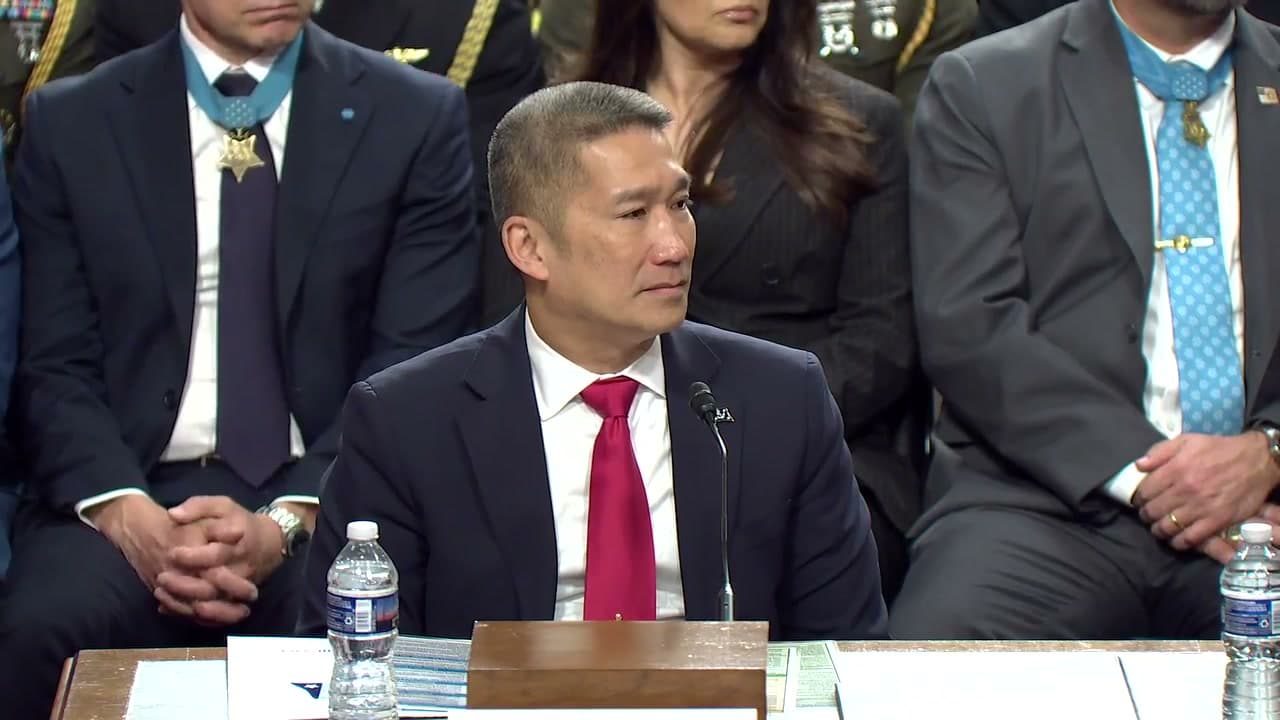
Senate Armed Services: Hearings to examine the nomination of Hung Cao, of Virginia, to be Secretary of the Navy.
Alaska News • • 170 min
Articles from this transcript
Navy secretary nominee Hung Cao faces Democrats' questions over sailor suicide attempts
Senators grilled Navy secretary nominee Hung Cao over 8 suicide attempts on the USS Abraham Lincoln and info withheld from Congress.

No audio detected at 0:00
No audio detected at 2:00
No audio detected at 4:00
No audio detected at 6:00
No audio detected at 8:00
No audio detected at 10:00
No audio detected at 12:00
This is the 60-second warning.
No audio detected at 16:00
Good morning. Hearing will come to order.
Thank you for those in attendance. The Committee on Armed Services meets today to consider the nomination of Mr. Heng Kao to be Secretary of the Navy. Of course, Mr. Kao is currently confirmed as the Undersecretary of the Navy. And is serving as Acting Secretary. Acting Secretary Cowell is a combat veteran and a retired Navy captain.
He's dedicated his career to serving our country. In other words, he understands the demands we place on sailors and Marines, and he knows the importance of having a Navy that is equipped, trained, and ready to fight. His military experience gives him an important perspective on the challenges facing the department. And they are many. During his time there, he has proven to be a strong leader, an effective manager, and willing to embrace innovation to deliver the capabilities our sailors need.
We need all of those attributes for the road ahead. I've spoken frequently about the pace at which China is building warships. Its navy is already the world's largest, and Beijing continues to invest heavily in submarine surface combatants nuclear and conventional long-range strike, and other maritime capabilities. These facts should trouble every American. They represent a clear threat to our economic and national security.
Conversely, for years, the U.S. Navy shipbuilding programs have been plagued by significant delays and cost overruns, failing to translate substantial investments into additional ships. Consequently, our fleet is smaller and less capable than we need it to be at a time when we cannot afford to fall further behind. Our challenges are not limited to one or two programs. The Columbia and Virginia-class submarines, the Ford-class aircraft carrier, and other major shipbuilding programs are all lagging. Promises about future fleet growth will ring hollow until we start delivering the ships that are overdue.
We need to change fundamentally how the Navy approaches shipbuilding. We must stabilize the technical requirements lists, streamline acquisition practices, and give industry consistent work and hold its workforce accountable.
Secretary Cowell, you'll be asked about that. However, simply pointing fingers will not get us where we need to be. We need to work collaboratively with our shipbuilders to embrace new approaches to deliver naval capability. The status of naval maintenance and readiness is equally troubling. Our sailors cannot fight and win if their ships are not available.
Shortages for parts, shipyard backlogs, and deferred maintenance undermine operational availability across the fleet. These delays reduce the number of available vessels and strain already deployed ships and sailors. The Navy must improve its maintenance planning, strengthen the maritime industrial base, and make better use of private sector capacity. We need to ensure that funding translates into actual readiness improvements. We must also honor our commitment to those who serve.
Our sailors and Marines are our greatest asset, but they cannot sustain an increasingly demanding operational tempo without adequate support. Our sailors are the finest in the world, as demonstrated by the incredible skill they've demonstrated in operations over the past 2 years, both in the Red Sea, the Straits of— the Strait of Hormuz and elsewhere. These incredibly challenging deployments evolving extended time away from families, the strain of operating ships that are undermanned. This all takes a toll on our sailors and their families. The sailors' effectiveness is a testament to the quality of our Navy when it is given the opportunity to perform at sea.
The challenges faced by the Navy are significant, but so are the opportunities. The next Secretary will be successful if he forces the Navy to move faster, to be decisive, and to deliver results for the American people. Mr. Secretary, I support you and I look forward to working with you to achieve those objectives. And I now recognize my friend and the ranking member, Senator Reed, for his opening remarks. Thank you very much, Mr. Chairman.
Secretary Cowell, welcome to today's hearing. I'd also like to recognize your wife, April, who's here, and also Representative Whitman. Thank you, Representative. I understand that Representative Elsworth might be here too, and let me recognize here. And finally, let me recognize the Medal of Honor winners.
Gentlemen, your courage and service is above and beyond the call of duty. We respect and indeed thank you profoundly. Secretary Kyle, you were nominated to be the Secretary of the Navy. If confirmed, you would lead the department at a difficult time. The service has been without a confirmed secretary for 8 months, but because of your recent active duty service, your nomination will require a waiver to be passed by both the House and the Senate in the waning days of this Congress in order to be confirmed.
Amid President Trump's war against Iran, at a moment when our naval forces are stretched thin across multiple theaters, this kind of disruption at the top, I believe, sends the wrong signal to our sailors and Marines. For nearly 2 straight years, our naval forces have been heavily deployed around the world. At President Trump's direction, our sailors and Marines have deployed to the Red Sea to fight the Houthis, to the Caribbean to attack alleged drug traffickers, to Venezuela to help capture Nicolás Maduro, and to the Middle East for the war against Iran. Thousands of our servicemembers, ships, and aircraft have come under fire, and many of our naval bases have sustained serious damage. Indeed, in a recent interview about Iran's attacks against the U.S. Fifth Fleet headquarters in Bahrain, you said, quote, they blew the hell out of Bahrain.
And I thank you for your candor. The toll from these deployments is significant. I would take a moment to acknowledge the homecoming of the USS Lincoln Battle Group last month. More than 5,000 sailors, aviators, and Marines were underway for nearly 11 months, including 7 months in combat against Iran. They perform with skill and determination, and they and their families have this committee's gratitude and great respect.
But this deployment is emblematic. During your tenure, more than half of our carriers have deployed for extended combat operations, including the Truman, Vinson, Bush, Washington, Ford, and Lincoln battle groups. Just this week, the USS Roosevelt arrived in the Arabian Sea to prepare for combat operations against Iran. Indeed, for the first time in many years, the United States has no forward-deployed carrier in the Pacific at this moment. These deployments have created highly visible readiness and morale problems throughout the force.
But when the media reported on the alarming conditions aboard the USS Lincoln, for example, you downplayed the situation as, quote, dishonest. Extended deployments have historically driven service members out harmed military families, and set maintenance back years. The munitions expended and damage sustained from Operation Epic Fury alone will take years to recover. With China and Russia in mind— and we have to keep them in mind— we must be judicious about how and when we deploy our military. Secretary Chao, I'd like to understand the full scope of these readiness problems and how you are trying to mitigate them.
Over the past few years, Secretary Hegseth has blocked and delayed the promotions of dozens of senior Navy officers, fired others, and relieved commanders. He's rarely provided justification to the officers affected or to the Congress. These officers served our nation honorably for decades, and they deserve answers, as do the thousands of young leaders under their command. My colleagues, I have heard directly from many of these personnel. Secretary Chao, I hope you will testify today about whether you stood up to Secretary Hagel to protect these officers, as we understand other service secretaries did.
If you did not, I expect you to describe the specific criteria for these dismissals and whether you will defend the military leaders in the future from partisan meddling in their careers. Finally, Secretary Chao, if confirmed, your top priorities must include growing and maintaining the fleet. For several years, the department has fallen far short of its shipbuilding and deployment plans. A number of vessels, including an aircraft carrier and multiple destroyers, are behind schedule, in some cases by several years. I would also note that the Virginia and Columbia-class submarines, which are critical for maintaining our undersea advantage and nuclear deterrent against competitors like China, are facing construction delays of over a year.
A key factor is the shipbuilding industrial base. Which continues to face significant workforce shortages and a fragile supply chain. I'd like to know how you address these problems and get them back on schedule and on budget. Secretary Cowell, while I appreciate and salute your prior service in the Navy, I am concerned, frankly, about your leadership record as acting secretary. I hope you will use this hearing to explain your actions and commit to begin engaging with the committees on a bipartisan basis.
Thank you, Mr. Chairman. Thank you, Senator Reid. Chairman Whitman, you are welcome here, and I understand you will be introducing Secretary Cowell, and you are recognized. Well, thank you, Chairman Wicker. And to you, Chairman Wicker, Ranking Member Reid, and the distinguished members of the committee, thank you for this opportunity and the honor to introduce my friend and fellow Virginian, Hung Cowell, as you consider his nomination for Secretary of the Navy.
For nearly two decades, I've had the privilege of serving on the House Armed Services Committee, including working hand in hand with many of you on Committee to rebuild our Navy, strengthen our maritime forces, and ensure our sailors and Marines have the resources they need to accomplish their missions. As a fellow Virginian, Hung understands the extraordinary breadth of the Navy and Marine Corps mission and shares the same ideals that I have. Our Commonwealth is home to the largest naval complex at Naval Station Norfolk and the Navy's East Coast master jet base at Naval Air Station Oceana. At Newport News, shipbuilders build and maintain our nuclear-powered aircraft carriers and submarines, while at Quantico, the Marine Corps trains its leaders and develops the warfighting capabilities of the future. Together, these installations illustrate the wide-ranging responsibilities of the Secretary of the Navy.
From maintaining readiness and modernizing our fleet to developing future capabilities and supporting our sailors and Marines and their families. As both a career naval officer and a proud Virginian, Hung has a deep appreciation for these missions and the challenges that our maritime forces face and the men and women who make that possible. He's a remarkable American story. Arriving in this country as a refugee from Vietnam, Hung went on to enlist in the United States Navy. He then graduated from the United States Naval Academy.
And he served our nation for over 25 years, retiring as a Navy captain. As a Navy Special Operations officer, Hung deployed to some of the most dangerous environments around the world, including Iraq, Afghanistan, and Somalia. He understands firsthand the demands we place on our warfighters and the importance of ensuring that they have the capabilities necessary to fight and to win. He recognizes the American maritime superiority requires more than simply building additional ships. It requires modernizing our fleet, strengthening our defense industrial base, and reforming the acquisition process.
President Trump has made rebuilding our Navy and revitalizing American shipbuilding a priority of his administration, and Hung understands the importance of translating those objectives into tangible results. Having served as Undersecretary and now Acting Secretary of the Navy, Hwang brings operational experience and firsthand knowledge of what it takes to lead the department. In these roles, Hwang has already set the department on a path to pass a clean audit. He's led efforts to ensure reliable housing for our Sailors and Marines. He's brought stakeholders together to supercharge American shipbuilding, and he streamlined communications across the Navy-Marine Corps team.
At a time when our adversaries are rapidly expanding their maritime capabilities, the Department of the Navy needs a steady hand at the helm. Confirmed leadership provides the continuity, stability, and authority necessary to make consequential decisions, advocate effectively for the Navy and Marine Corps, and advance the long-term investments essential to our nation's security. It also helps to ensure consistent leadership throughout the department including the undersecretary level, and Acting Secretary Hung has done just that. Hung recognizes that our Navy and Marine Corps must be ready to fight and win today while building the force our nation will need tomorrow. It is my honor to introduce him to the committee today, and he has without reservation my strongest recommendation to be confirmed as Secretary of the Navy.
Mr. Chairman, thank you. Thank you, Congressman Whitman, for that fine statement. You are excused.
You may want to stay for the whole hearing, but perhaps you have other duties. And if so, we understand. But thank you very much, sir. Secretary Chao, it's time now for your opening statement, and you are recognized.
Good morning, Chairman Wicker, Ranking Member Reid, and distinguished members of the Senate Armed Services Committee. Thank you for this opportunity to appear before you to testify on my nomination as Secretary of the Navy. I would like to thank President Trump, Secretary Hegseth, for trusting me and nominating me to be the 80th Secretary of the Navy. This is the absolute honor of my life. I'm joined today by my beautiful wife of nearly 28 years.
She's the mother— April is the mother of our 5 children: Second Lieutenant Gabriel Cow, Grace, Claire, Evelyn, and Liam. She's also the grandmother of our little Ellie. I would like to give praise and glory to our— my Lord and Savior, Jesus Christ, who— without whom I would not be here today. You can see God's fingerprints throughout my life bringing me to this moment. He plucked me out of Vietnam right before the fall of Saigon, and from there, sailors and Marines cared for me at refugee camps in Guam and Camp Pendleton.
I grew up in West Africa, where again in 1979, I faced another possible evacuation when the Shah of Iran fell. It was another Marine who stood watch over me. When I saw the look in his eyes that night that says, "Nothing will hurt you, not on my watch," I knew at that point I wanted to be a hero like him, and I wanted to serve in the military and pay back our debt to this amazing country. My family returned to the United States when I was 12, where I learned English and attended American schools. I spent my entire adult life serving the United States Navy Special Operations community with multiple combat deployments to Iraq, Afghanistan, and Somalia.
With my son now a second lieutenant, United States Marine Corps, my next fight has just begun. We are in an era of transformational change. This is our 1939 moment when the nation came together to deliver an arsenal for freedom. Today, we must strengthen our Navy shipbuilding capacity through predictable, federal funding and sustained investment in skilled maritime workforce. This will require a generational shift to align our entire force to support the workload, break through bottlenecks, and move with urgency.
As the Acting Secretary of Navy for the last 7 months, and if confirmed as a secretary, I will seek to drive the necessary changes through my 3 priorities: take care of our sailors and Marines, advance shipbuilding initiatives, and defend our homeland.
Sustained investment in our people will increase readiness, improve retention and recruitment, and enable our ability to support national objectives. Simultaneously, we must uphold standards because the bedrock of this department is to produce a lethal fighting force forged through good order and discipline and committed to embodying our warrior ethos. The Chief of Naval Operations, the Commandant, Marine Corps, and commanders at each echelon are charged to serve as standard bearers, and I view this as a shared priority, and I welcome the opportunity to partner, partner with this great body to take care of our people.
In May of this year, we released a Navy shipbuilding plan. The Navy's transforming its maritime power by modernizing the Navy, strengthening shipbuilding, improving operations, and investing in American workers to build a stronger future. We're changing how we do business by substituting bureaucracy for, for accountability. At the time, we are seeking to enhance our maritime dominance by building a larger, balanced fleet comprised of advanced ships and unmanned systems to deliver combat power and flexibility. And revitalizing our industrial base will require the creation of more skilled jobs, which in turn strengthens our national security.
We deliberately acted upon the president's mandate to accelerate shipbuilding by issuing the Navy's implementation direction for the president's National Security Presidential Memorandum on Navy Shipbuilding. This is our Marshall Plan to revitalize shipbuilding by increasing the size of the fleet and fast-tracking warfighting readiness of our ships and submarines. The Secretary of War's primary effort is to defend the U.S. homeland. The Department of Navy is building technologies that will dominate the drone and autonomous battlefield while preparing our fighting force for its critical domain. We must also harden our homeland and critical infrastructure against cyber threats and counter frontier AI threats.
My task is to provide a trained and lethal force to meet future demands, and I seek the opportunity to partner with each of you on this endeavor. My qualifications are fueled by my passion for our Navy and Marine Corps. If confirmed, I will care for our sailors, Marines, and civilians and seek to lead the Department of the Navy forward. I will deliver the most lethal Navy-Marine Corps team the world has ever seen. My sailors and Marines know that I'm never above them, never below them.
I'm always beside them. Chairman Wicker, I yield back my time. I stand by for your questions. Thank you very much, Mr. Secretary. At this point, I will ask you the standard questions which we ask all civilian nominees.
And again, Representative Whitman, thank you so much for your participation here.
Mr. Cao, have you adhered to applicable laws and regulations governing conflicts of interest? I have, Chairman.
And this is a tricky question for someone who's been Acting Secretary, but have you assumed any duties or taken any actions that would appear to presume the outcome of the confirmation process?
I have not, Chairman. Exercising our legislative and oversight responsibilities makes it important that this committee, its subcommittees, and other appropriate committees of Congress receive testimony briefings, reports, records, and other information from the executive branch on a timely basis. Do you agree, if confirmed, to appear and testify before this committee when requested? I do, Chairman. Do you agree to provide records, documents, and electronic communications in a timely manner when requested by this committee, its subcommittees, or other appropriate committees of Congress, and to consult with the requester regarding the basis for any good faith delay or denial in providing such records?
I will provide them, Chairman. Um, do you ensure that your staff complies with deadlines established by this committee for the production of reports, records, and other information, including timely responding to hearing questions for the record? I do, Chairman. Will you cooperate in providing witnesses and briefers in response to congressional requests? Will you?
I will, Chairman. Will those witnesses and briefers be protected from reprisal for their testimony or briefings? They will be, Chairman. Thank you very much. And now we'll move to, um, to questions.
Let me ask two specific questions, and then I might be able to get to a general question. Uh, um, we don't need another, um, frigate disaster. Um, They can't afford— we can't afford another program that's delayed by changing requirements. We need to get ships into the water and then into the fleet as quickly as possible. As you move forward with the FFX program, will you commit to maintaining stable requirements, working closely with industry, and providing the leadership necessary to keep this program on schedule?
Yes, Chairman, I do. Okay, what specific steps then would you take to make sure that, uh, this doesn't get out of hand as it has before? Chairman, what we've done, especially with, uh, Bath Iron Works down in Ingalls, is I've stopped all the engineering change proposals. They were giving about 4 to 5 engineering change proposals a week. Can you imagine trying to build a house where you're trying to— every week you decide that you're going to move the bathroom downstairs or the laundry room upstairs?
I mean, we can't We can't build ships that way, Chairman. That's why I've put a stop to that. I've put a stop to a lot of the excessive inspections so that we can get ships in the water, Chairman. We need to get this done quickly. Okay, let's move on then to the LSM, the Landing Ship Medium.
We're gonna have a lot of participation here. Hanwha Defense USA, Bollinger, Fincantieri, Um, there are 7 ships on contract, but we're going to need 35. Will you commit to maintaining the current focus on the LSM, delivering the first LSM on schedule, and building the full 35, um, ships the Marine Corps needs to operate? I do, Chairman, but that is also predicated on us having a $1.45 trillion budget, uh, for Department of War, because A lot of the LSMs, the extra LSMs, are in the reconciliation, Chairman. Okay, and I think that brings me to ask you to enlarge on a statement that you made during your prepared remarks about predictable funding.
As I said in my opening statement, we've got to stabilize the requirement list and streamline acquisition practices. To me, this is fundamental. Is that part of your shipbuilding plan, and do you view that as transformational? Yes, Chairman, we have to just super energize the workforce. We have to make sure that we give steady plans that we can, you know, the shipyards can plan out their build as well as buy the long lead items as well, Chairman.
Okay, and then how can we avoid what we've seen with our sailors the last year or so with extended time away from shore and the press reports about the hardships in that regard. Chairman, I share your concern about our sailors. I've gone out to see them as they return, both the Ford Carrier Strike Group as well as the Lincoln Strike Group and all the small boys as well. I met with the families down in Mayport in Hawaii. I feel for them.
No audio detected at 41:20
And the reason why we had to have these extended deployments is really because we only have 280 ships 6 ships today. As of today, we— there's only 286 ships in the battle force. We need 355, and we're doing the best we can to get these ships out there as quickly as we can so that, that sailors are not extended on deployment for a long time away from the families, and it causes a lot of maintenance issues for our ships as well. We are trying to accelerate as well the unmanned surface vessels in order to relieve the 17 destroyers that are supporting the blockade right now so we can put unmanned surface vessels out there to take their place and ensure that we can reduce the strain on the fleet? Well, as one of 100 votes on the floor and as chairman of this committee, I'm committed to trying very, very hard to get you the money you're asking for.
But we're going to need to see transformational changes as a result of that. So I wish you well. Yes, Chairman. And I now recognize my friend Senator Reid. Mr. Secretary, last week the Navy confirmed that the command leadership of the submarine South Dakota was relieved— the CO, the XO, and the chief of the boat.
But we received no notice of this when it happened. It was last October. And you talked about accountability in your opening statement. There is a degree— not a degree, but a requirement for accountability to the Congress.
The other situation is that we have no real specifics as to what happened causing the relief. There is speculation that there was a serious mishap with the vessel, the submarine, and that it was damaged. We need to have details promptly, and you have to do that, and you didn't do it. Can you tell us now, Mr. Secretary, what happened to the South Dakota? Well, Senator, uh, there, uh, Ranking Member, there, there was a near mishap issue, and we're still investigating it.
However, the squadron, uh, Commodore felt that they did not live up to their honor, courage, and commitment, uh, ethos, and therefore he relieved the commanding officer, the executive officer, and the command master chief. I am committed to ensuring that we have transparency and accountability. The other thing is that a lot of these members may not have lived up to their ethos and their jobs, but they have a career afterwards too. They have a right to provide for their families, and so we're trying to protect their their privacy also. But I will come to you and tell you exactly why they were relieved and the plans afterwards.
But I want to make sure that we don't destroy their careers afterwards because they still have to care for their families as well. A lot of times, you know, we relieve commanding officers for everything from negligence to even just fraternization or, you know, harassment or any kind. And I want to make sure that we're protecting their livelihood afterwards as well. They may not be suited for further military, you know, for their military service, but they're great citizens and they can contribute to this nation, sir. Well, that's a good goal, but the reality is that when word leaks that the commander and the XO and the Chief of Boat of the South Dakota, those names are easily correlated.
So not denying us information about a very significant event in the Navy is not justified by protecting those individuals. Is this, uh, can you describe the degree of damage to the ship?
Uh, Senator, I'm— it's still under investigation. It was a near mishap, uh, Ranky member, fine, and we will come to you and give you the full details as soon as the investigation is done. Thank you, Mr. Secretary. Uh, we talked about this in the office. The Virginia-class submarine and the Columbia-class are critical to our national security, and, uh, in addition to that, uh, we have engaged with Australia and Great Britain to produce additional submarines.
No audio detected at 46:00
So the stress is significant in terms of producing a significant number of submarines. Uh, do you— what's your view on the importance of submarines, Mr. Secretary? Senator, the submarines are an apex predator. And in order to deliver the Columbia-class, we need about 40,000 man-hours of work every week. And in order to produce one ballistic missile submarine and two fast attacks, we'll need 70,000.
We're almost there. And the way we're able to do that is a lot of times anybody who touches a submarine requires to have a security clearance. So it's hard enough for us to find people that want to work in shipyards, but also get the security clearance. What we've done is when you bend metal and cut steel, you don't need a security clearance. We can move that to the west, to the Midwest, and work on that there, and then free up the 5,000 people that have a security clearance in order to work on the submarines.
And that's how we're gonna get up to 70,000 man-hours in order to produce one ballistic missile submarine and two fast attack submarines Thank you, Mr. Secretary. Final question. I raised this in the office too. The Navy has done a very good job since 2023 increasing their recruits, which is commendable.
But looking into the data, over half of the new accessions in the Navy in the third quarter of 2026 had to obtain waivers. So half of your new recruits cannot get in without a waiver. That's for the active Navy. For the Reserve, it's 57%. There's always the question of quantity versus quality.
Are you sort of sacrificing quality for quantity? Not at all, Ranking Member. In fact, last year we brought in 8,000 more sailors than, than we were allotted, and this year we're bringing in 11,000. A lot of these waivers are waivers that about 80% of the people who apply are able to, to get the waivers anyway. So it's just little things like missing digits or just medicine when they're younger.
These are things we're able to, to overlook. Just a final point. As we discussed again in the office, many of these waivers, significant number, are for mental health issues or behavioral health issues. So it's not just a simple missing finger. It could involve long-term serious disabilities that are being waived at this moment.
No audio detected at 48:20
Thank you, Mr. Secretary. Thank you, Mr. Chairman. Secretary Calhoun, what percentage fall into the category that Senator Reid mentioned, emotional problems. Chairman, I will have to look into it. I know that about 30% of the, the people that applied for, um, to enlist in our military did ask for a waiver, but I will find out what, what part of that waiver is for mental health or, or just medicine.
Okay, well, Senator Reid's staff seems to think it's 35%. So if you'd get back to us on the record—. Yes, Chairman. —That would be very helpful. I appreciate you getting back to us on that.
Senator Fischer. Thank you, Mr. Chairman. Welcome, Mr. Secretary. The ranking member asked you about our workforce with our submarines, Columbia-class and the Virginia-class, and you mentioned the 70,000 man-hours that you were working towards. I would like to know, under the President's August 13th national security presidential memorandum on the Navy shipbuilding, it directed a plan within 120 days to establish a 5th public shipyard so that we can maintain our nuclear-powered fleet.
You're having issues trying to get the workforce currently for the submarines. How are we going to be able to find that workforce for this, for a new shipyard, which I am totally supportive of? Can you give any updates to the committee on the development of the plan that you've been working on? Senator, thank you so much for that question, because, you know, the workforce is a very important thing to me. The, um, when we talked about bringing in extra sailors last year, we had to turn away 50 5,000 people who raised their hand to want to come in the military, and I want to be able to use that to leverage that and push it to the maritime civilian mariners because we need civilian mariners for both our civilian ships as well as our military Sealift Command ships, but also can we direct them towards the shipyards as well?
We also have about a million young men and women in this country who are told, hey, you got to get a degree to get a job, but they're working in a coffee shop somewhere. If we can freeze their loans and for every year they work in a shipyard, we forgive one year of that loan, it gives them the dignity of work and also the dignity of paying back their student loans. And these are things that we're looking at, as well as looking at the model that we have for, again, civilian mariners and offshore oil rig workers, where can we do 3 on, 3 off. So if you live in North Dakota, you know, come work for me in Mississippi in the wintertime because it's a lot cooler there, and then go back and work in North Dakota in the summertime. Or if you have a farm, you can work in your farm and then come work at the shipyard in the off-season as well.
And these are things we're exploring, Senator. So you're exploring flexibility for workforce. It's good Senator Cramer isn't here to argue with you about keeping people in North Dakota in the wintertime as well. I voiced my concerns about the state of munitions stockpile and the production capacity we have for a long time. In the conflict in Iran, that's demonstrated the high expenditure rates of our exquisite munitions, and it's clear we have some work to do on that.
In your opinion, is the Navy currently pursuing the correct balance of high-end precision munitions and affordable mass munitions? Senator, we actually, uh, we absolutely are looking at all these things. Uh, in fact, we've increased the production of Tomahawks. For example, when I was in uniform, we only produced 125 Tomahawks a year. Right now, we're, we're well above 60 every month, and that's, that's, that's a, a good news story.
We're also working with industry to increase SM-6s. We're looking at new entrants as well, new entrants into the munitions production in order to increase the low and high-end munitions. We're also about 4,000 tons short of solid rocket propellant every year. And so opening new entrants into, like, my Commonwealth of Virginia, Avio USA, they were able to produce 2,000 tons to make up half that deficit, as well as looking at other companies out there that are able to produce the solid rocket motors. But we are looking at every single which way in order to make this happen.
Also, a lot of the munitions we use in Epic Fury, we were able to recode those. They were code Echo, code Foxtrot, which means they're expired. But I came from a poor family. Things like bread doesn't expire. You just rub some water on, microwave for 15 seconds, and it's good to go.
And so for, for some of these munitions, we recoded them, and so we're able to shoot off the expired munition, Senator. Okay. Do you think the Navy has the right mix of minesweeping capabilities? Senator, what Epic Fury has taught us is that we, we can't do mine countermeasures in a contested environment, and that's why we've been able to really transform the way we do mine countermeasures using the unmanned underwater vehicles. And essentially, one of our best admirals out there—.
No audio detected at 54:00
From, from what we're, um, what you're seeing in the, in the straits, you're able to adapt that to, um, how you're going to work on that in the future with the minesweeping? Absolutely, Senator. Have you already started that? We have, Senator. We have cleared basically a lot of sea lanes out there with unmanned underwater vehicles.
Again, I give this to Rear Admiral Brad Andros, the commander of Naval Expeditionary Combat Command, who has really transformed a lot of what we've done here. Okay, thank you, sir. Yes, Senator. Thank you, Mr. Chairman. For the record, Jackson County, Mississippi, and the Gulf Coast of Mississippi are delightful in the summertime, and those members who come to visit the shipyards on the Gulf Coast in Mississippi will be impressed by the way our shipyard workers are protected from the intense sunlight in those manufacturing plants.
Mr. Chairman, Nebraska's delightful year-round. Thank you.
That ranch sometimes is hard to get to, I understand, but I absolutely have the greatest affection for my Nebraska friends. Senator Blumenthal. Thanks, Mr. Chairman. From up north. I'm not going to get into this contention.
Mr. Cao, Secretary Cao, the world is less safe as a result of the Iran war. We've seen costs soar, lives lost, casualties. Our relationships with allies deteriorate as a result of this war. In fact, The Navy has been stretched beyond sustainable limits under your watch, and the fleet is in worse condition than it was when you took office along with this president. Uh, the USS Abraham Lincoln's deployment in particular, just one example, raises serious questions about your leadership of the Navy and even more important, your candor to members of this committee.
The Lincoln was supposed to sail on a 7-month deployment. Instead, the carrier was deployed, as you know, nearly 11 months, including 265 days consecutively without a port call. Now, the USS George Bush was supposed to be home, but you told families just last week that there was no end in sight to their deployment and that the Bush will come home when Iran agrees, quote, to a non-nuclear Iran, end quote. We're all familiar with the shortages of food, basic supplies, water contamination, broken plumbing, deteriorating living conditions, disruption in mail delivery, and serious mental health concerns on the Lincoln and now seemingly on the Bush.
You're failing these sailors and their families, and your confrontation with them leaves me with the clear impression that you simply don't care.
But equally important, you failed to provide Congress with a full and transparent accounting of the toll on these sailors and their family. Just last August, I wrote to you and demanded answers about the situation on that ship, the Lincoln. You responded to my inquiries on sailors' mental health by saying the strike group had, quote, not seen a statistically significant increase in serious medical emergencies. Only later did you acknowledge 8 suicide attempts across the carrier strike group. I directly asked you about the health and welfare of sailors aboard the Lincoln.
Why did you withhold critical information to me and other members of this committee?
Uh, I appreciate your concern on all these things, uh, these issues. Uh, just let me first address the fact that you said that I don't care. Senator, I look at everything through one lens and one lens only. How will this affect my son, a United States Marine, all his fellow Marines and his shipmates? That's the vision that I look through, the lens I look through every decision I make.
And so I care greatly for our sailors. They know—. Your solution seems to be to continue just asking these sailors and their families for more without giving them or us the truth about what the nature and length of their deployment is going to be? Well, Senator, I can't— I don't know. I don't control the deployment lengths, but I did answer those inquiries right away, especially with the mental health issues.
You see 8 suicide attempts. I see 8 suicides mitigations because of the chaplains we have on board, the deployment resiliency counselors, as well as mental health specialists. Normally, most carrier strike groups, when they deploy, have about 1 or 2 suicides. This is well before Epic Fury, before all this stuff. It's just unfortunately, this is the fight we're dealing with right now.
We had zero suicidal suicides on board the Abraham Lincoln. I equate that to the, again, the chaplains, the mental health providers, as well as the deployment resilience. Let me just move on because I know my colleagues will have questions on this topic as well. There are reports that one of the tankers potentially carrying illegal diesel oil as a result of the president's deal with Vladimir Putin may dock at a naval port. This sale would be illegal if it occurs and the diesel is offloaded at a naval facility.
Will you commit to this committee that the Navy will never allow sanctioned Russian fuel or any other illegal good to be offloaded in any of its facilities? Senator, we will abide by law to the fullest extent. I will look into this situation. I'm not aware of it, but I will, I will look into this. But again, the Navy and Marine Corps will abide by all laws.
Well, I will take that as a commitment that it will not be allowed to offload the Fernández, which is the name of the tanker currently, apparently. Is within range of that port, potentially in Virginia. And I will take that as a commitment that you will not allow that diesel to be offloaded at a naval facility. Is that correct? Senator, if confirmed, I will ensure that we abide by every single letter of the law.
Thank you, Mr. Chairman. Mr. Secretary, will you Will you respond also on the record to that last question? Yes, Chairman, I will answer on the record when I find out the answers. Okay. And when did your— how long has your son been a Marine?
Senator, he was commissioned in May. And where is he now? He is down in Quantico training in the field right now. Well, thank you very much. Senator Rounds.
Thank you, Mr. Chairman. Secretary Cowell, first of all, thank you for joining us today and for your continued service to our nation. I enjoyed our conversation in my office and appreciate your efforts to work with Congress to address matters of critical importance to our Navy and to our national security. I want to begin with one specific question because I think it's one that will come up during your tenure. And that has to, to do with spectrum issues, electromagnetic spectrum issues.
It's one that, that I, I continue to focus on. As we discussed in my office, I've long been concerned about protecting military capabilities which require use of the electromagnetic spectrum, particularly in the lower 3 GHz band. With World Radio Communication Conference 2027 approaching, we're also looking closely at X-band, specifically the 7.4 to 8.4 GHz range. Can you share which Navy systems rely on these frequencies and what the operational consequences would be if the Navy were forced to vacate or significantly restrict its use of that portion of the spectrum? Senator, thank you for the time in your office.
And again, we— before, we worked about against the, the S-band, right? I mean, the 3.4, 1, 3.4 gigahertz. And now we've moved into the, the, the X-band, which is 7.4 to 8.4 gigahertz, and where does it end? We go into the Ka/Ku bands eventually. I mean, this is so important.
The X-band is so important in satellite communications as well as ballistic missile defense of ourselves and our allies as well. So I'm very concerned and committed to protecting the X-band, the S-band before the X-band, and further reaches into our electromagnetic spectrum from carriers that want to expand their 5G, 6G, eventually 7G networks as well. And look, the reason why I bring it up in this particular setting, and we will on multiple times in the future, right now, the defense on the East Coast, the West Coast, Hawaii, Alaska depend upon our radar capabilities that are in these bands. There is a commercial desire, and it's promoted in many cases by China, to restrict our capabilities and in doing so limit our ability to have enough of that range so that it's more difficult to jam in those areas. And so I ask it now because it will come up and there will be pressure put on you and other secretaries not to object and to allow for that commercialization to continue forward.
That is the reason why I'm bringing it up now. And I want your commitment that you will stand up and that you will clearly deliniate just how serious it would be for the loss of those bands for our military operations. Senator, I share your commitment to defend the electromagnetic spectrum. Again, a year ago we were talking about the S-band. Now we're talking about the X-band.
And I think in the future we're going to talk about KU bands as well. I mean, this is— where does it end? And the defense of our nation is very important to me. And so if confirmed, I will ensure we work together in order to protect the electromagnetic Thank you. Um, the Navy's made significant commitments to expand munitions production, but a substantial portion of its FY27 weapons procurement requests rely on reconciliation funding.
No audio detected at 1:05:00
Regardless of which funding vehicle is used, whether reconciliation, a defense supplemental, or an increased defense top line, how would the Navy be impacted if you do not receive that additional funding for munitions? Senator, I'm concerned about us not getting the full $1.45 trillion. Again, I don't— personally, I don't care how we get it, whether it's reconciliation or baseline, but we need this money in order to ensure we tell— the multiyear procurement is very important because it allows us to drive down the cost instead of getting money last minute in, say, April or something like that. We're not able to negotiate with industry. And that's exactly why we need the multiyear And that's exactly why we need the $1.45 trillion.
A lot of what we're talking about with regard to munitions, but also with high-end capabilities, would be part of the new appropriations process, whether it be supplemental reconciliation or top line. Are you aware that on multiple occasions where there have been classified discussions, my Democrat colleagues weren't invited? And when you don't invite our Democrat colleagues to join in on these high-end, specific, top secret and above threats, that means that it limits us to basically using Republican votes only to, to pick up on a reconciliation. And if that doesn't work, a supplemental would require a 60 vote, which requires bipartisan support. Pretty tough to ask all of my colleagues to support that if they're not even invited in to hear the information in the first place.
Now, we've talked about this in the past. I don't recall that you were necessarily in those meetings or not, but I want a commitment from you, and we'll ask it from others, that we move this back to a bipartisan basis when it comes to sharing critical information in the defense of this country. And that requires a cooperative effort on your part in the future. Are you committed to that, sir? Senator, if confirmed, I will— I commit to being open and honest with the entire Senate and the Congress also.
I mean, this is a bipartisan issue. National defense is not a partisan issue. This is a bipartisan issue. And so I give you my commitment that I will work with both sides, just like I have bringing CODELs on board. Abraham Lincoln and Ford.
I, I'm open and honest, and I pledge that I will be, that I'll work with both sides. Thank you. Thank you, Mr. Chairman. Thank you, Senator Rounds. Senator Hirono.
Thank you, Mr. Chairman. Good morning, Secretary Chao. I'm going to start by asking my two initial questions of all nominees. So I'll do that. Since you became a legal adult, Have you ever made unwanted requests for sexual favors or committed any verbal or physical harassment or assault of a sexual nature?
I have not, Senator. Have you ever faced discipline or entered into a settlement relating to this kind of conduct? I have not, Senator. You just noted right now that national security is a bipartisan matter, and yet we have a president who unilaterally decided that we should start a war with Iran. So I don't think there's any question that the war on Iran has stressed our naval resources.
You just testified to that. So with long deployments and munitions needing to be replenished and the list goes on, would you not agree that this war on Iran is stressing naval resources? Senator, it is stressing our naval resources. But again, having— I've grown up where I lost a country, where I didn't have a flag to stand under. And I'm telling you right now that I will fight every single day to keep that from happening to my children or my grandchildren.
You know, I think that we need to be paying attention to whether this illegal war is having an impact on our readiness. For example, we have 3 striker groups in the Middle East, there are none in the, in the Pacific area when we are looking at China, not to mention North Korea, and what especially what China may have in mind. See, this is stretching and stressing our resources. You can't take away the, these, uh, strike group out of the Indo-Pacific. That is certainly my opinion, and I'm sure it's one that you would share.
So Anyway, this war has been going on for 8 months, even if both the president and Secretary Hicks has said that it would just go on for a few months. We've already gone through billions, tens of billions of dollars going through critical munitions, diverting ships, as I mentioned, from the Indo-Pacific, delaying critical maintenance. And, you know, I commend you for your commitment to building more ships, but at the same time, if you're going to build more ships, we need to make sure that our maintenance shipyards are modernized. And that is something that we need to pay just as much attention to, because when the ships are deployed, they have to be maintained. And especially now with the long deployments, when they are coming in for maintenance, it takes longer.
So all of this is not a good picture.
So can you just describe in your view, because you did acknowledge that this war in Iran is stressing your resources, How is the war disrupting fleet-wide maintenance? That's something that I care about because we have in Hawaii one of the 4 maintenance shipyards. So disrupting fleet-wide maintenance schedules, and what concrete steps are you taking to mitigate the impact of the delays on our readiness in the Indo-Pacific? Aor. Senator, I want to thank you for that question, and I want to thank you also for the, the shipyard workers in Hawaii.
They are among the best And we actually had to move some of them out. They were doing TDY, temporary duty at other shipyards in order to make up for the lack of shipyard workers. And I commend them for what they're doing. This war, again, I know it's a strain on our Navy, but it's really set China back on their heels 'cause they've never seen the combined forces of our Navy, Army, Air Force, Marine Corps, and cyber all working together, and that's really set them back in terms of development. Excuse me, Mr. Secretary, but at the same time as we are turning our attention to the Middle East, China, I would say, is quite active in the Indo-Pacific area.
And every time we leave an area, they step in with funds, etc., etc. So please, I don't think you can sit there and tell me that we are setting China back on its heels. They have more planes, they have more ships, they have more of all of the kind of resources that we are, that we need more of. I'm kind of amazed, but be that as it may. I know you're saying they have more ships and aircraft, but what they don't have is our enlisted community.
No audio detected at 1:12:20
It's an 18-year-old young man or woman driving that 100,000-ton aircraft carrier. It's an 18-year-old young man or woman launching that $100 million aircraft. An E-9 in the Chinese Navy is only good to push your broom. Mr. Secretary, you know, I am wondering whether you have the ability to, to tell the president this war is draining our resources. Have you had that kind of conversation with the president or with Secretary Hagel that you have concerns about what this war is doing to our readiness?
Senator, I have, uh, I, I laid out all of our requirements again My job is to organize, train, and equip the Navy, and I provide the Secretary of War and the President of the United States with options and really the mitigation plan as well as what the fallbacks are. I mean—. And yet there— excuse me, I'm running out of time— and yet there is no end in sight for this illegal war. Thank you, Mr. Chairman. Thank you, Senator Hirono.
Senator Ernst. Thank you. Thank you, Secretary, for being in front of us today. It's a pleasure to have you here. And I I appreciate your service very, very much.
I'm going to start with a topic that is always very important to me, and we have discussed this before. But as we saw yesterday, our Pentagon has failed its 9th consecutive financial audit. Okay, I bring this up— every nominee that comes in front of me, I bring it up. What are we going to do to get this right. The 9th year.
I know Secretary Hegseth sat in front of me, promised we're going to get this right. The 9th year that we have failed a financial audit at a time when the administration is now asking us as Congress to allow for a $1.5 trillion budget, and we can't pass a financial audit. But Here's the good news. Our Marines have continued to do very well, and they have passed their financial audit, I believe, 3 years now. So if you can, Secretary Cowell, please explain a little bit about why the Marines have been so successful when everyone else has failed, and what you will do to lead our Navy towards a clean financial audit?
Senator, thank you so much for that question. And I share with you that we owe the American public to tell them exactly where their money is. So yes, the Marine Corps has done an amazing job, and the Commandant and the Assistant Commandant have been pushing this. I'm pleased to tell you that the United States Navy, we finished our working capital fund audit, and we should have a clean finding in February, but also I have accelerated— as of yesterday, I accelerated the general fund. So I give you my pledge that by the end of this fiscal year, we will have a clean audit for both the Department of Navy and Department— I'm sorry, the, the United States Navy and Marine Corps.
So the entire Department of Navy will be the first department within the Department of War that has a clean audit. That is extraordinary. And what What can you attribute that success towards? Senator, it's guys like Jim Kilby, our Vice Chief of Naval Operations, who literally rolls up his sleeve and goes down there and shows our sailors how to do, you know, inventory and how to look through things. And it's just leadership, Senator.
It's pure leadership going down to the deck plates and showing our sailors and Marines exactly what needs to be done. I really appreciate it, and thank you for that. And I wish you luck on that. I'm going to go back and double down. A number of my colleagues have talked about the maritime blockade against Iran and how that is straining a lot of our systems.
And the Navy is currently as well pursuing an AI-enabled maintenance and logistics system that would really roll up a lot of the issues that, that we have seen in the past and be able to address those a lot faster. Okay, so AI is playing a role there. I'm so thankful for that. But what you did in July of 2026, you directed Operation Cattle Drive 2.0. Okay, can you talk to me a little bit about that and why that's important and maybe how AI is playing a role there?
Thank you, Senator. AI, I mean, it can be a force for good, but also it can be a force for bad. So for Frontier AI, What we're finding out is what used to take months or years to break into a system is now taking hours or even a day, just a day. And so, with Operation Cattle Drive, I've taken 500 disparate systems and crunched it down, and we're trying to get it down to about a dozen systems, because I can protect a dozen systems better than I can protect 500 systems. And that also gets rid of the legacy systems, It also frees up a lot of money.
I think so far we've saved the Navy over, you know, close to a billion dollars in redundant systems or old legacy systems where if you have 100 certificates or 10,000 certificates and we only have like 4 or 5 people using it, it's a waste of our taxpayers' money, Senator. Yeah, and thank you so much for focusing on that. It's been a long time since I had to hand jam numbers into an old Excel spreadsheet to track logistics. We called it the Logistics Estimate Worksheet. And AI and these systems will be so beneficial moving forward.
So my final point for the committee really is that we do have this $1.5 trillion sitting in front of us that I know so many members are plugging. It is necessary to modernize our systems. This is one example of that. But at the same time, we still see a lot of fraud, waste, and abuse within the department. And if we can't get our finances right, get those audits clean, then we are throwing taxpayer money away.
So we want to be able to support you in your endeavors. Let's make sure we're doing it right. The rest of the Department of Defense should be following Navy's lead, and it pains me to say that as someone from the Army. But, um, thanks so much for your hard work on that. I really appreciate it.
Thank you, Mr. Chair. Uh, thank you, Senator Ernst, and thank you for your service. Um, Senator Kaine. Thank you, Mr.
Chair, and good Good to see you again, Mr. Secretary. I want to return to a line of questioning both from Senators Reid and Rounds about communication with Congress. And you come into the hearing a little bit under a shadow not of your own making, because I think that many on the dais in both parties have not been happy with the responsiveness of the Pentagon to requests for information. And so let me use the South Dakota grounding incident as an example. This Virginia-class sub, an apex predator as you called it, had a grounding or near-grounding incident.
You referred to it as a near mishap in September. On the 14th of October, the Navy took the step of removing the triad command from that sub. Around the same time, they— the Navy also commended a junior sailor aboard that ship who sort of went outside the chain of command a little bit to take a step that helped save it from worse damage. No notice was given about this to Congress about the incident or about the sacking of the command. In previous incidences, the collisions of the USS Fitzgerald and the USS McCain and the grounding incidents of the USS Hartford and USS Connecticut, clear and timely communications were given to Congress.
So September, the incident, which we still don't know what it is other than a near mishap. October 14th, decisive personnel action was taken. Uh, it came to light to Congress when a reporter asked members of the House from Connecticut what they knew about the South Dakota being back at Groton. And apparently the reporter found out about it because of a Facebook post of one of the family members of one of the sailors on the Dakota. Why did you not, I understand that we wanna protect people's reputations, and so you might not have put this out in a press release, but we are the authorizing committee with oversight, and many on the committee are also appropriators who have to grapple with, was there damage?
How much is it gonna cost? How long will it be out of commission? What do we need to do budgetarily to potentially resolve it? Why did you not bring this to the attention of Congress in the way that had been done in the past?
Senator, thank you for that question. My answer is there's no excuse, Senator. I will— I spoke to Congressman Courtney in depth about this. We will come up with procedures so I can inform you on a timely manner. I just— my thing is I just didn't want it to be blasted out on Navy Times again.
Over past years, you know, all our commanding officers— we're the only service that publicizes. Can I just say, I, I— and I wouldn't either, but if, if your assumption is if I share stuff with Congress, who has the constitutional role of exercising oversight, they're just going to put it in the press, you're starting with with, you know, a bias that is not going to be helpful in this relationship. Let me just introduce into the record, if I could, the letter from November 12th from House Members Adam Smith and Joe Courtney inquiring about this incident. Without objection, it will be accepted. Great.
And Mr. Kelly, one other— Secretary Kelly, one other item. On August 13th, the President released a memorandum that included language directing the Secretary of Defense and Secretary of the Navy to provide a plan for replacing the current Electromagnetic Launch System for aircraft carriers with steam and hydraulic systems. I recently visited the Ford, and I went on the flight deck, and I talked to the sailors on that flight deck, many of whom had worked on carriers that both had steam and hydraulic launch systems and, and the EMALS system, and they were very complimentary of the EMALS system. Very complimentary of it. Should the U.S. return to steam systems to launch aircraft off aircraft carriers?
Senator, the whole question is how can I get— I can maintain 11 carriers. At this point, because of the delays with EMALS and the electromagnetic elevators, it's delaying our carriers by 7 years. We're going to have 5 years where we're going to be down to 9 carriers. I'm trying to accelerate that. And does that mean that you're you're considering return to steam launches?
Because just the electromagnetic elevators alone, I don't know if you know, they require certain spacing. And so you weld— what they do is they weld the elevator in place. Yeah, I'm not asking about the elevators. I'm asking about the launches based again on what the folks on the flight deck told me. The EMAL system works very, very well.
And to retrofit existing carriers or change the design you talked about, in an earlier instance, changing designs causes problems, and to go back to an old way of doing it is going to have an increased cost with diminished capacity. And so just because the president directed it, I do hope you'll consider the experience of those who've been operating these launches on the Ford in deciding before— but before you decide to go down a path that will be more expensive and also less capable. That— with that, I yield back, Mr. Chair.
Secretary Chao, returning to steam is a nonstarter, and everybody needs to understand that.
Senator Scott, you're recognized. Secretary Chao, first off, congratulations on your nomination. I want to thank you and your family for your sacrifice and your service. Why is, why is this, why is this job important to you?
Senator, thank you very much for that question. This job is important because I've gotten so much out of the Navy. And again, with a son now in the Marine Corps, I want to make sure that they don't go to war the way I did. When we went to war in Iraq, you know, we didn't have armored vehicles. And so we took off our body armor, slung it over the windows to protect ourselves.
And when we finally tack welded some metal plates we took our back plates and gave it to guys who didn't have any plates at all. And so I vowed that I would never allow my son or any of America's sons and daughters to go to war the way I did, Senator. And that's why it's so important to me. So I want to talk about the importance of building ships in the United States. As you know, we've talked about this, the importance of it.
So I enlisted at 18. I served on the USS Glover. It was a great ship. It was built in the United States, is built in Maine at Bath Iron Works. Like, you know, Navy ships, American-made Navy ships are the best in the world.
First off, I think we'd all— you would agree with that, right? So we have higher standards than the rest of the world. We have higher standards because we want to take care of our sailors and our Marines and anybody on our ships. Would you agree with that? I do, Senator.
So, so the—. What's—. What's— what we did this year in this year's NDA the committee adopted Senator King's amendment to prevent the building of warships overseas. It closes the presidential waiver loophole because this is the key issue. It's, it's because I think it's very important to anybody that cares about our Marines and our sailors.
It's great importance to our states and our national security. In my state, and I think in a lot of states, we've seen shipyards really step up. They're investing more money. We have— it also creates American jobs. And they're great-paying jobs.
So, and we've been doing this for a long time. Our first 6 frigates, when we had our independence, were all American-made. We did buy some foreign ships in late 1800s and early 1900s, but finally, I think in 1965, we— Congress said we were not going to have any foreign-built components and extended that to complete naval vessels in '68. So I think it's really important to national security. I think it's important to the security of our sailors, important to the security of Marines.
So talk to me about where you are. Do you believe that all naval ships are being built in the United States? Senator, it's about just not just Navy warships. It's about all of our ships. We are a maritime nation.
We depend on the sea lanes communications for 68— between 60 and 80% of our trade. And right now we only have 155 flagged U.S. merchant ships, 105 military sealift command ships, And as of today, I have 286 warships that I can use. And so we need to look at new entrants to bring this, you know, the ability to build more things in the United States right now. And so, you know, when you look at Korea, for example, they're building 230 seagoing vessels this year alone. We're only building less than 20 in our country.
And this is a country that's 99 times smaller than the United States. And we should be able to accelerate and move faster. And I don't know how else we can energize the workforce. I mean, if we are allowing new entrants to bring over their technology and the way they build things more efficiently, we will build 540,000 jobs in the United States, and we will be able to build more ships. Again, China has 11,000 merchant ships.
We only have 155, and this is a problem for our nation. And I want to be able to accelerate this, not just for the United States Navy, but also our merchant fleet as well, Senator. But you agree that, that both naval ships and merchant ships should be built in the United States with, with American workers, with American technology? Senator, with, uh, if we bring in these new entrants, they will be built in the United States with American workers and with American standards. With American standards, Senator.
Okay, so What Senator King, the amendment that Senator King put in the NDA, and I think it's in the House side, you completely support that?
Senator, I'm lost. I need to relook at all those because there's always nuances in there that, you know, if I agree with something, it's just— but I'm telling you, right, I want to bring these new entrances.
Senator, would you like to know? I'm sure we'll be able to discuss when you ask me the question, Senator, but Again, this is about bringing new entrants to the United States that can modernize and move things faster. I mean, right now we have a guy walking around with a clipboard with an Excel spreadsheet instead of using AI and using technology to build faster, Senator. Okay. Well, if you'll— once you have time, when you get back, if you just look at the amendment and absolutely tell us if you have any issues with it, because I think it's really important to this committee.
I think it's in the House NDA also. Thank you. Thank you, Senator Scott. And it happens that Senator King is next. He's recognized.
Thank you, Mr. Chairman. Mr. Secretary, I was moved by the opening of your testimony about your personal story. And I sat here and didn't plan to discuss this, but I couldn't help but, but think that today you wouldn't be let in. Your family wouldn't be let in the country. Refugees from abroad were diminished by 90%.
Starting last year, and the only refugees being allowed in this year, I understand, are from South Africa. So I just want to point out, you're a walking advertisement for the importance of this country being— having open arms to refugees from around the world. And the irony of your being here today and starting your testimony with that very powerful American story I just couldn't help but note.
Following up, there's an old New England saying, "What you do speaks so loud, I cannot hear what you say." And all of the comments out of the administration have been about revitalizing shipbuilding, rebuilding shipbuilding in the US. The problem is, in your budget, you wanted to build warships in Korea and Japan, And in your budget there was only one destroyer. I would point out that there are 15 destroyers in the Middle East today as the workhorse of the Navy. And finally, in your budget you abandoned the DD-X, which is the next generation of surface combatants. So my concern is that, that the whole idea of revitalizing shipbuilding is inconsistent with, with the budget, and the budget is policy.
So I hope that you will commit to recommit to the American shipbuilding base, no building of warships abroad, and supporting the— giving our shipbuilders the demand signal that they need in order to invest and rebuild the industrial base in terms of shipbuilding in the United States. Is that a commitment you can make? Well, Senator, let me first say thank you for your opening comment. As you look into the audience here, including my sister, and a lot of the members here are Vietnamese refugees, and we came to this country and we embraced the culture. We became Americans.
And I'm with you. I think that's the story of America. Thank you, sir. And it just concerns me that we're losing the thread of that story right now. Yes, sir.
We just need to love America. When you come here, you just need— but again, sir, going back to bath built, and you know bath built is best built. We've talked about this. Chuck up there has done such amazing work, and that's why we added another destroyer into the budget this year. Senator, there was only one that was, that was in the budget.
There was only one. One has been added by the committee, and I understand that's been accepted in the, in the House and is in the recently put forth mark of the Appropriations Committee. But you started with just one, and that's not enough. Yes, sir. To keep the flow going at Bath and at Ingalls.
Senator, I understand. Again, we, we have to get back to moving faster. Again, when Arleigh Burke was actually first built, it took 2 years between when we laid the keel and when we commissioned the ship. Right now it's taken 68 years to build it. And so I've worked with the shipyards in order to diminish what the Navy's done.
We've accelerated by 7 months by taking out of the, a lot of the redundant inspections and everything else. And then the shipyards are now owing me another year so we can get down to 5 years. Uh, of— Senator, I would put 100 destroyers up there if I could, if I knew they could build it. And that's why we, we were very—. Let the record show the Secretary just said he wants 100 new destroyers.
Uh, well, you understand, yes, Senator, budgets are policy. The budget should reflect the policy, and the policy right now is not supportive of what I believe the priorities for shipbuilding should be. Uh, secondly, the The sailors are performing admirably right now. Yes, sir. With the pressure that's been on them, 10 to 12-month deployments though are, I believe, unsustainable.
And are you working to figure out how to reconfigure those deployments so they're not so lengthy in the Middle East? Senator, yes, sir, that's exactly why we're putting in unmanned surface vessels, that's why why we're, we're accelerating the shipyard, uh, maintenance availabilities. Again, I, I— and Senator Kaine, I know I'm calling you out, sir— we talked about this where we're up in, uh, down at the James River. We can dredge through there, uh, we'll be able to increase dry dock availabilities by 50% and, and pier side availability by 80% if we work together again with the Commonwealth of Virginia, the— with the governor there. If we can do, do all these things in order to increase the the repair capacity of our shipyards?
I think that's a very high priority. Here's again, again, the problem: the budget doesn't reflect that. That's a $1.9 billion shortfall in depot maintenance budget. So we got to build more ships, but we also have to have more ships at sea. So I hope availability is also going to be one of your priorities.
And then I think we can meet the demands of this moment. Thank you, Senator. Yes, it is my priority, sir. Thank you. Thank you, Mr. Chairman.
Thank you, Senator King. Senator Tuberville. Thank you, Mr. Secretary. Secretary, thank you for being here and your passion for your job, because we need that. We need that in all areas.
And, you know, I grew up in a military family, and, you know, I know that all these people on these ships were tired and hungry and all that. My dad was over a year and a half sleeping underneath the tank after he landed at Normandy. They never complained. They had to save this world, and that's what military is supposed to do. So thank you for your, your work.
One thing that you brought up earlier in your opening statement is very concerning. Getting ready to be the new governor of Alabama, I'm dealing with a lot of things right now with change orders. It costs a fortune when you change order something. Can you expound on that? Who is changing the— who is changing the design?
I mean, cannot we not come up with a design of a ship that we're going to use and make 15 or 20 of them and build these damn things instead of worry about changing things? Go ahead, Senator. I share the same concern you do. When I found out, I was flabbergasted, and I put out an order that all changes from this point on when we're building ships has to come through the, uh, the Assistant Secretary of Navy for Research, Development, and Acquisitions, and then approved by myself as well, because we just can't keep changing. I mean, it's, it's unattainable, and this is exactly why we're delayed.
That's why it takes 6 to 8 years to build a destroyer now when it used to take 2 years. Who makes those change orders? Who, who gives that order to put a bathroom on the front or the back, whatever? Who makes that decision? A lot of times, Senator, the, the tech warrant holders come in last minute.
And this is why we build these, uh, portfolio acquisitions executives, because you'd have— in the past you'd had 4 or 5 people that tells you no, but now we're aligning everybody underneath that PAE in order to have— including the tech warrant holders— so that you can— you, you have to go through that one single source to say yes or no. And then for— again, for the engineering change proposals, it would have to go up to ASN RDA and then myself as well. Who underneath you makes that decision? Because you can't keep— I'm I mean, who does that? Who keeps an eye on the, you know, the architects or the designers or the planners to keep their feet to the fire, saying, no, hell no, we're not going to do it this way, we're going to build these ships and get them done, we need them?
No audio detected at 1:37:20
Who does that? Sir, that's our PA Maritime. So again, I, I just promoted, uh, uh, Rear Admiral Rucker, and I hope that this committee will, will accept our, our, our request to promote him to Vice Admiral, because John Rucker is really a change agent. He's right now with the— works under Vice Admiral Rob Gaucher, who is the DIRPM submarines, and they have been able to accelerate submarine building. So I'm stealing him over to put him into maritime to, to accelerate a submariner to build ships for us because he's the right type of person to make this happen.
Yeah, well, thank you. Also, as being a new governor, we build ships, we build submarines in the state of Alabama. And I heard it's really nice there in the wintertime too. Yeah, it's very nice. A lot better than Mississippi.
But the thing also is we do—. Gentleman's time has expired.
Here's one other problem we're running into. We have a lot of defense contractors in my state. We build Tomahawks, we build Patriots all over our state. We have a huge shortage of steel in this country, and the steel is going to a lot of our manufacturers because President Trump's got manufacturing coming back galore into our country, thank God. We got jobs for our kids, but we've got to start pushing to make more steel, American steel, to build ships, to build missiles and do those things.
And I've just heard from our defense contractors here lately and they can't get steel to upgrade and build more Patriots and Tomahawks. I mean, we're between a rock and hard place, but that's for something else. But recently, Admiral Seif noted that we just released 10 submarines. I think they were returned to service, is that correct? Yes, sir.
Yeah, what class were those? Those are Los Angeles-class submarines, sir. Again, they're still good. Again, if you look at the Charlotte, she's a 32-year-old submarine that did some very exquisite things out there against very new platforms, but also they were the first submarine to launch a torpedo and sink a ship since World War II. Yeah, the other thing that we're going to do in our state is we're going to— workforce development.
We're going to have a new thousand electricians, plumbers, uh, people, and welders, people that can actually— you kids that can use their hands and make a heck of a better living than getting a social justice degree at some of these universities. So, uh, we're committed to that. So, Mr. Secretary, thank you for what you're doing and, uh, keep pushing hard. We need more ships. We need to protect the greatest country ever, and that's the United States of America.
Thank you. God bless you. Thank you, Governor-Elect. Thank you, Senator Tuberville. Senator Warren.
Thank you, Mr. Chairman. So the American people just sent a clear message to Washington. It is time to stop Donald Trump's war with Iran and lower costs for American families. But the costs of this war just keep going up. 23 Service members dead, uh, the money we're paying through the roof, and a taxpayer bill of at least $47 billion and counting.
Acting Secretary Cowell, you have been in your role leading the Navy since April, and now you've been nominated to fill this role permanently. So I just want to talk for a minute about what this war is costing the Navy and what we could do with that money here at home instead. So the Navy is being asked to take a central role in this war by imposing a blockade on the Strait of Hormuz. That means keeping aircraft carriers, destroyers, other vessels home to thousands of sailors, supplied with food and fuel and other supplies for what have turned out to be increasingly long deployments. Acting Secretary Cowell, what is the daily cost of the US naval blockade on Iranian ports?
No audio detected at 1:41:00
Senator, I do not know the daily cost, ma'am.
You don't have any idea? You've been running this thing since April and you don't have any idea what that costs? Well, Senator, I know the rough cost of how much it's costing us so far. But again, the cost of losing the Straits of Hormuz—. I'm not asking you that.
I just want to have the dollars here. Independent estimates are about $32.5 million a day. Does that sound about right to you, Senator? And let me do some quick Asian math in my head. But yes, it's about $30 billion.
Okay. So you, you confirm that number, and that means the American taxpayers are spending about $1 billion a month just on this blockade. Let's do another. Iranian strikes have also caused extensive damage to US bases and facilities in the region, including the US naval base in Bahrain. It's home to U.S.
Naval Forces Central Command and the U.S. Fifth Fleet, and is a critical strategic hub for the U.S. military. You yourself said that Iran, quote, "blew the hell out of that base," but the Navy has yet to tell Congress or the American people how much that damage cost. So, Acting Secretary Calhoun, when Iran hit our naval base in Bahrain, how much Did that cost? Well, Senator, we have not been able to do a full assessment yet because it's still a non-permissive area. Okay, not a full assessment.
What's your estimate? Senator, it's again, we're still making all the assessments because it's a non-permissive area for us to go in. So no number until I pull a number from somebody else. In June, the Wall Street Journal estimated that the damage to the US naval base in Bahrain has cost the United States at least $400 million. It's a lot of money.
It's not included in the Pentagon's estimates for the cost of this war. Does that number sound about right to you? So I'll find out. You've been running this for more than half a year and you don't even know if this is in the right area. Senator, I can't— again, we have to assess the damage and we still have to go in there.
There's still—. There's just now thinking of assessing the damage in November. Senator Moller. So look, Trump's war is costing taxpayers billions. It is harming our readiness, all while driving up prices here at home.
So it's no surprise that the Trump administration doesn't want to reveal the total cost of this war. The Pentagon has admitted that it's at least $47 billion already, $47 billion and counting, all while Republicans have slashed healthcare for millions of Americans. Americans. This is outrageous. We should not spend another cent on this war, and instead we should be spending this money at home to lower costs.
So let's do a little math, Acting Secretary Calhoun. How many Americans' federal student loans could we wipe out with the $47 billion that we have already spent on this war?
Senator, I— if we didn't have the blockade, We would— we already protected 3,700 ships. Did you hear my question? Senator, we— I'm asking you, the cost would be higher. $47 Billion that we have already spent on this blockade. I'll tell you the number.
It's more than 2 million people could have all their student loan debt wiped out. For an extra $47 billion, we could send every 4-year-old in America to a high-quality pre-K for a year. For an extra $47 billion, we could knock about $200 a month off the monthly insurance bill for families with private insurance. For an extra $47 billion a year, we could wipe out unpayable medical debts for more than 10 million families. And instead, the Trump administration has signed Americans up for another forever war that America didn't want.
Congress should use all of our tools at our disposal, including the upcoming government funding bill next month to end this war and end it now.
Thank you, Senator Warren. Senator Banks. Thank you, Mr. Chairman. Secretary Cowell, thank you for being here. Congratulations on your nomination.
Can you talk for a brief moment about why it's important to not just to you but to our sailors why we have a permanent confirmed Secretary of the Navy instead of an acting Secretary? Senator, thank you very much for that question.
I, by statute, I can stay in this job until the president fires me or until January 20th, 2029. But not having a permanent person into this billet means that every, every 6 months I have to rotate out the Undersecretary of the Navy because they're, they're, they're PTDO, performing the duties of, and so they're, they're limited 210 days of work, and then not only that, it doesn't give the steady hand that the Navy needs in order to negotiate with industry. They're just gonna see me as a temporary guy, even though I would be there until the president fires me or until January 20th, 2029, Senator. Take that a step, why does that matter to us? Why does that matter to the sailors?
To the sailors, they need a steady hand, Senator. They need to see a Secretary of the Navy that's leading them, that understands that's been there with them in the trenches. And that's why they—. What authorities does a confirmed secretary have that an acting secretary doesn't have? Well, Senator, as the acting, again, I have everything under statute to do my job.
But again, it's the negotiating with industry that's going to be hard because they only see me as an acting person. And so a temporary guy, I'm not able to get the better deal for our taxpayers. Well, I'm here because I think it's it's fundamentally important that we have a confirmed Secretary of the Navy for the next 2 years, and we got to get you confirmed. I want to thank you for coming to Indiana just a few, few weeks ago. You have, even in, in both of your roles, you have shown more interest in Crane Navy Base than any Secretary of the Navy before you, and I greatly appreciate that, not just because I represent it, because of, but because of the important role that it plays to our nation's defense.
And I really appreciate that more than anybody else, you made something happen that makes Crane bigger, better, more influential than it's ever been before in bringing the one-star position, the program management office, to Crane. Admiral Finney arrived at the beginning of October, as you know, to lead the PMO. And I wondered if you could elaborate just for a moment on the strategic importance of that move and why it matters to the Navy. Senator, I'm so glad we were able to work together to get the Admiral up there because this is gonna accelerate our SLCMN as well as hypersonics. So SLCMN is, I mean, imagine not just having 14 ballistic missile submarines out there that have nuclear weapons, but also the other 55 submarine fast attacks and Virginia payload modules, the Virginia-class submarines, the SSGNs also, that will be able to launch nuclear missiles.
So that helps with deterrence turrets. And so the Admiral going up there will be able to, to, to work between the office down here and, and all your engineers up there in Ukraine to accelerate the Slickoman program, to accelerate hypersonics. Imagine a weapon that can go from here to California in 17 minutes, and that's what the hypersonics can do from ships or submarines that can't be seen anywhere. And that's exactly why we need to accelerate these weapon systems and these programs and no better place than Crane, Indiana. Thank you for that.
I know the Navy's initial plan is for at least 150 government civilians to join the Admiral by the end of FY29. I just wonder about that. Is the commitment still there from the Navy that this end strength will represent a floor, not a ceiling, for the PMO? Senator, yes. So again, these are billets that were not used anywhere else.
We're not moving anybody from any other state to, to Indiana. Basically, we, we have these unfilled billets that we're able to build right there in Indiana. Again, imagine an unfederated range that we can use. I mean, there's so many things we can do there for electronic warfare, for, for hypersonic weapons, and all these things that we could do right there in your state, uh, Senator, and, and to be able to accelerate the capability and capacity for our country. I want to work with you over the next couple of years to as we progress down that path to make that happen.
No audio detected at 1:49:40
Anything that I can do to assist you in that, please let me know. If you haven't, um, I, I also want to talk about the, um, the SSP part of that. I mean, you mentioned that, but the— do we need any additional hiring authorities to make any of that happen, or are you confident that the— that you have what you need to? Senator, I believe at this moment we have everything we need in order to affect the, the hiring of those personnel up there. I thank you for your leadership.
You're leaning into areas that the Navy hasn't leaned into before. That's the type of leadership that we need in our next Secretary of the Navy, which is very important to me. You have my full support. With that, I yield back. Thank you, Senator.
Again, the third largest naval base in the country. Thank you very much. Senator Kelly. Thank you, Mr. Chairman. Secretary Cal— I wanna discuss the well-being of our sailors that are deployed in support of operations in the Middle East.
As a guy who spent a lot of time underway on an aircraft carrier, particularly during combat operations, you know, I know the challenges, not only the challenges for the sailors, but also the challenges for the Navy, I get it. But we also have a responsibility. To give our service members the support and resources they need to carry out their mission. And it's clear to me that was not the case. Earlier this year, we saw reports about unacceptable conditions aboard the USS Abraham Lincoln.
Uh, that was during an extended 321-day deployment, but the reports included inadequate supplies, deteriorating mental health, and sailors attempting suicide. You subsequently confirmed that 8 sailors across the Lincoln Carrier Strike Group had attempted to take their own lives during the deployment. I'm also hearing concerns about conditions aboard the USS George Washington and the Boxer Amphibious Ready Group, including reports of not enough food, and inadequate basic necessities. One parent told us that their kid lost more than 45 pounds in 6 months because of a lack of food, but also lacked basic hygiene supplies. Another reported significant weight loss among Marines, some visibly malnourished.
Families report that service members are not getting adequate nutrition and are relying on care packages. So their families are having to ship them food to supplement, uh, the inadequate supply aboard the ship. These are service members deployed in support of combat operations, and they're not even being given the basic things to stay healthy and carry out their missions. This is completely unacceptable. What I find even more troubling is that when this was brought up to the Secretary of Defense, he dismissed it.
Says we do everything and they have everything they need. Not the case. What's even more concerning is that we're hearing these same problems after everything that happened aboard Lincoln. So it continues. The Navy was already on notice about the toll that these deployments were taking on our sailors.
We shouldn't be waiting for another crisis before addressing these very basic needs that our soldiers, or sailors and Marines have. So let me ask you this, what is the Navy doing to ensure that sailors deployed in the region have adequate food, adequate mental care, mental health resources, and other essential supplies, particularly, for the extended deployments as the op tempo increases? And please be specific. Senator, I share your concern with our— about the well-being of our sailors and Marines deployed. Every day I walk down to the— our watch floor when I get a brief on current conditions on board their ships, and I look at the number of days of rations they still have left.
Right now, the one that worries me most is USS Gonzalez destroyer, you know, they have about a week left. Usually we— I, I don't like them to go below 2 weeks of supplies. Now Gonzalo is going to—. Do you know if those supplies that they have are actually adequate? Yes, to their needs, Senator, they are adequate.
It might not be all the—. How often does one of those ships get to zero? You say there's a week. Does it ever get down to zero? It has never gone to zero, Senator.
Not once? Not—. No, Senator. So, so are you saying then that these reports of somebody losing 45 pounds are not true? Well, Senator, it's just not what they want.
It's like my kids opening up the refrigerator door and saying, there's nothing to eat in here. No, I don't think that's— Senator, Mr. Secretary, I don't— somebody doesn't, somebody doesn't lose 45 pounds just because they don't like the options. I, I don't think that's a fair assessment. Have you done— speaking of assessments— have you done a fleet-wide assessment of the living conditions supply shortfalls, mental health resources? We have, Senator.
Again, this is why we have 5— well, every small boy, all these— all the destroyers will have one chaplain on board. All the carriers have 5 chaplains as well as mental resiliency counselors, as well as the mental health specialists as well. So that's why you say 8 suicide attempts. I see as 8 suicide mitigations that we're able to keep these young men and women. Okay, well, it's actually both.
There were 8 individuals that tried to take their own lives and it was mitigated. I'll give you that. Yes, sir. But we shouldn't have conditions where sailors are wanting to end their lives because of the deteriorating conditions aboard the ship. Hey, these are demanding deployments.
I get it. There should be adequate food on board. There isn't. If this isn't corrected, these issues are going to continue. And we're going to continue to come back at you.
So I suggest you do everything you possibly can to make sure they have adequate food, adequate mental health counseling aboard the ship, adequate hygiene supplies, because otherwise this is going to continue to be a problem. Senator, if I'm confirmed, I will work with you to make sure that we take care of our sailors and Marines. Thank you. Yes, sir. Thank you, Senator Kelly.
Senator Cotton. Secretary Terry Kahl, thank you for your appearance and your service here today. We've heard a lot from Democratic senators this morning about ending the Iran war, by which I think they mean surrendering to Iran, just simply unilaterally raising the white flag, letting Iran control the Strait of Hormuz, letting its terrorist proxies control other critical waterways in the region, letting them rebuild their nuclear weapons program as well. I too would like to end the Iran war by winning the war. I wish we had won it in April by allowing the military to finish its operational plan and then put in place the blockade that we've had in place over the last few months and by forcing the strait open as it has been now for a couple months.
We need a victory strategy, not an exit strategy. We certainly don't need another ill-advised, naïve, foolish memorandum of understanding, which this summer allowed Iran to regroup and rearm and enrich itself and probably prolong the war. We've heard complaints about forever wars. It's probably that memorandum of understanding that allowed the Democrats to characterize this conflict as a forever war. We need to end it by winning it now.
But since our Democratic colleagues keep talking about ending the war, let me ask you this: If we took that approach and simply surrendered and raised the white flag and allowed Iran to control the Strait of Hormuz and its terrorist proxies to run the entire region, would the Navy's need for the budget it's requested be any different at all? If we stopped everything we're doing with the blockade in the Strait of Hormuz today, would the Navy be able to reduce its budget request by a single penny? Senator, thank you very much for that question. Again, let's go back to the Iran issue. I mean, this has been going on for 47 years.
All the IEDs that I stopped in Iraq and Afghanistan, in fact, I'll tell you right now, one of the caches I found is in the Meson Valley in a small boat that have these EFP liners, the explosively formed penetrators. We downloaded the GPS and it went right back to Iran. Those came from Iran. They were killing and maiming our soldiers and soldiers, sailors, airmen, Marines in Afghanistan and Iraq for decades. In fact, One of the families, Sean Levi English, his son told me when I was running for office that, "Sir, when you win, please make sure the Iranians pay for taking my father away from me." And so these are things I— look, they've been killing and maiming our people for years, but the budget that we submitted to the Congress was before EPIC Fury started.
This is what we need. This is the generational change we need in order to rebuild our fleet from 20 years of war in Iraq and Afghanistan. So even if we surrendered in Iran, as the Democrats apparently propose, the Navy would still need all of this money to rebuild its munition stockpile, to continue on its shipbuilding plan, and to protect the nation from threats like communist China or Russia or other terrorist groups. Senator, you're absolutely right, because what we're dealing with now is stuff that happened from 20, 25 years ago when we we stop building ships. I mean, again, we, we need to be able to build like we did back in World War II.
This is why I say this is our 1939 moment, Senator. Thank you. Um, another claim we've heard from the Democrats is substandard conditions on ships, especially ships on extended deployments. Those are always serious matters that need to be thoroughly reviewed by the chain of command if you've had anything in those Along those lines, I would expect the chain of command to take appropriate action up to and including yourself. I have confidence in you and the Navy to do so.
Um, if the picture painted by the Democrats were so bleak, would the Navy have reached its recruiting goals 3 months early, as I understand you did, with 45,000 new recruits? Senator, we would not be there. And in fact, I'm glad you brought that up. The retention rate aboard USS Abraham Lincoln throughout this deployment was 84.4% retention rate. That is above any, any carrier out there.
Well, I'm glad the Navy is doing so well in recruiting and retaining sailors for the future. Thank you.
Senator Cotton, I completely agree and subscribe to the statement you made before your first question, and I thank you for pointing that out. Senator Shaheen. Thank you, Mr. Chairman, and Acting Secretary Chao, thank you for being here. Secretary Chao, I was also moved by your very amazing personal story. I very much appreciate the service that you and your family have provided to this country.
But I have to be honest and tell you I have serious questions about your decision-making, about your willingness to stand up to your superiors and make clear your views and that they should be listened to, and about your ability to be transparent with Congress.
You said that you think submarines are the apex predator, and I certainly agree with that. But we can't rebuild our shipping industry by hamstringing our public shipyards. And during your last testimony in May, I asked you about the $65 million budget shortfalls that are facing the Portsmouth Naval Shipyard at the end of 2025. You required installations to give bonuses to top-performing, in quotes, civilian employees, and you did that without providing the additional funds that forced Portsmouth to take $32 million out of its operations and maintenance budget. You also pulled back another $33 million from PS&A, from the shipyard, for under-execution of hiring, which doesn't make any sense because they were prevented from hiring workers by the personnel office and by the department until Congress stepped in and exempted them from the civilian hiring freeze.
This shortfall has had a real tangible impact on the ability of the shipyard to do its job. Your office response when we raised these issues provided no commitment or path forward to mitigate this. They even— you even acknowledged that there is, and I'm quoting, there's a real impact to Virginia-class submarine availabilities, specifically the USS Virginia and the USS South Dakota. So Why was there no budgeting for a hiring thaw? Why was there no acknowledgment that the shipyard would be unable to hire on schedule because of the freeze that had been put on by the administration?
And how can you now hold the shipyard accountable for that and refuse the $65 million budget shortfall that they need? Senator, thank you for that question. Again, I came in this job on April 22nd, 2026. And so I, and I know that in May when we had just taken over and we did the posture hearings, you asked me about this, and I'm going to tell you right now that I failed you. I was supposed to bring you back the answers and I didn't do that.
And I commit to you right now that within a week of us finishing this, I will find out the answer and we will, we will find a way to work together. And again, if confirmed, I will work with you to make sure that we free up the $33 million in order to adequately pay for that. Well, Acting Secretary Calhoun, you have heard from a number of members of this committee on both sides of the aisle our frustration with the lack of transparency from the department, that we are not getting information that's requested and that people are disassembling when they're asked direct questions. Have you been instructed by Secretary Hegseth or anyone else within the department to not be open with Congress when you are asked questions that are difficult to answer? Senator, I have not been directed in any way like that.
Well, did Secretary Hagseth ask for the Department of the Navy's input on his decision to mandate civilian bonuses without any additional funding, and how did you respond to that?
Again, Senator, a lot of these happened before I took over as Acting Secretary of the Navy, but we I'm not aware of any, any requests like that from Secretary Hagel.
But, but clearly the department did require civilian bonuses. So who made that decision?
Senator, I'll look back and get back to you again. It's—. Again, I took over in April 2026 and I will come back to you and get you the answer.
Well, do you think that that is a decision that's helpful to ensuring that our public shipyards operate at full capacity? And if we are asking them to provide civilian bonuses, shouldn't there be some criteria for how those are given out? And shouldn't the department make available the funding to do that if that's a decision-wide, um, yes, issue within the department? Senator, we're doing all that. We're also increasing the wage grade, uh, in order to, to pay our shipyard workers more.
No audio detected at 2:06:20
We need to be able to pay more for them instead of giving them only $2 more per hour than, than what they would make it, you know, from minimum wage. So you have my My pledge that I will work with you in order to properly compensate our shipyard workers. Well, thank you. I'm out of time, but I just want to again make the point that the problem we're having at the Portsmouth Naval Shipyard with hiring has everything as much to do with the back and forth that's come out of the department about that ability to hire as it is to get the workers. Workers want to work for the shipyard just like they want to join the Navy, and we need to give them that avenue to do that.
Thank you, Mr. Chairman. Thank you, Senator Shaheen. Senator Sheehy, what does your son do for a living? Uh, Senator, right now he's a United States Marine. He's not picked up MOS yet.
He's still a TBS. What did you do for 30 years? I did EOD in the Deep Sea Diving Center in Special Operations. I'm pretty sure that you're very focused on the well-being of our warfighters and you're not trying to starve them or deprive them of basic well-being. They are fighting a war and that's what they signed up to do.
And that's why all those men behind you wearing that blue ribbon are there, because they understand that you're a warfighter, father to a warfighter. And right now we are fighting a war against savage barbarians. That have been trying to wipe our civilization off the face of the earth for 50 years, and they want all of us in this room dead, and they will laugh and celebrate as they do it. So, how many Marines were killed in the 1983 barracks bombing, you remember?
I don't want to quote off—. Yeah, it was about 282, I think, and while they slept in their beds, which is how Iranians like to kill people, because they like to kill innocent civilians. And they like to hide in schools and hospitals, uh, because they are radical Islamic lunatics. And, uh, surrendering to them, uh, sends a message of weakness to the entire world that we do not have the backbone to stand up to people that want to kill our nation and our way of life. So you are in charge of our most important branch of the military.
All fairness to you guys, I'm a veteran of the Navy, so I can say that, but the truth is we're the only nation that can project global naval power. And that's why enshrined in our Constitution, the Navy is the only branch of the military that must be maintained at all times in our Constitution, because our framers understood that our ability to protect our shores, protect our economy, and project power was critical to our national ascendance. Now, getting specific, what is the Navy's plan to have a frigate in the future? Because we have decided to make the destroyer the Swiss Army knife of the Navy, and we're gonna have basically two ships. We're gonna have aircraft carriers and destroyers.
That's not a sustainable model. There's different classes of ships for a reason, and I think our divestiture out of the cruiser class is a mistake. I think our, our lack of commitment towards the frigate class is also a mistake. So as you see it today, how do you view our building out yet again of a diversified ship portfolio throughout the Navy to include frigates and cruisers? Senator, first of all, I want to address— thank you for addressing the issue with Iran.
I mean, they threaten our people all the time. You saw recently they threatened the US— the CEO, XO of USS Spruance, who came back from a 359-day deployment. We have a lot of threats on our family also. But this is the price of freedom. But again, with the— going to the frigate, Senator, we have to explore all avenues of building of frigates.
Right now, if we can bring in new entrants to look at ways that we can build better frigates, like, for example, for the Koreans, the Chungnam, it takes them 15 months from the moment they lay a keel until they launch that vessel. So we need to look at other entrants that can bring these technology to the United States. These companies are already in the United States, right? Hanwha is up in Philly. They're looking at other shipyards around the country.
To build here with American hands to enhance our ships because we need a high-low mix from frigate to destroyer and then to battleship as well. And I implore you as Acting Secretary and at the very least future Secretary for the next 2.5 years, please make concrete progress in the shipbuilding because we see so many press releases and cartoons about this shipyard, this Czar and this shipbuilding office and this shipbuilding program. And there's more press releases about shipbuilding than you can shake a stick at, yet we're not moving the needle yet. So dig in and actually lay keels and build hulls, because that's the critical. And at the risk of angering our great chairman here, even if we have to build them in other countries, uh, we have to build them, because where they're built is less important than them actually being built.
And when China builds ships 230 times faster than we do, we have to explore all avenues from allied shipbuilding to private yards to public yards to increase our output. Now, very quickly, can you comment on how you're balancing the priorities, as Senator Sheen mentioned, of public shipyards, which are generally about 35% more expensive than, than private shipyards? How are you going to incentivize more private shipyards to enter the market so we can increase our output? Thank you for that question, Senator. Again, we're— what I envision is for the public shipyards to do a lot of the maintenance repair, and then for the, the private shipyards to, to build our ships quickly.
Again, whether it's, uh, with new entrants from other countries or with the existing ones we have with General Dynamics, uh, Huntington Ingalls, and also, you know, NASCOV, all— we have to look at every single way. We only have 155 merchant ships in the country, 105 military sealift command ships. We only have 286 warships. We need more. China, like you said, they have 11,000 merchant ships right now and a 400-ship navy.
We need to increase our capability and we need to increase it now. I'm out of time, but thank you. And as a parting comment, I know the Merchant Marine is not under your purview, but the Merchant Marine is an absolutely critical component to our national defense paradigm. It does not get enough focus, so I encourage you, please lean in with your Merchant Marine counterparts to make sure we're also investing in that. Thank you.
Senator Sheehy, I began my questioning concerning the frigate program, and so I appreciate you circling back to the importance of that type of vessel also. And I believe Senator Rosen, you are next. Well, thank you, Chairman Wicker, Ranking Member Reed, for holding this hearing. I'd like to thank Secretary Chao for testifying today, for your service to our country and for meeting with me, I guess, a month ago, maybe a month and a half ago now. Of course, I want to talk about continuing to implement Fallon modernization, as we discussed in my office.
No audio detected at 2:13:20
And so I do want to thank you for sending Assistant Secretary Rogers to Fallon last month to meet with me and Churchill County and the impacted ranchers so that we can finally work together to implement the FY23 NDAA in line with congressional intent and make things right for my constituents. It was a very productive meeting. I'm sure that you heard. However, as you and I discussed when we met a few months ago, we're nearly 4 years into the modernization effort of the Fallon Range Training Complex, and in that time, the divide between the Navy and local community has only grown larger. I've made it clear each time that Navy leadership has come before this committee that as part of the deal struck in 2022, the Navy must fully and completely compensate the grazing permit holders for their lifetime loss of ranching operations due to the necessary range expansion.
If the payments offered to the ranchers in the B-16 range completely miss the mark, the Navy is not utilizing existing USDA metrics and formulas to evaluate the ranching operations, which would be the appropriate way to do this. And so we've had 2 years with no progress addressing the gap between the Navy's offers and what existing U.S. government data says they should be. That's why our teams, this committee, other committees in Congress working on that language to include an FY27 NDAA to address these issues, clarify our congressional intent of the 2020— excuse me, 2022 agreement under which multi— generational ranchers agreed to give up their livelihood in service to this country. If you heard a readout of the meeting, they are patriots. They love living next to Fallon.
They are out there on their ranch every morning. They hear that national anthem in the morning. They hear the Taps at night, and they said there is nothing that feels more American to them. And so it is really important. So if confirmed, When you make those fair valuations and standardized payment offers, would you commit to utilizing existing data from the Department of Agriculture from qualified USDA appraisers who understand ranching operations, as was the congressional intent, to ensure that every single permittee is made whole?
Senator, thank you for that question, and thank you again for the time in your office where we're able to discuss this. And thank you also for receiving Secretary Rogers. He's one of the brilliant men that have been able to negotiate so many things for us, and as well as, you know, to help get the good, clean, safe, comfortable housing for our sailors and Marines. But right now, to be able to finally come to— I think we're almost at the finish line on this, where we're able to work with the ranchers, because one of the issues we had was we didn't know how they got to that. Where their estimates, like, 10 times off of ours.
I don't want to pay them low, too low, but then, you know, we're seeing—. I think that's where we had agreement using the USDA, those standard metrics. I know we can meet with this offline. I have a couple other things, but it was a terrific meeting. But we do—.
Time is of the essence in order to get this in this year's NDAA. And so I want to just bring up the other portion, which are the roads, moving the roads. The Navy's agreed to take on maintenance and liability requirements on the relocation relocated Sand Canyon Road. Churchill and Pershing Counties are still concerned about underlying maintenance and liability requirements falling to them for Sand Canyon and Pole Line Roads in particular. During the meeting last month with Assistant Secretary Rogers, all parties were happy with the Navy's commitments related to maintenance and liability for the relocated Sand Canyon Road, working collaboratively— collaboratively, excuse me— to address ongoing certainty related Poline Road.
No audio detected at 2:17:00
The Navy offered to coordinate with Department of Interior to see if there's that opportunity to seek a waiver for maintenance and liability requirements when granting a Bureau of Land Management right-of-way. A right-of-way. So will you commit to working with my office? I think we're about there, but to meaningfully address the issue of the roads as we move them and take care of them with the Department of Interior and get their authority to grant this important waiver. Absolutely, Senator.
I mean, uh, we discussed in your office where, you know, I, I want to make sure we're not closing off roads with, uh, our gates and stuff like that. And, and where, where does our, our, um, where do we end? You know, does it start where—. This is more the maintenance and liability of, of these types of roads that counties have never had to do before. And in Pershing County, I think it's, uh, 4 million acres and 8,000 people.
No audio detected at 2:18:00
So continue working with your your office, Senator. Thank you, appreciate it. Thank you, Mr. Chair. Thank you very much.
Senator Moody.
Thank you, uh, Mr. Chairman. Good to see you. Thank you for being here. Congratulations on your nomination. I want to raise Naval Support Activity Orlando.
It's an installation that matters to Florida and to the entire Joint Force. Naval Support Activity Orlando anchors the Central Florida research Park, and that's the nation's premier hub for modeling, simulation, and training, an ecosystem worth over $7 billion a year to Central Florida. Every se— soldier, sailor, airman, Marine, and Guardian trains on systems touched by this ecosystem. Its security detachment provides the armed response that classified facilities across the park need to keep their SCIFs within the 5 to 15 minute window intelligence community standards require. And it's not just a Navy issue.
The Navy may be able to protect its own spaces, but the partners cannot. Army, Air Force, and Marine Corps commands in the park have told us they would lose their skiffs without this detachment. So would the Navy Space Force and UCF Warm Gaming Center, set to stand up in fiscal year 2027. Florida has invested over $150 million to build space for these missions. If they lose their classified capability, those missions and the high skilled jobs that come with them will face real pressure to leave the state.
In July, my senior Senator Scott and myself, we wrote to ask about the consolidation of NSA Orlando under NAS Jacksonville and asked to be briefed before any decision. My office specifically reached out and wanted to be kept in the loop and briefed. This was the letter we got back. About that from Scott Gray, and it said that I could expect a detailed response by November 13th, 2026. We have not gotten that response.
It's not just my office that has reached out and expressed concerns. Last week, the National Center for Simu— Center for Simulation and its more than 300 industry members, UCF, Orange and Seminole Counties, The City of Orlando and our regional economic partners wrote to you warning this consolidation would disrupt a $7 billion industry with no tangible gains that we know of because we haven't been briefed. So will you commit to keeping that security detachment in place until the impact on every tenant's SCIF has been assessed and until our offices have been totally briefed? Sir, I do. And as I indicated to you down when we were in Cape Canaveral a few weeks ago.
I will go down to NSA Orlando myself to assess it personally. And will you commit to getting our office that specific response along with the courses of action and the written justification, including cost analysis or security analysis, before any final decision? I do, Senator. Okay, thank you. Thank you, Mr. Chairman.
And thank you. Next we have Senator Slotkin. Great. Thank you for being here. Um, you know, I think when you look at kind of where we are with the war right now, 23 service members killed, 100 or 860 wounded, um, 30 bases across the Middle East, um, suffering significant damage, 50,000 service members deployed across the Middle East.
And then yesterday, You moved in a third aircraft carrier into the Middle East for the first time since 2003 in the Iraq War.
And as someone who wants to be the permanent Secretary of the Navy, freedom of navigation and the ability for us to go anywhere in the world, I think, is a fundamental kind of tenet of the Navy. It's why, in many ways, the Navy exists. There are two major choke points. In the Middle East, the Strait of Hormuz, which every American now understands what it is, and we're escorting ships. And then the Bab-el-Mandeb, this location that controls the inward and outward movement through the Red Sea.
Who controls those two choke points in the Middle East today? At this point, Senator, we, we do. Can a ship, a commercial ship, successfully trans— transit either of the major choke points today without a formal U.S. military escort? No, sir. They haven't been able to do that even before the war, because the— before Epic Fury, because, you know, the Iranians would target them with unmanned surface vessels.
I mean, we've protected 3,700 merchant ships. We've been able to get 1.8 billion—. I don't— I do not quibble with how much the Navy is doing. But a year ago today, did a ship, a commercial vessel carrying petroleum products, need a military escort through either the Bab-el-Mandeb or the Strait of Hormuz? In all honesty.
Well, Senator, that's why their insurance rates is $54,000 just for one transit. But it's so, it's so dangerous over there, Senator. That's exactly why. A year ago today, were the insurance Insurance rates. You're dodging the question.
A year ago today, a commercial ship flagged for any nation could successfully transit the Bab-el-Mandeb and the Strait of Hormuz without a naval escort. So always, again, Senator, that insurance rate was a year ago, $54,000. Today it's $64 million just to get across. I believe it because we launched a war. Okay.
We launched a war and we cannot have the same. We do not have the same freedom of navigation. That we had a year ago. And it's not a— you don't have to be a defense professional to understand that the price tag of those insurance rates going through the roof, the price tag of fuel. I mean, the cost of this war by any estimate is over $260 billion.
The average American has paid $2,000 because of the price of gas and additional delivery fees because of that. So just again, in an objective way of where are we on this war? And I'm someone who served in Iraq. The Iranians absolutely killed friends of mine. I understand, I think, in detail what bad actors they are.
But that's different than deciding to launch a war that you can't get out of and that you had no strategic plan for. But so we all agree in this, in this committee We actually passed a budget last year in a bipartisan way. We all support shipbuilding and all the major investments that we want the Navy to do. But this war that we didn't have to get into is now the thing that is holding up all the modernization, all the important improvements that we all want to make long-term for our military, because we can't get any details on how much this war has cost and what the plan is with now what I understand from Secretary Hegseth, another $417 billion that he wants for this war. So my, my question for you, as someone— if I take as an article of faith that you want to improve the Navy, you want to make these investments, how can we get basic information on the cost of war to the American public and the cost of war to the Pentagon?
How can I help you How can you help me help you by getting even basic, basic information for the billions of dollars that you are now requesting for this war? Again, Senator, the budget was written before the epic fury, right? And then you got into a war, and then you refused to come back to Congress. You refused to brief us on what was happening. Secretary Hegseth has done like 2 press conferences in 6 months.
The American people told you very clearly what they feel about this war and getting into it. So how can we get this information so that we can have basic oversight of this war that you cannot get out of? We will, we will do our very best to provide the information because many of us, myself included, want to do the modernization in the budget that you submitted before this war. But then you went into a war and you can't get out of it. And as much as my peers across the aisle say, We don't want to surrender and all that stuff.
Show me the plan to get out of it. We all want out of this war. I'm willing to entertain any of it. But I think the idea that we are going to snow over the fact that we are in a war with 50,000 deployed troops that we can't get out of, and that you're just going to go on as business as usual and expect us to approve things, doesn't meet kind of the sniff test. So Please take that back, and I'm sorry I'm over time.
I yield back. Secretary Cowell, you, you may take some time to answer that question if you'd like to. Well, thank you, Chairman. Um, again, Senator, my job is to organize, train, and equip the military. I don't employ the forces, but we will get you the information that you need in order to, to make a good decision on how to really fund our military.
No audio detected at 2:27:20
Senator Schmidt. Thank you. And thank you for your years of service to our country. I don't want to miss the opportunity to thank you for that. I have a sort of a couple of Missouri questions that I want to focus on with the limited time that I have.
I know you're tracking outreach from the Missouri delegation, the governor's office, and my team requesting that the Navy agree to convey the land it currently holds adjacent to Lambert International Airport. That's the airport in St. Louis. I believe it's in the interest of the Navy to relocate to a better installation and to work with the Missouri National Guard and the airport to make that happen. It's my understanding that the Missouri National Guard unit presently located on the land will move off that location, leaving the Navy Reserve Center with little or no force protection. Recognize that there's a— there's resourcing concerns when considering moving facility.
The Missouri National Guard, however, has identified both a temporary property and permanent one at Jefferson Barracks Air National Guard Station as the best location to move the NRSC. Uh, this would be a win-win scenario in my opinion. The Navy would get a newer, more modern facility within a military installation, and the airport gets the land it needs for commercial activity. In your response back to my office, you said that the Navy does not have an operational requirement to move. Um, how can we change that?
Position from your perspective? Senator, thank you for that question. Again, the original place that we were— the, the original abandoned National Guard facility was not adequate for safety and security of our people, and so that's why we, we turned down that area. And we're— I think we're work— I believe we're working together to, to look for a secondary place. I mean, this— there's— again, the Reserve Center is very important.
My— one of my former commanding officers commanded that Reserve Center many years ago, and again It brings the Midwest together, and so we are committed to working with you in order to find a more adequate place to move that Reserve Center, sir. Okay, I think we found that place, so I really want to work with you on that because these things tend to take way too much time, so I wanted to make sure we had a chance to address that. What else, in your view, would the Navy need from Congress to allow that that transfer to occur? Again, Senator, we just need to assess, uh, we need to do a force protection assessment to make sure it's the right place to go, if it's the right facility for, for all the reservists in that general area to, to convey to. And then I will come back to you and, and work with you to, to get Congress to— if we need any legislation or, or any kind of verbiage from Congress in order to, to make that move happen, sir.
No audio detected at 2:30:00
Okay. All right, well, we'll follow up with that. As relates to readiness along with modernization, the Navy's moving forward with the next generation fighter. I think that's very exciting, the F/A-XX, and that will be built coincidentally in St. Louis. We're very happy about that.
I just wanted to ask you with the time that I have, How— what are your plans as far as sort of funding moving forward for that? The, the Air Force has their F-47, the Navy now has their F/A-XX. What is the sort of the, um, how are you thinking about funding to make sure that that's adequately resourced and on time? Senator, again, I was speaking this with, uh, Ranking Member Reid yesterday in terms of, uh, we still had to fly the F-35 until 2040, in late 2040s. I mean, just like right now, we're still flying the F/A-18 until the foreseeable future.
And so F/A-XX will be able to— I'm glad that we're able to partner with the Air Force, being that the same company that's building F-47 is going to build the F/A-XX. And with that, we're able to learn a lot from the Air Force to accelerate the F/A-XX program. As of right now, we literally just awarded the contract a little over a month ago. We're doing the preliminary decisions to see how much it would cost in order to get the low rate initial product out there so that we can accelerate the program and get the next generation fighter. We need this for that, you know, our near-peer competitors and our peer competitors if we go into a fight with China or Russia.
Can we get you out to the 1.1 million square foot facility where they're going to be building it? We'd love to have you there. And by the way, interestingly, it's only about 2 football fields away from that current installation that we want to move to Jefferson Barracks. So we can do it all in one day. It'll be great.
It sounds like a date. All right. Thanks. Thank you.
Thank you very much. Senator Duckworth. Thank you, Mr. Chairman. I had some prepared remarks, but I just want to start off and reject what my colleagues on the other side of the aisle is saying about Democrats on this side of the aisle. About us wanting to surrender.
Let me tell you something. I am a warfighter. I spent 2 decades, over 2 decades as a warfighter. I am married to a man who spent 3 decades as a warfighter. I am the daughter of a gentleman who served during 2 wars.
My daughter is named for Great Aunt Pearl, who was an Army nurse who kept a pistol in her bra, even as she taught served and even as she treated German POWs on multiple crossings across the Atlantic while being hunted down by German submarines. So let me tell you something. This is about you becoming Navy Secretary. And are you gonna stand up for the men and women in uniform? And the question is not about whether or not we're gonna let the Iranians control the Strait of Hormuz.
They didn't control the Strait of Hormuz before this ill-thought-out war. Now we've given them veto power over the Strait of Hormuz that they did not have before Trump, the 5-time draft dodging coward, decided to launch this war. So let's be clear, as someone who did lead troops, unlike our Secretary of Defense, who, by the way, managed to make it to the rank of major without a Ranger tab, jump wings, or an air assault badge, or a company command. The most unqualified Secretary of Defense in this nation's history. As someone who had more experience than that Secretary of Defense, did you or did you not stand up to this Secretary and say, Mr. Secretary, I do not think that moving forward is going to be in the best interest of the readiness of our nation's Navy?
Did you stand up to him and tell him that it was time to bring our troops home?
Senator, I want to thank you and your family for for your service and also your personal sacrifice as well. Again, I was born in war just like you were. Answer my question. Did you stand up to the Secretary of Defense? Did you tell him and urge him and tell him that moving forward and not ending this war was not in the best interest of the United States of America?
No audio detected at 2:34:20
Senator, my job is to organize, train, and equip the United States Navy. And when we had to bring the Abraham Lincoln home, I worked with Secretary of War war, including the Indo-PACOM and the Central Command commander, in order to get the George Washington into the—. Did you push Secretary Hagseth to end this war? Did you tell him? Did you tell him?
Senator, it's not within my purview to do that. It is within your purview. It is to tell him and to urge him. Did you do that? But, Senator, I mean, the Iranians have been killing us for 47 years, Senator.
I mean, I, again, I—. There is a way to conduct a war, and let me tell you something. This is a failure of leadership by President Trump and the unqualified yes-men he's installed, and it sounds like you want to be one of those. It's a failure of military strategy. It is a failure of military planning, and it's a failure of diplomacy.
They started a war they didn't know how to end. They've not come to the American people and given us a plan on how they're going to win this war. Come to us and tell us, how are you going to win this war? And you are the person that's supposed to stand up and give your best advice to the Secretary of Defense and say, you know what, I sat down, uh, and I heard the harrowing stories from the USS Lincoln at my town hall with their families. Reporting broke out last week of that town hall that you held with family members of the George Washington— the, um, George Bush Carrier Strike Group, some of whom expressed concern that they're burning out under the immense strain.
And you talk about recruiting —those recruiting numbers don't reflect the stories that are coming out. They're from prior to that. I want to know what happens to recruiting numbers after this, because I've sat down with those family members, including the spouses and those who have come home off of those ships, and they've said, you know what, we're not going to re-up. We've thought twice about it, three times about it. And this isn't about sailors being weak.
Your sailors are some— America's sailors are some of the toughest fighting men and women we have. They deserve to be the best equipped, but they also need— deserve to be the best supported logistically, and they're not being supported. The point is that if you don't have people who can fly the jets and man their ships, then you don't have a fighting force that can take the battle to our enemy and destroy them on their soil.
You're supposed to stand up to the Secretary of Defense, and you have done everything that you can to not answer this question. I mean, when you heard of rotten food, broken plumbing, unsafe water access for sailors on the USS Lincoln, did you tell the Secretary of Defense that this is not acceptable and that you cannot sustain that? Senator, I went out to the ships to talk to the sailors personally. Again, we're talking about a very small—. Did you talk to the Secretary of Defense and tell him that it is This war is unsustainable for the Navy.
The Secretary of War knows my stance on what our readiness and the strain it takes on our sailors. And again, I cannot vote for you because you're going to be another yes man. I yield back.
Senator Budd. Thank you, Mr. Chairman. Secretary, good to see you. I enjoyed our meeting last September. And again, thank you for your continued work as acting secretary.
Um, when we talked in September, uh, we talked about the Navy's plan to base the new, uh, TACAMO aircraft at Marine Corps Air Station Cherry Point, um, in North Carolina. So I led a North Carolina-wide letter, uh, to your office advocating for more military construction dollars to make the move easier for the service members and for their families. Talk to me about the TACAMO mission, uh, where are we and what do we need to do to make it success at Cherry Point. Senator, thank you for, again, the time in your office. And there's also this, uh, very important question.
The TACAMO, the Take Charge and Move Out, uh, which is the national, uh, the nuclear command and control, you know, they fly up there. It's a no-fail mission. They have to be in the air 24 hours a day, and they're using aging aircraft, 707s, which no one else flies anymore. We actually had to buy some, some old aircraft to use as supply our parts right now to keep those planes flying. So we need to get the EC-130Js out there in order to, to take over that job.
And, and when we do that, it will be flown in both California and most likely Cherry Point, North Carolina. So we do need to prepare for that. For right now, I need to accelerate the program. It's taken about 10 years for us to, from now, to, to build the and get the first EC-130Js out there to do this, uh, Takamo, uh, mission. And, uh, so we, we need to work with you, Senator, and that's exactly why, again, we need this $1.45 trillion budget in order to accelerate and move a lot of these, these requirements forward, and as well as the milcons that are required to, to build the hangars for the EC-130Js as well.
Well, thank you, and I look forward to continuing to discuss that TACAMO mission. Very important. Again, no fail. So Cherry Point is also the Marine Corps'— its large— its largest air station, as I understand it, only one 24/7 airfield operations and year-round. So I think that's why the Marines are moving so many of the fifth-generation fighters there.
If you look at the 2025 and the 2026 Marine aviation plans, the plan was to be for Cherry Point to be the home of 6 squadrons, 6 F-35 squadrons. I believe we talked about that back in September. But when I last spoke with the Commandant of the Marine Corps, he told me that 6 squadrons is still the plan. Do you plan on changing that? And if not, what do you need to help make the 6 squadrons reality?
Senator, as of right now, I do not have any plans to change that construct. I trust the Commandant of the Marine Corps on his force laydown, and he, he submits that force laydown proposal to me, and then we dish it out in order to make sure that we have, you know, the forces split evenly in both coasts. Thank you very much, and we'll continue to work on that together. Secretary, about pilot retention, you know, if we have 5 or 6 or however many squadrons, it doesn't matter unless we have pilots.
Both the Marine Corps and the Navy have regular shortfalls in keeping these aviators in service. Most critically for the F-35 and the F-18 communities. So what steps are you taking, and if confirmed, to reverse the trend and to fix the trend? How can we be helpful? Senator, thank you so much for that.
We are facing a pretty historic drop in, in retention of our pilots, our, our advanced fighter aircraft. We're looking at possibly 15% or more drawdown, and so— or actually people just leaving to go to industry. Our— my Chief of Naval Personnel, Vice Admiral Chirico, has come up with 27— basically plan a 27-point plan in order to mitigate that, from everything from splitting the squadrons for the Navy aircraft from both East Coast and West Coast so they have better, you know, opportunities for the families to live, increasing the hiring rates for the family members out in California, But also, we're looking at companies, and we're working with some of these airliners to say, hey, don't take our pilots now. Give them a deferment. Basically, we're looking at ways to— they give them a promissory note saying, hey, in 5 or 10 years when you retire, you can come work for us.
We're giving you this block. It basically guarantees them a job after they leave the military, after they retire. So they don't feel like, oh, now's the— now's the time for me to get out or else I won't get a job anymore. And this is very innovative. And again, I, I give this to Cesar Cherico.
He's been thinking through this problem set, and he's really come up with a very good, concise plan in order to, to maintain our pilot retention as well as, as, uh, giving them a future after the military, sir. Absolutely critical. Thanks for your work on that, and looking forward to continue in the discussion. Thank you, Chairman. Thank you, Senator Butt.
Senator Gillibrand. Mr. Secretary, um, I appreciate, um, the concern that my colleagues have about this position that you are hoping to get, uh, to be the Secretary of the Navy. And what Senator Duckworth was really trying to get at you is that you have a role to play as a leader that she's concerned you will not play. I've also listened to this hearing. I'm deeply concerned that there are briefings with Republicans only on our national security in classified settings that Democrats aren't invited to.
That has to end today. I need your commitment that you will not have Republican-only briefings in the future. Senator, thank you for your concern of our military as well as the, you know, basically our military period. And you do have my pledge that if confirmed, I will make sure that I brief you on every aspect of the—. Thank you.
No party-only briefings on national security. Do you commit to that? Senator, I have not done any only, you know, one partisan—. I respect Senator Rounds, and the fact that he raised this in an open hearing shows the level of his concern. So we need a commitment from you that you will not participate in such a thing.
I will not do partisan only. Thank you again. Thank you. Thank you, Mr. Secretary. That's all I need.
I want to set some facts straight, which is why the consternation is part of this hearing.
Yes or no, did President Trump claim the USS Lincoln was, quote, beautifully maintained in response to public reports of poor conditions that he called fake news? Yes or no?
I don't know exactly what he said. The answer is yes, he said that. Did Secretary of Defense Pete Hegseth claim reports of poor conditions and morale on board the USS Lincoln were, quote, completely misrepresented?
I believe he did, Senator. Thank you. In August, as the USS Abraham Lincoln was nearing 9 months of uninterrupted time at sea, military families raised urgent alarms about ration supplies, sanitation failures, and severe mental health strain. Did you issue a public statement calling news reports dishonest and accusing the press of, quote, trying to paint our warriors as victims? I did, Senator, and I spoke to our sailors on board, and they, they felt the same way.
Well, I disagree with your assessment. 5 Weeks later, in response to my oversight letter, You yourself confirmed in writing that 8 sailors in the Lincoln Strike Group attempted suicide during that deployment, including one sailor who tried to go overboard in March. And you acknowledged piping failures, desalination outages, and rationed hygiene supplies. Looking back at those 8 suicide attempts and the documented conditions on board, were the president and Secretary Hagseth wrong to dismiss those concerns. Well, Senator, again, these are 8 mitigations we're able to mitigate.
No audio detected at 2:45:40
Please don't call attempted suicide mitigations. That is such an insult. It's an insult to these men and women who are devoting their lives to the armed services. When you say it's mitigation, you're compartmentalizing something that is clearly a mental health failure. The fact that a service member, a sailor, went overboard is beyond mitigation.
It is an attempted suicide that, but for the grace of God, was unsuccessful. Senator, that sailor was not trying to kill himself, and he admitted that. He admitted that to the community. What was he trying to do, swim to Guam? He was trying to get out of there.
He jumped overboard with a—. Is there a logical explanation of jumping overboard to get out of service? Senator, it will result in death. No, it does not, Senator. Did he, did he jump overboard where he could swim to shore?
He jumped overboard with a life preserver on, and, and again, he admitted it to the commanding officer afterwards, maybe to save whatever discipline he was about to undergo. But I think you are minimizing what mental health strain is on these service members. If it was your son or your daughter, would you be minimizing it and saying, well, there was mitigation? I I don't think you would. I think your response is inhumane.
I think it's inadequate. I don't think it understands the stress and strain that these men and women are on because of these poor conditions. Senator, I have done many deployments to Iraq, Afghanistan, Somalia. I have been in places that we get 2 MREs a day and 5 bottles of water. That's what I got.
And then, you know, talk about no showers or anything else. I understand what our sailors and Marines are going through. And I put mental health as a top of my concern. I've really worked a lot to mitigate mental health concerns and mitigated a lot of suicides, especially in—. Secretary Cowell, you said that you believed— you said you dismissed the sailors and their families' concerns as dishonest, as dishonest.
No audio detected at 2:47:40
Dishonest victimhood is not an appropriate response to 8 attempted suicides. I just don't understand how you could minimize that mental health failure and because of conditions that were on that ship.
Again, Senator, we have mental health resiliency providers as well as chaplains on board, and that's how we were able to mitigate—. It's inadequate. It's inadequate. When we need more, absolutely. Then that's why we need more—.
Mr. Secretary, I will submit to you additional questions. I think we need a further hearing on mental health and stability and how you maintain it, because 8 suicides is unacceptable. And this is exactly why we need the budget we do in order— we increase the Fleet and Family Services, we increase by 100 counselors this year and 25 more chaplains in the United States Navy. You need to do better for our service members if you want to be Secretary of the Navy. Yes, Senator.
And that's exactly why we need more money in order to do this. Thank you, Senator Gillibrand. This concludes today's hearing.
I asked the ranking member if he had follow-up questions, and neither he nor I have such questions. So I want to thank our witness today for his testimony. For the information of members, questions for the record will be due to the committee within 2 business days of the The conclusion of this hearing. We are now adjourned. Chairman.
Chairman.
No audio detected at 2:49:40
Speakers in this transcript
Angus King
Elizabeth Warren
Eric Schmitt
United States Senate
Hung Cao
Acting Secretary of the Navy · United States Department of the Navy
Jack Reed
Jacky Rosen
U.S. Senate
Jim Banks
Maggie Hassan
U.S. Senate
Mark Kelly
Mazie Hirono
United States Senator; member of the Senate Committee on Energy and Natural Resources · U.S. Senate; Senate Committee on Energy and Natural Resources
Mike Rounds
U.S. Senator · United States Senate
Richard Blumenthal
Rick Scott
Roger Wicker
Chairman · United States Senate Committee on Armed Services
Tammy Duckworth
United States Senate
Tim Kaine
Tommy Tuberville