RDC: Day 1 Keynote-.mp4
Alaska News • • 23 min
Articles from this transcript
Winter NPR-A oil exploration can now skip separate environmental assessments
Hunting for oil in the NPR-A happens on ice, against the clock. BLM now lets that winter work skip its own environmental assessment. ConocoPhillips said thanks.

No audio detected at 0:00
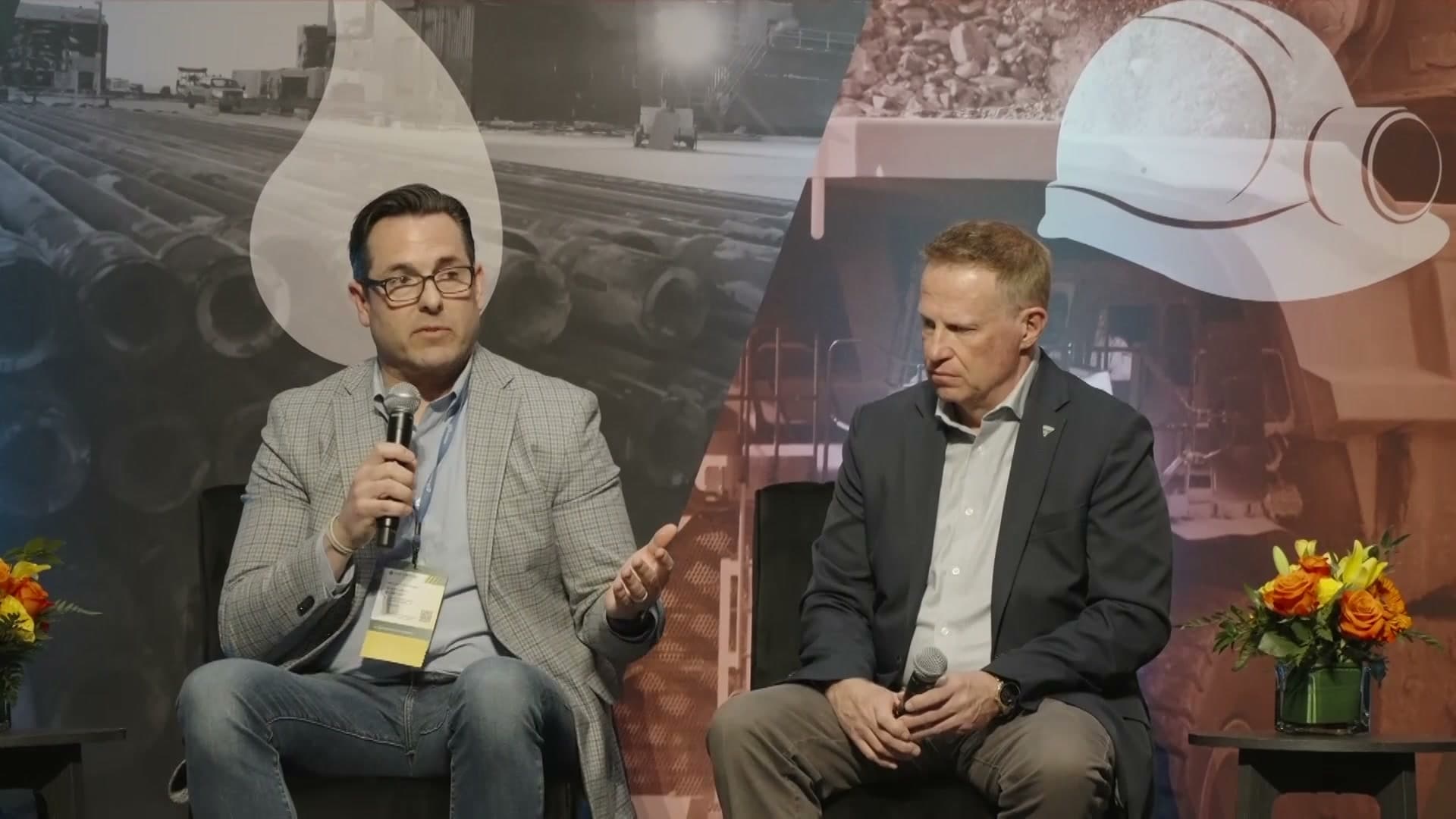
And with that, I'd also like to get a warm round of applause for our friends at Northrim Bank. They're our sponsors today for the lunch. Thank you very much, North Rim. We're going to now move into our keynote lunch presentation with a conversation with leaders from the Department of Interior about the momentum in our industries and discuss federal lands, resources, and opportunities for Alaska. Please welcome our moderator, none other than Tara Sweeney, Vice President of External Affairs for ConocoPhillips, and our guest, Bill Goffey, Principal Deputy Director of Bureau of Land Management, Mike Olson, the Associate Deputy Director, Acting Director of Marine Minerals Administration, Department of the Interior.
If you want to learn a little bit more about these folks, please look on the back of your QR code and it'll tell you more about their bios. And with that, Tara, it's yours.
I think so.
So welcome everyone and thank you to RDC for hosting this lunch. I would also like to say happy Veterans Day and thank you to all the veterans in the audience for your service. It's deeply appreciated. So it's an honor to share the stage with Bill Graffi, who is an honorary Alaskan. It seems like he is spent quite a bit of time up in the state this fall.
No audio detected at 1:20
No audio detected at 1:30
No audio detected at 1:40
Well, this month, last month as well. The last 2 weeks. Yep. And of course, Mike Olson with the Marine Minerals Administration. So today I figured we'd just have a conversation about your departments or your agencies inside the Department of the Interior.
No audio detected at 2:00
You're familiar with Alaska. And you've spent some time, I know, Bill, traveling around the state. But before we get started, on behalf of ConocoPhillips Alaska, I want to thank BLM for issuing the categorical exclusions for our seismic and exploration program.
Thank you. Thank you very much. Yes, we are excited about activity in the NPRA. We are excited to provide some regulatory certainty and a pathway for folks to look at the resources up there. And this CADX gives operators a tool to use to, you know, get started on development.
No audio detected at 2:40
No audio detected at 2:50
It's the first step of many that I'm sure we will watch over the next few years. But we were very proud to be able to get this done. And thank you very much. Thank you. And can you explain, is this the first of its kind?
I can't say whether it's the first of its kind, but it's probably the first one here in Alaska. And so we are, we are, you know, in it. Let me just make sure it's clear. You know, what this does is it basically utilizes existing NEPA, existing EAs, EISs. So it's not bypassing any of the normal reviews, none of the none of the normal NEPA process.
But what it does look at is how do we use what's already in existence to basically build on that and provide certainty. And like I said, that regulatory red tape cutting for operators to go out and do some development. And we know that winter exploration and the winter season on the North Slope runs a very short clock. So this type of predictability is essential for continuing to hunt for oil in NPRA. Yeah, as a matter of fact, that's one of the things that I've heard.
I've been here, I was here last week, went up to the NPRA, went up to the North Slope. I've been here the last couple days. I also was in Fairbanks earlier this week. But one of the things that the staff keeps telling me, unlike in the northern 48, you know, when summer's over, fall's over, everybody kind of slows down through the winter. Here, you guys are excited about snow and ice because then you can actually get to work.
Yep, yep, yep. So I have a question for both of you. Executive Order 14153 and Secretary— the Secretary's Order 3422, both titled Unleashing Alaska's Extraordinary Resource Potential, set Interior's direction for Alaska. So looking out 5 to 10 years, what is the single best, biggest opportunity, and what has to happen in the next 12 months to make it real? And so I'll start with you, Mike, and then you, Bill.
Okay, I'll go first. And I'm kind of bummed out that I'm not named an honorary Alaskan, but—. One more trip and you're covered. All right, fine. Fair enough.
No audio detected at 5:10
It's no secret that the president has made Alaska a top priority, or unleashing energy in Alaska a top priority. Frankly, unleashing energy everywhere a priority. This is very disconcerting. I cannot— looking at myself up there. It is kind of weird.
No audio detected at 5:30
We can see ourselves on the screen. Can we do something about that?
So what was the question again? Sorry. Actually, you know what, I do want to share— I do want to share something because I think it's relevant. And I'm going to pull up my phone here and find this. But, you know, looking ahead, and I'm going to quote our Secretary.
No audio detected at 5:50
He held an all-staff meeting yesterday, all hands, all staff, all team. Of the entire department nationwide. And one of the things we talked about was our— or his vision for the department. And I think— and it's relatively new and I don't have it committed to memory, but I think it's important and I think it answers your question a little bit. Our vision at the department: manage resources, improve lives, and create opportunity.
No audio detected at 6:10
No audio detected at 6:20
And I think if we look at that as a vision for the department, but also apply that to Alaska looking forward, say looking out 5 years or 10 years, where we have done our job to manage resources and improve lives and create opportunity here in Alask— whether that's economic or otherwise. I'll also just, if I can, read our mission, which again is very much applicable: Steward America's natural and cultural resources deliver actionable science, and honor trust responsibilities to tribal and insular communities. So in the vein of all the things that we do at the department— and I, I wear a couple of different hats. I work in the Deputy Secretary's office and serve as the Acting Director of the Marine Minerals Administration. So in, in the, in the work that I get to do, which ranges from Indian Affairs to managing, managing the, the offshore you know, the OCS, we have a huge opportunity to do a lot of great things.
No audio detected at 6:40
No audio detected at 6:50
And if we can carry forward the president's vision and the secretary's vision and unlock additional energy development, critical minerals, and do it in a way that accounts for and takes into consideration local stakeholders, the input of Alaska Natives, I think we're going to be in pretty good shape.
Yeah, I mean, just, just from a perspective of just one of the bureaus in the Department of Interior, Alaska is very important to our portfolio. I think if we looked out and, and could determine, you know, success going forward, one of the things is that regulatory certainty, making sure that we have consistent oil and gas lease sales, seeing how we can get— because this isn't just an oil and gas group, we've also got mining associated here. So making sure that you have a stable regulatory and certain environment going forward, whether you're digging for minerals or oil and gas or conducting any other operation here in Alaska that is on federal lands and develops federal resources. So in March, the BLM held an amazing lease sale within NPRA and And I know that there are many Alaskans in this room that are very thankful for the department's commitment to carrying out that record lease sale. As you look to further developments inside of NPRA, what else is the Bureau of Land Management doing to make it more predictable for development inside the petroleum reserve?
No audio detected at 8:10
No audio detected at 9:00
Yeah, as most of you know, you know, the leasing part of it is just the first step. Right now you have to actually be able to access that resource. So the categorical exclusion we talked about is one of the first steps of that. The other thing is just the other day we closed a comment period on a satellite pad development rule that we are looking at going forward, and we'll finalize that and we'll take those comments. So it— that is part of doing the job of making sure there's some certainty.
We will also be— and thanks to the One Big Beautiful Bill, We'll be setting up a set of predictable lease sale timings going forward. So all of those things, when you add up, hopefully will provide the operators and the business community with a pathway forward and a predictable pathway forward. Thank you. Mike, Secretary Order 3451. You're not going to make me.
Okay. What is that one? Okay. Yes. So your current department, as it's named, Marine Minerals Administration, has had several names throughout the years.
No audio detected at 10:30
Some have known it as BOEM, some have known it as BSEE, others, not to date anyone in this room, but MMS, right? I see some of you out there as well who know. I'm dated with that. So can you explain to this crowd here, tell us more about your department, the structure of it, and are there, is there a local office? What do Alaskans need to know about this newly named administration?
No audio detected at 11:00
No audio detected at 11:10
Because I want to give Bill plenty of time to talk about all kinds of other things, I'll try and make this quick. The Secretary did sign an order that essentially reunifies the Bureau of Ocean Energy Management and the Bureau of Safety and Environmental Enforcement. And I will— dating myself— I had the opportunity to serve at the department during the George W. Bush administration, and I worked very closely with what was then the Minerals Management Service. So I've had kind of an interesting opportunity to see the various regulatory agencies that govern offshore energy development.
The Secretary in that secretarial order said a number of different things, but one of the main principles or one of the main reasons that we, that he, and that we as a department feel that that is an important step is because it will, it brings together, again, two bureaus that are tasked with the oversight and regulation of offshore energy development. So it will remove redundancy. It will put these two agencies back together the way they were when they were the Minerals Management Service with one governing— one director one management team, and will allow us to— and allow the staff to regulate oil and gas development from resource assessment, planning, leasing, drilling, issuing permits to drill, all of that under one leadership structure where we don't have two separate agencies with two separate directors focused on essentially the same industry, the same effort, offshore energy development, but we do it now with one leadership structure that will allow us to do this much more efficiently and create an essentially one-stop shop for the industry. And does this have an impact on the ONRR, the Office of Natural Resource Revenue? Great question.
No audio detected at 12:30
No audio detected at 13:10
When MMS was split into BOEM and BSEE, the Office of Natural Resources Revenue was also taken out of the— out of MMS and put into a separate— kind of a separate corner, separate part of the department. We are not doing anything with Honor. Honor is the office that manages revenue distribution, the And that is staying where it is in the Office of Policy Management and Budget. We are not touching that. We're just bringing BOEM and BSEE back together.
So in terms of MMA's offshore work plan for Alaska covering the Cook Inlet and the Arctic over the next 12 to 24 months, does the Alaska Region have the appropriate staff to deliver on the secretarial mandate?
No audio detected at 14:20
Yes, but we've heard a lot, in fact as recently as this morning in a meeting that we had, people questioning whether we at the department do have sufficient staff to accomplish the things that we need to. And we recognize that there are, there are concerns about that, there are questions about that. But we are very actively filling key roles.
There were a number of retirements and things that occurred over the last year. But yes, we do have, and we have the staff necessary to fulfill the mission. And we're also filling key positions as we speak. So you're looking for good Alaskans. We are looking for good Alaskans.
No audio detected at 15:10
In fact, I think all Alaskans are good.
So we're looking for Alaskans. Great. Now, can I be an honorary Alaskan? Geez, I've been here before. You know, I think the question really is, have you tried muktuk before?
Is that okay? Yes. Yes, I have. I'm looking at Drew. Who's telling you?
Yes, Drew. Drew, I have, haven't I? I have. I have. I promise.
I don't even need to look at Drew. You have to know what it looks like. I'll test you afterwards. Okay, okay, all right, fair enough. Okay.
Who's got the fermented stuff? Anyone up here from Wainwright, Cocktail Week, Barrow? If you've got Mickey up, let's hit him up afterwards. I'm down for that. All right.
And then we'll see. Okay, fine, fine. Onto a couple of— I know we've got just a little bit of time left. So I wanted to talk about— I wanted to talk about permitting minerals and land. So Bill, for you, for critical minerals and mining, how long does it take BLM today to process exploration notices and plans of operation in Alaska?
And what is the biggest bottleneck? Yeah, thank you very much. So we are getting better. I know our state director, Kevin Prendergast, is here today. He won't like me saying this, but it takes— still takes too long.
But we are doing a much better job. Some of the changes that we've made in the department, whether it's NEPA reforms, some of the permitting things that we're doing, are getting to the point where we can move these things along. We are also working on staffing to make sure that we have the right staff. Taking care of the projects that are coming through. We don't want to blame anything on staffing at the department.
It is— we are setting priorities and we will get the work done that needs to be done that the president wants done, that the secretary wants done. We have to be creative sometimes. We borrow people from other states and let them spend some time up here and become honorary Alaskans as well by having them come up here. So But right now we are in the process. I mean, it can take anywhere from a few weeks to a few months to get a project through on a mining project.
The one thing I would ask is that we— it's a partnership. We need folks coming to us early, and we need you coming early and often to talk to us about your project. The earlier you get in the door to have a conversation with us, the more we can help you and tell you exactly what we are going to need in order to review your project. And their team is always open, the doors are always open, and Kevin looks forward to meeting with folks all the time, coming in, talking about mining projects, and we can let you know what is going to be required, and that way you know up front what we're looking for, and that'll help us on the backside being able to get the reviews done and get the decision made going forward. Thank you.
Can you share with the crowd the top 3 priorities of for your agencies that are focused on Alaska, or just your top priority? Everything's a top priority. Um, no, we've— we. Like that answer. The big, the big thing is regulatory certainty, uh, consistent lease sales, and permitting efficiencies.
No audio detected at 18:30
Those are really the big three things that we're looking at. It doesn't matter if you're doing a mining project, you're doing a pipeline, you're doing an oil and gas operation. That is what we're focused on. I spend a lot of my time not on policy issues, I spend a lot of my time on process. And so we're trying to, in the BLM, from the headquarters all the way down, change processes so that those three things can get done.
Mike? Same. Regulatory certainty, permitting, all those things. I guess I would be remiss if I didn't say we're— we can continue with this reunification of BOEM and BSEE, and we want to make sure that that's done. We want to make sure that our employees are are happy with it, that they feel heard, that they are engaged, and that we all have some ownership for it.
I also—.
That looks good. That's pretty. Yeah.
I lost my train of thought.
I guess I'll just say what Phil said. Reunification. Yes, reunification. But also, Again, we— communication, that was what I was going to say. And to kind of reiterate Bill's point, we want to hear from you all.
No audio detected at 19:50
We want— it's one thing for us in Washington to be making decisions, and as you know full well, and doing them because we all think in Washington, you know, we're at the center of the universe, we're so smart. But really, the real work is done here by other people. And the stuff that we do, you know, over the course of my career, I've been able to see how the decision-making in Washington affects industry and tribes. And, you know, we need to hear from you all. We want to know what we can do better, and we want to know whether what we're doing is working and isn't working.
So I guess a priority is to just make sure we are keeping those lines of communication open, that we're working together and that we're hearing from you. I guess the help us help you is kind of the—. I like that, a little Jerry Maguire. Yeah, I guess I wish I could take credit for that, but that is Jerry Maguire. But to build on what you're saying, you're talking about the people at the local level who are doing a lot of the work, the heavy lifting.
They're engaging with different operators in different industries. On a daily basis, and they're at the front lines. I may be biased because I worked at DOI, but I also feel like, you know, DOI has a solid team of people in the state of Alaska working on behalf of growth and development in this state. And I do want to recognize those employees across, across the department and very thankful for that. The last point that I'd like to make, if, to build again on what you were saying about hearing from people locally, from an industry standpoint, it's also extremely critical to continue that engagement at the local level with your city governments, with your tribal governments, through the consultation process, your public hearings, your organized county governments, and making sure that the tribal consultation policy, your Alaska Native Corporation engagement policies are adhered to at DOI.
And I know that you guys have done a great job doing that these past, you know, several years in this administration. So I want to thank you for that continued commitment to robust dialogue. So I have one last question, and I've done this a couple of times. Salmon or halibut? Oh, salmon.
Bill? I feel like this is a trick question. No trick question. I'll go with halibut since he chose salmon. Okay, great.
Well, I'd like to thank you both for coming onto this stage. I'm sure we've got some muktuk in the back, so let's go eat. Let's get that. Thank you very much. Thank you.
No audio detected at 23:00
No audio detected at 23:10
No audio detected at 23:20