Sitka: City and Borough Assembly, 2026-11-10
Alaska News • • 98 min
Articles from this transcript
Sitka Assembly appoints Blake Conaway to Planning Commission from five applicants
Sitka Assembly picked Blake Conaway over four other applicants to fill Darryl Windsor's seat on the Planning Commission.

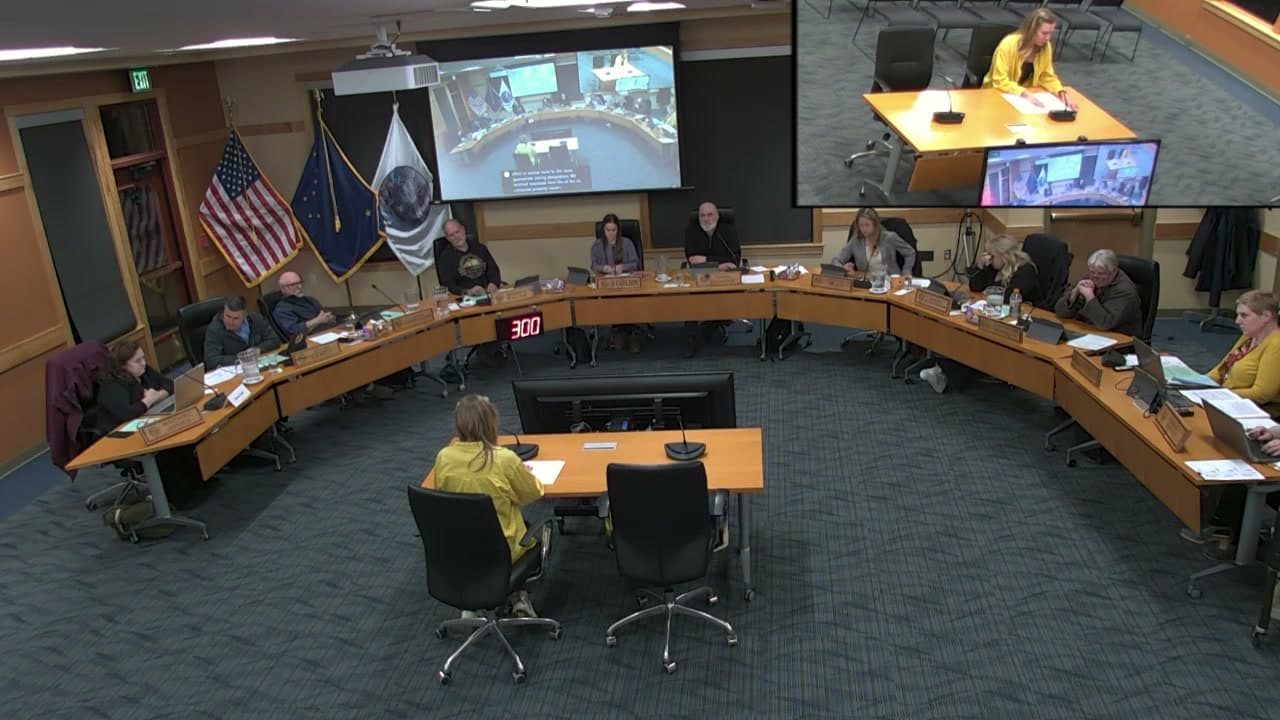
Good evening. I'd like to call to order the November 10th assembly meeting. Please join me for a flag salute.
I pledge allegiance to the flag of the United States of America and to the Republic for which it stands, one nation under God, indivisible, with liberty and justice for all.
The Assembly of the City and Borough of Sitka would like to respectfully acknowledge the traditional First People of Sheetʼká. With gratitude, we proceed. Hángit'áanii. Sara Peterson, roll call please. Mayor Mosher.
Here. Ms. Carlson. Here. Ms. Riley. Here.
Mr. Christianson. Here. Mr. Saline. Here. Ms. Blankenship.
Here. And Mr. Winzert. Present.
Thank you. Are there any correspondence or agenda changes tonight?
Okay, seeing none, we'll move on to special reports.
I'm sorry, uh, sorry, ceremony matters. Sorry. Um, okay, we have a proclamation honoring Veterans Day, and Brian McLaughlin and John Gorel are here to accept.
Proclamation honoring Veterans Day. Whereas America is the land of freedom, preserved and protected willingly and freely by citizen soldiers, and whereas through generations their courage has allowed our republic to flourish, and whereas a nation acknowledges its profound debt of gratitude to those who have served and died in war, and whereas with respect for and in recognition of the sacrifices and contributions of those who serve in the U.S. military, who are deserving of commemoration, honor, and recognition. Now therefore be it resolved that the Assembly of the City and Borough of Sitka, Alaska does hereby call upon the citizens of Sitka to observe the 11th day of November, 2026, as Veterans Day and commend, honor, and recognize the valor and sacrifices of our veterans for defending and protecting our country, our freedom, and our way of life. I just want to add to that, thank you so much for serving, and there's so many veterans in Sitka. Thank each and every one who have served, no matter what your position.
Anyone who served, raised their hand and swore that oath and served, uh, is a veteran and has served. And, uh, many of the— all the liberties that we enjoy today are because of those sacrifices. Thank you for your service. Thank you. Uh, would you like to say anything?
No, I'm good. On behalf of all the veterans, I appreciate you receiving this. Thank you. Yes, sir. Yes, sir.
Okay.
Okay, now we move to special reports.
Is there any government-to-government? Is anyone from the tribe here tonight?
Okay, seeing none. Uh, municipal boards, commissions, committee assignments. Municipal departments, school district. Is there anyone from the school district here tonight?
No. Okay, students and guests.
Okay, we have a couple reports. Department quarterly reports. Uh, is Brandon here? Brandon for Harbors? No, I don't see him.
Move on to public and government relations with Melissa.
Good evening, Mayor and assembly members. Melissa Lunas, Public and Government Relations Director. The administration department has expended or committed approximately 30% of its annual FY27 budget. That's as of October 29th. I do want to mention contracted services because that number can look a little high this early in the fiscal year.
A lot of those contracts are encumbered at the beginning of the year, so even though 94% of that budget is committed or expended, we actually have spent 22%.
So we're working on implementing the communications plan. We kicked off the communications liaison network, which brings together employees all from different departments to improve internal coordination so that we can better communicate to the public. We had some really good discussions by looking at what's working and where we can improve upcoming events, programs, projects, priorities. We went over the goals and strategies in the plan, and a few priorities emerged, including strengthening media and community relationships, improving our website. Establishing clear internal processes, and addressing misinformation.
Our first regular monthly meeting will be in December, so we'll start working through some of those together. We're already trying some new approaches to social media, particularly how we share information about assembly meetings and city projects, and looking at metrics for engagement. And we're in our fourth year of the current strategic plan. And staff have met and gone through all of the action items. So next is our planning workshop on Saturday.
We'll see you all there. And there will be about 11 members of staff in attendance. We'll spend some time celebrating what we've accomplished in year 4, which is 2026, and, and then talk about where we want to focus our efforts next year, year 5. And then we'll start looking ahead to the next strategic plan, so that will include what our vision and priorities might look like and how we want to involve the community in that process. The assembly adopted the ADA Title II back in May.
That replaced the policy from 1996. Since then, I've been working on the procedures and information to support that, including a grievance procedure and updates to our website. Another project I've been working on is our administrative policies and procedures inventory. We've completed the initial inventory, and now we're coordinating with departments on what might be outdated or what is duplicated or what— or who should be responsible for those documents. The bigger goal is to have one central place in our SharePoint site where employees can easily find all of those procedures and policies.
On the legislative side, we're getting closer to that busy time of year as we prepare for the upcoming session. I've also been working on the $10 million in federal funding for our wastewater treatment plant disinfection project, and even though the funding was included in the federal appropriations process. There's still quite a bit of work involved in actually getting those dollars to the city. So I've been working with Public Works on the application and all the federal requirements that go along with it. We're also following up on some of the federal hydroelectric incentive funding that hasn't been distributed yet.
And also in your packet was our quarterly newsletter. It went out September 30th. The next newsletter is scheduled for end of December. And I just want to put a plug in that for anybody that wants to sign up to receive the CBS News, they can go to cityofsitka.com and then scroll all the way down to the bottom and click on the gov delivery icon. That's all I have.
Thank you, Melissa. Are there any questions?
Is that strategic plan, uh, work session this weekend open to the public? It is, yeah, and it's been advertised through the clerk's office.
Anyone else? Okay, uh, thank you, Melissa. Appreciate your service for your time. This brings us to Brooke with Finance.
Good evening, Brooke Volschenk, Finance Director. Um, for Finance's, uh, report this quarter, the FY26 interim financial statements were in your packet. Um, I'm just going to briefly summarize the general fund results, um, as well as the airport fund, um, just because it's an area of concern. Uh, my kind of standard disclaimer that these are preliminary statements and they don't include several year-end adjustments. So if you wanted to hold them side by side with audited financials when they come out, you're going to see some differences.
So for the general fund, revenue came in pretty strong. General fund revenue was about $41.2 million, which is roughly $2.7 million above last year. $2.6 Million above the budget. Some of that is one-time revenue, so, um, most of the increase was due to federal revenue, including a retroactive Secure Rural Schools, um, payment that went directly to the school district. Um, as a consequence of that, the PILT payment in FY 2027 is expected to drop, um, uh, because those pieces are included in the calculation of what we get.
Also, about $241,000 of the sales tax increase came from collecting past due taxes. Spending was under budget, mainly due to vacancies, which is nothing new. We came in about $3.9 million under budget, and about $2.7 million of that was personnel costs. The fund balance for the general fund grew modestly. There were about $3.2 million in supplemental appropriations for the year, and then there was a $3 million transfer to the public infrastructure sinking fund, which meant that the amended budget planned to use about $5.8 million of fund balance, and instead the fund grew by about $500,000.
Capital spending continues to lag. There's about $21.5 million as of June 30, 2026, that's unspent, and that's partly because of large projects like the airport terminal that take up a lot of staff time, and then partly because of those vacancies as well. For the airport fund, the revenue is, is well short of what's needed. For FY26. At the same time, costs have gone up as the new terminal and the updated terminal are being used.
So you can see from those financial statements that the operations are not covering costs. And as a result of that, the fund is relying on— the airport fund is relying on the general fund for support. There is not a lot of cash in that fund. So that means the timing differences that we have with reimbursement requests from DOT for the airport project, we don't have the cash to cover it, so the airport fund has to take an advance from the general fund to be able to meet their cash needs. Going forward, we are working on finalizing the terminal leases and identifying some ongoing revenue to support operations.
The Alaska Airlines lease is in place, so that's already made a big difference for FY '27. And then we're working with the state on an agreement for parking. One other notable thing is that the water fund is in good shape now, and I know it's probably been years since you've been seeing that the critical secondary water payments are coming. They really are at this time, so we are expected to make the first payment in January. So once we start making payments on that loan, it is going to significantly reduce the cash that is available for reinvestment in that fund.
Is that it? Okay. Any questions from the assembly? JJ? I have said several times, this is my favorite document you produce.
And it's just so helpful to kind of see it all in one place. And you think maybe the audit is the best, but that's a different language. This is very plain language, and that's to your credit. I appreciate what you do here and kind of your cover sheets and putting the capital in there and your summaries really make it attainable to people. So if anyone in town wants to read a very valuable 55 pages, this is the document.
Understand where your city tax dollars go.
Absolutely, that's very, very, very good information. Katie? Yeah, thank you so much, Brooke. This is, uh, really helpful to read, and I appreciate the overall picture. I thought was laid out pretty clearly about the status of why we have extra funds and that they come from these personnel absences and gaps, and that that also impacts how much capital improvements that we're able to carry out.
My question in there, I saw a couple times, and this could be for Public Works, but reference to the vehicle inventory and replacement schedule. And I know that there was a policy that was being worked on for how we go about thinking about replacing vehicles and what the schedule is for that. Probably out of Finance's purview, but just given that it was referenced, I was wondering, is that something that has been finalized? How is that kind of factoring into next year's budget? Any insight on that?
I'll answer a piece of that. You're right that a big part of it is really with Public Works. The piece that the Finance Director maintains is the vehicle sinking fund balances. So we have funding— each of the funds make payments to Central Garage each year with the idea that when it's time to replace your vehicles after they're at the end of their useful life, there's already enough funding there to replace them and that you don't need to come up with that in a single year. There are— there have been some challenges with those sinking funds over the last few years because the cost of vehicles has gone up so much that the inflationary adjustments that we were making to kind of guess what those vehicles would cost when we went to replace them, some of them were really, really need some help.
So I know that for my part, Finance and Public Works and Connor and Dennis and Mark, we've all been working on making improvements to that sinking fund area and into taking a look at the fleet and kind of planning out what's needed. But probably one of the biggest things that we're still— we'll do in the next budget year is just try and adjust those projected replacement costs so that we get a full picture of how much our existing fleet is already costing us. Okay. Thank you. Yeah, that's super helpful.
And then will we, during the budget season, kind of get an analysis of, like, maintenance costs on existing aging fleet versus the replacement, like, the cost-benefit analysis? Is that— does that metric kind of change with the inflationary pressures that you're talking about? I can't recall exactly how much I covered in the presentation itself last year on that. I know we talked about sinking fund payments. And with an aging fleet, if you don't replace the vehicles when you should, that's going to increase the costs on the maintenance side.
And I can cover a little bit more and talk about, like, lay out exactly what those costs are. If you just look at the budget, there's so many things combined into central garage that is not immediately clear what all is included in that amount, but I can do that. Thank you so much.
Anyone else? Okay, seeing none, we'll move on to persons to be heard. We are now at persons to be heard for public participation on any item off the agenda, not to exceed 3 minutes per individual. Is there any public comment for items off the agenda? Please come forward and state your name, your first and last name, for the record.
Good evening, Assembly members, Mr. Mayor. My name is Amy McLaughlin. I'm a board member of the Sitka Recreation Foundation, and I'm excited to share that our Parks and Rec Master Plan community survey is going to go live tomorrow, November 11th, and it'll stay open till December 13th. We're encouraging all Sitkans to participate.
Our goal is to hear from residents of all ages so we can gather a diverse range of perspectives and better understand our community's priorities for parks and recreation. We're also interested in getting the voices of our youth, so we encourage parents and guardians to help their children participate in the survey so we can get their views. The survey link will be available on the Sitka Recreation Foundation website, and information will also be shared through our social media channels. And in addition, we'll have flyers containing a QR code that will link directly to the survey throughout town. And thank you for your time and your opportunity, the opportunity to share this information with you.
Thank you. Thank you for your comments.
Anyone else for persons to be heard on any item not on the agenda? Okay.
I'm not seeing anyone, so move on. Uh, now we're at the consent agenda, um, unless someone wants to pull Item A, which is the only item for discussion. Um, can I have a motion?
I move to approve a consent agenda consisting of Item A. Second.
Motion has been made. That's item A, approve the minutes of the October 27th assembly meeting. Is there any public comment on the consent agenda? No, seeing none. Sara Peterson.
All right, on the motion to approve the minutes of the October 27th assembly meeting. Mayor Moser? Yes. Ms. Blankenship? Yes.
Mr. Christianson? Yes. Ms. Riley? Yes. Ms. Carlson?
Yes. Mr. Saline? Yes. And Mr. Windsor? Yes.
Motion passes 7-0 on Item A. Okay, thank you. That brings us to Item B, appointing someone to an unexpired term on the Planning Commission. Sara, you've outlined the possible motions to us. Is there anyone that would like to make a motion?
I nominate Richard Cole, Blake Conaway, Andrew Foster, Eric Hageman, and Ben Hilberg to serve on the Planning Commission. I second. Okay, it's been moved and seconded. So Sarah's let me know here that all applicants will be attending except for maybe Ben. He's flying on a flight.
Oh, okay, he is here. Okay, great. Um, would anyone— before we go to public comment, would any of the applicants like to come up and speak?
Please. Okay. Hey, I just want to introduce myself real quick just so you all had an idea of who I was before choosing. Um, my name is Eric. I've lived in Sitka for 11 years now.
I currently work for Alaska Kama and Haran Appraisals where I I'm the contract assessor for the City of Craig and a developer for our CAMA and market data systems. Before that, I worked at Spinard's working one-on-one with many of the local contractors in town as well as homeowners and landowners. I believe the experience I've gained in those careers would definitely benefit the commission, the Planning Commission and their work. I've seen how different cities have used and promoted their land. I've worked with city staff directly, either here or in other cities across Alaska, in very similar situations as here.
Craig was one of them.
And then the other thing is living here for 11 years. I've been renting the entire time. I've been trying to purchase a house for the last 6 years. And I've yet to get that opportunity here. Um, and it's something I've seen with plenty of my friends and peers to the point where a lot of them have even moved out of town to either start families or find their home that they can start, basically.
Uh, and part of that is why I am applying for the commission here. Um, and I also wanted to just see if any of you guys had any questions specifically for me or not. So I think what we're going to do is, um, have you guys all make your, your presentation, and then we'll have public comment, and then if members have questions for you, we'll call you back up. Okay, thank you.
Anyone else? Any of the other applicants would like to come up?
Hello, good evening. I'm Blake Conaway. I just wanted to take an opportunity to come up here and introduce myself. I'm a 17-year-long Sitkan, and I've been at the Sitka Sound Science Center now for 10 years in different capacities.
And I don't have a lot to add to my application that I sent in, but I really think that that experience that I've gained at the Science Center has been—. Would be pretty valuable in me being a member of the Planning Commission, you know, the being part of the historic Sheldon Jackson campus.
Myriad of different construction projects, historic renovations, along with a handful of residential projects, I think makes me a pretty well-balanced and rounded person to join that group. So, anyways, thank you. Thank you, Blake.
Please.
Hi, how do I introduce myself? Can you press the red button first? It'll turn red when you push it. Oh, there we go. Thank you.
Okay, so I'll introduce myself again. I'm Richard Cole. I recently moved back to Sitka about 2 years ago, but was raised here. And I'm a third-generation Sitkan. I have managed commercial and governmental properties and nonprofit properties in 5 communities around Southeast Alaska.
When I left Sitka, it was because Sitka was facing many of the challenges we're still facing with regard to housing and childcare. I currently am the executive director of a nonprofit here in town currently trying to be creative in how we house employees in that position. Um, and so recognize a lot of the work you guys have done in the Planning Commission has done in trying to address the challenges we have for both commercial development and for housing development. In my mind, especially housing development. Um, I was gratified to see some of the changes that Planning Commission's made recently with regard to ancillary housing units and being a little more creative in how we can address those things.
Because like some of the other folks, I rent here and it is, it is a challenge to be in Sitka. I am fortunate enough that I was able to get a position that allowed me to be able to afford to come home, but it is a challenge. Here, and I, I like to see the work that the Assembly and the Planning Commission has been doing. I think my experience in property management and ownership gives me, I guess, enough perspective to help be part of the creative process as we look for different ways to, to come at it from different angles, because it is, you know, obviously we have geographic limitations, we have cost limitations, and currently we have code limitations. Populations.
And so how we, how we address some of those things to see if we can improve that to make it more possible for Sitkans to live here affordably. So thank you so much. Thank you very much.
Good evening. My name is Ben Hilberg. I've been here in Sitka the late— or pardon me, the middle '80s when I came to town to help reopen Mount Edgecomb High School. So my experience here is vast. I have had as many as 175 employees.
I continue to live here and still do work, although I'm no longer at Edgecomb. I think my almost 50 years of experience as being a business owner and a landowner uniquely qualifies me to bring some perspective in terms of working with different entities and different groups.
If nothing else, the patience it takes to kind of figure out solutions. You know, we're facing a lot a lot of problems as time moves on, and the housing is probably the biggest, as well as qualified staffing and how we move forward. But we're given this great opportunity, and fortunately I've got some time to share, so thank you for your time. Thank you very much.
Okay.
We have one more.
Mayor, Assembly members, I'm Andrew Foster. I want to thank you for your time and consideration. I prepared some remarks about my motivation, not my credentials, because I know that you already have a packet for that. So 4 years ago, my wife and I chose Sitka to raise our children because places like this are rare. But the Sitka we chose isn't guaranteed to be the Sitka our children inherit.
Decisions about housing, our working waterfront, and economic growth will shape whether our kids can build their lives here or whether they'll have to leave. I spent my career launching new products and businesses across 27 different countries. That experience taught me how to balance competing interests, navigate complexity, and make tough decisions with real consequences. But I'm not here today because I have all the answers. I'm here because I know how to ask hard questions, I know how to listen carefully, and I know how to make sound decisions.
I have much to learn from the longtime residents here, but I also bring fresh eyes and independent judgment. No old allegiances, just a deeply personal stake in Sitka's future. I want our children to inherit a Sitka every bit as remarkable as the one that we chose. I'm ready to do the work, and I'd be honored to serve. Thank you.
Thank you very much.
Okay, now we'll move it to public comment on this motion. Anyone like to come up and speak?
Okay, not seeing anyone. Bring it back to the assembly table. Um, we do— I just want to say thank you for everyone who put your name in. It is a very, very important and consequential commission, and they have a lot of important work to do, so I'm very grateful that every single person applied. With that, I'll open up for discussion.
Tough duty picking everybody here, and that's why I've got to, uh, express why I'm voting for Blake. And, uh, 17 years in town and being diversified, meaning going from fishing, starting a family, and then realizing where fishing's going, and then staying in town no matter what and getting the job at the Science Center and knowing different vessels that he's fished on in the past and those skippers, being an astute deckhand and then changing your economics just to stay in town and keep your family going. Uh, I'm babbling now, but that's why I'm voting for Blake. Thank you. Tor, I wanted to amplify a little bit of what you said earlier, that we're lucky.
I Honestly, we've got everybody here qualified, and it's unusual even for the Planning Commission to have this many people. But we also have— obviously not everybody's going to get this, only one person is going to get it, but we've got a lot of slots open, uh, from other commissions, and some of them, like the Finance Committee, needs— is definitely looking for somebody. And, uh, I mean, if you are at all interested, talk to Sara Peterson. We get an email— is it today that you sent the list of them all open or was it yesterday? But we have got a lot of openings.
So please, there is more than one way to contribute to our community. So, thank you. Thank you, Tor. Darryl, please. Yeah.
All the applicants are clearly qualified. It makes the decision really hard, but one person I do know and have kind of followed for a long time is Blake Conway. And that's the way I'm going to go ahead and vote, just because I know him probably better than I know the other guys. But like I said, everybody is more than qualified. And it's a special spot because it's a seat I left.
Absolutely, you served a long time.
JJ Carlson. Yeah, there is a lot of vision here with the future and planning. This community includes that kind of comprehensive plan which is coming up. It is not just housing and childcare and our kind of shorter-term 5-year goals that we do in the strategic plan. That comprehensive plan is upcoming.
I also need to mention that there may be some boring times the Planning Commission, you may need to spend a whole 10 minutes discussing what is the front and what is the side of a lot. That happens regularly enough. Getting some nods from our audience there. So there is just some duty to it, as well as I'm seeing that making that vision of future of town. If visioning is really what you're interested in, the Sustainability Commission can be a good avenue.
Very suitable place for that. We're looking at those longer-term, how to keep Sitka the beautiful, thriving, and stewardship-minded place that we are. This is a challenge for me because I'm thinking of the current composition of the board and what kind of perspective might do balance. Balance is something we discuss quite a bit when when looking through applications for appointments to commissions, because there is that kind of wide-ranging perspective that is best in representative democracy. And I'm happy to hear that other people have other kind of perspectives, but I've got a couple of front-runners here based on that experience and that understanding of that Sitka— Sheetʼká.
Perspective and that Southeast community is key. And there's— but there's always, always more to learn. If someone wants to share any other bit of wisdom.
Sure. Yeah, I just want to say the same thing, that every one of these applications are excellent. There's a lot of experience. Everyone is invested in their community. They have a continued interest in being invested, and most of you are also on boards or somehow engaged in your community.
So it's very difficult to make this, this decision. And I've been in your position before, wanting to join a commission and be involved, and so I have a special place in my heart for that, that position that you're in.
I don't know many of you personally, so that I will have to say sometimes plays in all of our decisions. I only know one of you personally, and I can say that, um, that person I, I probably will vote for based on what I know of them in the community and how invested they are. Um, no bias. I only know them on a business since. So, but I want to say thank you for everyone putting in their time into this.
Thank you. Katie, did you have anything? Yeah, I'll just echo and reiterate what everyone is saying. This Commission definitely takes up, I would say, the most time except for the Assembly and sometimes more. So thank you all so much for putting your names forward and your expertise.
It is meaningful that people are willing to dedicate that time to bettering our community and solving some of the difficult challenges that we have that face our continued growth and prosperity. So I just want to say thank you to everyone. I too am thinking about this in terms of what kind of perspective and expertise is, you know, could be served by augmenting the current members of the Commission. I am going to support Mr. Conway as well. I really appreciate the hands-on experience that he brings in construction and knowing the lay of the land in Sitka.
And I will just say that I was trailer park neighbors with Blake for, for quite a few years there, and this is a housing issue that I'm very passionate about. It's, you know, 10% of the housing in our community is located in our trailer parks. And we've got a lot of work to do to figure out how to make those long-term sustainable. So I'm hoping that Mr. Conway will be a partner in that if he's selected tonight. And I just want to thank everyone for putting their name forward, and the skills that you all bring are bettering our community in many ways.
So thank you. Thank you, Katie Riley. I don't really have much I can add to that. I agree with everything everyone said. We're just so fortunate to have this many people applying, and I think every single one is qualified.
I am also going to go with Blake, but for those who did not get selected, please do not think that it is because of a lack of qualifications. And as JJ and Tor pointed out, we have many, many commissions that are available. And, you know, this— she mentioned sustainability, that's a very good one, and they do a lot of work there too. So let's go ahead, I'm going to hand it off to Sara for your roll call. Alright, so assembly members, when I call your name, if you could please state your applicant of choice.
And then just a reminder that an applicant must receive at least 4 votes to be appointed. Mr. Christianson. Kohl. Ms. Blankenship. Kohl.
Ms. Carlson. Blake. Mayor Mosher. Blake.
Mr. Windsor. Blake. Mr. Saline. Blake. And Ms. Riley.
Blake. All right, Blake, you're appointed. 5 Votes. Our office will be in touch with you with all the details you need. Okay.
Thank you. Okay. We are going to move on to Item C. Can I get a motion? Sorry, go ahead. I move to appoint Charlie Trishield to an unexpired term on the Ports and Harbors Commission.
Second. Okay. It has been moved and seconded. Is there any public comment?
Okay. Seeing none, any— is there any assembly deliberation?
No. Okay, Sarah. All right, on the motion to appoint Charlie Treshield to an unexpired term on the Port and Harbors Commission. Ms. Riley? Yes.
Mr. Saline? Yes. Mr. Christianson? Yes. Mayor Mosher?
Yes. Ms. Carlson? Yes. Mr. Windsor? Yes.
And Ms. Blankenship? Yes. Motion passes 7-0 on Item C. Okay, thank you. This moves us on to unfinished business, uh, Item D. Can I get a motion?
I move to approve Ordinance 2026-27 on second and final reading, setting a special election on February 2nd, 2027, proposing an amendment to Title IV, Revenue and Finance, Chapter 4.25, Sales Tax, the Sitka General Code to increase the 6% sales tax from April through September to 6.5% by amending Section 4.25.010, Levy of Sales Tax, and submitting the question of such an amendment to the qualified voters. Second. Okay, it's been moved and seconded. Uh, is there any public comment?
My name is Carrie Segal. Lauren Wild couldn't be here tonight, so I'm reading something from her. Dear Assembly, I left the first reading of this ordinance wondering what a half percent increase in sales tax would be like for a family like mine. The increased sales tax would be in effect from April 1 through September 30 for a 6-month period. My husband and I calculated our household taxable expenditures for those 6 months for a family of 4.
We included groceries, gas, utilities, harbor mortgage, and internet fees. We have monthly subscriptions for Amazon diapers and dog food, plus some predictable summer expenses from the local hardware store. For that period, we spend about $13,000 on those items that are subject to sales tax. A half percent sales tax on $13,000 is $65. That is the increased amount of sales tax we would pay over the summer if this ballot initiative were to pass.
This equals about $11 per month for the 6-month period. This is doable for our household. It may not be easy for some households in Sitka. However, I encourage everyone to do the same calculation for their household to learn what a half a percent is for you seasonally, you might find the number to be far less of a burden than what you imagine when you hear tax increase. On the flip side of that, what does $65 get me?
This revenue generated is an investment in the sustainability and the future of our community. Class sizes in elementary school have declined by 20 kids per grade in the last 4 years alone. We only have half the half the population we had 20 years ago. Employers wonder why they cannot find college kids to work summers, or why there are fewer local kids for seasonal jobs. We have our answer.
We have half the children that we used to have. The childcare crisis is one of the top 2 reasons we are losing families. The other is housing. It is worth investing in childcare to stop this decline. This revenue would help Sitka stabilize our our challenging youth population and enable us to grow back into a thriving community for families.
My kids are going to grow up in Sitka. They will participate in sports and athletics. I want them to have modern equipment and fields, but we will not be able to justify these things without a robust youth population. I will continue to advocate for affordable and available childcare even after my kids are out of the childcare age system. I want families to live here and have kids here more than anything because I remember what an amazing place this was to grow up, and so much of it was the people in the community and the friends we all had.
I want that for my kids too, and I'm so hopeful about what an investment in this 0-5 population of Sitka can do for the future of Sitka. Thank you. Thank you for your comments. Anyone else?
Good evening, Mayor and assembly members. My name is Annette Evans. I'm the director at Betty Eliason Early Learning Center. I'm also a mother of two. Thank you, sponsors, for putting into action municipal support towards a community childcare crisis solution.
Unfortunately, the demographics and economy have already experienced the effect of the lack of access to affordable childcare. I hope tonight's assembly action can help steer our community towards improvement in programs for early childhood, which would support growth for Sitka overall. Thank you, Assembly members, for taking time to analyze the data presented to you by the Local Early Childhood Coalition, SDA's Child Care Needs Assessment from 2022, the Health Needs and Human Services Commission Report of 2024, and the Southeast Childhood Coalition Analysis of 2026. You've done a lot of work. Thank you for hearing the many painful parent testimonies.
Thank you for referencing child care's place in the strategic plan of CBS. Thank you for recognizing that child care providers alone cannot solve this problem and that the child care business model is not sustainable in the private sector. Thank you for understanding that the solution must include support—. Supporting child care workers, beginning with CTE, for we cannot increase child enrollment without adequate child care employees. Thank you for working together as the assembly with city staff to coordinate this proposed ordinance.
Thank you for reiterating that local businesses can play a role and should play a role in the collaboration of solutions for their employees. Thank you for listening to my many testimonies over the last 4 years. And for only cutting me off once after the timer. Awkward. I cannot promise you won't hear from me again.
Thank you for asking the citizens of Sitka to step up and share their voices, and thank you for voting in support of Ordinance 2627.
Thank you for comments.
Anyone else for persons to be— or, I'm sorry, for public comment on this item?
Not seeing anyone, so I'll bring it back to the assembly table.
Tor? Yeah, as I say, we— I think we spoke to this pretty exclusively— exhaustively, excuse me— 2 weeks ago, and I'm not sure what more needs to be said. But if there's any more questions for the sponsors, feel free. But the point being, in my In my mind is this is now, if we pass this, it's out of our hands. It is now up to the people of Sitka.
And so, you know, we're not declaring a tax on people. This is going to be something where the people of Sitka are deciding that this is something we need to keep the economy of Sitka going because this is an economic question.
More than anything. I mean, it's the right thing to do, you know, to take care of the kids. But more importantly— I mean, or more importantly, but as importantly, it's something we need to keep the economy going because the lack of child care is stopping, you know, is making it harder and harder for us to get employees and of course to have them stay in Sitka. But again, at the end of the day, it's not our call. It's going to be the people of Sitka's call.
Thank you, Darryl.
Being fairly new on the assembly, but I did hear a couple meetings before I became on assembly, different options for the tax increase or whatever. A couple things that bother me is I've heard, and maybe you can answer this, Thor, that if this didn't pass, there's other options. And I haven't heard any other options besides the tax increase.
I don't think— we've bounced around some other things, but let's just say that, at least in my opinion, this is the least painful there.
And one of the things that was driven home, and I talked about this last week, is that we need a steady source of income in order to make— to stabilize the childcare providers. And that's why we've got the PPP, the public-private partnership, going towards scholarships to reduce cost, but that can be variable. I mean, it's not the end of the world if that goes up and down, but we need to have a steady source of income that we can count, that the providers can count on. And some sort of a tax is really the only way. Anything else we do is going to have, you know, be at the will of the assembly, if they will have any kind of excess.
And so we won't, they won't be able to count count on it. And that's— it's vitally important. And this got made very clear to us and all the— and I'm sure that some of the folks who just spoke can speak to this— is that if they can plan on it, they can plan on— they can raise wages, they can plan on training that they can't do if it's not a steady known source. So that's probably You know, what kind of tax? Yeah, there's been— there's ideas on that, and I know I loved the idea of the 4-7, but the city staff convinced us that that was just going to be really hard for them to do.
And also really hard to put on the agenda— on the ballot, because it would have required making changes that weren't immediately apparent that that's what the changes we were doing. So, and, you know, Kevin, if you were—. I can answer that too, or speak to that. But, but as well, some sort of revenue generation, otherwise known as the tax, was going to have to come forward. Yeah, and I'll, I'll speak to that since I'm one of the sponsors.
And, um, we've— this has been a long process. We just— to catch up, um, the Health Needs and Human Services, Social Services, they did a very extensive report delineating some ideas for addressing childcare and the need. Not much was done for about a year, and then the assembly took up, and Tor and I, and then Chris Yessted at the time, we met with the childcare providers and some other folks. Then we had, I think, a work session. We got the assembly The assembly agreed to fund a $25,000 report on options and things like that, not funding options, but options to address it.
And that was done by an outside entity. That report was presented. Then we had a series of work sessions. We worked on, I think, 2 or 3 over the past couple of months. We did have input from finance on the funding options, and this is the one we landed on.
Yes, you know, I agree that there are other options. It's just my personal opinion that those are not feasible or the best at this time. There's things like removing the senior sales tax exemption, and that's obviously a highly political, contentious thing. Plus, it would be very difficult to determine the difference. You know, how do you know which portion of that There was an alcohol tax increase suggestion.
That amount estimate was about, I think, half a million dollars, and we're looking at we need at least a million dollars to have a good effect. Plus the alcohol tax carries the risk of a decent amount of risk of litigation from, you know, the alcohol industry or what have you. And then there's also something we looked into was removing the sales tax, the cap off of sales tax. Currently it's is capped at $12,000.
And that, in my opinion— well, one, that's also very difficult to determine how much more you're getting. And another thing, when you do that, it's just my opinion that you also have, you know, every action has other actions and unintended consequences that people could decide to take their business elsewhere. You know, someone wants to buy a piece of equipment here, that is pretty expensive and there's no tax on, you know, they might just go somewhere else and buy it. So we could end up losing revenue rather than gaining in the long haul.
We, like I said, I want to like point out that we did have several work sessions. The assembly did end up deciding on this tax. We talked about different ones like increasing it by, to 7% in the summer and reducing to 4% in the winter. And, you know, we ended up on the half percent in the summer only with the idea that this will have the least amount of burden on, on people, is at the same time leveraging the increased substantial increase in economic activity from outside of Sitka. So ideally bringing funds from outside instead of just taxing within.
So that's the kind of thing.
I believe, you know, so Kari read Lauren Wild's, you know, email and about the amount it would be, you know, and I did the math too at the last one. You know, it's only if you just did the $12,000 cap, it's $60, you know. So it's not— I mean, no tax is great, but what you get— I like what she said in the email— what you get in in exchange for this is well over $1 million, which could really go a long way with helping address this. And ultimately, it does go to the vote of the people, and it'll be Sitka's choice. You know, I will acknowledge that— and we talked about this last night at the government-to-government dinner with STA— that the subject was brought up and we talked about it.
You know, I acknowledged, and I acknowledge now, that this— it would be a departure, if the residents voted in favor of this, a departure from the norms of government, you know, what the government does. Normally governments provide, you know, public safety, roads, schools, things like of that nature. This would be a change. I do— if you look outside of Sitka, it is a growing phenomenon in this country where governments, towns, states— New Mexico instituted its own full coverage of childcare. It's an experiment.
We'll see how it goes. They're using oil revenue or lease revenue, I believe. But I think it's a growing concern and decision in this country that, you know, the dynamics have changed from 20, 30, 40 years ago. It's a lot harder for growing families to make it. And so this would be, even though it's a tax, it's a very small one.
It would only be for the summer, and it would long-term substantially, hopefully, theoretically, increase economic activity and make it more affordable, allowed young families to grow their families, you know, people to— they want to come here, to come here, assuming we're able to help with housing and things like that. It's another huge issue. Those are the two main issues. So this is just an attempt.
As reminding you, we, if this passes, we'll be putting out an RFP for an outside entity to manage those funds and to distribute them as we've talked about. So that's kind of my answer. In my opinion, it's, we've gotten this far. You know, you can go far and then say, well, at the last minute, well, what about this? What about this?
At this point, timing is an issue. We're giving it to the people. I think we should give them a shot.
Yeah, and I can see the fact that I haven't been to these meetings and I haven't heard a lot of the story.
Just the thought in the back of my head is that every little tax increase kind of starts a nickel and dime. It never comes back down, ever, ever. Even when it did, it got voted right back in.
Like you said, we'll leave it up to the vote of the people, so I'll concede that fact. And then I didn't hear it all, so—.
Katie, please. Yeah, I'll just say the other funding mechanisms that we talked about that were not taxes were how do we use our existing revenues to support our strategic priorities as a community. So the city has budgeted $700,000 for a land study because housing is a priority and increasing access to land. We budget money every single year for our domestic violence shelter because we believe that is an investment in our public safety. We budget money for communications plan because it is a priority that our citizens have good communications and access to information about what their public government is doing so.
We fund our community priorities and the things that we think will make our community better and more accessible for our citizens through our normal budgeting process every year. And this is not something that has been included in that budget every year, but that is a decision that this assembly can make. And so I've previously, um, you know, reiterated that I very much want to see how this vote goes. I'm in support of this vote going to the people I very much appreciate Lauren Wild's calculations, always bringing the valuable data, and so much of all of the advocates that have come up have really brought that critical data that I think lays this into understandable terms, you know, for what this is, how this is going to impact people. So I appreciate that.
But I'm willing to explore all options because I do believe that this is a very critical, you know, issue for our community and the future growth of it, our economic development. And so willing to explore some of those other options as well should the need arise. And every year we put aside that money for our sinking fund, our capital infrastructure. And I'm in favor of, you know, redirecting some of that to invest in our human infrastructure. We do have a period of time here where we are going to be waiting to see how this goes and then before funds arrive.
So there are still some conversations that we can have at this table for how to cover that gap.
Thank you, Katie. Did you have something, Sherri? Yeah, I just wanted to mention that, you know, while we are— while this goes to the people for a vote, we are also going to be looking for other funding for this through private partnership. And one of the things I am concerned about is voter education, that they understand before they go to the voter box that this cannot be revisited for another 10 years after this goes through. So even if we find funding and we find consistent funding, the children that are going to be in those daycares, and for those families that vote on this right now, they they will no longer need daycare probably by the time this goes up for vote again.
So that is just something to think about. By the time that this matures, uh, you know, we won't be able to do anything about it as far as changing it and say, hey, we know we found funding that's consistent, um, yet we raise the tax. So that's just something that we need to think about with voter education, I guess. Thank you. Uh, Scotty, I just concur with that because I've lost it with me trying to explain to people every penny you put into kids before school ends up keeping them out of juvie later on.
I don't think this is going to pass any more than raising our mill rate to get more money for the schools. Did you just say that this can't be another special vote for 10 years? Well, to clarify what she's saying, this has a 10-year expiration date. So if this passes, the voters pass this, then it would automatically expire in 10 years. The voters would get a chance to reapprove it.
I will point out, I don't think there's going to be— if something— how we have found a huge slush fund of money, I don't think the voters would have a hard time if we put up another vote asking them to reduce taxes. I don't see that being as a problem. Problem. So we do have the option if we find this just a massive amount of money, we don't need the tax anymore. So say the vote passes and then 5 years we find all this money, we can just put another vote and ask them, do you want to get rid of it?
And I think that would, that would pass. So I don't see that as being a problem.
Does that— no, do you want me to walk that? Okay, okay, I'll, I'll, let's walk it. Let's just Let's just go on. We're going for it. Let them vote on it.
Okay. Tor? Just a couple of points. Like you said, if— let's say we actually start selling lots of water, that would probably do it, and we had extra money, like I said, we could— the assembly at the time could put it on the ballot to reduce it before the 10 years if they wanted to. That would not be an issue.
Issue. The— honestly, that's about the only place I think we could get a steady supply like that. As far as the idea that people who have kids in now, in 10 years they won't have kids in, that's okay because this is a continual problem. I mean, it doesn't matter— I mean, my kids are out of child care care, thank God. But I'm still supporting this because I don't see it as just the right thing to do.
It's an economic driver. It's what allows employers to hire new people. It's what— in a perfect world, yeah, those employers that have their own childcare, but it's not. And this does have a mechanism for allowing employers to kick in. And I think that with the public-private partnership, I think that it's going to be a lot easier for employers to kick into that because they're actually lowering prices, whereas this keeps us having something to lower, if that makes any sense.
What this does is it stabilizes it so that the public-private partnership can do do the fun stuff, which is going to be actually lowering the cost. But we don't— we can't lower the cost if there's nothing there to lower. I mean, that if— and from what I understand, listening to the providers, they're on a razor's edge right now. And if we don't do something pretty quick— and yes, we have looked at a lot of different things, and I understand that there's other there are other things we could try and do, but the problem I see with almost every other one is either wasn't enough money and wasn't steady, because I think if something— if we have something where the assembly has to vote on it every year, the amount, that's not something that they can count on. And I mean, you can't count on the amount.
So this way is a dedicated fund that has to go to this, and we know pretty darn close what it's going to be. Every year so that you can make plans 5, 10 years out. You can expand an operation, you can start things like infant child care and know that you're going to have the support. And that's what's so important, knowing you have that steady support and how much it's going to be roughly. So I think that we have, like I said last week, I've I spent more time in meetings, more time talking to people than any other action I've ever been a part of in the Assembly.
Way more. And as far as the education is concerned, we've got a group of people that have been talking to us for years now that I think are going to do a very nice job of that education. They're going to be better at it than we are, and I'm looking for them to do that, and I think they will. So Thank you.
Okay, is there any other, any other comments? I'm seeing none. Sara Peterson. All right, on the motion before you to approve Ordinance 2026-27 on second and final reading. Mr. Christianson?
Yes. Ms. Carlson? Mr. Saline? Yes. Ms. Blankenship?
Yes. Ms. Riley? Yes. Mr. Windsor? Yes.
And Mayor Mosher? Yes. Motion passes 7-0 on second and final reading. Thank you. It's past the top of the hour.
Let's take a 7-minute break. Sarah, can we do that?
Okay. My little scheme to have a 7-minute break to try to be more efficient and then I'm the last one here, so I need to be more realistic next time. Okay. We're moving on to new business, uh, item E. Can I get a motion?
I move to approve Ordinance 2026-29 on first reading, making supplemental appropriations for fiscal year 2027 special election. Second. Okay, it's been moved and seconded. Are there any comments from the sponsors?
Apparently we're the sponsors. This is a supplemental appropriations to pay for the special election. I think we should support it given that we just voted on having a special election, so that would be my recommendation. Thank you, Katie. Very good.
Yes, thank you so much. That's, that's well said. Okay, public comment on this one?
Nope, seeing none. Assembly deliberation, uh, please. A bit of an overview, um, we're looking at $20,000, a little less than $20,000, uh, to have that special election on February 2nd, the first Tuesday in February, and do the 2 weeks of early voting in advance of that. Um, so that is, is what we're looking at here, um, to support that, that last thing we just passed. Thank you, JJ.
Anyone else? Okay, Sara. All right, on the motion to approve Ordinance 2026-29 on first reading, Mayor Moser? Yes. Miss Blankenship?
Yes. Mr. Christianson? Yes. Ms. Carlson? Yes.
Ms. Riley? Yes. Mr. Saline? Yes. And Mr. Windsor?
Yes. Motion passes 7-0 on first reading. Great. Move to Item F. Can I get a motion?
I move to approve Ordinance 2026-30 on first reading, amending the official Sitka zoning map to rezone historic cemetery properties from R-1 Single Family and Duplex Residential District and P Public Plans to District 2C Cemetery District. Second. Okay, great. It's been moved and seconded. Now we're going to have an intro from Adrienne Will, our planner.
Good evening, Mayor Moser and assembly members. I'm Ariadne Will, Planner 1. I'm here to to discuss the rezoning of some historic cemetery properties to C Cemetery District. This ordinance includes 6 cemeteries to be rezoned. 2 Of those are currently zoned R-1 single-family duplex residential district.
4 Are currently zoned as P Public Lands District. This rezoning will allow for additional protections to those interred in these cemeteries. The cemetery district is more restrictive than the current zoning designation and is intended for cemetery uses only. It would not impact the existing uses of these properties. Some background: the Cemetery District was created in 2019, and since then, only one cemetery has been rezoned to the Cemetery District.
The city has not been approached by any other cemetery property owners since. And so in August of last year, we sent a letter to some cemetery property owners in an effort to rezone more to this more appropriate zoning designation. We received responses from 5 of the 6 contacted property owners, including letters of support and non-objection from property owners for the 6 properties listed in your staff report. Um, this includes also a cemetery that the city is the property owner of. Staff is also available if other property owners want to come forward and pursue zoning for additional properties that could benefit from this zoning designation.
The Planning Commission recommended this for approval on October 21st, and the Historic Preservation Commission recommended the approval of this zoning change on October 14th. It's also supported by the 2030 Comprehensive Plan, Action HCA 1.1 to coordinate and collaborate with interested parties to compile cemetery information, as well as the Strategic Plan Goal 2.3, to foster relationships with underrepresented groups and populations in the community to improve engagement and representation. This is particularly pertinent given the history of disinterment of Indigenous remains. It's also supported by the Historic Preservation Plan Action 2.7, to rezone Sitka cemeteries as cemetery zone. There's no cost associated with this action, and staff recommends approval.
Thank you for your time, and Amy and I are available to to answer any questions. Thank you, Ariadne.
We'll move to public comment. Is there any public comment on this item? Seeing none, or there's not really many people in, in the room, um, I'm going to go to assembly deliberation. Is there any deliberation on this? Any comments?
Gerald, please. I just like to say that this is about 7 years late. It should have been done 2019, but so I don't see any problem with this at all. Okay. Katie Riley, there was nothing that happened between 2019 and now that could have possibly diverted the Planning Commission's efforts.
Um, but I would like to thank the department and the Commission for working on this. Uh, you know, one of those longstanding items that has been on the list, I know, for some time, and it's great So it's great to see that being moved through and these lands being protected and given that appropriate designation. So thank you guys for this work. Okay. And just a thing to add to this where it's indigenous remains, you know, it was the city of Sitka that caused Indian property become restricted.
And people don't understand that the Tlingit people of Sitka, in order to get the right to vote and own their land, had to claims to everything east of Marine Street. And so the Chinese graves that the city covered up behind the Veterans Cemetery, there's no one here to speak for them as far as their participation in Sitka's history. And there's not a lot that you can go to from the 1890s, but if somebody was here representing those people in their effort to live in Sitka, and then how the city just covered up all their graves. And, uh, it's just a thing of awareness of, you know, Sitka keeps going, housing going up, but there were people here before us, and we're late on respecting them. Thanks, Scotty.
I don't see anyone else. Did you have something? Okay, I'll just say thank you, Ariadne, for your hard work on this. Um, it's, it's very well done and very good work. Thank you.
Uh, Sara? All right, on the motion before you is to approve Ordinance 2026-30 on first reading. Ms. Riley? Yes. Mayor Mosher?
Yes. Ms. Carlson? Yes. Mr. Windsor? Yes.
Ms. Blankenship? Yes. Mr. Christianson? Yes. And Mr. Saline?
Yes. Motion passes 7-0 on Item F. That's first reading. Okay, great. So we're moving on to Item G. Is there a motion? I move to approve Ordinance 2026-28 on first reading, amending Title I, General Provisions, to Administration and Personnel 9, Health and Safety, 11, Vehicles and Traffic, 13, Port and Harbors, 21, Subdivisions, and 22, Zoning of the Sitka General Code to reorganize the municipality's administrative leadership structure by adding Section 2.10.005 definitions and 13.05.015 definitions restating the established departments and their responsibilities, establishing a Port Director as the head of the Port and Harbors Department, repealing Sections 2.10.130 through 2.10.150 and 13.05.050 through 13.05.280, and making— conforming name, title, title and terminology changes throughout.
Do you have a second? Okay, it's been moved and seconded. Thank you for reading that, JJ. That was extremely long. Um, oratory skills.
Uh, looks like John has an intro before we go to public comment. I do. Thank you, Mayor. And if you thought the title was wrong, you should see the amount of pages that we had to go through and putting the ordinance together. I will try to make this as brief as I possibly can.
I guess I will start with what happens if this passes tonight? Nothing. And what happens if it doesn't pass tonight? Probably nothing as well, except we will just continue to operate out of code with the way that the city is organized and we have been organized for quite some time versus what our code actually says. So the purpose of this was following the reorganization that I had you all review and passed last year, the main thing being the addition of an Assistant Municipal Administrator, which we finally changed to Deputy Municipal Administrator, having talked to some other municipalities, and the addition of the Port Director and then putting the Port Director into code.
And a little foresight, you are probably going to be seeing an appropriation coming soon about getting that Port Director position refunded so we can get it filled. But if you look through, I will just pick out some, a few examples in the draft ordinance, which is very long, and I also provided a summary of the changes and why the change is there for each area.
We didn't have a Finance Department in code for the longest time, but there are other areas of code that We talk about the finance director. There's no assessor in code, but there's parts of the— you know, there's no defined assessor in code. And I can go on and on. We still have a section of our code that says we have a municipal court. It's called the law department in here, and obviously it's the legal department.
So what this ordinance does is I did a lot of searching to find any departments that were referenced anywhere in code. And put those in definitions under— in Chapter 2 of these are the defined departments for the city. Granted, there are going to be more departments than just these. They just might be departments that are not referenced in code. So, for example, we still have an IT department, but the IT department is really—.
It's an internal support department. It's not something that's going to be referenced and code in many places. And part of this makes it interesting is I need to define those better. So when hiring actions happen with those positions, our charter says that hiring and termination of any department heads has to come forward to the assembly for approval. That is in our charter.
That can only be changed with a vote of the people. I will say we are very unique across the nation and in the state of Alaska in having that, especially when we have an organization that's supposed to be an administrator form of government for staff. But if they pick and choose their staff, it's really the assembly approving or disapproving the staff that they want. But yet the administrator is held accountable to the assembly. You can probably see I can see the mix-up there.
But I know that a charter change and getting something like that through the voters is going to be quite the challenge. So instead, we just got code aligned with saying what those departments are that the assembly needs to have that purview on in accordance with the charter. So most of it is language change. And there's some minor things in there too, like, Harbor Master, in some areas of the code it was Harbor-Master and sometimes Harbor Master, so trying to get those things consistent. And then I would say the one major addition is adding the Port Director in the Port and Harbors Department and then defining the areas that the Port Director will oversee with the addition of the airport terminal manager in there, so the airport terminal manager will now have responsibility for the airport and the future seaplane base.
The harbor master will still have purview of the harbor. So just a small change there, but basically reorganization in accordance with how we are already operating. So again, if it passes, you won't see anything, and if it doesn't pass, you probably still won't see anything. Thank you, John. That was actually very helpful.
Um, is there any public comment on this?
Okay, seeing none, back to the assembly. Any comments? Katie? I'd just like to recognize that of all of the multiple millions of dollars of capital projects that John has overseen under his tenure, he's going out on making sure that his lasting legacy is removing the dash between Harbor and Master. So just gives me a little chuckle.
But I do want to thank staff for their diligence. A lot of this code hasn't been updated since 1972. And I think that's great to bring that into alignment with how we currently operate. So thanks for your efforts there. Agreed.
Tor? Yeah, it's not uncommon for us to kind of retroactively change the code as reality forces our ways of doing business to change. Every once in a while we have to update the way we said we were doing it. So I, again, I think I appreciate John saying that nothing will change no matter what we do here. Well, not nothing, but— and the other thing is that I'm very aware of the challenges our charter puts on the administrator when it comes to hiring and firing of department heads, and that's okay.
We like our administrators to be on edge a little bit, but I also don't think the assembly has ever not gone with the administrator in my experience. Anytime he's made a change to a department, I don't think we've ever gotten in his way. So, but I'm very happy to see us come up and come up to the current state of affairs, and in 10 years they'll be saying, why didn't they do more earlier? So be doing it again.
Thank you, Thor. Anyone else? Okay, yeah, I agree with all the above. Thank you, uh, Sara. All right, on the motion to approve Ordinance 2026- -28 on first reading.
Mr. Christianson? Yes. Mayor Mosher? Yes. Ms. Carlson?
Yes. Mr. Windsor? Yes. Mr. Saline? Yes.
Ms. Blankenship? Yes. And Ms. Wrightley? Yes. Motion passes 7-0 on Item G for first reading.
Thank you, everyone. This brings us to persons to be heard. We are now at persons to be heard for public participation on any item that is on or off the agenda. Not to exceed 3 minutes per individual. Is there any public comment for items on or off the agenda?
Okay, no one. On to reports. Mayor's report, a couple things.
Um, uh, somebody will remember last year we changed how we did the— issued the nonprofit grant system where we outsource it to, um, uh, the Sitka Legacy Fund. Foundation. Well, they just finished their first year of doing that. I was invited last week to an awards ceremony thing at SJ campus and where, you know, they had the people who were awarded, nonprofits who were awarded, and then some of, you know, the donors. And it was just a really wonderful and nice affair.
The thing I got out of there was that the nonprofits there, you know, people were very grateful and thankful. Very, very positive comments about how the process went. I was told by several people that, you know, the Legacy Foundation went above and beyond to try to make it, you know, teach them how to apply for the grants. And of course we're talking about the city funds that we used to give out through assembly discussion. We now just hand that money over to them because they have experience with that.
So just positive comments all around. It's very nice. And they did that. And then the next day they emailed me and I forwarded it to Sarah. She forwarded to the assembly the report with the summary of the wards.
So every assembly member has had it. And had a chance to review it. I'm very happy with the report.
Just— I'm going to give you a few awards summary statistics. And keep in mind this is including the other money besides CBS money. CBS donated $47,500 funds and then the rest of the funds that they also— the legacy fund also raises gave to a total available funding of $87,000. $182,000. There's applications received are 26, eligible applications reviewed 25, total requested $182,000 and change, um, the number of awards approved 20, total awarded $87,000.
Um, and I'm not going to go through all that, I could take me a while to read the report, but I'm just, I'm very pleased is what I'm trying to say with how process went. We took a, a process that the assembly members, um, didn't always have experience doing. Uh, we also were able to lift some of the burden off of city staff. That was a very laborious process, uh, where they had to run that whole, whole process themselves, uh, as far as getting it all ready, receiving applications, helping people. So there was just an efficiency that we've had, and I'm grateful, um, people have helped us make that happen.
So very grateful.
Also today I attended the Parks and Rec Committee meeting. There's a couple things. There was a report about the Sitka Parks and Rec Master Plan. I believe Amy McLaughlin gave a report on that. There is the master plan that's happening.
There was an outreach last month that was very well attended by the community. Community and lots of participation. I personally went to that. I was very impressed. I thought it went well.
And tomorrow going live is a survey for community members to take. The survey closes on December 13th. You can look up this information on Facebook. You can also look up the Sitka Recreation Foundation. And I'm just going to read it.
If you want to take the survey, please go to surveymonkey.com/r, r as in rock, /SitkaParksAndRec. Sorry, my R pronunciation was a little weird. If you have any questions, you can also call Kevin Knox at 907-747-4032 or Barb Morse at 907-730-875. That's very important. City has contributed funds to that to as well as, you know, um, like Recreation Foundation.
Um, uh, it's going to be very important, and I just encourage anyone who's interested to, to participate in that. Um, you're in your mayor's report. I think this is only his own report.
All right. Um, yes, thank you. Uh, I'm just— I'm already doing it, so I'm just going to continue. Um, I attended the Parks and Rec Committee, uh, meeting. Actually, you know what, you're right, I'll wait on the par— on that It's a liaison report.
I'll give the Parks and Rec one when we move on. So that's me. So, John?
I would have gone with R as in rutabaga, maybe. That was a fun one. Thank you, Mayor. We've got a few events coming up. As you know, the Our strategic planning retreat is this weekend, Saturday.
Don't leave without me handing you an agenda and some other materials for you to be prepared, but we'll have a fun day that Saturday setting the path for our next strategic plan or continuation of the ongoing plan and then renewal of the plan.
I think the biggest thing right now is Geri is here. She's sitting at the table with us today, showed up to work yesterday, and we've spent— how did I put it today— not just drinking from the fire hose over the past 2 days, but I think she's at the penstock at Blue Lake with it wide open right now, just drinking everything coming through. So some good sessions, and she's been very well welcomed into Southeast Alaska, car not here yet, ferry broken down, crazy windstorm a couple days ago. So if she hasn't run off yet, then I think we're safe right now. But that's all I have.
Excellent. Is Rachel still on the line? Rachel, do you have a report? Yeah, I'm still here, Kevin. Thank you.
Just reporting that I got a red line on the minor defense ordinance back from the court system this week. So that'll be my airplane homework, pulling that all together so that project continues to move forward and working on the recodification questions while I'm away as well.
Thank you, Rachel. Lees and representatives, is there anyone that would like to— Katie Riley. I attended the Planning Commission meeting last Wednesday, and although I was not at my most chipper, having just come from some travel, I very much understood the community sentiment towards the Stratton Library reuse, which was put forward by the state, and that was a conditional use permit asking to use the Stratton Library as a courthouse. It's currently a vacant building. And that came from the state.
And so the Commission denied that conditional use permit on grounds of traffic issues, parking issues, and, uh, neighborhood coherency issues. And there was many interested neighbors and entities that showed up to speak to those issues. So, uh, I think my only Following statement is that we need to not have any communications about that, ex parte communications, as the state decides their next steps. But just a heads up on how that went. Thank you, Katie.
JJ? Harbors would be tomorrow night, but with Veterans Day being tomorrow, it's rescheduled for next Tuesday. And Last, last night was Sustainability Commission. That was my first meeting with them as this new sustainability liaison. So I had a split time between government-to-government meeting with the tribe and this room sustainability.
And they got a good overview from the Southeast Alaska, the Sitka, swazi group or something like that. But the real thing for the community to know is you got 3 weeks left to submit your input for the SCRESS community survey. That's the renewable energy strategy and how we want our, you know, electricity and the broader community's energy use to be planned for. You can go to the city's website for that. And you're all encouraged also to apply to an open seat on that commission.
Scotty? For the library, it's looking good for the passenger vessel funds are downrange to beef up the library Wi-Fi. And like year-round is the way I'm seeing it. So looking forward to having that come together and then get assembly support and get some of that.
Anyone else? Okay, I'll give mine. I did have to— for the Parks and Rec, I did have to leave. The meeting usually goes for an hour, but at lunchtime, but it went heading pretty far over, so I had to go. But JJ Carlson was attending, so if I miss anything, JJ, please feel free to hop in after I'm done.
The The Parks and Rec Committee, they discussed and then approved an update of the commercial recreation land use permit plan. Just for reference, last year the Parks and Rec Commission or committee approved, you know, something so that for commercial use only, not, you know, we locals can use all the outdoor activities we want for free, but for commercial we regulated that to try to monitor and handle our resources responsibly. So there was a few updates. Kevin Knox gave those updates. One of the things that stood out to me was he— they— last year's plan did not include the downtown corridor, and there was adding the downtown corridor, which was good.
They discussed, um, um, Baronoff Warm Springs and Goddard. This is the part where I had to go, but as far as I understand, they did approve the plan. And that plan will be coming to— for approval to the next assembly meeting, I believe, uh, November 24th. Um, please, that's a little bit sad. It's not necessarily they approved the plan, is they recommended to the assembly to approve the plan.
Perfect. And so they reviewed it, gave comments, and are continuing it on to the assembly for approval. Perfect. Thank you for that clarification. That was— I thought when I didn't Miss anything.
So I don't see any more liaison representatives. So, clerks, Sara. Thank you, Mayor. I will just do a recap of your upcoming meetings.
As John mentioned, there is the strategic plan retreat on Saturday that begins at 8:30 in Room 5 here at Harrigan. Then you have a regular meeting on November 24th. And then just a reminder that the regular meetings for December have been rescheduled due to AML travel and the holidays. So the two November— or December dates will be December 15th and December 29th. And then I'll do a recap of the board, commission, committee vacancies.
But before I do that, I'll just remind folks to— I know it's a busy time of the year, but we will be starting the timeline for the special election. So I encourage folks to be on the lookout for voter registration deadlines, for early voting information. The first day of early voting will be Tuesday, January 19th here at Harrigan. And that'll go weekdays, 8:30 to 4:30, and then Saturdays. From 9 to noon.
So there will be a lot of information coming out on that. Um, the current and upcoming vacancies, um, that we have, uh, Animal Hearing Board, Building Department Appeals Board, Health Needs and Human Services, Historic Preservation, um, Investment Committee, Library Commission, uh, Parks and Rec, Police and Fire, Sustainability Commission, and then Tree and Landscape committee. So if folks are interested in those, stop by our office. We can get you set up with the application, and then the next opportunity to put forth the application will be on the November 24th meeting. So folks would need to have that information to us by noon on December— noon on Wednesday, November 18th.
That's all I got. Okay. Thank you, Sarah. Appreciate it. Uh, now the last one, other reports.
Are there any other reports? Anyone? Okay, seeing none, we have no executive session. That brings us to adjournment. Can I have a motion?
Motion to adjourn. Second. Okay, all in favor say aye. Aye. All opposed say the same sign.
Okay, we're.