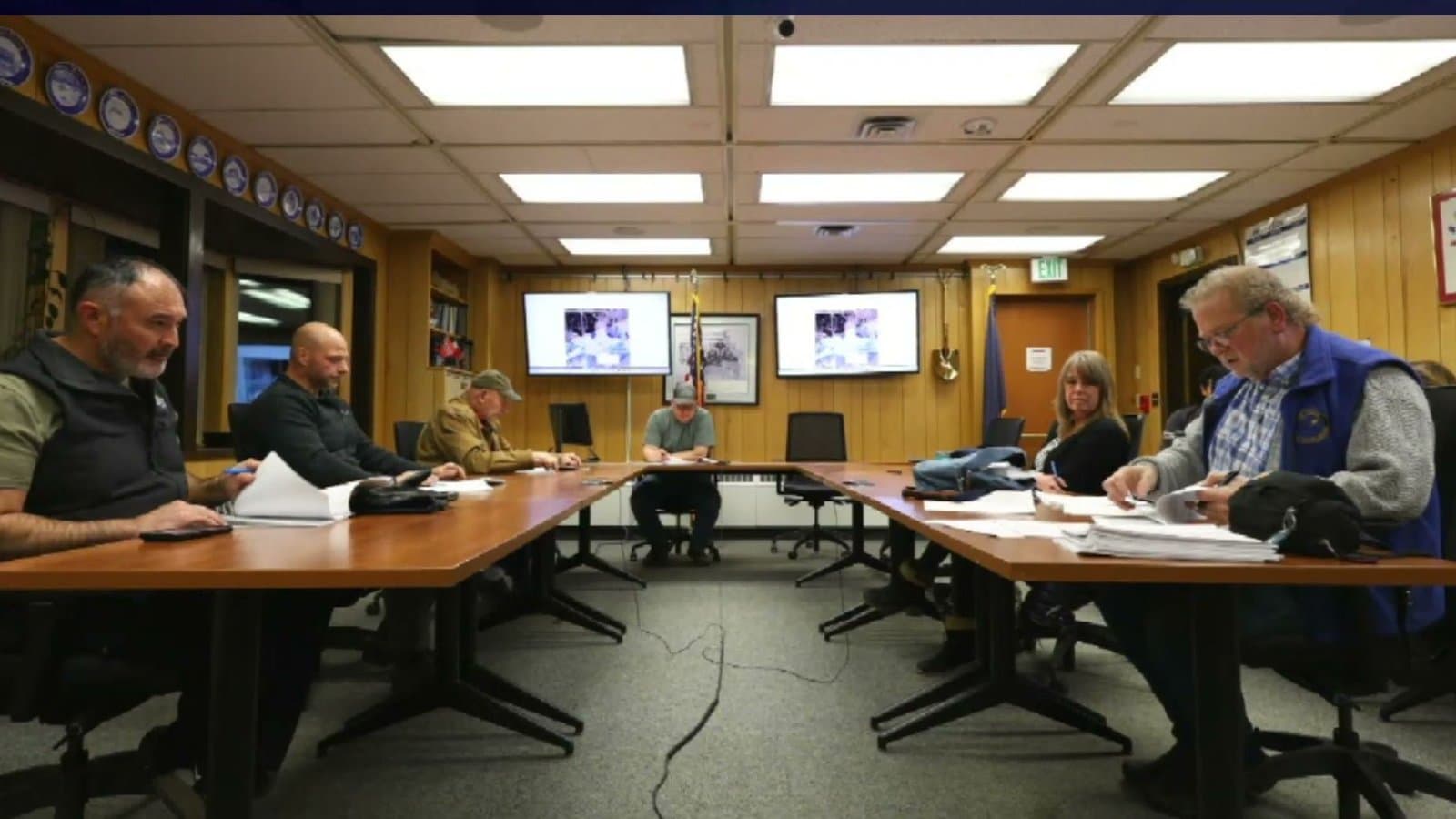
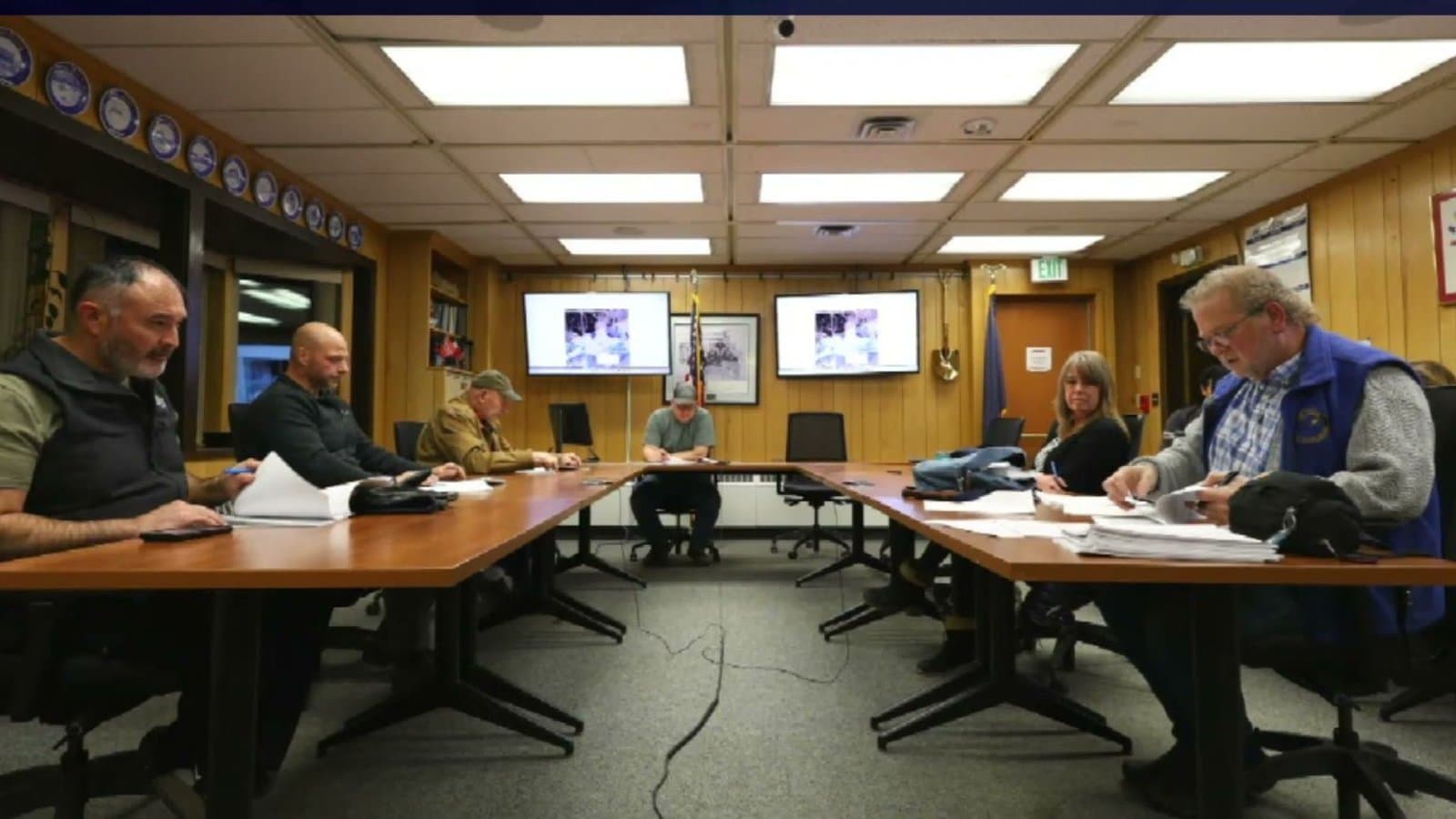
Nome Joint Utility System Board Meeting- Nov. 12, 2026
Alaska News • • 85 min
Articles from this transcript
Nome utility board presses manager over unfinished 2022 audits and blank budget
The Nome utility board ordered its manager to finish audits stalled since 2022 and fix a blank budget. Fuel surcharges on power bills will climb to 40 cents from 18, nearly doubling costs.

Nome utility manager expects fuel surcharge to rise to about 40 cents per kilowatt-hour
Nome Joint Utility System expects its fuel surcharge to nearly double, from 18 cents to about 40 cents per kilowatt hour.
No audio detected at 2:43
John, are we doing a work session first, or— No, no, no, this is our meeting. Yes. Um, Marilee, can you take roll call? Yes. Mr. Barron?
Here. Mr. Peterson? Here. Mr. Knodel? Here.
Mr. Emmons? Here. Mr. McLarty. Quorum established. Thank you.
Business of visitors, you can come up and state your name.
Anybody? Man, we finally had someone up here who's going to say something.
Okay, um, I'll take it would, uh, Take a motion to approve the agenda as presented unless there are some edits.
John? For me, thank you. Okay. I'll make that motion. I'll second it.
Mr. Barron? Yes. Mr. Peterson? Yes. Mr. Canoto?
Yes. Mr. Wilkerson? Yes. Agenda passed.
We move on to election of officers.
I guess we want to open the nominations.
I nominate Dave for chair.
I'll second that. Okay, who seconded? Carl. Carl didn't. I would make a motion that we keep our officers the same as they have been this last year.
Me, Pat, and me. I think I'm— yeah, Vice, Secretary. Can I have a second? I'll second that.
Call the question. They're withdrawing that first motion. Oh, they did? Yeah. So the motion is to keep the same.
All right, uh, Mr. Evans? Yes. Mr. Barron? Yes. Mr. Peterson?
Yes. Mr. Knoebel? Yes. I think if I said no, I'd still lose. You would.
Motion passes. I would take a motion to approve the minutes. There are no minutes. Okay. Table that to the next meeting.
That brings us to correspondence.
Those letters that are included there, Thomas has actually talked about them under his operations report. So I'll leave those to him to cover. If we could move on then to the operations report. All right. So that brings us to utility manager report, which would be operations report.
Thomas? Good evening, Can you hear me from Zoom? Very good. Sorry, I'm not there in the room with you. I'm in Anchorage with the family.
The operations report is rather conclusive. I have not much to add to it more than that. It is— some parts of it is our For example, the NSCDC credit was applied at this point, so that's all done. And yeah, I'm open for questions if you have any.
But is everything back to normal from the power outage, or are we— are there any other things we're working on with that? We're still working on generator 14. EPS is coming up here. I haven't gotten their travel dates yet, but they will come up here to do some troubleshooting on the control panel. 14 Will operate in manual.
However, we prefer not to do that. So it's still tagged out, locked out, tagged out, um, to solve the control panel issues that we've seen since the power outage. Everything else is operating normal, as normal. 16, Generator 16, is back. That was down due to the heat exchanger project modifications to the generator.
That was the reason why we couldn't utilize that engine. 15 Is back and 12 is running fine as well. We had EWT up here just a few days ago, earlier this week, and we did some additional maintenance work, updating components and software, so both windmills are running fine. EPS, when they come up for generator 14, they will also look into the battery system and do some modifications to that so that we can run that with less headache. But both the battery and the windmills are producing and they're helpful in our production.
So did we have both batteries running, or was one battery down during that, uh,. Power. Outage? Right, one battery was down. We operated on one battery, and the reason is we have a fault message on one of the battery racks in one of the battery conics, and we need to disconnect that rack to bypass the error message, and then we can operate the battery with one less rack and This is a part of the, uh, the issue that EPS will come up and look at together with SunGrid and, um, and the vendor of the battery.
Okay.
Um, I also have another question. Um, since we learned a lot from this power outage and stuff, have we started to do an SOP on the steps that we need to take, um, when, uh, we do lose power on something like this big in that long? Great question. Yeah, absolutely. We are building on this exact experience to come up with training material for, for these kind of situations.
I have some ideas in the loop that I will want to develop, work together with the EPS, who are a critical resource to us, and in that they, uh, support our SCADA system. And many of them have been around since we built the power plant, of course. So I have a vision for a training program, annual checkoff lists for our operators, just to make sure that we know as much as we can know about our system. And I could say for my 3.5 years with the utility, whenever we've had something of this magnitude, it has been something odd in the system that is out of the ordinary. So we take that and we take our lessons from it and we learn from it.
And what happened here on October 23rd, 22nd, 23rd was no exception. So Um, there will be, uh, something coming out of this. Yes,. That's good. I have a question for you, um, on the, uh, with EPS.
Do we have any kind of contract or agreement that they'll be there for us when— or is it just pick up the phone and maybe they'll answer, maybe they won't? Uh, we do not have a guaranteed, uh, contract with them, but we do— we have had various contracts for specific projects that they've been working on. Otherwise, they were just our engineer of record going back to the '90s.
But— But. There's nothing to say that if they get busy that we've got any kind of priority or anything like that to have them— like, we had a power outage I mean, we were lucky to get him on the phone, but next time, is there any guarantee that we'll get him?
The— I mean, besides Jacob, who do you call?
There are a couple others in, like, in the Skater Group and the Other, I'm not remembering the name of the other principal that we have contact with. Yoda. Well, Yoda's in the Skeda, Ryoda, Yoda. And so, the numbers for the various folks, we have 4 or 5 of them that are listed right on the screen of the HMI there. Of the SCADA system.
So we do have a call-down for it, but the— since Dan Rogers retired, I haven't actually been dealing with them as much as Ken has. So I will follow up. And if I may, John, this is a part of the material or the resource that I want to develop as well, is to establish these kind of points of contacts to have that crystal clear. Like you say, Carl, Jacob is available and his word is, you know, whenever you need me, you know, give me a shout. And same thing with other contractors.
But in this resource I want to develop, I hope for that to include those kind of names and numbers. Well, we'll look at getting just an ongoing service contract with them. Yeah, I mean, it would be kind of a— I mean, Jacob's going to go moose hunting one of these days. Right. What do you do then?
Wait till he gets the moose? You know, I mean, it's— I think it behooves us, you know, to know who to call, you know, for what kind of situation, you know, and and have, you know, because everything gets kind of frantic when the lights go out, especially this time of year. Right. Well, I want to thank Pat and Jacob, and there were a whole host of people that were here. Thomas did a great job in coordinating.
Ken was on the phone periodically from wherever he was at, and I was just monitoring things from my doctor's appointment in Anchorage. So I want to thank everybody that did respond to it. And our crew did a good job.
Thomas, are you guys going to look into changing that single relay to separate so that one motor can run without the other one?
Thomas, do you have an answer to that? Otherwise, I'll pick it up. I think, I think that's a good question to ask. And we haven't, we haven't acted on that question yet. I think that, you know, when the power plant was designed, you know, for a specific purpose, that relay was put in there, and that specific purpose never really materialized as it was imagined.
And so I think I think that's a, a good thing to explore, whether or not we can completely get rid of that one relay in the system. And that's a conversation I'll have to have with EPS moving forward, but that's part of this whole thing we're exploring.
Well, the relay can be removed, it's just a matter of doing some reprogramming with PLC, I believe. Pretty old. Well, that's from the original build, you know. Yeah. And so that's the other thing that Ken has mentioned in prior meetings with the— let's see if it was a—.
Thinking of the CMAP project. Yes, the Community Microgrid Project, $400,000 agreement with, uh, NREL, the National Electric Lab, when we'll be able to update the controls and the SCADA. Changing out all of the PLCs and the— excuse me, the PLCs have been recently upgraded, but changing out all the switches and in the control system. So all of the Cisco IE3000s that are long over life, as well as Moxa devices and any of the electronic devices that we have in there. Through this grant opportunity with NREL, we'll be able to take and get those all replaced.
Like, for 14, the problem is— I mean, that looked like pretty new, and that PLC just lost its programming, so it's—. Well, I'm working with Clint there to get— make sure that we have all of those programs on our in our own files here so that we can, you know, if something like that happens, we can dump them back on. Don't those have a battery, a little watch battery? Probably. Is there a maintenance schedule to change those?
But I would think if it had the battery, it wouldn't have lost the programming. Um, when I swing back by, I'll look at the battery. But yes, we, uh, we do check our emergency generators on a regular basis, and we do need to get those, you know, as far as those batteries, the other UPS that we have, UPSs that are around, you know, the batteries in the majority of those have been changed and have a new date on them, but it isn't until it doesn't work that we'll find out that,. You. Know, there's some reason I thought.
They had like little watch batteries in there to hold. Them. I think you're probably right, and in connection with this NREL grant, that we will ensure that that's, you know, a procedure with the new equipment is outlined.
Back to the power outage and stuff. I think scheduling projects, maybe not in wintertime. I mean, I think we got pretty lucky. The weather was somewhat warm. But having a generator down because we're doing a project and stuff, maybe we kind of try to schedule our projects in the spring.
You know, it could have been a lot worse. Yeah, I mean, it— Schedule did get extended a little more than we had liked or hoped. And in discussions with Ken and the engineers, we came up with, you know, this is the timeframe and, you know, if we're not done at this point, then we're going to have to abandon it and pick it up in the spring. But— Unfortunately, the— we got caught in the middle there. Yeah.
No audio detected at 20:43
And I'm just thankful that it didn't, you know, while it was a little longer and we usually don't have generator outages, primarily the outages that we experience are related to distribution and weather and like that. But yeah, no, the— this was not an ideal schedule, and we probably should have not started it before, you know, they were halfway through and needed to complete it. So where are we with that? I mean, obviously they're not done out there with either one of them. They're not making hot water out of the— stack boilers or anything like that, there must be a substantial amount of controls that have to go on that.
I see the pipes, most were there, but they're not, all the controls aren't on them and they're not flooded.
I mean, I don't know, are we just going to park that until spring or are they going to keep, those guys going to keep working or what's the schedule?
I guess I have this from Ken's writing on it, and unfortunately, he had to be in another location today and not able to participate.
We got it through October, and let me— put down an email to him if the email's back up today. The whole world has been having issues, and I'll get an answer for that.
Thomas, I was looking at the 2027 Title V source testing. My question is, why don't we just test all our generators?
The source testing? Yeah. I mean,. Right, we do that per the testing schedule and reporting schedule, and we usually And if I speak of what I know of the history, this is the first time I go through this process, but we do test both 15 and 16 when we do this, uh, even though we're just required to test one of the two. Um, and then we of course test, uh, 14 and 12 as well.
So we will most likely test both 15 and 16. Um, uh, but Yeah, go ahead. And I guess I haven't been involved in that part of it. The— is that what we requested in our solicitation? Because under the permit, we're required to do one or the other of the units, and then DEC considers the test on one representative of the test on the second one.
That's, that's correct. And historically we've tested both anyways, um, go above and beyond. But we, we are only required to test one or the other exactly because they consider them being twin units or sister units. So one, one will represent the other,. We hope.
Well, what's the value of this test? Are we, um When it comes back, what are we looking for? We're looking at NOx and CO2 emissions. There are limits in our operating permit, and in order to get our operating permit renewed for another 5 years, these source tests have to be conducted to ensure that we're still in compliance with the conditions. Well, I mean, I see a fair amount of money going into source testing, and we have a finite amount of fuel oil that we can burn no matter how we choose to burn it, and we can only have a finite amount of pollution we can make because of that.
Is there any way to just get that waived? I mean, are they going to say at some point, turn your lights off, you've made too much NOx? No, but if we exceed the permit, then we would be paying some factor, I mean, there is some formula that we would owe an additional, we have to make a payment to DEC every year for our potential to emit. And we are able to substitute the actual running time of the units so that, you know, we're not running 15 and 16 wide open all the time. So, you know, we aggregate the hours that are on there, and so then we get a reduction in the Title V permit fees based on what our actual emissions are, as opposed to having it based on the, you know, potential to emit.
Sounds like a job-making proposition. Well, the, you know, I circulated some information on a Caterpillar generator that was being circ— auctioned. Auctioned. Thank you. In Oregon.
And the unit had not been operated in a number of years. It was at a chemical dump and the— so, you know, it— anyway, besides looking at just the operations and the history of the unit, I also contacted the air permitting— or excuse me, the air quality consultant, HMH, that we use, and had them run a little analysis on what the implications on our air permit would be and what we would need to go through should we, you know, choose to pick up that unit. And it's— that was, indeed, the complicating factor.
When we did the new power plant, we had to go through an extensive testing period, and I don't remember if it was 3 years or— it was quite a while that we had that shack up on the hill there, and we would have to go through something like that again if we were going to add the unit into either the old plant or the new. The potential way to get around that was to locate it somewhere where it was not contiguous, you know, i.e., like had been at Belmont Point or at the school at one point in time. And, you know, that and having it in a self-contained, you know, it was in a, or is in a ConEx type of structure. And so, there are some ways, but the air permitting challenges were quite arduous in it. And, you know, it was a good idea, I think, and a 2.5 5-megawatt unit would fit very nicely in our system there to have some options to the Wartsilas and to also support the CATS.
But it— if indeed we want to do something like that, then there's a bigger, longer process to do it. And I guess the only thing that you know, kind of— many of you were around when we got the engine number 11 from a hospital that had had it for an emergency backup that they never used. And it had about 100 hours on it when it showed up in Nome. It was essentially a— it was an old unit but had not been operated. And we were able to— they didn't actually list the hours on this unit.
But as we scanned through the various photos, we found one that was clear enough for us to read that this one only had 168 hours on it. So it essentially was a brand new unit, you know, that just had been sitting there. I don't think that, you know, those types of deals don't come around all the time. But We did do some due diligence on the thing and then determined that based on the potential that the air permit would not be approved, that there was no reason to bring that unit to Nome and then just have it sit there or go down to Rusty Park. So that one fell off the table, but it was worth a little bit of time to figure out whether or not there were any benefits to it.
Well, wasn't there a backup one for Rock Creek in a Connex tractor-trailer? Uh, that I do not know. I. Think it was like 2 meg or something like that. I don't know, 800 kW.
It was sold with the equipment. I thought it was bigger than that. Yeah, 800's be pretty small.
Let's see, there was, uh, And then I guess just as far as the, uh, source, uh, testing there, to note that, um, you know, it needs to be done in early, uh, uh, '27. Um, you know, it runs on a 5-year schedule, so we'd We try to get it as close to having used the time up before we do those tests. And so, those are planned to happen right after the new year.
Oh, I missed one. It's the NOx, the CO2. Carbon monoxide and then also particulate matter that we need to look for.
And out of those that are listed here, the contractors that responded to our request for a proposal, the one in Alaska that we've used before satisfactorily, was by far the best as far as the price was concerned. And then the other one that's on this list that we'd used in the past is this now on Terrace. It was Montrose when they were up here and did a test for us 10 years ago.
No audio detected at 33:13
And then our actual fuel received was 2,011,808 gallons.
Uh, that, uh, it's right in the neighborhood of $450,000. Um, we actually, uh, overpaid the initial payment that we made, um, because, um, they had sent me the information, uh, and then we discovered that they had included, uh, off-road taxes on the thing. So there was about 27 cents or so That we paid on the first one that then is applied to the second one. 98,000. 98,000 In total?
What's that? 98,000 In total, I think. Okay. Credit. Okay.
For the next statement. Okay. And so, Crowley did actually give us credit again, and so we are intending to actually sell the fuel note next week to Northrim. We didn't sell it earlier just to avoid the additional interest on it, but that will happen next week. And the actual bill is due the 1st of December, but we're going to pay it a week early.
Good.
So, we're not paying Crowley any interest? No. So, it's interest-free, so we're—. Yes. Must be a lot of money in that.
Oil. What's that? Must be a lot of money in the oil. Yeah. If they can afford to do that.
Yeah, well, I mean, that's back to the, you know, the standard that we had that was 30-day terms, and that's what they gave us again.
So do we have any idea what the, uh, how much that's going to raise the price of electricity? Um, that will be on, uh, the next meeting here for that calculation. But my rough number is that the fuel surcharge will be close to 40 cents. 40 Cents additional,. Or— No, 40 cents, and currently it's 18 cents.
So that's what, 22 cents?
Yeah. So it's going to about double the kWh cost.
So the— yeah, essentially, I mean, because our tariff is essentially pretty close to 20 at this time. And the— but then for residential, just as soon as we get that payment into Crowley, And then we'll submit that information to AEA and the RCA, and our PCE rate will be going up as well. Is PCE funded, fully funded, that would affect that, or— Yes. The legislature actually did put a little extra money in it, and then they also sent us, what, $200 apiece on our PFD.
But yeah, there is sufficient funding in the endowment and in the legislative language to fully fund PCE.
We have all our paperwork to them and all that current?
Yep. I don't have October's in yet, but— Getting there. Yeah, we just don't want—. We're as current as we can be. Uh-huh.
Thomas, how'd the fire inspection go?
I believe they went well. We had both Tyler Fire up here and Nome, Arctic Fire and Security, they came up today and they're working today and tomorrow on a separate system that Tyler couldn't work on, I guess. And so I'm going to present that report to you guys, hopefully for the next meeting. But so far so good. Arctic Fire and Security also said they wanted to give an in-house training session to all our operators.
On our fire panels and what to know and how to understand those. So that was a great plus.
We requested it, but that's good that they—. That's great. Something's been a long time needed.
Yeah. And there are some— of course, maybe they'll catch us— but there's some of those doors out there are fire doors in the firehouse, you know, to stop stuff. I see some of them don't work, you know, the latches are broken and stuff. And hopefully the— I hear security in their name, maybe they'll be taking care of that part. But somebody ought to point it out to them if they're not.
Yeah, so what doors are not? Well, the one that goes between the watch shack and the powerhouse itself, the shop, that one the knob is broken on. They've got skirts that come down and close off the bottom, you know, when you open them, when you turn the knob and it picks and open the door, picks them up, you know, so they don't drag. But then they go down and you don't even know they're there normally when you open the door, but they're there to stop the fire and the smoke. And those should be inspected on kind of a regular basis, I suspect.
And I know that some of the knobs don't work, other ones the closers aren't tight enough to actually bring them closed, you know, the Graft holds them open and stuff that I've noticed.
And hoses coming out of the water room, so we can't close that door. That one's not a fire door. It isn't? No. The thing that comes down?
No. It doesn't have a trip on it. You notice there's a fusible link on the big ones in generator bays. They have a— that melt and the door will fall. That one doesn't have it.
They— when they— whoever painted the fire door thing on the bottom, made a mistake. It's not a fire door. I see.
Check back in the plans and see what was supposed to be put there.
I think our, um, uh, claims period has run.
Chris, you have anything you want to— if we can— if there's not anything further on the operations thing at the moment. I have one more question. Line crew equipment, is all our line crew equipment working, or we have some down, or? We had Altec here, and Thomas I believe that they completed all of the things on the punch list. And then maybe you want to talk about the Kotzebue trip, Thomas, if you wouldn't mind.
Yeah, thank you, John. There are still more things to be addressed from Altex visit. And so they are going to come back up here. And again, I'm grateful that they're doing that because some of our rigs are beyond what Altic would service in the first place. Uh, 48, um, is not a dependable bucket truck.
Do you mind, uh, giving it a description of what it is? Not everybody's familiar with the numbers. Yeah, 48, number 48 is our 1989, our older bucket truck. And so that is, that is only right now used in, in extreme, um, need. But we do have our new bucket truck that came off the barge.
And so we're, during the storm, for example, we, we used the new bucket truck and that was really a good resource. But we are wanting to get 48 back on track. Me and a lineman and a mechanic went up to Kotzebue a week and a half ago. Kotzebue Electric Corporation had one of their bucket trucks similar to number 48 that we have from 1989. This is the year 2000 model, and they, they asked us if we wanted to put in a really, really reasonable bid, and I— we put in a $5,000 bid on it.
And yeah, we went out there and inspected it, and It's really in beautiful condition and would then replace the 1989 bucket truck and effectively retire that one. Another one that is much more critical at this point is our Nodwell, our pressure digger on tracks that we— it's a modified 1970 '98 Nodwell 110 with a maybe a 1990 pressure digger on top of it. And it takes care of all of our off-road, basically tundra-based infrastructure, helping holding up poles, digging holes, setting poles. And it is constantly requiring reactive maintenance. And it's just an old piece of equipment.
So I have put that in as a request to consider that a capital project for next year, that we look at a replacement for that unit.
We do have some some issues with the, uh, the digger derrick, the big white truck. It has some issues with, I believe it is a, I'm going to call it a CPU device, which Altec is sending up a new device to swap out. So it causes some issues in the in, in the truck's functionality. And, um, but it's on the punch list to be addressed.
Um, and on top of that, Altec has identified aging cables in, in the trucks that needs to be addressed as well. So other than that, they're, they're working except those, those two exceptions that I mentioned. Thanks, Thomas.
Bill.
I guess just the other thing before Chris takes over for a moment here is that this power distribution system little handout that was included in your packet that gives kind of an outline of where the various feeders are in Nome. And, um, you know, because there are people that wonder why their neighbor's power is out and theirs— or their power is out and their neighbor's isn't. Um, you know, there are jogs that happen in the system, and this is just part of the start of the information that we're attempting to put together to be able to provide more information to the customers and have another list of things that we'll do as well to attempt to— nobody's trying to be secret. It's— we're going to share more information.
No audio detected at 46:43
Anything else for the utility manager? Operations or project? Are we going to do project? The project listing Ken put together here. I just was skimming that, and I didn't see anything specific here.
And I think we're pretty much done with the work for NSHC on the new apartment complexes that are coming on. And so that is going to add, what is it, 60 new customers to the— or is it 80? I think in all done it would be 80. Yeah, I think it's 80. But there's only 60 that are—.
Right now you're talking about—. 2 Buildings are going online. Yeah, 40. But then there's 2 more buildings coming. Yeah.
Take it off. Two more after that. Okay. Well, it's nice to have those additions and, you know, it's been over time that we've steadily had, you know, new customers coming on and that, you know, we haven't had to adjust our rates for some period of time. But in 2027, we do need to do the talked about rate study to just verify where we're at and come up with some kind of a formula, probably like the Port where they have a CPI, a adjustment.
It's not done every year, but there is a formula to recognize part of the inflation.
Have we had any more discussion about the in lieu of tax on the electric bill? No. Is that done, or what are we doing? Uh, no, it's, um, uh, I did get some information, um, from, uh, the attorney on how the sequence of events, um, needed to, uh, be. And, um, it's been a little bit here since I've had an opportunity to talk to the city manager, but We're planning a little meeting on that and some property issues when I get back from the doctor.
John, could you ask Kenny for an update on the front end lift station? It looks like— I thought at our last meeting that it was going out to bid. Now it's saying designer wants to do a final draft plan and estimates.
Just kind of wondering, when is that going out to bid, and when is it planned to start construction? Okay. Well, you know, I think that that's something that that particular stage needs to be looked at rather closely, because now that the hospital is routed through their sewer through there, when you get a fall storm and that goes down, where's the hospital sewer going? Out on the street. I mean, before, when it went around that, it didn't— it skipped that lift station on that end that's going to be inundated.
It doesn't have any backup power, any or anything. And if it's underwater, backup power doesn't look good anyhow. But that might be something that they want to consider in the design of that. I think it was always a mistake not to do it right from. —Beginning.
In that design, that's one of the things that Ken has mentioned a couple of times to me, that, you know, an emergency power source would be—. Out of the floodplain, hopefully. I mean, where, you know, they're going to have to put it up on stilts or something, you know, to do that. But, I mean, I think that really needs to be taken into consideration if they're planning on in which there are all the hospital sewage going through that lift station. Well, and the other night when somebody almost ran into the Convota lift station, it's— that's one too that is potentially needs to have the panels raised a little bit.
Because it's— I'm not sure what the difference is now. Well, the intent with the Fortis lift station was that it was going to go away when Front Street got redone. Correct. I don't know if that's still the case or not, but there was— if you were to go shut the power off on that, the water will just flow down the sewer under gravity. It won't do it efficiently, but it won't flood before run gravity down to the sewage treatment plant.
And that's why that one isn't as critical, you know, in a— and hopefully when Fortitude gets done, it will go away, and then that's another saving on electricity, so. Well, the— in the prior presentation on this, the determination was to design for new new water and new sewer, unlike what we did in Bering where we pretty much kept the old sewer and regraded portions of it. And, you know, but we would have to address both of them if we want to eliminate that lift station. Right. And that has been the direction that we've been following.
But I will ask him for information on how that is. And as noted there, we intend to use some clean water money for a portion of it, and then Norton Sound is actually paying 60% of that project. You know, as— contribution for their additional effluent going through that system. And the only thing that's going through that system from North Sound property is QCC. Well, they're going to switch to—.
Yeah. Hospital itself, right? No. Hospital goes the other way.
Hospital goes west. QCC goes downhill. And that was to get around the original design that way, to get around the End Street lift station, just because it saves on electricity. You know, it was all downhill anyhow. At one point, I think that the, you know, the plans had been that all of it would route down, seems to be my recollection on it.
But it was— they were going to change it and from the hospital, the main building, and go down through the N Street, go down N Street, go through the N Street lift station. The main hospital is going to I Street or wherever it goes. It was originally, but they were changing that. I think you need to look again. No, they didn't change it.
The only thing that's going down N Street It's QCC. The entirety of the building? Yes, so existing and new expansion. The part, the original part that goes through the hospital thing will be taken off of there. When, once the lift station gets finished.
Ready for Chris?
Yeah, you guys got any more questions, or you want to go to financial report? I'm good.
Chris. Okay, as of today— well, you guys have September's balance sheet and P&L in front of you, so things have changed since then. But, uh, today we have about $1.2 million in our bank account, about $280,000— a little over $280,000 in accounts payable, not including the fuel purchase. Grants receivable, we have about $385,000 sitting out there. The only thing that's a little wonky on the balance sheet is other accounts receivable.
There's a work— an invoice in there that I need to allocate still. And of course, depreciation hasn't been posted for this year.
Additionally, then we have the reimbursement from our insurance company, as well as I believe it's somewhere in the neighborhood of $250,000 in fuel that was used because we didn't have that wind turbine available. So that is pretty close to a million bucks that should be coming in here very soon. And then I did forget to mention too, we applied for a tax credit. Oh,. Yes.
For the best system, and I think that they're almost wrapped up with that video. So that will be a nice— another couple of grand. Yes. It— earlier today when I was talking with Travis, the consultant that we have used and still use, the deadline for that filing is Monday.
That will result in a $645,000 tax credit, and we will just have a credit because we don't have to file a tax return.
So. How is it usable? What's that? What's that? We'll get it in cash.
We'll get it in cash. We'll get it in cash. Oh. It's a tax— a refundable tax. Credit.
So, would that go back into our rainy day fund? Because I don't see our rainy day fund here. Yes, that's the intention on that. And then, we've been playing with some numbers there of, in addition to that, putting $250,000 a year into it as a minimum.
So that we can rebuild that fund.
And as I mentioned earlier, the email down today around the world has not been helpful, not that that was the only thing, but I— I finally was able to— when I wasn't getting any responses to my morning at 4:00 AM, I wasn't expecting it, I guess, but early morning emails, I have contacted Travis Werba again from Werba and Associates to come up here next week Sitŋasuaq, excuse me, to assist us next week. He has other obligations, so he can't actually come to Nome, but he is set up to work remotely with us. And he is— being— I will be leaving in the morning for surgery. The bringing him on to pick up these final pieces that I have on budget stuff, Travis is going to come and help us with that. Is he going to assist in the audits?
Yes, that will be in December. And he's looking at his schedule and is supposed to get back as far as when, what week or weeks he can be here. But it's somewhere around probably the week of the 10th, whatever that is. It seems like nothing's been done on the audits at all. Do we need to get— hire somebody else, a different outfit?
I mean, at some point this has just gotten ridiculous. No, we're getting him, uh, um, in. No, no, no, this is getting ridiculous, John. I mean, nothing has been done according to BDO on the stuff they've asked for and, and needed to finish the 2022 audits and stuff. We're still needing backup Why are we not getting the credit card backup?
We're working on that. We've got to make it a priority. It's got to be a priority. I mean, don't chase other generators or anything like that. Let's do this as a priority.
I mean, that's what's going to affect the cost of everything else we do. I don't care what you think, that's not— or not, but I know for a fact that when you don't pay your bills, any money you want costs more.
The, uh, as I said, I will be, uh, gone, uh, to surgery, uh, tomorrow. You don't have to do it, John. Hire somebody. Please finish. And so that, that will put— I have a, uh, then probably 4 or 5 days of convalescing that I, um, will be, uh, sitting at home and working at getting that project off the table.
But, Don, you don't need to do it. You can hire somebody. That's what managers do. You manage. Don't, don't not hire somebody and think that you need to do it yourself.
You're killing yourself. Just hire somebody. Let's get this done and everybody's going to be happier, including you.
I mean, it has become an embarrassment.
We will get Travis's confirmation, and I'm sure he knows somebody else that he could, he could bring along as well. That would be great if there was somebody else that can help. Let's just get it done and not have to think about it again. Use some of that $600,000.
No, we have other money.
I want to put that in the bank. Yep. So, we got to get it done. I mean, so.
Power production is the very last page, or may not have been the last page in the packet, Dick.
I forgot the one page on the deal with the power plant.
Statistics for the month of October. 2.9 Million— or 2.9 million kilowatts were generated. Out of that, 250 approximately came from wind farm. So subtracting that out for net diesel, we burned 142,000 gallons of fuel during the month of October. And so that's pretty close to 19 kilowatts to the gallon.
It seems to be up compared to what it's usually. 15 To 16. It used to be 16.5 or 17. So I'm wondering if they're burning more. Might possibly be some metering issues, um, but the— we have to take a, a little harder look at that.
Um, okay, going back to financials, budgets, they're still all zeros there. That's where I That's what I was just talking about. The TRAPS is coming up next week to help finish that. And that's fine, but the— it's hard for me to, like, sit here and listen to wanting more equipment, needing more of this, needing more of that, and we don't have a budget to even say, okay, where are we going to put that, where are we going to allocate it, anything. So,.
That, on the last page of the budget after we get through the operations. Then we figure out what the cash flow is from it. And that's where we will put our list of—. You have all the numbers here and you just move them forward. We can—.
I know it's oversimplifying things, but I'm seeing it. Well, that's true. Basically what we need to do is let's get a budget. And add what you want in there and then we can review it and go through it. So, it's, I don't know, I'm getting frustrated too.
I'm trying to be patient with certain stuff. Certainly. I'm sorry, I didn't mean to cut you off. I'm just trying to be patient with this whole process, and I asked for this at the last meeting or two ago, and you said you'd have it. I did, and I have been sick.
So, I'm calling for help. Calls back to what Carl's saying. I'm calling for help. So, okay,.
I thought Travis was going to come do the audits. We got somebody to come. He, he is going to do that, but he is also going to help, um, gather, uh, some more information and review the work that I've done on budget. Well, what, what do you propose it's going to take to get the audits done?
Um, the BDO had wanted some more information, and there's saying that they haven't got it yet.
The— well, we'll take a look.
I am not—. Did you forward that email to them from Joy? No. Maybe that would help. Yeah.
I would suspect it would. It sounds like there's a break in communication. Nobody's asked me for anything in a while, and last time they asked me for something, I got it to him. So I don't know what else is—. Yeah, he's got that today.
So, I'm not sure. Dave found an email and sent it to me. So, Dave's the weak link. Yeah. Way to communicate, Dave.
That's it. That's it. That's it. That job's a pretty important job. He couldn't email it today if he wanted, well, maybe he could have, but I might have started, but the emails were globally Down.
We're down. Well, I mean, I, I, if I was you, I would ask BDO what's the holdup? Why don't we have the audits? I mean, she, Joy was going to call in on one meeting and of course for one reason or another, I don't know if we've had another meeting since then or not, but nobody's encouraged it. I mean, we could have a special meeting, get all these audits done, you know, and, and just be easy for everybody.
As well as what Larry's saying about the budget, you know, we need a— I mean, we should be doing— leaning on 2027. We are. You know, not looking at zeros in 2026. We should be— we've got a pretty good idea what it costs this year. Now we should be able to do '27.
Well, we can certainly fill those zeros. Well, I think we should. Okay. I don't think we should be operating just with a bunch of blanks on there. I mean, how are we— we need to know what we're going to spend our money on.
What are we spending our money on? I mean, I don't know. Does anybody know what day-to-day you're ordering stuff and buying stuff and equipment and stuff? Where's that money coming from? Where's it getting paid?
Somebody's coming in and signing the checks. So yes, people Someone on the board is aware.
And I'll invite you—. Well, I'm signing these things, but I'm not— like, when we're sitting here looking at this in a meeting, you know, I'm trying to make sure that we're just paying our bills, right? But where is it going? I don't see that. It's there.
We will— we can provide additional details. I mean, what's it getting applied to in these? Cost codes and everything that's listed here. It may be getting to this, or it may be contributions and aid that we receive under these grants that we've been reporting to you on.
Okay.
I don't have anything else.
Unfinished business, there's nothing there. Do we have any new business? Not tonight.
Board comments, Larry.
No, I think the meeting speaks for itself. I think the financials are needed, audits and the budgets and everything. We got to start seeing this stuff, otherwise we're putting our community in jeopardy. The ratepayers are paying more potentially because of this. We got threatened to get PCE cut this summer because things were getting— weren't getting turned in.
I'm just bringing this stuff up, and we just got to get it— we got to get ourselves level with this stuff so we can hopefully start getting ahead of it again. So I concur, and we were only off of PCE for 10 days, and it wasn't that we were off, they simply held our reimbursement. There was no implication. That was my fault. We shouldn't even be— I wasn't getting the emails.
And I'm on PCE once a month and there was nothing saying—. I'm sorry to turn my comments into this kind of thing, but I'm frustrated. And, you know, like I said, I'm a pretty patient guy, but the can just keeps getting kicked further and further down the road. Road, and it just keeps— it's going to get worse and worse until we start seeing something. So those are my comments.
I'll try to put together a calendar, um, that lists out these various dates of things that we need to do and what we've done. And then if you see something missing, you can point it out. Okay.
Pat? Well, I think Larry said it all, but I'd also like to give a shout out to the line crew and the power plant guys for handling the storm and the outages. That was good. Carl? I agree with Larry.
I mean, it's— You know, I mean, I have to ask myself, how much less would we have paid for our oil if we'd done it in July? And then waiting until October and maybe going to get it, maybe the storm is not going to get it. I mean, you know, it's— and that's just a matter of people doing their jobs and all this stuff like these audits and all our financial stuff. There's no reason for that. There is absolutely no reason for those not to be right up to date.
There's no reason the budget— everything would be easier with the budget, not only making the next budget, but operating the utility if we knew we had money where for what, you know. I really think that we've done this to ourselves. And like Larry says, it's It's embarrassing. No, you—. So we were— had never planned to get oil earlier than September.
And the price under the contract, you know, did not change from what our contract said. We had already locked in for a 3-year period. The quote-unquote adder, the only thing that was different was, and again, that was a function that was part of the contract for a tug fuel adjustment that, you know, if the operation of the deal, of the tug, well, based on the cost of fuel. So we didn't have any plans to buy in July. We were always getting it in September.
It ended up in October. But it still was based on the August pricing, I believe. I mean, that's— I think we spent about $9,000— not $9,000— $9 million on fuel oil this year. And I don't think we've ever spent that, even when we bought 4 million gallons. No, this is the highest that it has been.
We did have a— fuel bond that was very close to $8 million once before, but certainly this $8.6 that we're getting now is the highest bond that we've had. And, you know, based on the best information that we had at the time, we figured that that would pay the full Crowley bill the fuel full port bill and our insurance related to it, the total to Crowley is going to be closer to $9 million. And so we've already paid, you know, it was about half a million that we were going to have to come up with ourselves. And we've already paid 1.
$1.3 Million from cash reserves on it so that, you know, some of that will come back when we actually execute the bond. And so that, you know, we've been doing great with Chris there to and with Ken's help too, to make sure that we were getting money in the door for things that probably have gone by the wayside in the past.
And Thomas too has been very good at assisting in getting that stuff out. And, you know, one of the things that has always been an issue is STP dumping fees, and we have executed an agreement with the new owner, Mr. Jesse— what's his last name? Blandford. Blandford, thank you. And so, you know, a rate has been established for that, and So that's another thing that we're doing.
Is it per chick?
Speaking of which, no. So, on the water up there, like this summer, the city was watering the streets even on days when it was raining. Are they paying us for that? Obviously not if they're going to to do that. I mean, they were watering 6th Avenue when the ice was still there, before it all melted, in last spring.
And they started, they just kept on going. Even though it was raining, the water truck would be out there watering the roads. Are they paying us for that? We have not been charging them, and they have not been charging us for equipment rental. Well, maybe we should change that.
I think that, um, that in there, if we're going to rent a piece of equipment, we need to rent it from a vendor here in town because then vendors wind up having more equipment available to the public in general. You know, the general public can't go necessarily rent a piece of equipment from the city, you know, so we should be supporting our, our business. And, and,.
Uh, we've, uh, uh, rented, um a number of pieces of equipment from Q Trucking specifically. And we can sure put a little report together on that to see what— Well,. I do report. I'd like to see how much money we're spending on, how much rent was going to the city if we're trading out all this water. Let's see where we are even-wise.
I mean, they've still got our old back truck, I think. I don't think they ever got— we ever got that back. I don't think they ever fixed it. That was a weird trade-out giveaway program to the city. I don't think we ever come out on top of doing that.
Let's just do it up front. If we need a piece of equipment, let's go rent it. Let's go rent it from the best price for the— Piece of what we need for the job. Often the things that we're doing when we're, you know, using equipment from the city, it is something that's needed for 2 or 3 hours, or, you know, it doesn't make sense to pay a daily rental, you know, for— well, I guess maybe it does make sense. We'll provide a report.
Okay, because I, I think that If the city has to pay for the water, maybe they'll be a little bit more cautious with what they do with it, you know. Not that I like dust any more than anybody else, but I sure don't like mud either.
We— they register how many gallons they're getting just like everybody else, so we can compute that.
Anything else, Paul? Nope.
I want to say thank you to the line crew and everyone that participated in getting power back to the city. I also want to echo what the other board members have said. We need to get our books in line and audits, budgets. And stuff done. I think since Chris has been online, she has done a lot of work to get where we are now, and, and, and staff.
So, um, we're just frustrated. We're not saying you guys are bad people or you're doing things wrong, but if you need help, you got to ask for help. If you need certain things, you got to give other people tasks. You got to let them have that information, use that information to help out. So thank you for all the hard work.
That's all I got. Thank you. And I really didn't have anything for executive session, so that was just a placeholder. What happened to our union deals? Those will be coming up here, hopefully At the beginning of December.
So this whole thing last summer, fall, that was for naught, or that was ongoing? I mean, the last board meeting you were going to have, it was to deal with the union contract. I just spoke with 302 midweek and getting together with them on their final— to get their agreement.
APEA one is pending. Guy just has to send me a piece of paper, but he's been on vacation. You know, because we don't use the matrix that APEA loves where there's ranges and steps, but they wanted to go through and plot the people onto that schedule.
For, I guess, their own purposes, because, you know, we were going to continue with the, you know, the percentage, you know, there's just a percentage for employees and not moving them up on the, you know, on a percentage and on a step. It's just all rolled into one. So, I mean, I don't understand it anyhow, and I really don't care, but it was— are there contracts in place? Are they working without contracts? They're working without contracts.
I've tentatively agreed to one with IBEW, and the APEA one will hopefully hear— the guy was supposed to be back in the office next Wednesday. That he'll respond to that so that we can put that one to bed. And the operator engineer one, I am going to send some other documents back and forth with Ronnie on Monday. Does the board get to see what you've agreed to? Yes, you of course have to, uh, you, you do have to ratify them.
Do we need to have a special meeting then scheduled, or? I don't think so, but let's just see if, if we can't just get, you know, the last little bit there so we can roll them all at one time. But they are effective as of 1/1/26, so. —People will have some back pay retroactive.
I kind of like to have an executive session for personnel, if I can have a motion. I'd make that motion. I'll second it. Okay. Was that Carl?
Yes. I made it. Okay, thank you. All right. This is to adjourn into executive session.
Yep. All right. Mr. Knodel? Yes. Mr. Emmons?
Yes. Mr. Barron? Yes. Mr. Peterson? Yes.
Motion passed. Adjourned at 6:53. Thank you. Good job.