Senate Indian Affairs: Business meeting
Alaska News • • 40 min
Articles from this transcript
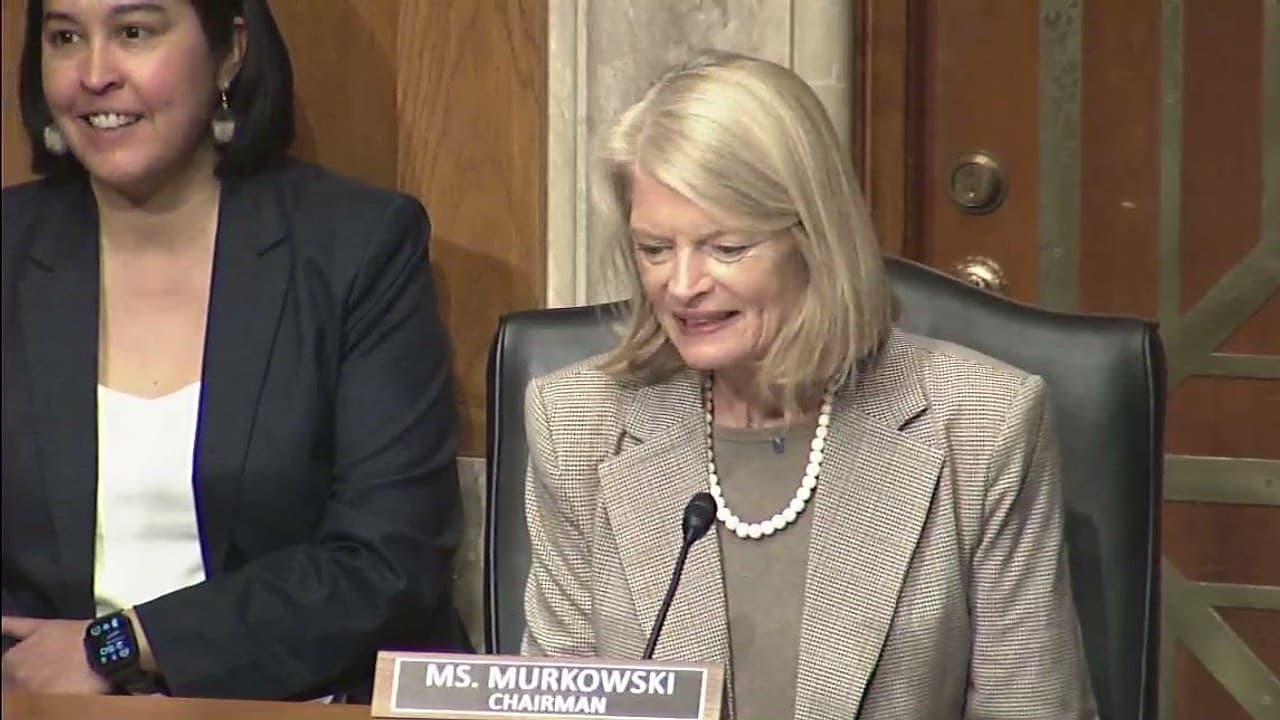
Senate panel led by Murkowski advances eight tribal land, water and membership bills
Senate Indian Affairs Committee, chaired by Murkowski, advanced 8 bills on tribal land, water and membership issues in a voice vote.

No audio detected at 0:00
No audio detected at 2:00
No audio detected at 4:00
No audio detected at 6:00
No audio detected at 8:00
No audio detected at 10:00
No audio detected at 12:00
No audio detected at 14:00
No audio detected at 16:00
No audio detected at 18:00
No audio detected at 20:00
No audio detected at 22:00
Good afternoon, everyone. Committee will come to order. Before we turn to the business meeting, I want to take a moment to recognize that this is likely going to be our committee's final markup of the Congress. Vice Chairman, I want to thank you for your partnership, your friendship. We've done some good things in this past Congress, and I really appreciate the working relationship we've had.
But to all the members of the committee, I appreciate the work that you have done with each of us and with your teams. It's good to be able to show the bipartisan spirit that has allowed our committee to remain productive and be focused on the needs of Native communities across the country. So thank you for all of that. So business at hand today. We're here to consider 8 bills addressing a range of issues important to Indian Country, including the settlement of tribal land claims, a technical fix to an existing water rights settlement, tribal sovereignty over membership determinations, and restoration of tribal lands.
S.3475 from Senator Gillibrand and H.R.2916 from Representative Stefanik would authorize, ratify, and confirm the signed settlement agreement between the parties and bring the decades-long Akwesasne/Mohawk land claim litigation to a close. Because the land claim is based on alleged violations of the Nonintercourse Act, congressional legislation is required to approve and implement the negotiated settlement. S.3573 from Senator Lujan would protect the continued implementation of the Ahmut Water Rights Settlement by allowing the settlement parties by mutual agreement to extend the statutory deadlines for determining substantial completion of the Pojoaque Basin Regional Water System where reasonably necessary. S.3859 from the late Senator Lindsey Graham and H.R.4463 from Representative Norman would amend the Catawba Indian Tribe of South Carolina Land Claims Settlement Act of 1993 to remove the requirement that individuals maintain continuous political relations with the tribe to qualify for tribal membership. These bills would restore the tribe's self-governance authority to determine its own membership.
And then S.4053 from Senator Padilla and H.R.5682 from Representative Issa would place approximately 860 acres of BLM-managed federal land adjacent to Puesca Mountain into trust for the benefit of the Pechanga Band of Indians. Placing this land into trust would consolidate land management of one of the tribe's most sacred sites. And then finally, H.R. 226 From Representative Fleischmann would place approximately 76 acres of Tennessee Valley Authority land and approximately 20 acres of permanent easements along the Little Tennessee River and the Teleco Reservoir into trust for the benefit of the Eastern Band of the Cherokee Indians. The legislation would allow the tribe to preserve and interpret Cherokee history in the area while maintaining TVA's authority to carry out river control and development.
The tribe has pursued this legislation for 12 years, spanning 6 Congressmen— Congresses, and I hope that we can finally get it across the finish line this year. I want to thank each of the sponsors for your work on these important measures for tribes across the country. I support advancing these bills and urge my colleagues to join me in moving them forward. Now I turn to Vice Chairman Schatz for his opening statement. We have a quorum.
We don't have a quorum. We do have a quorum. We can do the thing and then I'll do the opening statement. Let's do the thing. Okay.
Now that we have a quorum, we can do the thing, so we will get started. I ask members to hold any statements that they would like to make until after we've completed the voting. So, Vice Chairman, I thank you for the courtesy there. I now ask unanimous consent to take up and adopt the 8 items on the agenda on block agenda number 1, S3475, agenda number 2, S3573, agenda number 3, S3859, agenda number 4, S4053, agenda item 5, HR226, agenda item 6, HR2916, agenda 7, HR4463, and agenda item 8, HR5682. Is there an objection?
No audio detected at 28:00
Hearing no objection, the question is on agreeing to agenda items 1 through 8 on block. All those in favor say aye. Aye. Any opposed say nay. The ayes appear to have it.
The ayes do have it. The bills are agreed to. Are there any members wishing to be recorded no on any of these? That concludes our business, and so I will now turn to the vice chair for his statement and then any members who wish to speak. But thank you for for showing up and making the thing work today.
Thank you. Thank you, Chairman Murkowski, for convening today's business meeting. The bills we're considering today address different issues but share a common purpose: strengthening tribal sovereignty and self-determination by recognizing the right of tribal nations to make decisions about their lands, their people, and their future. But really, what I wanted to say was thank you. I want to thank You.
I want to thank each member of this committee. I want to thank each member of the staff on both sides of the aisle. I especially want to thank my team, Jennifer and her incredibly committed and capable people. You know, this was one of the most serious obligations I've ever undertaken to, to be sometimes in charge and sometimes the vice chair of this committee. And to interact with so many sovereigns, um, and to try to deliver for them.
No audio detected at 29:30
No audio detected at 29:40
And I think the work that we did over a long period of time, um, will stand apart in history, uh, in terms of making real progress towards justice and improving the material conditions of Native Hawaiians, Alaska Natives, and tribal members across the country. And so I just really want to thank everybody because this was a labor of love. It was not always easy. We did not always agree, but it really has been the honor of a lifetime to be in a leadership position on the committee with you. So thank you.
Thank you. Let me just say this. It has been a pleasure. I've been on this committee since I've been in the Senate, and it has been a pleasure to work not only with you, Bryan, with Lisa. I— both of you have done an incredible job of really ensuring that the focus is on our Alaska Natives, Hawaiian Natives, Native American communities, and not the partisan politics.
No audio detected at 30:50
No audio detected at 31:00
It's about how we work together to get things done. We may not have always agreed, but I so appreciate the leadership that both of you really showed on this committee, that working together, it can happen. The compromise, the bipartisanship does really exist right here in Washington, D.C., and this committee is one that shows it. I also appreciate Senator Armstrong, the ability to work with you as well. It's been a pleasure, and I thank you.
Thank you for that bipartisanship. We are— I'm going to miss the senator to my left. She also is someone who we will not see the next Congress. And again, same thing, Tina. It has been a pleasure to work with you.
I know the people of Minnesota. You've worked so hard on their behalf, and it was great to be a part of that with you.
Well, thank you so much. I wasn't even really processing that this might be the very last Indian Affairs Committee hearing that I serve on. And so I appreciate your courtesy. I want to first just take a moment to thank both you, Madam Chair, and Vice Chair Schatz for your welcome and your mentorship on these issues. Lisa, I think one of the first people that I got together with the first month that I was in the Senate was with you.
You had me over for a glass of wine in your hideaway, and we shared common— we shared stories about how both Senator Murkowski and I worked on the Trans-Alaska Pipeline together when we were young women.
And Senator Hoeven was, I believe, chair of the Senate Indian Affairs Committee when I first began serving. When I came to the Senate— When I came to the Senate, I remember telling our leader that the most important thing to me was I wanted to have a chance to serve on the Indian Affairs Committee. And he said, sure, that's fine.
And I felt like, this is amazing. I got it. Bryan Schatz, Vice Chair Schatz, and you've been chair as well, you and I have had many, many long conversations about these issues and conversations about how we can help our colleagues who aren't blessed with the opportunity to represent Alaska Native, Hawaiian Native, or Native American folks, tribal nations, help them to understand the true meaning of tribal sovereignty and self-determination and what that actually looks like when it's— what it looks like when it's happening. And so just so much gratitude to you and to all of you on this committee. I will miss you, and as I'm— even though I'm retiring from the Senate, I am not retiring from life.
So I look forward to our ongoing friendship and relationships on these and many other issues in the years to come. Thank you so much.
Comments? Senator, I wish to be recorded as present and voting in the affirmative. You shall be. And two, I would like to also include that we will certainly miss Senator Smith. She's been great to work with and not only on the business items, but just— she's just a positive person that's fun to work with.
No audio detected at 34:10
And so she will be missed. By our side of the aisle as well.
Senator Armstrong. I would just say I hope that the leadership that you two have brought to this committee is contagious and spreads throughout all the other Senate bodies and committees, and it's been nice to see a committee that's actually functioning and focusing on trying to get to the right decision. So thank you both for your leadership on that. Thank you. Madam Chair, if I could just have one more minute.
No audio detected at 34:40
I meant to mention this and I neglected to, and I'm in no way meaning to inject partisan politics into this, but it just does feel worth noting that we will be welcoming two Native women to the United States Senate in the coming weeks, and that I think for the first time ever, and I look forward to their contributions to the United States Senate as well. Thank you. Well, we can continue to throw bouquets at one another.
No audio detected at 35:00
No audio detected at 35:10
And we probably will in a different setting. But it really has been a privilege to work with people who are really committed to the issues of the people that they represent. All of us are here because we have tribal members, we have Native people that we represent in our states, some more than others. But there is something that happens here where there is a spirit of bipartisanship, where we have hard issues that we need to work on. But when I think about many of the successes, it's everything that we did with NAHASDA, on housing.
It's what we've been able to do on addressing the needs and the disparities of Native children through our Native Children's Report. We've got our Indian boarding schools legislation that we have been able to work to build. It's all the matters that we've been trying to address as it relates to energy opportunities, economic opportunities, And it has been good, good, good hard work. So thank you for making it happen. And again, to those who sit behind us and work so hard every day, thank you.
Because we put all the hard work on you, and then we stand to either take the credit or take the heat, but happy to do it because the cause is good. Well, we try to push it off on them and sometimes it doesn't work. But it is a privilege. We've done good work, committee. Good work, team.
Thank you. We're adjourned.
No audio detected at 37:20
No audio detected at 37:40
No audio detected at 38:00
No audio detected at 39:00
Speakers in this transcript
Brian Schatz
Vice Chairman, Senate Committee on Indian Affairs · U.S. Senate
Catherine Cortez Masto
United States Senate
Garrett Armstrong
Assembly Member · Fairbanks North Star Borough Assembly
John Hoeven
U.S. Senator · United States Senate
Lisa Murkowski
U.S. Senator · U.S. Senate
Tina Smith
U.S. Senator · United States Senate