Denali Borough: November 11, 2026 Assembly Meeting
Alaska News • • 150 min
Articles from this transcript
Denali Borough mayor files federal complaint over lost in-person care in Healy
Denali Borough Mayor Chris Noel filed a federal complaint saying Healy has no in-person health care since Interior Community Health Center closed its clinic there.

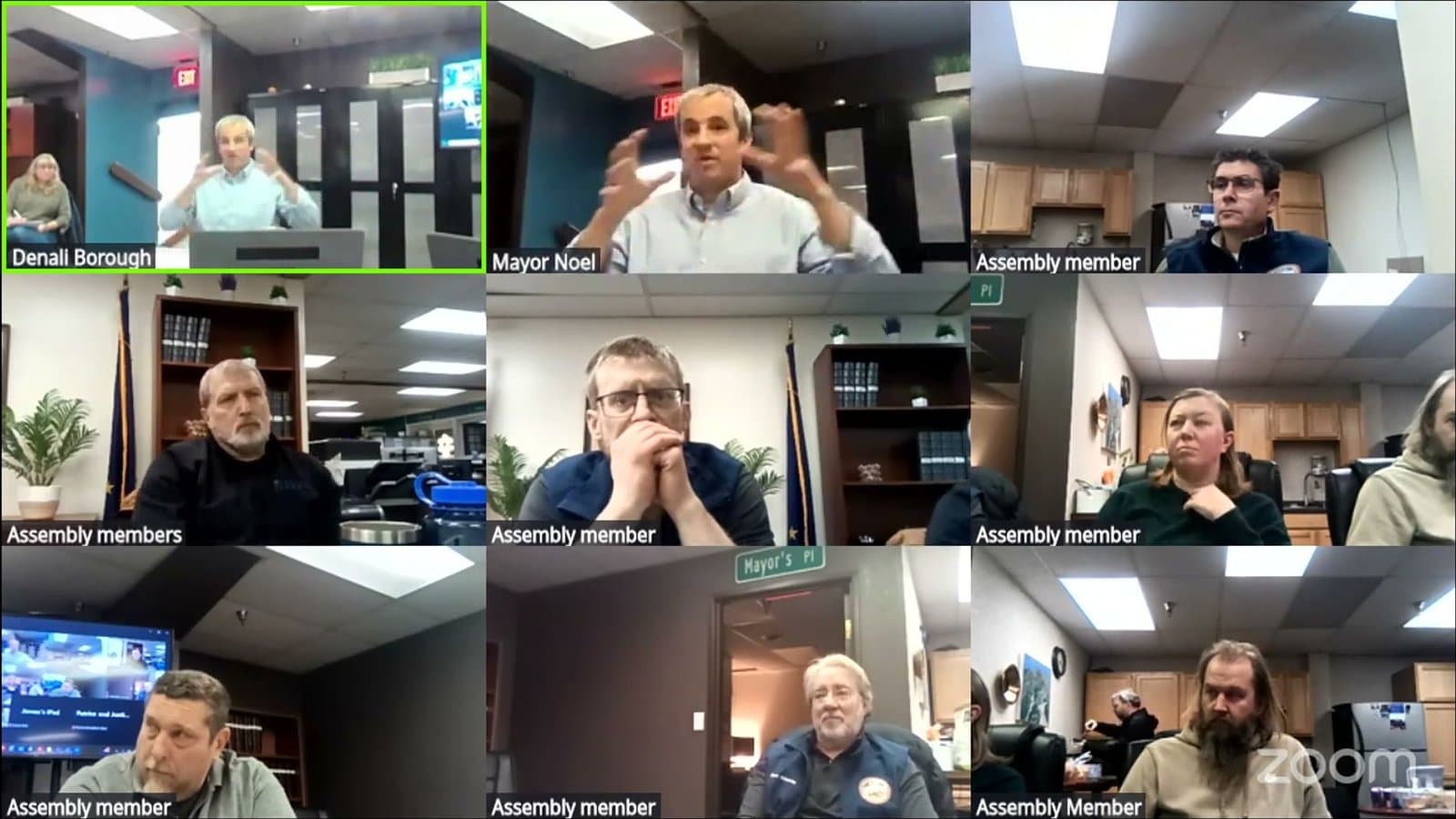
Thank you, Mayor Noel. Uh, it is, uh, Veterans Day, so thanks for everyone for meeting here on holiday, and thanks to all the, the veterans that we have. You're in the group, um, here tonight and, uh, around the borough. So much appreciated.
And we will take public comments at this time. Uh, when you're providing public comment, please include your full name and limit your testimony to approximately 3 minutes per person.
Start with Simon and then go to Mr. Chen. Hi, I'm Laura Lai Simon. I'm the Vice President of External Affairs for US Valley Coal Mine. I just wanted to come and introduce myself to the new assembly members. Great to see you.
I try to be here in person as often as possible, but I'm often just listening in on Zoom. But if you ever need anything, please don't hesitate to let me know. Good to see you again. Thank you.
Good evening, assembly and everyone. I'm Joseph Chatfield, uh, Denali Borough resident for past 20 years.
Uh, I have, uh, formally prepared, uh, notes here that I'm going to read to you here in a minute. First, I want to preface this by saying that I don't have a complaint or issue with, with our election workers or our borough clerk. Uh, I think they do an exceptionally good job. Um, as you all may have already caught wind, I'm, I'm, uh, I'm questioning, uh, the number of people registered in the borough versus the population that we have. Uh, in, in my email that I sent, uh, out that I'm going to read here in a minute, uh, one thing I, I noticed that I didn't put in here were the numbers and of of actual residents.
And the latest numbers— and I may get this wrong by a couple, like one or two, okay— but I, I went to, I went to the Permanent Fund Dividend and Department of Labor and Statistics and, uh, US Census Bureau for their, uh, latest estimate And they all come in with, within a few, just 5 or 10 of each other. And it was 1,615 was one of the numbers. That's total people alive. That includes infants through elderly.
When I, when I went through the, the school district records and checked with the Department of Education for the state of Alaska, we come up with approximately 200 students. Most of those students are not 18 years old. In fact, nearly all of them are not 18 years old. So that puts us down to approximately 1,400 people that actually could be eligible to vote, and the number may actually be less. So we have an issue here.
We have a large number of summer employees.
There have been complaints that have been filed with the Division of Elections that have gone ignored when people from out of state have made the statement, bragging to their friends and coworkers during the summer, that yes, they're voting in another state and they also vote here too.
That's very disturbing. It, regardless of what party you're aligned with, that should be very deeply disturbing because our political process hinges on election integrity and Some people might say, well, the end justifies the means. I say they're wrong because that casts a very dark cloud on not only them but all of us.
And our republic cannot stand if people don't have faith, good faith, that their vote is going to be counted and that leads to some very dark things. In this borough, we've always— the whole 20 years I've been here, we've always taken the high road. We always try to do our best, put our best foot forward. So I'm going to read this.
Questions, uh, for the Denali Borough Assembly, November 11th, 2026.
Registration figure requiring clarification. The Denali Borough's published November 3rd, 2026 election results reports 1,824 registered voters.
I'd like to reflect back to my estimate, which is a pretty solid one, of around 1,400 people that may be eligible. This figure warrants clarification concerning the accuracy, status, and verification of the underlying registration records. Questions requiring answers. 1, Registration totals. Does the figure of 1,824 include both active and inactive registrations?
How many registrations were classified as active on November 3rd, 2026? How many were classified as inactive? When was the registration last list— last updated before the election? 2, Residency and eligibility. What procedures were used to verify that individuals voting in the borough satisfied Alaska's, Alaska's residency and voting eligibility requirements?
How are individuals who permanently relocated outside Alaska identified? How are seasonal workers distinguished from individuals who have actually established domicile elsewhere? Registration maintenance. Does the borough receive updated registration information from the Alaska Division of Elections? Were any discrepancies identified between the registration list and election participation records?
Were any registrations questioned because of possible change of residence or eligibility?
What procedures are used to identify potential duplicate registrations? How are voter participation records reconciled to identify possible voting in more than one jurisdiction? Were any potential duplicate voting issues identified or referred to state authorities in connection with this election? 5, Ballot reconciliation. How many ballots were issued, returned, accepted, rejected, and counted?
Were all ballot totals reconciled with precinct registers and voter participation records? Were any unexplained discrepancies identified during the canvas committee's review?
Independent review number 6: Will the assembly request clarification from the Alaska Division of Elections concerning the 1,824 registration figure? Will the assembly seek assistance from the Division of Community and Regional Affairs concerning an administrative review of the borough's election procedure Will the Assembly ensure that all relevant election and registration records are preserved? Why this matters beyond Denali Borough. The Denali Borough is a microcosm of the larger state. If voter registration maintenance or residency verification weaknesses exist here, similar conditions may exist elsewhere in Alaska.
The purpose of raising these questions is not to accuse individuals or presume that unlawful voting occurred. It is to determine whether the registration records are accurate, whether safeguards are adequate, and whether potential weaknesses deserve examination statewide. The public deserves confidence that the voter registration records are accurate, eligibility requirements are consistently applied, and every lawful vote is protected. Hmm. Requested action.
I respectfully request that the Assembly: 1, acknowledge these questions in the public meeting record; 2, ensure preservation of all relevant election records; 3, obtain clarification of the 1,824 registered voter figure and its active/inactive breakdown; 4, refer unresolved registration or eligibility concerns to the appropriate state authorities. And 5, provide a written response identifying any review or follow-up action.
Thank you. So hopefully I've made my point of running clear. Uh, I don't have a particular issue with any of these people in front of me, any of you. Um, but I do have an issue with, with such a large discrepancy in those numbers. And when I— and on a personal note, when I go to the post office and I get my son's ballot mailed to me when he's been gone for nearly 10 years— it's, it's been 9 years now, going on 10— he was supposed to have been taken off the records when he requested to be taken off, but he wasn't.
And if they for some reason didn't receive that request, they still are supposed to by law take him off after 8 years. That has not been done either. Is that 8 years without voting? If they— if you haven't voted in 8 years, yes, you get taken off. And, and none of that has occurred.
And he is not an anomaly. This happens all the time. And I was also not very pleased with the conversation that I had with an employee at the Division of Elections. I felt that their attitude was very condescending. It all of a sudden got so much better when I explained that I had been an assembly member for 9 years and that I understand the legislative process and the electoral process.
And I gave her credit. I said, but maybe not quite as well as you do, but Uh, the impression I got from that one employee, the one contact that I did have, uh, over the last week, was rather negative. And I hope that, uh, further contact that I have is a bit more positive than that. Okay, thank you.
Madam Clerk, there are a lot of questions in Mr. Chatfield's comment. I would like to get a little clarification here, and then of course if the Assembly wants to discuss more further later, we certainly can. But just in terms of our role in voter registration, how we manage the rolls, and I know we reviewed our election code quite a bit before the election, but could you kind of explain again kind of where, where our rules come from and like what our review process is, if any, in terms of determining if anybody is on the rolls that shouldn't be. Yeah, I would say our influence is zero. We have no ability or authority to alter the voter registration records.
The only voter registration I can affect would be my own. That being said, If we—. In past, if sometimes the precincts will send back notes of so-and-so moved away, so-and-so is deceased, things like that with those updates. And I do send those into the state when I return the registers to the state. So if I receive some written feedback about the registration, I do submit that.
And so So we here don't have any ability other than to see who's registered voter, and beyond that we don't have anything. Oh, okay. And thank you again, I'm glad you say, um, one question. And then in terms of our preservation of our election records, what, what do we keep? And for—.
I mean, required to keep everything for 30 days after certification. And then the election certificates we keep for a minimum of 4 years. I actually don't know that we've ever destroyed any election material. But kind of per our retention schedule, about 30 days in terms of kind of the active election materials. So once it's been certified, keep it for another 30 days, assume there's no whatever legal follow-up after that.
Yeah, yeah. And we, we could hold it for for longer requests.
Yeah, okay. All right, and then, um, voter rolls are public information, like the, the, the list of registered voters in the Denali Borough. Um, do you know if that's publicly available from the, the state of Alaska? From the state of Alaska, you would need to request it from the state of Alaska. It's not a Denali Borough record.
So I, I can't provide that as a Denali Borough record since it's not one, right? Um, but, um, I, I do believe that, that people can request a— I see you're nodding. I do believe people can request that as a voter registration. Yep. Okay, done.
Great. May I make a, a point? Sure. Okay, uh, as, as Mrs. Renshaw has said, uh It's not the Bureau's responsibility to maintain voter rolls. What the Bureau does have the ability to do is you have the resolution power where you can, you can make a resolution to formally request of the Division of Elections to produce those voter rolls as well as do an audit and make sure that they get cleaned up.
The assembly and the mayor's office has far more power than just one single individual does. It shouldn't necessarily be that way, but that is the way that it is. So I, I would recommend that, and, and that's one of my recommendations. I'm not coming here just complaining, and I, I do have some solutions here. Thank you, Mr. Sheffield.
Any other, uh, we did have two written comments, I believe, um, that came in, at least that I saw by email earlier today. Um, and those would be in the online meeting packet. It should be in our email. Any other public comments here tonight? Okay, uh, Mr.
D brought to my attention that we skipped calling the roll. So before we take any action tonight, uh, I would like to, um, have a, have a roll call, please. David Alexander. Here. Walter Warner.
Here. Dominic Canale. Jeremy Stanfield. Here. Mark Johnson.
Here. Krista Zappone. Jared Zimmerman. Here. There's a car.
Like to make a motion to excuse Krista Zappone and Dominic Canale. Second that. Moved by Mr. Alexander to excuse and seconded. Any discussion?
All in favor of excusing absent members, show of hands.
Unanimous. That'll bring us to approving tonight's agenda. Like to make a motion to approve tonight's agenda. Second. Moved by Mr. Alexander to approve and seconded.
Any discussion, changes to the agenda?
Anyone opposed? Well, that unanimous—. Bring us to the minutes of the October 14th meeting.
Like to make a motion to approve the Amended minutes of the October 14th meeting. Seconded. I move by—. Moved by Mr. Alexander to approve the amended minutes, or corrected, maybe. Corrected.
And, and that's in the, in the current online packet version? Yeah. Okay, all right.
Any discussion of the minutes? All in favor of approving, show of hands.
Manos. That'll bring us to certification of the November 3rd, 2026 regular election.
We make a motion. Motion for that? Yeah, make a motion. All right, I'd like to make a motion to certify the results of the November 3rd, 2026 federal election.
Moved by Mr. Alexander to certify the election and seconded. So, um, I guess I would ask for a, a report. We certainly have, uh, the kind of the, the certified, uh, the certified results in front of us, but, uh, is there a report from the election Officials, Canvas Committee. I would be happy to say anything that you want me to say. Yeah, early canvas.
Um, this was the first time the Healy precinct, um, counted the early ballots from the Healy area. It took an extra hour, so we didn't get done until after 11 that night. Um, I think there was 118 if I remember right, 130, 130 I think. Um, and just to let you know how that happened, if you're curious, on the canvas meeting we gather up here, we, um empty the ballot box. We separate them into— sometimes people bring in their mail ballots and drop it in, so we separate those.
We, um, you know, get them all straightened out and we start making piles. At that time, Amber was taking the— our register of people that signed in and comparing it to the, um, ones that came in, voted early, or mailed theirs in. I really feel like there's no nefarious— people mail them in because they're excited to vote, and then it's Election Day and they come and vote again. There was two of those. I don't think they're trying to throw the election.
I think they just really want to vote and make sure that they're heard and that happens. So we were able to do that, the extra 130 that night as well. So, and then how many came in after?
Was there any that arrived after?
Yeah, I think, I think we had one ex— one other male one. We, we did try to tighten the timeline this year where we canvassed on Thursday instead of the Monday. And I do feel like we— I think that we've had 6 or 7 come in over the weekend. So we did the 6 or 7 by trying to push that timeline up. So that's something to consider for next year.
Did you see that they were postmarked by—. They were postmarked. They would have been counted. They would have been counted. I know for sure one was a dad that was voting and he was excited because his daughter— and he said, and I told her to make sure to take it.
She's out of state. Make sure to take it to the, um, desk to get that stamp today instead of just dropping in the box. And I was looking at him and smiling, going, there's no way it's going to make it here by Thursday. So that was different this year too.
We did have, um, borough staff and community members from Denali and Healy that were in the canvas meeting together, and we nailed that out on Thursday in a few hours.
Awesome. I have a question just in general. So on the question ballot cast, the 22 that I see up there, so what is the process for that and how does that get sort of resolved? Yeah, my name is Tina Graham, by the way. I didn't say that at the beginning.
Yeah, so question ballot, this is very common here at the Healy election precinct because we have a lot of people that live north or south that work in Healy. So they might be working at the power plant and driving from McKinley Village, but they're not going to try to hustle home or wait to get to work in order to vote on poll 3. They're going to do it here. And school teachers and stuff like that too. So they come in, they're not on the list because they're on the Anderson or the McKinley Village list.
So we can't sign them in. We have them do a question ballot. And then what we do with question ballots is we make sure that on the Anderson register or the McKinley register, they didn't vote elsewhere in the borough. So technically, you could go to every precinct, do your question ballot, sign into the one that you actually are registered, and then we would kick them all out. Right.
We, you know, I had one gentleman, he's like, I don't live here, but I really want to vote. And I tried really hard to make my face go, okay, and not show my, you know. And so we had him do the question ballot. We let him vote. He is not a registered voter and we didn't count that.
So our I really strongly try to encourage people like, no, we let them vote. This is our way to make sure that they get to vote and lead. I did notice a large group of people voting because of the construction down in the canyon. They're here and they want to vote. They're eligible in the state election, but they're not residents of the Denali Borough.
So a few of those voted. We just— they don't have the ability to vote because they're not registered here. One other quick thing. So, so. Yeah, just a follow-up to that.
So that those 22 votes were then reconciled and added back into the, into the count? Absolutely. Okay. Yeah, and we do that anonymously, so we just take them out of their sleeves once we've decided that yes. Um, Amber has the whole list on her computer.
She can get in, make sure that's the right signature, that it's witnessed, all of that stuff, and done right. Do that. Okay, sorry to interrupt. No, no, continue. I was just going to say one thing that we had that was really fun this year is I went to the Tri-Valley Government High School class, and they're juniors and seniors, and I recruited 4 young people to sit at the election polls with us.
And that was really great. And I think that they enjoyed it. They got to see more about the process. None of them were 18, so none of them got to vote, but I think they will next year. So it's really fun to do that.
And then also another thing about this election is we had a poll watcher. First time at the Healy precinct, and I think there were a few of the other precincts too. So that was different, new for us, right? So yeah, well, thank you for your effort and all this, and seemed to go very smoothly, and it was fun. Yeah, and you know, to be honest, I think that the overall, uh, you know, feeling in the room was everybody's pretty happy to vote.
Yeah, it was a good—. Was a good day, even though we didn't get prime rib sandwiches. Cookies were good. Anything from, uh, clerk's office? No, I guess I, I would just add that the, as far as the background verification process goes, so we, um, we verify that they are registered voters within the borough, that they've registered, registered, um, more than 30 days, um, before the proposed election, and we are able to, um, verify the signature The state has a portal that we're able to view previous signatures from those voters.
So we compare those and they need to be witnessed. The question ballots, the mail ballots, and the early ones are all witnessed. And then in addition to that, we also verify that they did not vote on Election Day. That's kind of the 5 things we verified before the canvas committee would, uh, count them.
And for the individual that did vote twice, the ballot cast on Election Day supersedes the, the one they, they voted early with? Correct, because we have no idea to know inside that box which one was theirs, but we have theirs in the envelope that they mailed in with their name on it, and so we say nope, can't count those. Okay, great.
So, um, couple points. Um, the information that Mr. Chatfield presented earlier, which is not a surprise to me, which is why I pushed for the two, um, ordinances changes earlier in the year. Um, 1,824, which we've all heard those numbers. The estimated total residents from census and VFD is 1,631. This is from my search numbers I ran 6, 7 months ago.
Estimated children is 18, so the estimated adults aged 18 and over is only 1,272, plus or minus a couple percent. But those are the numbers from the states and, and the feds. Um, still, well, and I'll oppose it again next time, mailing out ballots because it's too easy to sign it and send it back in. I don't believe it affected our local elections. Could have affected state, federal, potentially.
So I'm not going to vote against certifying our elections unless you want Donald Duck to win. For those of you that see that, there's a Donald Duck writing. Um, but I would— and if this is the right step, because I'm still fairly new— I would like to make a— ask for a resolution to take the recommendations from Mr. Chatfield and just say ask the Division of Elections to say please do a more thorough audit of our borough and that information. I don't think that's an unreasonable request, and it's part of our duties to not to just make sure they can vote, but that, that the vote is accurate.
So at whatever point I can make that resolution request.
Yeah, uh, just as a point of order, I guess, um, we can bring resolutions up to the assembly when resolutions come on here, or if you want to take and like draft something and put it on the agenda for the next meeting. I believe in terms of the proper order, that would be the time if we wanted to resolve anything in that regard.
Yeah, I'm with Mr. Johnson. I, I don't believe there's any nefarious stuff going on. You know, at least to the point of affecting our election. But I think, you know, we talked about not doing blanket mail-in ballots, you know, just as a point of efficiency. And just on that point alone, I think we should stop doing mail-in, blanket mail-in ballots.
But then, Clearly our registration is out of whack with reality. And, you know, so we sent out 500 to 600 mail-in ballots to people who do not live here. Like that, that's— could be more. You know, it's wild. And, you know, we were just talking about efficiency.
None of us are seeing shadows in closet. You know, so we weren't really worried about it. But just on that efficiency point, I'm for it. But then you add to it, you know, just there's no, there's no way for us to catch it. There's, there's nothing.
There's nothing. You know, if those, you know, 500 or more people decided to send their ballots in, there's no catch. There's, there's, there's no mechanism for us to say, Oh, that shouldn't have gone. You know, we don't have any, any way to stop that. So I think we definitely need to look into that.
It's state authority and it's for the state to police and understand. And I will also say that, you know, close to 50% of the people voted by mail, you know, so that was obviously for whatever reasons, very much a convenience for them. And, you know, it was a fair number. And I think mail-in ballots are wonderful, but if you need to mail in a ballot, you can request one. You know, it is an added step.
I understand that. But it's not an onerous extra step. It's just a, hey, I'm not going to be here, please let me do it in mail-in ballot, um, as opposed to sending ballots to somebody who hasn't lived here for 10 years. I'm off the, off the rules. That, that's not, um, so we just have this big loaded, loaded voter process, you know, we use those roles.
So as a body, you know, as a bureau, we certainly have an interest in how those are maintained. So we could request just a visit, they could, you know, zoom in and just kind of explain, explain that process, whatever it is. So yeah, that might be very much something that we don't quite understand. Yeah, I don't know if it works. So, and, and I don't know if it's just like by default, if every— if it's like state code that borough election rolls are by default state election rolls for residents of that borough.
Is that Like, would we have the authority to do our own voter registry? Yeah, never—. I've never been curious about that. Yeah, I'll take some research. I don't think we should, but I'm not sure about it if they even give us the choice or not.
Like I said, sounds like elections are state level. Good discussion. But, um, yeah, anything else regarding the certification of this election?
No, uh, I'd ask for a roll call vote on certification. Jeremy Stanfield? Yes. Walter Warner? Yes.
Mark Johnson? Yes. David Alexander? Yes. Jared Zimmerman?
Yes. Passes— or it's unanimous, sorry. Election is certified. Congratulations to, uh, to the winners of, uh The selections.
So that would bring us to oath of office for the new assembly members. And the mayor. Thank you. You're right. Yeah, I didn't read over somebody's shoulder.
I didn't print out yours. Sorry, better have it memorized.
This don't say state your name. I state your name.
This is going to be yours, but I'm going to use it to read right now. They said, Chris, you're gonna, you're gonna affirm as well. So you're You're swearing and affirming that you do solemnly swear that I will support the Constitution and laws of the United States and the State of Alaska and the laws and ordinances of the Denali Borough, and that I will honestly, faithfully, and impartially discharge my duties to the best of my ability. Billy Graham, do you affirm? I do.
Kaia Clowder, do you affirm that? I do. Mark Johnson? I do. Chris Noel?
I do. Okay, great. All right, congratulations and thank you for your willingness to, to serve with us.
Thanks.
That'll bring us to the, uh, election of assembly officers. We have presiding officer and deputy presiding officer to elect. Do them individually or as a slate, but we just take nominations. I'd like to nominate Jared Zimmerman for presiding officer. Second that.
Second that.
Other nominations? I nominate Jeremy Stanfield for deputy presiding officer.
Second that. Second it. Yeah, you did good last time.
It was the fastest meeting ever.
Are there, are there other nominations? If we have multiple nominations, we just do, uh, I think a ballot. That's good.
I reject the vote. Yeah, um, if there are no other nominations, ask for, uh, um, I guess, uh, show of hands, all in favor of myself and Mr. Stanfield as presiding officer and deputy presiding officer. Unanimous.
Thank you. Um, for, for new assembly members, um, just if you have any, any questions or issues with how the meeting's being presided or whatever it is, um, certainly let me know. Try and make sure everybody gets heard and everybody has a chance to speak, and my, my best effort to not close off any discussion, you know, pertinent to, you know, the motion at hand before we're, we're ready to vote on it. But I do. Everybody appreciates a good, a good, a good, good efficient meeting as well.
So, um, there's, uh, it feels like we're failing on, on one side or the other of those, um, let me know. And there's points of order. And, um, yeah, in terms of Robert's Rules, I think the, the clerk is the, um, kind of the parliamentarian. If we've got any, any questions about if we're following proper procedures during the meeting, defer to you on that one. Um, and there is a good training coming up for, for newly elected officials at the Municipal League Conference in December.
So if you're interested in, in that or the other aspects of the conference, um, yeah, get, get signed up for that. I did that. Yeah, the training is good.
With that, we do not have any communication or appearances. That brings us to reports, and we'll start off with partner reports. And we have a member of Commerce, Discover Denali. Yeah, my name is Eliza. I'm here with Knowledge Chamber of Commerce, Discover Denali, and the Knowledge Community Foundation.
For those of you who I have not met, I'm the executive director for those three organizations. Fairly new to the role, so I'm still fresh and excited and grateful to be here with you all today. So I just like some general updates for you. Our 2027 membership recruitment is still open and active for both the Chamber and for the Visitor Center memberships, as well as the advertising for the Visitor Center is also open. So that's for our vacation planner and on-the-go brochures that we publish each year.
And so that advertising is available to be purchased through November. And so then my hope is to put the publications together and send those to the printer sometime January, February. It takes about a month to get those printed, and then we'll have those for distribution around the borough. Also, we get a lot of visitors trying to plan trips that request those publications via mail. Right now we're, we're using last year's as we, as we prepare for next summer.
So yeah, so that's an update on that. As far as some updates specific to the Chamber of Commerce, we had our trunk or treat event on Halloween, which was a big success. We partnered with the Tri-Valley Community Library to kind of put on a dual, like a multifaceted event. So we had trunks, trunk or treat outside with crafts and hot drinks inside. We had 19 volunteers to host trunks, so we filled the whole bus loop.
And we are estimating there was about 200 kids, which was double what we had estimated based off of last year. So Maybe it was the nice mild weather, or maybe it was, you know, who knows what, but it was great turnout and we're definitely excited for next year. We've already kind of started talking about some ideas based off of this year for how we can kind of improve things for next year. But overall went really well. I guess the library at one point, maybe people were warming up, was like completely packed full of people.
So it was a good turnout. We're looking forward to working with the National Park Service and with the borough and other organizations for Winterfest this year. We're looking at bringing back some exciting things and excited to be partnering kind of with a lot of different groups on that and looking forward to that. So more to come later as we get more fine-tuned details worked out. But, and then yeah, I'm Personally, very excited to have more of a visual presence, presence in the community on behalf of the chamber and hosting some more events and getting involved with events that are already existing and looking at how we can partner with organizations that are already kind of hosting these, these really fun, important gatherings for our communities.
So, and my hope is to, to work across the borough on that.
Yeah. And then as far as Discover Denali, we have printed a small batch of our 2026 winter guide. So that kind of lays out businesses that are open anywhere from, you know, mid-September through mid-May. Those are all included in our winter guide. And we printed a small batch already and those have been distributed to the Morris Thompson Visitor Center in Fairbanks.
With through Explore Fairbanks and then by request kind of throughout the community. We started with a small batch because something new we're doing this year is we are going to print, do a reprint of more in January with new members that have signed up for 2027. So we're hoping to kind of bolster that winter guide up for starting January once we have a better idea because we've already had some new members sign up that do operate in the winter are interested in being included in that guide.
And then the Denali Community Foundation, I've been working closely with Stephanie Ford on several projects. We've been in good communication and definitely working together on a lot of things. One project that we're kind of taking the lead on is that community well that I had. That's been in the works or at least as a question mark for quite a few years now. But I'm kind of restarting that project.
We're working with an organization called RCAC in hopes for some funding for technical assistance. We had— there was an EPA assistance for financial assistance for the technical engineering piece of that, but it was closed out. So we're working with this other organization to kind of restart that project. We'll keep you updated as we make progress on that. But there's some things we're kind of questioning, figuring out answers to some questions before we go back to the EPA and kind of reopen that technical assistance.
Yeah, you guys have any questions for me? I'm here and also I am a written extort. So if you have any questions, you know, not tonight, just let me know. I do have a quick question with the grant that was put together to help the groups get through their financial and staffing issues. What, at the time there wasn't collections for your members and so forth.
Where does that stand today and what kind of improvements have you been seeing? So are you talking for, um, the chamber, the grants from the borough office? Okay. Um, yeah, so we have, as far as what we're, what I've been doing since I, since I came on, so, so a big push was to hire an executive director. Um, so I've been hired and I'm here.
Um, and I have been kind of doing a lot of backend administrative, getting things back up to speed, and then focusing really significantly on membership and working with our board to figure out what, what opportunities we offered members in the past and what we can offer newly in the future. So one, one new benefit to Chamber of Commerce members that we've decided on in our advertising for, for 2027 members is 1 free rental space of the chamber building is going to be included for members. That's, yeah, so we're kind of, we're doing a lot of like, okay, what, what does our membership currently look like and what are we actually providing to our members? I'm hoping to do some, offer some training, some like technical training, hands-on training in the borough for, for, skills that are needed if people are looking for different job training opportunities, seeing if we can bring in that for members. And then also more business operations trainings, looking at that kind of stuff.
And then also doing— we work with a lot of organizations around the state, and so a lot of them are putting on trainings around the state. And so doing a lot of advertising to our members about opportunities that are already existing. So the one, one of the main drivers for the grant was that you weren't collecting membership fees from your members. Has that been resolved? Yes.
So we are, so 2025 membership, my understanding, 2025 membership rolled over to 2026. '26 For the chamber. The visitor center was— we had a— Justin was our manager and was, you know, kind of maintained that. So we did collect visitor center membership in 2026. For 2026 on the chamber side, no membership fees were collected on the understanding of there was no executive director, there wasn't too much going on, and could we fairly collect membership without providing that service.
So everyone that was members in 2025, we honored the membership for 2026. And so now we are kind of starting with our 2025 membership list going forward to 2027.
Hey, thank you. Thank you for your work. Thanks for the trunk or treat. My kids enjoyed it. Yes, it was really good turnout.
Uh, let's see, any other partner reports tonight?
Okay, move on to school district report. Thank you, Superintendent Burke. Thanks for joining us. Well, I have to say, uh, happy Veterans Day. There are veterans, you know, on the assembly or in the audience.
Thank you for your service. Speaking of that, we had a Veterans Day assembly at Tri-Valley today. If, uh, hopefully some of you had a chance to visit that. And music, poems, the works. So, uh, it was excellent.
Um, we did have a music concert that brought Nanana down again this past week. Those are always great. So if you see those on your calendar or hear about them, they're worth going to Uh, we also have volleyball games the last two days, so lots of excitement going on right here in town. Um, our student counts have, uh, are almost completed. That's where our funding comes in.
Um, we're within the budget of what we had anticipated. Um, we also completed the audit the outside audit that's required. And I'm going to give a shout out to the business office. We had— we didn't have any findings. We got a few minimal things to do, but that's great.
Not that we were anticipating anything bad, but it is nice for me to say to the assembly that supports the school district that we, uh, we are— we are having a clean audit.
Thinking of money, the oil prices are still expected to remain above the amount to have our last CIP project, the two generators, one at Anderson and one at Cantwell, both the demolition of what's there and putting the new ones in. We will know on December 31st, but we're still seeing, even with the latest oil drop, we are still above the cutoff there. However, we did put in a CIP for that just in case as a backup, which did make 27th on the, on the list. Hopefully we won't need that. There are no other CIP projects for this coming year.
The anticipation is that the generator project will take up a lot of time And they'll do it in stages. So there isn't any other projects from assembly standpoint of trying to set aside money. We don't have anything outside of those— that generator project for next summer. Uh, there will be more the following year, but for now, um, we are just like you did, reorganizing, uh, our school board with a couple of new members. So in Anderson next week, so we will have some new faces and new officers as well.
Our strategic plan for fundamentals will— we have planned for mid-December. Invites will go out soon. We're trying to get to establish it. Some of you participated on previous strategic plans. I've seen your names and That's appreciated, and we do hope that we have input from this body as well as the communities and businesses.
We're trying to match up all of the different areas to find our district goals for where we're going in the next 5 years. The state just recently sent us the property, the full value of property. Which affects this year's foundation funding. It changes the minimum, um, the minimum contribution that the borough would give us. Property rates did go up, uh, it's a difference of, I think, uh, $66,000 was roughly, uh, a number that we had.
The maximum allowable also went up slightly We are not from— the reason I bring that up, we're not looking to change anything from the assembly side. We don't anticipate asking for any more, and we'll be able to cover the change in that. But it will mean that that number is higher next fiscal year. So.
We are still very interested in the blacktop project. That is something that, especially during the warm-cold aspects this year of seeing the— how that looks on our— if that's a possibility, we're very much in favor of that. Knowing that we're going to have some employee retirements coming up, maybe not a large amount immediately, but who wants to leave our area? Which means housing of people who retire and are still going to stay here could put additional stress on it. So the school district is, is very open to those conversations as well, back and forth between the borough and ourselves.
So We are trying to look into the, into the future. CTE, we are expanding what we can do in CTE. There is an Interior Department consortium that was involved in last year on the other side of the mountains, and they are discussing with their board if they'll, if they want to include other school districts. Denali is interested in we are interested in intensives for career and technical education where the students would be sent and for professional training for a week at a time. And then I will— it doesn't directly affect us, but where I was last year in Tok, they had 5 intensives that students went to and they got hired.
They graduated, 5 graduates got jobs at the end of the year because they went to these. And I, I think the opportunity is pretty high, um, and continuing through that. Um, we are also working with the City of Anderson, um, hoping to get a cybersecurity program going possible. We're, we're very interested in that as well. We'll see if that comes to pass, but the conversations are still going, which, which would be very helpful.
And the last few things I had, we did get a hunter safety grant. So you're more than welcome to see the students as they go through the hunter safety. And lastly, we got a Presidential Fitness Test grant. So looking around the room, most, most of us remember in elementary or junior high doing the Presidential Fitness Test and in my case, failing badly in a few of those areas. So we, we will be—.
You will see advertisements for that. And if you want to relive your youth, By all means. And if you outdo the kids, then we'll put your name on the plaque.
Thank you. Question? Any questions for me? What fields were those intensives in? Uh, sheet metal, uh, construction.
We had welding, and then mining was a big one. Um, so at the Mine Training Center What we are looking at, if we could join that consortium, is things like mining, which we have, tourism, and probably technological field. Cool, thank you.
Question regarding student counts. Do you have like numbers? I know Cantwell and Anderson have both had like pretty high fluctuation in student numbers last couple years and there's kind of a 10-student threshold that is relevant to us. But do you know where those numbers are coming in for, for this year's count?
I think Cantwell officially was just slightly below 12. Anderson was 14. And this does not count pre-K. So although we have a preschool grant, those are numbers that are above that. We're anticipating a few more students.
From the preschool moving into kindergarten in Cantwell without losing any seniors. And Anderson, they're anticipating roughly staying the same, although they do have seniors. They also have students moving up and the possibility for more. So right now we are above the cutoffs. We're close, but we are above them officially in And none of those are challenged that I know of.
One at Anderson, it's challenged, but it's a 0.05, I think. It won't— so the, the numbers are good this year. We're anticipating that they will be good next year, um, but it doesn't take much for a drop in student population if a family moves. And challenge you're referring to is if they're claimed by another school, they could like enrolled in another school district, right? You got to adjudicate which one they get counted towards for funding purposes.
And we are still working on that overall. That's why I don't have a specific number on our total for the district, but, um, we're within the range that I'm comfortable with from the, the school district that this year we will be open. And blacktop project you mentioned, would that be for, for Tri-Valley with the, the pathways project that's coming through? Correct. That'd be awesome if it's possible.
And we talked with the, the mayor about if they have a plant, if they have a blacktop plant here and trying to expand, it would be the most cost-effective time to do it. So does that require you to do extra plowing or change the plowing or? It would lighten it a bit because we don't have an even surface. Right. So plowing gets to dig in.
It would involve a change in how we plow, but that's more, uh, the, the person behind the plow than the process of, of plowing. So it would be extra cost. To the—. To the—. Wouldn't necessarily be savings either.
Time, and that is a saving, right? Right now we can't plow as well as— right, we are, um, I think it's even on order, working on how to clear sidewalks. So we've been lacking, um, the ability aside from manual, and that will also save us time. And we're looking at getting that this year out of our, our maintenance budget.
Yeah, thanks to the, thanks to the folks doing the plowing so far this year, because I know there's a skating rink everywhere but school parking lot. Doing by far not the worst place around, so that's much appreciated. Thank you.
Okay, and we have a Community and Outdoor Recreation Committee report. Yes, that's me. All right, thank you. So I'm Tina Graham and I've been part of the CORC. We started out as the Trails and Outdoor Recreation Committee in 2022 and then we became the community outdoor, the CORC.
So this is our first time having an official report at this meeting and so it's kind of exciting for us. I'm the presiding officer and Healy's my husband, so I decided that this would be a great opportunity for me to come. Today. We are a very active and busy committee. We're enthusiastic about adding positive things to our communities.
We do have a new committee member. That's Michael Christie. He'll be joining us next month— next meeting. I also met— when I was meeting with the government class about Election Day, I also invited some of them to join us on the CORC since some of the projects are community related and we would love their input. And I have recruited 2 youth that are going to sit on that.
I had Abigail Walker Denali joined us for the last meeting. And about 8:30, I'm like, you should probably go, knowing that she has, you know, volleyball practice and a drive and school in the morning, homework, those kind of things. Um, we have been very excited and passionate about community outreach, and we attended the Healy Health Fair last spring, the Anderson Strawberry Festival, I think it was July, and we even represented at Healy's Trunk or Treat this year. We too are planning on having some sort of presence at the Winterfest in February. We are hoping that people recognize the CORC as a borough committee and get excited and promote the projects that we're working on.
Antler Ridge, we're really looking forward to the completion of that hopefully next summer. We hope to do some sort of trail celebration if, you know, depending on when completion happens and whatever. We've been working hard to perfect the kiosk that will be on display on the information boards there in the parking lot. Separated bike paths, that's an exciting project for us that's coming hopefully next summer. We're even hoping to do some school collaboration with students and do like a bike safety day or get the kids, you know, they've done that before, just on those paths, maybe do helmet checks.
Or things like that. And having some students on our court makes it really great to have to see what they would. If it doesn't get to be next fall because the completion dates may be the following spring, you know, a May day where we ride bikes. Shooting range, that's one of the big ones that we've been working on. We've had a lot of discussion about the range here in Healy because of the closure of the Mile 252 Pangeni gravel pit.
And we are working with a group that wants to form a nonprofit, Interested Sportsmen, that are considering becoming a club that could manage it. We've had 2 work sessions now to discuss how the borough and a nonprofit could work together to make this come— become a reality in our community. Hopefully the nonprofit will prepare— propel this forward for us. And obviously the location of the shooting range will— is a big decision, but that's going to be the contentious part, right? We understand that the land at the Cantwell shooting range is another topic you guys have been working on.
And I know that's a new discussion for the borough. I was actually excited to hear about the hunter safety grant because that is one part of our shooting range that we recognize that there's like the Pangeni site has been used for troopers to requalify. Theirs and stuff and Hunter's Ed, that kind of thing. And so having, you know, maybe a partnership with, again, with school and the Hunter's thing, maybe that can be— I don't know, I just heard about it. But anyway, that's exciting.
The Nordic ski trails. So last winter, Cork member Al Guggisberg took it upon himself using his time equipment and gas money to begin grooming the trail at Otter Lake. Two fabulous Denali Park was a great success. I hope some of you got to ski there. Um, we had a winter of snow for that place to be a huge success, and we joked that it's the first thing on Facebook on the Healy page that has ever had several dozen comments and none of them to be negative.
Um, so we knew from our previous surveys that it was a great community interest, and we also are being realistic that the lake's not always an ideal place for the ski between the wind and the drift and then the ice overflow up there. It just kind of came together for us last year. Knowing it always won't. So Al has been searching for better spots that are so close to the community. So he's landed on the railroad to the south here of sulfide loop, sulfide subdivision loop.
And he has even talked to homeowners in that area, seeing what the impact would be to them having people, you know, that way skiing. They were, from what I understand, positive because they're like, I would love to ski right out the back door.
So we have passed a resolution that is on your agendas as well, I think, that to support the partnership with the railroad to lease that land for that. We have a meeting next week. To discuss this further, a work session about it. Our missing link right now besides snow is the parking situation. Here at the community center might be, then you'd have a kind of ways to go.
Behind the Vitus gas station down there, there's some property maybe, but we're talking about maybe almost a mile to where you get to the 6th 6-mile loop. Also, he has it mapped out and planned that there'll be a few smaller loops. So we want to encourage shorter skiers that might be a little tired, get tired legs quicker, or newer skiers that, or just, you don't have the time to do a 6-mile, but you can get out and do a mile loop or whatever. Because we have seen good success with the borough and the railroad and the nonprofit of the Lions Club, Up at Auto Lake, we're excited, hoping that this is going to be a similar promotion type of thing. And you know, it'll be a good thing to see how our relationship with the railroad develops and how a land lease will really work with them.
Stephanie let me know today that we're— that the application is in process and we expect to hear by the end of the week for sure. By then, we're work session next Thursday, we'll know what the agreement with the railroad would be.
So that is what I have for you today. Any questions for me?
A lot of, lot of stuff going on here. Yeah, thank you. So the, the, the ski loop here would be for here, you would think? I think, I think that Al would like to— well depending on the railroad in that process, which we just don't know because we've never done it. But as soon as we have snow, Al Skinner— okay, nice, you know.
Yeah, and he uses his own equipment instead. And, you know, maybe, maybe that will promote a Nordic ski club, right, that would have some sort of membership and volunteers. In fact, last year we had volunteers, um, even up at the lake that was going and scooping the dog poop from people that didn't clean up after themselves so it wouldn't go in the lake. And I'm like, that's very much a dedicated volunteer. It's easier when it is easier.
Yeah, thank you. Well, yeah, yeah, thank you. Thanks to you and all the other committee members. I know it's several years of work that's starting to see like the fruits of, of all that labor, but I know there's a lot of, a lot of work has gone into getting us to this point. Yeah, and thanks for coming and presenting committee report to us here.
Yep, just needs a little bit of snow. Exactly. Hey, and we have our finance report.
Don't have finance report. I'll try to get— there'll be two, I think, next month.
We do have mayor's report. Okay, well, thank you. Good evening. Welcome to our, our new folks. Thank you for stepping up to serve.
Um, and I also wanted to take a moment and just thank the, you know, the public for the vote of confidence. And it's an honor, it's humbling to be, um, able to serve for another term. So thank you. So I have my written report in front of me, and I typically traditionally get it to you right before your meeting, and then we attach it to the packet. And sorry for the confusion, I— we sent the October, but it was actually November.
So I'm going to go through and just highlight a few things here. I, as per the usual, I try to highlight some things that the team is doing too, including emergency management, land planning, community development, solid waste. So I'll just get right in here. As has been mentioned, we had 22 election judges, so thank you to them on behalf of the borough. Including those 4 students.
That's really cool. And, um, yeah, it's just what a way to participate in the democratic process. So I wanted to highlight for the body that just this last week I submitted a written— I guess it'd be, um, it's a complaint with the U.S. Department of Health and Human Services Office of the Inspector General regarding the federally qualified healthcare center that used to have an office here in Healy. And so based on some consultation with partners elsewhere in Alaska who are also part of federally qualified healthcare centers, and after a phone call with the Department of Health and Human Services, this seemed to be the preferred pathway to start the ball rolling, to notify them that we have, you know, that we are not getting in-person care that a federally qualified healthcare center that, you know, kind of includes some of our zip codes, including Anderson, Healy, McKinley Village. I believe Cantwell qualifies under Copper River Native Associations, but to notify them that, you know, we've lost access to care.
And so I will keep the, you know, the body informed on how that goes. And there may be things to come, including, you know, action needed by the body to pass potentially resolution. Does Interior Community Health get some sort of credit for our zip codes in there? Something like that. Yeah, yeah, they get a one lump sum grant through the Health HRSA Grant Program.
So I couldn't tell you what that acronym stands for, but if you look there, you know, they have received the same amount in 2026 that that they did in 2025. There was no reduction, right? They do, I believe, still claim our zip codes. I do recognize and just want to acknowledge there are likely still residents, our neighbors, who go to Fairbanks and seek care at Interior Community Health Center in Fairbanks. So it's not as though they're not providing care, it's just that we don't have access to in-person care here in Healy.
So which is the entire point of the grant, which is it's, it's to increase access to care for rural disadvantaged communities, which we, you know, thank you for bringing that up. It's timely with the other funding opportunities that are available to provide access to it. But if on the books it looks like we have an active healthcare center that's serving us, yeah, yeah, it's not, not an accurate picture, right? So Yeah, yeah, you bet. And one thing we were, we've known about this, this is an action item for a few months and we're waiting until we have this new, our healthcare rural health program coordinator.
I may not have the title right, hoping that she can help us through this process as we hear back and find out about any additional steps needed. She can help boost our capacity in that regard.
Moving on to tax audits, we are in the midst of our audit as well, but as per code, we typically choose randomly a small number, I think 3 operators, overnight accommodations, severance, and alcohol and marijuana, and perform a random audit. It covers the last 3 years of remittance to the Denali Borough. So I appreciate first and foremost their participation in that process. All of our operators responded to our auditor. As is typically the case, they— there were some findings.
There was no fraud or malintent. And the thing that I want to flag is that when it comes to overnight accommodations, if the charge is required regardless of whether or not the person gets any other service other than a place to stay for that night, it should be included. It's subject to the 7.5% tax. And So cleaning fees is the thing at issue. And I just want to flag cleaning fees are required to be included in that total that's subject to the tax.
And we have talked internally about how to make that more clear and just help work with our operators to help them understand the process. For those who use some of the online platforms like Airbnb, it's as simple as a checkbox, but it's not— it's not maybe as user-friendly as we might hope. So, so the Airbnb actually, if you set it up, they'll include that into the price. I mean, they will, the tax calculation, they will. But it's not by default.
You have to manually take action. Otherwise your price, and they're doing their own, they're changing the way fees are displayed to the customer. I think many of the platforms are doing this so that it's kind of an all-in-one number. And you're not facing all these small fees after the fact after you've booked. But it does take action on operators.
And, you know, that's just kind of the point of this audit is to find out things like this. Yeah, yeah, yeah. And help, help educate. But the bill, you know, I do recognize this comes with a bill potentially for those who maybe weren't collecting but are due up.
Last, on just kind of general items of interest, I wanted to highlight that our seat on the Golden Valley Electric Association Board of Directors for District 7, that's open for applications. They will go through a nomination committee and then be forwarded to, I guess, to be voted on. This is one of two pathways. You don't need to go through this, but just wanted to get the word out. Folks who are UCSD employees, folks who work at the power plant are not eligible.
And so that does limit our already kind of limited pool of folks, but it's an impactful job. And Kathy Hannigan is our local nominating committee chair, and send anybody interested her way.
Emergency planning, a couple things I'll flag. Nate Grimes is, you know, on the job about a month and a half now, doing a great job. We're very happy to have him. He has been working in year 1 of the Rural Health Transformation Program. Cantwell was awarded a new ambulance, and so he's working with Cantwell Fire Department and the Alaska Municipal League to help Cantwell receive that ambulance.
And then another thing I wanted to flag is we know, you know, that Cantwell Volunteer Fire Department is going through some challenges. Their longtime chief, Marge and Dale Nord, they're trying to step away. And they need, you know, some volunteers, a new fire chief. So he's been working with them to help, you know, become more aware of the situation and help do what we can to support them. Moving to community development, the other highlight from year 1 of the Rural Health Transformation Program, Tri-Valley Volunteer Fire Department was awarded a new medium rescue truck.
So at some point we will, they may work directly with the Alaska Native MS Healy who put in that bundled application, but we'll support them through that procurement process. So that's really exciting. Year 2 applications I wanted to flag, we supported Tri-Valley, basically all the, all the fire departments going in on a bundled application for EMS equipment, and we focused on communications. So radios, some specific EMS infrastructure, like stuff that goes in the ambulance. So kind of a variety of things.
The second application was Tri-Valley worked directly with the Alaska Municipal League on some equipment upgrades and training funds.
And I think I'm missing a page here. I apologize. The third thing, we are going to talk about it later, You mind if I repeat? Thank you. I'll leave Ferry here.
The third thing was a planning study regarding EMS service in the Denali Borough, and we'll talk more about that later. The last thing, we helped support collecting letters of recommendation, including from partners, Golden Valley, Yusubeli, to name a few, to support a private entity opening a clinic here in the Tri-Valley Community Center. They were not able to submit But we're going to continue to work with them. By May. Moving on, I wanted to just highlight that the Statewide Transportation Improvement Plan, also known as the STIP, was open for public comment.
We submitted a comment on behalf of the borough for projects that were not listed in there. And so in my report, I've listed the projects that we kind of helped advocate for. We understand that the STIP is just, it's one planning tool, and I believe the Department of Transportation has quite a bit of latitude to change priorities based on what's in that STIP. So we're, we're trying to use every tool we can to help advocate for those projects. Let's see, I'm going to move through solid waste.
We are underway repairing the landfill shop there. Land planning, I'll just highlight the Planning Commission has a meeting next week. There's a few items on there. We're continuing to work on the commercial use permit, which we talked about at the Assembly's Finance Committee. I believe that was last month.
That we're going to, we're going to talk about that next week. Excuse me. Okay, back to Mike. Thank you. Last, I wanted to, in addition to the full value determination when it comes to the school district, and I appreciate Superintendent Byrd's report on that, I wanted to flag that the Alaska Joint Legislative Task Force on Education Funding just put out their kind of final recommendations a couple days ago.
There is going to be an opportunity to comment on that. And so we will review it, plan to review it and put in comment. That a legislative task force? Did the governor put that together? It was.
I don't know the, the structure, but it was bicameral, um, bipartisan. And, um, yeah, and so while it didn't— they didn't pass any legislation, they passed some, um, recommendations on, and they cite quite a bit of kind of ongoing legislation that may need funding attached or, or various things. So we're going to dig in, better understand. Um, two last things I wanted to, um, Mr. Don DeBlau called today and mentioned that a, um, a former Denali Park Assembly member, Miss Patty Tatum, um, passed away yesterday. So, you know, pass that on.
Our thoughts are with her family, and we thank her for her service and celebrate all the contributions that she made, I believe representing the Northern District for about 5 years by my, by my recollection. And then last but not least, I'll just flag the Alaska Municipal League, especially for the newly elected officials here on the body. The Alaska Municipal League annual conference is coming up. It's the second week in December. There's training.
It's a great opportunity to connect with other municipalities. There's all sorts of presentations and things like that. So happy to talk more about that. The body, you have a travel budget, we, we can, you know, the body can pay for her DM and lodging and all that. So let us know if you're interested.
And that goes for—. That's it. Thank you for the opportunity. Happy to answer questions. There's more.
Anything for the mayor? Thank you. Brings us to assembly comments, and, uh, start with, uh, Mr.
Johnson. Sorry, um, congratulations to all the new folks, and this is my third time sitting in the seat, first time being elected, so we'll see what kind of mess we can make this time. So Yeah, congratulations and welcome aboard our new members. Fun. It's a fun thing.
You're going to like it. And thank you very much for the reports and thanks a lot for the work that the CORC has done. I think it's really nice. I took advantage of the trail on Otter Lake a few times and it was really quite fun. And so I'm looking forward to this one and it's a nice little addition to our Winter, uh, brochure, you know that there's this in-town little adventure, ski adventure.
Um, that's it.
Excited to be joining you all, and, uh, yeah, really looking forward to serving our communities together. Yeah, extend my congratulations as well to all the newly elected folks, uh, everybody on the school board, um, as well. Got new members there. And, uh, yeah, big thanks to everybody that served on the, the local election committees and made the, made the election happen. Did a lot of work and, and stayed up late counting votes.
Much appreciated.
Uh, welcome aboard, everybody. Um, great work on the recreational stuff. And let us know if there's anything we can do to make the shooting range happen sooner. All about that. But I just want to thank everybody for their services that, that, that you guys have served for the community.
And I look forward to serving alongside you, trying to make a difference.
And we do have ordinances for introduction on the agenda tonight. And first one up is Ordinance 26-19, Solid Waste Tipping Fee Increase. Like to make a motion to introduce Ordinance Number 26-19. Seconded.
Moved by Mr. Alexander to introduce and seconded. Anyone ask a—. You're an old Thank you. Okay, so by background, our tipping fee is set at the landfill by ordinance. The tipping fees at the transfer stations are included in our fee schedule, which is also passed by the assembly.
So this ordinance, the last increase to our solid waste tipping fees occurred in April of 2024, which was 6 months after the, the ordinance was introduced. We are currently— the tipping fee is currently at $150 a ton. The landfill did recover 64% of its operating costs last year, which exceeded our kind of internal administrative target of offsetting 50% of our operational costs. So at the same time, we felt like a regular an incremental increase was the right way to do it. The previous increase had— was, you know, we wanted to just revisit it regularly.
And so wanted to start— I do recognize this is, you know, 10% increase. And for comparison, the Fairbanks North Star Borough rates are $148 per ton if it's commercial. Obviously residential is covered by property taxes up there. The Matsuburo, which is also set up as an enterprise, their tipping fee is $147 per ton. So we are kind of right in line with our neighbors at the moment.
The only other thing I'd add, and then happy to just kind of have discussion, and is that overall our operation, the whole solid waste operation, is established as an enterprise. We've always recognized that the, the cost of doing business with a small facility is— it's challenging to recover all of those costs via fees. We're balancing. We want people to do the right thing with their waste. We accept things that we really don't want in the waste stream or on the side of the road, like household hazardous waste.
We accept that at no charge.
And we have an aging fleet of heavy equipment that we have to maintain and long-term liabilities for the the operation that we have to balance. So I wanted to present this for your consideration. And I will say, while it was not attached to the packet, the October 5th Finance Committee, there was kind of a solid waste annual fee review. And so there's more detailed information, some charts, and that's available on our website. So that's what I've got by way of introduction.
And, and, and by rule, once this gets passed, 6 months later takes, takes effect. I think actually by rule it's 6 months from introduction. But you know what we have done in the past is we've, under a Section 4 establishment, we've identified the date that it takes effect so that we, the public, the commercial haulers, everybody aware of what the, what the fee is going to do. I think it's by— from introduction, though.
Thank you, Mayor Noel. Any, any discussion on the introduction of Ordinance 29-26-19?
And I would ask then for a roll call vote on introduction.
Hi, Clowder. Oh, please don't break my gut for me. Say yes. Yes. Yes.
Jeremy Stanfield. Yes. David Alexander. Yes. Mark Johnson.
Yes. Healy Graham. Yes. Jared Zimmerman. Yes.
It's random. It's anonymous. It's completely random. Okay, so the ordinance is introduced. I would entertain a motion to postpone to our next meeting.
I'd like to make a motion to postpone Ordinance 26-19 until next meeting. Second. Moved by Mr. Alexander, postponed. Seconded. Any discussion?
Just like say, um, all ordinances by code need to have a public hearing before they can be voted on. So they'll get introduced at this meeting tonight, gets put on the agenda, we can announce public hearing almost always kind of before the next regular meeting, and then at that point we can take—. And then we can pass it next meeting. So there's always this lag to give public time to look at things and decide whether they want to have any public comment in it or gives everybody an opportunity. You want to post, uh, postponing to the next meeting?
Okay, we'll call that unanimous. Brings us to Ordinance 26-20, with the amending Denali Borough Code Chapters 3.2, Review of Public Fund, and 3.21, Management of Grants, and 3.05, Budget General. I'd like to make a motion to introduce Ordinance Number 26- -20. Second. Moved by David Alexander, introduced and seconded.
Mayor Noel, you talk us through this one? Sure, I'd be happy to. Yeah, thank you. So yeah, Ordinance 26-20, this would change borough code related to our grant programs. Um, I will say attached to the packet, which some of you may have in front of you, some may not, um there is an analysis by Treasurer Allison Johnson, Finance Clerk, and Grant Administrator Nicole Dalton, um, with recommendations that informed this ordinance that was also attached to the October 6th Finance Committee.
I'm going to say this is all stuff we already discussed at the Finance Committee level. Yeah, yep. And, and there have been some themes—. That's just us. Yeah, there have been some themes in past grant administration cycles that we've tried to capture in this ordinance.
So I'll walk through some of the highlights as I see them, and then I'm happy to answer questions or talk through it. So it's kind of two different things. It's a structural change, um, to include all of the grants in under one bucket, but then break that out into two different buckets: operational and capital. So when it comes to roads, there's operational, the road maintenance grant, and there's the road improvement grant. So that's under the capital item.
And so we're thinking about it in terms of those two different types of grants while they are all included in under the cap that by code was, I'll, I'm just going to read the, the ordinance here. Funding for nonprofit and community organizations and incorporated municipalities shall not exceed— it was 9%, we're proposing to increase that to 15% of the funds available for budgetary purposes of the following fiscal year as of January 1st. So this is part of our forward funding formula. We come up with this 9% number and that's how much is available to award to the nonprofits. That's existing code.
What we're proposing to do is increase that to 15%. Now I want to make something clear. Currently, the 9% applies to nonprofits. There's an additional 1% where municipal assistance is— that's a program that's just for the City of Anderson— that's capped at 1%. And then our matching grant program previously was not subject to this cap, and that was capped at $75,000.
And so that was a— that is about 1%. Historically. It was at—. Yeah, you know, it's a little less than 1%. So in terms of how I'm thinking about it, we are currently at 11% is available to provide supplemental funding to nonprofits.
We would be— we're proposing to move that to 15%, or a 4% increase in total capacity to help the nonprofits.
So that's kind of one of the main structural changes. And now I was just going to walk through the ordinance and flag a few things that I thought are also relevant and, and important to—. I, I have a question. Sure. So, um, you know, we bumped out, um, the DPLC— no, preschool, is that right?
Yes. Yep. Um, out of that, either one of those buckets. Yep.
Um, would we put it back now that there's additional funds in there, or that would stay up? Um, it's possible, and, um, to be honest, I haven't had a conversation with the preschool, so I don't know what I would—. Supposed to advocate for. It was supposed to just be once, right? I, I mean, it was—.
Well, I mean, looked at it for, you know, this budget, for this budget cycle. And, you know, the budgets are year after year after year. Why don't I keep talking about what this would do, because that might inform what, you know, you can— we can think through some different scenarios. Um, I have another question on that 4%, sorry. So right now, um, whatever— we don't generally have a lot of money left over for nonprofits grants.
But if we do, where does that money go? Is there—.
Could we set it up where like, hey, we don't have the money to fund this really cool grant that we would like to fund, but if we hold on to these monies, you know, we could do that next year? Is that something we could set up, or is it set up that that would be too hard to do? I, I would say My initial response is that is the way it's framed now because we're forward funded. And so if those dollars are not awarded this year, they just stay in our account and they go into the— they, you know, they, um, they're available for budgeting. They stay in the general fund.
They stay in the general fund, yeah. And we can move them to like an AMLIP high-yield savings account or something, but effectively they're available. We didn't budget for them. We will That means we'll save them. Okay.
But then that would just affect— that would make the 9% bigger because there would be more money in the budget.
Well, yeah, yeah, the more—. 15%—. The more we save, the more is available for budgeting the following year. So, and that's important, an important point that we've shared with the nonprofits. This isn't a use it or lose it, right?
We're not in a use it or lose it environment. We want to— if you don't need it, and don't spend it, and it'll be available for the next year. That's— I think that's something we have tried to share, I hope, with the nonprofits. Do the nonprofits have to apply every year for that money, or once it's awarded to them, that fund is available to them? They do.
They have to apply annually. Most grant cycles are 1 year. Road—. I believe road construction, I think we extended it to 15 months. Well, and matching grants.
So the capital projects, we've acknowledged, like, it takes maybe 2 years, a year and a half, because, you know, you can only do it during the summer, and the fiscal year rolls over June, July 1st, so it's an awkward time if you're in construction to finish something up. So we give them that next first quarter of the next fiscal year to finish up projects. Yeah. Amber, I might ask, while we're continuing Do you— can you pull up the FY28 grant program recommendations document? Because I might ask that you pull up the page 5 at some point.
It was attached.
While she's pulling that up, I'm going to move through the ordinance, if that's okay, because there's some things I wanted to flag under our current nonprofit grant program. Applications are capped at $25,000. That was a change not that long ago. I think maybe 2019 or something. What we're proposing is to increase that cap to $30,000.
So we'll have more capacity in all the programs, and then we're going to increase the ability for the nonprofits to apply. $30,000, That's roughly keeping up with inflation from the time that the $25,000 was set. $30,000 Is It's, you know, it's just giving that one 5. What's that? 30 Is the new 25.
Exactly, exactly.
I think 50 is the new 25. So I'm going to keep moving here.
I will just say throughout, one additional administrative ask or requirement that we're placing on the nonprofits is a copy of the organization's most recently filed IRS Form 990. I'm no expert on the IRS rules, so don't start there. But I believe the Form 990 provides a snapshot into the financial health of the nonprofit. And that's something that's come up before the body before. What's the need?
How do we measure need at these different nonprofits? So requiring them to file this Form 990, which I believe includes like gross revenue for the previous fiscal year might allow us to, you know, the bodies and, and the public to know, you know, how big or small are these organizations by, as measured by the amount of money they're bringing in.
Moving to road maintenance, a structural, or kind of an, an, a structural change to the grant would be we would just We could make these, it would be on an advanced payment basis. So this reduces the administrative burden similar to the per capita funding for nonprofit or for fire departments. And then we would require one report at the end, reducing the applicant burden. So reducing burden on both sides. This is for maintenance.
This is by formula prescribed maintenance monies. That nonprofits are eligible for if they claim a segment of public road.
I'm going to keep going because that's on a per-mile—. It's on a per-mile basis. The expenses are relatively uniform. It's things like plowing, you know, and so that—. So the rundown of the monies that they spent would be at the final report where they would reconcile it all and say, okay, we spent all the money doing this.
Yeah, and if they don't spend it, they would have to send it back. In that case, like, they physically would have to send us a check.
Okay, moving to the road improvement grant, which is under that capital, capital improvement bucket. No big changes to road improvements. We did remove the in-kind match, which for those that It was not even used, but it allowed, say somebody had their own grader, they could go use that grader and that match would, that their time could be counted towards the grant match.
The per capita program, which is a modest amount of money to fire and EMS departments per person in their service area. That we've moved that under. We think that was in the, the cap, but it's within the 9 or 15% cap.
Is that the pass-through from the state? That's separate, different. Yeah, that's different than community assistance.
A big change to municipal assistance that I wanted to flag is By moving it within that larger 15% cap, we could remove the 1% cap, which would allow the, the municipality, the City of Anderson, to apply for more than what they have been able to apply for in the past. It all would come out of that 15% bucket eligible to apply for capital grants.
Um, that's a good question. I think in general maybe it has to be— it has to be included in their budget, so it kind of depends on what they would—. What they're budgeting for.
Yeah, yeah, but that—. Yeah, there's something to kind of figure out as if they're going to get lumped— kind of lumped in.
Yeah. Yeah, that's a good point. Yeah, or if we want to make it available to them, like capital improvement. Yeah, this will allow us like more discretion on who gets what, and it opens up some additional ability for us to do things. But as it's currently structured, that—.
Yeah. Amber, can we pull that page 5 up? I think this might be the, um, that was in the FY28 grant program recommendations.
Yeah, this kind of speaks to your, your comment, Mr. Alexander, because while it provides more opportunity, it also, without kind of a clear structure, provides more uncertainty, right? Page 5. Yeah, page 5.
So on the left under current, you know, this shows that 11% total nonprofit funding, the 9% is for what we call— it includes both operational grants, the community nonprofit, emergency services, and road maintenance, as well as the road improvement, which we are now calling a capital grant. It includes the matching grant, which does not actually have a 1%. It's capped at $75,000 today. And then if you could scroll down and just— and then municipal assistance. So what we're proposing is we would remove that 1%.
We would not have a match, a code-prescribed cap on those capital grants. You can scroll up a little bit more, Amber. Thanks. We're proposing an administrative breakdown of 12, 2, and 1, but there would be flexibility. So in that case of a grant year like the municipal, the Anderson, it, it wouldn't be 1%, right?
By the way the code is written, it would not be capped at 1%, right? It would just be included within that, within the whole 15. Yeah. So it allows a little more flexibility in the case, I think, like last year where there were maybe one matching grant for $11,000, but there were unmet requests in the nonprofit grant program, this would allow those resources to be shifted between programs where it was not previously able to be shifted. It also, that provides, you know, uncertainty for the nonprofits.
If it's more administrative work to be clear about why, what one thing is do, you know, what we're doing and why we're doing it. But it provides more flexibility. Possibility. So that's, that's the way it's currently written.
And the last thing I think I'll flag here is that the Emergency Response Apparatus Grant, which is a borough grant program to help with fire and EMS equipment, that will remain outside of the cap. That takes a separate allocation ordinance from the Assembly, and the funding for that is dependent on the balance in a particular account that's dedicated to that program. So that basically stays the same with some code cleanup.
Thank you. Yeah, this is awesome. A lot of things. Thanks for taking a big bite at a— I think what seems to me to be like a thorough review of kind of grant administration, um, kind of process. And I think that's good.
Um, one question I do have, just kind of going in, decide what we want to chew on tonight and in the future. Um, the idea would be to get this into code before grants get announced for the next kind of round of applications so that they can be implemented in our next budget. Cycle. So what is in terms of a deadline to be able to get it out to our, to our partners? Um, when, when do we want to have this approved and in the books for next year?
That—. Yeah, that's a great question, and I think we should check with our treasurer who's currently out of town. But I think, I do believe the assembly could take this to the January meeting and pass code changes and we could implement it that same year, the, the balance, the snapshot would be taken on January 1st. That's going to determine either the 9% or the 15% using that number. So no matter what, we'll have a program, we'll have an amount, and it'll just be a percentage of that total that's available.
We typically release the grant applications in early to mid-January, so we could push that to mid-January. They are typically due March 1st, so it kind of compresses things. Um, December would probably be ideal, but I, I guess I just would give—. I think there's a possibility we could do it as of January. So what dollars-wise, like, you know, say this last year fiscal year, where to— what is that 4% amount?
Well, it's interesting that you bring that up, Mr. Warner, because one thing, interesting thing, that, that adding all this under the 15%, our budgetary reserve is 15%. And so there's a line item in our budget, it's a dollar amount that we plan for but typically never spend it's kind of a conservative budgeting technique. And so the budgetary reserve, and under the amended budget, is $1,319,542. So that is, um, what— I'm not giving you the 4%, but $1 million—. Can you— Eric, can we just pull out the calculator?
What was that? What was that number again? $1,319,542.
So when we think of the big picture Denali Borough budget, um, yeah, 15% we plan to save and never spend. Basically, 15% would be available for our nonprofit grant programs.
So the math is right, that extra 4% is A little over $350,000. Yeah, that sounds about right.
We'd have to add over $100,000 per person. Yeah, $351,877. And just for reference, I think another conversation that we've had internally, and I know the body has had this, non— you know, emergency services, what's our level of effort when it comes to emergency services? This year, the Denali Borough is budgeting for $449,600 to go to Cantwell, Denali Park Emergency Services for primarily insurance, McKinley Volunteer Fire Department, Tri-Valley Volunteer Fire Department. So 3 of the 4 departments that, you know, that $450,000 is basically funding their operation.
So for, um, with the emergency services, there's no question. Then there's a bunch of older sacred cows that I've not poked the bear at since I've come on. But, uh, since I, I've been on, this assembly has bailed out 4 failed businesses, which I find abhorrent. We want to continue doing these public programs which are going to be— turn out to be who's the favorite child or what's my favorite task— to expand that budget for things that should be going on in the borough, potentially increasing emergency services. And, uh, so I'm not— until we particularly stop bailing out failed businesses, which again, the importance of that is beyond measure.
But the, uh, and not— and then taking it out of grants and calling it whatever we ended up calling it, an MOU. And what did you— what was the name of it? Uh, Child Care Assistance. Yeah, there was another term, but whatever it may be, I'm not I'm not going to support extension of a program that's going to continue to attempt to bail out failed business models and be pick-me projects.
There are a lot of things in this ordinance that are cleaning up code, and I like that. I like things getting simpler. I don't know if I like I don't know if I look on the $351,000 out there for programs. Well, I mean, that, that we don't have to spend, right? This is, this is, this is the stuff in that, you know, we're going to have come the season, and, you know, as a body we make a decision, and it doesn't say that it has to be spent.
It doesn't say that it's whatever. It's just is It's always up to us.
So it really doesn't, you know, in that respect it doesn't change much.
Just makes it a little— I mean, we have some cash.
We—. I feel like we deserve to make life better for Residents of Denali Borough, that's our job, and if we can do it, then good. And but this is all, like I said, it's all come March. We're going to be sitting here late going through this and deciding.
I got a couple thoughts. One is this is a lot. I do want to keep it on that timeline, but I'd be willing to come in and do just a work session topic specifically on this Does it make sense to like reach out to people that apply for these grants like on a regular basis and partner with those if any of these changes are going to potentially impact, you know, availability of funds or any of that stuff? Big picture-wise though, I think there is kind of two separate questions. One is like, how do we set this up so that it's efficient in our— do we want caps like or not?
Do we want emergency services competing with libraries for funds, like, or not. Like, how do we want to get this money, like, set up in the right buckets so that we can administer it the most efficiently? Like, some of the stuff that comes up is kind of debated, you know, at the assembly level, and other stuff is a little bit more like, okay, you did a good job last year, rubber stamp, we want to do that again, and, um, you kind of move on. So I don't want to lose— I don't want to lose that. Still.
Um, the one is like, how do we, how do we want to get it set up so that we can manage, you know, $1 million in grants efficiently? And then the other part is, is like, how much do we want to spend every year on supporting nonprofits or whatever it is? And it's like, how involved do we as Assembly want to be in the administration? Or like, you know, line by line, you know, approving, approving the grants. So one thing that popped into my head, I think was the first question.
Anyway, it was, um, I guess right now all our grant administration comes up as part of the budget cycle. It goes into our annual budget every year. I could see where for budgetary purposes we decide it's like, oh, we, we're going to put $1 million towards nonprofit grants. And that's it. And from a budgetary— budget perspective, like, that's what we have, a nonprofit grant fund that we put money into it every year, and then we just administer how.
And if it gets low on funds, then we have low on funds. And in our budget, if we want to increase the amount that goes in there on any given year, but it kind of takes the, the line-by-line budgeting aspect of it away. And then we could, you know, approve all these grants or these grant programs, you know, just by resolution or whatever. And if we want to change the cap from $25,000 to $30,000 one year, or whatever it is, like nonprofit grant administration doesn't necessarily need to be a code change every time we want to do that. We could be like a little bit more responsive and to, um, yeah, to the needs of the community.
Like, what do our— what, what are our nonprofit partners asking for? What do we need to do? And Um, from a— so that's kind of where I see, like, on a budget perspective, I want to be like, how much can we afford to give nonprofits? And then how efficiently and effectively we want to distribute that is good. And I think you could within that, like, if we want to pull apart and have a separate, like, emergency services, you know, support fund, it's, you know, never— it's going to be a separate pot of money from the library fund or the road maintenance fund or whatever it is.
Because I do— I— there was, as I was reading through kind of the notes, it did seem like there was, by lumping everything together as capital, it's like, you know, a new, you know, new stuff in the library or like a road improvement would kind of be competing a little bit in that same cap. And one of the big impetuses for the creating like a good solid like road operations and road maintenance program was like we want to keep that, keep that separate. And I think similarly with emergency services, we just don't want— I don't like want those competing with some of the other, um, maybe more discretionary or different public purpose, whatever it is. So I think there could be some more fine-tuning that way, but that's a pretty big question. Like, the, the way that it's set up, nonprofit grant support is just like line item by line item, each each group gets a little piece of the budget, and I don't know if that's the best way to do it.
Yeah, I mean, I think that I hear what you're saying, but also if it's sort of lumped together, if there's some sort of situation where, you know, say emergency services this particular year needed something, who knows what, right? It would allow us to say, look, I'm sorry, you know, your other grant programs, it's going to be less because we need to put these funds towards this. It's more important. So in a way, it gives us a little bit more flexibility.
I think it makes—. Gives us more responsibility for balancing all the things, whereas before we didn't have to think about, right? It's like, oh, the emergency grants, you know, we just would pretty much say fine, right? There was never really that much discussion about it.
I don't know whether there should be or not, but I don't know, I can see lumping them together as, you know, saying, okay, well, this is, you know, the percentage and we're not going to go above that. How we div— you know, dividing it up.
I don't know, something to think about. Yeah, there's a lot to digest in this. Lots of green and red.
What year was that 9%? Yeah, established.
I will find that for you.
December 2019.
No, I'm sorry, the 9% cap. Oh gosh, yeah, we'd have to go back. That was the first one back when, uh, what, this guy's been working on the roads on that assembly? Yeah, it's been quite a while, quite a long time. Yeah, yeah, at least 10, 15 years.
So long. I'm trying to remember if it was What was new? Yeah, well, I'm not eager to spend a bunch of money. We have to take into account inflation too, so that 9% that there is, that to take into consideration. And I think the income for the borough has gone up as well.
Yeah, yeah, it's— that's what I'm saying, with the inflation. Yeah, it's not necessarily though an equal thing, you know, like our, our income hasn't necessarily kept up with inflation.
The, um, this recommendations document also speaks to that, and, and that it has historic— the number of nonprofits that have applied, which has, which has also gone up. And I think we can just look at roads, and not that many years ago there were no nonprofits even getting money, very few nonprofits getting any kind of road maintenance or improvement. So yeah, nonprofits are doing more. I think that means, and I hope, responding to kind of public need and public demand.
Yeah, and I think us putting, putting the availability of those grant funds out there. Yeah, it's like, oh, if you want to volunteer your time to do work on you know, public property or whatever it is. Well, glad you give you some money to go out and buy the stuff you need to go out and do, um, do what you want to do, I think, with the public purpose. So I do think that having that grant program available, certainly we saw with the road that we saw a number of road groups start up to take advantage of it. Um, I guess one other kind of general kind of concern that I have— not a concern, but Um, just like with our relationship with nonprofits, like, don't want them to be like employees of the borough and like maintaining self-sufficiency.
Like, each one of these entities is going to be a partner with us. Like, part of that vetting process is like making sure that they are, um, kind of standalone, self-sufficient entities that if we disappear, that those services aren't going to just disappear completely. We certainly saw with COVID where everybody got $5,000 and a pat on the back and see you next year. And I mean, that's all— that all survived. Like, everybody survived and came back again after that.
But, um, if we're— yeah, don't want to see if nonprofits are starting up just to take advantage of like only these grant funds. It's like, oh, what does that mean, like, long-term sustainability for the communities and stuff like that? For neighborhood road projects, it's like, no, I think those organizations are going to be there. Like, even if they don't have any money, still need to take care of the jointly shared roads. And having that infrastructure in place, I think, is a good thing regardless of how much money is in there.
All right, should we vote on introduction?
Yeah, we have a roll call vote on introduction of this one, Ordinance 26-0. 0. Thank you. Walter Warner? Yes.
Mark Johnson? Yes. Ty Plowder? Yes. Billy Graham?
Yes. David Alexander? Yes. Stanfield? Yes.
David Zimmerman? Yes. I'd like to make a motion to postpone Ordinance Number 26-20. Second. See, by Mr. Alexander to postpone the next meeting.
The next meeting. All right, any discussion on that?
You want to close? Oh, are we going to make that a work session? Well, that's, uh, there's a couple of potential work sessions at time and place of the next meeting. So maybe let's, let's revisit a work session on this agenda topic at the time and place of the next meeting. Actually, we'll just make a note to make sure we cover it, and if necessary we can postpone it for another meeting.
But obviously we want to get through this if we can. Yeah, even with the— even with a work session, it would only be on the agenda at the next Okay, all in favor of postponing? Unanimous. And that brings us to resolutions, and we have Resolution 26-20, support for the seasonal grooming and use of the Denali Trail on Alaska Railroad land in Healy. I'd like to make a motion to approve Resolution 26-20.
Second that. Moved by Mr. Alexander and seconded.
We heard from the, the court committee on this one. Mayor Noel? Yeah, I think any— what I might add to, um, to Ms. Graham's comments here, this does— it follows up on the court's resolution in support of this program. Um, I think what I have here is it I mean, we talk about expanding winter-based tourism. These are— we've talked about this, this has come up tonight.
This kind of does that. It's an incremental step in that direction. It's something the borough can do. We've submitted, you know, this annual entry fee. We're going to wait to hear back on that permit.
It's a very mod— you know, $500 annually. Um, there's no anticipated plowing costs. We don't know where they're going to park just yet. So I do see this as a low-cost experiment. Um, I do see it as somewhat different than the Lions Club and the Auto Lake thing in that there's no nonprofit there.
It's kind of direct with a CORC member. Um, but I'm very comfortable with it and think it's a great idea. And it was very well received. The Auto Lake grooming was very well received last year, so I think this is And we, we're trying to expand our relationship. It builds on our relationship with the railroad and, and lands that they have here at Healy.
So I think it's a good idea.
Just one thing to add, I know that Al has went through and mapped out his trail and he's trying really hard to do it like in trees so that the wind will be maybe not so hard and not a lot of straightaways where snow machines might want to grow really fast there, but more scenic route in the trees where there won't be as much drifting. So welcome to come to the work session next week and see. This separate, separate from kind of existing snow machine trails? Yes. Or yes, so it, it will be crossing some of the power line trails, but it's not going to be like just on the straight power line because there are a lot of younger people that love to snow machine and go that way, but more in the trees.
Yeah, and not like trying to take over snow machine trail and just keep it— now we're just going to have skiers on it or whatever, right? Yeah, we're hoping that will be promoted that way, and because we have a lot of ski jurors too, you know, it's good. And maybe as far as timeline, maybe one other thing, and I, I look to you, Tina. I think we've submitted for a 1-year permit, entry fee permit, and then that can be extended up to 5 years. I believe.
Yes. And again, we're not sure what they're going to give us. Like, maybe they're get— you know, the application come back for one year. We're going to try it out. But also, as far as the railroad goes, there's not going to be any cut trees or permanent structures, or, you know, it's a pretty, pretty easy, uh, partnership with them too.
But it would be— the borough would be getting that entry fee. We would be paying the entry fee. We've submitted for the permit. So I think we saw this as just like a statement of support, like the Assembly is in support of this kind of endeavor that the Quirk is very strongly in support of, and we, you know, it supports the administration moving forward with it. So it's a statement of support.
Yeah, but there's not a separate nonprofit in between because the Quirk would be the No, you know, our committee. Yeah. And of note, the railroad does require liability insurance, and so in this case, the borough's policy would be kind of the, the policy that, that's there in place, unlike the Lions Club who carries their own liability policy. Yeah. And I wouldn't be surprised if a Nordic ski club nonprofit group of volunteers type of a thing comes out of this.
But for now, no, there's not anything formally. It's a guy in a snow machine. Sometime down in the future, it would be good to have a nonprofit associated with it and more of a formal kind of structure and take a little bit of the burden off of just one person, especially if, you know, maybe this will eventually expand and become, you know, something of a larger thing. I know the school has— the Kids in Motion has a Nordic ski club for the students at school, so, you know, that is an extra ways for them to get from after school to out this way. But, you know, you never know, right?
Does this increase the cost of, uh, the borough's liability?
I don't believe so. No, I think our Our standard policy up—. Covers this. It's sufficient for the application, the entry permit. Yeah, I would ask for the roll call vote on approval of Resolution 26-20.
Jeremy Stanfield? Yes. Mark Johnson? Yes. Billy Graham?
Yes. Hannah Clowder? Yes. David Alexander? Yes.
Walter Warner? Yes. Jared Zimmerman? Yes. Unanimous.
Resolution is approved. We have Resolution 26-21, support for the Rural Health Transformation Program grant application. You'd like to make a motion to approve Resolution 26-21? Second. Move by Mr. Warner to approve.
I'm seconded.
Thank you. Okay. I will just flag a few, um, few things here. This grant, again, as I mentioned in my report, we did already apply for this, um, this EMS needs assessment and feasibility study that was part of the year 2 round 1 funding through the Rural Health Transformation Program. We're in year 2 right now.
The—. What this will do is allow us to gather data, kind of paints a picture of the problem. I want to be very clear, like, we know if we look at Cantwell that the volunteer model is kind of collapsing, that we're not unique in this. Our emergency manager, Nate Grimes, is very familiar with this, and it's like, this is not a problem unique to the Denali Park, Delta Junction, who we look to, we're very similar in a lot of ways, has gone through this, and they had a contract ambulance service, and it kind of collapsed, and then they, I think they have something different now. So in many ways, we know what the problem is, but this would paint a picture of here's how the model has worked, here's where, here's what's working in other municipalities.
We're going to connect all the partners, Interior Region EMS, the different volunteer fire departments, the state Office of EMS. We're going to get their input, weigh the different approaches, come up with cost estimates, and kind of provide concrete recommendations that we can, we as a borough can act on to move forward to, at the end of the day, we want the ambulance to show up and be able to help at our, you know, our time of need. So this does, it also kind of coincides with the rural health transformation priorities right now. They're in the kind of, they want to stabilize, and then we're going to look to transform. And we, I think, I do see us needing to transform the way we provide EMS service in the borough.
I don't think the volunteer model that has carried us to today is going to carry us. It's not the model moving forward. If we do want the ambulance to show up, and I do, Very much so. And so we're, we're kind of in the stabilizing/transform phase. This meets the RHTP priorities.
I do think there's a good chance it'll get funded.
Happy to answer questions.
And that funding would go towards the kind of specific—.
A report, a plan, a report, a plan. Yeah, that we've talked about. Completed by, that would be contracted out? Mm-hmm. Yeah.
It could be our existing emergency planner would be the borough liaison. Yeah. That would work with. Yeah. Yeah, that's a great point.
I think our additional capacity with our Rural Health Transformation Program project coordinator, our newest position, I don't, forgive me, I don't have the title memorized. She, Monica Magari, brings that additional capacity to help us administer this as well, help connect the partners. I think one thing I wanted to flag that we were talking about earlier today, they asked like, what's the risk in applying for this money? What's, what are the risks of the grant? We're talking about communicating with nonprofits that are relying on volunteers.
In Cantwell's case, that are ready to step away. We need their input. We need their expertise. We need, I think this helps us in that it's a somebody specifically who can help communicate with them, meet them where they're at, go show up in the community, get their input, document it, um, help us chart a course where we, where we should go. I think we're so unique in so many ways just because so much of the, so much of the EMS program is like taking care of old tourists.
To the summertime for a few months a year, and then the rest of the year it's— it is a little bit more volunteer-based, you know, responding to accidents on the highway and for local residents or wherever it is. But have a program that can take advantage of that, that summer opportunity that's there, just in terms of staffing and funding and stuff like that, it's worthwhile of taking a dive into. And if we can leverage that to, to grow that service year-round and across the borough would be awesome.
Well, I would ask for a roll call vote then on approval of Resolution 26-21.
Allison Johnson? Yes. David Alexander? Yes. Ally Plowderk?
Yes. Jeremy Stanfield? Yes. Walter Warner? Yes.
Billy Graham? Yes. Jared Zimmerman? Yes. Resolution's approved.
Takes us to other business, and we have a—. Nope, resolution. Um, I'll come back with the larger one in regards to making a request, uh, for assistance and asking the state, that kind of thing. But for this particular resolution, one thing I would ask is the data that can— is not required to be, but can be tossed out in 30 days is held for 90 days instead. And I—.
And, and for any reason it's needed.
Okay. Yeah. And I don't know if that would necessarily need to be a resolution, but that could just be a, uh, Would just be a motion. I mean, that's a—. Yeah, it would be a motion, um, to direct the administration to retain those records for longer.
Okay, so my motion is to retain those for 90 days instead of 30 days. Okay, we'll second that if needed. Yeah. Okay, so it's been moved to retain our election records for 90 days and seconded. And then, uh, discussion.
I guess one question I have is, is there any— is there anything in our, in our code that says that we shouldn't do that? No. Okay, other discussion then on your records? Additional difficulties for staff? Actually still have the props from last year, so the same We're planning on it anyway.
Um, well, I guess a show of hands then on a motion to hold on to our election records for, for 90 days. It's unanimous. Thank you.
That'll bring us to other business, which is— first up is a confirmation of a Planning Commission seat appointments to CD. I'd—. Oh yeah, do we— I'd like to make a motion to confirm Sarah Crowley's appointment to the Planning Commission. Second. Okay, moved by Mr. Alexander to confirm the appointment and seconded.
Mayor Noel, um, Miss Crowley, if you're on the Zoom meeting, welcome.
I will just want to acknowledge our presiding officer for our Planning Commission, Mr. James Ward, is in the audience. So, um, I— and I would just say, yes, uh, Miss Crowley reached out. CE has been vacant for some time. Our Planning Commission seats serve at large. She, um, probably does live in Healy, also lives in McKinley Village.
I think she'll do a great job. Looking forward to having her input and, and, um, involvement in the body. Thank you for your consideration.
Any discussion?
Okay, all in favor of confirming the appointment, show of hands. That's a unanimous approval. Uh, thanks, Miss Crowley.
And next up is Alcohol Marijuana Control Office license consideration of non-protest, and up for consideration is the Sugarloaf Market and Liquor license transfer application. Make a motion to non-protest the Sugarloaf Market and Liquor license transfer application. Second. Thank you, Mr. Alexander, to not protest and seconded. Any discussion?
Didn't have any public comment on this one. Yeah, all, all in favor of non-protest, show of hands. Unanimous.
That'll bring us to public comments.
Public comment. Jim Ward here as a member of the public. Many of us have been working on the Denali Borough Comprehensive Economic Development Plan. And just yesterday, I saw that the Fairbanks North Star Borough released their draft economic development plan. And as I read through it, I saw something that I will see if they accept my comment from down here, but I thought that they could have done well to mention that a lot of their economic health depends on outlying areas.
Things down here, you know, GVA services their borough and our area. There's a lot of residents in our area that go use their health services. So I'll submit a comment in my own name suggesting that they expand on that a little bit. And anybody who's interested in joining the, uh, Fairbanks-North Starboro Comprehensive Economic Development Plan comment period is, I think, for another 29 days. Well, thank you.
Thank you. Thanks, Mr. Ward. I got to believe Costco gets a bunch of business from this. They do for me, at least. We'll keep it afloat.
Any other public comments? Okay, hearing none, we'll go on to assembly comments and start with Mr. Graham. So, just a pleasure to serve, thank you.
Veterans Day, just—. We've already mentioned a bunch of times, but can't really mention it enough. You know, I didn't serve, but both my grandfathers were in World War II. Um, one was a navigator on B-17s, and the other was with the 1st Marines on Guadalcanal. I grew up on stories from, from the things that they went through.
My own father served. Um, I have an awful lot of friends that have served, some who have given their lives. So for everybody who has served or is currently serving, I'm extremely grateful for everything they've done, and that's all I've got.
Uh, yeah, just many thanks for me as well, uh, to all the veterans, uh, the public comments, uh, and helpful today, um, the poll workers, canvas committee, everyone that helped, uh, with us in the election. That work is very appreciative and welcome to the assembly.
And, um, yeah, I had my say. Thanks everybody for coming tonight. No additional comments, please. Yeah, thanks. Good meeting.
And also thank you for the good work of the former assembly members, Denali Daniels and Krista Zappone. Certainly appreciate their years of service to this body. So welcome to the new members. Again, this is my first time after being voted in, after on my third round.
And congratulations on beating Donald Duck. But thank everybody on this group for this meeting. Stay lively. Uh, hopefully we'll do a good job in service to the community.
Brings us to time and place of next meeting. Um, it is, uh, next regular meeting, um, has been requested, uh, to change to the 16th of December because the Municipal League Conference, um, will be taking up, uh, staff and hopefully some of our assembly members' time the week, the week previous. So recommendation from, from staff is to do it in the week of the 16th, following Wednesday.
Okay.
All right, I will be, I will be out of town It should be available via Zoom on that one. But if you're here in person, okay, have you facilitate the meeting.
And then work session requested here to discuss a community solar project via work session. Also talked about maybe the need or desire for a grant. Program work session. Um, and we also sometimes will get together and do a joint session with the school board over the winter. Um, so I would like that.
They have new, new, new members as well. A lot of times we'll discuss like capital projects, or before we all go to Juneau and do our lobbying efforts, but just kind of have a unified voice because the school board also kind of does their, does their thing. So, um, I'd be in favor of that if it, if it works works out. But just to be a little, little strategic, sometimes we can do a work session just before the regular meeting. It can get a little long, so just depending if we want to come in on a— just have a standalone work session on another evening outside of the regular schedule, that's also an option for you guys.
So are you thinking a work session that we could do both community solar and ordinance 2016 grants? Are you thinking separate? I mean, that's going to end up being—. I could see doing them together, but it's going to end up being a pretty long meeting. I think we do it, you know, not the same night as a regular meeting, but it would have to be, I think, a different night because, you know, say we did it, you know, usually you start these work sessions like 5, right?
There's no way that we're going to be able to cover both those things in a, in a half an hour each. I would think if we were going to try to do both, we would do one just for those two. But I guess what I was getting at is both of these seem pretty high priority on a timeline. Yeah, for you guys. Yeah.
So, you know, rather than have to pick which one to do, if we could do them both, try to get them both and hammer out whatever we need to, that way at the next full meeting we're prepared to make some decisions. You can benefit shoulder. So do it the— what day? Day before the regular meeting? We could do— want to stick like— if Wednesday nights work for folks, we could do like December 2nd.
Uh, that would be, I guess, 2 weeks from now after Thanksgiving. Okay, and that's another week so that it, uh, that doesn't conflict with the AML. That would be the week 4, then their Airbnb week, and then the Wednesday following would be our regular assembly meeting. And can work pretty nice. Oh, I'm getting off of— Okay, okay, right.
You do that. I have to Zoom it, but that's fine. I think we'll all be Zooming. I'll be Zooming too often, but yeah, I guess would we be okay? We could just do a Zoom.
Nobody's going to be here. We could all— we could all meet via Zoom. For a work session? Can we do that? You could.
I'll always be here. Okay, but I mean, if you don't have to set everything up, and does that make somehow easier? Would anybody be—. Want to be here in person? I'll be in Solana, so yeah, I'll be gone.
Yeah, I don't think I'll be able to be here in person. I think I'd have to be in Burbank. I think in person would be more effective. It is always—. Work sessions are for, I think, for like discussion and collaboration a little more.
So is there a day that would work?
Say again? Is there a day that would work to be in person? Because Zoom stinks for work sessions. Tuesday the 15th. Sorry, I hate to say it, but what about a weekend day where we have morning lunch and then the afternoon session.
I hate to do it myself. Well, they still out there Saturday.
I'm not sure I can do a Sunday, but I could do Saturdays as long as I'm not working.
I guess for community solar, does it seem like before the next regular meeting is when we want to get together for a, for a work session. Yeah, I think on that front, I am feeling is time is of the essence if we anticipate trying to meet the, the end of 2027 deadline. And it's, it's a very— it would be a very ambitious and compressed timeline for the Denali Borough to undertake a pretty large capital project. That said, I'm still pretty optimistic we could do it. But I think we need to have an allocation ordinance introduced in December, and because we have not talked about it since the report was issued, I think I just sent the report out to you all plus the model in October.
The new members have not seen that. There's, I think there's a lot of discussion and kind of build up our general understanding of the project before you consider the allocation ordinance that may be necessary to push-go. So we could—. We contemplated doing that separately, and I would advocate even if not everybody was able to make that work session about community solar, at least there we know we would— I think it'd be—. Start with that one.
And that could be separate from— and then you could keep the grant code work session right before the December 16th meeting. If—. Does that make sense? Like standalone solar? Standalone solar.
Yeah, is that— that's that way. Do you want to throw out a date for standalone solar? We talked about the 14th, the Monday before, just to give us a little bit of extra time to talk about it, look at what we hope to be a revised model, talk about that report. 14Th. If the 14th doesn't work, the 2nd would work.
I think we could do it all online. The model is going to be— it's an Excel spreadsheet. So for those, you know, we're going to be following somebody's screen no matter what. A lot of this has to do with the economics of the project, and so the model is, I think, very important for the body's consideration of whether or not to undertake this. So I think that would work.
I think digit, you know, all, all virtual meeting on the 2nd would work. I will be out of town, but able to make that.
I think that works for the majority. Okay, we'll do a virtual work session on solar project on December 2nd, 6 PM Alaska time. Works. Okay, and then on the 16th, do work session at 5 o'clock with a regular meeting to follow.
But plan on— we could have an hour. Treasurer will be here on the 16th. Okay, yeah, I think that'd be good.
Okay, and regular meeting on the 16th. Takes care of it. And then, um, yeah, I would entertain a motion to adjourn. I'd like to make a motion to adjourn. Second.
Objection. Unanimous. All right, thanks everybody.
I'd like to make a motion to adjourn. Second.
Objection. I'd like to make a motion to adjourn. Second. Objection. Thanks everybody.
I'd like to make a motion to adjourn. Second. Objection. Unanimous. I'd like to make a motion to adjourn.
Second. Objection. Unanimous.