Anchorage School Board: 11/17/2026: School Board Work Session
Alaska News • • 96 min
Articles from this transcript
Chugach Optional asks Anchorage School Board to let it become a charter school in 2027-28
Chugach Optional asked the Anchorage School Board to become a charter school by 2027-28. The move seeks to control budget cuts but faces questions over a $1 million increase in proposed spending.

Good morning everyone, or good afternoon. I'm James Dowdy. I am an assurance principal with BDO, so we've been doing the audit for many years. Today what I'd like to do is walk through the report that you have in front of you, which is the required communications between those charged with governance, which is the school board, and the auditors. Looking at that first page, welcome.
Just letting you know that this communication is required to be in writing, and therefore it has been provided to you at the end of the audit. Also that previously we communicated our plan for the audit was our planning document. We'll move a couple pages forward past the executive summary to overview and status of our audit. So we have substantially completed our audit for the financial statements for the year ended June 30th, 2026. Our audit was performed in accordance with generally accepted auditing standards and GAS, which is government auditing standards.
The objective of the audit is to obtain reasonable but not absolute assurance about whether those financial statements are free from material misstatement. And that third bullet point there is the important one. It says we have issued an unmodified opinion on the financial statements and the GAS. So an important distinction to make: we issue four opinions on the Anchorage School District financial statements. The first is on the financial statements themselves.
The second is the government auditing standards. The third is the state single audit, and the fourth is the federal single audit. Currently, we cannot issue the reports on the state or federal single audit because the federal compliance supplement has not been released in final form. Therefore, we're not allowed to actually issue an opinion until that happens. But right now we have issued what we can, which is the financial statements.
So the ACFR and the GAS reporting. This happened a couple of years back, so hopefully sometime in the next month or so we'll get the final compliance supplement we'll see if anything changed. We're not anticipating any changes to what we've already performed, uh, but at that time then we will, we will be allowed to finalize the single audits. Um, at this point we do expect to issue an unmodified opinion on those reports as well. Uh, there are no findings or issues that we have found for those.
Uh, draw your attention to the bottom two bullet points there. So all records information requested by BDO were freely available for our inspection, and management's cooperation was excellent. We received full access to all information. I just want to take a moment to tell you that we really appreciate your team. They prioritize the audit.
It's a lot of information, a lot of things. The district operations are very vast, so it takes some time to go through there. You know, we get started in June doing interim procedures and then basically doing that all the way up through September, October, and then looking to issue at the beginning part of November. We do most of that through the portal, so put a bunch of requests on there, then have meetings. So it is no small task, you know, and this is on top of everyone else's responsibility.
So really appreciate your team's effort and making it a priority. So thank you.
Stepping forward a couple of pages forward. So areas of significant risk. These are two areas of significant risk. Management override of controls, revenue recognition. This is what you'll find in almost all financial statements.
This is just saying that these are areas that we spend more time on and can be of more risk. However, we have no concerns over these areas. We didn't find any management override and we didn't find any improper revenue recognition. The auditing standards just say that you're supposed to communicate those areas that were heightened and we considered a significant risk, but consistent with prior years, we didn't find any issues upon those additional procedures. Next page is corrected and uncorrected misstatements.
Corrected misstatement is if we come in, we audit the number and we determine that it should be a different number. If you record a journal entry and that's significant, we would communicate that with you. There was no corrected misstatements. There is an uncorrected misstatement. So this is where there is an amount that we've identified that there's a difference, but it's not recorded.
I wouldn't be be concerned about this uncorrected misstatement. This has been happening for several years now. There was a new accounting standard for SBITAs, which is subscription-based information technology agreements. Fancy way of saying if you are leasing software over a period of time, you should recognize that liability. That total amount added up is not what we would call a material amount, and it only shows up on the full accrual.
So the front two statements of the schedule. So because it's not material, The district has not implemented that standard. This is consistent with what other organizations do as well. So we just identified that, that, that has not been fully implemented, but compared to the total assets of the district, it really is not a significant amount. So it's not causing any, any difference of what is being reported.
A couple pages forward, page 12. So internal control over financial reporting. We have to gain an understanding of your internal controls. Allows us to properly plan and perform the audit. In doing so, if we identify significant deficiencies, material weaknesses, we would let you know.
We have not identified any material weaknesses, any significant deficiencies. Uh, next page, similar, it's internal control over compliance findings. So this is just a way to say the first one is your, you know, internal controls over how the numbers are reported. This next one more covers the two single audits. So when we audit those, uh, those grants, um, those have compliance supplements either by the state or federal government that lists out all these procedures that we need to perform to make sure that you are spending the money in accordance With that, we did not identify any compliance findings over the single audit areas.
Page 15. So we review your accounting practices, policies, estimates. There was two new standards implemented this year, GASB Statement 103, GASB Statement 104. 103 Basically just had some changes to the format of the MD&A. Other than that, this was not a standard that really changed the numbers.
So no significant changes or restatements of previous numbers. And Statement 104 did not have a significant impact on your financials. You already had, you know, the appropriate disclosures of your capital assets in your footnotes. Draw your attention to the right-hand side. Those are the accounting estimates that are a part of your financials.
Estimates are always a part of financial statements. There's just certain things that you don't know exactly. For one of those is like the PERS and TERS liability. The future unfunded amount is just a projection based upon the number of participants, estimated liability. So the key part to this is those are the estimates in your financial statements, but the bullet point down below says management did not make any significant changes to the processes or assumptions used to develop those estimates.
So that makes those estimates consistent and comparable between years, and that's what we want to see. Lastly, in the additional required communications, these are all items that per auditing standards we need to just discuss with you, looking for a lot of no answers, and that's what we have. No significant changes to our planned audit strategy. No alternative accounting treatment, no significant findings, no disagreements.
Yeah, if we had any of those matters that would come about, we would communicate those to you and we would have let you know before this meeting. Lastly, on page 19, just want to reaffirm that myself, your engagement team, and BDO, we are independent of the school district, and that is what allows us to be your independent auditor.
So high overview is just clean, unmodified opinion on the ACFR and the GAS. Expect to issue a clean, unmodified opinion on the state and federal single audit. Those will be finalized once we have the compliance supplement finalized. Any questions about the audit that I could answer, or the process, or any of those matters? Yes, Member Bellamy.
Thank you. I think I know the answer to this. So last meeting we had the student nutrition report. This is not part of that, right? Because that's a separate audit that you're in the middle of doing.
That is correct. Okay, yeah, that is. And I guess my question is, at some point, will, will it be part of this, or will it always be separate?
Um, well, they would audit the transfer. So you guys approve this transfer from our student, our general fund, to the student attrition fund. So their audit work will make sure that the backup and documentation is in place for that as part of this general financial audit. The causes of that is what's a different review that would happen. Okay.
All right. Thank you.
Seeing no other questions from the board, thank you for the presentation and your work. Thank you very much for the time. Have a great rest of your meeting, and we'll talk again when we have the single audit final.
Okay. Will transition us to our second item of discussion, which is the Chugach State Park optional charter school application. If the applicants would like to come forward at this time.
Welcome all. If you could introduce yourselves for our record and then begin your presentation.
Okay, so we'll just turn these on and off as we speak. Is that correct? Um, if you forget, we will do it for you, but in general, that would be helpful. Okay, thank you. Um, good afternoon.
My name is Bonnie Easley-Appleyard, and I serve as chair of the APC. I'm a parent of two children who attend Chugach, with a third who will join them in the future.
Hi, I'm Leslie Boyd. I'm the vice chair of the APC, and I am parent to two Chugach graduates who now attend, uh, ASD middle schools.
All right, my name is Cameron Vincent Lang. I am the parent of one Chugach student, a future student, um, is currently 2. I also work within ASD as a charter school administrator.
My name is Tiffany Gill. I am the parent of a 6th grader at Chugach. I also serve as the CEC president, and I have been a parent in the school district for almost 15 years.
Hi, I'm Aimee Brobeck. I'm the Chugach State Park optional librarian. I've been with the district since 2001, and I proudly have an ASD graduate who started kindergarten and went through ASD.
Hi, I am Elsa Madsengoltz. I teach kindergarten at Chugach State Park optional, and I'm also a former Chugach parent.
And I also want to recognize we have Susan, Kelly, Jess, and Casey sitting behind us. They are also members of the Chugach APC. So thank you for having us on the agenda. We recognize that an ASD school transitioning to charter status is a new process, and we're grateful for the opportunity to collaborate with you on it. Today we will walk through Chugach's charter application.
Who we are, why we are applying, what the program looks like, and how governance and accountability will work.
Before we talk about the charter, we want to take a moment to introduce Chugach and what makes this program unique. Chugach has been part of the Anchorage School District since 1973, serving generations of Anchorage families through a distinctive student-centered approach to learning and a shared educational philosophy shaped and sustained over 5 decades by teachers, staff, students, and families. Today we are a K-6 program serving approximately 250 to 260 students each year. At the heart of Chugach is a simple mission: a nurturing community holding children at the heart of learning. You see that mission come to life throughout the school.
Students learn in multi-age family groups explore ideas through themes, projects, and inquiry, and are given meaningful opportunities to make choices, reflect on their growth, and take increasing responsibility for their own learning. Chugach State Park really is a community. Teachers, staff, families, and students all pay— play an active role in creating the learning environment. Families are partners in the educational experience, working alongside teachers to support learning and strengthen the community as a whole. That combination of student-centered learning, strong relations, relationships, and shared community has defined Chugach for more than 50 years, and it's the foundation for everything we'll share with you today.
So we wanted to take a minute and talk about how we got here. If we really wanted to tell the full story of Chugach becoming a charter school, we could probably go all the way back to 1973. But we know we don't have enough time for that today. Back then, a group of parents and educators came together around a shared vision for a different approach to education. They researched, organized, built community support, and brought a proposal to the school board.
More than 50 years later, our community has once again come together to think intentionally about the future of this program, do the research, and bring forward a proposal. The idea of Chugach becoming a charter has come up many times over the years, and in early 2026, our community decided to take serious look at what a charter status could mean for the school. In January, a community meeting led to the formation of the Charter Assessment Committee. This committee was asked to research what it could actually mean for Chugach to become a charter school. We started by asking families what questions they had and what they wanted to understand.
The committee spent the next several months researching these questions, and in April brought its findings back to the community. Then we asked the bigger question: should we move forward? We surveyed the community, and more than 90% of respondents said yes. From there, a working group came together to develop the charter application, and the founding Academic Policy Committee was formed.
The APC submitted the first application to ASD on June 30th. Since then, we've worked through multiple rounds of district review. ASD requested revisions twice, and each time we addressed that feedback, strengthened the application, and resubmitted. In October, we completed the administrative review. What you see in the application today reflects that iterative process.
It has continued to evolve through research, discussion, community input, district feedback, and revision as we work toward opening as a charter school in the 2027-28 school year.
All right, so really at the center of this, we have to ask that question: why? Why is it that we're coming together to do this work?
We want to clarify that asking the Anchorage School Board to consider this charter application is a response to our community. At the heart, this proposal addresses continuity. Chugach State Park has a distinct educational model, and I know many of you have had the opportunity to see that model in action. It has an established community, experienced educators, and a unique model of instruction. We are here to represent the Chugach community, but we're not coming today before this board with the intention of creating something new or fundamentally changing what families have pursued for their children for generations.
We're seeking a transition to a governance structure that allows us to preserve what makes Chugach State Park distinctive while providing the tools and the responsibilities that are necessary to sustain a program into the future. So in the first section of our charter application, we established the purpose, but we went beyond just writing the purpose of the program. We also explained the why— why are we doing this and why are we doing it now?
The application states that Chugach State Park has an established identity and that the educational model is not simply a collection of these individual teaching practices. Rather, it's this interconnected approach to education that comes together through classroom structure, instructional philosophy, staffing, family participation, curriculum assessment, and also the physical learning environment. That pulls all those pieces together. Over time, though, these elements have developed into the cohesive educational program that all of us up here as parents sought out for our children. Preserving that program requires more than maintaining the school building or engaging in name retention.
It requires ensuring that the decisions that affect the program are made with the understanding of how those decisions influence the entire educational model that Chugach State Park provides. And that's where charter status specifically becomes relevant. We believe the proposed charter provides the opportunity to establish clear local responsibility for decisions that involve the educational program, the budget priorities, the staffing needs of the program, curriculum, professional development, but most importantly, really, the long-term planning for the program.
We believe right now that we are proposing an appropriate balance between local decision-making and district accountability. Our goal is not to separate Chugach State Park from ASD. We recognize that we are a public school right now, and that if given the opportunity to exercise as a charter school, we would continue to be a public school that serves Anchorage families, and that we have the responsibilities to ASD, to the state of Alaska, that we remain accountable for our finance— financial and our operational responsibilities. This is also ultimately about stewardship. We've inherited a successful program, one that's been around for decades, and this model needs to be able to be in place for our next generation of students as well.
No audio detected at 18:30
You can go to the next slide.
So today Chugach State Park serves K-6 students through those 11 core family groups. Maintaining consistent enrollment, uh, through decades of sustained family interest and support. Our distinctive model of family groups, thematic studies, student ownership and learning, um, is not new, but it's a long-standing foundation to this program. The simple way to understand the proposal is to really look at two things. What would remain the same?
And what could be new for this program if charter status was applied? So what does stay the same? The family groups, the theme studies, and the in-charge learning continues. The proposal is to remain in the same facility and preserve the environment that supports this model. Second, Chugach State Park remains free and open to the Anchorage community.
There are no academic screening requirements or additional admission requirements. Third, students continue to participate in all required state and district assessments. Charter status does not remove those expectations. And fourth, oversight does not go away. Chugach remains accountable to applicable state and federal requirements, to the district, to the school board, and also to the charter that is in place for the program.
So what does this add? First, it adds the Academic Policy Committee, or APC, which is made up of parents, staff, community members who come together to govern and make program-level decisions at a local level and in public view. Second, it allows for the development of a school-specific strategic plan that will translate the school's mission and values into measurable goals. Third, the APC has then the opportunity to meet publicly each month in accordance with the Open Meetings Act. Meetings include that opportunity for the public to comment and be engaged.
Those meetings are in public and they are held once, once a month. And fourth, and probably most importantly, it provides accountability that includes action and follow-through. If the school is not meeting its established goals, the APC is responsible for reviewing the performance and taking appropriate corrective action. Ultimately, this proposal is not about changing what families value about Chugach State Park. It's about creating a governance structure that gives gives the program clear local responsibility, measurable goals that connect back to the school's specific mission and for the purpose of the program, and a defined process for accountability while preserving that educational model that served Anchorage families for more than 50 years.
So when we, when we talk about this process for Chugach State Park, And I believe Bonnie spoke about this first. We, we like to see it as a transition and not a startup. Chugach State Park already exists as an ASD program. This transition also looks different than from a typical startup charter. There are 3 important areas where that transition is important to this process.
So that's around our facility, the staff, and the students. So with the facility, as mentioned in the charter application, uh, the intent would be to remain at 1205 East Street, and we'll talk a little bit more about the facility later. But of course, that would be subject to the approval of the superintendent and the school board and the terms of whatever facility agreement would be in place. Under the proposed charter, the school would assume responsibility for routine building care as well as minor repairs. Now for the staff, we know that charter status does not automatically transfer guarantee of employment to the existing staff that is at Chugiak.
Current employee— current employees though who do wish to continue at Chugiak may pursue charter positions through applicable ASD hiring, transfer, placement process, as well as the negotiated agreements that those bargaining units have with ASD. At the same time, as stated in our application and with conversations with the Chugach State Park community, including staff, we would anticipate the initial staff would consist primarily of current Chugach State Park employees.
I want to take a moment to really address what open optional learning requires from teachers. It's very different than a standard neighborhood program. Similarly to immersion learning, similarly to our highly structured programs, our ABC programs within ASD, different programs require training of our staff and of our teachers, and our Chugach State Park teachers are highly qualified to produce, to, to do the work that they do every single day because that work is unique. Now for our students, Students who are enrolled at Chugach State Park during the 26-27 school year would automatically continue into their first year of the charter operation. They would not need to reapply or enter the lottery.
However, the lottery process is still there for students who are in families who would be choosing to pursue this program afterwards.
We'd like to dive a little deeper into our program by sharing 5 of the defining elements of the Chugach State Park model. So we have intentional multi-age classrooms that we call family groups. Kindergarten is on its own, and then grades 1 and 2 and 2 and 3— I'm sorry, 1 and 2, 3 and 4, and 5 and 6 are paired with students keeping the same teacher for 2 years. The older students in those groups take on roles as elders in the classroom. We have thematic project-based learning, so interdisciplinary theme projects allow for deep and engaging learning.
As an example, in kindergarten, for a raven theme, students learn about the scientific method by testing raven paper airplanes. They collect data, they arrive at a conclusion, they report on their on their results in tables and prose. Students learn about the natural history of ravens and write about what they learned. They learn about the role ravens play in Alaska Native legends, and they compare different iterations of similar stories. We work to create in-charge learners.
An in-charge learner makes choices that are aligned both with strong academic performance and strong character. As they grow at Chugiak State Park, Students, students get more choice as they show more responsibility. We assess in multiple ways. We use state and district standardized tests along with portfolio shares, which are periodic presentations of student work and student-led conferences to show and evaluate their growth. Our families are crucial to the approach at Chugach State Park Optional.
Families are deeply involved in the classroom, so they might be helping early readers connect their letter names and letter sounds. They might be running a book club. They might do something as simple as making copies, or they might be helping to guide creation of an architectural model of the school building. Parents help both in and outside of school. When you step into Chugach State Park, you can see and feel the presence and the impact of families who are working in partnership with teachers to work toward a common goal.
Assessment at Chugach looks different than it does at neighborhood schools. Letter grades are not given, but assessment is happening every day. Teachers focus on, on cultivating intrinsic motivation for learning and achievement. Emphasis is placed on goal setting, project work, and self-assessment, culminating in portfolio shares and student-led conferences. Projects are designed with goals that span both academic and social-emotional skills.
So by the time they leave Chugach State Park, students can manage their time, they can think critically, they can solve a math problem, they can give feedback that's both accurate and kind, they can receive feedback with curiosity, and they can be a reliable friend. As part of our assessment approach, PLC teams review portfolios and projects against common age-appropriate rubrics to keep expectations consistent across the family groups. Required state and district tests are still taken and shared with families, but they're one tool among many, not a picture, a whole picture of a child. Throughout a child's experience at Chugach State Park, teachers are in regular dialogue with families in person and electronically to make sure that they're talking about current and planned work and also to identify strengths and areas for growth.
As you've read in our application, the assessment data that we shared with you covers for the past 4 years. I'm so sorry, let me try that again. As you've read in our application, the assessment data covers for the past 4 years. We have students in the red and in the orange and in the yellow and the green and the blue. But as you see, here are the results of the most recent years.
And instead of me reading to you to you, I'd like you to just take a moment to see how Chugach Optional exceeds ASD goals across the board.
Preserving our Chugach model also helps and supports preserve these results.
So diving into the governance and what that looks like. As Kameron was mentioning, the APC would be the governing body of the charter and will set policy, approve and monitor the budget, set strategic goals, oversee the educational program, and review outcomes. The principal manages day-to-day operations, supervises staff, and reports to the APC. The Chugach State Corporation is a separate 501 support organization for fundraising, grants, community engagement, and enrichment, and the CEC is not a governing body. ASD will remain a partner, as Cameron mentioned, keeping its obligations under law, policy, negotiated agreements, and the charter contract.
Teachers will continue to collaborate regularly to analyze student learning, identify priority standards, design curriculum and assessments, and align instruction with state standards.
So monitoring runs on a regular rhythm. Every month the APC meets publicly and receives a written report from the principal covering enrollment, attendance, staffing, student achievement, student support, climate and SEL, budget, facilities, family engagement, and progress towards APC goals. Annually, the school runs a family survey and collects staff feedback. The APC reviews the results and school data to revise the strategic plan. An annual compliance calendar would track required reports and deadlines.
Teachers monitor progress on a more frequent cycle, though. About 2 Fridays a month, you will see PLC teams reviewing MAP and MCAS data, and student project work against the Common Rubrics and grade-level standards, then adjusting instruction, planning intervention and enrichment, and coordinating upcoming theme work. Their findings would feed into the principal's monthly report and the APC's annual review. The monitoring will be outlined in depth in the strategic plan that would be developed in the first year of the charter, and it would be developed, uh, in— with the Association of Alaska School Boards. You'll see here on the screen there's 5 initial goal areas to be further developed in this strategic plan, which are social-emotional learning, school climate and belonging, family engagement, academic performance and growth, and attendance.
All of these will have annual targets set from baseline data.
This slide covers the practical side of running this school, and the theme is continuity. Students keep the same special education, English learner, gifted, and multi-tiered supports under ASD state and federal law. We follow the ASD calendar except for the early release Fridays, which we give— which give teachers time to collaborate. In short, the structure changes behind the scenes, not at the school door.
For the budget, the proposed budget as it exists in the application is about $3.28 million. 82% Of the budget is in salaries and benefits. This funding comes from the ADM charter school funding formula that ASD uses to allocate charter school funding across ASD. Funding follows the State of Alaska Pre-Student Formula, the BSA, as well as the local contributions from the Municipality of Anchorage and can be supplemented by grants and CEC fundraising approved by the APC. A 4% indirect rate covers ASD Central Services such as accounting, payroll, purchasing, and risk management.
The budget also includes the purchase of assets that do not transfer with Chugach to charter status. The principal's monthly report to the APC will include a written budget to actual report with oversight from the APC treasurer.
So why does this building mean so much? Like, why does it matter? Chugach Optional has been at 1205 East Street since 1973. We had a major renovation in 2005, which included design input from students, from staff, and from our community. When we say open design, like, we mean it.
There are no doors. You can stand on one end of the building and see through 6 family groups to the other end, to the opposite end. Then when guests visit, the design honestly bewilders them. Their immediate wonder is like, how does this work? Our design is intentional.
The layout of the building serves our mission and supports our philosophy. When there are no walls, we purposely need to know that what we say and what we do matters. We have windows into each other's learning. We develop a common language, and instead of hearing, "No running," we hear others say, "Hey, thanks for using your safe feet." And instead of hearing, "Oh wow, you're really smart," we hear, "You worked really hard on that. Can you explain and tell me more?" Without doors and fixed walls, there's constant learning and role modeling for the whole community, for our students, for our teachers, for our families, through our learning, through our behaviors, through our actions, through our connections.
Chugach State Park is like an ecosystem. We rely on each other, and this actually includes our building as well. The design is part of our daily curriculum through our theme studies and allowing our family groups to interact and learn with each other, all of which is essential to our social-emotional learning.
As you can see with these pictures, there is an open design where there would traditionally be walls. The learning space does not stop when one leaves the room and enters the hallway. There are no barriers. Learning happens in every bit of our building, in our open library, in our hallways, in our MPR. The importance of our unique design comes to life when you experience it for yourself, and so we invite you to come for a visit.
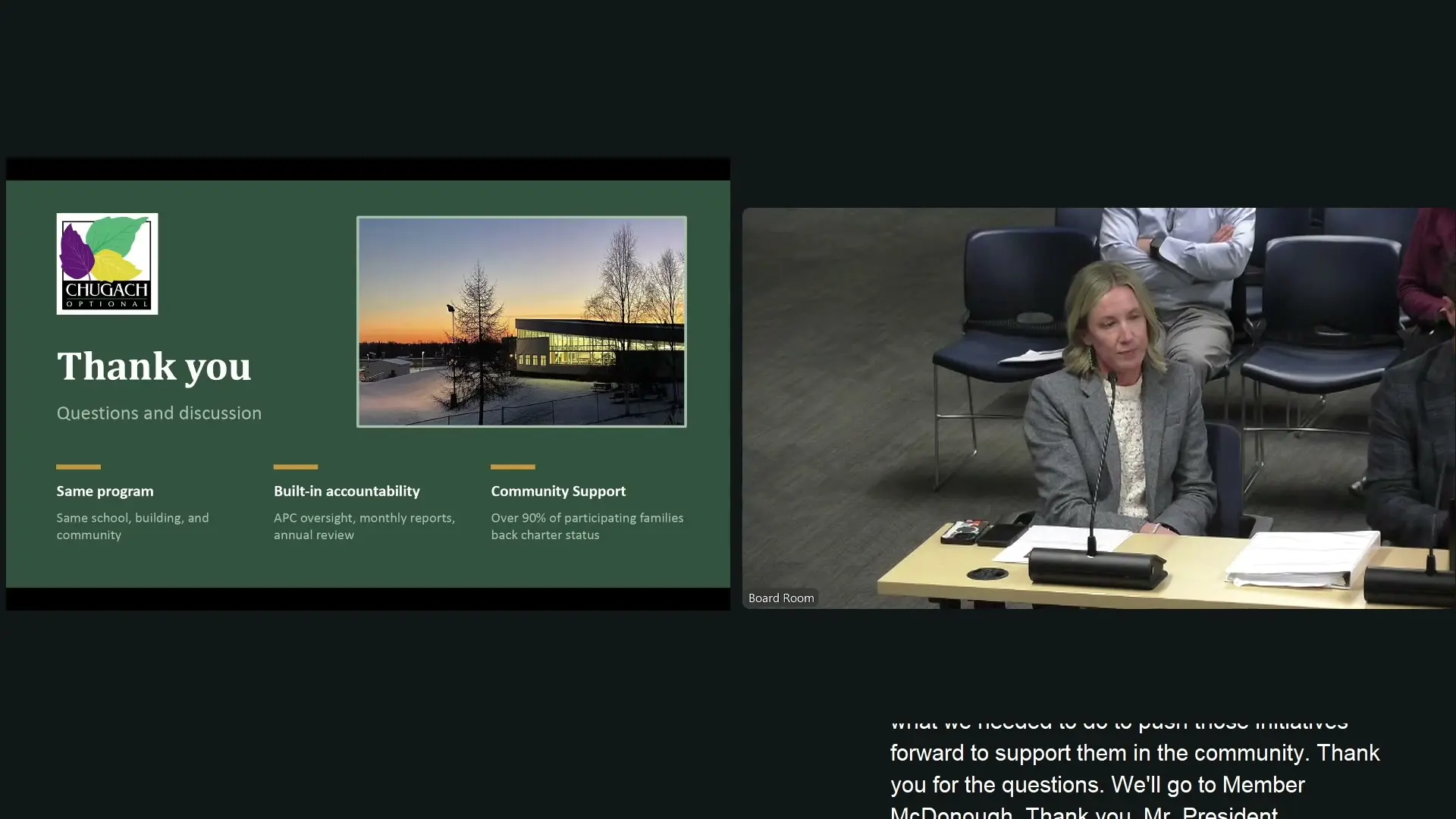
We want to thank you for your time. To reiterate, what we're proposing is a transition to charter school status with the same program the same building and community, with accountability built in through the APC monthly reports and annual review, and providing continuity for our students. We would love to answer any questions that you may have.
Thank you for the presentation, for being with us today. We'll start with questions. I'll go to my left with, uh, Member Blakeslee, then Member Bellamy. Hi, thank you all for being here. And those of you who are sitting behind those of you who presented in your beautiful presentation, I have a lot of questions, but I'll try to be as brief as I can since I have a lot of colleagues here.
Sorry, President Jacobs, we're ending at 4, is that right for this session? Oh, just kidding. I believe we're going till 5 o'clock. Oh, until 5. Oh, we have a lot more time.
Okay, great. Thank you for that clarification. Okay, yeah, I was a little worried. Okay, that makes me— that gives me I'll still be as fast as I can. Woo!
Okay, so I guess first high-level question that I have is I really appreciated your outline of the things that will be the same and the things that will be new. And sort of throughout all of this, I feel like so many of the core elements that you are trying to preserve will fall in that bucket of what will be the same, right? And I was taking notes, things related to, and even what you just said at the end, same program, building community. And so I guess my first question is, even with the new items, the, the new is, um, you know, specific school strategic plan, meeting publicly each month for public comment, but so much of the core of the identity of the school feels like it's preserving what exists. And so my question is really about, um, what— how would the— would a proposed transition to a charter school look, change what it looks like for the day-to-day lives of students?
What looks different for kids every day in that building with your transition to a proposed charter if so much of what you're trying to retain is intrinsic to your identity is the same?
Um, I'll, I'll start real quick and then ask, uh, my colleagues to chime in as well. Um, but I, I don't think there would be much change that they would see, um, because we're focusing on that continuity. Um, and it would be more having the ability to make those decisions behind the scenes, uh, locally based off of our program. And I'll see who else wants to chime in.
Um, past multiple years with different budget cuts, we've had a lot of our energy— just like all of you have a lot of our energy in February, January, February, March— be focused on if we don't have a teacher or two teachers, what is this going to look like? We're going to have to restructure. We're going to have to end the We have to figure out new curriculum because our curriculum is based on— not so— when we have a first and second grade, it's not one year's first grade curriculum and standards, this next year's second grade curriculum and standards. It's all interwoven. So if we have to restructure, we have to restructure our curriculum that we've created as well.
And a lot of our energy for our parents, for our staff, we've been focused on What's going to happen? What's next year going to look like? And we wouldn't have those concerns and that energy focus there. Our energy would then be directly for our students and our students' learning.
I would also add that when we go through a budget cycle as a charter school that, that budget is set ahead of ASD's budget. So come December, January, this board is going to need to look at the existing charter school budgets as they've been passed by their APCs. They'll come to you guys for approval as well. But one of the benefits to that is that it allows for predictive planning. I can say at the school that I work at, knowing what our FTE is, because that was set as a priority when we go through that budget cycle, is very helpful in making sure that we can get the qualified teachers to teach in that specialized program.
And if we can't get them, figure out and have enough time to get them to start the school year so it's successful for student learning. I would explain that a lot of alternative programs within ASD are not that much different from the immersion model. If we are to take a teacher who doesn't speak the, the target language or speaks it not fluently and they are placed into that setting, they are not able to deliver on the purpose and mission of that immersion program. Open optional learning is very similar to a language, and if somebody doesn't have that skill set, the training, the preparation, the ability to be teamed up and partnered with existing professionals who are experts in that space, they are going into a building or into a program where they don't speak that language. So being able to have that, that, that, that predictable planning to support learning into the, in like the next coming school year is a great benefit to that charter model.
And I will say for Chugach State Park, if the standard is continuity, and a large part of that continuity is the 11-teacher model, 2 in kindergarten, right? And then we have our 3 family groups in those other combined age group classrooms. That can be where that conversation starts. Yes, we need to fulfill special education standards within the program. We need to make sure teachers have their planning time.
How do they do that? They do that through specials. But if the standard to the program is that 11-teacher model which has been in place for 50-some years, making sure that that's in place to start allows for strong continuity for the students coming the following year.
I appreciate that. I wasn't sure someone else wanted to jump in, um, from your group. Uh, thank you for that. And, and I hear you. It sounds like a big, um, determining factor are budget cuts and the way it impacts your ability to provide continuity in the model that you have retained since 1973.
Um, so thank you for that additional, uh, context. I also, um, earlier in your presentation, um, you know, you talked about the survey that you sent out to individuals asking if they would be interested in exploring or becoming a charter school. And so while, uh, you know, those of you who are here obviously are representing, representing those respondents, I was wondering if you could give any additional insight about the data So I'm specifically wondering about, you know, 90% of respondents total, but I'm wondering how many responses you got out of your entire community that you surveyed. And I would also love to know who was surveyed, if it was just individuals in your school building, parents and staff, if it included members of the surrounding neighborhood, just who was involved in the survey. And how many of them, how many people actually participated out of the people you sent it to?
So the survey was sent to the Chugach State Park community. We have what we call the community assembly, which is our version of a PTA. The difference with the Chugach PTA or community assembly is that everybody's automatically a member. You don't have to join, you know, register, pay to become a member. So We sent that survey to every adult in our community as part of our community assembly.
That was about approximately 380. We had a 50% response rate. So that's actually— we felt pretty, pretty positive response rate for a survey of that nature. And just double clarification, so in— it's the Chugach State Park community, and that means those who are participating in the building itself as a parent or a staff member. Correct, right?
Okay. And so, uh, no one else— there are no other constituents or community members around? Okay, thank you. Um, I'm gonna pause my questions for now. I have more, but I'm going to give time to my colleagues.
Member Bellamy. Well, you did ask one that I was going to ask, so that's okay. So this is the first time that, um, we've had— that in my experience that we've had a neighborhood school transitioning to a charter school.
So, so I'm wondering, so help me understand, how does that impact kids who live in the neighborhood? They do. They have these 255 students that you have now. How many of them are from the hood, the neighborhood?
So Chugach, as it operates right now, is a full lottery program. It doesn't serve a neighborhood. Unless they get in the lottery, they can't go. No, no. So we— there are other open optional programs within ASD, and they are within a neighborhood program.
So Chugach operates as just Chugach, right? It's, it's a The full school is underneath that model, and while there are students that attend from closer by neighboring schools, there are also students that are coming from Eagle River, right, the south side of town, Midtown, and everywhere in between.
Okay, um, anyway, thank you guys for— I mean, your application I got through it pretty quickly. Your presentation today was great. My questions, you know, you know, equitable access. I know right now parents have to do 36 hours of whatever amount of hours of service, and that's going to continue, right? Um, there is no transportation, right?
Still not gonna— will you have a transportation plan as part of this? I don't remember seeing anything about that, and it's okay if you don't. I'm just asking. Um, yeah, so I'm trying to just remember what you're— I lost the, the first thought that you, uh, I had. Um, the volunteer hours.
Yeah, I wanted to clarify that. Um, that is a goal, but it's nothing we are tracking. There is parents that do hundreds and hundreds of hours over the school year and other parents that are not able to contribute very much. It's just a goal that we're— we shoot for, and, and we're— there is, there is really no judgment when parents cannot contribute. So I want to make that very clear that, and that would not be admissions requirement or any requirement moving forward.
Regarding transportation, yes, families provide all of their transportation currently. We, if the school district moved more towards a transportation plan for all choice schools, we would be on board for working with the school district. We talked about that a little bit and the complexities with something for us to solely take on. But with that, I do want to say that just with some kids of parents of some of my kids' friends, they— I know this year thought about not coming back to Chugach because of transportation, and our community stepped up, and there are other parents helping those kids come back to Chugach because that's where they wanted to be. So we have a very strong community that does help each other out when there are transportation challenges.
Okay, with transportation, I, I do just want to, I want to really stress what, what Bonnie shared. I know that's a conversation that's happening within ASD and charter schools and choice programs in general. Chugach State Park currently, as it stands, does not provide transportation for students under, underneath ASD. If it was a charter school, just as it is a choice school right now, if that option comes to the table, if that's at the best interest of supporting the families and the students within that community, then by all means, we are there to partner with ASD to make sure that this educational model is available to as many students as possible. Coming from the experience of working within a charter program, there's a, there's a few different areas where access can, can be a struggle, right?
And as Bonnie shared, being able for families to be able to work together and coordinate that travel has been a hurdle for transportation. It's not the same as busing, and I want to acknowledge that, right? The other piece is student nutrition. And within the building where Chugach State Park currently is, there is a kitchen. Student Nutrition is able to provide meals to students, breakfast and lunch.
And I know for us, even at Roka, we've been able to open our doors to students who would have not otherwise joined our program because we have Student Nutrition. So So barriers, I think, can slowly be broken down, but those barriers exist across choice and charter programs as they exist within the structure of how they, you know, how they exist.
I think that's it for me for right now. Good. Thank you. I'm going to jump in, then we'll go keep going down the line. A follow-up question on transportation to the team.
I appreciate the comments that, uh, Chugach State Park currently doesn't provide transportation, and the application doesn't propose to provide transportation either. It isn't lost on me that as an— as a non-charter program, participation in a district-sponsored transportation program would be made by district administration, the school board, versus an APC. And reviewing the application, the section on transportation, there are a few qualifiers as to whether or not the applicants are interested in participating in a district-led transportation initiative. Um, and the answer that was given, I— what I heard, I think, was in the best interest of students and will participate. Um, is any district-sponsored initiative to provide transportation and break down barriers of access, would it not be in the interest of students?
In other words, Is there a way to strengthen the language in the application to say we'll participate when the district provides a method for there to be a collaborative way to get kids on buses to charter and optional programs?
I believe so. I don't think there's any reason why we couldn't strengthen that language. Okay.
And then a question regarding the budget and maintenance.
What is the cost? I think I saw contracted services. My apologies, my laptop just restarted. I tried to pull up the budget. I believe it was $160,000 that you have for a list of items, including contracted services.
Is that the category that the APC will budget out to provide maintenance of the current facility? And do you know what the historical costs for maintenance of the facility are and whether that's sufficient? Um, I did not have access to the historical maintenance costs for the building. Um, the staffing for the maintenance is covered under the staffing budget, and then any of the other consumables that would be needed for maintenance are covered under that other bucket with contract services. Appreciate that answer.
Um, does that mean that, um, there will be— the school will be having paid staff for the purposes of maintaining the building? And if so, who would that be? But are you referring to our janitorial staff? Because that is what I was referring to. So I just want to understand.
I'm thinking if, um, say a pipe freezes, or if, uh, one of the— if there's an issue in the bathroom and maybe a sink handle busts I know our BPOs are largely amazing. I don't know that they typically engage in repair work, and so I was trying to navigate how the program will pay for those expenses. So I think there are some things like that that currently do happen that are— that people are aware of, and so that we would follow the same protocols we do now and just use those historical averages as a rough baseline to gauge for that type of activity. In the budget going forward. But our BPO is fantastic, and as mentioned in the application, we do have very strong support from our community for other maintenance-type activities, grounds maintenance.
The students actually participate in some of that— not fixes, but maintenance, keep up and stuff like that as well. So it's more of a community approach. Sure. Um, okay, just to track maybe just how things operate at Chugach State Park currently, um, what I believe to be the case, but stand to be corrected please, um, is that if there's an issue with the building, um, currently the school administration can contact ASD building facilities folks who will then come out like fix a broken sink handle. Um, whereas what I think I understand about the process is a charter school would be expected to contract services to provide those because that's part of a charter application, the responsibilities of a charter school.
Is that correct? Those two distinctions accurate? So for, for day-to-day maintenance of the building, that is working with ASD, right, and putting in through that work order process to get that work done through ASD's maintenance department. I wanted to delineate the difference between capital project improvement and day-to-day maintenance. Those are two very different discussions on how to support a building over time.
But that day-to-day maintenance, charter schools get billed for that work that's done. Oh, charter schools are then billed for— understood. I track that now. Thank you. I did— I was also tracking the difference between day-to-day and then capital planning.
I want to ask a question about that. I don't have recent CIPs up in front of me.
Are there— does the building have major needs that are imminent to be addressed within the first charter period? And I think typically we look at either a 5-year period for a charter approval initially, and then maybe a 10-year full. So within the next 5 years, does the facility need significant major maintenance, and is there a plan for how to address that? Uh, the building— the school is currently on, I believe, the list for the 2032 bond. For a roof replacement.
But that is all that we are aware of for major capital projects. Um, we would continue to work together with the school district, um, and our partners to ensure that we were doing what we needed to do to push those initiatives forward, to support them in the community.
Thank you for the, the questions. Um, we'll go to Member McDonough. Thank you, Mr. President. Um, sorry, catching my throat.
I'm gonna get put on the spot. So my, my first of all, huge appreciation for the— I think the way I would describe it is the pedagogical almost perfection of your school. Um, it to me is the best vision of learning that fits the values of exactly what the parents who joined your school are looking for. I really commend that.
Um, if the board will permit, permit me just a brief sort of like meandering. I'm a member of a cooperative preschool, and it reminds me a lot of just the way that your parents are connected to the school as like real ownership that is really hard for me to find in other schools. So I think you guys like really set yourself in the front of the pack as far as you're taking command of the space that your children are in. And that's something like I want to make sure we always govern in accordance with and promote and build towards. Um, I have some fiduciary type questions about obstacles, um, where the presentation was really helpful at understanding the virtues of the school getting moved to a charter, but they can, uh, basically like the, the legal condition has never happened where a neighborhood school is transitioning.
Um, instead every other charter that I know of in this city and in others is a brand new idea, where yours is like maturing an idea into something that's indefinite. Um, so there's just been this like weird sense of scrutiny that I want to know whether the conditions of the school that no other charter has ever had to stand and describe. And so just forgive me for that. But basically, I'd like to know what, what, if any, are the— so there's 6 of these, but I'll give them one at a time. What, if any, are the instructional obstacles of your current governance model that, that would specifically be lifted with charter status?
And it might be something for a future date, right? We're not making decisions tonight, so these could be things you guys like bring back to the incredibly involved parent governing group and, and help us present. I'm not sure I'm understanding exactly what your, um, question is aiming toward. I guess, um, if I can reframe it, uh, I, I generally like to approach governance, like the fiduciary responsibility of making decisions on behalf of tens of thousands of families. Of, um, my number one job is barrier lifting and removal of obstacles.
So I like to know what are the merits of a decision based on obstacles, and that really helps me navigate the logic. So on instructional obstacles, pre-post Chugach Charter, what are the current obstacles that we would lift by helping this, or by approving this charter here in the coming months? And, and if there's no answer now, it's not really a weakness because I'm like asking incredibly critical questions that you're probably going to need to go back to your instructional team to answer. We, we've actually had a lot of in-depth conversations about this, so I was actually wondering if one of our teachers wanted to discuss, um, what we were talking about with the art and music this year and how that has been an obstacle.
Um, sure. So we, we have been in discussion about this, so One of the challenges this year in particular has been the change to art and music. Currently we have art in the fall, we'll have music in the spring, but by design our program is intended to have art and music woven through our thematic, our themes throughout the year. We asked to have music in the spring because is one of the culminating projects for our upper groups, our 5th and 6th graders, is that they do musicals. Um, and so we've always had, um, just incredible support from our music teachers to make that happen.
No audio detected at 1:02:00
Um, and so they're, they're working with the classroom teachers, they're working with the kids, they're involved in the rehearsals. So we had asked for that to happen in the spring. However, we have all these other themes that are happening through the fall and early winter that do not have any music support because that music is only happening in the spring. So that's been a real adjustment for our curriculum on how to make those themes work absent that piece. And certainly classroom teachers can support that to a certain degree, but the experience for our students is different that year.
Similarly with art, our, our theme work in the spring is not going to have that same artistic support that they usually are able to get to support that theme work. So while there's lots of work that we can still do with those themes, the pieces that relied on that kind of artistic opportunity to apply skills and knowledge within that artistic realm is not going to be there this spring related to that. So one of our hopes is that through this charter process, we would be able to have some independence on having art and music throughout the year. Because that's really important to how we approach the kids' learning, is that we want those woven through. Does that answer your question?
Yeah, that, that was extremely, uh, like, I, I can see exactly how there's an instructional benefit. Um, a big part of your presentation too was on this system of parent-held accountability and transparency. Um, could you describe the The same sort of question about barrier lifting. Where are the current barriers to accountability and transparency at directing your instructional team and then receiving feedback on the results that would be improved pre-post-charter?
No audio detected at 1:04:00
Um, I, I guess maybe I'm misunderstanding your question. I don't feel like currently there are significant barriers as far as communicating instructional, um, like assessment pieces or anything. We're, I think, unusually in touch with our parents. Um, so most parents are coming in in the morning and picking up at the end of the day and coming into the school. And so there's, there's a pretty unusual, um, level of, of interaction that are those daily conversations, but certainly also by email and phone.
Um, I feel like communication on what's happening in the classroom, what needs work what are those instructional pieces that their child is struggling with, that, that communication is happening pretty comfortably. And I'm not sure the intent is that would stay the same as a charter. Okay, um, so my interpretation of the answer is like that, that's already something that's already ex— like excelling, and there's not a lot of friction. Yeah, I don't think that— that's not something—. But you're looking to gel that in place and make sure that it's a guarantee long term, where right now it's like something you've worked at.
And, and, you know, my, like, commendations to ASD's academic team that also helps give that space. Um, but it's like my understanding of that space is it's conditional on ASD's current academic team providing that space for you to have that instructional accountability at your own fingertips. So just commentary, but yeah, please. And part of our doors, we have like a main hallway. I'm not sure if you've been in our building or not, but we have that main hallway and our doors open up at 8:10 and we not just have students coming down, we have parents.
Our expectation, our hope is that our parents come in, especially with our kindy and our primary, our first and second. There's a morning board sign-in, there's a, you know, communication, a conversation, and a lot of those pieces that are on that morning board sign is, are connected with what they learned either yesterday or the day before and what they're going to be learning this coming day. And so the parents are understanding as well as supporting the, the students' learning with that piece as well. And we have, um, part of the opportunities and volunteers for our middle, our 3-4 and our 5-6, coming in for math time, coming in for those academic pieces, not just the thrills of making cardboard boats for the boat regatta for our uppers or bring them on a field trip, but like the day-to-day learning opportunities.
No audio detected at 1:06:30
Thank you. And then the final question is parallel, and I believe you answered a lot of this with Member Blakeslee's questions about resources. What are the current barriers to sustainability that this new model would enhance?
So one of the, the things that I have felt over the last, you know, since I've been teaching at Chugach State Park, and this is my 6th year, I think, is just partly just reflecting on how it's such a strong, consistently high-performing school and obviously has this very long legacy and such a strong community and committed teachers and kids who love to go to school. At the same time, it's very fragile, and so, and I think that fragility is because it relies on that 11-teacher model. It relies on families who can count on a stable educational experience for their child. They know that what they had this year is what they're going to get next next year. And there's so many pieces that go into creating that kid— a child's experience at Chugach State Park, and they all kind of have to be happening in order for it to work.
But the environment of the last, whatever, half dozen years has, has been challenging, and parents don't know from one year to the next, is my child going to be able to share in this experience again? So I think that's a stability piece we're hoping can be improved with the transition. I really appreciate that wording, especially the word fragile. Earlier I was asking about the case law about durability, and I think those words are kind of the opposites on purpose, where the goal is durability, the current conditional challenge is fragility.
That will give me kind of a lot to consider as we work together to see if this plan emerges successfully.
The, um, I think the piece here— I'll step into my box as a, like, an immersion parent. Um, I think the school here, Chugach State Park, is a sort of like spokesman and bellwether for conditions of existential crisis that is happening in all of our opt-in programs, lottery-in, school-within-a-school. And something that I didn't recognize, even though like I've got a long history in teaching, I didn't recognize until I was a parent the dread it feels at the end of a really difficult budget year to wonder is this cohort of entering students large enough to sustain the next— in immersion, it's a 12-year model. And if we don't get enough kindergartners at Chugiak State Park for Spanish, that could mean 9 years from now there just won't be high school immersion because there won't be enough students. And so I really approach, because of my experience as an immersion parent, I approach that fragility understanding that it's a— it's a continuum across years that currently betrays our governance model as a board.
Um, I'm elected to serve a 3-year term, but next year there will be at least 3 of us standing for election, and that could—. It's an entirely different board. And there, there's a lot of conditions in which we can't govern next year's board's decisions. And that goes completely at odds with our opt-in models, which are 12-year investments in Merson's case. In your school, I think it's 6 years.
And then they mostly enter into, like, uh, any myriad of middle school models. Like, there's— it's not a pipeline, right? After— okay, um, I don't know the solution. You know, I'm going to work with our administration to see, like, how this works, because I think that the, the solution for Chugach presents an opportunity for the solution across 50 or 15 or 20 other programs that are also experiencing that sort of existential dread, where what we want to know is that, am I entering a cohort with my kindergarten kid that's large enough so that I can keep this promise to them when they're, in my kid's case, 18, but in your kid's case, 12. Um, I don't know the answers to that.
It's something I want to just like tell the administration I'm thinking very closely about. And if you guys see legal solutions and school board activity that we can do that will help every future board navigate this crisis in good faith, you know, those are the— like, that's really, I think, an innovation that helps. And I'll end my comment by also commending Chugach State Park is like the innovation school. Um, your school predates Alaska's charter statutes, and Alaska's charter statutes were designed largely because Chugach was a really successful program where an ASD school board made an exception to tradition to let a parent-governed school exist downtown Anchorage. Um, I think we're experiencing the same sort of like stagnation of Alaska's new local control governance models, and Chugach has the opportunity to continue doing that sort of top-down innovation where we can look at what you're doing at the state level and at the local level and find solutions that will also work and open the door for thousands of other kids.
To me, that hasn't emerged yet, but we've got, we've got a lot of time to knock at all of these sort of loose bricks and see if there's something behind them. So that's kind of my commentary. If you guys have feedback, I, I now welcome that. Yeah, Member McDonough, I— so I'm a product of choice options within ASD. My mom taught within a choice option.
Actually, my parents sat at, uh, the, the park on Abbott 35 years ago and helped start Polaris. That was 1991 when that— when those meetings were occurring, and charter schools weren't an option then. That didn't happen until 1997. But the way in which Polaris operated in those beginning years— take away the governance structure, all the other components the community engagement, the unique model to instruction, the community input, all of that allowed that school to occur. And Chugach State Park had 20 years on that before Polaris was able to do what they did.
In fact, a lot of what Polaris did in the early '90s was based on the success of a program like Chugach State Park, and Stellar State Park as well.
There are difficult ways to look at an umbrella that's so large within a district that provides so many great opportunities for our students, especially in times of scarcity where, you know, our state is not funding education the way it should be funded. Um, but those models of choice options within our district are what helped solidify my wife Haley and I to decide to stay here. It's what drove me to be an educator in the first place, um, and then develop my skills as a school administrator working within the program that I'm working in. It it, it requires innovative thinking and new approaches to make sure that our students have wonderful opportunities. And I think at the, at the center of this, besides continuity for our students, these programs require innovative approaches for them to be successful and for them to continue to exist moving forward.
And really at the heart of what we're trying to do is provide an innovative way to support this program's continuity and future.
Thank you, Mr. Vincent Lang. Um, the, the final sort of, at the risk of belaboring oration, I would, um, I would just provide commentary on this topic where durability being the, the key challenge. It's a statewide conditional problem, existential. And at your school's level, it's does this pipeline break because we don't have enough kindergartners, or we won't get 11 teachers, and you just literally break— like, you just cut it in half like a saw. In rural Alaska, the question is more like migration.
And it's like, if, if they have 4 kids leave a building that could fundamentally just like completely— like that, the, the per-pupil funding could mean that school loses an entire teacher just because it swung by 4. So, um, the state did this year pass legislation. I think it was introduced by Maxine Dibert, but I would have to fact-check that, um, improving the durability of really the rural school models um, where they now have like a 3-year average instead of a 1-year student count.
I'm putting on my opportunity and exploration cap to see how can we innovate along those lines, and will we need state policy, or is there something the board has power to do? I'm not quite sure yet, but I'm going to keep digging at those sort of policy surfaces to see what the state has now done to stabilize the rural student migration flow. I think we have a duty to find that here so that Chugach will always have 11 teachers, no matter— I mean, not maybe not no matter, but like, we need to improve the ability for you to keep your 11 teachers, bottom line. But thank you. That's the end of my comments, Mr. President.
We'll go to member lessons. Um, thank you to everyone for thoughtful questions and robust answers and, and really a thoughtful presentation for a super strong school. It's one of the gems, I think, in ASD. Um, I think one of the questions that I have is really sort of focused on sort of the fiscal note, and I— could you clarify or confirm the $3.275 million figure? That's what you would have as a working fund for your school after the 4%?
I'm not sure who to ask. Thank you. Yes, that is— that includes the 4% reduction back to ASD. So I— thank you. So I looked at your budget for this year, at least as of February, and I recognize that it may have adjusted.
It's about a— that's about a million dollars more than this year's budget for Chugach.
So how do I move forward from this question? Would you be able to propose— I guess would this APC be interested in pivoting to charter status if the statute changed?
And this is going to be a random question or a hard question to answer, and you couldn't retain more than 80%, right? If it moved from 4% to 20%, I mean, is there like a break-even? If you only— it looks like your budget, it cut like 2.6 classroom teachers from last year to this year in the budget. And if we look forward, you'd be gaining $1 million in your working budget, which is more than a couple of teachers.
I guess I'm wondering, where's the rest of the money going to go? And, um, um, what am I wondering? Um, I'm wondering how we would rationalize— what are the ethics when we have a $9 million deficit already for next year, knowing that we won't be— that we're leaning on savings and we won't be applying this year's one-time funding for about 100 FTE that we band-aided over at the end of— at the start of the school year. Um, what are the ethics from your perspective of supporting a wonderful school and deepening the district's deficit district-wide? Um, so there's—.
I kind of threw a lot at you, and I don't know how you want to prioritize. Yeah, no. Um, so what's What's tough about looking at the current year's budget as, as it stands in the ASD budget book is it's not reflecting the full staff that's at Chugach State Park. And so the, the SPED staff, I think the other 0.5 BPO, like the evening BPO, is not reflected in that staff headcount. And so once you start pulling all of those out of like the district-wide allocation pool for staffing.
That's what's building up the remaining part of that budget. That might be something I follow up then with the administration, but that's a really helpful nudge. Yeah, so member lessons, just as you know, supporting the work of building the budget for, for the school that I work at, um, we have to budget for our special education staff, not just the teacher but the paraprofessionals that also make sure that the minutes for special education are being met for our students. Currently, within the model of how Chugach State Park operates, like, the special education staff— and correct me if I am wrong on this, but that funding, I believe, comes out of the general fund, not the money that directly goes towards Chugach State Park. The other piece at cost that comes to charter programs is curriculum.
Now, parts of what Chugach does is created curriculum that is standards-aligned. That's in the model of what Chugach does. But if there are subscriptions to curriculum that need, need to be made for math or for English language arts, those come at the cost to the charter program, and those aren't cheap, right? I mean, you guys know that supporting ASD as a whole, um, and then it's important to make sure that as stewards of a program and of a building, that as emergency costs do arise, anything from building needs to making sure that the retention of that 11-teacher model is in place that the funds are there to meet the needs of that charter. We're also aware that within a charter model, you know, even within an ASD building, not everything is given in there.
So being able to make sure that classrooms are set up appropriately with the technology needs that they have, all of those costs do come back to charter schools in the end. And, you know, like, being able to operate within an ASD building allows for a little bit larger of a cushion to really meet the needs of students. I'll say, for several years, building a budget that was 80% staff, 19% building, 1% everything else— I mean, that was hard to spread that 1%.
But really it comes back to making sure that the needs of the charter, the model that's being presented, are being met through the, the ADM allocated money. And I just wanted to add, you had asked about if that percentage of 4% changed, and we've had those discussions as well, and we wanted to continue to move forward with this process, um, because we really are wanting to bring that local governance that we've talked about so that when there are cuts— because there probably will continue to be cuts— that we can control where those are. So that if it's art and music, how can we navigate that a little bit differently, and how can we try to work on that more than 2 weeks before school starts? So that is less impactful on our students and our, our teachers and, and our community.
No audio detected at 1:24:00
I'll just add too that I think what I budgeted for expected maintenance to build out that 4% was about $150,000, which is pretty significant. And so if that helps give you any sort of comfort, is in terms of like that we've budgeted enough back to the district to support what we do need and still be able to provide the existing staffing model that the school has to be successful.
I guess I would be interested in, in whatever follow-up conversation or conversations may have. I don't know if this is our only opportunity to speak, probably not. Um, you know, is there a break-even point? Like, if statute changed, like, does this not work at 15%, 10%, 18%? I don't know, like How do the numbers— how does the math math?
I think that's a fair question. I mean, even if you look at the fact that salaries shouldn't be expected to remain static, we should expect staff salaries to increase over time. So costs will increase over time. But that's where, as an APC, that's where that budget is built to decide here's where things are changing, where are our priorities to preserve the program, and where do we need to make changes? So that we're financially sound.
Okay, we'll go to Member Higgins. Thank you. Do you have a waiting list of people trying to get in that you're doing it, and how big is it?
I don't know, I'm not sure I remember the exact number, but it was 140— 46, yeah, 146 people on the waitlist for the 2025-2026 next school year, I believe. Is there an option here of expanding the number of kids coming to your school with using that thing within the existing school? Uh, I think our challenge would be the building space at this point, right? I realize that. That's what I was asking.
Given the circumstances, you're not interested in adding portables to do it? You really want to maintain it within the school, right? We have not entertained that that idea. Our focus has just been providing, as we've talked about, the continuity of our current program and staying with where we're at right now. But, but we have had dreams, like truly, like we're like, oh wow, like is there a way of getting Stellar closer?
Because Stellar was created the year after, in 1974, because they had a need of like, oh, Oh, where are Chugach kids going? Oh yeah, we're going to open up Cellar. We're like, oh, can we have a block? That'd be awesome to have open up this optional block. And then, so we've had dreams.
I, I, I speak for myself probably, but I'd love to work with people on trying to expand. We, we had a review on closing the schools and realized that expansion of charter schools results in a financial loss in the operations otherwise within the district. That's why I asked, because within that. I guess, tough question, but an interesting one. How much was the— it's— I've seen the schools and parent groups taking on a charter school requires a lot of investment of time with parents and staff admit that, and they just didn't want to do it because of how much is committed there.
No audio detected at 1:27:30
Then we get to the point where either the involvement with the district in the process, or if you're concerned that the board may decide they want to close another cluster of schools. The last 3 schools we closed included Chugach State Park—. I mean, included Campbell Lake STEM, the only STEM program—. And closed the Montessori program at Tudor, which was one of the few places where you got all around there surrounded with Title I schools. So you had the low income, which was one of our is to expand access to charter schools with that.
Is—. Was that a consideration and factor? Because I have discussed it with—. I've been very upfront about it, that I was disappointed with closing Campbell and, you know, a program that's highly successful based on saving a few bucks, and we lost more than that. But is— was that a concern that yours— you know, was that a motivation for your parents and staff to say, I don't really want to do this, but, uh, and go from there.
In my conversations with staff and with families, um, there was not a concern of they're shutting us down, so we have to go into this piece. It was looking at the preservation of the cuts, not that cuts of the number of staff, of our 11. That was— but then there were other pieces too of like, well, you know, at one point in time we're going to split librarians. And so we have like an open library. We have kids coming in constantly throughout, not just during our class times, but that's where they're able to go and practice being an in-charge learner.
That's where they're able to go. They can check out whenever they want. They can work in groups, work individually. If they need a quiet time, they can be in charge and go and find that spot. And if you cut that librarian in half, that strong piece of our philosophy, of our programs gone.
If we say we can only have 9 family group teachers, that changes our whole program, our philosophy. That's really where our drive was coming from. And we had been talking about this for even pre-COVID. We had conversations about charter. Hmm, are we wanting to go there?
Well, we're not really sure. And then because of the state budget cuts and because of the decisions that the district had to make because of what was happening and the lack of funding, we became more solidified this year because of that too. And we were making plans. Okay, how are we running this with two? How do we have two middle 3/4s and two 5/6s uppers?
We're going to have 34, 36 kids. In a purposely multi-age. So those teachers are going to have to be able to differentiate from maybe in 3rd grade, really a 2nd grade reading, possibly up to like a 6th or 7th grade reading level, all within with 35-36. So that's really was our drive, not our concern that— and maybe we were foolish not to think that, but not our concern of that you were going to shut down our school. It was more of that how we would lose that fragile piece.
While we are strong, it is very fragile if we lose any of our family group teachers. Yeah, I appreciate the differentiated instruction issue of making sure all kids are academically growing a full year, and, and I can tell you that I've saw data that showed charter schools are leading the place with the academic growth at 3rd grade compared to other schools. So that's a pretty positive type impact, and I appreciate that. I just, I just see it as one of— it's, it's more work for y'all, I know it. It's more work for the parents, but I think it's very rewarding.
I think it's more engaging, and I think you're gonna, gonna benefit from it. So I appreciate that. Thank you. Member Higgins, just to talk about expansion, that's something we did discuss initially in, in the process of going through the charter application, writing the charter application. What is stated in the charter application is it has our student cap at 255, 260 students.
That's the model that exists right now for that 11-teacher model. You know, Chugach has had a, has had a rich 50-plus year history. Who knows what goes on in the next 50 years for that program? But what we are proposing is for the, the population of our, of our students to not, to not grow, right? We're not looking at growing, in part because of the, the facility piece, but even more than the facility, it's the structure of that 11-teacher model— 2 at kindergarten and then 3, 3 teachers at each one of those combined grade levels moving forward.
That is the solid rock of what makes Chugach Chugach State Park. And when we start talking about expanding the program, it rocks that model. Well, my focus on what, what we do is not based on the dollar issue. It's based upon what's best for the kids. And I think that your academic scores are commendable.
I recognize that and I appreciate that. And some of the other outcomes I've seen are very positive. So this gives you greater security in a lot of ways, gives you more flexibility, and if it ties with the parents and the staff. I appreciate the effort you're going through. Thank you.
Thank you, Member Higgins. Um, board members, we have just, uh, over 10 minutes left in our work session today, and there's not possible to cover everyone again who's in the queue. Um, so a question to the applicant team: if I asked the board to consolidate their questions with our executive assistant and ask them to send those and distribute those to you. Would that be appropriate to get another second set of questions that we could potentially release in our weekly board communication from administration? Would that be helpful?
And that's something you're willing to facilitate, written answers to additional questions? Yes. Okay, so I'm going to propose that we do that to ensure that All board members have equal access to providing questions. And for the board, um, the intent is for, um, another work session on this topic with administration providing their presentation at our— during the date of our next regular meeting. And then we'll have, I think, a third work session prior to a potential vote on the application.
So this topic will come up at future meetings. Um, with that said, I'm going to propose that we allow ourselves plenty of time to get into executive session and would ask for a— well, first I'll ask if there's any closing comments from the team, then I'll ask for a motion from the board.
I just want to thank you again for listening and all your great questions today. Great, thank you, and thank you for being here. And I will second, third, fourth, fifth the comments from the board regarding appreciation for the work that's going on every day at your program currently. With that said, to.