Anchorage School Board: 11/17/26 ASD School Board Meeting
Alaska News • • 188 min
Articles from this transcript
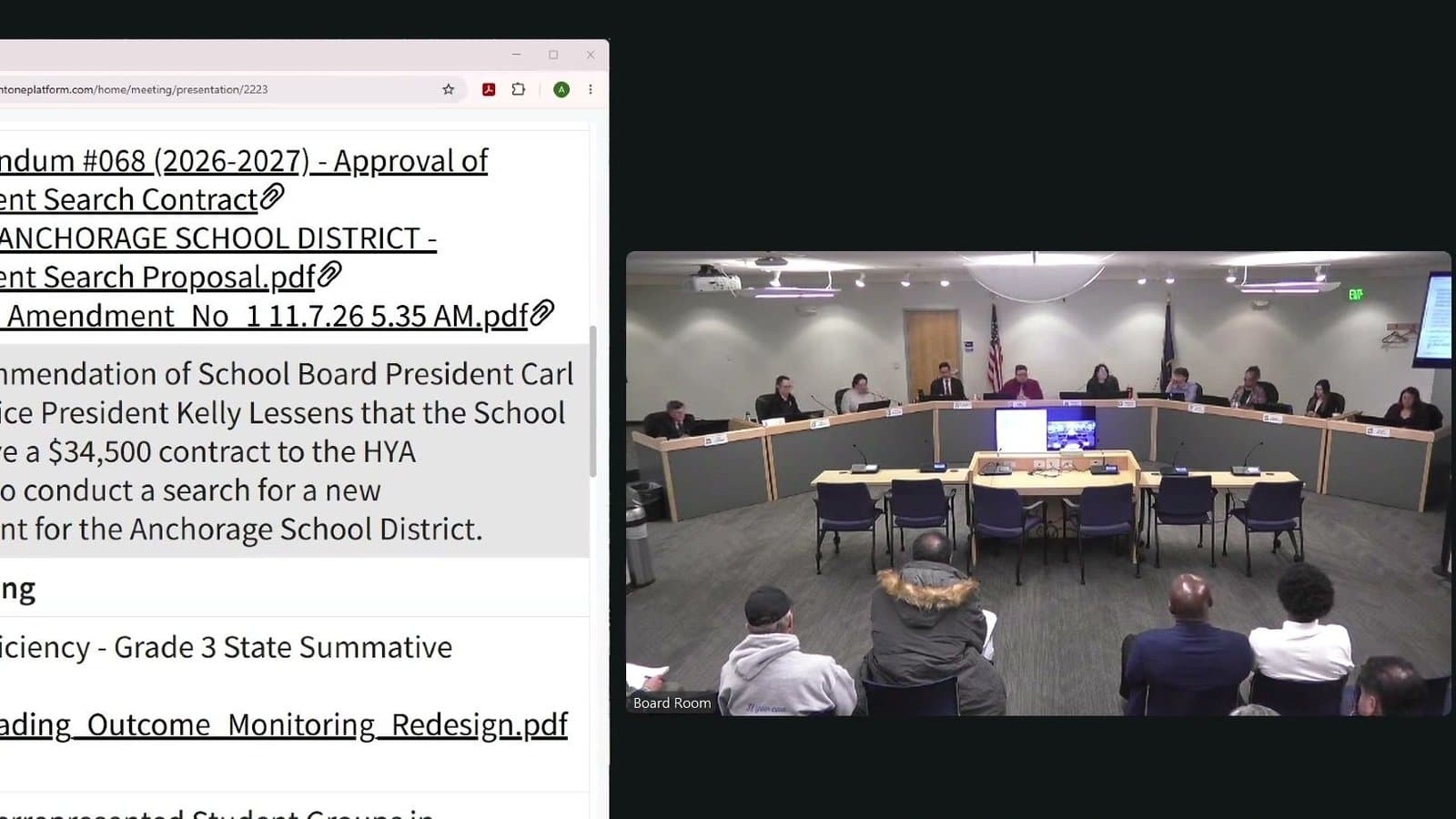
Anchorage School Board approves $34,500 contract with HYA to find next superintendent
Anchorage School Board hired search firm HYA for $34,500 to find its next superintendent, due by fall 2027. • Board also named Clare Fulp interim superintendent effective Dec. 1, replacing Jharrett Bryantt, who leaves for Virginia.

Is there a motion to approve the agendas drafted?
I move to approve the agenda as drafted. Is there a second? Second. Motion made by Member Lessens, seconded by Member Wilson. Is there any discussion or additional motions?
I just have a question. I think it's more about process than the agenda, where public comment is on line F, special action items are above it. Um, can the president clarify if there's an opportunity for the public to comment on these special action items? Absolutely. Uh, the— any testifier who signed up will speak prior to the board deliberation on an action item.
Okay, thank you. Uh, Member Blakeslee, I would like to move to postpone Memorandum 017, adoption of the superintendent contract.
I'll second for discussion. Okay, motion made by Blixley, seconded by Lessens. Uh, Member Blixley, would you like to speak to your motion?
Yeah, um, I know this is a sensitive issue, and I want to first preface that my desire to postpone this amendment is not rooted in, um, a desire to disparage any candidate. Or applicant for our interim superintendent role. Um, I also believe that it is incumbent upon us as a board to ensure that the processes that we're taking are done with due diligence. And I talk a lot about transparency, um, and my desire to listen to the community. And it's not just about listening to testimony.
Um, or feelings. It is my desire to listen to the community's, um, sort of frustration, I think, over a long period of time about ASD's processes. And I see in this moment, um, an opportunity to admit that we have not, I, in my opinion, uh, fully, uh, completed the process of this interim superintendent search. And I, I am not interested in, um, the feelings of animosity or the feelings of, um, just the feelings in general about any particular candidate. No matter who is in a position of leadership will always have a lot of scrutiny around that person, and there will always be people who are joyful and people who are less than joyful, and those are rooted in our own opinions.
I am interested in making sure that we are doing our due diligence as far as, as the processes themselves, and, um, and I do not think that we have fully considered all of the information that is— we should be considering for, um, for this position and believe that warrants more time. And so that is the purpose of my motion. It is not to state an opinion on any individual. It is simply to ensure that we are conducting a thorough process and, um, and accounting for, for all information at our disposal. And I don't believe that we have done that thus far.
Member McDonough. This is, um, well, first I actually do have more of a question to the president about process of, uh, just the way our agenda would then work where, um, I clarified, or the president clarified, that, uh, public comment would be invited on the action item if postponed. How would that relate to the public comment Excellent question, Member McDonough. Any testimony on an item that's no longer an action item would still be covered under the public, public comment section of our agenda, so everyone will still have a chance to testify tonight. Um, also, process question: let's say hypothetically the board doesn't grant this motion at this time, does that eliminate the ability for there to be a motion to postpone after we've actually heard from the public and given them a chance to present themselves.
Um, if this motion is, uh, dispatched of either way, then yes, the motion wouldn't be in order if it was made again.
No further questions then.
Um, I'll join the queue and speak to the underlying motion. Um, I want to clarify, Member Blakeslee, um, should have caught this when the motion was made. The motion to table can be done with no time certain. Um, a motion to postpone, typically there's a date associated with it.
By default, that can sometimes be the next meeting. It could be a specific date if you want to attempt to schedule a special meeting. Do you have a particular date in mind? I did not have a particular date in mind. If I were to motion to table, can you explain to me the difference between— is it just I would— we would not have to have a specific date?
It wouldn't require a specific date. It could in theory be brought up later in this meeting. Typically, if based on your comments, a motion to postpone to a time certain typically would be more appropriate. My recommendation would be to postpone to our very next meeting where we could then take up the issue. If there needs to be more time, there could be another motion to postpone.
A motion to table can be done indefinitely. It can be done, um, and then later an item can be pulled from the table. I would like to move to postpone to the next school board meeting.
Um, Member Lessens as a second, would you agree to that? Amendment? Uh, yes. Okay, thank you for the clarity on the motion. So I'll speak to the, the motion itself.
Um, I think it, uh, I think if there are board members who have questions and need additional information and want to make sure that a process is thorough and incorporates community feedback and engagement, um, that transparency and accountability from our board is appropriate, fair, and what we owe the folks who chose to allow us to be sitting on this dais. Um, I'll say that the, the process the board chose to engage in to, to allow us to choose an interim superintendent was fairly unique and mimicked in many ways the process that we are contracting, or we may be contracting with a vendor on depending upon the outcome of the other special action item, uh, to identify and select the next superintendent. There was application solicitation, um, interviews, and, um, deliberation debates. Um, however, the, uh, the board, uh, well, it had a well-intended process. It very fairly could be argued, may not have incorporated the full depth of information and research that it had available at its disposal for review.
And I think that's an attempt to complete a full-throated process of vetting will ensure that the selected candidate avoids additional scrutiny and there are answers to questions that have been asked shying away from that, in my opinion, is not necessary and not necessarily in the best interest of the district and the students we serve. So I think that I am in favor, and we'll go through additional testimony and board comment as we deliberate. I see Member Bellamy up next. So it's really unusual that we would deliberate publicly on a personnel matter. I do not support, um, delaying tonight's vote, whether it goes yay or nay.
I don't think it's fair to the process. I think our process was just fine, and I'm an HR person.
It's not like we were hiring somebody off the street. So while I can appreciate all of the sentiments before, I think we were transparent. We explained exactly what that process was going to look like, and we followed that process. So I don't— so I, so I don't— I'm not for delaying tonight's vote. Thank you.
Thank you. We'll go to Member McDonough. Thank you, Mr. President.
Um, so I, I appreciate the presence of caution always, um, especially as public figures representing public dollars, and most importantly serving children with thousands of employees who rely on us to make sound decisions.
Two aspects of the motion to table give me great pause. Uh, the first aspect is more process, but it, it is kind of grave within the ideas of Robert's Rules. Um, I didn't know until just earlier, but if we dispatch this now we basically bind our hands to make a decision after the public has spoken. And that is a, a concern of mine where we're, we're acting in haste, but in the wrong kind of haste.
The second issue I have with the motion to table is the processes we decided on were internal for many, many, many reasons, especially because the employees within ASD stand the scrutiny of our systems already. So anyone working within ASD, unless otherwise noted, is in— like, their performance is in good conduct. And while that is not necessarily the same thing as they only ever treat people amazingly. I think an impeachment of the way that the Anchorage School District oversees its employees is in extreme contradiction to our commitment to supporting our employees. And this was an internal search for many reasons, but especially because it helps us take shortcuts that don't incur more risk and don't— we've got a lot of business to do as a board, and we've got a lot of support and transition to do as Dr. Bryant takes his leave from Alaska.
And, um, we needed swiftness, which is an uncommon trait for government bodies, and this was the swift way and the safe way and the sound way. And, and ASD systems that support its employees are good and they're strong. And, and so I don't support the motion to table, but I do support letting the public speak before I make a decision. Like, there's a yes and a no vote later on anyway, and that, that's the way it is. And if it fails a vote, if it passed— like, it's not like we are— we, we still then supervise employees.
I mean, it A motion to table feels like really out of order in the way that we conduct management of thousands of people in this district. So that, that's all. Thank you.
I remember Pat Higgins.
Um, thank you. Um, the concern here, you know, you're projecting for us that we're going to wait until December before we go back to it. Uh, if there are issues or concerns that can be addressed with in a, in an expedited process, I think we need to do that. But I also think that we need to define the void. If the issues are there, what to do.
We've gotten a lot of public feedback, and I appreciate that, both positive and negative. I like it when the voice of the public is, is, is out there. That's important. We sometimes— this board doesn't have the reputation of listening to the public, and I like the fact that the public is speaking out. There are a lot of issues here that look like opinions.
Is this— whatever's going on, that's a public display. Everybody can see that in a variety of different sources. I just don't think that a delay of this duration of what's being proposed is a fair process to reverse a decision. It's not really just, just delay is reversing a decision in this process should be expedited and should be focused, and we need to do that quickly. And I just don't see this, this proposal as being equitable to all parties, and for that reason I will not support it.
Member Lessens, this is perhaps a bit of an out-of-order question or request, but is it possible to have legal input on the matter in this public forum at this point in time, much as the way the Assembly has legal analysis? Uh, I, I think we could ask legal whether or not it's appropriate to have legal weigh-in on the board's deliberation. I think that that's fair. I think I would appreciate their analysis on whether it's, um, it's certainly not our usual process, but I want to recognize that other local governing bodies, including the Assembly, do. So I can we can take a 2-minute at ease and I can reach out to legal and confirm, and then we can come back and if they deem it's appropriate to contribute to the discussion, we'll do that.
No audio detected at 14:45
Yep. So I'm going to— we'll call it a 2-minute recess and we'll be right back.
Okay. So we'll be back in 2 minutes. Thank you.
No audio detected at 17:15
No audio detected at 19:15
No audio detected at 19:45
So we'll call ourselves back to order at 6:43 PM. To answer your question, after a brief conversation with legal counsel Member Lessens, the board can choose to waive attorney-client privilege regarding guidance it has received, but that would take a vote of the full board.
If you wish to make additional comments, ask additional questions, or anything else at this time, it would be appropriate. I think I do not wish to waive attorney-client privilege at this time.
Uh, Member Blakeslee, just in the sake of continuing the deliberation we're already having, I just want to, um, respond to some of Member Higgins' comments and some of the other concerns of my colleagues that I don't view that the, the postponement of a vote on this decision as a reversal. I view it as a completion of a process that we haven't completed and I take it seriously to be able to vote on something with all of the information at hand, and right now I don't feel fully informed to be able to make a vote. And so my, my motion to, um, postpone a decision is really out of an interest to ensure that our votes can be fully informed and not one in which I am trying to disparage any credibility of any, um, candidate and of our current candidate. Um, I, I take that very seriously, and it's really about the process that I just do not believe we have completed, um, in full.
Uh, Member Wilson, I absolutely hear what Member Blakeslee said, and I, I validate that that's, that's how you feel. Um, I feel like there have been— there has been a lot of information that was received by the board. I also feel like In any industry, in any interview, in any hiring, there's still going to be possible questions unanswered. I don't think that's unusual in any job application for myself, for an interview that I have for someone else in my industry. I think we could ask and ask and ask and continue to have questions that come from those questions that have been answered.
No audio detected at 24:15
And at some point, we have to move forward with the decision based on the information that we have at hand. There's, there's always going to be more questions regardless of who we select for what position we're, we're choosing. So I personally am comfortable with the amount of information that was received and the decision made by the entire body in the selection process. So I, I think we should move, move ahead to vote tonight.
Our student representative, Mr. Gibson, go ahead. Um, I just want to say that, you know, this might be a big thing, but we're already putting so much energy and resources into it. Um, and seeing that how much of the public came here, especially today, Um, and that it's already scheduled to be on the agenda. Um, I think we should move forward with the votes on this. Um, and I also just kind of had to question what goes into the, um, the process of selecting a superintendent, because, uh, the way it was phrased to me, and especially the, I guess, the public, was that we already kind of reached a consensus on who our main candidate was.
No audio detected at 25:45
For the school board. Um, so I just kind of want to kind of direct my question to the presidents.
Yeah, Mr. Gibson, so, um, the, the board communicated with the community regarding its intended process to have an open application window, uh, followed by some initial screening of applicants through the Anchorage School District human resource team, followed by a board process of interviews and deliberations. Um, that essentially has been the process that was utilized, which is, um, kind of a miniature version of, of the process that's outlined in the second special action item and the memorandum and contract that are attached to that item that the board intends to, or at least has proposed to use, uh, for the permanent superintendent search process. And maybe be a good resource for you for additional information. Does that help?
No audio detected at 26:45
Yes, thank you. Certainly. Okay.
Also, just a few more comments on that since I don't see anyone else in the queue.
I appreciate the comments by Member Wilson indicating she feels she has enough information and that at some point you have to— you receive enough information, there may always still be questions. And I agree with that. I think that— I think we're probably pretty far from that point. I think there's some basic due diligence that can still be done to both continue to justify the board selection as well as to answer legitimate questions that have come from the community.
And I worry a bit from a governance perspective. I haven't been on this board when I've heard one of the duly elected members indicate that they don't have enough information to make a decision that the board— or at least a decision of this magnitude. I can't recall one where the board chose to not seriously consider honoring that request. Um, I worry about the precedent that sets. And so I think there's, there's good cause for taking a pause of a short duration to answer some, um, and check some basic due diligence boxes, um, and completing a thorough and fair process, um, recognizing that we owe that to our candidate, our community, the students we serve, and the families we serve.
So I still am generally in favor of supporting the motion. Uh, Mr. McDonough. Um, yeah, Mr. President, I just— I would like to express through you to the public, caution is always a factor. The district is built with due process and due diligence and due discipline throughout its whole thing.
I think that there are members of the board participating in some theatrics that don't agree with past action. Member McDonough, that characterization is out of order. It speaks to intent. Please. So I will then rather look at the, the impeachment of the process that is attempted through this motion that the president says he ex— he He doesn't feel that the board was presented with enough information, and yet he worked with us, queried with the decision, and issued the announcement to the public that the board has reached a decision.
I would ask people to consider how those two things layer on top of each other with truth.
Um, there are many ways to reverse a decision one doesn't like or to reconsider the manner in which, especially on a government body, man, like, it's very hard for us to complete business. And when we do complete business, we need to be able to own it. And my characterization of the way I participated in a process throughout the last 3 weeks is that it was sufficient by the standards of the president to ask me who I supported, and I gave him an answer. And now the president is telling me he doesn't think he had enough information to ask me that, and I just don't think that there's genuineness between those two things. That's just all I need to say.
This motion, I really honor that Member Blakeslee wants Caution inside of ASD, I really invite her to spend some time that a lot of those of us that have been former hiring managers do some tours through the Talent Management Department and the EEO processes that we have and become familiar with them. Caution is built into the system. That doesn't mean we should never scrutinize caution. It means we need to give it the tools to run. And finally, we've already spent I don't know how long not talking about students, not talking about the resources that we are going to direct our interim superintendent to give to our students.
I really want us to get out of this world where we only— like, adults talking about adults means we are ignoring what our job is.
If we come to consensus, then the next question is how do we help kids? And that's the question I want this board to arrive at by the end of tonight. Thank you.
Yep. So I don't see anyone else in the queue. I'll just briefly respond. Um, member McDonough, as you know, the process that was designed to identify the interim superintendent was a process that we all had equal partnership in. Um, as board president, I facilitated the will of the majority, um, but this was not my process.
This was yours. And mine and 5 other individuals. Um, when new information about gaps in our process comes to light, we owe it to our community to be responsive and genuinely admit if we've missed a step or we think we could do something a bit better. Um, and that is serving students, and that is important. Um, and I, I'm happy to, to be on that hill in support of that basic concept.
So Thank you. We'll have a voice vote on the motion to postpone this item to our next board meeting. Point of order. I believe the motion was changed. Could we call the motion as the maker raised it?
I asked the question about the difference between tabling and postponing, and then I asked to— I moved to postpone to the next board meeting. Thank you for the clarification.
Can we have a voice vote, please, on the motion to postpone?
Student Representative Gibson? No.
Member Bellamy? No. Member Lessens?
Yes. Member Higgins?
No. Member Blakeslee? Yes. Member McDonough? No.
Member Wilson? No. President Jacobs? Yes. The motion to postpone fails by a vote of 3 to 4.
We have our agenda in front of us. Is there any other discussion or proposed amendments? Seeing none, is there any opposition to approving the agenda? We have an agenda. Thank you.
Okay, our first special action item is ASD Memorandum Number 071-2026.
Oh, apologies, we missed a couple items. Thank you. I'm going to scroll back up. Uh, we will continue with reports. We'll start with our Student Advisory Report, then move to board conference and committee reports.
Mr. Gibson, the floor is yours. Uh, hello everybody. Um, my job is to give a report on this thing called Student Advisory Board, which is basically a collection of student governments in Anchorage that meet monthly. So I'll just share a couple of things that happened on November 10th. We had a, a meeting.
It was on Zoom because of the midterms. It went pretty successful, actually. And at the meeting, what we primarily discussed was we had questions about how does your school, like, give back and provide back to the community? My school, Blair's, for example, gives back with the food drive. There's many other schools.
I'm sure you can piece it together there. And then I also wanted to kind of share, there's this thing called an AASB conference this past weekend. There was a couple school board members there who I was fortunate to meet and be with as I was there. We talked through a couple of things there, and that was just meeting with other school boards and seeing how they connect and see how they operate. It was very inspiring and awesome to see some great innovative ideas and see some other student representatives there.
It felt very inspiring. And then on top of that, we just got— I just got to connect and represent Anchorage, which is an honor, to say the least. So yeah, that's the end of my report.
Thank you for your report, Mr. Gibson. Member McDonough, you have a question for a student representative? Yeah, I do. Um, one of the— so I— Mr. Gibson joined me at the conference along with Member Bellamy and Member Blakeslee, or briefly Member Blakeslee and, uh, Member Lessens. I understand you guys got a conference with the Senator, uh, Murkowski, and I was hoping you could explain the way that went and, and the, you know, like, we have a new Congress coming up, and, uh, how did that go for you and for the advocacy that the students are looking for?
Yeah, so, um, uh, Senator Lisa Murkowski, uh, got to be there, and we— she basically had an open mic, um, at its luncheon. It was very cool to see her and see how, you know, senators want to come and represent. Um, there's a couple of concerning questions on AI, um, Most particularly, my question was, how are we going to deal with AI bubble? And that we're putting funding into it. And then just seeing what her reaction was.
There's a couple other concerns, particularly with like de-skilling, particularly with just everything regarding AI in classrooms. And I got to talk with her one-on-one about how we were going to deal with the data centers and just AI regulation in classrooms in general. Um, so yeah, that's kind of all there was to it, but it was awesome to see.
Okay, thank you, sir. We'll move to board conference and committee reports. Is there a board committee chair who wishes to make a report at this time? We'll go to Member Bellamy, then Member Lessens. Uh, thank you.
So in terms of the Communications Committee, we will meet, uh, on the 19th at 1:30. Um, going back to what Mr. Gibson just talked about, the AASB, the Association of Alaska School Boards conference that was held, um, he was at the Youth Leadership Institute, and myself, several other board members, Dr. Aguilar, Member Blakeslee presented, so did Member Lessens and I with Dr. Aguilar. So I thank you guys for that.
The conference theme was coming together for our students, and so these were approximately 350 school board members from throughout the state coming together in Anchorage for a 3-day conference. Following that, following the conference, we also had the board of directors meeting, of which member McDonough and I participated in. So that's pretty much it on the conference. And similarly to what the kids were talking about, AI just dominated the conversation. You know how the benefit, the impacts and benefits and how we structure our policies.
And I know that some of some samples or drafts of policies will be forwarded for our governance committee to take a look at. So thank you.
Thank you. We'll go to Member Lessens.
Sure, I'm going to double dip and talk briefly about governance and AASB as well. We held our October governance committee at the start of November, and we have our November governance committee next week. So in early November— this week, Thursday, Thursday the 19th, who knows what day it is. Thursday, yes, 11 AM. I'll be there.
The first meeting of November, we did amend the SCWA, which is the Student Community Workforce Agreement. That will be brought forward to the full board for consideration through the non-action-action cycle, likely in December. And we did a little wordsmithing in the student discipline policy, so we will no longer be searching and seizing students. So just a subtle thing, but you can't have fun with words.
With respect to the AASB, I think it's important to share that this board's unanimous resolution about scholarship-granting organizations failed spectacularly. It was halted at the resolution committee level, and I sense that it is a totally new concept to the state, to school board members around the state. Members expressed their concern, multiple concerns, and expressed interest in learning more. And this resolution went nowhere. It was notable, however, when Senator Murkowski was at our luncheon that when I asked her about her stance on SGOs, She suggested that it's— it seemed unlikely to her that they were going away at a federal level.
So I think that our state and school boards in around our state are going to have to come to some kind of understanding about what our role in the education tax credits look like. So I think there's an ongoing conversation. That said, we will be talking about SGOs at the upcoming Governance Committee meeting, and we will be hearing from RISE Alaska as well as the ASD administration. And then in December, we'll hear about some AI policies under construction.
Member Blixley, just jumping in to also say that our Finance Committee meeting is also on the 19th at 12:30.
That completes board committee reports. Dr. Bryant, Superintendent report is up next. Great, thanks, Mr. President, and thank you to the ASD community. We're going to pull up a few slides, and really the, uh, purpose of my report tonight is to share with the community the results of the ASD Listens Community Value Survey. So just to take a step back, um, if you need a refresher, so earlier this school year I launched an initiative that's very important to me called ASD Listens because I view the ASD is at a critical inflection point.
And of course, this was far before I made the decision to move on to a new district. But despite the fact that there's going to be a leadership change, that doesn't change the underscoring calculus where there is an opportunity for the board to receive feedback and determine what that next step forward will be. So this community value survey was intended to be step one, to give me a broad understanding of how the community feels about a wide range of issues that are going to continue to be very relevant to our future. And the intent was to follow up with a series of ongoing engagement opportunities, in-person events, digital events, a series of ways to demystify things that are really difficult for an everyday parent to understand unless you have some background information. So I say all of that because I want to, um, you know, remind the board that there's going to be a report tonight that shows facts and figures where, where people stand on certain issues.
But my purpose tonight is, and as I've always said, ASD Listens is not intended to be a vote on a specific initiative. This was supposed to be the first step in having authentic feedback loops, and I hope that that work continues with the leadership transition in whatever form that that looks like. But what I will say, and we can go to the next slide, is that even though not every single member of the Anchorage community participated in this survey, Over 3,900 people did, which is a pretty large sample size, and it gives us some data points. And just because some respondents choose one selection over another doesn't mean that the most popular selection wins some sort of vote. It really gives us a data point for which we can create a feedback loop to ask more questions.
As we go through the slides, I'll elaborate a bit more, but High level, the survey took place between September 8th through 29th, and the survey themes were on trust and confidence, understanding the budget and operations, budget priorities and tough choices, future school buildings, and how the community wants to engage. And this really started shortly after last year's bond proposition because that was an inflection point to realize that this is an opportunity for ASD to engage in humility and to understand what we can do better and where we want to go as a system. So on the right, you'll see the survey breakdown by race and ethnicity, and the key point here is that there's still some more work to be done to engage every corner of our community. I'm really proud to have, to have served one of the most diverse school districts in America, and my aspiration is that these race and ethnicity snapshots should capture that diversity. And while we fell short, what this signals to me is that there are alternative and additional ways that we can engage to make sure that all voices are heard in our community.
Uh, we can actually go to the next slide. So let's talk a little bit more about who filled out the survey, and it's really interesting to see the breakdown. Um, we have of course a lot of parents. Um, half of the respondents were, uh, parents or guardians of current ASD students, all the way to Anchorage property taxpayers, ASD graduates, employees, and what have you. And by the way, there's going to be a lot of data shared today This is posted on the board agenda tonight, and you'll find the full report on the ASD Listens webpage so you don't have to jot down every single statistic.
But the key point here is that throughout this presentation, families were able to select multiple options, or survey respondents were able to select multiple options. So many families, for example, could also identify as an employee. That's just one common example. So that's why none of these percentages will add up to 100%. One thing I do want to highlight, which I highlighted last month, is that we had a really strong student participation, and I just really want to credit our students for taking this opportunity to make sure that their voices are heard.
I think the future direction for this report should be to disaggregate by all of these different groups, but for tonight, I do want to spend a couple of slides on the student perspective specifically because it's, it's interesting interesting to see how students see a school building's operations a little differently than somebody like a board member or a parent. It's fascinating, and ultimately students are the end user in the school, and their perspective is incredibly important. Next slide, please.
So one of the questions that we asked the public is, what would you like us to explain better about the district's budget and operations? And I do want to note the most popular selection was, um, they would like the district to acknowledge mistakes and explain what changed. And I find that fascinating, and it's also very humbling. And one of the reasons why I love the Anchorage community is because our community doesn't expect perfection, but they do expect us to show our work. And when things fall short, they want us to explain what happened and where do we go from here.
And I know sitting at this dais, it's very tempting to appear like we have all the answers, but we don't. We're imperfect, and we often make decisions with imperfect information. And I don't have a crystal ball, but I'm sure there's going to be a time when ASC makes a decision that falls short. And when we do, it's very important that the public understand, well, what happened? And what— how have your assumptions— how were they wrong?
And how is that going to inform future action? We are a continuously improving organization, and that's something that we need to hold as a badge of honor, not some sort of thing that makes us worse performing. I think that that's something we should be proud of and continue to embrace and develop. And I hope that this is something that we continue to do better, and it's something that slowly but surely we're attempting to model in what we do. So with all of that said, the other key point here, and just to read off a few of the other examples, a lot of folks want to see how community feedback was used.
That was really important to me in the development of ASD Listens because the last thing I wanted to do was to produce a survey that just ended up on a shelf and didn't result in action, which is why the theory of action for ASD Listens was to use this survey to create a series of authentic feedback loops through engagement. What that engagement looks like will fall on the next leader and leadership team of ASD, but I wanted to share my intent on the record because no matter who is at the helm of ASD We do need to take these feedback loops seriously. It's something that the community values. Another thing that the community values is explaining the decisions before they're made. This is something we hear very often, especially during the budget process.
But as you dig deeper, the people talk about this in context beyond just budget processes. Think everyday school operations. And the key point here, without going through every single line on this presentation, is the community doesn't necessarily always want the what. I think we're pretty good at telling the community the what is the problem, whether it's stagnant BSA, whether it's unpredictable funding, whether it's changing needs in our schools, et cetera, et cetera. I think our community is sophisticated and smart enough to really demand the why as well as the how.
And that's my key takeaway here. So in addition to just sharing information, I think the community is ready to have these more in-depth conversations that are two-way feedback loops. And that is easier said than done. But it became clear to me in these survey results that it is an expectation of the community, and we have to aspire to meet that commitment that the community has of us. Next slide, please.
This one was important to me just to set a baseline. The question is, what do you think about ASD administration? What do you actually mean? And the reason why we asked this question is because one of the most popular ways to balance a budget would be to reduce administrators. And I think that's a fair thing to raise because the idea is, at least when I talk to parents, is that let's make reductions as far away from the classroom as possible and prioritize our teachers.
But it's really important that when we use a term like administrator, I just wanted to know what are people talking about? Um, because sometimes the administrator could be myself and my senior leadership team, but I've met with parents that consider an assistant principal an administrator, or a coach an administrator, or a nurse an administrator. And these are just wildly different perspectives on what is an administrator. So when we prepare a budget that proposes reducing administration, I wanted to make sure I have a baseline for what the community is thinking about. So many people are tracking that administration are these people over here, um, and myself, um, but many people also feel like various central office departments are also district administration.
You'll also notice, and this one's important, payroll, human resources, finance, legal, technology, compliance, and operations. Many people also consider that administration. Now this is something that I want to be very clear with the board about because you're about to make a very important budget adoption decision in the coming months. It will be tempting to try to eliminate as many of these types of positions as possible, but just know payroll is one of those things to where you don't think about it until something goes wrong with payroll. So then that's just one of many examples.
It may seem simple enough to reduce a budget analyst or an accountant in special education thinking that, okay, we're gonna preserve as many resources for the classroom, but what we may be doing is trying to save a penny, but it's going to cost us cost us a dollar in the long run. So that's not to say that there aren't reductions that can be made outside the classroom, but I think it's important at this dais that we really tackle this issue with a great deal of nuance, and my team is more than prepared to help us think through it so the board can make a decision. But that's a great example of just because this may or may not be the most popular selection, this really helps me understand that when we talk about administration, we have to go deeper and really help people understand what are the stakes we add something or remove something, because it can't be as simple as only touch administrators, don't remove things from the classroom. There are implications no matter what we do. And just a key point, I know the board is aware of this, but the public may not realize is that we have 135 fewer administrators by department than we did in 2012.
Um, 135, that's quite a bit. So I say all of that because if you think that there's low-hanging fruit or cut or fat to cut, certainly we're going to have to do that in these austere times, but we must also know that there was low-hanging fruit that was probably reduced many, many years ago. So all that to say that that is a lot to think about, but it provided a valuable baseline at least for me, and I hope to the public as well. Next slide. And then we asked this question a few different ways, so I will try not to belabor the point here, but we asked the public if ASD has to reduce spending, what should be protected first?
And it shouldn't surprise anyone that the most important thing to protect are our classroom teachers, which makes intuitive and also pedagogical sense when you're running a school system. We're in the business of educating children, and having as many incredible teachers as possible allows us to meet our academic goals, but it also affords us the opportunity to create create manageable class sizes that we can use to deliver an even better education to our students. So with that said, we also see things like music, art electives are very important to the, the general public, reading and math. But you'll also notice some things at the very bottom of the list, and this is very important to me that again, this is not about votes because see what's almost close to the bottom, which is transportation. And it's not until we're in these really difficult budget conversations that we as a board start talking about, okay, well, what is the impact of reducing transportation to this high-demand specialized program, and what are the ways that we can protect it?
Transportation is going to be one of those things that falls outside of classroom instruction, but when you touch it, you're actually reducing access to students' opportunities to other programs in the district, potentially. So this is one where just because transportation's ranked lowly doesn't mean that transportation shouldn't be protected. But I think it means there's an opportunity to talk about things like transportation in ways like we haven't before in terms of what are the stakes if we continue to reduce transportation. This past budget cycle alone, we reduced, I believe, 10 drivers before board amendments that took place later in the summer. And because that raised a really important opportunity for us to realize that when we don't have enough buses to serve the programs that we've put in place in ASD, then we're falling short of the vision that we originally had, and we have to have philosophical conversations instead.
So just very important. I don't wanna belabor that too much, but these are just very interesting trends, not just about what people feel, but also what are the ways that we can engage in different ways so we have a better shared mutual understanding of what's happening in our schools. Next slide, please. And this is a similar question. If we have to reduce long-term costs, what options would you be most willing to consider?
And of course, at the very top is reducing central office positions because we have to protect our classrooms above all costs. And you'll notice that the top 3 are things like consolidating schools, combining programs. And what I'm hearing is not necessarily a policy endorsement, but what I'm hearing is that if there are opportunities to merge our programs so we can protect, if not expand, academic opportunity, we should consider it. Um, and when we pursue these types of dialogues, having a robust way to gather input before a decision is made. Very complicated, especially in a compressed budget timeline, but this is how the community is thinking about things based off of my reading of the aggregate data.
And then, you know, as you go down the list, people are not willing to consider increasing class sizes, and I completely agree. I think that's the very last thing that we should be considering Given where we're at, given the very austere reductions that we had to make last budget cycle, our community is ready for us to build, but it's going to take collaborations between us, the municipality, and the state to get there. But our community has high expectations for us to figure that out, and it's not easy. Next slide, please.
I did ask a question about closing schools, but I want to be very clear to the public that both the board and administration made a commitment to not consider closing schools. Closing schools this year, and it rests upon the ad hoc committee to determine what that work looks like moving forward. But I did ask the question because I wanted the board to have another snapshot into how people are thinking. Um, we can go to the next slide, actually.
Okay, I think I am slightly off track. My apologies. So this slide is, um, which possible reductions would be hardest for you to accept? And this underscores the question that we had also asked previously. This is not the time to consider large increases to class sizes, what parents and families in the community at large are feeling, and if there are opportunities to look at building support services and things such as combining resources, that's more palatable, but even if it is more palatable, I think the community is owed thorough, robust opportunities to engage and to potentially make our proposals much stronger and even better.
Next slide, please.
And then, as I was sharing, if the district ever had to close or combine schools again, what would you want us to explain before those decisions are made? The top 3 were the criteria for which schools are selected, how students would be affected, and why the change is needed. And I think that's a great summary, just to, um, in a nutshell The community is saying we're not necessarily opposed to school closure, some certainly are, but for those that are willing to engage in that conversation, there needs to be a lot of why, there needs to be a lot of work that's shown, and there needs to be incredible care taken by the board administration when doing these things. It's very heart-wrenching, but there is a reason why when we consistently ask the public where they stand on this issue, more people than not feel that we have far too many buildings given our enrollment trends. And that brings me to the next slide.
Which statement comes closest to your view about future school closures? And then, for example, 36% say schools should be considered for closure or consolidation when enrollment, building use, or cost show they're no longer sustainable. There needs to be a justifiable reason. Others are looking for school closures to fit within a long-range plan. In other words, it doesn't feel good as a resident when it feels that schools are being arbitrarily closed and any neighborhood is at risk of having a school shuttered.
They need to feel that this is part of a larger vision and cohesion where they can see with clarity what the benefits, risks, and shortfalls could be if we go down that path. Which is a really humbling message to receive, but I think it's one that has been internalized and received, at least for myself and certainly others in this room. Next slide.
And how would you like to receive information about ASD budget facilities and planning decisions? We have a number of conversations here about, you know, does it make sense to engage more often at neighborhood councils? Does it make sense to have more town halls? Does it make sense to do things in different formats and modalities? And it seems that the answer is yes and.
You'll notice that school board meetings, for example, are at 13.3%. There are hundreds of people that really want to receive better information at school board meetings, but there are others that realize that they want to engage with the district through newsletters, one-pagers, digital content, and ways that are easily accessible. This goes back to my earlier point on the first slide. Not everybody was able to take the survey, but they may have been able and interested in engaging in a short poll or survey that was embedded in a newsletter. These are just some of the ways that we can take this feedback and start asking more detailed questions so we can understand how can we best engage.
And granted, this was taking place shortly before the November election, so text Text messages were not very high on the list. I think we're all kind of exhausted from the text messages, myself included. Next slide, please.
What would make ASD engagement opportunities more useful? What I want to leave on this slide is a follow-up summary of what ASD heard, and that's why, even though I'm transitioning from the district, it was important for me to model that we do need to follow up with what we heard. I wish I could be here to detail what the next step could look like to improve the implementation plan. But at minimum, I think the community deserves to hear what other parents were saying or other students are saying and to see the data, engage with it, and to continue asking for questions and opportunities to engage. What would also be helpful is, you know, explaining how their feedback will influence a decision, or at least clarity if their input doesn't influence a decision.
I think sometimes the public can feel frustrated if it's more often the latter and we're not clear about it. So that's something that we need to own as leaders and is very humbling but important feedback for me to receive. Of course, clear data, different ways to engage, translation services are critical, critical for many members in our community, and we have to keep that in mind as well. But what I'm gathering from this data at a very high level is that it's not always more, more, more in terms of things, in terms of events. It's also about quality, how things are presented, and making sure that it's audience-appropriate.
Not everybody is a super fan of the district and engaged in every single acronym and things that we're doing. Most people are not like that, and we have to be really mindful of that and to meet people where they're at and to hopefully build upon their knowledge along the way. Next slide. And then my last few slides, I definitely wanted to again applaud our students for engaging in this survey because it was designed for them too. And I just wanted to highlight why it's going to be important for the public and hopefully the staff in future months to continue to disaggregate this data by group.
I will leave you with just a few examples of why it's important to disaggregate. Students, for example, differ from the general public in a number of interesting ways. A couple that I want to point out would be we asked students, when you think about ASD, what matters most to you? And you'll notice that students actually valued mental health services and safety more than other respondents who weren't students. That's really interesting, but I think to understand, one, we have to engage with students and talk more about this in future SAB meetings or other forums.
But think about it from their perspective. Think about the environment we live in where, you know, it's not hard to find an article about a terrible incident that could have happened or did happen in a school. Safety is on our students' mind, and I will remind the public again that school safety is one of those things that's going to be an investment outside the classroom. It's something that some in the community may see as administration or overhead, But to our students, feeling safety and confidence in the structure and safety of their building is critical for them to feel comfortable learning and being the best versions of themselves. So safety is something that is an additional investment that we don't always receive the money that we need.
But it's important to our students, as is mental health services. And that's another thing where, you know, there's going to be a huge push to invest in more teachers, and I completely agree. But I've also spoken to many, many teachers over the past several years, and it's a yes and. For our teachers to be the best instructors they can be, they lean on critical support services like mental health providers so that they can refer students to the resources they need given the complexities of the places where our students call home. They come to us with many needs, and mental health is one that our students have flagged as being very vital.
Valuable to them, and that's a message that's received by me, and I know it has been received by this board due to our continuous investment in mental health services. But with that said, now that we know where students fall on mental health, I want to have more conversations with students about what does that look like and what does a better resource school when it comes to mental health and student support services look like. What's going well and where are we missing the mark? That's an important future direction. And next slide.
I think just a couple more. And the student perspective on if ASD has to reduce spending, what should be protected first? And I think what you'll gather is that our students want a holistic, well-rounded education. You'll see that more than non-student respondents, students prioritize sports and activities, school safety, electives, and mental health again. These are things that students preferred on the whole more than non-students.
And think about it from the student's perspective. I think it's a given that they're going to school to learn, but from the student perspective, what keeps them engaged and sometimes in school are the opportunities to engage in activities, and that's in electives that enrich them beyond the ABCs and 123s. I'm preaching to the choir, but as we develop budgets, I know it's going to be really difficult to provide all the resources and services that our students and families expect. But it's always a valuable exercise to take a moment and walk in the student's shoes, and these are the things that make them feel compelled to be the best versions of themselves as learners in our buildings. So just two more slides.
Next slide, please. So what we heard in a nutshell— I know I've talked your ear off at this point, but communicating clearly is very important to our community, and it's not so much the number of events that we do, it's explaining the decisions, the trade-offs, and showing the data. Our community is very discerning and they're ready to have those robust dialogue. And then engaging earlier and more broadly. It's easier said than done.
Like, in just a few months, this board will have to pass a budget, and it feels like we're already behind in having those important budget conversations. Um, but it is worth it, and our community is hungry for that dialogue, and it will rest on this board and future leadership team to figure out what that looks like. And then the last thing I'll share on this slide is that, um, our community doesn't just want to be heard, they want to see how their feedback was used and what's next. Those feedback loops are critical. Last slide.
And results are going to take some action and time. So this was our board meeting update tonight. I hope that there are more opportunities like this for the district to talk about other data in the future and and how it's being used. You can find this and more information about ASD Listens and the vision for how this initiative was structured on our webpage at asdk12/asdlistens.
And then of course we need to continue to figure out ways to increase the diversity and breadth of responses from our community, and I want to personally thank all the Superintendent Advisory Committees for giving me helpful recommendations for how to get that work started. And we took that feedback to heart, and now it's time to operationalize it. And I'm really thankful to have a wonderful leader in Lika Makauli, who has really tried to push us to the next level when it comes to ways to engage with families in an authentic and meaningful way. And then there's still work to be done. This board is aware more than anybody that there is an ad hoc right-sizing advisory committee that'll be in the Works in the future, more to come, as well as robust budget development.
And then of course we have our superintendent search, and this is another opportunity to use a tool such as a superintendent search to hear more holistically about how the community wants to be engaged and where we see our future. And this is my last slide, but I just want to share that it's been an honor to hear from our community over the years, and you didn't always tell me what what I wanted to hear, but you told me what I needed to hear. And I did my best as your superintendent to take that feedback in stride and to try to get us closer to where we aspire to be as a district. It's been an honor to serve, and thank you for the opportunity to share a little bit about what you had to share with me through this process. Thank you.
Thank you, Dr. Bryant.
Hey, having completed reports We will move on to our special action items. Prior to the introduction of the action item, we will hear from any individual who signed up specifically to testify on that action item. All other individuals will still testify. However, it will be during our normal public comment period, action item F, further in our agenda.
With that said, our first action item tonight is ASDE Memorandum Number 071. 26-27, Interim superintendent contract. Do we have individuals signed up to testify on this item?
Okay, right, before we begin public testimony, I'm going to read some general public testimony guidelines that the board utilizes.
So during public comment, board members do not answer questions or engage in discussion with members of the public. This is the public's time to speak and the board's time to listen. We welcome the public to observe and contribute to our meetings through comments. Our meetings do need to be structured and civil. We utilize Robert's Rules of Order to govern our meetings.
Which is an orderly set of rules that have been utilized since the late 1800s. Specific provisions of Robert's Rules include: do not attack a member or speaker's motives, no profanity or foul language, please refrain from disturbing the meeting, no cheering, applause, outbursts, or waving of signs or posters. If you have handouts or information you wish to share with the board, please give them to Ms. Sullivan, who's seated to my left. As president of the board, it's my duty to enforce these rules of civility and decorum. More additional information is available in a handout near the entrance of our boardroom.
Our first testifier tonight is Tammy Hershman.
Welcome. You have 3 minutes. You can begin when you're ready.
Thank you. Good evening, Anchorage School Board members. My name is Tammy Hirschman, and I am the proud principal of Birchwood ABC Elementary. Dr. Claire Fulp has earned my respect, trust, and support, and she is the leader of our— the leader our district needs and deserves. Let me tell you why.
A true measure of leadership is not just the decisions we make, but the values and convictions that guide those decisions. Leadership requires having hard conversations, making difficult decisions, and standing firm when those decisions are not popular. Dr. Fulp puts students at the center of those decisions. Dr. Fulp is committed to students with disabilities. I observed Dr. Fulp join the life skills classrooms at Birchwood, interacting with our students with the highest need.
She treats them with genuine care, patience, and compassion. These interactions matter. Our students deserve leaders who see them, value them, recognize their potential, and understand that they are an important part of our school communities. That is Dr. Fulp. As a principal, I have worked hard to build a culture of inclusion at Birchwood.
In early 2026, I was honored to receive the Inclusive Practices Award from the Governor's Council on Disabilities and Special Education. While I am incredibly proud of that recognition, meaningful change doesn't happen in isolation. Dr. Fulp has been a strong advocate for this work, supporting my efforts to build a culture of inclusion and create opportunities for all students. We need leadership that understands that inclusion is more than a program or a placement. When I advocate for students who did not have a voice at the table, I need a leader who understands why that advocacy matters.
Dr. Fulp demonstrates that commitment. Our district needs leadership grounded in courage, compassion, and dedication to doing what is right for all students. She has the experience, integrity, and conviction to lead our district forward, and I would be proud to serve under her as our interim superintendent. Thank you. Thank you for your testimony.
Our next speaker tonight is Courtney Carmen. Um, you can hit star 6 to unmute, and then I think we hear you. Can begin when you're ready. You have 3 minutes. Hi, my name is Courtney Kitchen Carmen.
I have 2 school-aged children. I have had direct interaction with Miss Fulp in her professional capacity, and based on that experience, firmly believe she is unfit to be interim superintendent. We need a trustworthy, intelligent, community-building leader, someone who will bring the community, the teachers, staff, and families together to build stronger schools. Ms. Polk is not that person. Last year, she inserted herself into my child's school, forced changes to the school schedule and programming that violated the Elementary and Secondary Education Act of 1965.
Specifically, she eliminated Title I programs and disregarded the approved school-wide plan for the year. She then held a meeting about her changes and presented false and misleading information about state and federal law and even the academic studies she cited. She disregarded our community's concerns and silenced audience members, even the ASD Title I coordinator for our school. Then proceeded to threaten both teachers and parents of opposition to her changes, continued, even suggested to a parent group that our federal Title I funding could be jeopardized if we continued to oppose or even question the schedule changes. After— finally, after meeting with her supervisor and others, ASD admitted Ms. Fulp's changes violated federal Title I law, addressed the violations at our school, and eventually even removed Ms. Fulp from supervising.
The dismissive and ill-informed conduct and illegal actions I saw last year were not isolated incidents. During my advocacy Last year, for my child's school, I heard from parents across the school district and even those higher up in ASD expressing similar concerns about Ms. Falt's conduct and leadership, corroborating what I and my school community had experienced. In short, he has a very troubling pattern of behavior that is not appropriate for any leadership position within ASD. ASD needs an uplifting, intelligent, and strong community leader as superintendent. Ms. Fulp is not that person.
The school board cannot and should not overlook Ms. Fulp's past conduct when making its decision about interim superintendent. I urge the board not to appoint Ms. Fulp. Thank you. Thank you for your testimony. Our next speaker tonight is Lena Brower.
Welcome. You have 3 minutes. You can begin when you're ready.
Good evening, Dr. Bryant and members of the board. Um, I'm Lena Brower, an elementary school principal, and I first want to say thank you for the hard work that you've done the last year. It was really, really tough, and the fiscal budget was really tough, and you've had to make some really hard decisions. Um, and so thank you for, for weathering that storm.
Um, this is my 17th year in education, my 12th in ASD. And my 6th year as a principal. We're all here for one reason, and that's for kids. For me, that's deeply personal. Had I been born 1 year earlier, I would have been born in a refugee camp in Thailand.
My parents didn't speak English. They couldn't help with homework or advocate for me at school, but my teachers did. We trusted the system because we had no other choice. And that system gave me life chances that I never would have. And I want that same promise for my children and for every child in ASD.
Keeping that promise takes strong leadership in every building. The principal is the one person responsible for keeping everyone accountable, from parents in the pickup line to student discipline to, um, to staff. We have difficult conversations and make tough decisions to keep our community safe, and we can't make everyone happy. And we will never win popularity contests. Why?
Because good leaders celebrate the wins of those they lead, and they take ownership of the losses and don't point fingers. Schools succeed because of the teachers, staff, and families who show up every day. Students thrive when teachers are supported, and that support starts with the principal. But who supports the principal? For me, that has been our senior directors, directly Dr. Fulp.
Strong leadership has a range. She has the range to see the big picture and the precision to fix the small details. She has a career. She is a career ESD leader and a strong Alaskan leader deeply invested in the school district. When I've made hard decisions as a school leader to keep my school safe, she has stood behind me.
When our intermediate resource and special education self-contained students needed up-to-date curriculum. She advocated for that, and now they have it. Dr. Fulp has been a long-time principal, and she has owned those losses. And I believe some of what you see on social media is her owning those losses. You don't always get to see the brilliant things that principals or leaderships or leaders are doing, but they definitely always have somebody, um, as a scapegoat.
The formula is simple. To students— to support students, we support teachers. To support teachers, we support principals. And to support principals, we need a leadership team that has proven they know how to support buildings. And I believe Dr. Fulp is that person.
Public service is a hard and thankless job, but I know we are all here doing the right thing for kids. So thank you for your time. For listening.
Thank you for your testimony. Our next speaker tonight is Joshua Branstad.
Welcome, sir. You have 3 minutes. You can begin when you're ready.
Hi, my name is, uh, Joshua Albeza Branstad. I'm the parent of two, uh, special needs kids and students in the ASD. I do a lot of work in the community. I have lobbied for early intervention funding in Juneau for our students. I've raised funds for a stone soup group and have worked with advocacy groups for students over the years.
I care deeply about students in this community. I know many of you. I've worked with some of you. I've marched with some of you, and, uh, I've never spoken from the school board before, but I think this is pretty important. I think that the superintendent is, uh, one of the most important, one of the most relevant people in my life, honestly.
I mean, I'd say like the people that can make my life harder or better go my kids, the president, and the superintendent. I mean, we've all, we've all had those days where you open up your text messages and it says snow day, and I've been like, Jared, you're killing me. But you know, it's, it's an important role. And I know that we are all here because we care deeply about this. Um, I didn't hear a lot of laughs on that joke I made, so maybe some of you aren't public school parents, but I respect you being here anyway.
We all pay taxes. Um, the superintendent is such an essential role, and when I found out that it was announced on Friday, I was kind of shocked. I understand that this is a role that is, uh, typically picked internally, but there is a vetting process that is, is important if we were to hire a new superintendent. Someone that isn't interim, that isn't already in the system. But I would say that the processes that we implement to make sure that who we're picking is the right person and is not going to leave us open to vulnerabilities is, is important whether it is interim or not.
This is our superintendent. You hire a firm to do this. When someone is hired into the ASD, you might not have the same level of scrutiny put against you, but you could raise through the ranks and then be established as superintendent. To find out that someone can leave the role early and recommend someone, and then it can just be picked without public comment to decide. That is— was upsetting to hear.
I, as I said, um, see the superintendent as an incredibly vital role, and we need to hold our vetting to that as well. Um, to not— to just skip through this leaves the board and the school district vulnerable. In the case of, uh, Des Moines Public Schools versus JAG Consulting, JG Consulting, the firm that was supposed to vet it, was held liable for negligence and skipping due process for a superintendent that was removed for misdemeanor violations. They were arrested. I don't know if Clare Fulp is going to be a great superintendent, but for many of us, we just found out about her on Friday.
Thank you.
Thank you for your testimony. Our next speaker is Rosalyn Grady.
Welcome. You have 3 minutes. You can begin when you're ready.
Hello. I don't know. Oh, oh, okay. Good evening, President and members of the Anchorage School Board. Tonight I stand before you Without a title, my name is Rosalyn Grady, and, um, I'm not here on behalf of any organizations.
I'm just here on behalf of myself, cafeteria manager, a paraprofessional, a long-term sub, and now a certified special education teacher. It sounds like the decision has already been made, but making a decision does not end your responsibility for the process that produced it. Tonight I'm not here to speak about a person because I was definitely the Stephen Warren in the movie Django for her. I am here to speak about a system. An interim superintendent carries serious responsibility.
Temporary does not mean insignificant, and interim does not mean exempt from proper vetting. And here is the question I cannot get past: how do you properly evaluate someone's leadership history if relevant documents were not provided to the decision makers? Who determines the information is— if what information is relevant, who verifies that the board has what it needs, and what safeguards require additional review when serious concerns are raised. Because where is the caution built into the system? Where is the safeguard that requires decision makers to slow down when concerns have not been resolved or even asked because you weren't allowed?
Where is the accountability when information is missing? And where is the protection for employees and families who are afraid to speak, or who is speaking tonight. I know board members have received emails expressing fear of retaliation. Employees and families have raised concerns for children. Requests for assistance had also been made through community organizations including the NAACP, and I have them because a majority of you are on there.
After listening to some of the explanations offered, I am left questioning whether familiarity and existing relationships were given more weight than the concerns being raised. Because if a particular family invested in my school board race, I would move on as well. I am asking how those concerns were handled, whether they were appropriately reviewed, and how the board assured itself that relevant information was considered. When employees receive responses explaining that the board does not handle individual personnel matters, I understand the jurisdictional distinction But referring a concern elsewhere cannot be the end of the board's responsibility to examine whether its oversight systems are working. And now I need to address something else.
Board members, you need to get it together. You have not liked each other, or something is going on in there. You do not have to agree on every issue, and you do not even have to share the same vision for how every problem should be solved. But you do have to govern together, whether personal frustrations political disagreements or broken relationships exist among you, they cannot be allowed to interfere with the work you were selected to do because that was messy earlier. Your disagreements are adult business.
The consequences of your decisions are children's business. Students with disabilities are still depending on their IEP services. Get it together, please, and make the right decision. And thank you, Rachel, for bringing that up. Thank you for your testimony.
Our next speaker is Erin Conlon. Uh, Miss Conlin, you can hit star 6 to unmute, and then you'll have 3 minutes. You can begin when you're ready. I think we hear you. You can hear me?
Yes, ma'am, go ahead. Hold on. All right, I'm just switching windows. Okay, um, I really wish that I could be giving this testimony in person today. Um, because I would like to be looking you all in the face, and I would like to be looking the person that has caused so much harm in the face as I, as I say my piece.
Um, but I do first want to talk about the process because I think it's really funny that you guys, you basically said, well, we made up a process, and based on a process that we created we decided we did enough and then that's it. Like, that's— it's not something that was written in stone. You wrote it and then you are acting as though you are bound to it when big questions are being raised about your process and about your conclusions. Um, I also think it's really ironic that Dr. Bryant talked about ASD listens tonight because ASD has been screaming at the top of our lungs for the last 3 days, but really for several years now, about our concerns about Dr. Fulp. And, uh, to have that be one of the focal points of this meeting could not be more ironic and could not make everything seem that much more disingenuous.
Um, I, uh, I know that you feel that you had enough information. I don't know how you could know what enough information is when, when so much more comes in after you think you're good. Um, I would characterize what has happened, and I know that there could always be more, there could always be a trickle of further snippets and complaints and concerns, but I would better characterize what has happened in the last few days since the announcement as a flood, a deluge, or maybe even a tsunami. Um, I am, uh, genuinely concerned with how quickly this has gone. I'm genuinely concerned about conversations that I've had with board members, and while I do very much appreciate Mr. Jacobs and Ms. Blakeslee and Ms. Lessens.
Um, they're not the only board members that I know I've spoken with, and while Mr. Higgins was very concerned about the processes across the district and how we do things and how broken they are when we spoke one-on-one last night, I didn't hear any of that concern today when it was his time to weigh in on postponing this vote.
Um, on a— I have personally witnessed the harm that Dr. Foltz has done.
Uh, your time has elapsed. Thank you for your testimony. Um, you are welcome to submit full comments in writing if you've not already done so. Our next speaker is Chassidy Northington.
Okay, not seeing Chasity. We'll hear from Lynnae Kaffmeyer if she's with us.
Welcome. You have 3 minutes. You can begin when you're ready. Thank you.
Hi. Thank you for your service, and thank you for the opportunity to share. I'm really nervous. I've never done this before, so. Bear with my shaky voice.
Um, hi, my name is Linnea and I'm a school counselor with Anchorage School District. This is my 9th year in this role. Previously I spent 8 years at Airport Heights Elementary. I'm here to share my concerns about the appointment of Dr. Clare Phillip as interim superintendent. Based on my personal experience and that of my former colleagues at Airport Heights, I have concerns about what her leadership might look like at the district level at interim as interim superintendent.
While she was the director overseeing our school last year at Airport Heights, our staff, who had previously been a collaborative, synergetic staff, shifted to one characterized by tension and fear. During this time, staff members at our school, myself included, needed to seek out support, um, and guidance and protection from Human Resources as well as AEA. Dr. Falt made unilateral sweeping changes to our school last fall where there was little consideration for professionals' expertise, student developmental needs, or the traditions that made our school special and who we were as a community. Luckily, Airport Heights is a strong and tight-knit community with passionate stakeholders, and through advocacy, we were able to mobilize, and the decision was made to appoint Airport Heights a different senior director. Many in our community are concerned about what Anchorage School District might look like under Dr. Phelps' leadership.
To the board, as you make this decision, please remember who has the most at stake but the least— and say the least— to say the least say in our outcome: our students. Last year, what worried me most was the fact that our students were the ones who were most impacted, impacted by the loss of important programming that was a part of our school's identity. Impacted by the stress that teachers were experiencing as a result of Dr. Clare Phelps' leadership style, impacted by a schedule that was mandated, did not— that did not meet their needs. I'd like to share a picture of a sticky note that a 4th grader gave to me last year. It says, I kind of abhor the new schedule.
He goes on to cite no explorations and asks that we fix the 2 hours of reading. I think this note speaks volumes. It's a reminder that this district-level decision will have real implications that not only affect our highly trained teachers and ASD staff employees, but most importantly, our students. Thank you for your time. Thank you for your testimony.
Our next speaker tonight is Stephanie McFadden Evans.
Welcome. You have 3 minutes. You can begin when you're ready. Good evening, school board members, our community. I'm Stephanie McFadden Evans.
I want to make 2 points. First, criticism does not erase qualifications. And second, true leadership is not about where you're uncomfortable serving, but where you're willing to make a difference. Throughout history, remarkable women have faced opposition despite their qualifications. In science, Katherine Johnson broke barriers to help people go into space.
In education, Ruby Bridges faced Anchorage.
Crowds and helped change the course of school integration. And in law, Ruth Bader Ginsburg overcame discrimination to become a Supreme Court justice. And I don't need to look national. Let's talk about Anchorage. Carol Como led this district for 12 years, making progress in students' outcomes while navigating public disagreement over education.
Dena Bishop challenged the status quo, used student performance data to drive accountability, and faced intense public criticism during her leadership. 5 Women, 3 different outcomes. One lesson: opposition does not determine qualifications, and popularity does not define leadership. What brings me to Claire Fulp. Claire led Chugiak State Park, a high-performing school with strong parental involvement.
She should have— she could have remained there, but no, she didn't. She chose to lead Mountain View Elementary, 100% Title I school serving one of Anchorage's most diverse and economically disadvantaged communities. She didn't run from the challenge, she ran to it. And that is what leadership looks like. I know because I worked alongside Claire with my work at Alaska Public Media, Cook Inlet Tribal Council, and as MQC as a business partner.
I witnessed her advocating funding, resources, Saturday reading programs, and partnerships that brought literacy directly into elementary schools. I'm not speaking from rumors on Facebook comments. I'm not speaking from first— I'm speaking from firsthand experiences. I have the receipts. The data, and the work to back it up.
I've heard criticism, and I recognize that not everyone has had the same experience, but there's a difference between being an unpopular leader and being a qualified, effective leader, and that is what Dr. Fulp is. Leadership sometimes requires difficult decisions, uncomfortable conversations, and holding people accountable. This does not mean every criticism is unfounded. Legitimate concerns, especially ones dealing with Vulnerable kids deserve to be heard. I can only testify to what I know firsthand.
I know that this Clare has advocated for struggling students, brought resources into schools, and created opportunities to underserved families. This is leadership I witnessed, and that is why I support the board's decision. Accountability matters. Nelson Mandela once said, education is the most powerful weapon we can use to change the world. And Clare, you have done that.
Let's spend less time throwing stones and more time building bridges for our children to cross. And with my last 9 seconds, HR, if you vet it clear and she wasn't clear, y'all need to audit y'all processes. Thank you. Thank you for your testimony. Our next speaker tonight is Christy Sitz.
Welcome. You have 3 minutes. Please begin when you're ready.
Good evening, school board members and Dr. Bryant. My name is Christy Sitz, and I serve as the president of AEA. I'm here today to share concerns raised by members about the leadership of interim superintendent appointee Dr. Claire Folpe based on their firsthand experiences with her as a building principal and a responsible supervisor.
At a time when ASD faces significant challenges, we need leadership that builds trust, values our educators' expertise, and fosters strong relationships with families and school communities.
Unfortunately, some educators who worked under Dr. Polk describe a leadership style that is prioritized top-down decision-making over collaboration. Educators found Dr. Fulk to be the opposite of collaborative, a micromanager, and at times punitive. Members have also raised concerns about her interactions with families, the handling of challenging situations, and changes to school environment that reportedly disregarded student work, staff contributions, and the school's established identity. Effective leadership takes more than certification and experience. It requires listening, collaboration, mutual respect, and trust.
We urge you to take these concerns seriously and seek meaningful feedback from educators who have worked directly under Dr. Phelps' leadership. Our educators deserve to be treated as partners in public education, and our students deserve leadership that values people and communities that our schools serve. Thank you. Thank you for your testimony. Our next speaker tonight is Ann McKay Bryson.
Uh, Miss Bryson, star 6 to unmute, and then— yes, we can hear you. Welcome. You have 3 minutes. Please begin. Thank you.
Good evening, Dr. Bryan and members of the board. I am signed up as a speaker as a community member. I also worked for the Anchorage School District from 1980 to 2010, 30 years. I was privileged to serve under Dr. Carol Como as a teacher and self— in central office supporting teachers and leaders, especially as work around culture and climate, and that's where I got to first meet and know Clare Fulp as a caring and supportive classroom teacher, as a curious and very committed leader. I was able to work with her through years of professional development as she collaborated with other teacher leaders.
When I saw the announcement that Dr. Fulp was going to be interim superintendent, I was happy to think of her steady hand on the tiller. Lifelong Alaskan, she's committed to our community, committed to just in my 3 kids who went through the Anchorage School District. I have a foster granddaughter and a granddaughter who are part of the Anchorage School District. Clare has been a leader that was very beneficial in their experiences. So I really support your decision and hope that Anchorage, who certainly deserves someone who knows the school district, as we go through yet again another leadership transition.
So I'm offering my support of your decision to have Dr. Clare Fulp as interim superintendent. Thank you.
And thank you for your testimony. Our next speaker is Paulina Lorenes.
Not seeing Paulina.
That completes the list of individuals who have signed up to testify on this particular action item.
Uh, we'll ask if there's a motion, and then, um, I want to ask the board if they would entertain— it was my intent to allow Dr. Fulp to address the board prior to deliberating, but after a motion was made. So first, we'll ask for a motion. Mr. President, I move to adopt the terms and conditions of the interim superintendent's contract with Dr. Clare Fulp. Second. Motion made by Member Lawson, seconded by Member McDonough.
Uh, board members, is there any objection from hearing from, uh, Dr. Fulp at this time?
Dr. Fulp, if you are with us tonight.
Uh, sure, we can take a 2-minute recess while we address inquiry.
No audio detected at 1:42:45
No audio detected at 1:43:15
No audio detected at 1:43:45
No audio detected at 1:44:45
No audio detected at 1:45:15
No audio detected at 1:45:45
No audio detected at 1:46:15
All right, we're going to call ourselves back to order at 8:08 PM. Um, to the board, um, during our brief break, um, two individuals indicated, um, that they signed up on the wrong testimony list, um, they wish to testify on an action item versus later in the meeting. So, um, with the board's permission, I will have them testify first before we allow Dr. Fulp a chance to, uh, come forward. And then there's one individual who missed the cutoff by less than a minute at 6 o'clock, and asking the will of the board if they would prefer that we hear from that individual. Didn't want to make that call alone.
So, um, is there a motion to deviate from our typical process and allow someone who was just a minute behind to testify tonight? So move. Second. Is there any opposition? Okay, perfect.
So we'll hear from those 3 individuals now. Uh, okay, so, um, next we'll hear from testimony from Saleth Saadi.
Welcome. You have 3 minutes. You can begin when you're ready.
Sorry, kind of nervous. Never done this before, but, um, all right. Uh, hello everyone. My name is Saleth Saadi. I'm 19 years old, and, um, my family moved here to Anchorage in 2015.
And at the time, English wasn't an easy language for me to learn. And, you know, being just young and eager to learn and wanting to fit in with my classmates, I wanted to pick up the language as quickly as possible. So I attended a lot of different schools and summer programs throughout the years. One of the summer schools I attended was where I first met Miss Clare. It was Chugach Optional.
You know, when I went to Chugach, whether you were just walking through the halls or just arriving in the morning, You know, Claire was always like just greeting students with the biggest smile, high fives, and just making everyone feel welcomed. She had this amazing energy about her that, you know, made the school genuinely just feel exciting to come to. And, you know, honestly, nobody likes going to summer school, but I was always excited to go, not just because I was learning English and that was something that I wanted to learn and just see my friends, but also interacting with the teachers and of course seeing Miss Claire there. She was a big part of what made those days special for me. And eventually my parents asked me if I wanted to attend Chugach State Park Optional in general.
I had already had friends at Fairview Elementary. That's the school I went to prior to that. And it was an environment that I felt comfortable with. But looking back, I generally believe it was one of the best decisions my family could have made for me. I met so many incredible people at Chugach State Park Optional, and my English improved as well.
I made long life connections, and I was surrounded by many individuals who generally wanted to see me succeed. And Miss Claire was one of those people. She was someone who went above and beyond to help me. She would come to my house when I needed extra support, speak— speaking with my parents and making sure I was getting my homework done. And she would also constantly just check in to see how I was doing.
She was always looking out for me in many ways I hadn't really experienced before.
And one thing that I will never forget is during COVID when Clare would come to my house and pick me up every single day to take me to Chugach State Park so she could help me with my homework while she was working. Think about that for a second. She was already a teacher with her own responsibilities, yet she still made the time to come and make sure I wasn't falling behind. I didn't know many teachers who would go out of their way to do something like that. And it wasn't just about, about school.
Clare also cared about my entire family. She would ask my parents if we needed help getting anything like clothes, winter jackets, or food as well. She genuinely cared about making sure we were okay. And that's what made her special. She wasn't just someone who showed up to teach or just someone who was a principal to me.
She was someone who showed up for people. What's more, what's more incredible is her support didn't stop when I graduated from elementary school. Clare continued checking on me throughout the years all the way until my graduation from West Anchorage High School. She would ask how I was doing, how things were going at work, and whether my family needed anything. She never lost touch.
She never stopped caring. And that says so much about the kind of person she is.
Clare isn't someone who teaches just because it's her job. She is someone who genuinely cares about the students she serves, and I think that's what being an educator is really about— caring about your students and recognizing their potential.
You've elapsed your timer, but you're welcome to submit written comments if you'd like, and we appreciate your testimony tonight. Thank you. Okay.
Our next testifier is Eddie, the last initials A, I can't quite make out the rest of the name. Welcome, sir. You have 3 minutes. You can begin when you're ready, and then would you also state and spell your name for our record? Eddie Astogi, last name A-S-T-O-J-I.
Good evening, my name is Eddie Astogi. I'm here to support Dr. Faub as the interim superintendent of ASDB. I migrated to Anchorage over 22 years ago. Although my education was in business, my first job was supporting individuals with special needs. The experience shaped my career as a provider advocate for individuals with intellectual and developmental delays and their families.
My deepest connection to special education is personal. I have two children diagnosed with autism and intellectual delays. As a parent, you want your children to be safe, understood, and valued. You want people to recognize their abilities. Even when they communicate, learn differently, you want them to grow, connect, and belong.
Our family has experienced that care throughout ASU, and I want to say thank you. I want to say thank you to the Goldenview crew, uh, Gordonville Middle School crew, um, from Miss Tammy, Serena, Miss Clark, the special education team, the ACT program, um, Vicky, Sarah, Joy, uh, Whaley School, Tiffany and her team, Beaumont Elementary, Miss Allison, Maria, Mackenzie, Samantha, Lena, the principal there, the speech therapist, OTs, paraprofessionals, everyone behind the scenes. Thank you for helping me raise these amazing kids. For our children in general education, a shout out to West High School, Chugach State Park, Bear Valley, AK Choice. I may not know each and everyone's name over there, but please know our family is grateful.
These, these experiences shape what I look for in a superintendent, someone who listens to families, respects educators, and recognizes every child's needs and potential. I believe Dr. Faub brings these qualities. To be transparent, Dr. Clay is my partner, and together we raised 5 children under one roof. I see her commitment firsthand as she takes time to understand our children, celebrates their progress, works through challenges, and with patience and love Leading the district requires accountability, difficult decisions, and commitment to every student. I see Claire listens carefully, takes concerns seriously, and remains committed even when the work gets hard.
Throughout my career, I've been fortunate to work alongside strong women in leadership. In Claire, I see strength, compassion, and determination. I have no doubt she will work to ensure every child is seen and heard. And respected. As a provider, advocate, and father of children with special needs, I could not wish for a better advocate than Dr.
Felt. I believe we would— she would champion our children and support it.
Thank you for your testimony.
And then our last testifier is Truman Ward.
Welcome, sir. You have 3 minutes. You can begin when you're ready.
Hello, members of the board committee. I'll make it quick, upfront, and very blunt. Um, there's always two sides to every story. There's third parties, and there are very negative things online that people see. And unfortunately, us adults have been, I think, a little bit more reckless than children as far as online bullying.
Dr. Fulk, I have personally witnessed, is to be extremely competent and the right person for this job. She, on and off duty, loves children, and that's why she does this profession of over 20 years. She doesn't do it so much for the pay. She doesn't do it so much for the status. She does it because she loves children, specifically and especially special needs children.
She does it because she cares. I'm going to read a passage from another parent who— Dr. Folk, and I stress the word doctor because she is in fact highly qualified for this position.
And I read: To whom it may concern, I am writing in express for my wholehearted support for Clare Folk Doctor as a candidate for the superintendent of the Anchorage, uh, School District. Clare has been an incredible asset to ASD, and my family has personally experienced a positive impact of her dedication and compassion. During an extremely difficult time for our family, Clare showed up for us. She showed up. She showed up in a way that made the lasting difference.
She was attentive, caring, understanding. She listens to our concerns, validates our experiences, and worked diligently to address the situation as quickly as possible. And we are talking about special needs children. She always keeps the best interest of my children at the forefront. My son has special needs, and the support Clare helped facilitate has made an immeasurable difference to this education experience.
Without that education support and advocacy, I believe he would have likely still been struggling significantly. Instead, my children are now thriving in a new school environment, and my son has the support he needs to succeed. Behind the scenes, Dr. Fulk, she cares. You get the third parties You get the online, you get some of the comments, but I personally know Dr. Fulk for 20-some years. I have worked with her, I've worked with her nonprofits, I have worked with her in ASDs, and I have— I am an ASD parent.
I fully advocate her for this position because she deserves it and she has earned it and she is qualified. Point, period, full stop.
Thank you for your testimony. That completes those who have signed up. Um, we— the board has made a motion to approve and has asked to hear from Dr. Fulp if she's available and has interest in making comments.
Welcome, Dr. Fulp. Feel free to share your perspective, comments you'd like to with the board. We appreciate your time tonight. Am I on? There we go.
First of all, I just want to start by thanking everybody who shared their voice today.
Good evening, my name is Clare Fulp. I'm a third-generation Alaskan from Kodiak Island. I'm the youngest of 6 children, and my childhood was shaped by Kodiak Strong Public Schools and its excellent teachers. I hold two master's degrees, a doctorate, and a superintendent endorsement. I began my journey with Anchorage School District nearly 20 years ago as a teacher at Muldoon Elementary.
I remember my first class of students fondly. I love teaching and the difference that I could make in the life of a child. I served as an assistant principal and principal over the next 13 years I worked in Title I schools, neighborhood schools, choice schools, and ultimately ended there as a principal at Mountain View Elementary. I highlight Mountain View especially because I felt compelled to lead that school with all of its unique challenges and opportunities. More recently, over the past 3 years, I have served as a senior director, a role which involves, involves supporting schools and guiding principals.
My job involves compassionately handling parent complaints, responding to complex situations in our schools, and equipping our principals with the appropriate tools to navigate their difficult jobs. Having been a teacher, I understand our teachers' concerns, including the facts that the classrooms are bigger than they used to be, that our students present with more demanding needs, and the threat of burnout is real. I have a real stake in students' day-to-day experiences. I have a daughter in our district, and I co-parent 4 boys with my partner. 2 Of our boys have special needs, which greatly impact their daily life.
Both are in self-contained programs. Well, I have always had compassion as an educator and an intellectual understanding of special needs. Living with 2 children, advocating for them, and loving them as a parent has expanded my vision of how the district may best serve them and other similarly situated students. That experience has shaped my perspective as both a parent and educator. It has reinforced my own commitment to ensuring that all students, including students with disabilities, receive what they need to succeed.
No audio detected at 2:00:45
These experiences have all shaped me and make me uniquely qualified to take the next step. I applied to be the Anchorage School District's interim superintendent after hearing your voices say that building trust should be prioritized during the transition period. Anchorage families and educators deserve strong, steady leadership. I am the right person for this job.
As interim superintendent, my focus will be on strengthening teaching and learning, supporting educators and staff, and building stronger relationships with the communities our schools serve. I know that trust is earned through action, and I intend to earn it by listening, making thoughtful decisions, and following through on my commitments. I will provide an entry plan with clear priorities, actions, and measures of progress. I will build on ASD Listens and expand it beyond digital engagement by meeting more families and staff face to face. I will keep the board informed about what we are hearing and how we are responding.
Our work must remain anchored in what is best for our students and providing the support that teachers and staff need to deliver excellent instruction. Anchorage is my home and the place I have devoted my career to serving. For as long as I have the privilege of leading this remarkable district, my door will be open to students, families, educators, and members of our community. I will listen, I will learn, I will work every day to make our school stronger. Thank you for your consideration.
Thank you for your remarks, Dr. Folt.
Is there board deliberation on this topic?
Seeing none, uh, can we have a, uh, member Higgins? Thank you. A lot of very emotional, positive, negative testimony, comments. I will comment on the issue about— I hate the term Mr. Higgins, it's Pat, but that's okay— about being the system being broken. A lot of people raise issues, they don't get a response to what the administration did, and so I addressed it that way.
With it. It's not the way it should be done. But I got to tell you my personal experience in one of the allegations and concerns had to do with Airport Heights. I went to Airport Heights and I was in the library where, where teachers were upset about schedule change and parents were upset and wanted more time outside within the schedule, the garden and other issues. And the administration was there.
Clare was the principal, new principal, and the administration was telling the groups, he said, we have to spend so much time on these different subjects. We are directing it. This is it. But she still took it. She told— she took ownership for the change because it affects academic outcomes.
But she was being with the support, she really playing the game of what's best for the kids, taking that position. She didn't go out there and try to argue. She didn't do anything else. She let the administration do it. I was impressed with that.
And so when I hear issues about schedule change, I went to another school, different principal that had to do the changes to get some teachers that didn't want to spend more than 20 minutes on math or on different subjects. And they said, you know, you have to devote a certain amount of time for the— because it's tied to success. And I know that that upset people. That's leadership. That is issues associated with saying my obligation is for the kids first.
So that— those concerns did not alarm me because I saw firsthand the way this went. And I listened to administration while it happened. I was in the place. I was watching and I was so impressed with the way they— there was commitment for that. Other principals' commitment to improving educational outcomes because you can't limit math to 20 minutes and you got to be able to spread your time out.
So he pushed it forward. The academics went up. There was another principal. I don't know how all these fell out, but I do know you end up half of people supportive and people are not because I want to do it my way. I'm comfortable with it.
But it's for the kids. Everything we're doing is for the kids. It's academic outcomes, it's safety of the kids. So this is— I appreciate a lot of the comments back. There were some concerns out there that are legitimate concerns.
Even these are legitimate concerns because you want the communications. But I'm looking at it and saying, okay, we have to have a selection in here. We have timeframe here that's coming up very quickly, much quicker than, than not. We have someone who's got a history of change management for whatever it takes for the kids and communications. I really appreciate the good speech, uh, the comments here and the commitment.
And I know that when the top comes down with, with directions and they are not willing to yield Is top-down management. You're right, the decisions are made. You can listen, you can talk, but the decisions are made doing what's best for kids, doing what's best for kids. I really thought I would push this back, but I read through all the comments we had. This time was 6 to 4, but I expected probably 60 to 40.
I didn't know what to expect because we got so many emails. I was thinking I'm going to be here all night. Um, but I just want to thank, you know, anyone willing to step up to this situation. I believe that we've looked at the issues that are critical. Could we do it better?
Yes, if we had more time. I would never have supported it. When we go with the long term, I hope that we have meetings with the publics in here meeting the last 3. We do it top to bottom. We have the professional recruiters, but when you need somebody in a few weeks, you can't take that kind of situation and process, and you need somebody in the system that knows everything.
She's got a wealth of knowledge of the Anchorage School District. So I am going to support this. I think it's very, very important that we move quickly. It was difficult because I heard concerns that are legitimate concerns, but I don't think right now And the fact that they were handled by administration, we don't know what's going on, but it's in the past. I'm comfortable right now that we have to do what's best for kids.
And so that's what we get. That's what we took this job to do, what we think is best for kids. That's the issue. Forget the politics, forget everything else. It's all about kids.
And so it's got my support. I think it's important action we're taking. Yes, it's very stressful. Yes, I, I joke about that all the time. This has been my roughest year ever.
And I've been in school board now 15 years. This has been tough the entire year. But I am very, very, very pleased with the, with the skills, knowledge, and the expertise that will be brought to the job. We do need to make sure we focus on good communications. We heard you.
But I don't think we— it would be wise to hold this back. Thank you.
Go to Member McDonough. Thank you, Mr. President.
Um, I think the public saw a pretty big hesitation from the board to comment, largely because they, they teach us essentially don't— like, we, we don't really air personnel matters in front of the public, and that's one of the reasons boards only have one employee. Um, it is— I'm going against the grain, but with the abundance of community feedback, I— and the motion is to adopt a contract— the community feedback really spoke to overall district health. So Um, I will refrain from commenting on individuals and their reputations. The process that we conducted indicates an overall need to improve institutional health very quickly, and, and that comes from board leadership, that comes from, if this motion is passed, Dr. Phillips' leadership. Um, So I do urge the motion passes, and I, I ask my colleagues, as you vote yes with me, make 3 commitments to yourselves and then show up tomorrow and start doing the work to fulfill these 3 commitments.
First, to board leadership and our committee chairs, I am asking us to strengthen the structures this board uses to oversee administrator conduct.
That means clear expectations, clear reporting lines, and a clearer process when concerns are raised so that nobody has to rely on the annals of social media. Second, I'm committing myself, and I ask you to join me in committing to strong oversight of Dr. Phillips' plan. She will bring us goals when she is officially transitioned into this role. And it's our duty to hold her accountable to those goals.
That includes regular public progress reports that we need to begin initiating, honest evaluation, and providing her the tools to succeed. The third thing I'm asking this board is to be innovative and deliberative about inviting the public as partners in oversight.
I know Dr. Fulp in, in like various vague capacities as I ran a district program. But the one thing I, I can say confidently, just from the— like, I, I oversaw a district administration and she moved through many schools.
She will not push back if we bring the public to evaluate her.
So I asked the board to be innovative where we might need some new structures. I think the superintendent's listening, ASD Listens report earlier gave us pretty clear direction that the public wants us to be more responsive, and I think that's us first.
So the, the public testimony and the online comments and the emails, like all of those people are brave, and they did stuff braver than I ever did when I was an employee under the same illness of institutional malaise. I didn't speak out about what was occurring to me. They did, and we need to honor them. So this is a contract where we can be focused on maintaining the health of ASD. And finally, in the comments here, I, I do want to acknowledge the representative Aishai in the audience where I think you've heard the stories, I'm preaching to the choir here, of how hard leadership is during a time of crisis, and all of us, as we say our job tomorrow morning is for the kids, it's also to work with the state government that we just elected, koodi misereishide, to bring resources to these kids.
Our job is to give it to Dr. Phulp, if this contract is passed, and make sure that the kids get every penny of that investment. And the, the stories that we heard earlier about leadership during crisis will only continue if we maintain this low state funding.
Thank you, Mr. President.
Member Blixley. Yeah, I just first want to thank everyone who came to testify, um, and everyone who has provided testimony and reached out to board members throughout this process. And it does feel rushed, I think, in many ways because we are on such a time-bound, um, or time-bound. We have a limited amount of time by which to make a decision, and I acknowledge that. And I also don't want to rely on social media.
I heard a lot of, a lot of impassioned testimony about online hateful comments, which I don't approve of. I don't, I'm not condoning, you know, disparaging comments about individuals. And at the same time, I don't, I don't want to be in a position of being judge and jury over feelings. I want to be able to make an informed decision based off of facts. And I think what I'm hearing, even among my colleagues on the board, even this evening, is some hesitation and maybe admission that we, we had an imperfect process thus far.
Um, and there are hesitations, um, I think among my colleagues and myself included about the way we conducted this process thus far, ways that we can improve that process going forward. Um, and I guess just for my sake, you know, the reason I'd made that earlier motion and the way I'm feeling still is that it's, it's really difficult for me to move forward acknowledging that there are hesitations and there are gaps potentially in our process. At least that's how I personally feel. Um, and I'm hearing sort of some similarities of those hesitations among colleagues, and I, I just, I don't want to move forward acknowledging that that process was, um, not thorough for all candidates, not any individual. Um, and to simply say that we acknowledge that it was imperfect and we want to do better next time when we still have an opportunity to complete the process and do it right this time.
Um, and again, in no way disparaging Dr. Fulp as an individual, but really a criticism of our own process that we are actually still in the middle of, that we have not completed. Um, and so anyway, I just want to— I, I know that I have a difference of opinion of some of my colleagues. That's still my opinion, and I do respect all of you, um, you know, even with your differences of opinion. I know these are difficult decisions Um, that's just where I'm sitting currently.
And the process that we used as the Anchorage School Board, I think, was appropriate. I think the questions that are right— that came up, came up after the fact. Uh, we're not talking about someone that came off the street. We're talking about someone who literally grew up in this district. Um, or at least in the community.
And you don't—. You don't get— leadership is a really lonely place. You don't get to— if you do make friends, they can be fleeting. But at the same time, it gives you the opportunity to understand diverse perspectives and needs and So I, I don't have a problem with the process. My problem is with how the board, um, chose to address this whole issue.
I just don't think it's appropriate, but it's happened. It's over. The majority has ruled, and, uh, I will be supporting, uh, memo number 071 because I believe it's the right thing to do. For our kids. And I have no problem with the, with the, um, with, uh, the process that we use.
I thought it was very appropriate, very thought out and planned. Thank you, Mr. Chair.
Seeing no additional comments, can we have a voice vote on ESD Memorandum Number 071?
Member Higgins, can you go on record please? Yes.
Member Lessens? Yes. Member Bellamy? Yes. Member Blakeslee?
No. Member McDonogh?
Yes. Member Wilson? Yes. President Jacobs?
No. That motion is adopted by a vote of 5 to 2. We have one additional special action item tonight, ASD Memorandum Number 068, uh, the approval of superintendent search contract. We have any testimony on this action item? Okay, is there a motion from the board?
Mr. President, I move to approve ASD Memorandum 068, Approval of Superintendent Search Contract.
It is the recommendation of School Board President Carl Jacobs and Vice President Kelly Lessens that the school board approve a $34,500 contract to the HYA Corporation to conduct a search for a new superintendent for the Anchorage School District.
Second. Motion made by Member Lessens, seconded by Member McDonough. Is there any discussion?
Member McDonough.
Surprise, I was first. Um, yeah, I— looking forward, I'm very grateful to the search firm here offering its services to ASD. It's clear we need them. It's clear we need robust public partnerships to be reconstructed. And, um, you know, the price tag of $34,500 does give me great pause because I want to bring that to the students.
No audio detected at 2:20:45
Um, but this contract really means the students and the parents and the community members and the educators can join us in, in doing really the best search that this district has ever achieved. And, um, so I, I really strongly urge the passage of this contract, and when it does, I greatly look forward to the way that the community can join this board in helping us and joining us and partnering with us in the next, you know, in bringing education to all of our kids.
Member Lessens.
Yeah, thanks. I really wanted to speak to some concerns that some community members shared. Why does the board need to spend money on this firm? Why can't the board do it itself? And I think Um, board members serve, quite frankly, in a largely voluntary capacity.
We have to abide by the Open Meetings Act, which means that we can't have 4 of us gather to do planning and organizational work. We certainly can't have 5, 6, or 7 of us, otherwise that's an actual meeting.
To serve a school district that remains in the top 1% nationwide for size, to serve students from around the state and around the world speaking all of the beautiful languages and coming with all of the different backgrounds and perspectives that we have.
It takes an organization with expertise and leadership. And personally, when I read all of the different proposals we had before us, I was so impressed by their track record of robust community engagement, by what I believe will be the development of a really comprehensive leadership profile. This is an investment that will translate to dramatically improved insights about what our community values is truly what its vision for the future is for our students. And I'm excited to begin that work. I don't know step by step what it will entail.
We will be in touch, pending board approval, about immediate and mid and long-term next steps over the course of this process. Um, but I'm really looking forward to it, and I will be supporting this. Thank you.
Seeing no other comments, can we have a voice vote on ASD Memorandum Number 068, please? Member Wilson? Yes. Member Bellamy? Yes.
Member Lessens? Yes. Member Higgins? Yes. Member Blakeslee?
Yes. Member McDonough? Yes. President Jacobs? Yes.
Uh, ASD Memorandum Number 068 is adopted by a vote of 7 to 0. A point of information, Mr. President. Um, I'm wondering if it's a— it's just like kind of an accident that we did not roll call Mr. Gibson or Gibbon Gibson. It was intentional. Um, okay, the student representative was not present during executive session for the development of these action items, and so it would be unfair for him to ask him to weigh in on this.
Okay, thank you.
Yeah, okay, thank you. Okay, we're up next to goal monitoring. I mean, I understand there's a motion. Yeah, if I might, I'd like for us to table the goal monitoring conversation for future date.
Second.
Is there any opposition to that motion?
Seeing none, we will work to recalendar goal monitoring on Um, so we see no opposition. We will move to table, um, the reading proficiency goal monitoring grade 3 state summative assessment for a future date, and I'll work with the vice president and the superintendent to identify a good date for that.
Okay, we now have public comment, and we do have additional public comment on non-action items.
Okay, our first meeting speaker to be heard on non-action items is Theresa Obermeyer.
Welcome. You have 3 minutes. Please begin when you're ready. I wanted to congratulate your interim superintendent. This organization means so much to all of us who live in this town of Anchorage, and your work is so important to us.
I now have 7 grandchildren that are on their way to the Anchorage School District, so you're going to be hearing a lot more from us, but maybe just in our own schools. Uh, Theresa Obermeyer, and what I want— I have emailed you And I wanted to read, I am trying to ask that we have an advisory vote in the municipal ballot that would be on April 6th, 2027. But I might not meet the deadline 'cause I have to get 7,220 signatures by February 1st. And to my knowledge, and I'm trying to ask, one of the reasons I wanted to come is to ask you if you're interested in this. Let me read this.
Should Alaska have an elected attorney general based on SJR, which is Senate Joint Resolution number 21. That's February 24th, 2020, proposing amendments to the Constitution of the State of Alaska relating to the Office of Attorney General. And I'm pretty sure that there will be someone that will reintroduce this bill that is already passed, has already been in as a Senate Joint Resolution in 19— in 2020, that will be reintroduced in the 35th Alaska Legislature, first session. I do have a Facebook group, and I'd like anybody that's interested in these issues to look at it. And it's just entitled Elect Alaska Attorney General.
It really is time for this. If you've read anything that I, I have posted on the Facebook group and the emails that I sent you, it's things like our Constitution was established in 1959, and our population has grown 329% since then. I'd like you to look at an overview of the fact that our active Alaska Bar Association has 30% active out of state. Now, why are all those attorneys licensed in Alaska? They are making money off of our state.
Wouldn't it be better if our state bar was more in within the state of Alaska. They— we also— I have about 30%, to my knowledge, although I can't get it from the acting attorney general, the exact number. About 30% are state of Alaska attorneys. So that's 60%. And then when you consider the municipal attorneys and the federal attorneys, that might be up to 80% of our Alaska Bar Association.
It's a very, very small private bar. Therefore, people don't have access to lawyers. And it really is time for us to think about all this. I really commend all of you. Really, it's such a tough job and it's very difficult.
And thank you so much for hearing me. I don't think you take questions, but—. And thank you for your testimony. Our next community speaker to be heard is Daylo Graham.
Okay, not seeing that individual. Mike Bronson, welcome, sir. You have 3 minutes. Please begin when you're ready.
Thank you, Mr. President. Hi, I'm Mike Bronson. I volunteer with the local branch of the National Association for the Advancement of Colored People. I'm on your side, but please consider from me a friendly suggestion for the upcoming budget effort on your part. First, if you think that you need more money to improve classroom instruction, then you should ask legislators for that specific amount.
It may be over the current revenue you have now, and it might be above your balanced budget book. You could call that proposal a supplemental budget or a stretch budget or a budget amendment. The proposal could comprise line item commitments from you, kind of like the school board's Amendment Number 1 from 2 years ago, but bigger.
You should propose to cut class sizes down to the PICS recommendation and below the new statutory class size caps. You should plan to add tutors and expand Pre-K as well, just like ASD's adequacy study recommended back in 2015. Then go to Juneau, make your case to legislators face to face like others of us do. Assure them that you can be held accountable for the line-by-line commitments to your students. You and the legislators are responsible to provide, provide each student the academic growth opportunities that they are entitled to under the state constitution.
Tell the legislators that you want them to meet Judge Gleason's definition of constitutionally adequate education funding.
Her definition, as you— I hope you know, said that a substantial majority of students must become proficient in the state's reading and math performance standards. We'll know that you have met the Constitution when your students have doubled their percentage scoring proficient on state assessments and have raised their proficiency by a full grade level. I know that's a heavy lift for you. However, giving students what they're entitled to by the Constitution won't happen unless you propose it in a budget. Thank you.
Thank you for your testimony.
Our last community speaker to be heard is William Baxter.
Welcome, sir. You have 3 minutes. Please begin when you're ready.
All you people here, all you guys, I can say you're my mastermind group. And also, I think big. I read your— read the book Magic Thinking Big, and I think big. Susanne LaFrance is thinking big on me on this agriculture. I have a lot of other people thinking big on this agriculture.
I have—. I see— I went to the, uh, uh, the, uh, Farm Bureau Convention. I see FFA kids thinking big. I think Litelon people are thinking big. Uh, I know, uh Dick Begich is thinking big on this.
Lisa Murkowski's people are thinking big. Some of the nicest people I go to is Lisa Murkowski's people. They're very— she's got really great people. They're really good people there. And I go to Dan Sullivan.
They're good people. And a lot of people are thinking big on this. I even see, uh, 4-H kids thinking big, FFA kids thinking big on this. They're all thinking big. I'm a leader.
Yeah, I can tell you what's simple about being a leader. Let's read the books, listen to tapes. That's what leader— simple. I'm on the leader's side. Everyone wants the movie, uh, about McDonald's industry, the McDonald's brothers, the McDonald's brothers.
Then Ray Kroc came along. He was a leader. A lot of people are good managers. They were Them guy— the McDonald's guys, brothers, were good. They were geniuses.
But Ray Kroc was a leader. I'm a leader. I read a lot of books. I've been in Amway. I'm leading.
Thank you. Thank you for your testimony. That completes public comment this evening. We'll move on to our consent agenda. Is there a motion to approve Well, is there a board member who wishes to pull an item from the consent agenda for discussion?
Seeing none, is there a motion to— Member McDonough? Uh, sorry, I'm looking down to see if it was pulled.
Okay, I see nothing was pulled, so I— and sorry, my screen just lost.
Paper version.
Um, looking, Mr. President, I'd like to pull SD Memorandum 066. Seeing no other members wishing to pull an item, is there a motion to approve the consent agenda?
Is there a motion to approve the consent agenda as amended? I move to approve the consent agenda as amended. Second. Motion made by Lessens, seconded by Higgins. Seeing no discussion, can we have a voice vote to approve the consent agenda as amended?
Member Higgins?
Yes. Member Lessens? Yes. Member McDonough? Yes.
Member Wilson? Yes. Member Blakeslee? Yes. Member Bellamy?
Yes. President Jacobs? Yes. The consent agenda has been adopted by a vote of 7 to 0. We'll go to action items, of which we have one, ASD Memorandum Number 066.
Is there a motion?
I move to approve ASD Memorandum 066, Acceptance of Grant Award FY 2027, Alaska Department of Education and Early Development, Alaska Presidential Fitness Test— excuse me, Presidential Physical Fitness Testing Program Grant.
Is there a second?
I will second for the discussion. Okay, made by Lessens, seconded by McDonough. Member McDonough, you pulled this item. The floor is yours. Uh, thank you, Mr. President.
So I, I did, you know, with the bandwidth of this week, um, I sent in comments and questions to the president and the office of the superintendent on Saturday. Um, Dr. Bryant, has your team been able to prepare answers to the questions, or is this something that might benefit from tabling? I don't wanna, I don't wanna like just pounce on it. It just, this has been a bandwidth-filled week. Sure.
Dr. Aguilar, do you happen to have the questions? So are you asking about the questions for the third grade report? Uh, this is questions on the Presidential Fitness Test grant award. Mr. Prince is on his way back in because the team just left after, um, the other item was delayed.
So if we have like 30 seconds, Mr. Prince will be back in. I'm not familiar with the questions, so I have not seen them or received them.
Member Lessens, we need to have you restate the motion on record. And then Dr. Bryant, it sounds like we want to get the right people in the room to answer questions submitted by a member done on Saturday. Correct. Okay, the motion, uh, for regarding ASD Memorandum 066, um, would more fully be read as follows. To authorize the Superintendent to accept the FY 2027 Alaska Presidential Physical Fitness Testing Education Award from the Alaska Department of Education and Early Development in the amount of $100,000, subject to confirmation of the final award.
The funding will support a pilot program at 10 elementary schools serving an estimated 3,500 students.
Okay, I think we've met our board compliance issues with reading the motion. Dr. Bryant, what is your preference to address the questions raised by Mr. McDonough? Um, if the staff aren't present with us tonight, would you prefer we postpone or maybe a brief recess to get the folks available? Your choice, sir. Uh, it appears that Mr.
Prince has just arrived, so he should be able to answer some of the questions Okay. Sure. We'll— yep, we'll take a brief 2-minute recess, and then we'll come back and address the questions.
No audio detected at 2:39:45
No audio detected at 2:40:45
No audio detected at 2:42:15
No audio detected at 2:42:45
No audio detected at 2:43:15
No audio detected at 2:43:45
No audio detected at 2:45:15
We'll call ourselves back to order. 9:07 PM. We have Administration available to answer questions on this agenda item. Member McDonough, do you want to ask your question or ask a question?
Uh, yes, and thank you both to Mr. Prince and Ms. Somerville for coming back. Um, I understand there was some email routing problems that my, my forward notice on Saturday didn't reach you to, so thank you both for driving back here and coming. The first question is, do we have the opportunity to postpone? Like, frankly, is there a staffing problem, or is there like a reason we need to spend the dollars this week?
Because I would really love to give you guys the 2 weeks to have some dialogue about the questions. But so, is it— are we like— is there something that action is needed this week, or very soon on behalf of the administration. You mean to accept the award? Um, if the board chooses not to accept it tonight and instead takes it up on a future agenda, is there some programmatic issue that you guys would ask us to avoid? Um, I would like to post, and then I have a meeting scheduled with the PE teachers as well as the PE curriculum Point 2s to give them more information.
I had also—. We spent a session of it at our November 3rd cross district on the Presidential Physical Fitness Test and what it was and what this next year, year 1 pilot would be. We haven't applied for years 2 through 5 yet, so this was just a small pilot. Okay, so I'm hearing like there, there really is a programmatic constraint for action. We would like to, yes.
Okay, so I, I will not, I will not ask my colleagues to defer. Instead, I'll try and give like the questions at the highest level that gave me just a reason to pause. And I appreciate that this is a pilot. Pilots are intended to help us learn So, um, you don't have to have the answers tonight. Uh, the biggest question is regarding the Presidential Fitness Test mandate that has come down from the federal administration and then has reached Alaska through an RHTP grant into DEED, Rural Health Transition Program, I think is what the RHTP stands for.
My concern is that this fitness test mandate, we, we can choose not to adopt because Alaska's PE standards allow us to have control over our testing, and we have a fiduciary responsibility as a board to follow evidence-based practices. And when the American College of Sports Medicine and the National Strength and Conditioning Association say that the Presidential Fitness Test award cutoffs go well beyond reasonable health standards, I'm wondering why there is desire within ASD to go towards these tests while they go against these two Nationalwide evidence-based practice organizations. So the findings from those organizations are based on how the test was run prior to the latest rollout. The intent of the Alaska adoption of the test and how the plan is currently within the state of Alaska is that it is to increase physical fitness within the state of Alaska and just Improvement of Physical Fitness of Students, Children within the State of Alaska. So whereas they do want us to administer the test, we can as a district choose whether it is all kids, single grades.
We would need to administer it twice to whatever our choice is. And then we're looking for growth from fall to spring, or growth over years, not necessarily to obtain the badge that they used to give out, the patch that Mr. Prince obtained when he was in school. I did not because I don't remember doing this in ASD when I was in school. S'like this To clarify the record, I received a couple of patches but not all of the patches.
As testing goes, as I made comments to you earlier, Member McDonough, that one of the test administrators insisted on the shuttle test be conducted where you had to place the baton standing, and if it did not remain standing, I didn't get points for that effort. I think really what, um, we're really talking about is just getting kids interested in physical fitness and using the grant to support our district in that pursuit. And there's enough flexibility in there for us to kind of choose our own adventure for this, because there is an endless debate about what fitness is good for you and what is not, and I think that if we can set our own goals and say that we do have to administer the test as presented, it is what that is. And our PE teachers then can be involved in setting the standard for the state, as opposed to having either a smaller school district set that standard or an outside school district set that standard for this program that is possibly coming our way whether we want it or not. The state of Alaska accepted the funds through the Rural Health Care Initiative program.
DEED agreed with it to add the school district's Presidential Physical Fitness part. At this point, it's optional for us to be part of it, which is— I think it's good that you're asking these questions. And the original rollout is Whereas it's $100,000, it's for a pilot with 10 schools, elementary schools, to choose whether or not they want to become involved. And then once they choose to become involved, whether or not what grades they would like for us to work on. However, all of the schools will still get addendum money to be able to provide physical fitness activities and equipment for all their kids.
It's kind of a yes and the state hasn't—. The feds and the state haven't determined, and this is where it was kind of iffy, some of the data pieces yet. And so that's where I can see your hesitation and my hesitation as well, is that the mechanism for turning in that data wasn't created yet. They know that, and we don't have to turn in anything this year.
It's— that's still kind of out there.
It's a use it or lose it.
And, uh, thank you for both of those. Well, kind of that whole story, I think that answers really the heart of most questions I have. Um, I lose my spot. A follow-up that I hope is still not offbeat us losing our emails.
It's hard to predict the future, especially in politics, but do we anticipate— like, is there a forecasting of the Alaska PE standards being reformed in the upcoming years that could compel us to Or do we anticipate that there's really not a lot of political pressure to move the PE standards and we will still maintain autonomy and, and not be required to move towards the Presidential Fitness Test? I don't imagine that the standards themselves will be finalized or adopted or finalized anytime in the real close future. However, I can see with this rural healthcare grant and the increase that the state of Alaska received because of the Presidential Physical Fitness Test. I believe it was a substantial amount more because DEED jumped on the bandwagon and said, "We'll bring it to the schools." That—. I don't know where the administration would go.
I'm not at, you know, I don't know where the next, you know, Dr. Bishop or any administration beyond that might lead. But it is a huge— it was a lot of money to the state by agreeing to be involved in this.
Thank you. I don't have questions for you two, um, so I'll leave the queue for, for the two of you, and, and then I'll enter it after so I can address my colleagues on my position. But thank you. Member Bellamy, uh, just to— so the Are we already spending some of this money? No, we have to spend it by June of 2027.
Yes, correct. We haven't spent any yet. The money just kind of came to us and went through the grant process. Once you approve it, we can't spend any of it. It would be this much money, $100,000 till, till June of 2027.
Then we would, we can then reapply for next year and we could get upwards of $350,000 to $400,000. Depending on how many schools we ask to or wish to participate each year. And that can be spent on personnel as well as equipment. And the PE teachers, uh, you said you'd already spoken to them and they're—. They're in favor.
I mean, we have enough of them that are very interested in pilot and then creating what the future holds. And I think that that's really where we want to go, is to have the teachers create the future. And so, you know, I didn't want to say it was K-12. I didn't want to say it was anything until our teachers come in and say, this is what we think we can feasibly do and how we think we can feasibly do it and where we think our emphasis should be. Okay.
And what's the fringe benefit? The fringe benefit, that's your—. It's called fringe when you write the grant, but it's basically your benefit. So it would be to pay your retirement and your health and those kinds of things. On the addendum?
Yeah, yeah.
Member Lessens. Um, thanks. I think I will be in support of it. I appreciate the conversation. I guess I'm flashing back to a PTA meeting I attended as a parent a couple years ago, and our PTA, which had raised a lot of money They bought crash pads for the PE teacher, right?
Those things are not cheap, and it took additional funds to source the school with what the PE teacher thought the students needed. And by golly, they love doing flips onto those crash pads. So I wish all $100,000 could go towards, you know, supplies and equipment, but I recognize staffing is important as well, but would encourage creative and thoughtful supply purchases in support of students' physical activity. Well, and it'll allow us to do things like the orienteering and the jamborees and all of the JNYO. The JNYO were cut, from my understanding, this past year.
No audio detected at 2:57:45
No, we still had the jamborees. We actually, we funded them to a greater deal than we've done in the past. What we did is we didn't have a coordinator and we had regional coordinators and one of the regions, it took us a while to find somebody willing. Okay, well great. I'm so glad to know that happened.
Yes. Anyways, thank you for driving back, answering questions, and here's to crash pads. Yeah, safety is no accident.
Member McDonough.
Um, yeah, so I said I'd enter the queue. These are— at this point, I, I will address my colleagues. So thank you both for, uh, like, spending so much time preparing, answering questions, coming back to the building. Um, the harshness of the next 5 minutes is definitely not directed at you. It's directed at the complex of education that we ought to really scrutinize and how autonomy plays into that.
Um, I don't intend to support the motion because frankly, if it was postponed and you could fully answer my questions, I still am left with a tremendous amount of heartburn for a grant that it— you know, I learned the hard way, and I like— my job full-time is to run Federal grants.
Grants don't offer autonomy, they offer narrow programs, and if they fit within your mission, then grants are incredible. If they fit outside of your vision, mission, values, and ethics, the grants are going to fix those problems. So we have as a board a commitment to evidence-based practices ethical education for students, both of which are under tremendous scrutiny from the scientific consensus. Um, and I want to make a very clear emphasis that there's a difference between debate will indefinitely continue, which I think is really healthy, versus these institutions that are designed to help scientists agree on a position So the fact that we're still going to debate how to teach PE 500 years from now, that doesn't change the fact that right now the practitioners in the fields of sports medicine and health sciences do not find that the Presidential Fitness Test fits in with the Anchorage School District's values, particularly the ethical conduct of public displays of student performance being used as assessment.
We have a commitment that student assessments are done privately. I see some furrowed brows. If I'm wrong on that statement, you guys are welcome to correct me. I'm unsure as to why it would be public any more than any other assessment.
I guess I, I will admit I don't understand exactly the ethics of physical education assessment because generally you're in a gym or a very visible space and the coaches have to provide feedback. But historical practice, which is all we know because there's, there's stated reform from the political forces that are pushing this test, but there's not a consensus on where the reform will land.
Historical practice is that this test is used to single out the student performers that fit the design of the test, and it's not a great assessment tool. It doesn't provide comprehensive feedback, scaffolding.
There's so many problems with it, and I, and I appreciate both of you being resourceful and finding a way to meet our bottom line while we can't as a board. Um, grants are very tricky to get into business with when they don't fit your district's values. And the parallel discussion from much earlier tonight has a lot of— a lot to do with caution and the respect for an engaged, disciplined process Curriculum is, in my opinion, the highest level decision we make, above who is our leader, above anything else. Curriculum makes and breaks a district, and I don't see the way that DEED and the political forces of the nation fit in with this right now. I think the caution needs to come at the front of our decision-making with curriculum especially, and I don't think we need to be experimenting with an untested model.
As much as they have said it has been changed since the '90s, I just— I'll believe it when I see it, and then it'll fit in with our values, or we can make a better decision at that point. That's all. Thank you, Mr. President. Seeing no additional comments, can we have a voice vote to approve AST Memorandum Number 066?
Member Wilson? Yes. Member Bellamy? Yes. Member Lessens?
Yes. Member Higgins? Yes. Member Blakeslee? Yes.
Member McDonough? No. President Jacobs? Yes.
That motion is adopted by a vote of 6 to 1. That concludes all action items tonight. We'll move to school board comments. We'll start to my right. We'll go to Member Higgins.
I guess I need to put the thing on. Um, I guess I just make the comment that as we get— received all these concerns, and I appreciate everybody everybody that spoke out, I think is important. Um, what bothers me most is when you hear people are afraid to share what's going on. We've heard that from several sources, and that's a concern we have to address somehow. We've got to make it so people do not feel like they're subject to retaliation.
That's called a chilling effect, and it puts at risk all of our kids because people are afraid to raise safety issues, concerns that be a serious outcome, a very critical outcome. So that's an item for the agenda that I think is a high priority from a safety standpoint. So I appreciate that. And with that, I'm actually going to be short tonight. Hope you aren't too disappointed.
Member Lessens. Don't want to say a whole lot tonight. Thank you to everyone who testified. Um, thank you for board members' brave conversations. And I also wanted to extend a special note of gratitude to each of the individuals who indicated their willingness to serve as interim superintendent.
I was really touched in reading, um, each of their applications and look forward to working with them in myriad ways as we move forward, but just really grateful for each of their willingness to serve.
Member McDonough.
I'll time myself for less than a minute, and, um, with, with such a tense and emotion-filled week and weekend It's about the kids, and I really want to commend the young man. I forgot to write his name down, but Dr. Fulp, you know him well, and please let him know. Um, it means so much to hear from the students, or in this case, like, I think he graduated a few years ago. Um, and I don't know if I could say anything that kind about my former principals truth. Um, the relationship principals have is, is usually not in that context, so it really stood out.
Um, being able to speak one's truth really matters the most here. And, and please send him my deep appreciation.
Member Bellamy? No comment. Member Blixlee? Uh, no comments. Member Wilson?
I don't have a lot of comments, but I did want to recognize, uh, Representative Eischeid, uh, for attending the meeting tonight. I know he's not here, but he stuck through most of it, and I, I appreciate his advocacy for education.
That concludes our business tonight. Is there a motion to adjourn?
Move to adjourn. Second. Made by Lessens, seconded by Bellamy. Seeing no objection, we are adjourned at 9:29 PM. Thank you.
Speakers in this transcript
Carl Jacobs
Board President · Anchorage School Board
Dora Wilson
Board Member · Anchorage School Board
Jharrett Bryantt
Superintendent · Anchorage School District
Kelly Lessens
Board Member · Anchorage School Board
Margo Bellamy
Board Member · Anchorage School Board
Pat Higgins
Board Member · Anchorage School Board
Paul McDonogh
Rachel Blakeslee
William Baxter
Member of the Public