Sealaska Heritage Institute: NAHM Lecture Series: KÓOSHDAA KWÁANI - SPIRITUAL CONNECTIONS WITH THE LAND OTTER PEOPLE | SHI
Alaska News • • 76 min
Articles from this transcript
UAS professor tells Juneau audience Lingít land otter people are more than a boogeyman
UAS professor X̱ʼunei Lance Twitchell told a Juneau crowd the Lingít land otter people help and take, and are no boogeyman. He urged carrying tobacco or copper and never whistling at night.

Are we good?
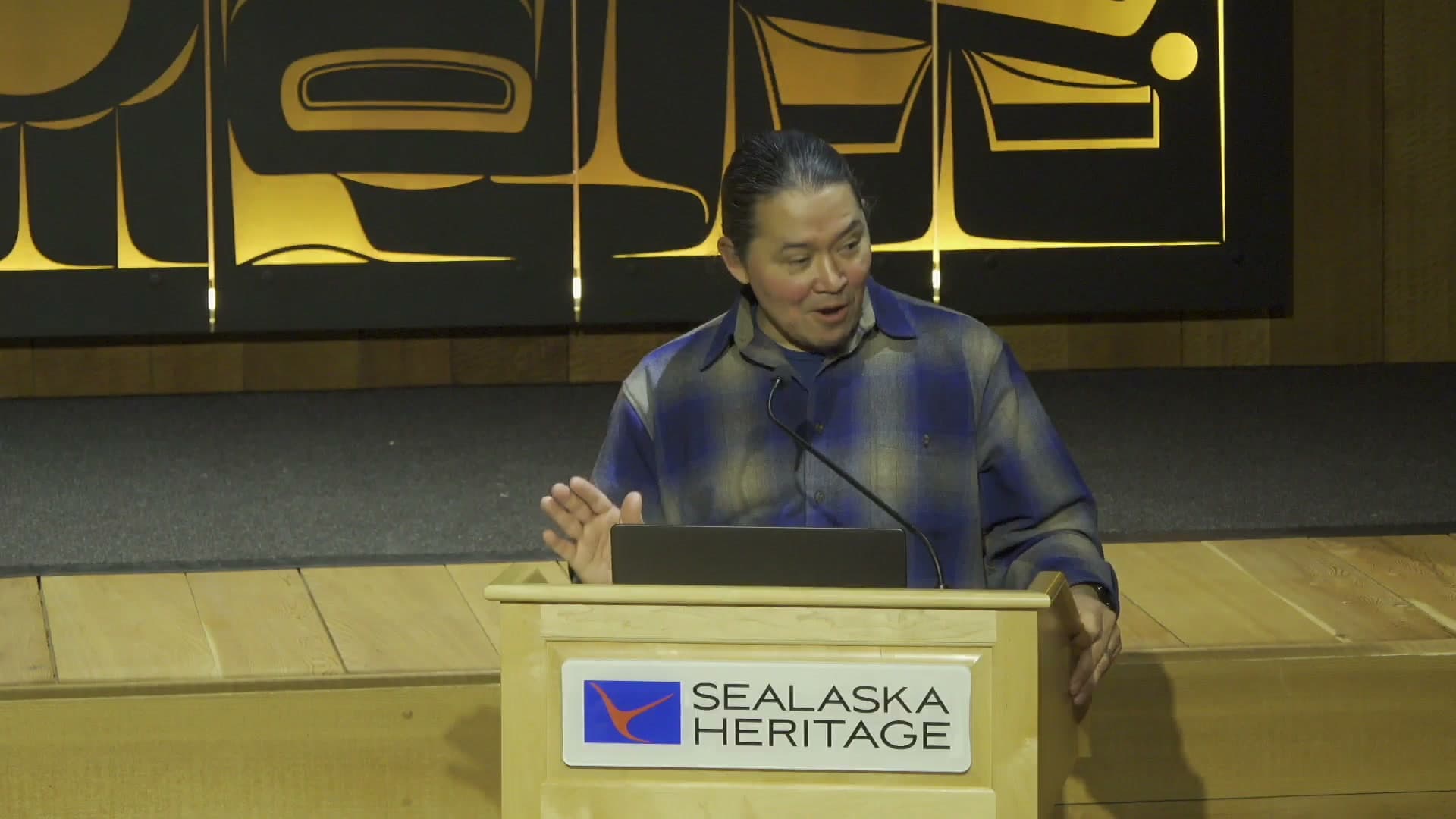
Okay. Hello everyone. My name is Ezra Ellisoff. I work here at Sealaska Heritage Institute as the language research specialist. At this time I have the great pleasure of introducing Dr. Juneau Lance Twitchell.
Juneau du wasaak sukaxa dirseti ka kwantanya dirseti.
He'll be giving a lecture about— I'd like to ask everyone to please silence your cell phones, please leave any food or drinks outside of the clan house as we're trying to do everything we can to preserve the space for the next generations.
So Professor Hoonah Twichell is of Alaska Native— or is an Alaska Native Languages professor at the University of Alaska Southeast. Hoonah is from the Tlingit, Haida, and Yup'ik Native nations, speaks and studies the Tlingit languages, and advocates for indigenous language revitalization. He lives in Juneau with his wife and bilingual children. Juneau's talk today is titled Kushta Kwaani: Spiritual Connections with the Land Otter People. The talk will describe the Kushta Kwaani, Land Otter Peoples, and their strong spiritual connection with Tlingit peoples in Southeast Alaska.
This presentation gives a brief overview of this relationship based on shared stories told in Tlingit and English. This relationship is one of help and strength, but also sometimes includes people taken by the Kushtokwani. Without further ado, please help me welcome Dr. Juneau Twichel.
Dzánti K'ihéeni aya, hatuwanx, yakannaddeen. Kunakwoya daxi tuxwotank, dateti nexaxas yeti, wey'ak'kwan. Kunakwoya xwosugu, iyaxakai, gedenaya hasautletin, yaxu'ani yetadk, yetlingetadki aya, aka'atuwasugu, lingedurrotangii awoe du'akchi. Achoyaktoo yakee khat yeeghoo hoo, Sealaska Heritage Institute. Chadeehaanayoo yohaan yakushtakwani daadayayookhakwotan.
Wan kooleens kaxasikwa ataaya ya haakus teekwaani daadayayookhakwotan. Wan kooleens kaxasikwa ataaya ya haakus teekwaani daadayayookhakwotan.
Gunaa'chiiish. I'm so happy that we're gathered together. I'm really honored to be invited to talk about the Kushtokwani. It's a sensitive thing, so we'll be careful. Don't get took.
That's sort of the primary message here. But I think also one of the things I would say is if we only think about these things in English, will never understand them. And so I started speaking in Tlingit at first because I really want us to all just be able to just speak it. It'd be great to just give an hour presentation in Tlingit. It'd be hard, but it'd be wonderful.
And to not have to rely on a translating language that will sometimes not do the best job of interpreting the way the world works in this place. So this is the land of the Akw'kwon, let's say gunalcheesh to the Wushkitan, Klin'neidi, and Yaktetan, for taking wonderful care of their lands. And I think about all the time, what do they need? What do the people need of this place? And as we sort of started, I was thinking, oh, we should do like a little a vocabulary lesson.
So there's this word which is "ku'u." And some of you might have heard it. There's a dance group called East Ku'u.
Iidetiaku'u would be like the present generation. Wuchitku'u would be subsequent generations. So this word "ku'u" means people. So there could be Shkakweku'u. The people of Skagway.
You could have Sít K'ak'u'u, the people of Petersburg, which are not historically Norwegian, but some of my ancestors are. And then there's this word K'wan. So K'u'u could be anybody who lives there. But K'wan is the ancestral people of a place. I'm not Ak'wan.
Our people are from X'k'ut. So that's— usually your name comes from a house, and then you're sort of from that place where the house is from. This is how Tlingit works. So even though you could live here and you could be— some people like to say, "I'm a fourth-generation Alaskan." Like, you could be a fourth generation living on Auk Kwan Aanii, but that does not mean you're Auk Kwan. If you are Auk Kwan, you're probably Oosh-ki-tan, or Juneau-tee, or Yak-tee-tan.
So there are certain clans that are tied to certain places, and they are kwaan. And so as people are making new names for things, I prefer to use k'uu as opposed to kwaan. So if you wanna say the basketball team, or the people who like to go in the canoe, or these other things like that, sometimes people are attaching the word kwaan to it. Thinking that it means just generally people. But it has to do with ancestry.
And this is important. Because we can also add this little "i" on the end, and you get "kwani." So "kwani" is the term we use in Tlingit when we're talking to something as in its human form. But this goes into some complex things in Tlingit. That I think have always been misunderstood by a lot of people. And that's sometimes someone can cross over into the animal realm, whether this is a brown bear or a land otter or a killer whale, and you'll see them take off their skin like somebody takes off a jacket.
And when they do that, they look like a person. And then you could talk to them. And so this is this in-between realm that we're gonna sort of find ourselves talking about a bit today. So I don't know a whole lot, but I ask people questions. My grandpa was the first one who started telling me about Kushta, and then I had lots of questions.
And I would ask him questions, and I would talk to other people, and I said, do you know any of these stories? Do you know any of these stories? But then I noticed that they were sort of being talked about as if it was just a straight-up boogeyman out of a simple movie, right? Like, here's the good people, here's the bad person. And I think it's much more complicated than that.
So I'm going to share some stuff. We could call it— we'll talk about the difference between Kushta, Kushtaka, and Kushtakwani. And I'm very happy to talk about those because it means we're learning and using the Tlingit language. Before we go forward, I just want to say Anybody here on Tlingit land can and should use the Tlingit language. Like, it's totally okay.
What's not okay is just sitting here pretending like people didn't try to destroy an entire language, an entire way of being. So we stand in solidarity with our relatives who are Haida, who are Tsimshian, and who are working within their language and culture to come back from this place where people really try to oppress us and keep us from being ourselves. So we'll start with a couple phrases. Iyakwone, keshastukhende yu igutkuk. So I will warn you, don't go near the land otters.
If you see land otters, like, that's interesting. We call them— the word kushda means land otter. Some of the times they could be really cute, like as little babies. Sometimes people like to watch them. I remember I worked at the ferry terminal in Skagway.
And my coworkers came up. They said, there's this land otter and babies over there. You want to go look? They're real cute. And I said, no.
Look at them all you want. I will be sitting here in my chair. And it's about like kind of not— messing with them. But hastuya ayaakuné, respect them. Respect them.
And so we have these phrases in Tlingit, chashtakata te yukwuhéi yukwukwudziti, which I learned from Kahtawu Cyril George, who is Tla'kwéidi. And then it means there's a living spirit in all things. And then I learned "Chakhtakata te jiqhtuti at'yaawunne." From Kahhwan'ish George Davis, who was T'akhten'tan. And that's, "We give respect to everything." So don't go messing with them. Don't— I guess here's a— there's gonna be a couple solid suggestions that I will leave you with here.
And if you go missing and you end up running with the land otters, I will say I told them. I told them, you know, because like I think a Sliget horror movie would be very short. Because people would walk into this building, this old house that they don't belong in, and there'd be this voice that says like, "Chukde!" You know, like, "Get out!" And then they'd be like, they would just get out, and then there'd be roll credits, movie over. Sometimes we're like, something will happen and we'll get— it'll spark our curiosity. Like, oh, what was that?
Let me go investigate. Right? And so these are fine lines, though. So some of the things— we'll go over these kind of step by step. But I'll give you a summary of them.
Don't whistle at night because the kushta like to whistle. And if you whistle at night, they will whistle back at you. And when they whistle, I think they're planting a little thought in your mind. That's how the whole sort of thing kind of works, I think, is they put these— they say, "Du shatukh aya ye hasausini." They got into their mind. And then next thing you know, you've got this idea.
Hey, I'm going to go meet so-and-so out in this wide open field in the middle of the night. Right? And so I've heard stories about this, of how they sort of plant a thought in your mind. I would also say that the information shared here is shared with the idea that we can respect, we can learn more, we can be safer, we can be smarter on the land, and we can make sure that, you know, .
Yik'at K'ihéeni. So that nobody gets harmed, we're going to live carefully on the land. So when you're on Tlingit Ani, you're never far from what is known in English as the wilderness. So you don't have to go very far to get completely lost. And so we always encourage people who are living on our land, who are visiting.
My children are getting big enough, they're starting to go on these hiking adventures. And so I talk to them about stuff. And I was talked to about stuff when I was younger. And some of this stuff is try not to go too many places alone, especially if you're going way out. Way out, it doesn't take long to get way out there where if something happens, it might be really hard to get back.
And this could be slip and fall, get hurt, get a little lost. Like, these things can happen. And so we want to live with good intentions also. On the land. So some foundational Tlingit teachings is you don't point at animals and you don't laugh at animals and you don't make fun of them.
So be careful, like fat bear contest, a little bit sketchy for me. I'm like, "I wouldn't." Just let them be. But, you know, people are admiring them, but it's getting close to making fun of them.
So kuxta is a land otter. There's nothing wrong with that word. That word's not scary. These are not things that are trying to cause us any harm at all. Qa is a person.
Now Tlingit generally has a lack of— it's not a gender-driven language generally. So you don't have to say like, he did it, she did it, her, his. It's just one pronoun that covers both of them. I know pronouns are scary for some people, but they're just fine. And so "qa" is an exception though.
"Qa" can be just a person. You can say, "A'tusa we qa?" Who's that person? But it could also mean a male or a man. And so in other instances, it could mean like a male thing. So you could say, "Zisk" is a moose.
And you could say, "Sheesh zisk," female moose, or "Kaa zisk," male moose. And that's important, 'cause sometimes you're gonna say, "Which ones do we shoot?" You know? And the kushda is a crest of at least the kaanakhteydi, the kaach-adi, the Kluukach-adi, and the tee-nee-di. There are probably other Raven clans who also use the kushda as a crest. I'm not trying to leave anybody out.
These are just the ones that I know. And so it's used as a crest. So I was in the village of K'ih'ik not too long ago, maybe a month or so. And something happened. I was a little upset.
I went for a walk. And I was just going to go not very far from these canneries. To the place that we're staying. Just going to walk down this boardwalk past these old buildings. Some of them, nobody's in there.
Some of them have been renovated into offices. Sometimes old buildings can be a little bit creepy. But it was daylight. I was walking. And I turned.
And in between these two canneries, I turned. And I thought I heard a bunch of seabirds. Making a bunch of noise. It was loud. And I started walking.
And a friend of mine, she said, I don't want to go that way. I said, it's just birds. And she said, it's not birds. And I said, well, we got to get to the other side because that's where we're staying. And so I just walked through.
And then she said, I just saw a kushta go under the boardwalk. And so they were screaming. And if you haven't heard kushta screaming, then you haven't heard Cushda screaming. Because I don't know what else sounds like that. And I walked through them.
And I said, guna chish. Because I had this thought as I was walking amongst them screaming. The thought was, I shouldn't be here. And then I said, chaadee yekhetnu. No, I didn't say that.
So chaadee yekhetnu was forgive me. That's not what I said.
Ganachiiish yuxaateeni. Xel peiqat is neexchak. I said, thank you for being seen by me. I'm thankful that I have seen you, is maybe how I might translate that. Don't take me.
So there's a verb. And Tlingit's all about verbs. If you want to learn Tlingit, you're going to go to verb verb ani at some point. You're just gonna be hanging out there, sipping coffee and tea and wondering how it all works. And it works, it makes sense, it's so fun.
But there's this verb which you could say— well, I'll put it in this context. We're arguing for language rights right up there where the politicians meet, and I sit next to Kaseykh Selina Everson. And she said, "Hausaneikhayuk atangi." And I thought, yes, absolutely. Our language saved us. So this verb on its own could be "hausaneikh," and that means they saved them, they healed them.
It could work for like you had a wound and they healed it, like a doctor might do, or someone who knows about traditional medicines. It could also mean they saved you, like you fell in the water and they pulled you out. Or you were going astray and they helped you out. Or, you know, this is one that's been adopted by Christians who wanted to learn Tlingit and use it. It was used in terms of talking about salvation.
And so, but it also could mean to like set, like I got some food, I'm like, "Ooh, I'm gonna save this bite for later." That would be you know, and well, in this case it'd be chwasaneich, like I set it aside, I saved it for later. But it also seems to be the same verb as for when the kushta come and take you. So there's something to that. I think there's something to the vocabulary of it all. And so we're going to talk about what all of this means.
So the framework of this is I'll do 4 slides. We're on slide number 2. There's a little The Kushta started over there, and it's gonna go over there, then down there, then over there. And then there's gonna be a little video where you can watch someone tell a story about Kushta.
So an Ikt is the name we have for a shaman or a medicine person. They were very powerful. I think they've been very misinterpreted over the years in terms of what they did, who they were. It was something that was really oppressed by people who didn't want us to have these folks among us anymore. But they were ones who could really communicate between worlds.
They would gain strength by fasting. So they had specific locations they went to, and usually it was 4 days, 4 nights. And if you're going to sort of get stronger spiritually, an animal would come out in front of you. And fall down dead. Like, you wouldn't touch it.
It would just die. And you would cut the tongue out, and you would put it in a pouch, and you would keep it with you. And that's it giving its wisdom to you and becoming what we call a yéik, a spirit helper. So when you were going to do some sort of ceremony, the spirit of that animal would come and help you. So this is why a lot of our carvings have tongues that are You know, it's a tongue going to another.
They had one tongue between two different things. And so this is what— and they would say, "One'a'yawodu'akash." It began cutting the— well, you'd say, "Atlu'ti'awawakash." They cut the tongues. And it's a metaphor for they were gaining spirit power. And I think the most powerful things was the kushta. When the kushta presented itself to the ikht, that they were getting to these highest levels of the spiritual realm.
So I— let's see, did I go over that? Ikht ow e hastu in yuk e watan.
I got a spelling error there. Talking about the ikht. Ha ikht e shiwe kushta. I think the land otters help people. I really do.
So the stories that I've been told is that if someone was lost, like their boat capsized and nobody knows where they are, sometimes the icht would have a ceremony and talk to the Kushtakwani, the land otter people. And sometimes the land otter people would say, "Yeah, they're over here on this island. We're trying to get them." So it was sort of a, yeah, they're over here. You better get there before we get in their mind. So they'd get there and get the land otters to take off.
I was told when a ceremony was going to happen from an Ikt, like if you could just zoom out on the village, you would see Kushta standing at attention, watching. To see what was going to happen. The icht could ask questions of the kushda kwani.
But, hasteto asugu ye kusa nixchi. They want to take people. They do. Right? And so this is something that is maybe not fully understood.
This can start with whistles. So if you're out at night and you start hearing whistles, it's time to Engage your protective measures, which is tobacco and copper. Those are your two strongest things that I've been told, is that they don't like either of those things.
But someone might come and sort of gesture to you, like a friend of mine, he said his dad was hunting outside of Sitka. His dad knew the area. And he kind of came out into this clearing that went up, and it was a hill. And he saw someone up towards the top of the hill. And the person went like this.
And so he thought, oh, maybe somebody got hurt or something. So he starts to follow that person. And every now and then, they'd turn around and they'd look back and wave. And so he's following them for a while. And then he thinks, well, this is brown bear country.
He doesn't have a gun or anything? It's kind of strange. So then he yells at him, hey. And the guy just turns back and waves him forward. And so he points his gun at him.
And he yells, hey! And it turns around. I'll say it now. And then it gets on all fours and scurries up the mountain. And so these are things.
So there's things you'll see sometimes or hear that are just a little off. And so it's good to stay present, stay aware. It's good to travel and have a buddy. If you're going on a hike, take a friend. But sometimes people go by themselves.
A dog would help, I think. But they don't talk. So if you encountered someone, they just won't talk. And so there's something about it where I don't think they can really fully form language. They can bring you into this realm where you'll probably start hearing them talk.
But if someone went up, it would be them making their land otter noises and you just probably making them right back. So you'd be pulled into their world. And this is where communication gets very interesting.
So I think medicines help. Our people would always, like, there'd be day-to-day things like ts'akhtini and ts'ikshaktin. So Devil's Club water and Hudson Bay tea. And you would have these things that you would take every day to keep yourself strong. Then you'd have people who knew how to make medicines if something went wrong.
And so now we're going to listen to someone else talk about these. So this is Anyashkahash, Sam Johnston. He's Ishkitan. This was recorded in 2015 in Daislin, or Akhaka is what it's also called. We had a language gathering up there, and it was in between the semesters, and I went up there and we did some language classes, and then we had a couple sessions where we just said, "Let's just record some speakers, whatever you folks want to tell us." And this was, I think, if I remember right, this was the first story that was told.
So he's one of our 6 living master-level speakers, if you ask me. I don't think there's anyone that can replace him yet. He lives in Tesla now, and he is a treasure. And we'll watch this. I think it's got like a long beginning.
So, gunashees to the Tesla Tlingit Council for funding this workshop and to Anasha Haash for sharing this narrative. It's pretty short. It's got subtitles.
No audio detected at 27:00
No audio detected at 27:30
Yeah, what? I love Whitney and again, if you want to learn more about typos, do something like this.
It's such an amazing sort of entry-level story, right? Just like people do get taken by them. This is something that we know has happened, still happens today. They just kind of probably turn up missing sometimes. So the things that we were taught was to carry tobacco.
Like, they don't like tobacco. And so if you're really unsure what's going on, If you encountered someone out in the woods and they're not talking to you, offer them some tobacco and see what they do. Or carry copper. I was in an intense debate with a friend of mine because she was like, "I'll just carry pennies." I was like, "I don't think they're copper anymore." And she's like, "Yeah, they're like 1%." I was like, "I don't want a 1% chance of survival." But like, they don't like copper, so that's why we love to wear copper all the time. We would carry copper with us.
And you can ask the ancestors for help. You can ask, if you encounter someone, you can ask them to talk. Say, "Hey, why aren't you talking?" You know, especially, "Wanakseya tlilhakin yuukheyeetunk." Say it in Tlingit, "Why aren't you talking to me?" In Angoon, I was taught that they'd say, "Bite my paddle." That's a phrase that they would use there. Because they can change their appearance, but they can't change their teeth. So they would still have really sharp little teeth.
Well, they're probably not little. They'd probably tear you apart. And so the story goes a guy was paddling around perhaps, or maybe there were some people paddling around. They saw someone stranded on an island. And they said, "Oh, maybe they got shipwrecked.
Let's go see if they need help." And he wouldn't talk. And so they said, "Bite my paddle." And so that was an old Tlingit phrase. Like if you saw someone on an island and just kind of out there in the middle of nowhere sometimes. And these are like little stories that we share about things that you just get this feeling that maybe something's kind of off. Which is, it could be scary.
But these weren't just told to keep us scared or to keep us from going off at night or going out into the woods. Like these were things that our people lived next to and we understood. It's always good to let people know where you're going, even if it's just, "Hey, I'm just gonna go on a little hike from here to there." But just let people know. That way if you end up missing, they know where— and this is just good common sense for living in rural Alaska. And watch out for one another.
You know, try to go and and sets and just be ready.
Ate hastu a'akchi yeh. So like I said, so this friend of mine, his name was Natski'ish. He was a lot of fun to talk to. And he told me a story. He said, there's a group of people that are going hunting.
Everybody knew the plan. They're going as a group. Day 1, hike to the cabin. That's it. That's the plan.
Camp overnight. Go look for moose in the morning. Everybody knew that's what's going on. They're walking and they're sort of following the beach at one point. And he goes out on this point of land.
He hears a whistle over here. Doesn't see anything. Hears a whistle over here. Doesn't see anything. Later that night, everybody ate dinner.
Everybody's in for the night. If anybody's going outside, they're just going to the bathroom. That's all that's gonna happen. He starts tying up his boots. His friend goes, "Where you going, Ted?" He goes, "Oh, we're gonna go out on that point and meet so-and-so." And he names this person that they all know.
And he said, "No, we're not. That's not what we're doing." Just take your boots off. So he takes his boots off. An hour later, he's putting his boots on. His buddy goes, where you going, Ted?
He says, oh, we're going to get in a boat and paddle out and go meet so-and-so. And he named some other person. And meet him in the middle of the bay in the middle of the night. And he goes, no, we're not. Take your boots off.
So it's like an idea, something that gets planted in your mind.
If there's another story of someone who was— he went hunting at a place that he knew really well. And all of a sudden, he just kept coming up to the same spot. And he's like, "I'm not turning. Something's wrong." So he sat down and he was a smoker. I don't— carry tobacco, I'm not saying use tobacco.
But he started like smoking. And then he thought that there was something around him, so he said, "You're not going to get me." And so they started to cry. And I've heard the screaming. And I've also heard they can cry and it sounds like a woman crying. And that's just the way it was explained to me.
And so they start crying. And so he just kept smoking. And then they threw pine cones at him. And then when that stops, he waited until he felt like he was OK. And he got up and he walked home. But an interesting part of that story— it was a part I forgot— was he kind of kept seeing that he could see where he was trying to go and he couldn't really get there.
And then sometimes they'll scream. And as far as these different noises they make, it's different things. It's so much that's unknown. And so I just share the bits that I have heard.
Don't follow them. If you see a land otter, don't be like, hey, it'd be cute to go take a picture. Maybe don't. Maybe don't. Go find a picture online.
I wouldn't even go see one. If there was one at a zoo, I'd be like, I don't really like zoos, but I'd just go. I'll go the other way. And so for me, I just— I mean, I was taught a thing, you know. And so some people— everybody's different.
Like someone says, don't touch that fence, you get electric shock. Somebody is going to touch that fence, right? Because I'm like, really? But for me, I'm like, OK. Just you tell me, and I got it. But that's not the case with everybody.
And also, sometimes things are going to happen. Maybe you say, oh, I'm right near town. I'm just going to walk across. I was talking to someone. And she said, yeah, when the tide went out, you could walk to this little reef.
And we were out there. And we were stuck for 3 hours. We couldn't find how to get off the reef. And I was like, uh-oh. Did you hear anything?
And they said, yeah, we could hear something whistling.
They might gesture and they might act like they need help. And this is, you know, I'm also not saying don't help anybody. Because you don't want to be this person stuck on an island because you're trying to wave at people and they're like, "There it is." You know, they just throw tobacco at you and take off.
And then, but they might look familiar too. It might look like someone you know. Because I don't know what they do when they put that thought into your mind. And then they also— but they won't talk. Like, so that's another thing.
I'll get to another story here in a second. Ahastu chishakuni kudziti. So they have tools that they use in the world as well, which is really interesting to me. So thinking of the vocabulary in Tlingit, kush de yagu is another name I've heard for this thing we also call kaja. Which is a kelp island.
And so I was told that they use kelp island as boats. They can also make boats out of a bunch of little animals. And Kushtayagi is another name for this animal we call kuk. And kuk has 4 names, which is, Asqatilhkaykhe was the first one I heard, which means y'all sit in the woods. Asqatilhkaykwa, which was told to me by J'akaytla, Irene Kerriente, which is making magic in the woods.
And then Kushtayegi is what Kahkwan'is George Davis told me. And it's this little owl, and it's another very spiritually powerful creature. We don't— again, with owls, you don't mess with them.
I don't think for Tlingit there's a thing where, like, sometimes you'll see an owl in the daytime, it's bad. Bad. But I think for Tlingit, it was more sort of like it might be telling you something's gonna happen. And there's different cultures that have different beliefs. I just want to say a word that I think we could probably do without, unless you're talking about the song by Stevie Wonder, is superstition, right?
Because I think that word behind it is this idea that only we know the truth. Right? And so, like, if there's a baseball player who every time he does this to his wristband, he gets a hit, fine. Like, if that works for him, that's fine. Like, it's a process.
It's a belief. And so this line between belief and superstition, I think, is one that cannot exist without judgment. So instead, we could probably say, "Okay, that works for you. I don't know if I really believe that, but why should that affect me?" me. And, you know, like you should be able to believe your thing.
And so if you find yourself trapped among them, speak Tlingit and explain your loneliness for your own people. I miss my son. I miss my daughters. I'm lonely for my family. I want my village.
And maybe they'll have compassion.
Show them the tobacco or copper that you have on you. And there's one more thing here. Is you could fart a stinky one.
This is a last resort. So there's a story I was told. There's a person who was stranded on an island. Something happened to their boat. And they made it to this island.
And they were like, You know, that's traumatic. And after a while, this boat comes along. And like, oh, thank goodness. So they gesture to get on board. And you know, what are you going to— you're like stranded.
So he gets on board. And they start taking off. And he goes, hey, where are you guys going? They didn't say anything.
Where are you from? They just look at him and— Why won't you talk to me? What's going on? And so it starts to set in that something unusual might be happening. Right?
Like being stranded is bad enough. But then you get in a boat and you don't know where you're going and nobody will talk to you. And so his stomach got upset. And then he passed some gas. And then they all started yelling because they didn't like the stink.
And then they dropped him off at the next island. So he got off. And when he turned back, he saw it was land otters. And it wasn't a boat. It was a whole bunch of little animals just holding on to each other.
So it's this other thing where it's like, it's mysterious to think that you can't see what you're seeing and you can't hear what you're hearing. But this is what happens when you're crossing that boundary. Between the world we know and the world that's unknown. And this could be really unsettling for people. But it's also like as Tlingit people, the way we were raised, there's just all kinds of things out there.
Giant octopus, giant rats. And these are things about being in a place too for 10,000 to 20,000 years, as you've seen some things. People were speaking Tlingit in this area when there was a mammoth still walking on the earth. Saber-tooth tiger. This is the type of longevity that we're talking about with one particular place.
So we've seen some things and we still continue to see things. But as we teach about what we know about these things, we ask people to keep your mind open. Because it's more simple than just, it's a scary thing that's coming to get us. That being said, it's a hiti hasa'chiwanak. This is a story that I was told by Kahhwan'ish George Davis.
He was born in Kake. He has a K'ihk'wan dialect for sure. He was wonderful. He and Shukshani Marge Dodson, who was Ishkitan but grew up mostly in Juneau, but was from— and Douglas, was from the Taku area. And then K'ahu'aneesh is from Juneau, the group in Kake.
And so the complexities of their lives are so interesting to me. And these are folks born in the 1920s, These are folks who survived incredible— like, I was talking to a friend of mine, Cheek Woo, about how incredible it is that we have what we have today. With everybody who tried to destroy Tlingit, like whole governments, whole churches, big powerful people that kind of never talk about it today. Like, I don't know when the last time someone who was like in a high office said, "Hey, we tried to kind of destroy all the indigenous people. Let's fix everything we did." I don't think I've ever really heard that kind of talk.
Maybe occasionally a little acknowledgement here and there.
March Dutton went to school at a place called the Mayflower School, which is a little white school building over in Douglas. It's totally different than what it was. Back then. But on her first day of school, her older sister said, "Can't speak Tlingit there. Don't.
Get in big trouble." But she grew up, she spoke Tlingit. All kids in the 1920s spoke Tlingit. Like, this is just something they did. So she goes to school, she's probably 5 years old. First day of school, sees her friends, talking, not doing anything wrong.
And the teacher calls her up in front of the class and grabs her by the hair and lifts her up and shakes her violently and says, "I will hit you right in the face if you do that again. Cannot speak that language here." And drops her. She said it was a big lady. And so this happens in front of everybody and she's Hurt, scared, embarrassed. She walks over and she picks up her stuff off her desk and she leaves.
Her hair is all pulled up. She's crying. She walks all the way home. And then she— her parents ask her what happened. She tells them.
And she watches her parents get into a physical altercation. Because her father is going to go kill this lady. For hurting his child. And the mother is stopping him. And this is what our people have lived through.
And so when I talk about like akústa, I'm like, yeah, that's wild. But colonization is a big monster. And Kahhwan'ísh was drafted into the Army. So he went from K'eq to Ketchikan. And he's getting ready and they're going to all fly out to this Army base or whatever.
And he's walking down the street in Ketchikan with his commanding officer, and he sees his family walking towards them.
And his father and mother say, "Can we talk to you?" So they stepped aside and they had a meeting, and they said, "We need him. I know that you guys picked him to be in the Army, and he's going to have to go do this thing." but we need him for fishing. It's fishing season. We just need one more year with him, and then we'll send him. So they agreed.
They said, OK, he can go next year. So they went back to Kake. The next day, that plane full of people took off, and it crashed. Everybody on it died. And there's all these different stories like this about what they endured, what kind of chances they had to survive.
And then they survive so that we can have stories like this one.
No audio detected at 46:30
Jayadev agreed to take this next mission. Once again, he has to call the shuttle, shout with the Uruk-hai shout.
Jayadev has to sussahibi as a Chewbacca baby. The Huotar Oh, Archie, you're a baby.
My goodness, you got 5 minutes.
No audio detected at 48:00
No audio detected at 48:30
No audio detected at 49:00
All kinds of birds. The canary would sing.
If they ever straighten that little baby's arm like a human being.
The spirit of the land otter man.
I think it's a colorful story of a baby, but it actually happened.
No audio detected at 51:30
No audio detected at 52:00
No audio detected at 52:30
For listening, folks. I do think they're gonna help us. I think they'll help us. There's a lot of things that happen to us as people, and I think sometimes we're presented with things that just aren't what they seem. And so this idea of saying, you know, I also heard you could say I see you.
Right? And just naming that thing really helps. And I think it's going to help us to untangle these things. Qaxqawu used to talk about this place called Qatqaxakeen, a river that untangles a person's mind. And I'm always trying to go there when I think about this kind of stuff.
And talk about the kushda. This is a design from a canoe prow. It was probably Chukna Khadi. So I should add them to my list of clans. I just want to confirm that they do use it as a crest.
I told a friend in Kake, I said, hey, you work in the cannery, yeah? He goes, yeah, yeah. He does— He works on sea otter hides in there. And I said, "You ever hear those land otters screaming? They were screaming at me yesterday." He said, "Oh yeah, they really go at it." I was like, "Does it scare you?" He's like, "It's our crests.
We use them. It's our relative." And so I also think it's more complicated than just a scary story you tell at night. So just remember that. Keep tobacco on you if you're going out in the woods. I don't smoke, but I got some in my boat.
If you see killer whales, you put some in the water. You say, "Hakaytaywu, hakaytaywu." And there's all these things. Like, there's so much depth to our culture and to our language. And I encourage you to keep learning, keep using the language, and I think maybe we have time for questions. Yuxhe, questions?
No audio detected at 55:30
So he wanted to know where he could hear more stories.
Well, one time— I'll give you a little story, and then I'll translate what I said, if I can remember. I was living in Kasan, and these kids came to the door. And they said, we built a fire. It's dark. You want to come tell scary stories with us?
And I was like, heck yeah. And so I told all these fun stories. And then we had fun. And they went, and I went. All kinds of stories about all kinds of things.
Because there's a— then you got to get into Haida culture too. And you get into the kakeed and all this other stuff. And I remember like a kakeed is sort of a Haida equivalent. It's not the same, but it's similar. And when someone drowns, they come back.
And sometimes they're stuck in between worlds. And they come back all disfigured. And they're eating sea urchins. Spines are poking through their face. And Robert Davidson carved one.
He showed it to his grandpa. And he said, it's the prettiest k'agida I ever saw. So he's like, I got to make it scarier.
But anyway, so I told these kids stories at night. And then I was like, I got to walk my dogs. And there's only two lights in Kazan. It's a very dark place in the winter. At least it was when I lived there.
And so I go walking my dogs. And I had a headlamp on. And there was a cat in the bushes. And it's just a cat, but at night its eyes are so bright. And I was like, ah!
And I go walking a little ways, and there's another cat. Ah! And I go walk, and then there's this— I'm about 100 feet from this, where the road— there's an intersection. You can either go out of town or out to the docks. And I'd always walk my dogs to the docks and back.
And I just saw this set of eyes there. And I like— That's it. We're done. We're going home. And so, do what you gotta do, dogs.
This is as far as you're going. But Nora Dauenhauer and Richard Dauenhauer recorded quite a few stories. I think Day Laguna might have as well. There's a finding guide that Zach Jones put together with Kingisti, David Katzeek, and Koneoti, Marsha Hotch. And you could search a whole bunch of stuff through this Hundreds of tapes of recorded Tlingit.
And they wanted to do a book about this. One of their next books was going to be— it was supposed to go raven stories, then it was supposed to go kushda and ikht stories. But people stopped it. People, like, they said, "You're committing a sin. You can't do it." And so I just really want us to know the things that our ancient people used to know.
And to not stop each other from looking at these things. No one's trying to convert anybody to anything. I brought my pamphlet for— I should just go door to door and be like, "Have you spoken Tlingit today?" and just give them a pamphlet. That's my conversion.
Other thoughts or questions? I'll answer every question with a 15-minute story.
Thank you. I am Doc Nakeen, Kahootsuhkuwu. My ceremonial name given by Uncle Clan Leader Frank Jack. Shaana'kit hootsit hootsnoo'kwan. I have 3 questions, but I start with this.
Back in the day, the elders would say to me not to talk about Kushtaka, and so I'm being within that realm of your starting of this conversation. So not to offend anybody and Are there any collection of sightings of Kushtaka?
That's a good— like most of these stories I found, they— like people tell the stories, right? And I understand, like I was taught to like to be careful when you're talking about it in public and just to be cautious. But I also go back and forth with this stuff like because now there's a lot of people who don't know a lot, you know? And so as far as collections like We talked about putting together, like, there'll probably be a book coming with a collection of these stories, just so people can study them and know them and learn from them, because they're things that our people used to talk about. Like, this was on a canoe, and so, and then all the, the icht, they had these different batons that had kushta on them all the time.
And so I think it's something that people were very careful of But I also worry that sometimes we've been sort of tricked into never talking about certain things. So yeah, I hope there's a collection forthcoming. I don't know of a whole lot. It's usually stories that people tell to each other. The next question is, what recurring physical features are predominant relative to Kushtaka?
From what I've heard, it's the teeth is the only thing that will give them away. But maybe there's something in the eyes too. And so, a friend of mine said, we're talking about, I think we're just talking about all kinds of Tlingit stuff. His name is Ze'ush James Krippen. And then we're just going off and off, and my little brother was there.
He was with us. He goes, "What's linguistics?" And I was like, "Explain it." And then he sort of went in a different direction than I expected. And he said, There's this phenomenon that when two human beings encounter each other, your right eye looks at their right eye. And I thought about it. I was like, is this going to be one of those things I'm going to overthink and then Pim be like, why are you staring at my right eye?
But he said, that's how you could tell. And he said, this is how you could tell when something's a little off with a person sometimes, is because they might not do that. Then he also said, there's only one other animal in the world that does that. Anybody want to guess? And if I've told you, you can't guess.
Yell it out. A dog. A dog. 100%. First try.
Good. Because they've been by people for so long that they picked up on this thing. So if you're out in the woods, unless you're a tourist— because I had this husky who had this blue, bright blue And he was a blonde husky, and he jumped out of the woods one time in Skagway, and these tourists go, "Woof!" And they got really scared. I was like, "He's got a harness on." But if you have ever seen a wolf, when it looks at you, you know it, because it doesn't do the right eye, right eye thing. So it's probably that.
But it's also they won't talk. That's a big thing, is they'll only gesture. Last question is, what shamanic influence As you had stated earlier in Rosita's book, his, quote, "His tongue contains all the knowledge and secrets of shaman." So what shamanic influence relative to Ik to Kushtaka? Well, so the Ik were the only ones who were never, who weren't burned. So we cremated everybody pre-contact except for the Ik.
Who were put in certain places with all of their tools and all of their ceremonial clothing. And so once white people figured that out, they just started stealing all of that stuff, including their bodies. And this is why I would probably say 99% of all the icht'jishagun, the tools that they— so they would leave them with their tools to help the next generation of healers. And these were healers. These were medicine people.
They were not, you know, out there hurting people. And I think there's something lost when all that stuff is removed from the earth. So I think it's time for all the museums and universities, 'cause I was at a training one time, and this guy said, "There's about 2 million Native Americans." This was in 2004, probably. He says, "About 2 million Native Americans walking on the earth today." And there's more Native American human remains in museums and colleges than there are walking the earth. And I thought, that's weird.
Why don't we do something about that, or at least talk about it? So I think there's a future where everything that belonged to a medicine person is returned to our land. Just say, okay, we're not gonna talk about the legalities of it, we're not gonna talk about who had the right to what, like, just get it back here. But people will steal it. People are still stealing things today.
If they find out, if you found out that there's something in some building that doesn't have some lock on it and a camera, and especially if it belonged to a medicine person, someone will steal it because they could sell it the next day for probably a million dollars. And this is the world we live in, and it's sad to me. But I think we can construct maybe these little buildings. That's just like a little bunker that's open to the earth below. And it's just for putting the medicine people's stuff back on our land.
And we'll probably just have to do the best we can. Say, "We know that they were from Angoon, so we're gonna put this one in the Angoon house." And so I want us to be innovative problem solvers because they were the ones who walked that boundary between these known worlds.
Cheese. I just find this very interesting because I was born and raised in Mongolia and we were always told to not whistle at home or whistle at night and I never knew why.
And there are so many similarities that go across indigenous people all over the world. And I'm— I just recently learned that if we move from a certain place that had these creatures or like unknown things, you put— so when you move from a place, you leave an ankle bone of a sheep. And if it's— and they're named after boar cattle. And if it is a camel, It means that there's something unknown in this area. And I mean, all these things that— I mean, there wasn't so bad of colonialism in Mongolia, but when I just recently went back and trying to learn my own culture, I'm just seeing, wow, like how much that Manchurians and the communism wiped away.
I feel like a dummy in my own culture. So yeah, I just appreciate your presentation and how much it resonated with me and my cultures. Thank you. I think in 2007, I was at this training in Anchorage with the National Park Service, and I was taking archival training. And then the person I was training with said, "Oh, there's something going on in this room upstairs.
You wanna go see it?" Sure. So we go, and what it was was the president of Mongolia was there, which I started to figure it out because people had like little earpieces and they were like, what's going on? And then the head of the Park Service region stood up and said, I want to thank the president of Mongolia, and like really did a bad job saying his name. And then, and I had They were making sister cities and sister parks. And I think everybody just treated it like it was not a big deal.
They said, "Well, we can't. We're government employees, so we can't have champagne, so we'll have sparkling cider." I'm like, "That's fine." But then they had these cheap little plastic cups. I'm like, "Couldn't we do a good job?" And I was kind of embarrassed. And so, I went up and it was over and I went up to just say hi. And a bunch of people kind of were watching me, and I said, "Oh, I just want to say hi.
Is that okay?" And they said, "Yeah." And so I spoke to him in Tlingit, and I said, "Our people live far away from each other. Maybe a long time ago, our ancestors somehow knew who each other were." And everything stopped, and then he had his ambassador speak to me in Mongolian. It was very fun. So, leechish. Thank you, my distant relatives.
Wokanaxish. Anything else?
Gnaaxish. My name is Denali. I work. Here at Sealaska Heritage. There's a few things that— one, just thank you for your presentation.
I've been trying to learn a lot more about The people that I come from, I am Sáagweydi Yadi, K'izáadi dashk'ohan, and I'm slowly learning the language. But in this process of learning, it is very difficult to learn about certain topics. So this is one of them. That anytime I've asked about it, it's just been, "Oh, we don't talk about that." So there's a few questions that I had, and one of them was actually on one of your slides. It mentioned peppermint may be a deterrent.
Could you actually— maybe speak about that a little bit? Yeah, yeah, I'm glad that you saw that. So there's this term "nak" in Tlingit, which is medicine, right? And so, but it's interesting to me, and some of it like it lines up. Like they'll say "khutnak" is the name they gave to like something that helps your stomach, and "khétuknak" would be like a throat glossary.
And so it's like throat medicine, stomach medicine. Shantunagwu is like if you get a headache and so you need to take something that helps. So the way it works is making sense to me. But then I started noticing some stuff like I was saying, how do you say mosquito repellent? And I said, "Tak anagwu." I was like, "Wait, this is the 'nakw'?" So "nakw," I think means medicine, but I think it could also refer to a repellent.
And so when we were trying to sort of analyze some things, there's some plants that have really interesting names, and I can't be sure if kushtanagu— like, I don't think it means the kushta take it and use it as medicine. I think it means you can put it around things if you don't want them to come around. Which makes me think, because sometimes there's like a— I had a mouse problem for a while in my house because I found a little hole. And the mice love little holes because like, "I go somewhere warm and eat snacks all day and then get into pantries and raise a ruckus." And but then I found these packets at the store that are supposed to keep mice away. And it smells like peppermint to me.
And so it's interesting to think about that, 'cause tsách'kiná'gu is another one, and that's a sage that grows mostly in the interior. And so I do think that those were things that people knew that those things didn't like.
And so I just want to say, like, we have to be careful how we talk about things, but that doesn't mean we never talk about things. And so I want us to be aware of the poison pills of colonization, which I get a little paranoid about it all. Someone once, they put like, they took a picture of someone who was like, had red string and were doing conspiracy, and they put my head on there and said it was me talking about decolonization. I get a little paranoid about stuff because I was in a community, I was in a community, and they said, "Well, when someone dies in a clan, you don't dance for a whole year." I said, "The whole clan?" They said, "Yeah, the whole clan." I said, "Well, I don't wanna be insensitive, but some clans are very large, and they're probably gonna have somebody die every year." So you would never dance if that were the case. And so I think we need to keep talking about this stuff and figure it out and say, Well, sometimes we could tell everybody and have a broadcasted lecture and talk about things.
No audio detected at 1:12:30
Sometimes we just need to close the door and figure out how to get a handle on some things. Because we also have people who are wishing ill will on others. We also have people who are doing physical harm to others. And I think we need to talk about the ways we took care of each other and we used spiritual knowledge to help people. Like, what is going to help the people?
What's going to bring our language back to daily use? And those are the things I'm always interested in talking about. We go all day, but this event is over.
No audio detected at 1:14:00
No audio detected at 1:14:30