Anchorage Assembly: Energy, Enterprise, & Utilities Oversight Committee-of-the-Whole Committee Meeting
Alaska News • • 92 min
Articles from this transcript
Anchorage's water utility would cut its Eklutna hydro payments roughly in half
Anchorage's water utility would pay the Eklutna hydro owners about half as much under new deals, then could own water rights at the lake in 2055.

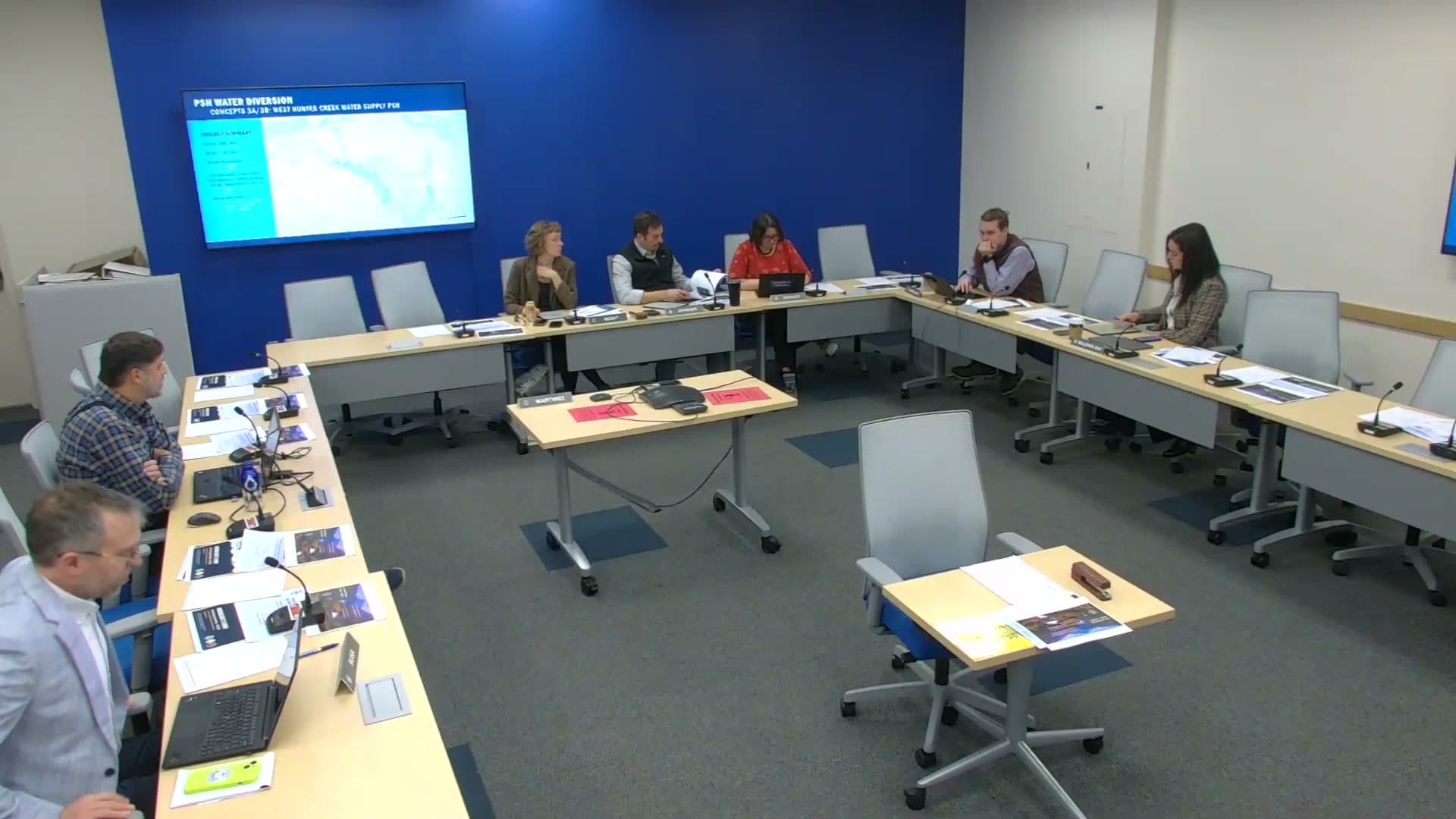
Really quick, I wanted to review— with review and update of the committee purpose statement for the website. For those in the room, it's on the back of our agenda. We made some updates basically reflecting the overall committee structure change, so we pulled out a few different agencies and departments, and this committee is just focused on hydropower, AWU, solid waste services, the Port of Alaska, Merrill Field, Eklutna, and then want to leave some space for any other activities related to municipal energy enterprise and utilities. So this committee used to be combined with infrastructure as well, and that has— and transportation ended up here sometimes, so we've Tried to separate that out a little bit. Anyone have thoughts on the committee purpose statement?
Great. Okay. Yeah, just a narrower focus. We have a number of like shorter presentations set up for today, starting with an update from the Department of Law and AWU. On the agreements between AWU and the Eklutna Power Project owners.
So would love to call— I think David is leading this. Oh, and at 10:03, members Baldwin Day and Martinez joined us over the phone. And member— I mean, Chair, probably. Member in this meeting, um, joined us in person. Thank you.
And we are getting the presentation set up right now.
And I'll share some background on the impetus For this presentation specifically, we updated, um, a resolution regarding these agreements a couple of assembly meetings ago, probably about a month ago at this point. Um, and some members asked for more information, context, clarification on why we were doing that. So requested this presentation so that folks can get a better understanding.
If we can have staff introduce yourselves, and then whenever you're ready to jump into the presentation. Uh, David Persinger, General Manager, Anchorage Water and Wastewater Utility.
Michael McLaughlin from the law firm of Guess and Rudd. I'm outside counsel for AWWU. I'm Joseph Buse. I'm the Deputy Municipal Attorney.
Thank you.
So noticing we have, um, legislative counsel for the assembly, Matthew Hurt. Sorry, sorry, I don't usually introduce myself, but that's cool.
Good morning, thank you. If you could go ahead and go to the next slide, please.
So, a little background on Eklutna. Almost 100 years ago, the lower Eklutna River, if you look at the picture in the middle there, near where the Eklutna Water Treatment Facility, there's a big canyon there, it's about 400 feet deep, and there was about, I think, a 60-foot tall dam dam constructed there in the mid-1920s. That was the original dam on the Eagle River that stopped the flow of the river and was the original power plant that provided power for Anchorage. And so that kind of gives an overview, shows where the water treatment plant, and then in the 1950s the federal government built the Eklutna Power Plant. And then just as a kind of a point of reference, the native village of Eklutna is right there at the kind of the mouth of the Eklutna River where it enters into Knik Arm.
And the Eklutna Native Village of Eklutna has been using water and resources from that area for thousands of years. Next slide, please.
So, back in the 1950s, the U.S. Bureau of Reclamation constructed the Eklutna Hydroelectric Project, and that was a federal project was approved by Congress. Fast forward to the 1980s, we were looking— the municipality was growing. Anchorage Water and Wastewater Utility had the Ship Creek Water Treatment Facility, but we were looking for another water source that would carry us forward into the 21st century. We looked at a lot of different areas. One concept that was developed fairly far was the Upper Eagle River Watershed.
Ultimately, Clutena Lake was chosen. And so we partnered— Anchorage Water and Wastewater Utility partnered with the federal government at that time to construct the Clutena Water Treatment Facility, connect into the existing hydroelectric tunnel, and build the water treatment system as we know today. And so that happened in the mid-1980s. 1984 Was when the original agreement was signed between the municipality and the federal government. Fast forward to the 1990s, the federal government elected to get out of that project and they essentially transferred it through a sale to the local hydroelectric consortium which formed the Utqutna Hydro Project, which was made up of Matanuska Electric— at the time it was Municipal Light and Power— and Chugiak Electric.
Next slide, please.
A little bit more background on our drinking water system. One of the things that's really unique with the way the system is designed and with the elevation of the Eklutna Lake and where the treatment plant is and then where the rest of our system is, we're able to supply over 85% of our customers with gravity flow from Eklutna, which is huge, particularly when you have like we had here recently with a big windstorm, you lose a lot of power outages. So having gravity flow is huge. We also recover energy at the treatment facility. The Klutna Water Plant recovers enough energy to completely power the facility and put energy back on the grid through Matanuska Electric.
And we also recover energy throughout our system. And about 90% of the drinking water for Anchorage comes from from Eklutna. Now, one of the things under the state of Alaska's constitution is that drinking water has the highest priority for use. Doesn't necessarily mean that you have to get that water free and clear. You have to maybe compensate the entity that owns those water rights.
And so, as part of that transfer, the hydroelectric owners ended up ultimately obtaining water rights for the entire Eklutna Lake. And we take water underneath of their water right through a beneficial use permit. And if there's questions, I'll take those as they go along. Yeah, I think Donald has a question. Yeah, so with the 90%, is that, uh, so is the other 10% from, from wells and stuff like that?
There's, there's not another source? So 100% of, uh, AWW's water source is from the Eklutna Watershed, correct? Through the chair, uh, we get about 90% from the Eklutna Watershed. We also have a treatment plant that pulls water out of the military's reservoir on Ship Creek. That supplements the water system.
We have several high production wells. Okay, so is that— is the 90% then is that of Anchorage's water source? 90% Of Anchorage's water comes from McCluton Lake, yes. Okay.
And then 10% comes from the—. From those other sources, yes. And that's on average, you know, it goes up and down depending on the year and what we have going on in the system. Thank you. So then, I guess, like, people pulling from, I guess, wells and stuff, their own water, table there.
Is that not included in this, or is that a—. That's not included in this, no. This is the public water for Anchorage. So the public water that Anchorage water and wastewater supplies, 90% of that comes from McClinton Lake. Okay.
And so, um, in the, the '90, the 1984 agreement that set forth the terms of use, uh, it set up a calculation for when there's— we basically pay for lost power production. So whatever water we use however much electricity could be generated, we compensate the hydroelectric owners for that. Next slide, please.
And so, then, in that 1991 agreement between the federal government and the power consortium or the hydroelectric owner— hydro owners, as we call them— that transferred the project from federal to local ownership. As I mentioned before, at the time it was Chugach State Park, Matanuska, and Municipal Light and Hydro Power. And under that '91 agreement, there was an obligation for the hydro owners to look at a fish and wildlife program and to restore fish and wildlife habitat, or at least address the mitigated— I think was the term that was used in there— the effects of the original project. And that had to be done and submitted to the governor by October of 2024. Next slide.
So, as that concept was kind of coming up and they were looking at alternatives, the hydro owners came to AWWU in 2022 and said, you know, we want to explore potentially looking at using some of your infrastructure as part of the Fish and Wildlife program. And so in the interim, we started negotiating agreements with them, some tentative agreements that would be subject to future assembly approval to make sure that whatever concept was submitted to the governor, that that was something that was, you know, was viable, something that we could manage the risks on and something that they could manage on their end. Fast forward to October 2024, Governor Dunleavy largely adopted their proposed Fish and Wildlife program using some of AWW's facilities. And also as part of that order was to look at the pumped storage hydro, which I believe Mark Shimshimer is going to give an update on here shortly. It was also ordered them to look at pumped storage hydro, and then 2027 to 2032 is the implementation of the final program.
Next slide.
So really, I mean, since 19— you know, the mid-1980s when we constructed the Eklutna Water Project and connected into that— into the, at the time, federal tunnel, now the hydroelectric tunnel— we've shared resources, we've shared the lake water, we've shared infrastructure, and we've worked largely together for decades as a collaborative relationship between Anchorage Water and the hydro owners. Next slide. So this is kind of a— this is a large map that gives a lot of information, but I wanted to bring this in here to kind of show the, you know, kind of the large one, you know, the area that we're talking about, the different portions of the infrastructure, as well as the, you know, just how large it is. So the original tunnel that went through the mountain in 1956 is the one that kind of goes vertically up there. You'll see the powerhouse and the Oklutna tailrace up at the at the lake, that tunnel has an intake that goes out into the lake.
And then, once it's onshore, during the Eklutna Water Project, AWW actually bored a tunnel through the mountain to essentially intercept the hydroelectric tunnel and connect into that. And so, we connected with some valves and flow meters and whatnot. And then, we tunneled through the mountain for about a mile. I think it was about 2 miles or just over 2 miles. And then, where that comes out is what's called the AWW Portal Facility.
Essentially what that is, is where the AWU tunnel goes to a buried pipeline, and that buried pipeline was put in when the river was dry during the '80s, all the way down through the Klutna Canyon, and it comes up out of the canyon near where the treatment facility is. And that portal facility is located approximately 1 mile downstream of the dam at the Klutna Lake. And so when you talk Here, let's talk about the portal facility. That is that facility essentially where the AW tunnel goes to a steel pipeline from a bore tunnel.
Next slide, please. All right, can I— can we stand this one for— so the portal facility is that what's labeled portal valve? Yeah, AW portal valve, yes. Thank you.
So then this is just a little bit more of a more detailed look at that. So there's the connection where we connect into the hydro tunnel. There's a very deep shaft that goes down there that has a lot of infrastructure, including valves and flow meters and backup generation. And then at the actual portal valve, there's a building there. There's, again, there's some valves and other facilities in there.
And what the proposal from the hydro owners to do is essentially connect into that that portal facility with an apparatus that allows water to flow into the river basically as a controlled release into that to provide a certain quantity of water over certain times. And I think there's some variation with that depending on the time of year and the requirements. Next slide.
We love recycling.
Must be that day.
So just a little bit more detail on the Eagle River Release Facility, and say that really fast 3 or 4 times in a row. The ERFF, essentially that's a constructed tie-in to our facility with a lot of control systems in place. And one of the things that we did with this with these agreements, and it's really important for us because this is such a critical piece of infrastructure, and failure is not an option in the drinking water business, that there's a lot of redundancy. There's a lot of requirements in there where the utility has control over that facility so that if something happens, we protect the drinking water system as the highest priority. And so essentially, when we get into these 3 agreements, What essentially we're doing is we're interconnected into the infrastructure.
We're transporting some of their water to rewater the river. And then there's another agreement which details the actual water supply or water rights. And we'll talk about those. Next slide.
So just a little bit more on this. We've, again, we've worked with these agreements for years. The 1984 agreement is one that we've been under. That was recently extended. I think last year the Assembly had some action as a short-term to essentially extend the status quo of that agreement until we could get new agreements negotiated and approved.
Next slide.
So, the facilities interconnection agreement, and again, you know, we looked at these We're regulated by the RCA, so are the hydro owners. And if you get in— and I've got Mike McLaughlin here, he can correct me if I'm wrong— but there's, you know, we're in the water and wastewater business, so that's kind of our fundamental services we provide. The hydro owners are in the electricity business. None of us are in rewatering rivers for fish. So it's kind of an area outside of what we're normally regulated to do.
And so A lot of these— the interconnection agreement and the transport agreement, essentially, those are— there's mutual benefit to both entities and there's no financial obligations on those. And so, the interconnection agreement, the purpose of that is to address the interconnection, make sure that we have the isolation valve structure and the actual river release facility detail, who has control over what. They're responsible for the design engineering, all the approvals, and the downstream river crossings with input from us, making sure that we're protecting the water resources for the municipality. And at the— ultimately, we'll have control over those valves and infrastructure to make sure that we can control that. Next slide.
And then the long-term water transportation agreement similarly leads to the interconnection that really details moving that water from where we tie into their tunnels to the river release facility. And it's essentially we're transporting water through our tunnel for the hydro owners for the purpose of rewatering the river. And again, the costs are broke down on that, on who bears what costs and who has the ultimate control over those facilities if there's an emergency situation. Next slide.
And then the water rights or the water supply agreement, and this is really the crux of this whole effort and has the most, I would say, the most benefit to the to Anchorage Water and Wastewater Utility over the length of these agreements. Like I said before, the Constitution gives us a preferential use, or, you know, the highest use under the state Constitution. It does not give us automatic water rights for drinking water. And what this agreement does is it gives us continued use of the infrastructure for public water supply, but we still have to compensate them However, we were able to cap our compensation at $600,000 a year with an adjustment for inflation, and that's going to save us about $600,000 a year. Currently, we spend about $1 million to $1.2 million per year on paying for lost power production.
And what that'll do is it allows us to save some money and use that for resiliency as we develop this, there's some risk to the facilities. Anytime you tie into a large pipeline or you build something like this, there's potential risks. And so this gives us some financial compensation that will help with that. And then ultimately at the end of these agreements, AWW ends up owning, ultimately owning the water rights for that. Let's go to the next slide.
So, there's two things that this gives us. One, it gives us first right of refusal if they do decide to close the power plant for whatever reason. If, you know, they decide it's not financially feasible or whatever happens and they decide they're going to shutter it, we would get first rights to purchase any of that infrastructure as well as water rights. And then, ultimately, the big one is the way these agreements are set in October of 2055, the municipality would own 37 million gallons per day of water rights, stream clear, on Eklutna Lake going forward.
So what's next? The assembly recently approved the framework of the agreements. We've got Joe from the Department of Law here. We've been working with the hydro owners to wordsmith the legal leads on the agreements. I don't know, anything you want to add to that, Joe?
Sure, happy to. Not much to add to that. There's some, you know, as we discussed at the assembly meeting a few weeks ago, you know, all the major significant terms have all been set for quite a while now. We're just wordsmithing a couple final points. Most importantly, there were a couple placeholder diagrams in the draft agreements that said, you know, technical diagram to come, and the work is being prepared to prepare those technical diagrams and insert them into the agreements.
So they have not yet been executed, but we anticipate executing them as soon as that work is done.
And that's all. I think that's all I had. Okay. We have a question from Erin on the phone.
Yeah. Hi. Thanks, Director Persinger. I'm curious about the risk that you mentioned to— and the resiliency that you need to build into the system with this interconnection. Can you say a little bit more about what types of risks you foresee and what exactly it is you would be trying to mitigate?
Yes, through the chair, Member Baldwin Day, when I speak about risks, you know, those are in general large-scale, you know, something bad happens to the pipeline, for example. And so when we talk about building resiliency in that, that's really resiliency in water sources. So that's looking at other alternative water sources like deep wells with high production capabilities that we could use to supplement or, you know, take over for the Eklutna water source when it's offline. And then, on the other side of that is also, as we go through the project, making sure that we're providing input and making sure that the project has, you know, resiliency built into it as far as construction techniques and engineering technology and whatnot.
Thank you. That's, that's helpful framing. And so, so this risk really is unique to the portal valve engineering itself, and the fact that that infrastructure is tying into our infrastructure, or I guess I should say, the AWOOS water infrastructure. And that is specifically where the risk comes from, is that tie-in, that interconnection. Through the chair, that yes, it's, it's the tie-in connection.
It's also, you know, when that pipeline was developed and designed, constructed, the, the river was, was essentially dry or had very low water levels in it. And, and so there's some risk, you know, anytime you rewater a river that's not been watered for a long time and you have critical infrastructure in there. So that the other side of that is making sure that where the river crosses pipeline, that there's, you know, hardening of the material around the pipeline so that it doesn't get washed out or there isn't scouring issues where the pipeline ends up being compromised. Mr. Persinger, is it correct that there's two categories of risk there? One comes just from tying into the portal valve, that specific mechanism of getting water back in the river.
The second category of risk is much more general and would be true for any mechanism for getting water back in the river. That's correct, thank you.
Okay, thank you. Yeah, that's— I think that was what I was trying to understand is, you know, how much of this really does pertain to rewatering the river and how much of this pertains to this particular option for rewatering the river. So I really appreciate the clarification. Thank you. And that's all for me.
Great, thank you for the question. Thank you for that question. That's super helpful. I think before we get into our next presentation, I have just one maybe recap question, which is if we could just get a quick summary of the updates that were made to the agreements at that assembly meeting, like what changed and why.
Sure, happy to speak to that, but I think actually Mr. Persinger might be better positioned to speak to the benefits of some of the things that have changed. The first set of draft agreements were quite prescriptive in the number of bridges that would have to be built and to what specifications, but a question arose as we got further into the project, well, do we know where the channel is going to be once we rewater the river? Maybe we don't need all these bridges, which might be quite expensive. Maybe we just need armored river crossings instead, which could reduce the overall cost to everybody involved while still providing a— with the necessary access. So we negotiated for that kind of flexibility built into the agreements.
Um, and then there is also some flexibility built in regarding the specific location of where the hydropower owners would tap into AWU infrastructure in order to rewater the river. There originally been some thought that that would happen in its own facility nearby the AWU portal valve with a new hole being dug down to intercept the AWU bore tunnel. And now there is some flexibility built in to allow that to actually occur inside of the AWU's own portal, that existing portal valve facility, to give AWU that additional level of control and observation.
Yeah, thank you, Joe. And that's correct. And all of those, in my opinion, reduce the risk to the, to the project and to the utility and our infrastructure. So those were, I think, were prudent changes to make.
Thank you. I want to keep us moving along. Here, but any final questions or information to add?
I appreciate this update. Thank you. Oh, sorry, one question, Anna. Um, yeah, thank you. Just briefly, I remember, uh, this agreement I think was from the 1980s, so what is the time frame on this?
Like, when would it come back up for renegotiation? I imagine it's long after all of us are in these jobs, but just curious. Or is this really just an in perpetuity agreement?
Member Brawley, through the chair, Michael McLaughlin responding. Yeah, this, this, at least the water supply agreement, which is the one that is the most, you know, the longest, the one that would be most longstanding, would come up in 30 years. So it would be essentially actually a little less than that. We were talking about 2055. When the water rights would actually transfer, that's keyed to the end of the existing agreement.
The original agreement from 1984 was also a 30-year agreement, and so this is essentially mirroring that but adding a few more wrinkles to it. And but so we go another 30 years. Thanks. Yeah, I just was curious about that, but also it's an interesting thing to reflect on is the fact that we're in these positions for so short, but we are dealing with an institution that has to think in decades. So thank you for your work and making sure we still have a water supply or access to a water supply.
And we have another question from Erin.
Yeah, thank you. That actually, the comment from Mr. Rudd triggered another question. So the 37 million gallons that we would have rights to free and clear in 2055, Is that— how does that compare to our sort of annual water utilization right now, like in the present day? Thank you. Through the chair, our current average year-round average is about 23 million gallons per day.
So that's significantly more. That's essentially what the capacity of the Eklutna Water Treatment Facility is designed That's the maximum it can push through that. We do see in the summertime at times when we have hot, dry weather, we'll see spikes up into the 50 million gallons a day, but that's usually a very short duration for several hours, and that's where we use our supplemental sources like Ship Creek and the deep wells that we have.
Understood. So essentially, this would give the municipality the water for, I hate to say free, but sort of free.
That is correct. At that point, we would own those water rights and would not be compensating anyone for those.
Super, thank you.
Great, thanks. Any more questions? All right, thank you all for being here. Next item on the agenda is an update on the public meetings, research, and progress with the pumped storage hydro piece of this.
Good morning. Mark Shimshimer, engineering director of Anchorage Hydropower Utility. And this is going to be an update of where we sit vis-à-vis pump storage hydro. And it's going to dovetail on the presentation that Mr. Persinger just gave on the background. I'm assuming that the assembly understands the background of this project to this point.
And so, what I'm really going to do in this presentation is take off where we are today what we know, and where we're heading.
So let me caveat about to see our slides that are culled down from a much larger presentation that was given on October 27th to the owners group, and October 28th in a public meeting. We had a very robust public meeting on the 28th over in Birchwood. I think we had 53 members of the public show up. They were engaged. This presentation took over 2.5 hours because of the engagement, which was a really healthy exercise.
And so we are going to be collecting comments back from the public. We have several different mechanisms to do that, but you'll see as you go through this, you can probably figure out what their comments and questions were.
So let me see if I can flip to the next slide. Who flips? Do I flip?
Does— There we go. Okay. As was referenced in the last presentation, a lot of what we're doing here stems from the obligations in the 1991 agreement. I'm with Anchorage Hydropower Utility, and this is the agreement that binds us into— us, Chugach State Park and MEA— into certain activities that we've undertaken vis-à-vis the mitigation of having fundamentally turned the river off and converted it to public water supply and power supply. And I just highlight here, this is the '91, and you can see the groups that this is between.
Over time, we've actually added the Native Village of Eklutna to the ranks of not this agreement, but to the stakeholder group.
See if— see if I can get myself to the next slide. There we go.
So in— let's see, October of 2024, the governor, after having been presented with the work of the hydro owners, came out with a decisional document. And the decisional document said that the— that his Number 1 selection was the Anchorage portal valve option to rehydrate the river for 11 out of 12 miles. That was the chosen alternative. However, there was given a what was called a limited re-opener for the Anchorage Hydropower Utility to study one alternative, which we've called pumps, which was called pump storage hydro, which you've heard about. And so what we're showing here today is where we've ended up with the study of pumped storage hydro that was a function of the governor's October 2024 decision.
I think we all understand kind of what pumped storage hydro is, but briefly, kind of a generic picture here. You're going to have an upper reservoir, a lower reservoir. You produce power when you drain from the upper to the lower reservoir in a powerhouse. And then if you have excess power and in some locales you do have excess power, let's say at night or at times when you have generation that you don't need on the— as a load, you pump— turn the pumps on backwards and you pump to the upper reservoir. There is, of course, an inherent inefficiency in this.
You only get about 70% of the power back when you do this. But if you have excess power, instead of burning it off, this is an excellent way to create a very large battery. Now, the system, the rail belt does have batteries. Of course, batteries are great for 24, 48-hour, you know, recharge. A reservoir can sit in the mountains for 6 months.
And in Anchorage, when you're getting rain in the summer and your load is in the winter, a 6-month battery is maybe not a bad idea. So, this was the concept that was pursued in the last 2 years. We hired Stantec, a consultant, a multinational consultant with expertise in this area, and we'll show you what we've come up with. But fundamentally, this is the concept.
And let me just say, there were other— the goals of pumped storage hydro are not just to create a large battery that was envisioned for renewable energy sources. So if you had wind and solar, you had a place to store the excess power. But it was looked at as a way of adding water to the Eklutna Reservoir so that we could put more water into the river and that we would take water from the reservoir to the river. The portal valve option that was just talked about rehydrates 11 of 12 miles and stopped short of putting fish in the reservoir. The governor's decision deemed that to be sufficient mitigation.
There's an open question from a lot of other parties if that is in fact sufficient mitigation. So what we've— what we are doing with pumped storage hydro is we're extending that mitigation, extending that water all the way through to the dam, over the dam, and into the tributaries, into the reservoir and into its tributaries. The effect of doing that, if you're successful, is that you will increase not just the quantity of fish, but the, the quantity of species that you're going to be getting. And from the Native villages' perspective, there are certain species that are maybe more important than other species, and water out of the reservoir will actually fulfill some of those goals. And those goals were shared by the municipality.
Just briefly, the working group that was put together mimics the working group of the '91 agreement, including the native village of Eklutna, which was not a party to the agreement but has been put forward as a stakeholder since. Now, you see that there's almost two tiers of participants here, obviously Anchorage Hydropower, Chugach State Park, Matanuska Electric, are, have a key stake in this. Native Village of Eklutna is a key stakeholder. Then you get to the Alaska Energy Authority and the State of Alaska. They're kind of commingled as I would suggest a second level stakeholder.
Hope they're not listening to that. But when we get to some of the national organizations, US Fish and Wildlife Service, There's been variable levels of participation in this because of, of course, staffing levels. So I believe that some of these participants are looking for the end product in a different light than maybe other participants are looking at this during, you know, we care about the power production. Everyone has a different emphasis here.
So what we've come up with, and we are now done with the work of preliminary design, we, we have got our concept design pretty well roughed out, and we have concept pictures, and we have, we have high-level cost estimates, and we are stopping the design at this point because we'll show you what happens next. Uh, there was when This concept was chosen. There's two permutations on it, so they called it Options 3A and 3B. This comes out of a set of seven different potential pump storage hydro schemes that we looked at. And what you can see here, because I believe you're all familiar enough with the lake and the Knik River, and in the last presentation you saw where the AWU pipeline is.
What this scheme does, what this proposal does, is it takes water from the West Hunter Creek drainage. It captures that water between a dam, which could be either 170 to 300 feet high, depending on the option chosen. It diverts the water through what you can see there to be a tunnel in red. It diverts a tunnel through the mountains. Into the lake.
So we're diverting one watershed into another. By the way, this is not an uncommon approach. If you think about Bradley Lake, which supplies maybe 10% of the Rail Belt's power, that's been done twice. There are two different drainages, one under construction right now, of water diversion. So water diversion is not a new concept.
What we were looking at was a water diversion that would put water into a powerhouse located at the lake, and that powerhouse would be reversible, hence the pump storage aspect. And we'd be using the Hunter Creek Reservoir as our upper reservoir, the Oklutna Reservoir as the lower reservoir. Then coupled with this, when we got to the Oklutna dam site, and I'll show you in the next two slides, we would be doing both fish ladders for fish to come into the lake, and we'd be having fish pumps to pump fish out of the lake, because we have static water level issues. As an aside here, one of the issues that the Eklutna Lake has with sustaining a fish population is that it's got a 50-foot summer/winter variation. It almost dries out the lakeshore.
We've all seen that lake with tremendous amounts of dry lakeshore. Well, fish need water. And so, there's not a lot of great habitat if you accept the 50-foot annual variation of lake level. This proposal here would take that variation and drop it to the 10- to 15-foot range, which would keep the majority of shoreline hydrated, which would allow for fish spawning. So, there was water balance, there was power, and there was fish in and out of this lake as a concept coupled with the variable energy battery concept.
Just as you'd imagine, one end of this picture, this is looking at the mountain that you would drill a tunnel through. It would actually be quite a large diameter tunnel. And of course, very expensive. But you would have on one end the West Hunter Drainage Dam and Reservoir draining back to the lake. Now, one of the tricks of pumped storage hydro is that in order to make it work as a concept, you have to drain fairly deep into the lake because the lake has to be able to drain back into your pumping system.
So you can't have a spout, so to speak, that comes out above the lake level and drain into the lake, meaning that your tunnel becomes longer and deeper and your powerhouse becomes deeper. But you do pick up power. This is actually a fairly good generation project on its own right. There is a lot of power that will be produced. And we have the numbers on that here in a second.
At the dam site, You have a fish ladder concept. We have both a fish ladder and a pumping system. Now, there's lots of details that were presented to the public, and we have that online as a public presentation, or I believe that's online. Yes, it's online. So there's a lot of details that were given out about how we're going to both put fish into the lake and how we're going to get the fish back out of the lake.
Quite, quite elaborate concepts here.
So, cost perspective. The different alternatives, depending which one you pick, would run $1.5 to $1.7 billion. There is an operating cost on an annual basis, but there's also a revenue that comes in with both the increased power at the existing powerhouse and power created at the new powerhouse. So we're expecting, you know, $25 million more or less. Now, very hard to predict the price of power into the future here because, you know, with depending on how natural gas imports and go on and so on and so forth, we could be seeing a whole wide range of power.
So these are numbers were based upon what we're seeing here today.
One thing about these— this style project is that it is a prime candidate for investment tax credits from the federal government. What my understanding is that almost anybody in the country that plans a project of this magnitude, of this type, generally is looking at a 50% tax credit penciling in. So while 1.7, 1.5 are big numbers, take that in half and then decide if you can live with half that number or less, because there are various different grant programs out there that can take this number down. Um, $25 million of revenue on power is, is not a small amount of power. This project is anticipated to produce about 20 megawatts more or less at the pump storage powerhouse and increase another 20 megawatts at the main powerhouse.
Keep in mind, the main powerhouse, which we've probably all seen over on the Eagle River, has a nameplate of about 42 megawatts production, but it doesn't— it occasionally runs at 42, but generally it's running around 20. It's— if you ran it at 42, you drained the lake. And that lake is used along the rail belt for winter capacity. More water, we can get that powerhouse without doing any upgrades to almost double its production. And it is the cheapest source of power on the rail belt.
I'm going to jump in real quick. Erin joined us in the room at like 10:35. And Anna has a question. And then Donald. Yeah, I was wondering, so obviously local government doesn't pay taxes.
Can you just unpack a little bit the tax credit? Because I understand the idea that there's a way to offset some of these costs, but who's actually getting that tax credit? Just so we're clear, or what is that mechanism? Is it like a low-income housing tax credits where it's the financier that gets the tax credit because they're basically lending for that particular purpose? Or I guess if it's too complex to explain, that's fine.
But I just think it's important because we don't pay taxes. So what are we getting a credit on? It's an excellent question. We have several projects that we are looking at investment tax credits on, and we've retained tax counsel that understands this quite well. I am not the person that understands it that well, but the way that these— the fundamental question is, can an entity that doesn't pay taxes get a tax credit?
The answer is strangely yes, it can. And the way the tax credit Apparently we would have to file taxes that say that we don't pay taxes and we would get the credit. And the credit would be paid back after construction. So you would front, I mean, it's one of the heavy lifts on this. You have to front the money and then you get paid back over time.
So there is a mechanism that to get an investment tax credit for a municipality. A municipality does have a higher level of performance that needs to be done than an investor, but I believe we can achieve that in this project. So yes, I believe we are eligible. There's also just a broader species of so-called fully refundable tax credits where the taxpayer, even if they owe no federal income tax, can get that tax credit by filing a tax return. Okay, then I have learned something new, which is that there's grants and then there's apparently tax credits that have a different name and sound a lot like a grant.
So thank you. They involve filing a tax return. And again, we're working on several different projects that will bring this up, and this will be a key point as to the viability of projects. It's a key point as to this viability. I think it may swing the pendulum on it.
Donald? Anna stole my question. Great. So, we are here today. We have our drawings complete, we have our concept complete, we have our cost estimates complete.
We've gone to the public with, with this. We're getting public comments back. We've gone to the working group folks to get comments from them back. And now we're going to enter a 3 to 6 months— and it's probably closer to the 6 months, um, I would call it a gauntlet of activities that we need to go through. And before any decisions are actually made, there is a group that the— that has been put together by the '91 agreement called the Monitoring and Adaptive Management Committee.
They are made up of various stakeholders from the state and federal government, mostly in the habitat folks. This work needs to be taken to them, presented to that committee, which is still undergoing formation. And once it is fully formed, it will analyze the work that we've done and give recommendations. Then those recommendations, by the way, are going to be against the 8 factors of the '91 agreement. So when we talk about mitigation, it's, it's actually quite well defined as to what is, what you have to consider when you say it is mitigated or it's not mitigated.
There's 8 specific factors in there, and the committee will look at our work, look at the 8 factors, And in the same way that the governor did, will pass judgment on this project and then put it back to us. We're then going to take it to the owners group for— and, and, and Mr. Bucic, correct me if I get this out of order because it gets kind of convoluted as we go through this. We're then taking it back to the owners group, of which we are one of the owners. So Chugach State Park, MEA, and Anchorage Hydropower will get this back after other people have had their say. And I don't know if it's a veto from the Adaptive Management Committee.
I think it's more of input. But in the owners group, I believe that there are veto capacities by some of the members. That's where it's going to get interesting. And I would toss that over to you, Joe, to talk about potential for capacity of veto by any particular group in the whole voting rights issue. But that's where that rubber will really hit the road on this one.
When we make it through that, if we make it through that, then we're going to go to the governor's office and look for the governor's approval. He will most likely look at what everyone has said about this, the Adaptive Management Committee, of which he's represented on the Adaptive Management Committee. He will look at the recommendations of the owners and then he too has to go through the 8 factors again to kind of distinguish. And I think we saw this in the last presentation. Are we going to go for pumped storage hydro or are we going to go for the portal valve option?
And it seems to be a binary choice at this point.
And that decision is looking like it would probably be in front of the governor second quarter of next year. Timing on this is kind of loose because we just don't have control over some of these committees, and, you know, I just suggest every time we turn around it's another 30 days for somebody to consider something.
So then we get the governor's approval, and then it gets kicked back to us, Anchorage Hydro Power and the owners, to figure out how we would finance this. And then it gets, in my mind, just a little bit murky about where it goes.
I think that we're gonna have a pretty interesting 6 months in front of us, and I do believe we'll be back to this group, to the Assembly, with updates as to the status of what is going on. And, and Joe, have I missed anything here, or is there anything here you would add to, let's say, voting rights? No, I think you've got that basically right. After the Adaptive Management Committee conducts this analysis, that analysis will be transferred, sent over to the owners committee for the owners to look at the analysis and determine whether they would like to endorse that analysis and submit to the government. Owner or not.
When Anchorage sold substantially all of the assets of MLNP to Chugach State Park back in 2020, we were required by the RCA to lay down our majority voting rights on the Includer Operators Committee as a condition of that sale. We have since sought to regain our voting rights, so far unsuccessfully. The RCA has denied that request twice, and we are now vigorously disputing that in Superior Court. We will be filing our reply brief in that case in the next couple weeks. And then it will be argued and decided sometime around 6 months after that.
As of right now, we don't have a vote on the Equipment Operating Committee. So when it comes to the owner's evaluation of the pump storage hydro— of the Adaptive Management Committee's assessment of pump storage hydro and how it scores on sort of 8 public interest factors for mitigating effects on fish and wildlife of the project, we won't have an official vote vote on that committee. Of course, we will be there and offer our perspective and do everything we can to persuade our counterparts about what we think about that project.
Well, I guess you're the co-chair, you can speak freely. You're chairing the meeting. Um, sorry, I think you, you said this, Mark, but I'll make sure I get it right. When is the Adaptive Management Committee expected to be seated or constituted? The committee is seated and constituted.
It meets on a monthly basis. Okay. However, they're working on internal chartering documents so that they have an idea of what their role is. And when we give them our study, which they're expecting, what would they do with it? How would they handle the situation?
They're not well staffed. Uh, some of the federal members have been have dropped out, at least from active participants, and there is— I don't want to say a bit of confusion, but they really do need to figure out how they're going to handle the review of this. But it is constituted. It is seated.
Thank you. So above and beyond all this, As you're aware, pump storage hydro is, is, is a dictate from the governor. And it was at our request and it was put forward at a time where there was a thought that there would be quite a bit of variable renewable energy on the rail belt that would need storage capacity. And as such, this seems to be, you know, something worthy of pursuit. If that's not the case, or if the parties somehow decide that this is not a project for them, Anchorage Hydro Power Utility has retained another consultant, Tetra Tech, to look at options that fulfill the goals of the administration, the municipality, and the parties without doing pump storage hydro, because there's quite a few aspects to this that if you were to remove the pump storage component and remove some of the larger ticket items, you could bring the cost down and still achieve the benefits.
They are in early stages of doing this. They've, they've reviewed everything, but they're, but they're unencumbered by obligations of the '91 agreement. And that's what's kind of fun about this, because they're able to take a free creative view of what the situation is and look at alternatives. We are leveraging heavily the work done by Stan Tech. So the two groups have sort of merged.
One is a pump storage, one is a free thinking, but it's a merged effort. And this I put up here almost just as a teaser to say these are the kind of things we're thinking about. What if we were to take that last mile of river above the portal valve and turn it into a series of ponds. The trick of the Eklutna Reservoir is that it is a very large fish spawning habitat, 'cause it's a lake. They need a lake, they, the fish, need a lake to spawn in.
If we created an artificial lake below the dam, Could we create an environment where we get multiple fish species to spawn and create that, that, that fishery that we're looking for? If we did this, are there alternative ways to get fish from these ponds to the big reservoir? So are there alternative ways to get water from one drainage to another without a very expensive dam you know, powerhouse and tunnel. So Tetra Tech is taking a pretty broad view of this, and we hope to report back within 3 to 6 months of alternatives that— and I just put this up here not as something that's going to happen, but as kind of thinking about the kind of thinking that we're doing, which is at a lower cost, what can we do to achieve our goals?
And we also look at a lower cost, hopefully funded by others.
That's— there are funds out there, and we should not design a project— we should design projects that we believe are, you know, grant eligible, not that are not. So that's my presentation on pump storage hydro, where we are, where we're heading, where the Tetra Tech is, and where it's heading.
Okay. Great, Aaron. Thank you. Can we pop back a couple of slides? Well, oops, we're already out.
I was hoping we could go back a couple of slides to the process slide and sort of what's happening next. Because I think that two issues is really salient, and that is there, there is going to be an evaluation that happens. And that evaluation will happen without the municipality having a real voice in that decision-making process, at least as it currently stands with our vote on the operating committee being in limbo. So have I, have I captured that correctly? I would say we have a voice but not a vote, right?
The municipality is free to offer all available arguments and try to persuade our counterparties, but we will not have a vote on the operators committee at that time, likely. I mean, we'll see how the litigation goes, but the odds are the Fair Court will not have finished its evaluation of the appeal by the time that happens. Got it. And what is the current breakdown of the— what are the voting percentages right now on the operating committee?
I mean, off the top of my head, I guess I don't know. I know that right now the voting rules are that Chugach is in the supermajority position, but decisions can only be made with unanimity of Chugach and MEA. That was a condition of our surrender of laying down the voting rights back before we— MLNP sold substantially all the assets of its assets to Chugach. The municipality had an undisputed majority voting position. And in order to protect the minority owners, there was a voting rule requiring a majority plus one.
So if we had one of the other two operators voting with us, that decision carried the day. And then once we were required to lay down our vote, there had to be a new voting rule. And again, in order to protect minority voting interests, I believe the RCA required a rule of consensus. Process between the two remaining voting owners. So it is at least theoretically possible that once this comes to the operating committee for review, if CEA and MEA were to concur that they don't like this option, they don't wish to pursue it, then we would essentially hit a wall in terms of what could happen with this particular project.
Is that correct?
I think that is possible. I wouldn't want to fully disclaim any ability we might have to nonetheless sort of ask for an amendment to the final plan from the governor. But yes, the governor's existing order as drafted seems to contemplate that it would take an affirmative vote to send Paul Hatcher's proposal to the governor for consideration. Yeah, I think that's important for us to recognize that the as the body who is going to be contemplating whatever it is that comes next, that it's— we are in a really interesting position where we don't necessarily have— we have voice but not vote, and we also hold financial liability, which is, I think, a concurrent question is how is it that we are financially liable for a portion of this project, and yet we have no specific say-so in how that unfolds. So I, I wanted to make that really clear on the record, but that is a situation that we find ourselves in.
That is, that is a great point and one of the themes of our Superior Court briefing. Love that. Um, thank you for the, for the clarification. And, um, I think to, um, to my, to my colleagues, um, I, I, I hope that this is something that we all continue to track because this is this really is significant for the long-term future of the municipality and for our energy. We are only going to continue to see energy prices climb.
And so we have a choice before us whether we continue to push for solutions that are more affordable in the long term for our community, or whether we continue to accept sort of the treadmill that we are on with respect to where our power comes from. So anyway, thank you very much. Appreciate your time.
Thank you. Anything else? Okay, I'm going to note, um, the next item that we have on the agenda is waste to energy. I just talked with Kelly and we're going to kick that to December, um, and move to item C, stormwater utility updates, which I believe is you again. So Perfect.
I do not have a presentation on the stormwater utility at this time, but I'll give you a verbal update of where the project sits. We have seated and selected 9 members of the public to be an advisory committee. That meets once a month to talk about stormwater utility issues. As you're aware, the stormwater utility actually does exist today in municipal code, but it's not staffed, financed, or set up.
There have been several efforts in the past to actually create a stormwater utility in this community, none of which have born fruit at this time. The committee is on a monthly basis looking at activities of the past, the needs of the community, and trying to come up with a forward path that fits this community best. And I think that's one of the reasons that we don't have a stormwater utility, is that past proposals maybe missed the mark, so to speak. We're looking at where we can create— we all understand the liability that's sitting in front of us. We all understand the problem with stormwater that's been presented here before.
What do we actually do? And how do we do it? And how do we do it in such a way that the community benefits from it, buys into it, and then it becomes a real asset to the community? That's kind of what we're looking at today. That's what the advisory committee is looking at.
So they were giving the monthly presentations on various different models. We've looked at models from around the country to see what works, what doesn't work. We're looking at past efforts to see what didn't work and what we would like to maybe move forward with. So I think this is worthy of continued updates, but that is what we're doing as of today. We have no, no consultants under contract, and so we're really more in of a brainstorming, soul-searching effort to figure out what is it that we should really be doing here and how are we going to do it.
Anna has a question. Yeah, thank you. I have a, I guess, a few questions. One, can you clarify? So I know we have a stormwater commission because I know we have appointed folks to that, and I know of course that requires that there being a stormwater utility, but I'm wondering like how does that entity interact with this advisory group?
Is there overlap? And I understand there's value in having those two different things. I'm just wondering what's the story behind the commission versus this advisory committee. Or I guess, is the commission even meeting? They're one and the same.
They are? Okay. Yeah, and maybe I've misused the term, but it is this— it— I call it an advisory commission. It could be a committee. It's, it's one and the same set of folks that we've recently seated in the last 6 to 9 months or so that were selected and approved by the assembly.
There is only one group. There's no— it's not to. Oh, okay, thanks. Yeah, because I know sometimes we do form it, you know, informal kitchen cabinet style, so that's why I was making sure that wasn't that. So, okay, for— that's my question.
Um, does that commission at this point include— or I guess, is there any consultation right now, knowing there's not a consultant, this is just brainstorming— with some of the major commercial landowners or maybe property management representatives? And I'm asking because, maybe I'm wrong, my understanding, part of the reason why there's resistance in the community is from some of the largest the people who own the most land, because by definition they would pay the most if they have a large parking lot. If they have a large piece of land that generates the most runoff, it seems like they would be more liable for some of these costs depending on how it's structured versus, you know, a homeowner that has a 6,000-square-foot lot. You know, everybody has some liability. So my understanding is some of that was political opposition in the past.
And so I know we can't solve political opposition just through a commission. But I'm wondering kind of how do we engage with those folks? Because my perception is that is part of the issue, is how we deal with the fact that those landowners would end up probably paying more than most.
When the commission— I call it the commission— was formed, there were— it was divided up into various segments. 2 People from the Hillside, 1 person from Artsa, 1 person from the Muni, 1 person from here and there. And so we got, you can only get who you can get. We had, and it's completely, it's a voluntary commission. We had people volunteer to fill each one of the slots per the categories that we agreed to, and the assembly approved.
The folks on this commission. I do know that we have major developers on the commission. I mean, it's, it's, it's open to the public as to who's, who is on the commission, who is not on the commission. Andres Spinelli is on the commission, um, so you can— and I don't recall all the names of who's on there, but you can go through and see who's on there and decide, does that really fulfill of does that really hit all the key stakeholders? I think your question is very fair, but it also comes to the point of who's gonna pay what and how are we gonna make them pay?
I don't wanna overassume that just because you're a large property owner that you are suddenly the large property taxpayer or fee payer. There are different models out there of how this will work. Yes, most likely somebody owns a very large parking lot is going to probably pay more than a single-family property owner. But, and their, and their point of view can be, is very important. Hopefully the commission that we put together is taking that into account because we, the people on the committee Some of them are on their third stormwater utility committee, and they've seen what it takes to make this not happen.
Yeah, thanks. So that's a fair point. And then one final question that I'm not expecting an answer on, but I hope that the Commission takes up. So we have— you mentioned ARTSA and Hillside, which can be a proxy for certain other road service areas. So I know the D in ARTSA stands for drainage, and so at least that road service area has responsibility for drainage.
Obviously, there's a lot of gaps in that system already, but I'm wondering— this is a question to bring back. As we've been talking about various road service areas, limited road service areas, and rural road service areas, I don't believe that they have responsibility for drainage. I also recognize that is a massive cost if it was added, but I think it needs to be part of the discussion is to what degree do road service areas also have to do with subsurface drainage, because obviously ARTSA, it already does. And so again, that's not a question to answer now, but I think— and I know I don't even know if that's the right answer, but I think again, there's no sacred cows in the situation we're in. And so we have to talk about kind of what that might look like in the context of that utility as well, or if there's an alternative, what that collective responsibility looks like.
It's, it's, it's an excellent point. And it is something that has been brought up. We've had presentations on work for— and I've been personally involved with road boards and LURSSAs and so on and so forth. A LURSSA is limited because it cannot do drainage. A rural road service can do drainage and will do drainage.
Then there's areas on the hillside that have no drainage control at all. So those issues when it comes to a stormwater utility are critical. Who is going to do what? Because it's, it's kind of a mess on the hillside, as we all understand. There's, I think, 22 different entities up there, and then there's the non— 40% of the hillside is not incorporated into any entity.
And yeah, it's kind of problematic. So it is definitely part of— is that a problem that has to be solved, or a situation that has to be changed to make a stormwater utility work? And that's an open question that is being contemplated by the committee. And then last point, not another question, but I'll just say I strongly encourage the commission folks to take a look at the Hillside District Plan from 2010, because it does basically— it doesn't have the solution, but it says please do something because the system that we have is not going to work long term. To that point, John Weddleton is on the committee, and he's one of the primary authors of the Hillside District Plan.
District plans. Right, I would encourage all the commission members to read it. Okay, Erin in the queue. Thank you. So I think I have more nuts and boltsy questions.
Um, who, who is staffing the— who's the assigned staffer for the commission right now?
Trivia time. Um, and the name escapes me. That's okay, and you, you can get back to me. We have We have municipal points of contact for— the commission meets on a monthly basis over at the Solid Waste Services building. Mark Spafford, the Deputy Municipal Manager, is kind of running the effort, so to speak, as being part of Anchorage Hydropower.
I'm involved with this, and I'm giving a presentation and update on his behalf today because he's out of town. There are municipal staffers out of, out of PM&E that are— I think it was Jenna over there doing her stormwater is involved with this. So there— so this is— this does touch the municipality, and there are municipal folks on this committee as well. So we're— it's well tied into the municipality. Sure, that's helpful.
Does the Commission have an actual work plan that it is moving through?
No. Okay. And is there any— are there any tentative timelines or deadlines that the Commission has identified with respect to when they will have produced a work product of some type?
No. And so I think my concern, which one of the— I think one of the first things, or one of the earliest meetings that I was a part of, was actually confirming appointments to the Stormwater Commission. And I think one of my biggest concerns is that this commission, without a work plan, without timelines, without deadlines, without a sense of urgency, will sort of continue to circle the same questions we've been asking for now, I don't know, upwards of a decade with respect to stormwater. And in the meantime, we continue to have $1 billion of drainage infrastructure that needs attention, and that is— that number is only getting bigger. And so I, I would love to understand what supports the Commission needs to be able to produce something that can inform the work of policymakers, because right now it feels like we're high-centered on this question, and we have to get off of high-center.
And I think we've all been hoping— well, I can't speak for my colleagues. I have been hoping that the Commission would bring forward a set of recommendations in a timely fashion for the policymakers and the rest of the municipality to contemplate and then enact. And I think my— I'm starting to get a little wary that we have reconstituted the same conversation that has no off-ramp. And I think this is because this is a politically fraught question. I can understand why commissioners might be hesitant to make recommendations.
I think my encouragement to the commission would be, please give us a suite of options and then let the rest of us take the political heat for whatever decision needs to be made. But something has to come forward that is concrete that the community can sink their teeth into. And until we have that work product, it is going to be very difficult to communicate urgency to the community and then to move forward with a solution. So apologies for being long-winded. I will now step off my soapbox, but I would really love to encourage the Commission to set itself some deadlines, some hard stops for when they will have at least a preliminary set of recommendations produced.
Thank you for those comments. I will— we have a meeting next Thursday. And I will bring your comments and probably the video of this right to them so that they can see. Excellent set of comments. Thank you.
I appreciate that. Thanks. Yeah, thank you. And yeah, that— my sharing of these concerns is a big reason why I put this on the agenda. And I'd like to, now that we've got our committees set up and rolling, plan to revisit this and would also love to see if I can swing by that meeting next Thursday, um, to talk with folks.
Anything else on stormwater utility? We have about 10 minutes left if we make time for audience participation, and I've invited someone to talk about the energy security and resilience plan, so I want to make sure she has time to speak. Okay, Rochelle.
Well, if you could introduce yourselves for the record, please.
Rochelle Johnson, Energy and Sustainability Manager at Solid Waste Services.
And Travis Morrison from the Mayor's Office. Welcome. Yeah, so no, sorry, this is, this is item— yeah, you have 3 minutes.
This is item D on the agenda. So I invited the two of you to talk. We have an existing— I think one of the themes that the municipality I've noticed is if you're interested in something, there actually probably already is a plan for that. And so I have invited Rochelle and Travis to talk about the plan we have regarding energy security and resilience. And didn't ask for a presentation, mostly just want a quick, like, update where we at and hope to dive deeper into this topic and really use this as sort of like a potential thread and guide for the work of this committee.
So thank you for being here. That's perfect because I think the comments that Travis and I prepared are like very intro and we— there's a lot to dig into on this topic. So we're fully anticipating future conversations. I wanted to start off and hopefully get this done pretty quickly for you guys with like an intro of sort of the background of how we got to the ESR. Back in 2025 when— or 2024— when the LaFrance administration got their feet underneath them, we sort of started having discussions about the 2019 Climate Action Plan and whether or not we needed to bring that back versus how we wanted to like sort of approach that body of work going forward.
At that time, we sort of created the ESR Plan, which is really an evolution of the 2019 Climate Action Plan, but it is a fresh document that is intended to sort encapsulate the current work and priorities of the municipality. We, I know we have a lot of new members on the assembly, but we presented on the ESR plan in April of 2016, and assembly members provided comments and feedback at that time, which we incorporated into the document. I'm going to hand it over to Travis to go into sort of the— how we've been framing the work that the municipality is doing and the priorities. Yes, this is Travis. And so I think one of the things about plans that is interesting is, right, they're subject to the timing of which they were made.
And so as we think about this particular plan in this particular moment of Anchorage and energy security and resiliency, it's a good time. And so what we're thinking is, right, through all of these plans in the ESR was kind of bucketed, but as we look at what we can do, right, like I like to say, there's 3 primary buckets. And the first bucket is what can the muni do within the muni's own power? So thinking of like, this is LEDs and buildings, energy reductions, and especially in today's climate, right? Talking about the budget, saving energy, a dollar saved is a dollar spent on direct programming versus gas and electricity.
As we think about that, quick back of napkin envelope math is like for every 500 kilowatt-hours saved, that's another pothole filled. Just trying to think in these moments of this is one way that we can "cut" or save money that then goes towards direct programming. And then as we think about bucket number 2, this is residents. How do we help residents and businesses get their house in order, especially as we look forward, right? Bills are going to get more expensive.
And so that is a reality. And so energy efficiencies, you'll kind of hit on this theme, you'll hear this theme a lot of just energy efficiency in this moment in time starts to pay off more and more, especially as you look out 2, 3 years. So putting in that energy today to weatherize, so like the Rural C.A.P.S. And HD's mobile home weatherization program is a great example of this bucket of being able to help protect especially vulnerable residents and populations from those surging energy prices. And then as we think about bucket 3, which I think is also kind of as we heard earlier today, this is that piece around diversifying the energy economy as a whole.
This is kind of the bigger holistic grid-level conversation of how do we diversify our energy economy so we're not necessarily subject to primary and sole source energy. How do we think about building in those redundancies, those resiliencies to again help alleviate some of those pressures that we're going to see? Coming down. And so that's, that's the general framework and framing that we're thinking about as we reinvigorate the ESR plan, that we're thinking about it.
I can highlight a couple of projects for you guys if you, if you'd like. So Travis hit on one, the, the mobile home weatherization program is, has been a big push, but the In bucket number 1, one of our major efforts over the last several months has been getting a good handle on our energy consumption across the entire municipality. The— that's a big sort of data lift, which I think is really fun, but gives most people a headache. But we've been going through the effort of working closely with NStar MEA Anchorage to get historical data for every single one of our meters and accounts that we have. And set up a system that reports that data on an ongoing basis so that we have sort of automatic data feedback on— and we have a good idea of what does our current energy consumption look like on a facility level, departmental level, and how is the interventions that we're trying to make impacting those consumptions.
Just for an idea of the sort of scale of that effort, we have 1,300 accounts at Chugach alone. And there's a lot of like fun little hidden accounts that we've been spending a lot of time and effort tracking down to make sure that we've got as close of 100% view as we can. Another one to highlight is rooftop solar projects that are happening across the municipality. The Egan Center solar installation expansion is underway. I think it broke ground a couple weeks ago.
That, that is an expansion to the existing Egan Center array. And then we have it—. It— the expected construction of rooftop solar at the central transfer station for solid waste services in 2027. We're sort of in pre-development for that. We— what else?
We've been exploring options for energy efficiency improvements across our sort of worst offender facilities, but that's expanding on work that has already been conducted with LED retrofits across Ben Bokey and a couple of other facilities. So it's often a moving target that we're trying to shoot at, and we're trying to stay flexible of the projects that we evaluate that sort of go to market. But those are a couple of the key ones to highlight, yeah. Awesome. Erin?
Thank you. I'm really interested what we intend to do do with the information that we get from the sort of energy audit or survey that we're conducting right now? And I, I love that there's a study happening, but I always want to know, oh, what are we going to do with the study? Um, the first thing that we're doing is sort of like providing that baseline information for, uh, for our energy consumption as a whole. We didn't— prior to putting all the, the data and accounts together, we didn't have a good grasp on how much are we spending as municipality on energy.
So answering that question I think is really important to— I mean, to work on anything into the future. We are also using that data to assess and prioritize projects like looking at which rooftops across our municipal facilities are the best cases for rooftop solar. Get an idea at, like, we can get from that data a very good rough back of the envelope estimate of how much solar can we put on a building and what will its impact be, and then use that to propose bonds for capital projects. The, those are the, the, the having the baseline and then measuring the impact of our projects are probably the two big things but having the capital and project information as well.
Yeah, just to build on that, I think the data that we're beginning to pull together and see will again just even help us, right? If we only have X amount of dollars to spend on energy efficiency, we know the best place to spend it for the bang for our buck and can then actually monitor and track Two of are we seeing that return? Are we seeing those energy savings come through? If I can expand on that again. Yeah.
I just quickly want to jump in. It's just about 11:30. Are we good to extend 5 or so minutes?
Okay. Yeah. The other really cool thing that we've been trying to do with the data is that on the electricity side of things we have 15-minute data and so we we can, with a long scale of time, we can look at where we have building anomalies, and then M&O can dispatch folks to assess their, the energy controls and situation and make quick fixes before they become much larger and more expensive.
Awesome. Okay. Any Further questions, thoughts? Yeah, I appreciate you joining. Really just wanted to tee up this conversation that I hope we can connect about sequencing some deeper dives on different aspects of the work that you're doing and how we on the Assembly can support it moving forward.
So thank you.
Is anyone here for audience participation? No. Um, so we have an item E on the agenda. Also was just trying to tee up a discussion for a bigger picture conversation about as we look at our energy picture here locally and how all the pieces connect with the utilities. What's happening at the state legislature, statewide decisions, etc.
Um, wanting to think about how we in Anchorage fit in that bigger picture conversation and how all these different intergovernmental groups are talking with each other. So that's a preview for our next meeting. Um, but yeah, Anna, I thought—. Yeah, very briefly, um, one is, uh, we're working in the legislative program, so folks will see that introduced, um, on the 17th, and then it will be a draft, and so there's still opportunity to change it, although we're not having another committee meeting on that point. And also, just to remind members, especially folks who this will be your first legislative session, there's the legislative program, and then we can also run resolutions or other ways that we can support either named legislation or budget amendments or whatever it is.
And so that's another avenue that enables us, if it passes is for the whole body in the municipality to speak in favor of something. It can be opposed to something, but we do that much more rarely. So that just to kind of flag that is something that I think is a great thing to talk about in the new year, and especially as we start seeing bills and other kind of specific proposals coming out. So thanks. Perfect.
Thank you. Okay, so for our next meeting, we'll meet December 10th, 10 to 11:30, same room. I'll plan for us to talk about waste-to-energy, talk a little bit more about the intergovernmental collaboration idea and opportunities that I'm thinking about, including that legislative program piece. Any closing comments, thoughts, questions? Okay, thanks everybody.
We are adjourned.