Ketchikan: Regular City Council Meeting
Articles from this transcript
Ketchikan City Council adds $151,000 for harbor storm drain as damage sites grow to four
Ketchikan council added $151,000 to a storm repair contract, now near $250,000, as damage sites from the October storm grew to four.

Engineering, surveying, logistics, and construction. Poole Engineering has been involved in various projects throughout the state and provided work for many young people wanting to earn money for college and gain work experience. Many of these previous employees have gone on to become professionals in various careers. Additionally, a few of Poole Engineering's employees have worked for the company for more than 50 years. Examples of projects throughout Southeast Alaska that pool engineering has been involved in include the Ward Creek Bridge, the Chester Lake Dam in Matlakatla, Sarkar River Bridge in Prince of Wales Island, Quartz Hill, Niblack Mining, Swan Lake, Green Lake, the Tai'i Lake Project, US Coast Guard, Coast Guard Wharf, Ketchikan Berth 1, 2, 3, and 4, Bayview and Warren Street Bridge, Whitman Lake, and Bar Harbor, to name a few.
In 2015, Chuck was appointed by the governor to the Denali Commission and spent a decade volunteering as a member of an advisory committee steering stimulus funds into economic projects and causes. He continued to be an integral part in the community of Ketchikan throughout his lifetime, and his impact— he's impacted lives on through to his family and to his businesses. Therefore, I, Bob Sivertsen, Mayor of the City of Ketchikan, along with the City Council, mourn the loss of Chuck Poole and urge the citizens of Ketchikan to recognize an extraordinary contribution made by Chuck and care for his legacy of hard work, service to the community of Southeast Alaska. Signed on behalf of the City Council and the citizens of Ketchikan. We have someone here to accept this proclamation.
And I'd like to recognize Chuck's family who is in the audience.
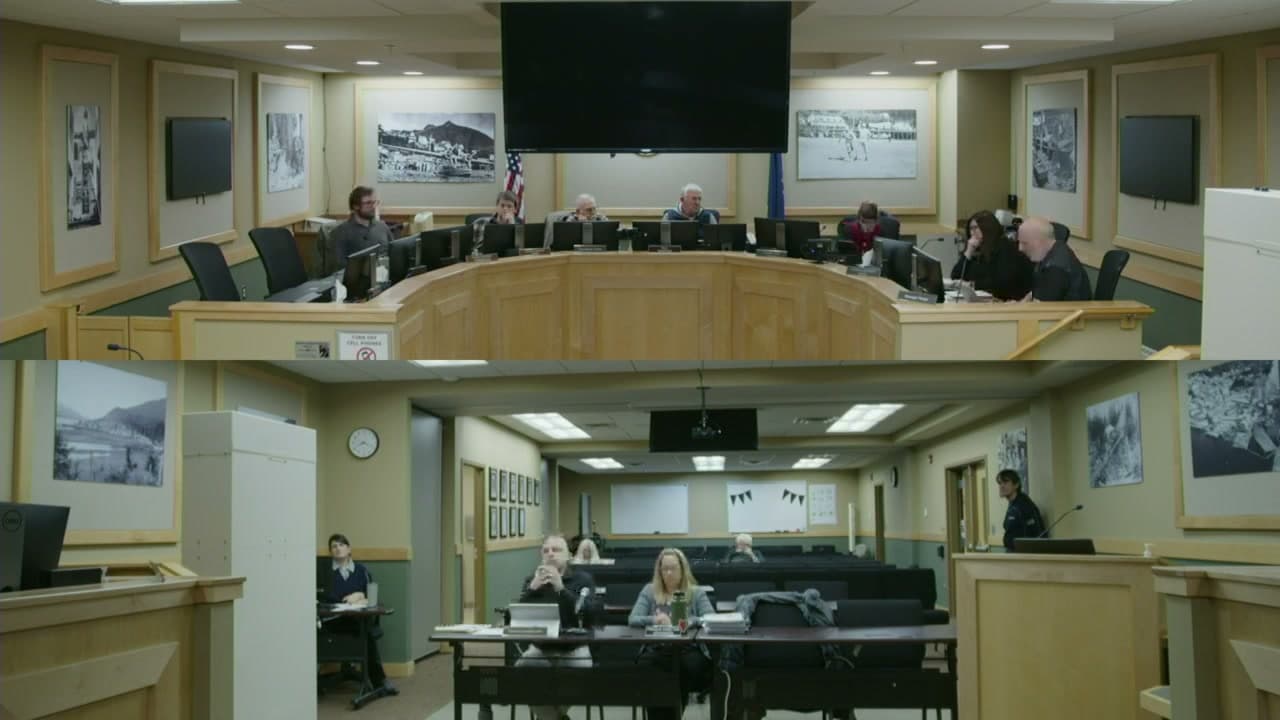
Apparently we're very dark on the video.
I'd like to thank you for this, for the acknowledgement of the things that my dad contributed to the community for the last 60 years. He loved this community and he would be very proud to receive this. So thank you. Thank you. Thank you.
That brings us on to proclamation for Veterans Day.
Whereas originally recognized as Armistice Day, November 11th commemorated the end of World War I, and whereas in 1954, U.S. Congress formally recognized the holiday of Veterans Day and honored U.S. citizen veterans of all wars, whereas millions of Americans have served in the United States Armed Forces in the past century, and whereas the State Department of Labor and Workforce estimates approximately 59,000 residents, or 8% of Alaska's population, are veterans, and whereas the freedom we cherish as Americans has been secured through the sacrifice of our veterans, and whereas it is our duty to honor and thank them for safeguarding our rights and defending our liberties at home and abroad, whereas our veterans are brave and selfless individuals who, when duty calls, willingly put themselves in harm's way to defend the lives of others. Whereas the men and women of our armed forces contribute to be inspired through their demonstration of courage, leadership, and commitment in their service to the community. Now therefore be it resolved that I, Robert Sivertsen, Mayor of the City of Ketchikan, do hereby proclaim Veterans Day, November 11th, 2026, and call upon the citizens of Ketchikan to acknowledge and honor the contributions of our veterans and to thank them personally for their service to our country. Do I have somebody here to receive this today?
No audio detected at 4:30
I'd like to thank Mayor Sivertsen and the City Council for the proclamation, but I'm going to speak to Veterans Day. Coming up this following Wednesday at 11 o'clock. We will be doing our Veterans Day ceremonies at the American Legion, followed by doors opening at 5 PM for our annual Jim Shank spaghetti feed. All veterans eat for free, and everyone else, we kindly request a $10 donation. So hope to see you all there.
And the hall is where? Right across from the old hall. It's the old water building next to PATH. On Park Avenue. So thank you, guys.
So that brings us down to persons to be heard. Madam Clerk, who do we have to speak to us tonight? First, we have Mr. Rick Hines.
Good evening, Honorable Mayor and City Council. As you know, due to retirement and promotion, we had two officers' positions open, two career lieutenants' promotions. This process involved a study period where they were given two books to learn and read. Once the study period was over, they were administered a written test an HR scenario, a fire scenario, an EMS scenario, and then the last was a chief's interview with myself, Assistant Chief Karlik, and Assistant City Manager Sean Hart. This was a highly competitive process.
All but 2 of our eligible career firefighters participated in this process. Uh, as a result of the process, um, we have 2 folks that have accepted the conditional offer of lieutenant, uh, that will be stepping into the role effective, uh, January 1st. And I, I just want to reiterate that this is a very competitive process. Some of the scores had less than 0.10 of a percentage point separating it. The evaluators were 3 respected and career fire chiefs from the lower 48 that took our policies and procedures and created a realistic process.
And it's my honor and my pleasure to introduce you to Tyler PenaGrass, Lieutenant Tyler PenaGrass, and Lieutenant Tyler Headley.
So Chief asked us to come up and just kind of tell you guys a little bit about our journey in the fire service. I grew up in and around firehouses down south, and I always knew that I'd volunteer at some point after I was established. And so after I graduated from college and moved to Ketchikan, I started volunteering with North Tongass Fire Department. I volunteered with them for about 10 years until Chief Hoag actually hired me at Ketchikan Fire Department 6 years ago. And that's been an incredible service.
And anybody that knows me knows that this is way more than a job to me. It's a passion and it's something that I care a lot about. I eat, I sleep, I dream it. And so I'm really excited for this opportunity to take my career to the next level and I'm excited to see what holds for next. Thanks, guys.
Hi there, Tyler Headley. I was born and raised here in Ketchikan. I joined as a volunteer or cadet back in 2011 and started completing Fire 1, EMT 1, and they couldn't even send me my certs because I was still 17 and they had to wait a period of time for me to turn 18. And then I was able to join as a volunteer and get my certs. And since then, it's been a long career.
I was hired in 2017 to be full-time. Also by Chief Hoag, and can't thank him enough for that opportunity. And I hope to continue to make him proud and all my fire chiefs proud and see where this takes me. Thank you. Thank you, guys.
Next, we have Mike Coleman.
It's going to be cheap.
Good evening, uh, Mayor and members of the council. Mike Holman, 700 Water Street. Um, I think laid on the table for each of you were three sets of documents. The first two consisted of one page, a letter from Director Tully of the Library, and then the second one was kind of a picture, a print of a Google image. Right in the middle of it, there's a pin.
My copy is kind of dark, but it says, "Old Civic Center location." Now, the Mayor will be able to correct me. If it wasn't really called the old Civic Center, but I remember going in there one time before it disappeared. It was green, but we roller skated in there in this space. So there's that, and then there's a stapled package of documents. So I'm going to take them up in that order.
I'll try not to be too long. So you see this email that Director Tolley kindly sent to me about the Library's collection of Ketchikan Daily News and perhaps its predecessors on microfilm at the Library, which I think is— I consider just a core part of our Library's collection. It's our history. It's comprehensive. And every few years, Not very often, and especially in the wintertime when I'm kind of bored, I'll decide, well, I want to embark on a project, but I need to know when these things happened and refresh my recollection about who did what and blah, blah, blah.
So I'll go up to the library because I know they got the Daily News on microfilm. And the last time or two that I went up there, I was kind of disappointed to find I wasn't able to scroll through there and see on the screen, but then print out to take home and work from copies of the articles that I was interested in. And I think I'm correct that the way you are able to take something home is kind of cumbersome. It might have improved or not since then, but the machine used to be able to press a button, print them out, and you get an 8x10 piece of paper printout of the article. They can't get toner anymore.
And so what you have to do is there's a cardboard box that's about this big with a hole in it. And you hold this cardboard box up to the screen. And then you get your cell phone out. And you take a picture through the hole in the cardboard box. And then you've got a copy of it.
But then you've got to get home and deal with Apple and iPhone and the cloud. And I used to be good at that stuff. But I took all afternoon just to get these things printed out. Besides, I don't like to pay Apple and Microsoft a monthly fee to be able to do— and Adobe. It's crazy.
So there are machines out there that can take that microfilm and scroll through it, get what you want, and save to a thumb drive or something. And then you can save a bunch of stuff real quick and get out of other people's way. If somebody else wants to use the machine, take it, plug it into your computer, and then you got what you're looking before, and it's just so much more efficient and accessible. Okay, so the fix, as you can see from Pat's email, is maybe $10,000. Okay, I found one used that had been sold to some other government agency.
Actually, there's 3 of them that were taken back by the distributor and made sure they worked all right, but they're used for $5,000 including a computer, okay, that maybe would do the job, but it's used. I don't know if there's a warranty or not, but it's $5,000 or $10,000 to solve that problem. That's a lot of money. I think that's a lot of money, but, you know, I'd like to be able to access the newspaper, especially the older editions. I like to go back to the '80s and the '70s.
I'm in there for a photo contest I won in 1976 or something. I'm not going to tell you who I beat, but because he didn't like it. I don't think either one of them did, but whatever. I'm in the police reports in several of them too, so it's not all good. Okay, so I've been talking with Tina Williams about it 3 or 4 times.
She has a very strong interest in the whole issue. It's her newspaper, her family's. Her interest is very similar but a little different. Her desire is to see all of the collection, and she's got the hard copies downstairs in a room, but it takes up a huge amount of space going way back. And I think she has them digitized because she's had it on the web for 10 or 12 years or something.
Those have been digitized somehow, so they're searchable. Okay, but then there's the other 30, 40, 50 years back, I don't know, that she would really like to have scanned. And there's been discussions about that. It's mentioned in Director Tully's thing. But that's very expensive.
It would take a lot of time. But I think both of these things need to be done. Last time I spoke with Tina, just a couple days ago, I said, well, what if we can get Mayor Sivertsen to appoint a little group, a little committee to meet with Director Tully, and Tina's on it, because she wants to generate a little revenue if possible too. I mean, she's paid for the production of this newspaper and the reporters who wrote all the articles and stuff. You know, that's another thing she's interested in.
I don't know how to deal with those things. All I care about is it's an important part of the collection. We need to be able to access it, everybody. The teachers, if they could pull it up off of the cloud somewhere someday and go back in a history class and show their students in the classroom, you know, the articles and stuff, that'd be invaluable. We're all in there, more or less.
So that's what I would ask, Mayor, is maybe think about appointing a little group with Director Tolley as the leader and Tina. And I don't care if I'm on it or not. I just want to see it. You know, Mayor Kiffer, Dave Kiffer should be on there. He probably uses it as much or more than anybody else.
And whoever else you might want to see on there to kind of figure it all out. Yeah, we'll take a look at it. Okay. Thank you.
So the second thing is this picture off of Google, old Civic Center location. Is that what it was called, Bob? Civic Center. Civic Center. OK.
So it was green. I didn't know— I think it was owned by the Forest Service or whatever. But anyhow, now there's nothing there. Used to play basketball and roller skate in there. It's just a hole on the south side of Waterfront Park there, right across from Keenan Currie Building.
Yeah. Okay. Well, I've thought for decades about getting a group of people together that might share an interest in getting that hole decked over again and made available to local artisans and fishmongers in the summer for sales to the tourists, but in the winter to bring the crab up or bring shrimp or fish or whatever and sell to locals, but a mini Pike Place type idea. But in any event, you got to have control of the property. Okay, so as I understand it, the city of Ketchikan should own that property today, long time ago, because there was a trade agreement made.
The city conveyed a parcel down across from the new KPU— I call it the new KPU building, it's not new— but across from Public Works so that they could build out their complex there.
There's a building that has some housing in it. There's a warehouse that has a shop and boat storage. And then there's the district ranger's building. So one of those— I think belonged to the city. The Forest Service wanted it and the city conveyed it to them.
And so they took it and built a building on it. In return, they were supposed to convey to the city this piece of waterfront. We never got it. My understanding from talking with the public works director a while back was BLM said, well, the next step And this is after decades after it was supposed to have happened. You know, needs to get around to finishing a survey, presumably to put— so they can put a property description in a deed and convey it to the city and get it done.
Well, it's not getting done. OK, so Blueberry Festival Day, Representative Baggett was in town with other notables, a lot of people out and about. He made himself available, and I asked him, you know, what would it take to get the federal government to convey this piece of property to the city? It's long overdue. It was very simple.
He said, here, here's a card. Here's the name of my lands guy back in D.C. We've done this many, many times just in the 2 years I've already been there. These bills that they pass are hundreds, maybe thousands of pages long with hundreds and hundreds of items in there. And he said, "We'll just stick an item in the next bill and order that it be done." Okay, well, he's still there at least for 2 more months and he's still in the majority for 2 months. And so, you know, couldn't we elevate this and just give Representative Baggage's staff whatever information they need for him to stick it in whatever they ram through in the lame duck session and get it over with?
I mean, maybe I can't find anybody else that's interested in my idea for the use of it, but at least then it's in local control. Maybe you want to sell it. You'd probably get $600,000, $700,000 for it if you sold it. That's all on that. All right.
Okay. I'll turn that over to the manager and we'll go from there. Okay. Appreciate it, Mike. Yeah.
So this next thing, this is closer to home for me. The stapled packet of stuff. Okay, that little office building up in the upper left quadrant, that little building at the entrance to Hopkins Alley, that's my building. I've owned that building for a long time, 40 years maybe. Okay, so we come up from— we come across from Pennick and come up the ramp and it says "keep out." It's been like this, says "keep out" since June 5th, I think.
Okay, well, that's a bummer. When the weather's nice, it's not such a big deal to take the detour down through the hanging baskets and down, even if you got trash. Now, we used to be able to dump the trash in the dumpster right there, but no, we can't do that anymore after COVID because, you know, you get a bad letter and $100 fine. So trash from Pennock has to go in your vehicle and then to the dump occasionally, you know. Every time you go, which is the only reason you go up there anyhow.
But now it's not so hard for me, not getting any easier, but my wife, she goes to work sometimes, and so she has to take the trash all the way around. Used to be, you know, go right there. Now that's my truck right there too. It's really handy. It's wonderful.
It's a great life, but I can't get there anymore. Okay, so the next picture is the barricade, the rope line. The distance from the promenade to the sidewalk is about 10 feet, maybe 9. And then you see the dumpster there. I'm going to talk about that dumpster for a minute.
But I'm trying to move through here quick. The next picture is a dumpster looking toward Gravina from the south of the dumpster. The promenade, and then there's a transfer plate. On a hinge or anyhow, it's on a little incline that's about 3 feet wide. And there's only about 5 feet from the dumpster to this transfer plate that's attached to the promenade.
So what would you like, Mike? What would I like? I'd like to know when it's going to be fixed. Well, that's a question we can ask, yes. I've spoken with the manager, but what you need to know is there's a big bid package out that's going to be, you know, bid on in the next 2 or 3 weeks.
Okay?
Now, when I look at the bid documents, I see no information about what's going to be done to fix this. I see 2 pilings going to be replaced on the south end.
The second to the last document I gave you is from 2007 calling for the kinds of repairs that, you know, they're talking about doing on the south end, 2007, 18 years ago or whatever, 19 years ago. Now, I don't see any expanded drawing of this area in the packet. I may have missed it. But I see in the last sheet that I gave you in the legend, new steel pile repair. You see that?
Second one down. The two that have that legend on them, that symbol, are on the south end. It gives me no information about when that work to get us from the harbor to the sidewalk is going to be done or what's going to be done. Now, the work— I didn't read the whole thing for comprehension. It's a long document.
And it consists of a great deal of work up and down the waterfront from Berth 1 to Berth 4. A lot of pieces of work. Now, I don't know whether it's all going to go to one bidder. Who's going to do all the work in whatever order he decides to get done, but it doesn't have to be done until April of 2028. I don't want, you know, to be living with this for another year and a half.
It's been 6 months. It's an important part of the infrastructure there. It's how you get from the ramp to the sidewalk and the crosswalk. And I've asked and gotten no answers. When I asked for information about what justified the closure of it in the first place, I was told I'm not going to give it to you.
You have to go to the attorney to get it. All right, Admiral, we can take that, right? Yes, Mr. Mayor. Thank you, Mike. Thank you.
All right, anybody else who wish to speak to the council tonight? Hearing, seeing none, brings us to the consent agenda.
Do I have a motion to consent?
Move to consent. Second.
Motion, uh, was made and seconded to consent. Any— Madam Clerk, would you read the items please? Approval of minutes, October 19th, 2026 special and regular City Council meetings. Resolution number 263045, amending the 2026 general government budget supplemental appropriations for the Police Department and Museum Department. Award of contract number 2653 for cemetery memorial expansion, Pool Engineering Inc. Budget transfer KPU Water Division travel.
Budget transfer KPU Electric Division boom truck repairs. Procurement of ExtraHop Reveal Network Zones LLC. Procurement of advanced metering infrastructure equipment, Eaton Cannon. Procurement of warehouse stock for zero copper cable, Wesco Annexter. Acceptance of Senator Mikowski Congressional Directed Spending Grant through the COPS program.
Council review of renewal liquor license and restaurant endorsement for Cape Fox Lodge LLC. Council review of liquor license restaurant endorsement for Wines International Limited. Council member appointments to boards and commissions. Any discussion?
Hearing none, would you please call the roll? Gage? Yes. Zinge?
Yes. Bradberry? Yes. Coose? Yes.
Finnegan? Yes. Strasburg?
Yes. Yes. Yes. Thank you. That passes and moves us on to new business.
There will be a change in new business. I'll take item 7D and move it to 7A1, as they're both dealing with the alternative raw water supply. And there's a presentation for both of them. We'll deal with the first one first, then we'll move right into the second one. So item A is a resolution 26-3046 approving loan number 481231-S for the Ketchikan Lakes Alternative Raw Water Supply from ADEC.
Do I have a motion, please?
Your Honor, I move to approve resolution number 26-3046 approving fully subsidized loan number 481231-S to the city by the Alaska Department of Environmental Conservation for the Ketchikan Lakes Alternative Raw Water Supply, as authorized by Resolution No. 25-2983, Authorize the City Manager to execute the documents on behalf of the City Council and establish an effective date. Second. It has been moved and seconded. Abner.
Yes, Mr. Mayor. We do have Floyd Damron here from Jacobs Engineering to give a presentation on the raw water supply line. As he's getting ready, I can tell you a little bit about Item 7A. Which is the modification request for the ADEC loan agreement. And what we are asking from the Council tonight is authorization for the Manager to sign an amended version of that loan agreement.
Originally when that came to the Council, it was for $2 million. $1.5 Million is subsidized refund— forgiveness loan, correct. We were going to take a $500,000 loan for the remaining portion. After looking at this with the finance director and staff, it is a better option for us not to finance $500,000. We can take that out of reserves and pay for that.
ADEC is willing to modify the loan to allow that to happen, and so that's what Item A will allow us to do. Thank you. And Mr. Dameron, when you're ready, you can proceed with your presentation about the line itself. Thank you very much, Honorable Mayor and council members and manager. Thanks for having me back.
It's my privilege to be here to speak to you tonight about this really important project, the alternative raw water pipeline project. Back about the summer of 2024, the city issued a competitive solicitation from engineering firms. We responded in August of '24. And through a selection process, KPU decided that Jacobs would be the pipeline designer. And for various reasons, the project has been delayed until now, and we really like to see this project move, move forward.
Funds are in place, and it'd be nice if that was approved tonight so we can get started. This is a multi-year project, as you'll see in the presentation. You can see on the slide on the picture at the left, that's the Ketchikan Lakes Dam spillway. And at the right are the two 54-inch diameter penstocks from the dam that lead water through tunnels into town, and that water supplies both KPU Electric's hydroelectric project and the city's water project. This is the city's only source of drinking water.
So I think if I go space, aha, good. So you've seen this before. But just, just as a refresher, KPU Water has two watersheds. KPU Electric has two watersheds. Water comes from Ketchikan Lakes and Granite Basin.
And you can see the water utility has 3,200 customers and 12 employees. And I just like to really compliment the 12 employees. This is an extremely efficiently run utility. And because of their dedication and hard work, as you know, back in July, KPU was the second utility in the nation to be awarded the limited alternative to filtration, which allows KPU to remain a filtration avoidance community. That's a really big deal.
So this photo shows from the dam looking towards the lake. The really nice thing about the Ketchikan Lakes is they act like a large settling basin, and that provides higher quality water than Granite Basin, which doesn't have those lakes. And so occasionally, KPU Water will divert water from Granite Basin so that the high-quality water is what the water that comes in delivers, so that KPU can protect that limited alternative filtration permit. And I'm really happy to say, as of a few days ago, we now know that KPU Water is gonna make it this year with no exceedance on source water fecal coliforms. And as a reminder, most of you know in 2019 there was a very, very temporary, very, very small exceedance of those fecal coliforms.
And within 2 weeks— I've never seen a state agency do this before— within 2 weeks, Ketchikan was ordered to build a filter plant.
And our estimate is that $70-80 million capital cost, $2 or $3 million to operate. And thankfully, we were able to negotiate with John Kleininger and his team, were able to negotiate with the state and say, rather than building a filter plant, let's develop a plan and see if we can't qualify for limited alternative filtration. And it's a 7-year story. There's all kinds of twists and turns, but thankfully that was awarded. And so we're now here to talk about the pipeline project.
This is a schematic of the water system that shows how the water goes from Ketchikan Lakes and Granite Basin to both the hydro plant and to the water plant. What the pipeline does, it's a 7,500 pipeline shown very schematically here that bypasses the majority of KP Electric's conveyance system. The tunnels, some of the penstocks. And what the nice thing about this is, is once this is in place, Granite water can continue to flow in the system and KPU Electric can take advantage of that water to create more hydroelectric energy than they were this year. Granite Basin has been diverted now for about 5 months.
And thankfully that was done because if Granite Basin hadn't been diverted, away from the system, it's 100% guaranteed that KPU would have violated drinking water standards. And that's especially not good in the first year that we have the limited alternative filtration. We basically would have to send an apology letter to the state and EPA and say, please, can we keep working with you, and can you honor the permit? But fortunately, that didn't happen. So that's the good news.
And KPU system, when it was put installed, because KPU gets its water just before the water goes into the powerhouse, way downstream of the dam and the lakes. And when that was put in, thanks to the advice of the mayor, tees were put there for future connection points. So this shows the KPU Electric's water conveyance system. This is the upstream end. You can see where the dam is, the photographs, you can see the dam, you can see the penstocks, and the bottom photo is just before it goes into the tunnel to Fawn Lake.
The next photo is at the bottom end downstream of the last tunnel. You can see the 3 penstocks headed to the powerhouse, and it's there where the city gets its water supply, and that's the water supply for drinking water and for firefighting water.
So what's the need and purpose of the project? It's really gonna be helpful if there are two conveyance systems. KPU Water wants the highest quality water. KPU Electric doesn't need the highest quality water, they just want water. And the more water they have, the more hydroelectric energy they can generate, which is good for the community.
The KPU conveyance system currently depends on 70 to 100-plus-year-old conveyance that needs to be dewatered very slowly, inspected, and most likely there's some maintenance requirements. But until that new pipeline is in place, you can't dewater the system. Why? Why can't you dewater the system? Because if you do that, the city has zero drinking water.
Zero. And there's no alternative water source. The only water source I can think of that might even be slightly viable, you used to use Carlana Lake water, but that created a Giardia outbreak. So if you use that as a backup water, everyone would be on a boil water notice. That's a horrible thing.
And you wouldn't be able to supply industrial water.
So it's currently figured the community's at risk. That's why we want to get this pipeline going. We want to get the project approved if possible. It's a multi-year project. But if any part of that conveyance system fails, you have other sources of electrical generation, right?
You have multiple sources. And worst case, if you have to, you go to diesels. There's no alternative drinking water source.
So there's competing basins, as I've mentioned. When water quality drops, Granite Basin water has to be diverted, and when it's diverted, that water is gone forever. You can't recover that water for hydroelectric generation. And so there's this yin-yang pull. Obviously, the electrical utility wants to generate as much hydro as possible.
I understand that 100%. The drinking water people want the highest quality water so that Ketchikan's not required to build a filter plant. So you see the little bit of a conflict there. Whoops, I hit something. As I mentioned, diverting Granite Basin this year saved the day.
We didn't violate on source water fecal coliform bacteria. That's a really big deal.
Mentioned that the old system really needs to be inspected and some repairs done. But based on— the project has been delayed for a couple years. Based on if we start today, my estimation is the earliest that the pipeline will be online is 2032. That's if all the funding can be lined up. If funding is delayed, then it would be later than that.
So what that means is KPU Electric is not going to be able to dewater and inspect and maintain their facilities at the earliest until 2032. When we originally envisioned the project, that was going to be 2030, but we've had a 2-year delay.
The proposed pipeline allows for growth in the community, growth for water demand from industry, from whatever reason. We want to, we want to give you a little bit of extra capacity so that pipeline be designed to carry a peak of 15 million gallons per day. And that will be considered a lifeline project because it also for firefighting water. So we'll design it as a very, very robust design for at least a 50, 50-year life, if not more. And so we're gonna be looking at seismic, geotechnical conditions, where bedrock is, stream crossings, flood conditions, all those things so that you have a reliable, dependable, pipeline you can count on for your community's water supply.
So let's talk about the Phase 1 project. That's the project up for approval now, and I'll go through the other phases here in a minute. But there's significant field work we're anticipating for spring of this year to get critical field data that will be for the permitting agencies, and there's something like 14 different federal and state permitting agencies and interested groups. Get that data for KPU. The field data really important for the beginning of the design of the pipeline.
And we actually have two projects to design. You have a pipeline, but to build the pipeline, the contractor needs an access road, which is a project all of itself. And once the project is over, the access road is going to be used by KPU then for operations and maintenance. So you have a pipeline and a road. So The field data will help us select what is the best route for the pipeline and for the road.
For constructability and for cost are some of the big deals. And once we get that field data, I guess, can pick a preliminary route working with John and his crew, then we can begin and develop the first credible construction cost estimate. Now, we won't have detailed plans and specs, but it will give you— it will shine a light on, is this a $20 million project? So $25 million, what is our estimate for the project?
So there's multiple landowners involved. This shows the approximate route of the pipeline. We've got Forest Service, BLM, State of Alaska, private landowners. So all those entities have to be reached out to and sought for permitting. And this, this slide shows the large number of state and federal agencies involved.
And some of these agencies have some pretty robust requirements, even just to step foot on their property to do the field work that we want to do, let alone to start digging. First off, we got to take a bunch of trees down, obviously. And then the construction for the pipeline and the access road.
So look at this, look at this list of 16 things that some of these landowners say we have to look at very carefully. If you take 16 times 14, that's a whole big, that's a whole lot of numbers that fills out a matrix. But some of these things have to be reviewed and accomplished with the agencies or they're gonna say you're not gonna build a pipeline. So fortunately, we have experts in the field that know how to deal with the agencies and to develop the field information that will satisfy their requirements. But there could be, we don't know yet, there could be stipulations on the construction contractor.
They may say there are certain times of the year we don't want you to construct anything. I don't know that that will happen, but may say because of bird migration, fish spawning, who knows what they may say. But if they have stipulations, that make the contract construction project longer or more difficult, that raises costs. So we need to find out what, if any, stipulations will the agencies have.
So here's a detailed list of some of the things Phase 1 is going to allow us to do. I mentioned all of the field work, civil, geotechnical, land surveying. We got to do a lot of land surveying out here to make sure that we pinpoint a route we select. We know which property we're affecting, we know what the contours are, we know what the slope of the pipe is, and et cetera.
John Kleiner and his crew has asked us, let's look at pipe material. What is the best material for this job? How big should this pipe be? Should it be 48-inch? Should it be 52-inch?
How big should it be? But it's gonna be a big pipe to carry 15 million gallons. So we're gonna make a recommendation and work with KPU on pipe material and pipe size. That needs to be pinned down early because the type of pipe also may determine which is gonna be the best route depending on the type of pipe used. Is it concrete?
Is it steel? Is it HDPE?
The route selection, and then how do you connect this brand new pipeline to the penstocks on the upstream end, on the downstream end. That's a very, very critical, important thing that be determined. Where are you gonna cross Ketchikan Creek? There's gonna have to be a bridge. What kind of bridge should it be?
How high does the bridge have to be so that if you have A 500-year flood coming out of Ketchikan Lakes, you want that bridge and the pipe to be higher than that high water.
That's the flood assessment. And then we're going to bring in— come some of our senior construction experts and say, how do we make this job more constructible for a construction contractor?
What can we do to facilitate the construction of the job? How many phases should it be?
Depending on the pipe type, where should the staging areas be as sources of gravel? Does any of this pipe gonna have to be flown in? Can it all be trucked in, et cetera?
And then, for long-range planning, a very small part of Phase 1 is what would it take to do an independent intake at Ketchikan Lake so that KPU water is 100% separated, and both KPU Electric and KPU Water have their own independent systems. But the nice thing about if an independent intake is put in, we can reach deeper water. That's very, very important if you have an extreme drought year, that having access to deeper water is a good thing. And also, the quality of the water may be different at different depths. And so we're gonna just do a quick look at what would it take to put an independent intake up on Ketchikan Lake.
We have some pretty good ideas about that already. Do a quick risk assessment of existing structures, and then like I mentioned, the construction estimate.
So let's talk about schedule. If you approve Phase 1, the majority of that work will be completed in 2027. A little bit of it will drift into 2028, but you're approving What's before you tonight is Phase 1 only. This is a multi-phase project, multi-year. So you're approving the first year, Phase 1, tonight.
Phase 2, we're estimating 2028. Once the route is selected, pipe selected, size is selected, all that is done, once the council approves Phase 2, then we can go into hard design and produce a 35% design which is a really important step in the design phase. Phase 3, '28 to '29, gets to the 65% design. Now we're getting serious. And what— as you get more design done, you get a much more accurate construction cost estimate, which allows you potentially to go to Congress to get money, go to the state, get money, go to the voters, get money, whatever you need to do.
But you'll have a better assurance of what kind of dollars are we looking 'Cause the need for the project is absolutely there. And this will probably be one of the largest projects KPU Water's ever done. It's one of the most important projects.
Phase 4, 2030, get the 95% design. Now we're getting down very, very serious. And if the funding is there, we can quickly get this job bid ready.
If we can bid the job, you have the funds to award a construction contract. We're estimating it's a 2-year construction job. It should be up and running by the end of 2032. If funding is delayed, then it's going to be in 2033 or 2034, whatever it may be.
We don't have control of that. You don't necessarily have control of that either. It depends what, what is Congress willing to partner up with Ketchikan here. So I guess for the reasons I've mentioned, we'd urge approval. It's an investment in Ketchikan's future.
I hope you can see that. That's the vision that I have. It helps us maintain the limited alternative filtration because once this pipeline is in, we don't have to divert Granite Basin like we are now. So there's a big advantage on that also. So I'm open to questions, and I hope this was helpful.
Yeah, so Floyd, explain the diversion of Granite Basin because we have the Upper Lake, right? Where the dam is and penstocks come out of that. Then we have Fawn Lake below it. So there are two pipelines that run out between, I guess, the Upper Lake and Fawn Lake, two penstocks. Yep.
They come out of the dam, they come out of the dam, and just before they go to Fawn Lake, they go into a tunnel. Off to the side is Granite Basin, and Granite Basin has its own tunnel to Fawn Lake. And if we don't want Granite Basin water, we divert it from going into the tunnel and divert it to the stream so it flows to Ketchikan Creek, and it's forever lost to hydropower. So does that answer? Yeah, because it's between the Upper Lake and Fawn Lake.
So if we were able to put a raw water or drinking water line into the Upper Lake, we no longer have to worry about the diversion. Is that correct? That's correct. There's multiple advantages to doing that because there's yin and yang here between the needs of hydroelectric generation and drinking water, but I really like the idea of being able to get access to deeper water.
So the existing pipeline comes into Fawn Lake, and it comes out of Fawn Lake and heads down to the powerhouse, right? Right, through a series of tunnels. And it's tunnels, it's not pipe? It's not— at the end of the last tunnel, then there's 3 penstocks that go into the powerhouse. Yeah, but I mean, the tunnel is from the lake to the—.
Yeah, I can go back and show you that one. To the valve house. Right? Yes, yes, let's see. So that was all done underneath, so there's no roadway, no system in place for that?
So this shows the upper end. You can see the green dashed line are the penstocks, and I don't think I have a mouse here. The red line is tunnels. You can see the granite tunnel and the tunnel into Fawn Lake. And if we go down below, you can see from Fawn Lake hydro tunnel all the way to the powerhouse.
And the very last 300 or 400— last 400 or 500 feet are those 3 penstocks. Those are steel pipe penstocks. And it's that last tunnel at the end, that's where those 3 leaking 36-inch valves are. We call that the bat cave. And in the bat cave is where KPU taps into the penstocks and gets the city's drinking water supply.
Scary place to be in when it's It's interesting. You don't want to have your Sunday shoes on. Especially in the winter when it's icy. Okay, that gives me a good explanation of why we need a road, because it was all tunnel before. Right, so we're going to be taking a totally different route.
We're going to mostly be following Ketchikan Creek on the left-hand side if you're looking upstream and follow that down to where KPU's first treatment plant is. There used to be a tram up there at some point. Yes. Back in maybe the early 1900s, I think there was a tram, a flume. Yeah.
And there's some historical photos on the website, and you see some interesting staged photos of people with fancy clothes on walking on that boardwalk. So if you go to the website, you can find those historical photos. Your Honor. Yes. Um, this also, once we do this, we also will make— um, does this also include like, um, cleaning up the old pipes so we have that backup?
Uh, or does it maintain and add into that one, the old original? Or would we be—. I'm not sure what you mean by the original pipe. Can you help me? Yeah, so I know a few years ago there was conversation about the fact that we have one line into town, what, drinking water.
So having a backup line in case something— with the old line being so old. I think I might understand. Yeah. Let me see if I understand. And forgive me if I'm missing something here.
The current connection, the plan is keep the current connection in place. Mm-hmm. That's a valuable asset. It's still the same water coming down. But when we build the independent pipeline, if we ever need to take the pipeline down to inspect it, or repair it, then you revert back to how you're doing today so that you still have water.
Right. But then once we put in the new line, we can fix the old line and nobody's out of water. Once we put the new line in, KPU Electric can dewater their tunnels, which you do really slowly going— there could be rockfalls in there. We don't know what's in there. They haven't been looked at.
They can repair those leaking valves. So that system can be refurbished. And once the pipeline is in place, KPU Electric may say— they may say every 5 or 10 years they want to do a good inspection job, and they will be able to do that. What is a disadvantage to KPU Electric when they do that is they have no water for hydroelectric power, which is understandable. So for some short period of time, that powerhouse is out of service, but you have other sources of electricity.
So I hope that—. Oh, that— yeah, no, that did. Thank you. Yeah, so back to that dewatering the tunnel, I don't think that's a real good idea. I think that we can maybe camera that or light it.
We did that at SEPA. We went down for Taií. Whatever is the safest and easiest way to do that. But you had that— you couldn't have water flowing. You had to close it off and block it off.
I understand that. But we dewatered the tunnel, yeah. The reason that you may want to dewater it is you have those 3 36-inch valves there, and if you have a large tunnel full of water, what are you gonna do? What do you do with the valves? And if you find rockfall in there that you may want to dress up and address, you would need dewater also.
But maybe the first step, I'll leave that up to Robert and his people, maybe the first step is a camera job to see it. What's there? Yeah, yeah, I appreciate that. Uh, but first of all, this, this motion takes care of getting the first stage, get the first stage going. That's I really urge you, let's get the process going.
It doesn't commit you to Phase 2, Phase 3. It doesn't commit you to construction. But at least we'll have a better idea. Do the agencies have crazy stipulations? We need to know that.
What's the best route? And what's our first estimate of construction costs? I think that would be really helpful. So is there any question on Item A? Yes, Riley.
Could we hear from Mr. Briggs from his side? How beneficial this would be to the electric department. Sure. Hi, honorable mayor, um, council. Yes, um, uh, we agree.
And actually, uh, John, uh, reached out to us, um, about 3, 4 months ago with, um, the plans and the engineering that, that we have plans for the same, uh, Ketchikan low-level outlet. So we've shared those drawings and engineering with them and encouraged them to give us their feedback and honest opinions of how we can collaborate and make sure. Yeah, he's right that the added generation, you know, I'll take generation water any way I can get it. And so through this project, long term, that will add water and it will add hydro to our electric system. So I'm in favor of it.
I know it's a very expensive project, but I think in the long run, it's worth it. And we do need to get in there, do our inspection of those penstocks, and do those other things that are really critical. Because if we have a failure or something like that, you know, it's a long process and a very expensive process. So it's better to spend the money up front to do what they're talking about and what Water wants to do, um, as, you know, for the good of the community. Thank you.
You're welcome. Anybody else?
Hearing none, Madam Clerk, would you please call the roll? Finnegan? Yes. Gass? No.
Coose? Yes. Strasburg?
Yes. Bradbury? Yes. Zingy?
Yes. Gage? Yes. And that passes your honor. Thank you very much.
So we're going to move item 7D, award of contract 2959 to Ketchikan Lakes Alternative Raw Water Supply Pipeline, Jacobs Engineering Inc. Do I have a motion please? Your Honor, pursuant to Sections 3.12.030, 3.12.051 and of the Ketchikan Municipal Code, I move the City Council award contract number 26-59, Ketchikan Lakes Alternative Raw Water Supply Piping Project Phase 1, to Jacobs Engineering Incorporated in the amount of $1,899,000, authorize a budget transfer in the amount of $399,000 from the 2026 Ketchikan Public Utilities appropriated reserves to the 2026 KPU Water Division capital improvement project, Ketchikan Lakes Alternative Raw Water Supply Piping Project, authorize funding from the Water Division's CIP, Ketchikan Lakes Alternative Raw Water Supply Piping Project, and authorize the general manager to execute the contract on behalf of the city council. Second. So, Abner, first of all, you may want to talk about the forgiveness of this loan as we go through this process. Is that right?
Yes, Mr. Mayor. On Item A that you just approved a minute ago, that's the— was the one that authorized us to update that agreement. Again, originally we had that planned and had been approved by Council as a $1.5 million loan from ADEC with loan forgiveness and then a $500,000 component of that loan that we would have to repay and was not going to be forgiven. So you've approved that in Item A that we can restructure that loan. This item will take that loan funding that we just talked about in Item A and will appropriate it to complete Phase 1 of the project that Mr. Dahmeron just talked about.
So $1.5 million of that is a forgivable loan from ADEC. Upon completion of the project, they will refund— not refund, they'll forgive the loan that we receive in the $1.5 million, and the balance of what that contract spends is what we will pay out of the reserves. Is there another presentation with this one? No, sir. We just have the one.
Any questions?
Hearing and seeing none, will you please call the roll? Singhee? Yes. Coose? Yes.
Gass? No. Finnegan? Yes. Bradbury?
Yes. Gage? Yes. Straussberg? Yes.
Motion passes. Bringing item E, Amendment Number 1 to Contract 2666, Site B. We got to go back to—. B. B. Turn— go back here.
Oh, we got to go back. Yeah, we're on—. Sorry about that. Budget Transfer KPU Division Overtime. Do I have a motion, please?
B, right? Yes, yes. Electric division over time. Yep. I move the city council authorize the general manager to transfer funds from within the 2026 Electric Division's operating and capital budget in the amounts of $50,000 to temporary wages account number 502.01, and $275,000 to personal services and wages overtime account number 501.01 for a total amount of $325,000 from the regular salaries and wage account, account number 501.01.
Second. It has been moved and seconded. Abner.
I'm having trouble finding this on the computer for some reason. Michelle, are you ready to talk about this? Or Robert, this is your item. You can come up and speak to it.
Yeah, part of the budgeting process, honorable mayor, honorable council people, is you have to look at the actuals, what the actuals are and how much you really do spend. So that's what I did through this budget process. I made sure that the budgeting reflected what it actually is. And I'd just like to read for the fourth quarter, overtime has averaged about $203,000 over the past 3 years and reached $258,223.
NOAA's forecasting a very strong El Niño with above average precipitation, as you can see from today, right? And last year it was the strongest, and in 2023 was very strong, and it was division's highest overtime. So the 275,000 requests, the current overage plus the fourth quarter of 2023 level, so the division can restore service through the severe storm season without returning to the Council later this year for additional funds. Is there any questions I can answer from the Council? Yes, Abner.
Mr. Mayor, it helps if you look at new business when we're on new business instead of consent agenda. So I'll also note that Electric Division had had some vacancies earlier on in the year which created additional overtime. And so Mr. Briggs has looked close for next year and trying to right-size his overtime, but for the current year, he had extra overtime costs. And so what we're asking to do is take funding from regular wages and move that over to overtime to cover those extra costs that he had and to make sure he has enough for this potential storm season, as we saw today, is already spending money that we need.
Yes, Riley. And Abner, just to clarify, uh, if say this is a little bit more than we need by the end of the year, could you Could you just clarify what happens to that money going into the next year? Whatever is unspent at the end of the year gets disencumbered and goes back into reserves. Yeah. Any other questions?
Hearing and seeing none, please call the roll. Okay. Thank you. Yes. Yes.
Straussberg. Yes. Jack Finnegan? Yes. Bradberry?
Yes. Gage? Yes. Zenge?
Yes. Dick Coose? Yes. Bringing us to Item C, budget transfer and award of contract number 2541 for 2813 Tongass Avenue demolition, Alaska Demolition LLC. Do I have a motion, please?
Your Honor, I move the City Council award contract number 25-41, 2813 Tongass Avenue demolition to Alaska Demolition LLC in the amount of $179,672, authorize use of a contingency $26,951 for total project cost of $206,623, authorize a budget transfer from the public works sales tax appropriated reserves in the amount of $178,000 $1,239,000, authorize funding from the 2026 Public Works capital project, Dangerous Building Abatement/Foreclosed Property Project, and direct the City Manager to execute the contract documents on behalf of the City Council. Is there a second? Second. It has been moved and seconded. Abner.
Yes, Mr. Mayor. This is the old Bar Harbor restaurant property that we've had it for a while now. We have all the permits in hand and we're ready to award the contract and get that building taken down. So we'll be able to fill in that section to make more parking lot and usable space out of it at some point in time, you think? Uh, that has yet to be determined.
Come up, Michaela, come up to the mic, get on record. Thank you, Council, Mayor. Uh, that has yet to be determined. I think that we have spoke about, um, a parking lot being there in the future, But again, we just haven't made concrete plans. And that will require quite a few permits being in the tideland area.
So thank you. Anybody else have any questions? Thank you. Please call the roll. Bradbury?
Yes. Gage? Yes. Zingy?
Yes. Yes. Yes. Finnegan. Yes.
Strasburg.
Yes. Thank you. That brings us down to item 8A, approval of vouchers for Southeast, uh, Fench Specialist in the amount of $375. 7 East. Mr. Mayor, what am I at?
7? 7 East. Everybody's lost, isn't Amendment number 1. I'm glad I'm not the only one, Mr. Mayor.
Yes, this one here. Yes, sir. Amend number 1 of contract 2666, Site B storm drain excavation investigation and building demolition, P&T Construction. Your Honor. Yes.
Move the city council authorize amendment number 1 to contract number 26-66, Site B Storm Drain Excavation Investigation and Building Demolition between the City of Ketchikan and P&T Construction at a cost not to exceed $150,999, bringing the total contract amount to $249,999, and direct the city manager to execute execute the amendment on behalf of the City Council. Second. Abner. Thank you, Mr. Mayor. So this is an addendum to the contract that was established after the October 15th winter rain event and landslide and erosion that happened over by Port and Harbor's office and the Port Maintenance— Port and Harbor's maintenance building.
P&T Construction was awarded a contract not to exceed $99,000 under that disaster. They did the initial diversion of that stormwater system so that we could protect from further erosion. This would allow them to, now that the storm pipe, storm drain pipe has arrived on island, to complete that project, replace the defective pipe and storm drain out to the Narrows. And I believe— does this also do some work on a couple other sites we identified, Shawn? Can you speak to that?
Sure. Councilmembers, Mayor, so yes, after I spoke on our October 19th meeting in regards to this disaster, there were two new sites that were discovered that were damaged a little bit from the storm. One is up on Fifth Avenue, which we're calling Site B3. Basically, what happened there is steady water at the base of the banks suggested a second water source. So the erosion is likely the source of a 3- to 4-inch bed load building up in the downstream 48— 48-inch pipe, and it's also a major entry point for debris.
Public Works has already flagged the spots for bank reinforcement or closed culvert. So basically what it did is kind of took an undercut from some trees. Those trees had possibly could have fallen and damaged more and everything else, so that has been taken care of, and that was part of this, our contract as well. And then the second site was what we're calling Site B2, which is just down from the telecommunications building. This was just some minor wash away from the storm drainage that just needs to be backfilled and everything else in regards to that.
And all of these projects are part of that disaster declaration, have been worked through the EOC, and are eligible for reimbursement from the state of Alaska. Thank you. Anybody else?
Zenge? Yes. Dick Coose? Yes. Bradberry?
Yes. Gage? Yes. Straussberg? Yes.
Finnegan? Yes. Gass? Yes. Thank you.
Now that brings us to 8 vouchers, and that's approval of voucher Southeast Specialist in the amount of $375. Do I have a motion?
Your Honor, I move for the approval of vouchers to Southeast Fence Specialists in the amount of $375. Second. Second. Abner. I'm going to have to abstain.
This is because— this is on the vouchers because the—. Yes, Mr. Mayor. Councilmember Strasburg has ownership in that company, and any time that a councilmember has that relationship with a vendor, then we bring those vouchers forward to council. Council for approval rather than through our normal process. Perfect.
Any questions?
Hearing and seeing none, please call the roll. Dick Coose? Yes. Gass? Yes.
Finnegan? Yes. Strasburg? Abstain. You abstain?
Yes. Yeah. Brad— um, yeah. Bradberry? Yes.
Gage? Yes. Zingy?
Yes. Yeah, did he abstain? Said yes. Oh, sorry, Mr. Strasburg, you'll be abstaining from this, correct? Yes, yes, I want to abstain, but when you asked me the question, I felt like I had to answer it.
It's a trick. Thank you, sorry about that. No questions. All right. That passes.
Brings us to the Manager's Report. What do you have for us, Abner? Yes, Mr. Mayor. First up, I would like to ask the Assistant City Manager to give you just an update on any additional information on the October 15th disaster declaration and the status of efforts. So thank you, Mayor— or thank you, Manager Hoag.
As I mentioned just a couple of minutes ago, we do have 2 new sites, which brings our total sites up to 4. We have Site A, which is our Ward Code Ward Cove substation, where we had that landslide that affected our substation and moved some of the buildings almost 8 feet off its foundation. Crews immediately moved the Ward Cove feeders to the Bethlehem Point Higgins substations. No customers lost power due to this. The state sent geologists to assess the slope, and we installed a camera to monitor it for movement.
Landslide Technologies completed 4 days of on-site work and gave us interim safety recommendations. Elevate, a company, a drone company, completed and surveyed the land to make sure that there was no additional possible landslides or anything, other cracks within the earth. And then October 30th, KPU energized the mobile substation next to the site. It is now carrying the North Point Higgins load. Some next steps we're working on, we are working on securing contracts and contractors for the interim slope work recommended by Landslide Technology.
Landslide Technology is finishing a memo with options for a permanent slope fix. We are working with other contractors in regards to actually assessing the damage and completing that work once it is safe to enter the area. We are still estimating the repair to take— or to cost up to $1.5 million, and that work should probably take about 2 to 3 months for completion. A second— and sorry, funding for this, we have our insurance claim for this portion. We are still working with them in regards to exactly how much they're going to recover for us.
Anything that is not recovered by insurance, the state has— will take over at that point. And then, as we're doing this and as we're moving along, the state is involved and knows everything that's happening. So each individual step that we go through, each kind of contract we go through, they're aware of and are working with us very nicely. Excuse me. Then we have Site B, which is the— or Site B1, which is the harbormaster drain pipe.
So the construction plans are complete, relief pipe is installed, and temporary berm on Tongass Avenue will push back— backed up water through the pipe and toward the North Boat Launch instead of flooding Tongass. The old maintenance shop has been demolished. During demolition, it was found a sinkhole beneath it, and that sinkhole was about 20 feet by 12 feet by 6 feet. So we're lucky there was no other emergencies or damage done prior to this. But there has been no further bank erosion in regards to the portion behind it that fell into the ocean.
And we were told that the new 60-inch pipe for this section is in town, and we're just waiting for good weather to start putting it in. As again, mentioned earlier, we have Site B2, which is a telecom site. Required documentation is complete, but construction has not started yet. Site B3 3rd or 5th Avenue up by the Armory. That's where I had mentioned they undercut the trees and we had potential of the trees falling.
We do have a temporary construction easement from the Army National Guard and are working on the permanent easement. The dangerous trees have been removed. The slope is temporarily stabilized and a new manhole and 50 feet of new pipe are in, both from city stock. So this project is about 80% complete. All of Site B, we've got about $80,000 into it as of today.
And we're still probably looking probably around $500,000 to— or $400,000, $500,000 for complete completion. Oh, just to add on to that, that sinkhole that was discovered at the Harbor Master Maintenance Facility, we were super fortunate that we took the action that we did. Had that still been sitting there today with the storm and we hadn't diverted the stormwater, a good chance that would have continued eroding into there. Kara was just briefing the staff at the department head meeting today and said there was a— some sort of floor support that happened to be right at the edge, and she thinks that's the only reason that that didn't collapse into that hole. And had it collapsed into that hole, that building had paint, it had fuel, it had all sorts of different materials for doing maintenance work that are hazardous.
It had a big diesel heating fuel tank that was right in that general area. And because of the actions that staff took and what we've done, we were able to move all of that and relocate it before it went in. So very, very positive actions. I have two more things that I'll just briefly mention. Number one is that the Totem Heritage Center 50th anniversary reception, opening reception, is tomorrow night from 5:00 to 7:00 PM at the Totem Heritage Center.
If you look on their Facebook page, they have a nice post on there about the times, and they've worked with the bus to arrange a free shuttle from various points downtown to get people up there because parking is limited. Those shuttles will start running at 4:30 and end at 7:30 PM. So it should be a good event. They'll be telling stories, I imagine, and I've heard there's cake and, you know, it should be fun. They have swag to sell, which, well, it'll be a good event.
Are they giving out swag too? And they're giving out swag. So if you can, please go down and see the Totem Heritage Center and celebrate their 50th anniversary. And then the last thing, I'll just give you a real quick update, something that came up since I published my memo is Harborview Park update. That project specifically, to kind of respond to some of the questions that were brought up in public comment, is a part of the larger project for— what are those things called?
Cathodic protection. Thank you. Slipped my mind. Cathodic protection project. So that project is a very large project across all 4 berths or all 3 berths and Harborview Park.
Harborview Park was identified with some severely degraded pilings around midsummer time and has been closed since then. Roughly somewhere in the neighborhood of a quarter to a third of the pilings are between 25% and 75% wasted, or maybe even more on a couple of them. So that project, the specifically the Harborview Park portion of it, is one of the first phases of that project. It is going to take a long period of time for the entire project, but the, the Harborview Park repairs are one of the earlier portions of that as part of Phase 1 items that have been identified. And those piles will either be replaced with steel piles, capped with a steel cap, wrapped with a protective material, and/or coated with a protective coating.
A combination of those things, depending on how far gone the piling is, what the condition of it is, whether it's above or below the waterline, all of those sorts of things. There's also a bunch of framing under there that's getting replaced. There are some components that are remaining in place as well, but in general, it's a rehab of the things that can be rehabbed, replacement of things that need to be replaced, and that is one of the very first components of that project. It is out on the street for bid currently. I don't have the exact date off the top of my head when it closes, but we do intend to move forward very quickly once that closes.
We have the project already in our CIP and funded this year, so we will bring that back to the City Council as soon as it's ready, get that awarded, and we expect work to start over this winter.
So was there— is that particular point in jeopardy of collapse? It's not in jeopardy of immediate collapse, but it's— the engineers did assess it, and they recommended not putting additional weight on it and dynamic load on it because of the condition of the pilings. There are a couple places like where the current path goes through, the pilings on either side and the framing for that specific area happen to be good on both sides of it, so you kind of have an independent walkway there. The port— the point that Mr. Holman was talking about has 4 pilings really that support that area. 2 Of the 4 are in very bad condition, and that's why that end on the kind of the north end-ish is closed.
Yes. Do we have any idea where Dock 13 is with BLM or the feds? The last that we checked on it, it was at the BLM. They needed to do the survey and they told us that all of their staff that do those surveys have been assigned to other projects by the administration. I did hear the comment about reaching out to Mr. Begich, and I will— staff will reach out to Representative Begich's office and try to contact his landsperson and see if there's something we can do to try to push that a little bit.
Riley. My question was on the project more broadly. If I'm not mistaken, we tried to push at least a piece of this forward last year and didn't get any bids. Is that correct? How that went last year on the Catholic protections?
I want to make sure— before I ask my question, I want to make sure I've understood. I think it was on the, um, Dolphins on Birth 3 that we didn't get any bids. Is that right? I thought we canceled that. And we did.
And so I don't know if we got that one. We canceled that. That was separate, is my recollection. Did we get—. So the one— sorry, Mayor, Council Members— so the ones we did not get any good bids on that we originally thought was going to cost cost about $9 million and came back at $20 million.
That was a Berth 3 safety design. So that was getting the bigger dolphins and the bigger, um, yeah, bollards. Yeah. Yeah. Okay.
Well, what I'm getting at here is on the cathodic protection side of things, do, and I don't know if this would be giving away any secrets or anything, so just tell me if it's, if it is, but do we have any, have we got any bids? Is there, uh, signs of interest or? Is what I'm worried about, because in the past we've heard that we couldn't even get the bids. So I just want to make sure that— or I guess my question would be, if we're in that predicament again, what's our plan B? Because I don't think we can keep pushing it out.
I have not heard of that. I understand you can't force anyone to bid, but I mean, I just want to be proactive. I haven't heard if we received any bids or not yet. The clerk may know. I don't know.
We don't say how many bids we have received in case— yeah. The port director did have some conversations and let some local bidders know that this was going out there, and they seem to have some potential interest. So hopefully we have some bids. Do you know the closing for that? I was just trying to look.
I don't remember off the top of my head. And for something like this, I feel like people usually wait until the last day to bid too, is what often happens. Or—. With the timeframe that we've given and some phased implementation that we've allowed in this, we're very hopeful hopeful that we'll have some bidders.
Thank you. Anything else? Mr. Mayor? Yes. Just a question following up from the manager's report from last month.
I'm just wondering if there's been any update or if we have any new information about the failed 911 calls from September. I know there was some attribution to telecom. There was discussion about it being related to Verizon. Maybe we don't have any new information now. I just want to keep it top of mind because that's just something we're going to want to have addressed before next season.
I remember seeing an email maybe last week on it, but I don't recall what it said. We've been kind of deep in this thing called budget. So that's insane. Councilmember Finnegan, we— I do have some information, um, just trying to figure out if it can be released publicly or not, or if we need to have a private, um executive session in regards to that, but we are working on it. Yes.
Thank you. All right. Did you have something, Chief Manson? Just had one more comment. We've recently had another out of town, so it was not a 907 Verizon cell phone that called 911, wasn't able to get through.
Dispatch was able to call them back. Uh, that typical call, or that specific call, was a motor vehicle accident that did require emergency services. So, I mean, it's an ongoing issue. So it has not been resolved yet. But again, it was an out-of-state, like, I can't remember, maybe Arizona area code.
So for the Chief, if I may, through the Mayor, was that also a— do you know if that was a Verizon user as well? It was a Verizon phone user, yes. Thank you. Yes. Staff will continue working on this and we'll bring something back to provide information once we have something solid to share.
Thanks. Thank you.
Anything else, Abner? No, Mr. Mayor, I think that is all I have for the manager's report. Thank you. City Clerk's file? Nothing, Your Honor.
City Attorney's file? He's on vacation, sir. Future agenda items? Yes, Riley. Question for—.
If I heard you correctly, what I think Dick was asking about it, but this deal on the— did you call it DOC 13? DOC 13, I think. What we're calling it? Yeah. You guys are working on that.
We don't need a future agenda item for that. Correct. We'll take care of it best we can anyway.
Mayor and council comments. Abby?
None tonight. Janalee? Nothing, Your Honor. Just condolence Condolences to the Poole family. Thank you.
Judy?
Nothing, Your Honor. Dick? Nothing, Your Honor. Riley? Yeah, thank you to the veterans and hope we can all take time to acknowledge Veterans Day coming up.
And also, uh, condolences and appreciation to the Poole family. Uh, they're just a family that's contributed to this town in so many ways for so many years and I got to know Chuck personally and certainly going to miss him and appreciate everything he did for the town. Thank you. Do you act? Thanks, Your Honor.
I was just going to mention that I was pleased to see that many of the division— KPU Electric Division vacancies have been filled for 2026 and was also pleased to see that a journeyman lineman is expected to start by mid-November, especially considering the weather we're seeing this week. It's nice to know that we'll have extra hands on the deck. Thank you. Spencer.
Yeah, same for me. Uh, condolences to the Poole family and a lot of appreciation for them. Um, I was lucky to work with, with Chuck on numerous jobs, and I really consider him a mentor. So, um, we're gonna—. Everybody's gonna miss him.
Other than that, Abner gave me a great onboarding this week. And I'm excited about getting busy.
Thank you. Thank you, Spencer. Yes, and rest condolence to the Poole family. Chuck is, you know, he did a lot of stuff in this community. He participated in many different things, supported our local sports, helped people out whenever they needed a hand.
He was good at collaboration. A wealth of knowledge, and he's certainly going to be missed. And he was a dear friend, so we'll miss him. And I'd like to welcome those firefighters on and getting their shirts up and being in the business and thank them for their service. And of course Veterans Day is coming up, and it's always a good event.
The American Legion does a great job on that, and I encourage anybody that would like to to go out and visit with them. They're very well.
Everybody needs to go to the museum.
That brings us to our first executive session. Request for an executive session, Ketchikan Gateway Borough Library Agreement.
Your Honor, I move the City Council declare that consistent with the City Manager's recommendation, it is in the best interest of the city to discuss the city's negotiated negotiating position and strategies relative to negotiation of library services to non-area-wide residents of the Ketchikan Gateway Borough following the December 31st, 2026 termination of the city borough library services agreement in executive session. In accordance with that finding, the City Council will go into executive session in accordance with KMC 2.04.025 to discuss said negotiations and subjects, the knowledge of which would have an adverse impact upon the finances of the city. Second. It has been moved and seconded.
First, we'll call the roll on this, and we'll take a short break afterwards. And we'd have to ask the public to clear the room because we utilize this room as our executive session, is that correct? All right, Madam Clerk, would you please call the roll? Gass? Yes.
Coose? Yep. Strasburg? Yes. Finnegan?
Yes.
Bradbury? Yes. Gage? Yes. Zingy?
Yes. We'll stand in recess for executive session. We'll take a short break and come back at about 5.
No audio detected at 1:28:30
No audio detected at 1:29:00
No audio detected at 1:31:00
No audio detected at 1:33:00
No audio detected at 1:35:00
No audio detected at 1:35:30
No audio detected at 1:37:30
No audio detected at 1:39:30
No audio detected at 1:41:30
No audio detected at 1:43:30
No audio detected at 1:45:30
No audio detected at 1:47:30
No audio detected at 1:49:30
No audio detected at 1:51:30
No audio detected at 1:53:30
No audio detected at 1:55:30
No audio detected at 1:57:30
No audio detected at 1:59:30
No audio detected at 2:01:30
No audio detected at 2:03:30
No audio detected at 2:05:30
No audio detected at 2:07:30
No audio detected at 2:09:30
No audio detected at 2:11:30
No audio detected at 2:13:30
No audio detected at 2:14:00
No audio detected at 2:16:00
No audio detected at 2:18:00
No audio detected at 2:20:00
No audio detected at 2:22:00
No audio detected at 2:24:00
No audio detected at 2:26:00
No audio detected at 2:28:00
No audio detected at 2:30:00
Sorry, it's a new system. Can you guys hear us? Okay, here we go. All right, we'll come out of executive session, reconvene in regular session. There's a place for a motion if needed at this time.
Is there any motion? Your Honor? Yes. I move the City Council direct the City Manager to negotiate with the Ketchikan Gateway Borough an interim amendment to the library services agreement extending its term through June 30th, 2027. And a transfer of library powers or a successor agreement consistent with the parameters discussed in executive session, with any proposed agreement returned to the City Council for approval.
Second. Any discussion?
Hearing none, Madam Clerk, would you please call the roll?
Bradberry.
Yes.
Jack Finnegan? Yes. Gass? Yes. Strasburg?
Yes. Coose? Yes. Gage? Yes.
Zingy?
Yes. That motion passes. Is there anybody outside that wants to come in?
We're going to have to kick him out again. We have to kick him out again for the next session. I know. I'll just inform them what we did.
We'll move forward.
Bring this item B, request for an executive session, collective bargaining agreement between the City of Ketchikan and IBEW Local 1547. Do I have a motion, please? Your Honor, I move the City Council declare that consistent with the City Manager's recommendation, it is in the best interest of the city to discuss the status of and strategies relative to negotiation of a new collective bargaining agreement between the City of Ketchikan doing business as Ketchikan Public Utilities and the International Brotherhood of Electrical Workers, Local 1547, to replace the existing contract expiring December 31st, 2026, in executive session. In accordance with that finding, the City Council will go into executive session in accordance with KMC 2.04.025 to discuss said negotiations and subjects, the knowledge of which would have an adverse impact upon the finances of the city and upon the city's ability to negotiate favorable labor agreements. Second.
It has been moved and seconded. Any discussion? Your Honor, I've been advised by the attorney that I am a member of that union, so I will be abstaining.
Okay.
No. Madam Clerk, please call the roll. Gage.
Yes. Dingy?
Yes. Coose? Yes. Bradberry?
Yes. Strasburg? Yes. Finnegan? Yes.
Gass? Abstain. All right, with that, we'll move into executive session. Um, sorry, one second.
No audio detected at 2:35:00
No audio detected at 2:36:00
No audio detected at 2:38:00
No audio detected at 2:40:00
No audio detected at 2:42:00
No audio detected at 2:44:00
No audio detected at 2:46:00
No audio detected at 2:48:00