Seward: City Council Meeting 11/9/2026
Alaska News • • 151 min
Articles from this transcript
Seward budget would end winter sales tax and set a 6% summer rate as hearings begin
Seward's proposed 2028 budget would drop sales tax to zero in winter and raise it to 6% in summer, plus cut property tax by one mill. Council votes Dec. 14 after two more public hearings.

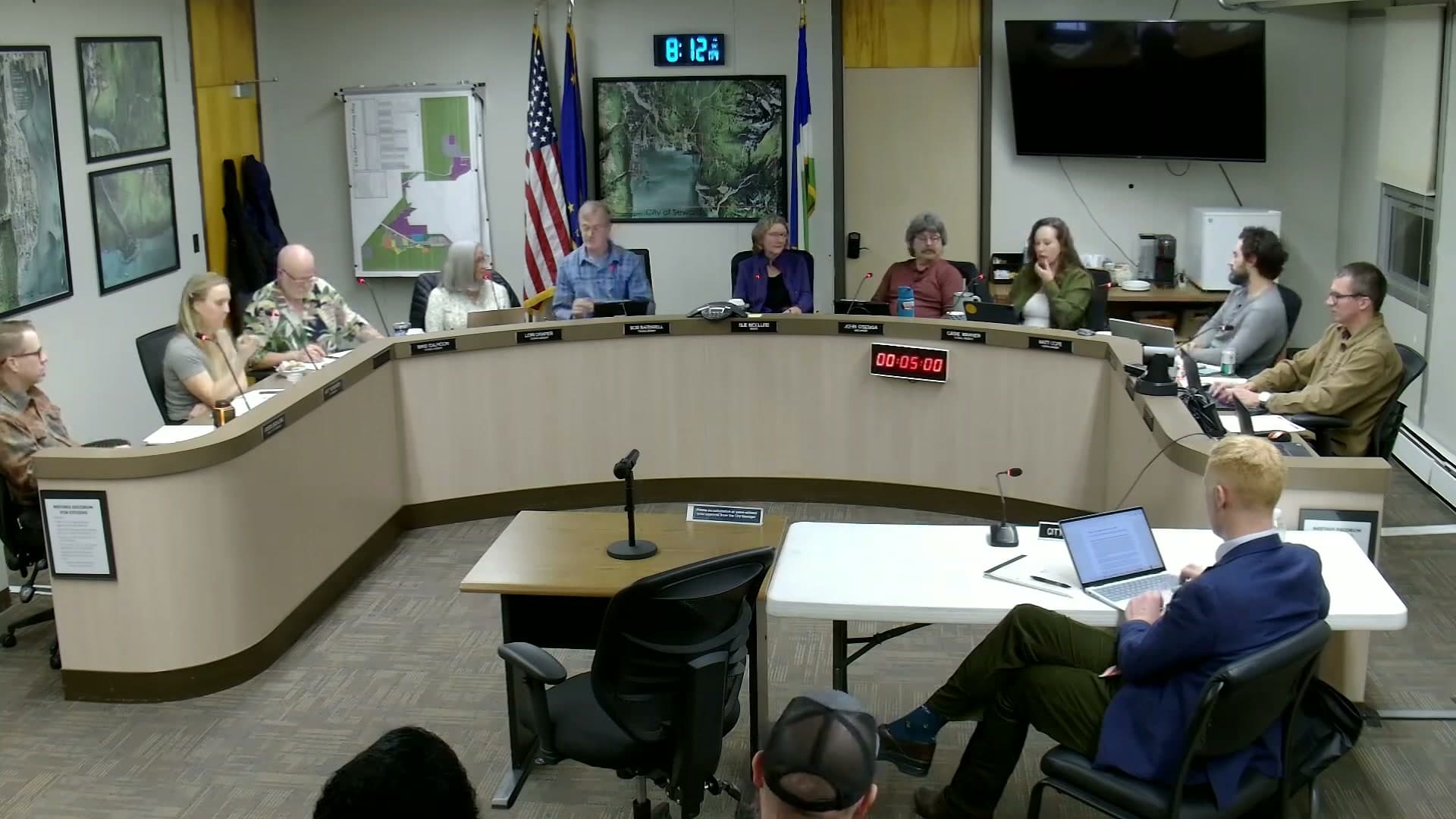
We're streaming to YouTube. Ready when you are. Okay, I'll call this meeting of the Seward City Council to order. It is Monday, November 9th, 2026, 7 PM. Chief Tyner, would you please lead us in the Pledge?
I pledge allegiance to the flag of the United States of America and to the Republic for which it stands, one nation under God, indivisible, with liberty and justice for all.
Mr. Clerk, would you please call the roll? Roll call for tonight's meeting. Calhoon. Here.
Osenga. Here. Casie Warner. Here. Draper.
Here. Barnwell. Here. Cope. Here.
And Mayor McClure. Here. You have a quorum. Okay, thank you. Um, we have one proclamation, and I've asked Councilmember Calhoon to please read it.
Thank you, Madam Mayor. Whereas, since the birth of this great nation, millions of Americans have answered the call to defend our American ideals of freedom and democracy throughout the world. And whereas Veterans Day is a time to reflect on the service and sacrifice of all generations of these veterans who have given selflessly of themselves to defend our freedom and our American way of life. And whereas the origin of Veterans Day began with the Armistice on June 28, 1918, also known as the Treaty of Versailles, which formally ended the hostilities of World War I. And whereas we gather on the 11th hour, on the 11th day of the 11th month, as we have every year since November 11, 1919, to express our gratitude and appreciation for the selfless service of our veterans to preserve our rights, liberties, and privileges.
And whereas our men and women in uniform have been the bearers of a proud military tradition of selfless service in both peace and war that has been passed down from generation to generation for more than two centuries, and whereas our community has a fundamental obligation to acknowledge the contribution, courage, and distinction in the face of adversity, the unwavering commitment to America of our veterans of all wars, and whereas it is essential that we salute those who have fought to defend our nation never forgetting the brave men and women who have made the ultimate sacrifice to ensure freedom for all people, and whereas on Veterans Day we pay tribute to our veterans from the humble beginnings of this great nation and their families to honor their selfless service with a renewed determination of commitment to keep the promises we have made to all who answered our country's call. Now therefore, Sue McClure Mayor of the City of Seward hereby proclaims November 11, 2026 as Veterans Day and calls upon all citizens of Seward to honor all veterans for their enduring commitment to preserve the highest freedoms and ideals on which America was founded. Dated this 9th day of November, 2026, and signed by Mayor McClure. Thank you.
Councilmember Calhoon, would you like to just mention what's happening for the veterans at the Legion? I can do that. On Veterans Day, which is Wednesday, there will be some of the elementary classes will be coming to the American Legion to talk to and meet some veterans. And Doug Capra is going to give a little historical talk there. He did that last year about Edna Weir, who was one of our female World War I veterans.
From here. So that was very interesting. And then the Senior Center will be hosting Veterans for Lunch at 12 o'clock at the Senior Center. Thank you. Um, I guess we're all the way to citizen comments on any subject except those items scheduled for public hearing.
We do have one public hearing item that's on the budget. Um, so you have 3 minutes to speak on any topic. There's a 36-minute total time. The clerk will keep track. There was a sign-up sheet for this, and we'll take those people signed up in order, and then within the time frame, I'll take those hands to come up and say whatever you want.
So, Mr. Clerk, who do we have signed up? There are 2 people signed in to speak, and First on the list is Jamie Crocker.
Hi, I'm Jamie Crocker from Inside City Limits. Good evening, Mayor and council members. I'm here tonight to express my interest in representing Seward on the Kenai Peninsula Borough Planning Commission. One thing I have discovered while working for the city of Seward is just how much I love public meeting process. I genuinely enjoy everything about it, from preparing for meetings to listening to discussions, learning about the issues, and seeing how decisions are made.
I've wanted to serve on a city commission for quite some time, but because I work for the city, that has not been an option for me. And I absolutely love my job, so leaving it is something that I just can't do. That led me to look for opportunities outside the city, and I came across this opening on the Borough Planning Commission. What makes it even more exciting is that it focuses on something I'm already incredibly passionate about, and that is planning and zoning. I know I still have a lot to learn, but I'm excited about that.
I would love the opportunity to take what I've learned through my work and use it to serve Seward in a new way. Thank you for your time and consideration. Thank you, Jamie. Um, Mr. Clerk, who's next?
Next on the list is Cosmo Anderson.
Hi, my name is Cosmo Anderson. My pronouns are they/them, and I live inside Seward city limits. I am here today to start a conversation that might be uncomfortable for some of us in this room But sometimes uncomfortable conversations must be had for the sake of education, reconciliation, and growth towards a community where everyone feels welcome. At the last City Council meeting, I introduced myself the same way I did tonight. The inclusion of my pronouns are intentional and essential because it directly communicates to everyone in this room how to refer to me in a way that honors and respects my dignity as a human being.
Later that same meeting, Councilmember Calhoon called me Mr. Anderson, and used he/him pronouns to refer to me. Whether or not this misgendering was intentional does not matter because it was disrespectful, harmful, and violates Section 18.80.255 of the Alaska Human Rights Law, which has been interpreted to include discrimination and harassment on the basis of a person's sexual orientation, gender identity, and gender expression as sex-based discrimination. The Human Rights Commission upheld their commitment to this interpretation in regards to employment on October 14th, 2025, in a case involving a non-binary youth. You do not have to understand what it means for someone to be non-binary to respect them. Some people have not heard a lot about non-binary genders or have trouble understanding them, and that's okay.
Identities that some people don't understand still deserve respect. Humans make mistakes. What matters most is to show that we're trying. If you mess up, briefly apologize and repeat what you just said using the correct pronouns. We can use our mistakes as learning opportunities and hold ourselves accountable by educating ourselves on this topic and committing to make a more conscious effort to ask for and respect people's pronouns in the future.
Over time, you might find yourself making fewer and fewer mistakes. Be patient and demonstrate support in trying, because when we use someone's correct pronouns, it creates an inclusive environment where everyone feels respected and welcome to participate. Actively choosing to not use someone's pronouns is harassment and implies that intersex, transgender, non-binary, and gender non-conforming people do not or should not exist. I would appreciate an apology from Council Member Calhoon, and I invite him and the rest of the council members to reach out to the Seward Pride Alliance at [email protected] for the sources referenced and the information I've shared tonight and to seek further education on how to ensure that Seward is a safe place for us all. Thank you for your time.
Thank you, Cosmo.
Those were the only two that signed in. Okay, anyone else wishing to speak on anything other than the public hearing item?
Come on up, I see the hand. Oh, Becky. There was a hand that I couldn't see. Becky Dunn, Inside the City.
I—. Part of the way I make a living is running U-Hauls, and I'm seeing a trend. Senior citizens are leaving at a rapid rate. We're talking people that you and I went to grade school with. They're leaving town.
I'm sorry, I was not supposed to address any particular person, but everybody knows who's lived here. Born here maybe, but yeah, so there's people that have lived here for a long time that are leaving, and families. I'm talking the whole family, the parents, the grandparents, and the children. So when we start to figure out how to address the mail rate, I would suggest starting with— the state of Alaska requires or regulates— not sure what the right word— a $1,500 exemption on property tax for senior citizens. The city of Seward does follow through with that.
The borough is $300,000. I would like to see the city of Seward do that, raise the senior citizens' property tax exemption is would be on the first $300,000. And the borough also offers a $75,000 exemption for year-round residents that own and live on the property. And I'd like to see the Seward City do that. We do not at this point.
So to make it clear, inside the city, you, you, outside the city, you get The first $375,000 value of your property, you do not have to pay taxes on if you're a senior citizen that lives there year-round. So if the city of Seward were to follow through with that, according to my calculations, for just the exemption— is stackable for the, for the borough, the $75,000 and the $300,000 is stackable. So inside the city It would be $288.75 on the first $75,000 if you were a year-round resident, which we're not getting right now. And for the senior citizens, it would be an additional $570— no, it wouldn't. That would be the total exemption, be $288 for the additional senior exemption, which would bring the total savings now would be more than— would be an additional $577.50.
And somebody else should probably check my numbers on all of that. But I just thought I would suggest that to make a— to help year-round residents. It's like getting part of a PFD or something. Maybe in addition with the sales tax thing to not charge sales tax on heating fuel for those months. Or or electricity, and I would like to see that follow through for the businesses that are year-round.
They need help too. Okay, thank you, Becky. Anyone else wishing to speak now?
Last chance. Okay, um, we'll close citizen comments at this point and move to approval of the agenda and the consent agenda. I'd ask I'll move for the approval of tonight's agenda and consent agenda. I'll second. Okay, are there any changes anyone would like to make?
Yes, Councilmember Calhoon. Madam Mayor, I'd like to add Jamie Crocker being appointed to the Planning Commission and Becky Dunn to PACAB to the consent agenda. Thank you. Is there any objection to that? I was about to do that very same thing.
Any other changes? Okay, Mr. Clerk, we're ready to vote.
Voting on the approval of tonight's agenda and consent agenda as amended. Osenga? Yes. Calhoon? Yes.
Barnwell? Yes. Cope? Yes. Warner?
Yes. Draper? Yes. And Mayor McClure? Yes.
Your agenda and consent agenda have been approved. And on the consent agenda were the October 26, 2026 City Council meeting minutes, the introduction of Ordinance 2026-012 amending the Seward City Code 15.10.226, land uses allowed, and 15.10.320, conditional use permits, to recommend Jamie Crocker for the Seward seat on the to the KPB Planning Commission. And lastly, to appoint Becky Dunn to PACAB for a term set to expire January 2029. Okay, thank you very much. Uh, next on the agenda is the City Manager report.
Madam City Manager. Thank you, Madam Mayor. Uh, one thing I wanted to point out in the City Manager report tonight, we have been hard at work at transitioning the Seward Middle School to the new community center. The Halloween Carnival was a huge success with over, uh, 600 people showing up to explore the haunted house and the different facets of that. And as we've gone through this process of moving it from a middle school over to a community center, some of the things that we've been working on are incorporating new activities within the space that are more in line with the community center.
And some people may remember back in 2021 No, 2022, we did a feasibility study for a recreation/community center that we've kind of been looking towards for inspiration there, as well as conversations in the community and things like that. So if you look at the city manager report today, you will see that a purchase order for a sauna was approved to put a sauna in the back of the community center. We currently utilize the sauna space at Avtech. It's very very highly utilized, seeing a dozen people each night for an hour, because it's split by gender and limited to an hour. So we wanted to move forward with that purchase to add that to the community center.
So as we transition out of the AV-TECH space, the community isn't losing anything and can still access that sauna. That being said, building codes might prohibit us from putting a sauna there. We even have to follow the building codes here at the city. So while it's— the purchase order was approved. It may not go through, but I just didn't want to point that out because sometimes it can be jarring to see a sauna on a purchase order and be like, what are we doing there?
Which I completely understand. Um, some of the other things that we have been going through, we, we've spent about $16,000 so far throughout the middle school. We've rekeyed it, we've gotten a few gym dividers to divide the space up into so there could be two activities going on at once. Pickleball equipment, different net equipment, a bunch of paint from in town here, and then we've been painting all the walls and everything. So I should have like a more robust report of what we've been doing so far, but just a quick update on that.
And look to December 1st for our official opening there. Yeah, and that's all for me tonight. All—. Yeah, okay. Uh, Mr. Bickling, do you have anything?
No, I don't. Thank you. Okay, are there questions, comments from Council? Yes, Councilmember Warner. Thank you, Madam Mayor.
Um, I was just wondering if we could get an update from Administration on what's happening with the culvert down by the lagoon. Yes, um, we had to do emergency repairs at the culvert, so we have been digging out there with the help from Metco just to make sure that's being maintained with the high rains that we had. It's flowing pretty well now, so we're in a good spot. We'll continue to manage and mitigate it as it goes on and look towards repairs and things in the future that are more long-standing. But as of this time, it's mostly emergency response and clearing it out and seeing what's hiding in there, which is a lot.
Thank you. And you go ahead. Thank you, Madam Mayor. Um, I have one more, and I should have probably left with this as more of a transition because it goes back to the Community Center, but Parks and Rec has held like the gross motor talk time activity at AVTEC. Is that going to be moving, that will move over to the new Community Center?
Probably, but I don't know off the top of my head. Yeah, we'll have, once the Community Center is up and running completely, we'll have a calendar just like we do currently with AVTEC that differentiates between what is and isn't being held and where it is. So like open, uh, not open volleyball, but volleyball on Mondays and Wednesdays is at the new community center now. And that's differentiated. So as we move on, certain things will move over, but I'm not 100% certain about tot time.
I think so. But I don't know. Other questions, comments? I've noticed— I was saying before the meeting, I've noticed that several people have turned on their Christmas lights or put new decorations out already. It's dark out, so we like the lights.
So I know the city will be doing their Christmas lights on power poles and things. Yes, we will. I focus on my house first and then the city. I'm sorry, but yes, we will be getting all that squared away. And then also mark your calendars The Saturday after Thanksgiving, the 28th, which is the 28th, we will be doing the Christmas tree lighting in conjunction with Shop Small Saturday throughout town here.
So it's always a really fun day. The library will have an open house and the museum and the museum, the museum and the library music. Uh-huh. And then the band will play as well. And then the mayor will light the tree.
I think the Grinch is gonna show up again. I don't know. I don't think I'm going to buy any Christmas this year. Butch can't keep him in cuffs, apparently. But there is an ongoing rule in my household from when I was a child that you can't talk about Christmas too much until Thanksgiving comes.
So that's my—. I don't have that rule. Community choir has been rehearsing since mid-September with only Christmas music, so we're tuned in. Very good. Anything else?
That's for City Manager. Okay, thank you very much. Um, City Clerk, you got the report on page 38. Yes, thank you, Mayor McClure. Last week was certainly a busy one, and City Council Chambers was in almost non-stop use— absentee voting office by day and then converted to the budget work session venue by night.
And I just wanted to share a few stats from the election for the Seward, Lowell Point District, we had 303 votes cast during the AVO period and then another 539 votes cast at the library on Election Day. So for anyone wondering what our voter turnout may have been like if our local election was in November, I'm guessing it would have been in the 800 range compared to the 388 that we got back in October. And then also, notice on my left, the seat is vacant. Jodi Kurtz has moved out of state, so we're sad to see her go and wish her well on her future adventures. And we are advertising for the position of Deputy City Clerk.
Okay, thank you. Um, yeah, in case you missed it, our— at our last meeting, we approved moving our municipal election to be the same day as the boroughs and the states and everything. So we've joined the— joined the others, and so we'll just have one election day. It would be the first Tuesday of November. Now see how that works.
Okay, any questions for the clerk? Councilmember Drake? Yes, Chris, I'm just wondering if you happen to have a percentage of voter turnout. Do you—. Did you do the math on that?
I don't have all the stats for this election because it wasn't a city election, so it's just sort of the borough and the state, and I got what stats I could from just the results tape as well as our logbook in here for the ABO. I was just kind of excited thinking it might have been one of our higher turnouts. Oh, wow. Thank you. Anything else?
Thank you, Chris. City Attorney report, you'll find on page— I just got it right here— 39. And we have our attorney Sam right there. We do. Yeah, thank you.
Um, last month, uh, definitely a little bit of an uptick in just overall, uh, contact with the city. Nothing bad, I think maybe just got darker outside. It'll turn to projects that have been deferred maybe.
Not much to add that's about any specific matter. I guess one thing as I'm looking over the report, the electric utility, Cody in my office has been doing a lot of the electric stuff and he has been given an opportunity to travel with the Coast Guard that he couldn't refuse. So he's— he is— He's still in contact and hopefully starts working again, but that was relatively recently, and so he's still kind of getting his feet under him, but that'll be for a while. So you'll see more of my name and others' or faces with regard to electric utility matters for a while until he's back to being more involved or back.
I guess the other thing, I often try to pick something and give a 45-second educational I'll fill in the pieces when I can, but one thing that I noted on here is that it talks about reviewing a participant waiver for events, and that's something we do often for cities, and it's a good exercise to just dust those off. And a couple things that were really big picture that we're looking for on those is there was some Supreme Court guidance years ago that said a couple of things which are really intuitive when you think about it, but— is that they really pay attention to like the font and how it reads and is it readable or is the information buried hopelessly in boilerplate that nobody's ever going to read. And they actually look at that. So one of the things is to just make sure that they're clear.
And another component of it is specificity in describing the potential dangers, which makes a lot of sense, but if you want to have a knowing voluntary waiver, you need to describe what the actual risks are. So that's not all we look at, but those are a couple of the things. And that's something we've done a handful of times for the city. But otherwise, unless there's questions, most of it's laid out there. As always, there's personnel matters and not appropriate to talk about those, but if Council ever publicly— but if Council ever needs or wants an update on what we're doing in that regard, glad to discuss it privately.
Okay, questions for Sam?
We love your educational moments. No questions? Well, thank you very much. That brings us already to number 8, public hearings. And we have just one.
And for the public hearing, we have a protocol when it's time for the speaker— for the public to speak. There is a sign-up, but we can take more, and you get, I believe, 5 minutes per person, so up to.
So, Mr. Clerk, Lori Draper, would you please read the title into the record?
Resolution 2026-090, adopting the City of Seward 2027 and 2028 operating budget and setting the mill rate. Okay, thank you. And you'll see the resolution itself on page 41. This hasn't been brought up for adoption yet. I'd ask for a motion to approve.
Approve and a second, please. I'll move for the approval of Resolution 2026-090. I'll second. Okay, it's been moved and seconded. Administration, what you got?
Thank you, Madam Mayor. I promise I have a very short presentation. I slimmed it down about 27 pages, so if the clerk could line that up. I also want to give a big shout out. I presented to Miss Sutherland's current events class at the high school last Thursday.
I gave them the, the overview presentation of the fiscal year budget for '27 and '28 and was really happy to get some feedback from them. And it was really interesting. And some of the changes that I made to this presentation were from feedback from high school students. So big shout out to that class. But tonight, Tonight, just a quick overview of kind of the things that we discussed at our week-long work session on the biennial budget.
The big starting point and the topic of conversation is the new general fund revenue stream starting in 2028 that transitions the city to a seasonal sales tax rate with 0% in Q1 and Q4 and 6% in Q2 and Q3. This move was made with— because about 81% of taxable sales happen in Q2, Q3, so the summer rate drives revenue in those, um, months. And the 3% borough tax does not change. This brings in additional revenue of $1.67 million from FY28 versus FY27, which is about a 14% increase. The next question you may ask: what do— does this new revenue cover?
With those additional $1.67 million in revenue, uh, $650,000— and these are rounded numbers, so please bear with me there— but about $650,000 of that covers a 1 mil tax rate— property tax rate reduction from 3.64% to 2.64%, in addition to a $75,000 homeowner exemption as well. So a pairing of both of those we are estimating to come in at about $650,000. So a $1 mil drop and a $75,000 primary homeowner exemption. We also are budgeting for $350,000 additional a year to hospital capital support to make sure that our hospital is maintaining and increasing capital up there. There's 3 positions that have been funded that will help make the city run a little bit smoother.
The addition of a second police sergeant so that we have 2 police sergeants helping to cover both of the those shifts for our fully staffed patrol. An IT technician to make sure that we're staying up to date on all of the IT infrastructure and cybersecurity throughout our entire city. The IT department helps manage every single thing that plugs in, including in this room, so they are very, very well utilized at all times. And a maintenance and street worker as we add streets to the town and see any new development and add buildings and things to the town, we want to make sure that we are maintaining those properly with the amount of right— of workforce. The other two big-ticket items that we approved this year that needed to be funded for the remaining years is the community center.
The utilities there average out about $235-ish thousand dollars a year. We also are budgeting for a part-time custodian and general upkeep of that building. Investing in it and maintaining that to be a well-run and well-utilized community center for years to come. And also the pool contract. We needed to step in when the borough said that they were going to unfund the pool and said that we were willing to make a commitment to fund that at $200,000 a year.
And so we need to make sure that the revenue is there to match that. Together these total about $1.85 million, slightly above the $1. $1.67 Million, and so there are additional things throughout that we were able to cut or adjust to make sure that the revenue matches expenditures. And this is for FY28 only. Recognizing that a lot of people pre-book in the summer months, we wanted to create a bridge year, a gap year before that seasonal tax rate starts.
So FY27 will have those costs bridged with a one-time transfer from the campgrounds and Parking Enterprise Fund. The fund does not have enough to sustain that indefinitely, so it can only be a one-time transfer. One of the reasons why we wanted to make this transition when we just— when we had our survey results out this previous summer for budgetary input, one of the big things was we heard from the community was making it a cheaper place or more cost-effective place to live year-round. And And so this was a slide that I was recommended by the high school students to make in the high school classes. How much exactly can a family or an individual save with a change in the sales tax?
On average, a city of— or a Seward community member will pay 3% year-round averaged sales tax with the seasonal sales tax. But what we really see is a bigger savings in the winter months. So we took the estimated average amount of $15,000 a year, which is spent on a family of 4 on groceries. In the winter, that would come out to $300 worth of sales tax— in— $300 savings in sales tax. In the summer, it would be about $150 extra with the seasonal rate, and so a net savings each year on groceries alone for a family of 4 would be about $150.
With this additional sales tax drop in Q1 and Q4, the grocery tax paid by a customer would be zero since the Kenai Peninsula Borough already exempts groceries in every month but June, July, and August. So we're able to add to the cost savings there for our community members. And then a small breakdown in the left of, uh, what exactly at different levels of taxable sales you would be saving as a Seward community member.
Another big question that we talked through was moving the campgrounds into an enterprise fund. This removes about $1.26 million of revenue from the general fund each year, but we are recommending to just transfer that in annually from the campgrounds. So the big question there is why would we Why would that be necessary then? The main reason it's necessary is because a general fund pays for core services like police, fire, and the library. They don't earn as much revenue, they earn very little revenue, so our general fund taxes are what pays for them.
Campground fees are set up to cover the costs of running, maintaining, and replacing the campgrounds, which is the fundamental test for what an enterprise fund should be. Parking works the same way and is operated by the same team, the Parks and Rec Department, department, so one combined fund can sustain itself in the long run. And it's a really good way to make sure that major repairs are paid from the fees of the campground users, not general fund taxes. We want to make sure that our general fund is going towards making our community a safer, healthier, happier place to be, not maintaining the campgrounds in the waterfront. The question that I asked myself and some people when we were discussing this is a general fund item is something that if it is gone, it will impact your day-to-day life.
So, if the campgrounds disappeared tomorrow, would your day-to-day life be negatively impacted? I can answer that for most everybody in here, maybe, but I won't do that. One thing to note is that we are, like I said, utilizing the campground funds funds to do a one-time transfer, a transition payment to cover expenses as the city transitions to a seasonal sales tax. Continuing from there, the transfer will be more in line with the annual revenue that we currently see from the campgrounds. Also in this year's budget, we funded several capital projects throughout the city's general fund.
The big one is streets and sidewalks. To make sure that we can update those streets and sidewalks throughout the town. We also need to update our phone system servers, our website to be more in line with ADA accessibility. And the 3rd Avenue building needs an upgrade on the elevator, the exterior, and some electrical. Parks and Recreation would like a basketball roof, restrooms, and we've incorporated $30,000 to explore and install ADA fishing access.
The city buildings, the annex roof, City Hall boiler, and res bay shop over on Lowell Point Road are all priorities in our capital, as well as the animal shelter sign, some ho— hose for Engine 2, and then outlets for the police department outside here so that they can plug in rather than idling all day. And then for the library, an RFID upgrade and children's room. And so this year we are specifically funding The capital projects in FY '27 and '28. In '27, it's $1.64 million. In '28, it's at a total of $472,000.
Uh, 2028 includes a culvert replacement for that culvert that's been giving us a lot of trouble. Uh, data center battery backups for all of City Hall and the Police Department. A Kiwabi Park renovation, not an internal, but more of an upgrade around that, some more culvert engineering, paving the driveway in the parking lot at Animal Control, helping turn the jail rooms— the jail cells into storage rooms downstairs, guardrail engineering on Nash Road, some hose for Engine 4, an upgrade over at Two Lakes, and then a shush— an additional shush booth at the library. And so that will be more about $472,000 total. And if you remember from the work sessions, that is part of our goal to, to bring our general fund unassigned balance more in line with our codes requirements, which are 3 to 6 months.
Historically, since 2020, we've been hovering at 7 to 8, and so we feel as administration that it's definitely time to take those extra funds and invest in our community and the capital to make sure that we are fixing the things or improving the things that our community needs, like sidewalks. Throughout the enterprise funds, we have suggested minimal changes this year. The utilities are increasing by CPI. Harbor and SMIC, there's a travel lift increase of 10%, but then all other harbor fees are increased by CPI only. Parking and campgrounds are joined, and those fees cover its own costs.
One of the big revenue drivers for parking and campgrounds is the cancellation fees, which is an interesting thing because we either see the revenue come in or cancellation come in because of bad weather in Seward or a very Seward summer. Electric, water, and wastewater— no general rate increases. CPI only. Both of those are undergoing longer-term rate studies. We want to make sure we get those back before we make any large changes or adjustments.
The healthcare fund are seeing no real revenue changes. It's supported by that transfer in. The Mountain Haven is remaining flat. And then the motor pool, we're not budgeting for any new purchases because, as you may remember, we're in the midst of an assessment, so I don't want to move forward with purchasing vehicles until we see what that assessment comes back and says we should do. Across all of these enterprise funds, there is a PILT and administrative fee.
The PILT is a payment in lieu of taxes of 8% of gross revenues, and the administrative cost sharing utilizes a formula made up of 70% of operating expenses and 30% of employee count. And that goes back to pay for the things that all the departments use across the the city. So like the IT department, the finance department, my time, that administrative fee goes back to account for those. And I think with that— wonderful, I'm so proud of how short that was. Thank you.
That's all I have. Yeah. Okay, in keeping with how we've been doing this, I'll have the public hearing and then bring it back to council for questions, if that's all right. Okay, so I'll open the public hearing on Resolution 2026-096. Mr.
Clerk, has anyone signed in? I didn't get a sign-in sheet for this. I don't know if there's one floating around. There's only one sign-in sheet. I guess we don't have a sign-in sheet for this one.
Okay, well then, who would like to speak? Raise your hand and we'll get all of you if you want. Go ahead.
By the way, while he's getting up here, this is the first of 3 public hearings. The next 2 meetings we will have this again.
Good evening, I'm Tom Tugas, 208 Bear Drive.
I want to talk about the budget. The key If you remember, 2 years ago, there was a proposal to double the bed tax. And so, I was appointed to the Borough Tourism Tax Task Force. And the first thing we looked at was need. Do we need to raise taxes?
And the second thing we looked at is the seasonal sales tax. And of course, we spent 3 sessions. Going to Seward 8 times on this. And they looked at a seasonal sales tax where it would have been 4% in the summer and 2% in the winter. And after a presentation from the borough finance team, they dropped that proposal.
The borough determined that they did not need to increase taxes, but in fact reduce taxes. As you know, the borough has reduced mill rate for 3 of the last 4 years because sales tax has come in higher than expected each year. And reading from the current city CAFR, what actually happened in 2025 in the city of Seward is it says sales tax revenue exceeded budget by approximately $803,000, or 10.5%, reflecting the continued tourism activity, spending activity in the community. The property tax revenue exceeded budget by $255,000.
And building permit revenues exceeded the budget by $228,000.
If building permits are up $228,000, that means there's there's going to be additional property tax in the future. What in fact happened, and this was the whole issue, was the question of need. The sales tax in 2025, if you look on page 68 of the budget, came in at $2.2 million more than was in the budget. And our point 2 years ago that they were under-budgeting sales tax. And if they had simply increased to a more realistic tax, there wasn't any need to raise the taxes.
No audio detected at 46:34
And so, I really think we need to ask ourselves, do we need to increase taxes?
And, you know, there's a— this is a huge change.
The, the, this increase in taxes each year. The current cash and investment account of the city in the last 2 years has gone from $60 million to $65 to $70 million in the last 3 years. And when you go from 3%, which is the current city sales tax, the sales tax to 5.5%, which is what the sales tax would be after you limit the hospital, that's an 83% increase in taxes in the summer. 83% Increase in taxes in the summer. And then, you know, in the presentation it says the number one reason for raising taxes.
It says costs keep rising, heating oil, nearly everything in the city keeps going up. But the fact is that in the city, it's true, everything keeps going up. But the amount that the city is paying is insignificant compared to the amount of incremental tax that other people are paying. You know, when you're paying $2 extra for gas and essential 1, you get 7% of that goes to the city. So it's— nobody benefits from inflation like the city.
And, and so the, the number one reason for increasing tax revenues kind of goes away since you realize that as costs go up, the city is the primary beneficiary.
I personally am an incrementalist. I believe in doing one new thing each year. You know, for example, 5 years ago we built the Gateway. And we focused on doing one thing and one thing well. And this last year, of course, we built the addition on the hotel.
And it's— I think there's like 15 huge changes in the city in this one budget. I think you need to focus on one. And I think that once you sold $11 million worth of bonds to build the harbormaster building, I think that became your big job for the year. So, I just focus on one thing. Not 15.
Thank you, Tom. Who else would like to speak?
Anyone?
You'll have two more times, so— oh, I see a hand. Okay.
Sorry, this is sort of spontaneous.
I have something to hand out. Is it all right if I approach? If you put it through Kris, we'll be able to forward it later. Thank you.
Alright.
There's not enough for everybody. I can send some more.
Okay, shall we? Alright. Shall I begin?
Yeah, okay, we need your name. My name is Jennifer DeCermia. I live out Nash Road. I'm here to speak to a proposed budget item, and that is funding the community and business partnership position, which I'm currently in. So I just wanted to put a face to the name and, yeah, and explain a little bit about the work that I've been doing doing and hope to continue to do and answer any questions that you have about the position.
So I am a brainchild of the Seward Education Advocates. That's a group of citizens in Seward that decided that the Seward schools were not reflecting the strengths of our community. So what could we do about that? So we came together and brainstormed. One of the things that's lacking at the high at the high school level.
It's a position that used to exist and it was cut years ago. It's one of those jobs that the work gets put on the people that remain and then more work gets put on them until it's, you know, trimming the fat, they can't do it anymore, so the work doesn't get done. So in essence, the work that I do is connecting kids at Seward High School with opportunities for career development, workforce workforce pathway type work. That would be— that looks like lining kids up with internships, bringing in guest speakers, arranging career days. So things that can get the businesses and organizations in Seward connected with the students in hopes that we can eventually develop a homegrown workforce and, you know, get these kids to to their opportunities after high school, because that's not the end of the road.
They have to become productive members of our community, so I want to help them strengthen those opportunities. I've given out— it's just a— I've been doing this since April, so I came up with a little one-pager with just some data about things that I've been doing, and I could just briefly highlight I'm in a 20-hour-a-week position, but I'm in the high school daily. I've arranged things like guest speakers for the science classes just for career exposure, field trips for several classes to the Seward Science Symposium, to the college and career fair at SOHI. I've coordinated internship opportunities. I currently have 5 students placed at Providence and Seward Seward Elementary School and Sprouts Preschool.
I've got more in development right now at SeaLife Center, Olympic Pride Marine Institute. Lots and lots of ideas. It's—. We're just popcorning ideas and putting things in front of kids and seeing what sticks. Let's see, what else?
I've also helped with kids with their on-the-job training, OJT. You can get credit on your high school transcript for this summer work that you do. There's just paperwork that you have to do, so I assist with that. I'm coordinating with Chugach Mute, and it's called Project Grad. We're bringing in career pathway workshops.
There's one per month for the whole school year, and we're doing lunch and learn workshops where we help them with applications or interview skills. Tomorrow night we're having a FAFSA seminar. That's how to fill out your federal application for student aid. Um, let's see, what else? I also assist with volunteer placements.
Every high schooler is required to do 40 hours of community service for graduation, or for an honors diploma it's 100 hours plus. So I can help place kids in that. The fields that I'm mostly focusing on right now are healthcare, early childhood education, sciences, trades, natural resource careers, and flight training. This is, this is student-driven. If a kid comes to me with an idea and we work it up and we try to get them placed in something that helps them think about their future.
And I am working with a lot of different partners at the district level. At the KPBSD, that's Analea Caron. She's the college and career readiness coordinator. I mentioned Chugach Mutin Project Grad. I work with Kenai Peninsula College, the Seward Chamber of Commerce.
There's a career guidance—. What would you call it—. A company called Rooted AK. We are the pilot site for that in the Kenai Peninsula Borough School District, so we're trying it this year, and if it works great, they're going to expand it district-wide.
Lastly, I'm working with the Sea Life Center, APMI, Seward Elementary, Sprouts Preschool, Providence Seward Community Health Center, Avtech, the Senior Center, the animal shelter. We've got lots of ideas, and we're just starting our work, and I would appreciate your support to keep doing it into the future. Thank you for your time. Any questions? We can't dialogue.
Oh, sorry. Thank you. Good timing. Um, did you want to go next?
I'll move out of the way. Thank you.
I'm Micah, inside city limits, and I'm kind of related to hers. Um, Mayor and council members, I'm here today as a member of the Seward Education Advocates to ask you to consider a $25,000 investment in continuing our business and community partnership coordinator position, which was Jennifer. Seward Education Advocates formed in the summer of 2025 when our schools were facing the loss of even more teachers. After years of declining educational resources, a group of concerned community members decided we need to do more than just simply respond to the next round of cuts. We began looking at what Seward what it has to offer.
For a community our size, we actually have extraordinary resources: marine science organizations, ABTEC, a large marine repair industry and a shipyard, healthcare professionals, skilled tradespeople, artists, entrepreneurs, and businesses representing a wide range of industries. We realized that while these resources existed right here in our community, there wasn't a consistent way to connect them with our students. So we brought together community partners, developed a plan, and raised funding through local businesses— Seward Rotary, Seward Community Foundation. We received a grant from them and a sponsorship from Seward Rotary and other businesses in town to establish a business and community partnership coordinator position for 20 hours a week, employed through Seward Prevention Coalition. The purpose of this position is to create meaningful connections between our students and the community through career exploration, job shadowing, internships, college and technical training opportunities, and hands-on learning experiences.
In just 6 months, we're already seeing encouraging results. You just heard from Jen. I want to focus on why this position matters for Seward's future. This is not simply an education initiative. This is a workforce development initiative.
Last year, this council recognized the importance of partnerships partnerships between our schools and businesses and community organizations through Resolution 2025-122. That resolution acknowledged the role these partnerships can play in expanding educational and workforce opportunities for Seward's young people. This coordinator position is a practical way to turn that commitment into action. Across the country, there is a growing recognition of a shortage of skilled tradespeople and technical workers. These are the people who build and maintain our infrastructure, keep our industries operating, and support our national security.
These skills are becoming increasingly critical, and communities everywhere are competing for this workforce. Seward is uniquely positioned to help develop these workers. We have maritime industries, technical training programs, scientific institutions, healthcare facilities, and businesses that can introduce students to careers they might not otherwise ever consider. We spend considerable time as a city and resources attract— trying to attract workers to our community, but we should also be investing in developing the workforce that is already growing up here. How can we expect them to consider becoming our future marine technicians, healthcare workers, mechanics, business owners, or skilled tradespeople if they've never had the opportunity to explore those careers?
And how can we we expect local businesses to engage with students when there is no one available to help coordinate these relationships. This is what that— that is what this position does. It builds connections that benefit students, employers, and our community. As a school board member, I recognize the value of this position remaining outside the district. Oh, I will continue to advocate for it being funded through the district.
Our district has experienced years of significant significant budget reductions, and when additional funding becomes available, our priority must be in restoring classroom teachers in essential educational programs. By employing this coordinator through Seward Prevention Coalition, we can protect the position's specific purpose while allowing it to work collaboratively with our schools, local employers, the Chamber of Commerce, and other community organizations. This isn't about replacing anything the school district should be providing. It's about building something our community needs that extends beyond the traditional classroom, and it benefits everyone. Students gain exposure to careers and opportunities.
Businesses have a way to engage with their future workforce, and Seward has an opportunity to encourage more of our young people to see a future for themselves right here. Our request, request to the city is for $25,000 towards continuing this position position. Seward Education Advocates will continue raising the remaining funds through grants, businesses, and community donations. Our long-term goal, goal is to grow this into a full-time position as the partnerships and opportunities expand. We're not asking the city to shoulder this responsibility alone.
We are asking the city to join a community investment that is already underway and already producing results. Strong schools help help attract and retain families. Meaningful career opportunities give young people reasons to envision a future here. Together, these essentials— these are essential to maintaining a thriving and year-round community. I hope you'll consider including $25,000 for this position in your budget.
Thank you. Thank you. Anyone else wishing to speak about the budget?
Last chance. Come on.
Wanda Hubbard, Inside City Limits. I was noticing the sign. It's like I don't have anything to solicit except my opinion right now.
I thought I'd start right from scratch. There was this one on the slide deck, I don't know if you remember, from Admin about what the community told us about increasing, maintaining, or reducing city services in the upcoming budget. And it does correctly note that, well, I guess it depends on how you look at it. It's sort of semantics, and I wanted to kind of bring both sides of the viewpoint to you. It does say 84% of the survey respondents want to see city services maintained or increased, yet note clearly that 50% of those respondents did want to see the city services maintained.
No audio detected at 1:02:04
And if you go on the flip side, you have 57% of the total respondents that would like to see services maintained maintained or decreased. And within that group, 73% of the respondents wanted to see the budget maintained. So maintaining the budget is kind of the key point here. And there was also a comment by Edmund that we need— we wanted to staff the city for its best or worst day. And I think we need to be careful about that because I know in my business 'Cause if I scheduled all my expenses according to everything that we— or in additions and capital to what we made on our best fishing day, it probably wouldn't work for the next year.
And you may want to be—. It's kind of like too trying to— and I heard this quote today, I thought it was kind of clever— like building a church that depends on only Christmas and Easter attendance. So I just implore the council to ask admin to work harder at controlling costs and spending in their departments. We've seen a budget increase over the past 3 years of $1 million plus, and in '27, $1.34 million is what it looks like. And I do get the pool and the community center and need to bring those online, but I am— I have to admit, I'm sort of getting my fill on Parks and Rec.
As much as I love seeing them create a lot of healthy activities for the community, I do kind of wonder about things. I'm not sure if we really need a sauna. There's already a business in town that provides sauna services. But I also think that we should look at creating more public-private partnerships on some of our projects. I was at I was at the dog park this weekend and all I saw was City of Seward and I thought, huh, seems like there would be a lot of people that would be interested or a lot of other entities, individuals, nonprofits, whatever, that would be interested in contributing to this.
So you could say that too, but maybe it would be frisbee golf or the pool. We got a Jessilee Home Park coming on. And so I would just encourage that we kind of give the community an opportunity whether it be from business or personal interest, nonprofits. We have the Seward Community Foundation here, Rotary, Native Corps, et cetera. So just an idea.
So regarding the sales tax and the mill rate reduction, I'm going to walk back what I had talked about previously at a budget hearing and about the mill rate reduction because I'm more in favor in a of reaching more year-round residents who live and thrive here, or may not even own property, but they certainly do pay for groceries, energy, and utility services. So whatever and whenever a sales tax is chosen, I ask that you exempt groceries, non-prepared food items, from September through May, which is exactly what the borough does, and it's It's not just Q1 and Q4, they— it's actually also part of Q3 and Q2. So they only charge tax, sales tax, on non-prepared food items for June, July, and August. And I think it would be great if the City of Seward mirrored that so it would be easier for the businesses as well that are selling those items. Uh, and then also, uh, no tax on heating oil and utilities on residences altogether.
You're welcome. And then I just wanted to highlight the harbor to revisit all the revenues that are generated in the harbor. It's both the general fund or the donations to the general fund and depreciation, both of the SMIC and harbor underwater, either $1.6 or $1.3 million respectively. And there's just a lot of a lot of income that's generated there, and I think that there should be some shifting around in some of the funding going to the general fund. So, that's all I have for now.
Thank you. Anyone else? Come on up.
It feels good to sit down.
Tim McDonald, Inside City Limits. I'd like to know what's in the budget to address water quality in Resurrection Bay, our wastewater treatment, and our garbage stream, which I think all deficient. And I don't know if anybody thinks about it, but the reason I'm interested in water quality in Resurrection Bay is I eat a lot of fish out of that bay, out of this bay, out of our bay. And I think a lot of Sewardites and the Sarmways, and that's despite salmon catches and other fish dropping about 80% since the 1980s. There's still fish in Resurrection Bay, but especially with the advent of overtourism, multiple dozens and dozens of cruise ships, and all the RV traffic, and we We got a pretty heavy load on our sewage system in the summer.
And basically, untreated sewage, of course they add chemicals to it to emulsify it, make it smell good, and then they dump it into Resurrection Bay. I call it clarified sewage because some of it does settle out. But it's still basically raw sewage full of all kinds of unknown chemicals, and Seward has become a mixing zone. You can call it what you want, it's a mixing zone, the whole darn bay. I don't want to eat fish that go through a mixing zone or live in a mixing zone.
And start— for starters, I want to know what's, what's in them. We need to start testing these fish. Everybody's rolling their eyes, but But you know, the world's on the brink of— the whole world's on the brink of famine, and we have free food supplies here. In the summer, you used to be able to put away enough salmon for the whole winter. It's no joke.
You know, it's part of something that no other state has. You know, and we don't care. We just piss on the salmon, basically. That's what we're doing.
And, you know, there's just— I can't understand why people aren't more up in arms about it. You know, there's ways to deal with it. All that urine is actually valuable fertilizer when it's separated into its components. I don't know how many of you know that, but— and plus there's a lot of other minerals in there. And we've got room out there back in the valley behind an old point to pump it there first and evaporate all the water out of it.
It's not that mysterious a process. First off, you get rid of 98% of it water, and then you've got this concentrated slurry of sewage chemicals and other pollutants. And then you continue down and separate it into components, and the silage you have left over should be— if it can be sanitized, that can be used for fertilizer too. The same thing with the The waste stream at the dump, I mean, the commercial dump we have, I know all our residential trash goes straight to the landfill, but the commercial dump, it's the biggest scene of waste I have ever seen. You can literally build a house out of new lumber that goes into that dump every single day.
This is related to our budget. Yes, it is. I want to know what you guys are doing about— I want to know what's in the budget to address these things. And I hope somebody can give me some answers because it's serious and nobody wants to pay any attention to it. It is part of the budget, or it should be.
So, and the dump, we can take the good stuff out, the rest run it through a shredder, put it in a compressor, coat it with something and make bricks out of it. Make buildings out of it. That's a bad place to have a landfill right next to that river. We've had thousand-year floods in the last 50 years, and we're bound to have more. It seems like we have a 100-year flood every 2 or 3 or 5 years.
So I think these, these are important basic problems we need to address in the budget. Thank you. Thank you, Tim. Anyone else to speak on the budget? Last chance, although we'll have— okay, come on up.
Good evening, Doug Bolden. I live out of town, but I wanted to just, as I'm listening here, a couple of things that keep rolling through my head when we talk about taxes. And I look at the city and the revenue streams that we have, which is tourist-related, lots of tourists. And one of the questions I have, and I'm hoping somebody can answer me, because I know we have head tax on the hotels and whatnot for the Seward hotels. We have a head tax, I believe, for all the charter guys, uh, the tourists that come in to go charter fishing, and that's collected by local businesses and paid.
No audio detected at 1:12:34
What about the cruise ships and all those people that roll on that, across that dock and onto the vessel, or off that vessel, across that dock and leave this town on a bus, you know, or the train. Are we taxing anywhere those people? I can't answer here, but I can answer after. We'll answer this later. Okay, great.
The other thing that rolls through my head, back in 1965, City of Seward started the Seward Silver Salmon derby to bring tourists to town. They put together a $10,000 biggest fish prize. In today's dollars, that's nothing. Today's dollars, it should be closer to $120,000. I'm not saying go there, but the city of Seward now competes with these salmon derbies, whether it be Ship Creek Whittier, Homer, all these towns are looking to get these people, these tourists, into these salmon derbies.
Obviously you got to have fish. You got a SeaLife Center here who years ago played with rearing king salmon smolt and actually released them, but then they quit that. So there's a lot of opportunities to do both. Anyway, kind of a fun thing to think about upping that big fish for the Silver Salmon Derby, get a bigger revenue stream, get more people in here. That might—.
But anyway, and I'm really curious about some kind of a head tax if we've got going on these cruise ship people that roll in and out here. Thank you. Thank you. Anyone else? About 2 seconds.
Okay. All right. Close the public hearing and bring it back to council.
At this point, we can discuss just about anything we want, or we've got two more public hearings, in which case we can— at which time we can make adjustments.
So, what you got, council? Anybody? Councilmember Warner. Thank you, Madam Mayor McClure. I have a question for Administration, um, looking at this Resolution, um, 2026-090, I see in the agenda statement that there is a comment about the $75,000, um, property tax exemption, uh, however, I don't see that anywhere in the actual ordinance?
Are we going to be seeing something in the future that will put that into our code? Yes, so thank you, Councilmember Warner. For an ordinance to exempt property tax or like change the sales tax, those have to be separate from the budget resolution, and they'll be introduced at the next meeting and then will be up for final approval at the last meeting of the year along with the budget, because kind of don't want to put one cart before the horse. So hoping just to get those all discussed at the final option. Yeah.
Okay.
Other—. Oh, I'm sorry, you wanted more? I have one. It was a very small hand raise. Sorry.
Well, I was going to see if maybe might bring it up later, but I'll go now. Thank you, Madam Thank you, Mayor.
I would like to see if there is any appetite from the body in also including a property tax exemption for those that are currently operating short-term rentals and converting those housing units into long-term rentals, if there was any appetite in also asking that that be included. Included in future ordinances and in our city code. I would like to see perhaps a $75,000 property tax exemption for anyone interested in converting short-term rentals into long-term.
Councilmember Barnwell. In response to that, thank you. Um, I have a little rental, and I found it this year— I was a little harder to rent. It might have something to do with me.
But I'm wondering if the market is more saturated in the winter for rentals than we might guess with all of these buildings. So if we did something like that, it would probably be good to run some data and see what kind of demand there is for that. Just thinking.
I would agree. I also have a couple of rental units that I do operate as Airbnbs and have in the past to open them up for month-to-month rent in the winter. But I think what is missed— I think the market is saturated there. But I think what we're missing is those 12-month-long leases where people are not having to move. That's what mine is.
Okay, thank you.
Just to add on, I think Sorry, I haven't gone through training yet. Apologies, Madam Mayor. It's mostly so people listening know who's—. Yeah, thank you. Apologies.
I think it's less about having an appetite and more about having a strategy. I think that if we have a housing strategy, we need to understand what we're going up against. I know that there's a study going out. In coordination with the Chamber about trying to study the impacts of tourism and hopefully addressing some of the things on housing. And I think that that's a great solution to a problem that I don't know the magnitude of.
And so for me, I would like to see us study housing to a point that we understand it, and then we can start pulling the levers on it. Because I think that limiting short-term rentals is something that I think blanketly we can say would be relatively good for opening up housing long term. But I don't know the magnitude of it and who that ultimately benefits in the realm of that particular subject. But I would support full-heartedly looking at housing, coming up with a strategy for housing, because I think this entire tax proposal is trying to address affordability in general. So I think this gets to the heart of that as a tenant.
And so, yeah, I have an appetite for it. I have an appetite for studying it and going through it. I think I would support it, but I just don't think during— for me personally, during this current cycle, I don't know if I'm there yet. Yeah, I had a couple of questions. By the way, I wanted to respond to Mr. Bolden.
We do have a cruise ship tax. And it's pretty darn controlled by the cruise ship industry. And it's a statewide program.
But we do actually do pretty well with getting money from the cruise ships. And we do have a harbor tax. And we do pretty— Seward's pretty lucky. I mean, our bed tax, for instance, Homer doesn't have bed tax. Kenai, Soldotna don't have bed tax.
Soldotna does. Oh, Soldotna does, okay. But we're pretty lucky to have that, although Mr. Tullius might not agree with me. But we do have quite a few. May I just add, Madam Mayor, for the CPV funds, which are the cruise passenger vessel taxes, Those are allocated to the city through the state and through a grant with Kenai Peninsula Borough, and they have to be directly impacting the cruise ship in some way, not even really the passengers.
And there's some workarounds that we can do, so we use it as a grant kind of pass-through to help fund the shuttle, some of the different emergency responses, as well as additional harbor improvements. So it's very, very, like Councilmember Barnwell was saying, very strategically controlled by the industry itself. Go ahead. So I have a question for the City Manager, for the management, probably Mr. Bickling, actually. The pool, it's $200,000.
No audio detected at 1:21:34
I did we ever get a read on the rest of it? And it's, I've heard kind of different rumors. And we've talked about equity and we've talked about the idea that if we get a new governor that's more willing to fund education next year, how that, how that might play out. And if that $200,000 might be evaporated at some point. So for the pool contract that we have, the biggest piece of it that we don't have in comparison to other communities on the peninsula is that we are funding the pool manager position through that so that we have a dedicated pool manager.
Uh, the Soldotna pool did close the Skyview and the Kenai pool are sharing a pool manager. So their costs are less than ours. And so we, I would say we've gotten it as equitable as we can based off of what we need as a community. That being said, there is an opportunity through pool fees to offset that $200,000. I don't anticipate this year, as our— as we heard a little bit in public comment, the first thing to come back if there is increase in the school funding isn't going to be the pool.
So I think that would be a longer-term battle of getting that to evaporate from our budget. But we did sign a contractual agreement to say that we would have $200,000 worth of funding for that for this year, and that is how the pool is open this year into next. So, okay, finally, uh, I agree with Councilmember Kope that our main intent here is really to help with affordability, particularly in the winter in this community.
And I, and I maybe— I apologize if we haven't talked about this before. I think we did, though. The property tax cut, for me, uh, it seems like a reduction in electricity rates goes to the heart of a lot of people our energy costs are overwhelming. And I just wondered if the administration has a comment on that, like how difficult it would be to decrease rates. Like we know that every penny is $500,000, right?
So if we reduced— if we reduced the price by 2 pennies, I don't know how much money that would save per person. Do you have a read on that?
Not off the top of my head, no. The average is about $400. Taylor, do you have a— can I invite Taylor Crocker up to speak to that?
I was about to pull out my own bill and multiply it, but—. That question just really depends on the person's usage. Right. But last year we did reduce the winter rate by 2 cents. And our goal is to actually cut the rates in half with the project across the bay.
Long-term goals. Long-term goals. I think in 5- to 10-year increments. Yeah. But anyway, I'm not sure that— we're really close to having this rate study.
Complete once we finish our transition to the uniform system of accounts. Then we're really going to have it dialed in where we need to be rate-wise for the electric rates. So it would be, you know, my suggestion that we wait to talk about electric rates until we have a really good view of where we're at and what we need and all that good stuff. Okay. But the option is there for the— the admin fee would be that opportunity, that outlet, as I think I brought it up in a work session because I was excited without really running it by too many people.
But I do think there is the opportunity there to allocate funding towards the administrative fee. One thing to keep in mind is that we did transition those fees to being non-arbitrary, and so that would once again turn it back to being arbitrary. So it's, it's a bit of a deviation from that, but I I think if it's the will of the council, the body, you know, just final comment on this, but if we—. If the average was 500 kilowatts per month, I think it's a lot more than that, right? That's only $10 a month.
No audio detected at 1:26:04
But $10 times 12 is $120 a year. And in this case, just doesn't sound like a lot of money. So I—. Yeah, I don't know. Okay, throwing ideas out there.
Councilmember Draper. Thank you, Madam Mayor. I wanted to speak to the housing issue, and I wanted to concur with Councilmember Cope regarding really doing a deep dive into the study of what do we have in terms of housing. I mean, I've reviewed the Kenai Peninsula housing study, but it doesn't drill down specifically in every area to Seward, specifically in long-term rentals. And I just don't know if there is a way in our budget to— it seems like we are not going to be able to make some of these decisions by the time our budget's approved.
Like, some of these things need to be reviewed. And we do have a lot more opportunities than we did in the past with the new legislation that's passed for exemptions. We can look at higher personal home, primary home exemptions, for instance. I didn't—. We don't have to stop at $75,000 to match the borough.
We can, we can double that if we want to make it a real significant impact for homeowners. And I had a lot of other comments I was gonna make. I've been in the weeds on this budget for a while, but I really want to take in now the comments that I've heard tonight. I've heard some really good ideas and and discover, you know, how those translate in dollars and if there's a way to have funds that are available for the future use when we do come up with, okay, we really want to incentivize long-term rental, so we want to give this tax break to do that when we know those numbers. I don't know if I'm making any sense here, but— That's kind of where I am with that.
And again, affordability is, I think, what we're after. Okay. Councilmember Kohn. Thank you, Madam Mayor. I just want to thank Tom, Jennifer, Micah, Rhonda, Tim, Doug, and Councilmember Warner for all coming up with different options.
I do want to point out that I think one of things that I'm taking away from tonight is that I don't know if we've adequately really nailed down the need. I think it's something that we can do a better job of describing. I think getting away from the path dependency of a year-round flat tax and doing something like this requires a little bit more bite. So just if that could be something that we lead with, I think moving forward to demonstrate that because, you know, Councilmember Barnwell's point that oddly enough this tax increase, decrease, however you— or reform rather, is about affordability. And I think if we do a good job of showcasing that, you know, because I went through kind of an interesting process of being onboarded thrown into 5 things and then a city tour that lasted a very long day, a very good day, but a very overwhelming day.
And so for me, that need is pretty close to being there. So I just think if we focus on that, we might have more luck describing or nailing down the rest.
Okay, sorry, Councilmember Barnwell.
I just want to mention that the property— that the property tax cut benefits the owners. Is there any way to figure out how to get to the rental market to decrease rent? I know we can't mandate owners to decrease rent, So I don't know if this trickles down to the renters. Just again throwing things out there. I just think it's time to do that.
So—. Councilmember Hardy. Thank you, Madam Mayor. There's some really interesting ideas in that study. If you read that study about programs that cities have adopted to address that need.
And— but they're longer-term things to look at. I urge you to—. To read through there.
Okay, anything else for tonight on this topic? Last, Council Member Warner. Thank you, Madam Mayor. Just to administration and for the public to also know, once we adopt— if this is adopted, this— sorry, I'm— this resolution resolution, what does the process look like for making amendments and such to the budget at the later public hearings? So no, you, um, sorry, you don't adopt the resolution tonight at all.
It just stays on unfinished business until the December council meeting where you can vote to adopt or not adopt. Um, by our code, a budget needs adopted 10 business days prior to the end of the year, so that 14th meeting cuts it close to the wire, but we have time between now and then to, if you would like, make adjustments and amendments. The order of operations for if you were to make an amendment, one thing to note is that it has to still equal zero at the end, so decreasing revenue of any type, you need to decrease expenditures of any type. So if you remember the slide I had that says Here's what those increases go towards, or different things throughout the budget. If somebody were to add $25,000, there needs to be something to match that to keep the scales balanced.
So amendments could be made in that way and discussed through just a regular amendment. And then we'll have a public hearing at the next meeting and then a discussion a public hearing at the last one and then a vote on it as well. And then we'll bring forward pairings of different ordinances that would accomplish the policies within the budget as well. Did that answer? Sorry.
Yeah, thank you for clarifying. Yeah, so no voting on anything unless it was an amendment, and then the voting would be on the 14th of December. Thank you. Okay, maybe that's the Ready to move on for tonight.
Okay, so what will happen is the next two meetings we'll do this again. I want to ask council, do we need a 5-minute break before we continue? Anybody? I'm not seeing it. Okay, let's continue.
Our next item is new business. We have a resolution that This is not a public hearing. Resolution 2026-091. Mr. Clerk, when you're ready, could you please read that into the record?
Resolution 2026-091, authorizing the city manager to enter into a contract with Sturgeon Electric Company for electric line construction services in an amount not to exceed $270,000 and appropriating funds. Okay, and you'll find this on page 47 of the packet. I'm sorry, I'd ask for a motion to approve and a second, please. I'll move for the approval of Resolution 2026-091.
I'll second. Okay, it's been moved and seconded. Um, administration. Thank you, Madam Mayor. I'll invite Taylor Crocker to come speak to this.
Madam Mayor, members of the council, we kind of heard some comments earlier about not managing to peaks and valleys, and so that's how we staff our line department, and this year we're on a peak. So my— I think we're at about 65 new services and a couple new neighborhoods, various system improvement projects. So one of those projects was a new development in the Salmon Creek trailer park. So one of the contractors in town, Jim Davis, is extending primary to build the tiny home similar to what he built over on Johnson Avenue, and then he's building another neighborhood behind the trailer park. So that's additional housing.
And then the Alaska Railroad had a job for us to underground all the power lines in their laydown yard. And so both these are customer-driven jobs. The customer pays their estimate, and then we go go out and do the work. We needed a little help because we have other neighborhoods that are also needing to be put in before freeze-up. And so that's why we're bringing Sturgeon in to, uh, you know, assist us so we can get all these services in before the ground freezes up.
And so it's customer paid on whatever the estimate would have been if our in-house crews would have done the work, and then Sturgeon would basically do the work, we have the money from the customer, and then it'll most likely be a little more expensive than our own crews.
Okay, so your not-to-exceed is really a not-to-exceed. I mean, a lot of that money will come back from the customers, right? Yes. Um, questions for Mr. Proctor? Okay, ready to vote on this?
Mr. Clerk, we're voting on the approval of Resolution 2026-091. Cope? Yes. Warner?
Yes. Calhoon? Yes. Osenga? Yes.
Draper? Yes. Barnwell? Yes. And Mayor McClure?
Yes. That resolution has been approved. Okay, under other new business, we have number 1, Forest 4 Acres of Fog Neck Subdivision Update. You'll find this on page 53, and I ask probably Mr. Bickling to talk about this. Yes, thank you, Madam Mayor.
Yeah, I wanted to give Council a little bit of an update on where we are at with 4 Acres of Fog Neck subdivision development progress, just because the subdivision seems to get more and more complex the more and more we dig into things, unfortunately. And so anyway, I just wanted to give you an update. And I've put a very comprehensive update in here that we're not going to go through it line by line. But the first thing I want to let you know is I have kept property owners— I've been in contact with them throughout this process. So I give them regular updates.
I'm like, hey, here's what's going on. Here's this hurdle. Here's this hurdle, why are things— this is why things are kind of moving slow. And so I just wanted to make sure I give you this and also just let any public who's interested be aware as well. So, so starting on page 53, this is just a really comprehensive background review that you guys are all— most of you guys will probably be pretty well aware of.
But then I want to come down to about the second paragraph. On page 54, just to remind people of kind of the last council actions we had on this. And so in April of 2026, we had a work session with all the DRP groups where they came and presented, and we talked about bringing a water line. We talked about what a water line would do to this area and enable development. And so we did not bring that back to you yet.
We will be doing that at some point in time. But then The next kind of thing that happened is that on June 22, 2026, Council passed a resolution which authorized us to do kind of a land swap with the Fog Neck. And that's because we needed— it's not platted with borough legal roads in there, and we don't have cul-de-sacs, and there's some other things that we needed to do in there just to be able to have the roads that we need when we do put that in there. And so, a couple things is that we have gone, and this is one of the situations where we have these pieces in place and we can't move to anything else until we get this piece resolved and then we can move on to that piece. And so, we have gone back and forth with the Fognac Logging attorneys a number of times, but we have not, we kind of had a preliminary agreement on what we're gonna swap.
But then after, you get, we approved the city manager to negotiate that. They've kind of come back and said, well, why can we do this, or can we do this? And, uh, we— there are things that we just can't do because of cost or time, or that's just not really possible. And so, um, Jim McCracken, who's kind of been our go-between person to talk with the Avognac attorneys, has been great to work with. But it just— it's, it's take— it takes a very long time to go back and forth.
The last time I I sent them information was like in mid-September, and so I haven't heard anything back yet from that last reply. So once we get that— once we get that land swap decided and finalized, then we can move on to the next step, which is platting.
And remember that, I mean, kind of the middle section of properties here has a plat note that says you cannot develop unless you hook up to city sewer. And so originally the borough said, yeah, you guys can just petition and get this plat note removed. So we did that. We had— you guys did pass a resolution to get that plat note removed. And we had people, property owners go and petition.
And then when it got to the Planning and Zoning Commission, they said, no, you can't do that. And I said, well, that's what you told us to do. And So they had to kind of back up on what they said. And so they said, you need to do a new plat for the area. So we started digging into that.
And that is going— that became— it's way more complex than we ever suspected because most of the— about half the properties in the area are based off of a 1949 original plat when those things were platted. And so they don't have correct road widths, they don't have utility easements, they don't have lots of things that we need to just install utilities in there and to kind of— and to create a plat that the Borough will approve, right? And so the very comprehensive plat requirements are listed in there. And one thing that's good is we have done— quite a bit of survey work already. R&M has done that in there.
But to do the rest of the survey work and to do the utility easements and all that other stuff is going to be about $100,000.
So—. And that will start— we can't start that until we get, obviously, that land swap. Swap done, but then once that land swap is done, we'll come back to you and we'll have to go through the public process of notifying the property owners of like, hey, here's the cost for the plat and the water line into the system, and kind of like we did with the original improvement district, because we're now adding and modifying the improvement district. And so on page 55, about halfway through, we can see the improvement district estimated costs. So what I did is just basically took the estimates that we have for water and the estimates we have for the platting action that's kind of distributed evenly between the lots based on size.
And so we can just see that for a half-acre lot, just the roads and electric, that was kind of the old assessment, is $22,000 per lot. Now we can see that roads, electric, water line, and re-plat will change that 50% assessment to about $32,000, which is still cheaper than a well, probably, making that jump. And then we can see the full-size lots, the acre lots there, are going to be paying a little bit more. So, um, but then I just kind of outlined the next steps on what the public hearing will be, um, assuming that the property owners agree to the revised assessment district. We can go to the top of page 56 and we can see kind of the update of the order of operations there.
We can do the survey and plat work, the engineering for the water line, and the survey and engineering for roads can all start upon approval. Once the plat is finished, then we can put out the RFPs for the water line, roads, and have the water line would obviously go in first, the roads would then be installed. Electric is installed last, and then the owners can get their septic their septic systems installed, and then once all utilities complete, the building permits can be issued.
So, um, that is kind of, uh, uh, where we're at right now. Uh, one other note that I have communicated to property owners is that, um, we are just doing that loop of the water line, and we might have a little bit of a stub extension, but if you're not like sitting right on there, you may may have to pay for like a service line, which I've talked to some contractors, um, and they said that that's something they can do, but that'd be the responsibility of the individual property owners. And then, um, and I have— if you look at my communications to property owners, I have let them know of things that they can do, uh, in the meantime, like meet with Community Development about the development requirements on your property for what you're thinking about building, uh, talk to Jeremy and the building department about permitting and what they need there. And so just kind of get things lined out so that when they are actually able to get started, they're already kind of ahead of the game and ready once we get all the utilities in. So, um, yeah, so that's just—.
It's—. And it's— I, I want to have this process over, so I can't imagine how the property owner is still— but it is, um, It's been super difficult, and they've been very patient, and I've tried to keep in good communication with them. But I just again wanted to communicate with you guys and give you guys an update, uh, on that front. So I'm happy to answer questions. Okay, questions?
I think you've covered it.
Okay, it's Councilman. Thank you very much, uh, Madam Mayor. I'm sorry, you texted me earlier in if I had any questions. And I wish I would have responded so you could have addressed it at that moment. But it seems like there's a path forward.
It's requiring a lot of different timelines. About how long do you think it is before I can put in a septic? I can't even tell you. I got— I don't even want to— like, the way that things are just gone, it's been so difficult. Like, we were— I was hoping that he'll have been able to build like a couple summers ago.
Right. I gotcha. And so I just I just can't even begin to say. I think that the key there is like, we're going to— whatever it is, we're going to make it to be as efficient a process as possible. Like, once we get that revised improvement district passed, let's say that the property owners are like, yep, we're good with this, we can do a lot of things like simultaneously.
You know, like we can do the survey and plot work, we can finalize the engineering, we can survey for the roads, and then we can also be, you know, we work on the plat and be doing a lot of that stuff at the same time. And then probably even possibly before the plat is finished— before the plat is finished, because that takes a little bit longer time, but as long as the survey and engineering for the roads and water line are done, we could probably put out the RFPs for both of those. They just couldn't be installed until— until the plat is like completed. Um, so yeah, I mean, we'll try and overlap and stick as much stuff together as efficiently as possible. Okay.
So, and it's tough too because we have such a short, uh, season for getting some of that stuff done. Um, and given to you, like, once we start getting there, we'll be working with each property owner, but, um, we'll, we'll look and see if, um if there's ways that we can work with like the building— not the building department— well, I mean the building department, but also some other things too. Because sometimes like we've been able to issue someone like a foundation permit before things are completely done, uh, you know, just to help property owners sometimes. Uh, does it still— and still like abide by code in that regard? Because I know the process is important, doing ABC I guess like if I had any sort of thing, it's just making sure they're not waiting on us when it's our turn.
Yeah, no, we've been very diligent trying to tackle things when we can. Appreciate all the work on that. Yeah. Okay. Let me get Councilmember Draplin first.
Okay. Thank you, Madam Mayor. Boy, if there's a sticky, thorny, messy job, let's give it to Jason. I appreciate all your work on this, but you know, this all started from a developer who didn't enter into the agreement for the utilities. And did we not close that loophole when we did that recent— I mean, we have now enforcement and penalties for this.
Yeah, that loophole is now closed. Yeah, this is like the result of what— of what happens when that just doesn't take place and when required improvements and replatting, all that stuff doesn't take place when they— Okay, thank you. When they do that. So, and it's also too, we really are putting like two pieces of subdivision together, one that did have a replat done and it has a plat restriction and then stuff that didn't have a replat done but doesn't have plat restrictions and then we have to make that all like one development and so it's just complex. Okay, thank you.
Council Member Barnold, did you—. Yeah, I do. Just quick, does that mean that those DRP funds, which I think half of $1.8 is what, almost $1 million tied up, or is that messing up our DRP program in terms of assigning other people? No. Okay.
No, no, the DRP is actually going really smoothly. We've had a couple developers that are already like working through, one's got already stuff. So those things are going really well. Are rolling right now. But we do have some DRP funds encumbered, but it's not messing up anyone else's stuff right now.
Great. Okay, anything else? Well, thank you. Yeah. It's sad.
Yeah, we'll get there. Okay, the last item is D— oh, it's number 4. 4. It's all scribbled out here. Discuss revised agenda format that combines citizen comments and public hearing comments.
And this is sponsored by the clerk, and it starts on page 60. And there have been some, um, changes to what we were thinking because of attorney input.
So, City Clerk, do you want to Thank you, Mayor McClure. So on our current agenda, the one that we're looking at tonight, the citizen comments on item 5 are on any subject except those scheduled for public hearing. And then on item 8, public hearings, we have that itemized public comment. And this would just be an idea to kind of streamline it and front-load the meeting with citizen comments. Mainly for convenience for the speakers.
They would have a chance to come into the meeting, say their piece, and then hopefully be on their way, you know, between 7:00 and 7:30 and get back to having dinner and not have to wait 45 minutes into the meeting to speak at the designated public hearing. So that's really the reasoning behind it. It would also give Council some flexibility because all the legislation would be under new business, so you would be able to move those around to consent agenda because they wouldn't be locked into the public hearing category. And this is just a discussion item. It would have to come back as an ordinance to make these changes because our agenda is in code.
So I was just looking for feedback or seeing if there's any interest in pursuing this. Otherwise, we could just leave it the way it is and be fine.
Okay. I have a question for you. On page 61 then, number— well, actually, look at 5 and 6. So, you've got for 5, public comments on non-agenda items, and that's the usual 3-minute that we have. What we have now, correct?
Well, sort of. Our citizen comments now is kind of a mix of non-agenda items as well as other agenda items, like for example, the resolution tonight that wasn't a public hearing.
So, nowhere on this mentions public hearing. So, when you're saying agenda item, it could be a public hearing item item. One thing I've learned from talking with the attorneys is that it all counts as public hearings because people have a chance to comment publicly.
Sam, do you want to chime in on that? Well, just let me make sure I'm tracking with the question, but not yet.
Good.
So, Rob Palmer stated that you can't have a time limit for agenda items, and then he put in parentheses public hearings. So, I'm just— I just want to make sure what we're doing here isn't in people's minds eliminating the possibility of speaking in a public hearing. But if we had a public hearing item on there, then I would have the same public hearing situation, or it would only happen at the beginning, right? There would be no more designated public hearing items because it— they're all public hearing items, basically. So the reason for this is that people haven't been signing up for public hearings, and it comes later in the agenda.
So the thought, I believe, was if we have the public hearing or agenda items, you can speak earlier, more people would come and speak, right? And that doesn't then limit— well, we do limit the time though, because we— on public hearing items, we still have a 5-minute—. It's a limit of the— and sorry to interrupt, it's a limit on the overarching amount of time for a public hearing. I'm trying to make sure every— because it kind of hit me as weird too. So if I will— if I may, Madam Mayor, the recommendation is to have 2 public comments at the beginning rather than— the first is for non-agenda items with which will be capped at 3 minutes per person for 30 minutes total, which is very similar to what we do now and what we saw at the beginning of the meeting today, and then transition into a public hearing type comment section that can have no limit.
Everybody will have 5 minutes to speak, but it kind of brings all of the comments together into one spot on things that are on the agenda. Okay. And so that gives people the opportunity who may have wanted to leave at like 7:05 to have an opportunity to speak beforehand. So it will be—. Before we deal with it.
Okay. Partly I just wanted everybody to have that straight too. So, and then there would still be public comments? The next round of public comments would be the closing comments. There they are.
So there would be no—. And we'd still have that. There would be no itemized public comments anywhere else in the meeting. Meeting, so there would be no comments tied to a particular resolution. Right, but at the end, the suggestion here, if you look on page 63, is to cut the final public comments down to 1 minute?
And that's just—. Placeholder number. A placeholder. It's not— the time limits are not in code anyway. That's more of just up for discussion.
So we can now— want to change any of that stuff. This is something that would have to come to us with an ordinance, with an ordinance to vote on. So which requires a public hearing. Yeah, exactly. Yes.
Can I just— maybe I'm not interpreting this right, but I'm having a hard time with the first example of number 5 being covered Comments on non-agenda items, and then 6 saying comments on agenda items. Right now we're asking for comments of anything on the agenda except— and even things that aren't, you can speak at anything, right, any topic. But we're still saying agenda items, right? This first part says non, so I guess I'm a little confused as to how that works with the wording we have now compared to what—. It does not match the wording we have now.
So it would take everything that's on the agenda, you can speak in that second public comment part, but anything that is on your mind is in that first one. So resolutions and ordinances would be included in that second one.
Okay. Yeah. Okay, so I guess someone just wants to come on the street and talk about trees. Well, people do. I mean, I know they do, but that's always been handled under just our blanket any topic.
Right. So I guess, I don't know, I just, it just seems kind of weird. The, and sorry, Chris, if I may, I believe the intention behind that is to have a limit to it, but we cannot, so if everybody wants to come in and talk about trees, there's a maximum of 30 minutes. But if somebody wants to come and talk about trees for 30 minutes, but one other person really wants to talk about the public hearing item on a replat, they don't get kicked out of that section. They have their own session to talk about the replat while 30 minutes are dedicated to trees.
Yeah. Council Member Grayson. I'm for anything that gets more people out to speak and that's the that we can hear from, so I'm kind of in favor of doing this. But it occurs to me that people will get a longer time to speak now on non-public hearing— what would now be a non-public hearing item, is that correct? Because now they have 3 minutes.
They would have 5 minutes on anything, even if it wasn't a public hearing item. Well, it was—. It is 3 minutes now currently for citizen comments. Oh, but it will be 5 if it's on the agenda, is that right? Am I not reading that right?
Yes. 5 If it's on the agenda. Agenda. But so if it's a resolution or ordinance—. Yeah, no matter what it is, it'll be 5 minutes, right?
Up to 5. Up to 5. Right now, if it wasn't a public hearing, they'd only have 3 during public comments, right? Right. So they get a little extra time on any agenda item.
Yeah, as long as it's on the agenda. That's what I was trying to clarify. Yes, Councilmember? The problem with that is you, you reduce the amount of people that can speak because if there is 5— they don't allow a certain amount of people to speak. No, there's no—.
There's not a limit. Well, it's 30 minutes. No, no, only for trees.
No, so you could— you could talk for 8 minutes. You can talk 3 minutes about trees, 5 minutes about an ordinance. The first is anything you want to talk about for a total of 30 minutes. The second is any agenda item, including public hearings.
No, I personally—. Yeah, I mean, that's why we're discussing a lot of talking.
I know there are— that's the time.
Okay, so Councilmember Draper has suggested we want people to come and speak.
That's where we're at right now.
I—. The only thing that I would change on this, I'd like to give it a try, but I think that the placeholder— now I've lost the page. The final public comments, I think a minute is really short. Could we give them 3 there? I mean, it was 5, and I think that's a little long at the end.
So, I would change that to 3. That would be number 13, just by the time you get up and you say who you are and you know, get things all—. Other communities that have done this? What? Other communities had success in this model?
I don't know exactly which communities do which format, but I've heard that some communities have it all completely up front combined comments, and other communities have itemized comments for each and every agenda item. And so we're kind of doing a hybrid right now where we have both the opening round of public comments and then the individual comments, but only for certain items like the ordinances or the certain resolutions that require a public hearing. So we're kind of doing both formats. If, if we say go ahead and bring this as an ordinance, when you do, we could make amendments to it, correct, before we actually vote on it? So that's a thought too.
We could vote it down, but the idea here is, I believe, to give the go-ahead to come up with something and bring it to us as an ordinance.
And, you know, we could tweak a couple things now, but like I did, and like Councilmember Barnwell pointed out, it would be very front-loaded with comments, so that could be either good or bad. That kind of depends on the convenience factor. We get it over with, you know.
Or we could decide now, just don't do this at all and keep it the way it is. That is totally another option. So, um, Lori Draper. Well, if we, if we do bring it back as an ordinance, it does give the public a chance to speak and give their opinion. That's the thing.
And then we also have the ability to amend it or turn it down. Yeah, I mean, there's always the standard thing of you— I'd ask for a motion and a second, and if there's no motion or second, it's dead too. So, you know, we may need to think about this some more. I'm sure we can all think of several public hearings that you opened and closed at the gavel and no one—. Oh, there's been so many.
—Didn't speak. And I just can't help but wonder if people would have came in to speak if it was more convenient at the beginning of the meeting. And this was with good intention. That was part of the reason. He looked back at how many times all over I don't know how long of a period of time that nobody spoke at any of the public hearings because, you know, it was all pretty straightforward stuff.
But, okay. So, what do you think? Do we want to— I'll just ask for the nods here. Should we—. Should he bring an ordinance that we can then discuss?
How many of you feel that he should? Are we okay with that? I'm seeing some nods, nod, nod, nod. Okay, because this is a discussion, we don't have to vote. So we're giving direction.
Okay, thank you for that. With my one amendment, if you could do that with that little bit extra time because, you know. Okay, are we all right with this? And be thinking on it over the next however long it takes. Maybe we would do this, Well, we'll do it when you do it.
Okay. With that, we are down to citizen comments. And at this point, you have up to 5 minutes to comment. Let me, let me get Amanda first. Okay.
Slightly by a fraction of a second, your hand went up first. I'm ready.
Hi, Amanda Speeding, Outside City Limits. I'm here as always with my chamber hat on. Quickly, we do have a luncheon Monday, November 16th with Melissa from First National Bank of Alaska, and she'll be doing her business financing Luncheon, and that's always a really popular one. And then our mixer this month is on November 19th, and that is with the Seward Senior Center. So please come on out.
We also have an angel tree now at the Chamber Visitor Center, so if you guys need to spread some Christmas cheer, come by the chamber. And then Seward Shop Small Weekend is coming up, as Kat mentioned. And so go ahead and give us a shout if you want to be a participating business. Um, okay, with that being said, I do have a statement from the board. Uh, the Seward Chamber of Commerce Board of Directors has voted to move the chamber's annual New Year's Eve fireworks display to Polar Bear Jump weekend.
For many years, the chamber has been proud to provide a New Year's Eve fireworks display free for our community visitors to enjoy, made possible in part through the support of local business sponsors. We know these fireworks have become a tradition for many Seward families, and this decision was made thoughtfully as we considered how best to use chamber resources while continuing to create meaningful community events. Last year, the chamber took on the Polar Bear Jump Festival to ensure this beloved, long-standing Seward event could continue. With deep roots in the community, the festival is an important fundraising opportunity supporting local children and families impacted by cancer. With the chamber now organizing the Polar Bear Jump Festival just a few weeks after New Year's Eve, bringing the fireworks and the festival together this this year allows us to focus our resources and efforts on one weekend, making Polar Bear Jump as successful, festive, and impactful as possible.
By moving the fireworks to Polar Bear Jump weekend, we hope to give locals and visitors another reason to come together for this event, build even more excitement around the festival, and strength— strengthen its fundraising efforts for children and families impacted by cancer. The January timing also means Seward students will be back in school rather than away for winter break, which we hope will allow more local families to be in town and enjoy the celebration together. We understand that changing a long-standing tradition can take some adjustments, and we are incredibly grateful to everyone who has celebrated New Year's Eve with us over the years. We're excited to bring the fireworks to Polar Bear Jump this January and make them a— them a part of a weekend of community celebration and support for a great cause. We look forward to seeing Seward light up during this year's Polar Bear Jump Festival weekend.
More details about the fireworks and the festival weekend will be shared in the coming months. Thank you, guys. Thank you. Okay, Tim.
Thank you, Madam Mayor. Uh, Tim McDonald, Inside City Limits. As I understand it, that suggestion on the citizens' comments is you're not You're not really changing much. You're just moving all those comments that are everywhere in the middle of the agenda right on top of the citizens' comments at the front. One, two.
I like it. It's efficient. And we need efficiency.
I want you to listen to this.
I think the Silver Salmon Derby started in the early 1950s. I think the gentleman quoted in the '60s or something, but I think it was the '50s. Because I remember they were giving away a pickup back in the '50s. They knocked that off for a while. But the city has always promoted the Silver Sam Derby as one of our premier tourism events and local events.
I don't know what the status is now, but But the city has also done a lot of stocking of salmon, paying for stocked smolt and stocked fry at several locations along the waterfront over the years.
I hate to keep going back in the '80s, but that's when I was doing a lot of commercial fishing. I started very early. I was raised as a sailor. And I was in on the last commercial opening in Resurrection Bay for dog salmon at Tonsina.
And it was epic. There was 12 or 15 boats in the fleet. Everybody got 2 loads of dog salmon. Man, we were deck loaded both times. And there was no pumps.
We had to jump up in there into our to unload them by hand.
Resurrection Bay is not a dead bay. It's got several nurseries. We've got small runs. Some of them are almost nonexistent now. They were originally pretty big.
I don't know if anybody knows the history of the sockeye run at Resurrection River, but it used to be huge. Fish and Game mistakenly thought the reds competed with the silvers, and in 1969 and 1970, they poisoned all the sockeye in there and they drove them out of the lake, roten them, the lake, poisoned the lake twice. They had all the commercial boys come in there, the setnetters, the seiners, everybody. It was a free-for-all and hundreds of thousands of pounds were caught both those years.
So the city has profited off salmon, the city has propagated salmon, and now the city's ignoring salmon.
The cruise ships didn't start coming until the late '80s, if I'm correct. '88, '89, First cruise ships. That was the start of it. Down, they're gone. On, you know, 80%, that's the approximate location.
I was on the city's board for 3 years for the Cook Inlet Aquaculture Associated by this council. I know a lot about salmon.
And these cruise ships, the unaddressed sewage at Low Point are all messing with our food supply. And the city is legally responsible for it. It's not a joke. It's a huge amount of food that— diminishing, no doubt— that comes out of Resurrection Bay and feeds not the residents of here, it feeds all Alaskans. Over on Nash Road, I would get 1,000 people on weekends catching those reds, 6 fish per person.
And when they were loading up their loading up. That's pretty much gone too now. So anyway, as far as I'm concerned, the city is liable for those fish runs. They've used them, abused them, made money off them, and now they're ignoring them so they can cash cruise ship checks. It's like, oh, they're not— no money in that no more, get rid of it.
Uh-uh. We have to make the conditions Ah, so that we can eat these fish. We always have and nobody's thinking twice about it. If you guys want to show good faith, next summer you get the Sea Life Center, do comprehensive testing throughout the whole bay, right down to your 36-inch pipeline that spews sewage into Resurrection Bay 24 hours a day. Comprehensive testing and see what it's doing, see what's in these fish, and quit just trying to shove it under the rug and make a joke about it.
It's not a joke. We eat them. This is our life. Thank you, Tim. Anyone else?
Okay, I'll— Becky, why don't you come first?
Becky Dunn, Inside the City. Wanted to thank Councilmember Warner and Draper for their thoughts on the long-term renting. There is a shortage for long-term renting. People don't want to get kicked out of their housing in the summer. I know this because my son just moved to Austin.
Priscilla because he couldn't— he had to move. His landlord decided they're going to use the house for family, so he had to try to find a place. And we did try to find a place but could not.
So, and even moving until he finds another place, I ended up with an extra roommate, a chameleon. So if anybody has any advice on those, I'm open for that later. But I do like it getting extended to having a personal exemption for property tax, the first $75,000, or why not even make it $100,000 for houses that are year-round rentals. We have to make that to where they— It would be too confusing if they were going to get a break if they let somebody live there for the winter, but then they get kicked out for the summer. But I can tell you, we were finding a very limited amount of housing for the winter, and it was very high.
And I— so that is— we could be the leader on that, too. I don't know if anybody else does that for rentals, for year-round rentals. Rentals, but that not just ones that are converting, but ones that are already renting just to year-round to get a break, even if they don't live in the house and they're renting to a family living there year-round. And if you extend the— in addition to that, if you do no rent, no sales tax on fuel oil in the winter, That would add a bit to— a landlord could maybe bring down the cost of rent because their expenses are less. So that might bring down the cost of— it will trickle down to the renter.
That would be one way to do that. And something else, I don't remember what it was, so—. Oh, exactly. I have 2 minutes and 35 seconds. Seconds left and I said what I need to say.
I do think that whatever happened in the meeting has happened, so at the end you're just saying either what you forgot to say or couldn't say, and I think it's more important to speak before than after. 5 Minutes is a long time to have people to speak after, and it just drags it out and everybody wants to go home and tired, and then council still has to do their comments. So maybe knock down the, um, at the end of the meeting to 4 minutes. All right, that's it. Still 2 minutes left.
I heard the comment that if we make your Oh, sorry, Mica Van Buskirk, Inside City Limits, that if we make a request for a budget, something to be added to the budget, that it, you know, the income be brought into the picture also. So for the $25,000 for the business partnership liaison, I would propose that the— so this pool, we have $200,000 set aside for the pool. But I know we make around $58,000-$60,000 on average in the past in terms of revenue. So I think there's some room in there for some revenue to come in and offset that. That's at least my understanding of the school board, is that those revenues would offset that $200,000.
No audio detected at 2:15:34
And then, so maybe $25,000 of that could be allocated to this business partnership program for the school, so we wouldn't have to— That's with that hat on. I'm going to take that hat off and just be a year-round resident that lives inside the city limits. And I just wanted to say I really appreciate that you guys are looking at the cost of living because it is very difficult. And I like the idea of a mill rate increase or property tax exemption. I really appreciate those ideas.
I like the idea of a, you know, if you don't do the seasonal sales tax, a heating fuel sales tax reduction or elimination, or I would be interested to know how much more revenue the CPI addition onto the electric rate is going to cost and if that is something that could be considered because inflation is hurting all of us but has I would like to know how much that would be and possibly not increase while electric rates are still up for kind of the rate study to investigate how much that would be to not increase that right now and then look at that all at once because inflation's hurting all of us. And that's all, thank you. Thank you. Anyone else? Where are you from?
Oh, Cosmo. Hi, I'm Cosmo. I live in Seward City Limits, and I wanted to comment on the housing from a renter's perspective. I want to echo kind of Councilmember Barmo's idea of like, how are we going to let the affordability offset to the renter? I know myself, I have a hard time affording rent in Seward City Limits, and a lot of really amazing community members who are around my age and working, so working to serve the community, are having a really hard time with affording Seward for housing, groceries, and everything kind of combined.
So maybe entertaining the idea of maybe not as much if it's somebody's second home that they own in Seward, and then also if they are receiving that benefit, that they're showing that it's how benefiting their renter in a way as well in terms of a rent incentive that way. I don't know, just an idea. Thank you, Councilwoman. And I saw a hand. Yeah, come on up.
Oh, I must get 9 minutes.
Good afternoon. Thank you for having me I'm really concerned about—. I'm sorry, you need your name? Randy McFarland, outside the city limits.
And the requirements? Yeah, again, I'm thankful for being here. Thanks for having me. Um, I was really concerned about, uh, the way I see, uh, changing the agenda. I see it as a, um, an attempt to limit people's rights to speak, especially at the end.
Okay, I had to wait till the end to talk tonight. I often wait to the end just out of respect. Okay, there's no sense, you know, wasting your time. And a lot of you, I'm sure some of you feel that I waste a lot of your time. And, but when I'm trying to explain something, I only get 3 minutes.
You know, I've been talking about people parking on the sidewalk for about 2 and a half years, 3 minutes at a time. And now you want it, according to this, it'd become down to 1 minute. Didn't it? We can't dialogue now. I know, I can't ask questions.
That's okay. Rules apply to everybody. But I see this as a slippery slope, is what I'm trying to say. If we're gonna change the agenda and how people communicate, I think it should be a much broader look than just moving people up and down the thing.
Boy, oh boy, I just— it's scary to me that personally I view it as— and I know obviously that people don't see the same way, but I, I view it as a restriction on my ability to speak here. And especially at that, you know, the end of the comments.
I could have swore that you thought it should be— I think it said on— I don't forget the page— that it would— the end of the comments would come down to 1 minute under what you wrote. Under yours, it would come down to 3 minutes. Isn't that what you just said? Currently, it's 5 minutes. Okay, so that is a reduction.
You're limiting people's, or will possibly limit people's ability to communicate. And it's just a, it's just a minute or two, but to me, I spent a lot of time or a lot of days, 3 minutes at a time because that's the rules, or 5 minutes or whatever. But to reduce that to 1 minute, my job was already hard enough to convince to convince what I call abusive public property. I've been on it for 2 and a half years. I said on the first night I didn't want to spend 5 years doing this, and we're already 2 and a half years into it.
Um, you know, there used to be letters to the council that would show up in the packet.
That's been eliminated. See, here there's another no solicitation or sales. Every time you come in here, I'm trying to sell something. Okay, I'm trying to tell you that those people are walking in the street, they're not walking on the sidewalk. That's kind of selling you something.
But this is just getting to be a slippery slope of there's less opportunity for us to communicate. One minute left.
Hello. Um, last time I was here, the meeting sort of ended, you know, I don't know, kind of crazy, I thought. And the next day I got 3 calls from someone in the city. I have an answering machine. I don't hear very well.
3 Calls in about 12 minutes, but all it said was City of Seward. If you're going to communicate, I mean, you called me up, somebody called me up, but no message, no way to get in touch with the person who called unless I call every single employee. Do you know what I'm saying? From my perspective, the opportunity to speak is being diminished, not daily, but slowly, piece by piece.
You know, I don't mind going in the woodshed once in a while, Mike. That's fine. I respect your right to say it. I hope that what we have to say is respected. You may not like to hear it.
Anyway, thank you for having me back. Thank you. Anyone else? Okay, I'm going bring it back to the administration or council and administration comments. Administration?
No comments. Thank you, Madam Mayor. Just a big thank you to everybody who came out and spoke tonight. Mr. Bickling? No comments.
Thank you. Okay, I'm going to go over to our new member, Mr. Cope, and see if you have any comments. I just want to thank Doug for taking me around the city. It was really nice, incredibly thoughtful, and just To everyone that I've encountered in the city helping me get on board, it's really appreciative and quite humbling, so thank you.
Okay, Council Member Warner. Yes, thank you, Madam Mayor. I am going to talk about trees just because it was brought up. Um, so there's a great article in the Seward Folly if nobody's seen it. Um, the state is going to be doing a timber harvest out on Nash Road, so pretty interesting.
Interesting. You should take a look at it since we're going to talk about trees sometimes. So, what, that just popped up. A couple other things. The high school is debuting their play this coming Friday, Friday the 13th.
It is written by a local high school student. So, I encourage everybody to go out and support the arts, support our high school, support our theater. And then, also, So the following day, Saturday, November 14th, the Seward 5th graders are doing their KMTA dinner fundraiser. So come out, support them, and support this great opportunity for our local youth to engage with the great outdoors through our partners with KMTA. And then just, I want to thank everybody that came out, made public comment today.
It's really important to have everybody's voices heard. Citizen comment is an important spot to highlight some of the things that we do here on the dais. Thank you to administration for all your hard work with the budget. Um, a very interesting process this go-around. I like it.
And thank you to the clerk's office for bringing forward the new agenda format. I'm interested to see how that plays out. Thank you. Okay, Councilmember Barnwell. I'm just mixing it up.
Great discussions tonight. Thank you, Mr. McFarland, for speaking. We are listening. That proposal, that 1 minute is not in stone. That's just a placeholder.
So when this comes back up, we'll decide how long. So your input helps. We're going to make that decision later on how long that will be. Those final comments will be. I think the whole intent of that whole thing was the clerk is trying to get more people involved.
So, uh, I know you're concerned about the final comments, but we really do want people involved. It really makes our day when there are more people speaking and being involved in this process. So, and then as far as a budget, we've been working very hard on this budget. I think As a body, we're really, I think, all collectively want affordability. It's huge on our task here.
We want it to be more affordable, particularly in the winter for Seward residents. So please keep that in mind. It's just, as you can see if you've been in this meeting today, there's a lot of things we have to balance and keep in. And I think there's going to be compromise. So not everyone will be happy.
That we're trying. So thanks. Okay, Council Member Draper. Thank you, Madam Mayor. I'd like to say thanks to Jamie Crocker for her enthusiastic application for the Planning Commission, and thanks to Becky for stepping up for PACAB, and thanks to everybody who came out with their citizens' comments.
I wanted to talk about the salmon derby for just a second. The City of Seward does not put on the salmon derby. It is the Chamber of Commerce that has put that on. I believe before that it was the JCs. I remember the first year I volunteered for the salmon derby, I had a coat that said JCs on it back in the— that was in the '70s.
And then also the stocking of fish was always a function of the fish restoration funds used for the purchasing of the fish. Those were used to buy other fish. As those funds went down because there were less returns, then it was kind of a self-fulfilling thing. But I believe that they are trying to work on putting more fish, silvers, back out there. So I just kind of wanted to speak to that for a quick second.
That's all I had. Okay. Councilmember Calhoon. Thank you, Madam Mayor. All I'll say is, on Wednesday, think about the veterans that you know and just keep them in your mind, your hearts, and hope that they're all safe wherever they are around on the world.
That's it. Okay, Vice Mayor Osenga. Thank you, Madam Mayor. Um, I'd like to just start off with thank Jamie, um, for asking for her and then our ability to, uh, recommend her for the, uh, KBB Planning Commission. And thanks to Becky for stepping up for PACAB.
Um, and I'd also say, uh, that Jodi, you know, since she's apparently gone already, I was going to say thank her for her time and her tenure here. I think she and her and everyone in the clerk's office did a really good job, but she'll be missed, I believe. And be careful out there. I think things are starting to get a little bit icy and colder at night. I mean, maybe not in the next week, but it was definitely a little icier today, so walking across the parking lot was a bit slick.
So everyone please be careful out there. Okay, thank you. And all of that, I'll Echo. Congratulations, especially to Jamie. I've always said that this is how I began my meteoric rise to fame, was I was on the Planning Commission representing Seward and then ended up with a few other things.
But also, congratulations, Becky. I'm glad to have you on PAC-CAM. We have a Saturday option before the dinner. At 2 o'clock, RBHS is sponsoring Doug Capra giving a talk on the hippie invasion of Seward in the '60s and '70s, and also his book on the homesteaders, The Last Homesteaders. So that'll be at the library community room at 2 o'clock.
I don't know how long it will go, but it should be interesting. Any last comments? Okay, I'm going to adjourn us at 9:25.
Speakers in this transcript
Casie Warner
Council Member · Seward City Council
Jason Bickling
City of Seward
John Osenga
Council Member · Seward City Council
Kat Sorensen
City Manager · City of Seward
Kris Peck
City Clerk · City of Seward
Lori Draper
Council Member · Seward City Council
Michael Calhoon
Council Member · Seward City Council
Robert Barnwell
Council Member · Seward City Council
Sue McClure
Mayor · City of Seward