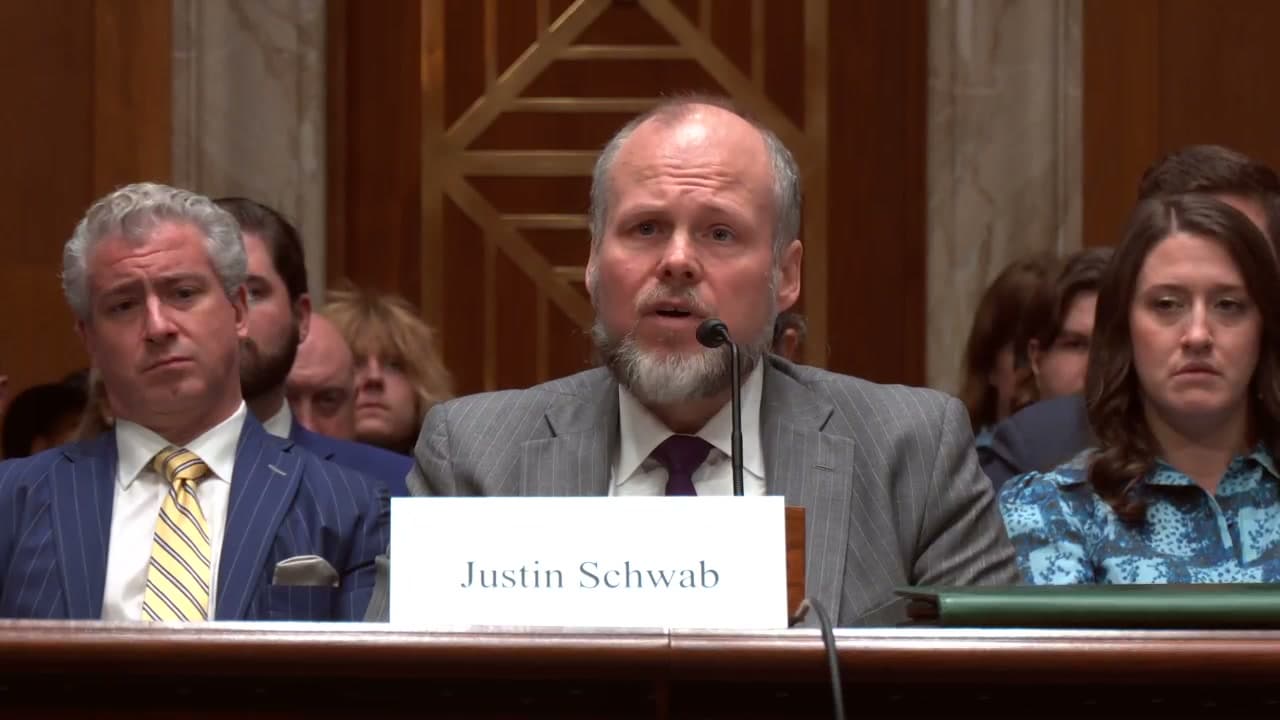
Senate Environment and Public Works: Hearings to examine the nomination of Justin Schwab
Alaska News • • 84 min
Articles from this transcript
Trump's pick for EPA air chief says he'll work to speed decisions on state pollution plans
EPA air nominee Justin Schwab pledged faster action on state air plans and refinery exemptions. EPA approves Alaska's plans, including Fairbanks's fine particle plan, due by Dec. 31, 2027.

Good one for him. So I think Dylan would do well in a home that just has people willing to invest in him, uh, Good morning. Hi, all. This is your instructor. Coming for the chairman of the committee, who's in another meeting, and Chairman Capito welcomes you all here this morning.
No audio detected at 2:00
No audio detected at 2:20
No audio detected at 4:20
No audio detected at 5:20
No audio detected at 7:20
No audio detected at 9:20
No audio detected at 11:20
No audio detected at 13:20
No audio detected at 15:20
No audio detected at 15:40
No audio detected at 17:40
No audio detected at 19:40
No audio detected at 21:40
No audio detected at 23:40
Today we will receive testimony from Justin Schwab, President Trump's nominee to serve as the EPA's assistant administrator for the Office of Air and Radiation. The Office of Air and Radiation implements one of our nation's most important environmental laws, the Clean Air Act. The programs established by the Clean Air Act and administered by OAR directly impact public health, energy affordability and reliability, and the ability of American businesses to invest and grow. Mr. Schwab is well qualified and prepared to step into this critical role. He currently serves as a senior advisor at the EPA, having having previously served as general counsel at the Council on Environmental Quality.
From 2017 to 2020, he served as deputy general counsel at the EPA. The nominee also brings experience from private practice, where he represented clients on complex environmental and regulatory matters. Mr. Schwab's experience will serve him well in implementing OAR's mission to protect public health and the environment within the legal authority granted to the agency by Congress. Under the Biden administration, the EPA pursued an aggressive regulatory agenda that placed significant burdens on American energy producers, manufacturers, and consumers. One of the most troubling examples was the Biden EPA's Clean Power Plan 2.0 rule.
This rule would have imposed extreme requirements on coal-fired and natural gas power plants with tremendous compliance costs designed to force the closure of reliable dispatchable power generation. In Wyoming, we know firsthand the consequences of federal policies that make it harder to produce affordable and reliable electricity. At a time when electricity demand is increasing, and grid reliability is becoming more important than ever, we need common-sense regulations that result in more affordable power generation, not less. Recently, the EPA issued a final rule repealing the Clean Power Plant 2.0's requirements to shift generation and impose unachievable pollution standards for power plants. I applaud these actions to dismantle Clean Power Plan 2.0 and look forward to the agency's future actions to address what remains of the Biden power sector strategy.
The Clean Air Act rests on a strong collaboration between the EPA and the states, who are partners in implementing our nation's air quality laws. Another important issue that I'm interested in hearing from the nominee on is how he will administer Renewable Fuel Standard, which includes the Small Refinery Exemption program. Small refineries across the country support local jobs and provide important fuel supplies to our communities. Congress established the SRE program because it was recognized that that some small refineries, such as Wyoming Refining Company in Newcastle, Wyoming, may face disproportionate economic hardship due to compliance costs associated with the renewable fuel standards. The EPA must administer the SRE process fairly, evaluate petitions based on the facts, and provide timely decisions.
As Congress laid out in statute. Mr. Schwab, if confirmed, you will play an important role in ensuring the OAR carries out its responsibilities effectively, efficiently, consistently, and in accordance with law. While the EPA continues its regulatory reform efforts, we must also acknowledge that those efforts alone are not enough. Congress must also modernize outdated laws to reflect today's energy and infrastructure needs. Throughout this entire Congress, Chairman Capito has worked closely with Ranking Member Whitehouse and his team, as well as Chairman Lee and Ranking Member Heinrich and their teams on the Energy and Natural Resources Committee to develop bipartisan legislation addressing longstanding problems with the federal permitting process.
And I want to acknowledge and thank Ranking Member Whitehouse, who's here today, for his work on those issues. As we developed the legislation, Mr. Schwab, in his previous role at CEQ, assisted Congress with technical assistance from the administration perspective and demonstrated a deep understanding of our environmental laws. That work resulted in the bipartisan American Affordability and Jobs Act. Legislation that will provide greater certainty and predictability for infrastructure projects across the country. And now, with the Senate finishing consideration of this legislation, we have an opportunity to finish the job.
This bill is about helping the families struggling with higher energy costs, businesses needing new manufacturing and infrastructure investments, and communities waiting for job-creating projects that that will strengthen their economy. We need clear requirements, predictable timelines, and timely decisions that allow projects of all types to be moved forward. We must get this bill across the finish line and signed into law before the 119th Congress adjourns. With that, I now recognize Ranking Member Whitehouse for his opening statement.
Thank you, Chair Lummis. Welcome, Mr. Schwab. Today's nominee to lead EPA's Office of Air and Radiation is, on paper, an impressive candidate with degrees from UC Berkeley and the Yale Law School and stints at EPA and CEQ. But look beneath the resume and what you find is yet another operative of Trump's big polluting industry donors. Don't get me wrong, Mr. Schwab's education experience allow him to understand how regulations work, but also how to unravel them.
Indeed, Mr. Schwab has already proved his commitment to attacking clean air rules while at EPA during the first administration and at CEQ just last year. And now since his return to EPA. If any of this sounds familiar, well, you're on to something. Mr. Schwab would replace Aaron Szabo, the fellow traveler with whom he crafted the EPA chapter of Project 2025. And EPA's actions since January 2025 read like a summary of Project 2025's polluter directives.
So what has EPA done? Using the Schwab-Sabo playbook. One, EPA rescinded its greenhouse gas tailpipe emission standards, a rescission that by EPA's own estimate will cost consumers at least $580 billion and up to $1.4 trillion at the gas pump. Money directly out of consumers' pockets and into the coffers of Trump's big oil donors, a massive transaction with consumers on the losing end. EPA rescinded the greenhouse gas endangerment finding, defying the law, scientific evidence, and the lived experience of millions of Americans.
Climate change is already driving up the costs of property insurance, groceries, and electricity across the country, and EPA colluding with polluters will turbocharge the climateflation that's already costing the average American family more than $500 a year.
3, EPA rolled back the Mercury and Air Toxics Rule, helping power plants emit more mercury—just what everybody wants—and other dangerous and carcinogenic pollutants. 4, EPA decided not to count not to count the health costs of pollution in its costs and benefits measures. It only counts the costs to its favored industry. And last, EPA rolled back the carbon pollution standards for power plants, a decision that by EPA's own estimation will cost Americans $370 billion over 2 decades. Mr. Schwab, and Mr. Szabo care zero about the cost to Americans of more wildfires and extreme weather, higher property insurance costs, and grocery and healthcare costs.
So why such love for big polluters? When he left the first Trump administration, Mr. Schwab opened a law firm affiliated with a conservative public affairs and advocacy firm. His colleague on the consulting side? Oh, Aaron Szabo. His major clients: fossil fuel companies and the Heritage Foundation.
In 2022, Mr. Schwab became chairman of the dark-money-funded so-called Center for Environmental Accountability, now apparently defunct, that served Trump-aligned donors and fossil fuel interests. He is a walking, breathing conflict of interest with zero business anywhere near an EPA position. Protecting our air. This sort of blatant corruption, raising people's costs, is exactly what the American people rejected so vociferously just two weeks ago. In an NBC News exit poll conducted on Election Day, 90% of voters said that government corruption was a crucial or major factor in their vote.
EPA obviously didn't get memo. Thank you, Chairman.
Thank you, Ranking Member Whitehouse, um, and thank you, Mr. Schwab, for being here this morning. Uh, before we move to your opening statement, I will now administer the oath to receive your sworn testimony. So, Mr. Schwab, would you please stand, raise your right hand, and answer the following question. Do you swear the testimony you are about to give to this committee is the truth, the whole truth, and nothing but the truth, so help you God? Let the record show that the witness has answered in the affirmative.
No audio detected at 35:40
So now we will hear from the nominee. You may be seated, Mr. Schwab, and when you are ready, you are recognized for 5 minutes for your opening statement.
Good morning, Senator Lummis, Ranking Member Whitehouse, and distinguished members of this committee. It is an honor to sit before you today as nominee for the position of Assistant Administrator for the Office of Air and Radiation in the United States Environmental Protection Agency. I am grateful to President Trump for nominating me and to Administrator Zeldin for his confidence in me. If confirmed, I pledge to them and to you to faithfully discharge the duties of that office. I thank my wife, Juliette, for her love, friendship, and support.
Everything I have accomplished or could ever hope to accomplish is her accomplishment as well. I want to express my love to our 3 children. All of us in public service are united by our understanding of the sacrifices that our families undergo as we pursue this calling. I thank my parents, Norma and Stuart, for setting me a model of decency, kindness, and hard work. I thank my siblings, my teachers, my mentors, my colleagues, and my friends.
You all made me who I am. This moment is for all of us. Two of the first images I can remember seeing are North Carolina pine trees blurring by a window as I sat in a car seat, and climbing the marble steps of a courthouse where my father was clerking. These two images of the natural environment that surrounds us and the framework of law and policy that surrounds how we regulate and protect that environment are bookends framing my career and the office to which I have now been nominated. We can and must protect our environment and unleash our prosperity at the same time.
This can only be done within the legal framework underpinning environmental regulation. The Clean Air Act is a very important piece of legislation. We all breathe the air that surrounds us. Every significant human activity at scale has the potential to affect it. The Clean Air Act has led to cleaner air and healthier Americans in the 55 years since its passage.
The Clean Air Act is also a very powerful tool, and it must be used as Congress has authorized. All agency authority ultimately derives from congressional delegation. People can in good faith disagree about the bounds of authority Congress has given EPA, but no one should mistake a concern that agencies stay within those bounds for a lack of concern about the environment and human health. My career has concentrated on environmental law for over a decade. In the first Trump administration, as Deputy General Counsel at EPA, I focused on the Clean Air Act.
I learned an immeasurable amount from the dedicated civil servants, both in the Counsel's Office and the Air Office. I will never forget how much I still have to learn. In this second administration, As General Counsel of the Council on Environmental Quality, I found myself once again within this committee's jurisdiction. In that role, I gained a deeper appreciation for the challenges of infrastructure and permitting and how they relate to environmental review. I've clerked for a federal judge and I've worked in federal agencies, but I've never worked in Congress.
But some of the colleagues that I've learned the most from have done so, including more than a few who worked for this very Committee. All of them regard this Committee as something special, and while I can't claim to be among their ranks, in a way I've learned from you through them. Now I am back at EPA as Senior Advisor to the Administrator. Once again, it is great to work with EPA staff, and it is a privilege to serve in President Trump's Administration under Administrator Zeldin's leadership. I understand we may have different views on the right way to implement laws passed by Congress.
I respect the role of Congress and of this committee. I look forward to your questioning as you fulfill your solemn constitutional role of advice and consent.
Thank you, Mr. Schwab. And I'll begin with questions. I'm going to start with something you and I had a chance to explore a little bit earlier, and that is the subject of small refineries and the exemptions that have become such a conundrum within that business. Wyoming is home to small refiners. I live right next to— a small refinery.
Uh, in August 2026, the EPA granted full exemptions to 18 small refiners and half or 50% exemptions to 11. Wyoming Refining Company in Newcastle and HF Sinclair in Casper were both issued partial exemptions. Protecting small refiners in my state is particularly important to me, and I want to support them and the EPA. In any way I can. So my question is this, Mr. Schwab.
Uh, EPA has said it is committed to addressing new petitions within the 90-day statutory review period. So how will you make sure petitions are decided on time so small refiners in Wyoming and elsewhere aren't left carrying compliance costs for years. Thank you for the question, Senator. It was a pleasure to visit with you earlier to learn more about the issues that concern you within this committee's jurisdiction. The small refinery exemption program is a crucial part of the Renewable Fuel Standard program.
Congress did provide a deadline for EPA to act on petitions for small refinery exemptions that it receives. If committed to this position to which I've been nominated, I commit to you and to the committee to work to ensure that EPA disposes of those petitions in a timely manner through efficient consultation with the Department of Energy, which consultation is required by statute, and through appropriate allocation of resources to that end. And, and a follow-up: What criteria does the EPA review to issue full or partial relief for small refiners, and how will you make sure those decisions are consistent and well documented? Thank you for the question, Senator. Congress provided, I believe, in 211.09 of the Clean Air Act that EPA is to consult with the Department of Energy and studies regarding the environmental impact of the renewable fuel standard program on small refineries that the Department of Energy conducts, and consider those and other economic factors.
If confirmed to this position, I would work in this area, as in all other areas of administrative law, to ensure that the decisions that EPA makes in this regard are consistent and are adequately documented and engage adequately with the record and provide an adequate explanation, both of the statutory factors that are engaged with and of the evidence before the agency.
Now I'd like to switch to some Clean Air Act issues. That are related to California specifically. Mr. Schwab, in August, my Republican colleagues on this committee and I introduced Congressional Review Acts to disapprove Biden-era Clean Air Act waivers to the California Air Resources Board. I introduced the Small Off-Road Engines CRA to overturn California's waiver that allowed them to phase out gas-powered small engines. This waiver has allowed California to dictate the quality of the product that consumers choose for themselves, such as landscape companies, manufacturers, and individuals.
Approving a Clean Air Act waiver to CARB does not mean the environmental regulations stop at California's borders. The manufacturing costs and requirements fall onto consumers across the country. Mr. Schwab, what can the EPA do to better support air quality without the need for a waiver, especially when approving a waiver means that a state can take their zero emissions mandate too far?
Thank you for the question, Senator. EPA can and does work closely with states and local air quality regions, both EPA in its headquarters capacity and through its regional offices, uh, to help the states get on a path to approvable state implementation plans for the attainment and maintenance of the National Ambient Air Quality Standards, uh, through identifying, uh, reductions that can be achieved consistent with the cooperative federalist framework that the Clean Air Act sets out.
And in follow-up, uh, Mr. Schwab, would you commit to working with this committee and with manufacturers and consumers to identify clear pathways for progress in the small off-road engine space? Yes, Senator, I do. Thank you. Now I'd like to move on to some small oil and gas producers. In my state.
In May of 2026, I introduced the Protest Domestic Oil and Gas Small Business Act with my Republican colleagues. This legislation is designed to safeguard small independent energy producers from burdensome federal methane reporting and emissions control requirements. Wyoming is the energy capital of our nation, certainly with regard to exporting Wyoming exports to other states about 12 or 13 times more energy than it consumes. And so we are the number one energy exporting state in the nation. Wyoming is tremendously important to America's energy future, and our small producers and stripper wells Across the state contribute greatly to that.
Of course, stripper wells are those that produce a very small amount of energy and oil and gas every day, but nevertheless, in the cumulative impacts are important to our nation. The goal of this bill is to ensure small producers across the country are protected from biased administrations that are biased against oil and gas. And we saw that in the financial sector and in the regulatory sector at EPA under previous administrations. Mr. Schwab, what have you seen from previous administrations that impose burdensome regulations that hurt the small producers in the oil and gas industry and that are not specifically authorized by law?
Thank you for the question, Senator. Uh, there is currently a proposal pending from the United States EPA, uh, to revise aspects of the oil and gas regulations issued in the previous administration. And some of the issues proposed for revision deal exactly with the topics that you are referring to, uh, whether it be, uh, proposals to subcategorize marginal wells as their own category on the recognition that regulations that might work for larger operations might not be feasible for them. Whether it be revisions to associated gas flaring provisions or that did not take account of the different geographic reality where different operations may occur, or whether it be unattainable zero emission standards or potentially unattainable zero emission standards. These are the kind of things that this administration is proposing revision and seeking comment on.
And this, I think, is relevant to your answer and is the kind of thing that we have seen and that this administration is working to revise.
Thank you, Mr. Schwab. I will now turn to the gentleman from California, Senator Padilla, for 5 minutes. Thank you, Madam Chair. Mr. Schwab, good to see you. Appreciate the opportunity to have spoken in my office yesterday, and especially I want to highlight on the record here one of the areas that we seem to agree on, and that's that cooperative federalism Matters and the recognition that California state and local air agencies play a critical role in protecting public health in California.
No audio detected at 49:20
Now California's efforts to set strong emission standards have dramatically improved our air quality over the years, but as I tried sharing with you and explaining to you yesterday, our geography, our ports, our freight corridors, topography in general provides some unique challenges, uh, and far too many Californians still, uh, live with unhealthy air. State and local regulators have cut emissions from every source within their jurisdiction, and what's left is what falls within the federal government's jurisdiction to regulate, including but not limited to the transportation sector. So let me be clear: the answer to non-attainment is not to lower the bar for attainment. That does nothing to clean the air that my constituents breathe. Instead, we need the federal government to step up and do its part.
Let me, uh, hone in on a couple specific questions here for you. You know, the federal government's partnership with state and local air quality agencies is critical to California's ability to reduce air pollution and protect public health.
EPA's recent restructuring combined with Substantial staff departures that have been widely reported has left the agency understaffed in many areas, especially regional offices. Reporting has shown that EPA has a large backlog of unprocessed state implementation plans, even as urgency— as it is, even as agency staffing and funding has been cut. And Region 9 has continued restructuring California's offices. Too often, air districts across California have had to deal with significant delays in getting their SIPs processed by EPA. Mr. Schwab, can you commit to working closely with EPA regional offices to act quickly to process SIP approvals?
Yes, Senator. Great. Another specific area I wanted to talk about, Section 71101 of the Bipartisan Infrastructure Investment and Jobs Act, authorized the EPA to administer a clean school bus program. The EPA accepted public comments earlier this year on changes to the school bus program. EPA Administrator Zeldin has said on record that the EPA is committed to implementing the program in a way that maximizes benefits to America's children, the environment, and the taxpayers.
EPA has also stated its plans to issue a new notice of funding opportunity for this program in November 2026. So this month, will you commit to implementing the Clean School Bus Program in accordance with the law over the remaining 2 years of authorization and appropriations? Thank you for that question, Senator. If I'm confirmed to this position, I do commit to implement that program and all other programs in accordance with law. Thank you very much.
And when, when can we anticipate the Round 4 notice of funding opportunity to be released, and when can we expect the federal award assistance to actually be provided to schools and school districts? Thank you for the question, Senator. In my current advisory capacity, I have not been directly or decisionally involved in issues of procurement. I would be happy to follow up on that question though. Okay, thank you.
I'll follow up on this and a couple of other issues with questions for the record. Thank you, Madam Chair. Thank you, Mr. Padilla. Before I move to Senator Curtis, I neglected to acknowledge— is your wife Juliette here? Yes, Senator, she is.
Juliette, would you please stand so we can acknowledge you? Thank you so much for coming today.
And you mentioned you have 3 children. Are any of them here today? They are not, Senator. 2 Of them are in school and 1 of them lives quite far away. And then what about your parents, Norma and Stuart?
They are not. Well, Juliette, we're delighted to have you. These are positions that involve families and require commitments from spouses and family members. We want you to know how much we appreciate your being here and the willingness of the family to serve. So thank you very much.
Senator Curtis, you are recognized for 5 minutes. Thank you. Mr. Schwab, congratulations on your nomination. I appreciate your previous experience at EPA, and I think it'll serve you well in this role. I also appreciate the chance we had to talk via Zoom a week or so ago.
I Really important to me is to acknowledge Administrator Zeldin, who has been just a great partner in understanding the uniqueness that we have in Utah with our geography and environmental challenges there. Please convey to him our appreciation from the state. In our, in our conversation, we talked about a couple of these issues, but I want to just reconfirm some of the things we discussed and get your. Help. In the Intermountain West, background ozone levels can approach the federal standard of 70 parts per billion before even accounting for our local emissions.
In some areas, as much as 80% of ozone pollution contributing to non-attainment comes from natural sources of pollution beyond the state's ability to control that. States should be responsible for addressing the pollution they can control, not penalized for the pollution they cannot. With that context, let me turn to a few specific issues facing Utah. First, Utah has demonstrated more than a 15% reduction in VOCs in the northern Wasatch Front, largely through its efforts to address fine particulate, fine particulate pollution. Despite these reductions, EPA has not approved Utah's proposed pathway to meet reasonable further progress requirements through a combination of NOx and VOCs reductions.
Utah has been working with EPA on this issue for nearly 2 years, yet the state remains potentially exposed to unnecessary sanctions despite the progress it's made. Can you commit to working with Utah to approve a pathway that recognizes these emissions reductions and allows the state to satisfy its reasonable further progress requirements. Thank you for the question, Senator. It was good to be able to visit with you earlier and discuss issues of concern to you and your state. If confirmed to this position, I do commit to work with Utah towards an approvable plan that recognizes, to the extent compatible with law, Utah's unique circumstances and that provides legal durability.
Thank you. And I would, I would assume in that commitment you could tell me if it's otherwise, is part of it is just communication, not letting this thing lag and sit there. But like I mentioned, It's been 2 years. Doesn't it seem reasonable if Utah was able to achieve a 15% reduction, they'd be authorized to make NOx substitutes in the future, especially since NOx reductions are better for the environment and the economy? Thank you, Senator.
I do think there is a good deal of common sense for us to what you're saying. Second, I appreciate EPA's recent proposals recognizing Utah's progress on ozone attainment. In April, EPA proposed returning the Uintah Basin to marginal nonattainment status after determining that the area met the ozone standards by extending attainment deadline. EPA also proposed approving Utah Section 179 International Emissions Demonstration, recognizing the significant impact of pollution originating outside the United States on the northern Wasatch Front's ability to meet federal ozone standards. That proposal would also reverse the area's 2024 reclassification from moderate to serious.
If confirmed, will you commit to working with Utah to move these proposals through the final approval process as quickly as possible? Thank you for the question, Senator. Yes, if confirmed to this position, I commit to work with Utah towards approval. Thank you. Finally, in our meeting a few weeks ago, we discussed the impact of wildfire on ozone.
In the state. We have better tools today to identify and analyze wildfire smoke impacts. EPA should be using these tools to streamline its review process rather than requiring states to repeatedly demonstrate what the data already shows. Will you commit to making the exceptional events process more workable for states, including improving the use of smoke analysis tools and expediting EPA's review of regional wildfire events? Thank you for the question, Senator.
I agree with your description of the general principle underlying multiple provisions of the Clean Air Act, that state and local governments should not be held to account or punished with respect to emissions that they have no ability to control, whether it be from international emissions or whether it be from wildfires. I also think the role of prescribed fire is something that is very important in this regard, and I do commit that if confirmed to this position, I would work towards any regulatory revisions that were necessary in this regard and would be interested in further discussions with you and your office about your views on this issue, in which I know you've been a leader. Thank you for that commitment. I just can't emphasize how important this is to a state like Utah, how much it impacts our economy, our workforce. And at the same time, I want to double down on the fact that we want to reduce emissions as well, and we have worked hard to do it.
No audio detected at 58:20
This isn't about an end run or getting around these. This is about practical solutions that reward those who are actually doing the good work. So we look forward to working with you as a partner. There's a lot of work to be done, a lot of heavy lifting, and we, we look forward to working with you on your commitments. Thank you very much.
Thank you, Senator Curtis. Senator Kelly, the gentleman from Arizona, is recognized for 5 minutes. Thank you, Madam Chair. And thank you, Mr. Schwab, for being here today. I'd like to first ask you about Maricopa County's efforts to improve air quality, which has spanned multiple administrations.
Just last week, EPA formally approved the county's Rule 205, which allows businesses to generate emissions— emissions credits by replacing older, higher-polluting vehicles with cleaner ones. I appreciate that progress, but Rule 204, which would establish a similar program for off-road equipment, still needs final approval. Mr. Schwab, if confirmed, will you commit to prioritizing EPA's ongoing work with Maricopa County to move Rule 204 toward final approval as quickly as possible? Thank you for the question, Senator.
Yes, if confirmed, I do commit to prioritizing that regard. Well, thank you. Uh, Mr. Schwab, next I want to talk about data centers. As you know, there's a massive boom in data center development across the country, and the thing I hear most from communities in Arizona where these proposed data center centers are built is, how can we have our voices heard? That's especially true if a data center is proposing to build what's called behind-the-meter generation.
Or in other words, they're gonna build their own power plant. Right now, those facilities would need to get a minor new source review permit. And for decades, EPA has required at least 30 days for the public to review and comment on proposed permits. Seems rather reasonable. 30 Days.
It basically says to a developer, If you want to admit up to 100 tons of nitrous oxide or soot a year, you need to give the surrounding community opportunity to understand the impacts of a project and voice their concerns before construction begins. Mr. Schwab, let me ask you a question. So would you be comfortable with a data center that admitted just less than the 100 tons of NOx or PM2.5 near your home without a guaranteed opportunity to give your input? Thank you for the question, Senator. Matters of permitting, generally speaking, are in the first instance the responsibility of state or local governments.
The Clean Air Act does provide certain minimum requirements The Clean Air Act does expressly require state permitting programs, in order to be approved by EPA, to provide for public engagement when it comes to major new source review sources, but does not contain any such requirement with respect to minor new source review sources. And in that regard—. Well, that's what I'm asking. But from your— in your personal life, would you be comfortable with a data center that emitted just less than the The cutoff is 100 tons, just less than the 100 tons of NOx or PM2.5 near your home without a guaranteed opportunity to give your own input. That's the question.
No audio detected at 1:02:20
Thank you for the question, Senator. It would depend on the particular circumstances of the facility and the—. Well, the circumstance is a data center is being built and it's going to emit, let's say, a just under 100 tons of nitrous oxide, of NOx. Would you be comfortable with that without having an opportunity to give your own input on the issue? Thank you for the question, Senator.
As I said, matters of permitting are appropriately— were consistent with federal law. The prerogative of state and local governments, and those are the ones that know their communities best. Yes, so you don't think homeowners, people in the region of where the data center is being built, should get a say if it's just less than the 100 tons? Or you don't think it's up to them at all?
No audio detected at 1:03:40
Senator, uh, the Congress, in enacting the Clean Air Act, has provided those areas in which federal law does require all state permitting process to engage, to include a public participation phase. And there are other areas in which federal law does not have that express requirement. And the proposal— there is a pending proposal in that regard from—. What sounds like your answer is no. Like, or actually, your answer is— I'm trying to understand, like, where are you on this?
If it's less than 100 tons, you don't think people should get an input?
You keep coming back to the law, but I'm just asking you your opinion. My opinion is that as a general principle, matters— state and local governments and agencies understand their communities and their concerns best. Well, earlier this year, EPA proposed a new rule that would allow states to eliminate the public comment opportunity for any minor source facility that emits less than 100 tons of pollution per year. I think that's unacceptable. And what I can't understand is who asked for this.
So I worked with Ranking Member Whitehouse to ask 9 of the leading data center developers. 7 Of them responded, and none of them said they asked EPA to make this rule. So, Mr. Schwab, you've been at EPA since these rules were proposed. And you've been in the Trump administration since the president took office. So maybe, you know, like, who asked the EPA to roll back these common sense protections?
Thank you for the question, Senator. The proposal is not specific to data centers. The proposal addresses generally requirements for miners. Yeah. And who asked to roll them back?
Senator, because it wasn't the data centers. So it must have been somebody, unless it was just decided internally that you don't think the community should have an input. Senator, the, the policies of the United States, as articulated by the president's executive orders, are where consistent with law to reform permitting processes to ensure that they do not include non-statutory, non-legally required provisions that may hinder development. Having said that, it is the prerogative of state and local governments in the first instance where federal law is silent on a question to determine what level of public participation may be appropriate under their own law. So it sounds like you're saying it came from the White House.
No audio detected at 1:06:20
Well, what I'm gonna ask you here is, will you commit to speaking with the administrator, Administrator Zeldin, and his team about the letter we sent to make sure we get an answer to our letter? Thank you for the question, Senator. I'm not familiar with this letter, but yes, I do confirm they're looking into the letter. All right. Thank you.
Thank you. Thank you, Madam Chair. Thank you, Senator Husted. Thank you, Madam Chair. Mr. Schwab,.
The EPA proposed in May to approve Ohio's request to remove the air nuisance rule from its SIP, finding it—. Finding it isn't needed to meet any, any air quality standard. If confirmed, will you commit to finalizing this action and on what timeline? Thank you for the question, Senator. If I'm confirmed to this position, I commit both to engage with the state of Ohio to understand its concerns in this regard and to work on this issue.
Yes. Okay. And what steps can EPA take to reduce avoidable delays in the review of the state's implementation plans? Thank you for the question, Senator. EPA does and should continue to engage closely with state agencies, both EPA's air office and then through its regional offices, to ensure that issues are addressed early and a path to approval and implement— and implementation, attainment, and maintenance of the standards is expeditious.
Well, I would I'd like to ask of you to make sure that you do this as quickly as possible because, uh, Mr. Schwab, Ohio is the only state in Region 5 with a nuisance rule still in its federal plan, and the EPA has removed similar provisions in other states. And so, I just ask, you know, do you agree Ohio employers shouldn't face federal federal citizen suits exposure that their competitors in Indiana and Michigan don't face. I mean, it's, it's just pretty simple. Why, why does Ohio have to continue to do this, not Indiana, Michigan? And are you gonna help get this done quickly?
Senator, I share your concern in that regard. Okay, well, thank you. Um, Ohio is seeing a major investment in new power generation. How will you speed up new source review permitting without shortcuts that invite litigation and delay? And I ask this question because we keep hearing people say that we want to drive down electricity prices.
Okay, so one of the ways you drive down prices is to make it less expensive to actually build the generation necessary to meet the needs, to create the supply to meet the demand. Over time, EPA shut down many power plants in Ohio. We used to be a net exporter of electricity. Now we're a net importer of electricity. We don't have enough electricity to meet our demands.
People say they want to make it more affordable. And so, um, what can you do to help bring these, uh, electrons online sooner rather than later?
It's an important question, Senator. In addition to the type of engagement that we discussed earlier, there may be regulatory reforms that are appropriate in order to expedite this process, including the revision of the definition of begin actual construction, which is a pending proposal from this administration.
So I know, I know the— we took some action last night. Congratulations, Madam Chair, on on making progress on permitting reform. And it seems that we have across many things in government these days, particularly the federal government, that we, you know, with respect to gentleman from Arizona's questions about, so we don't want data centers, but we don't wanna put our phones down, which require data centers. We don't want them to take power off the grid, but we want to make it harder for them to build their own power supply.
No audio detected at 1:10:20
All this seems pretty inconsistent with affordability, modernization, wanting to save people on their electric bills.
I just hope that in your role, if you're confirmed, you understand that, that time is money. And that money and that time delay and the cost gets passed along to the consumer. And the consumer ends up paying higher prices. They don't like to pay higher prices. They say, why we keep paying higher prices?
It's because we keep suing, delaying, and running up the cost of build the very things that we want to be less expensive. And I hope that while protecting the environment, that you also recognize that we have a responsibility to protect the consumer by trying to get things done as quickly as possible so that we can deliver them the services that they need at the lowest possible price. Thank you. Thank you. Welcome, Mr. Schwab.
Sorry I was not here to welcome you as the chair of the committee. I want to thank you and say hello to your wife Juliette, and thank you and your three children for being very supportive of you, as you mentioned in your opening statement. And thank you for stepping up here. I really appreciate this. Before I ask my questions, I will want to ask— start with 3 standing yes or no questions that were not asked at the beginning.
If we could do some of the formalities of the business that this committee asks of all nominees who appear before our committee. So I would like to ask you these 3 questions. Do you agree, if confirmed, to appear before the committee or designated members of this committee and other appropriate committees of the Congress to provide information subject to appropriate and necessary security protections with respect to your responsibilities? Yes, I do, Chairman. Thank you.
Do you agree to ensure that testimony, briefings, documents, and electronic and other forms of communication of information are provided to the committee and its staff and other appropriate committees in a timely manner? Yes, I do, Chairman. Thank you. And finally, do you know of any matters which you may or may not have disclosed that may place you— may place you in a conflict of interest if you are confirmed? I do not.
I am not, Senator and Chairman. Thank you for those formalities. And I'm going to ask questions and I'm going to turn it over to Senator Ricketts to ask questions and I think maybe close it out. I'd like to talk about— and if you've already answered this, I apologize. I was not able to get here at the beginning.
Um, the Biden EPA power sector strategy, uh, imposed costly, uh, requirements on coal-fired and natural gas power plants. You're aware of this, raising serious legal questions and threatening the continued operation of reliable and affordable electric— electricity generation units. At the same time, grid experts have warned us about the consequences of shutting down dependable power plants, what that consequences would be. And now electricity prices have increased as power supply hasn't kept up. So the Trump administration, including EPA's Office of Air and Radiation, has taken steps to repeal these regulations in line with existing law, with the added benefit of bringing down electricity costs in the future.
Mr. Schwab, how will you ensure that your office would consider electric reliability and energy affordability while carrying out the responsibilities of the Clean Air Act. Thank you for the question, Senator. As you noted, there has been an unfortunate history in some recent administrations of regulation under the Clean Air Act that does have— attempted to have transformative effects on the way that this nation generates electricity, with serious concerns of impacts for reliability. With specific respect to your question of how, if confirmed to this position, I would ensure that energy requirements were properly taken into account, It's important to note that multiple provisions of the Clean Air Act, including Section 111, which is the chief one under which these regulations have happened in the past, uh, specifically requires EPA to take energy requirements into account when determining what the best system of emission reduction is. And I would pledge to take that congressional direction very seriously.
No audio detected at 1:14:20
We would make sure that we would have the appropriate analysis of what the impacts of various emission control strategies would be on our energy needs. And as Congress has directed, that has to be a factor in EPA's deliberation in that regard. Thank you. I would imagine too, as we move forward with more energy demand and the rapid increase for demand for electricity, that this is going to become even more critical in your— in pursuit of your office. So next question is, Congress established small refinery exemptions, and we talked about this already, to provide relief to small refiners that experienced disproportionate economic hardships under the Renewable Fuel Standard.
I've raised concerns about how the EPA has administered this program, including the need for timely decisions and fair consideration. Mr. Schwab, if you're confirmed, will you commit to working with me and my staff on outstanding issues with the Small Refinery Exemption Program and to ensure that it is providing timely decisions and fair decisions in, uh, for the petitioning, uh, entities. Uh, yes, Senator, if confirmed to this position, I do commit to work with you and your staff and to work inside the agency towards those ends. Thank you. In your previous position and, uh, in your position as senior advisor, do you, uh, does part of your job description or your daily job, uh, duties include working with state regulators and other entities within the states and local on the issues, particularly in this case with air radiation.
No audio detected at 1:16:20
Have you worked with the state entities in the past? Thank you for the question, Senator, both in my time at EPA in the first Trump administration and my current role as an advisory role. But, but in that regard, I do witness various parts of EPA interacting directly with state officials, and if confirmed to this position, that would be part of my functions and responsibility as well. I mean, this is an important issue, I think, when we look at the partnership structure between EPA and the states in implementing our nation's air quality laws. We, in writing the permitting reform bill, and a lot of the negotiations that we went through, and you were helpful in this as your position at EPA for expert analysis, uh, this interplay between federal and state, who's got responsibilities, are lines clearly drawn where they are, and what kind of responsibilities are better off at the state level.
No audio detected at 1:17:00
These are really, really important issues, I think. So I would ask you, how will you work with state environmental agencies to ensure that the OAR carries out its responsibility inconsistent with cooperative federalism. Have you thought about that? Thank you for the question, Senator. Yes, I have.
As you know, the Clean Air Act in its design is a design of cooperative federalism. States, generally speaking, in the first instance design plans to attain and maintain air quality standards. If confirmed to this position, I would work respectfully and collaboratively with the states to try to get to yes wherever it were legally possible and supported by evidence in the record. All right. Thank you very much and good luck.
And I'll turn it over to Senator Ricketts. Thank you very much. Well, Mr. Johnson, thank you for being here and thank you to, for your willingness to serve our great country and for all your family supporting you. Nebraska is a biofuel state. Thanks to this administration and its EPA, we've seen the highest RVOs in the program's history.
This administration sent a strong signal of support to the domestic biofuels market. We've also seen meaningful support for year-round nationwide E15. This is a top priority for me, and it should be for the Congress. Biofuels are a win-win-win. Biofuels lower the prices at the pump, strengthen domestic fuel markets, and create new demand for Nebraska-grown feedstocks.
In the past year, Nebraska has seen a nearly 90 million bushel per year of soybean crush capacity increase. Additionally, Nebraska is now home to the largest bioethanol carbon capture facility in the world. Because of the EPA's policies, Nebraska is continuing to deliver for our farmers and our biofuel producers. One of the most consequential commitments this administration has made to the biofuels industry just came last month when Administrator Zeldin announced a proposal for 100% of the reallocation of the $770 million RINs exempted above what was originally estimated in Set 2. That commitment has been echoed by— across the administration.
As the incoming head of the Office of Air and Radiation, finalizing this rule will be one of your first and most urgent responsibilities. Mr. Schwab, will you finalize the supplemental allocation rule at 100%, honoring the president's promise and Administrator Zeldin's commitment to farmers? Thank you for the question, Senator. Well, we cannot prejudge the outcome of any particular matter. I understand the importance of that commitment made by the administration and would, if confirmed to this position, work expeditiously to finalize that proposal.
Well, can you commit to finalizing that supplemental rulemaking mid-December to provide market certainty for our biofuel producers? Thank you for the question, Senator. I would commit to finalization as soon as is practically possible.
Sooner rather than later is always better, just so you know, Mr. Schwab. The marketplace is looking for certainty. Congress also directed the EPA to establish RFS volumes for at least 14 months ahead of each compliance year. The statutory deadline for 2028-29 set 3 volumes just passed on November 1st. The import RIN reduction is a welcome approach to increase domestic feedstock production.
However, late rulemakings create market uncertainty and decrease investment. Previously delayed and weak rulemakings resulted in idle plants, furloughed workers, and depressed commodity prices for farmers. Mr. Schwab, can you commit to completing the Set 3 rulemaking as quickly as possible? Thank you, Senator. Yes.
Will you commit to building on the momentum of Set 2 by issuing volumes that drive investment? Thank you, Senator. It is the policies of this administration to support our farmers and support our domestic biofuels industry. Great, thank you, Mr. Schwab. Approvals of the Nebraska Regional HAGE State Implementation Plan are important for us.
The EPA has currently set 3 regional HAGE decisions pending for approval for Nebraska's state implementation plans. One of these plans stretches back to 2016. While Nebraska has provided all the necessary documentation and demonstrated reasonable progress on visibility improvement, EPA has yet to issue the decision decisions. With these plans still awaiting approval, uncertainty remains regarding how Nebraska power plants, including the Gerald Gentleman Station, will be operated. I might point out the Gerald Gentleman Station is one of the cleanest operating coal-fired plants in the country, um, and we have some of the cleanest air in Nebraska as well.
Regardless, the delay in this creates operational and planning risks. Will you commit to issuing decisions for Nebraska's 3 pending regional Hays decisions in timely and efficient manner. Thank you, Senator. Yes, I've confirmed this position. I would work with the regional office, the air office, and the state, uh, to, to, on that matter, to expedite it as, as much as possible.
Great. Well, again, I cannot stress how important this is to get the certainty and get this done. Again, considering some of these— well, the state of— one of these plans goes back 10 years. So, uh, thank you very much. I see nobody else here.
I'm going to go ahead and— oh, I brought the gavel. Good job. I ask unanimous consent to submit for the record multiple letters of support for Mr. Schwab's nomination. And without objection, so ordered. And with no further questions, I would like to thank the nominee for being here this morning and my colleagues for their participation in the hearing today.
Senators who wish to submit written questions for the record have until 5 p.m. this Friday, November 13th, to do so. The nominee's responses to those questions are due back to the committee no later than 5 p.m. Monday, November 16th and will be submitted for the record. With that, this hearing is adjourned.
No audio detected at 1:23:40