Fairbanks Borough: Planning Commission Meeting, 2026-11-10
Alaska News • • 398 min
Articles from this transcript
Fairbanks planners back a new 20-year blueprint for how the borough grows
Fairbanks planners voted 11-0 for a 20-year plan shaped by 4,000 people. Housing and energy costs topped their worries; data centers crashed the party late.

No audio detected at 0:00
No audio detected at 1:00
We are ready in the chambers.
Good evening, everybody. The Planning Commission meeting of November 10th, 2026 is called to order at 6:00. Clerk?
Mr. Ringstad? Here. Mr. Corbett? Present. Ms. Rodriguez?
Present. Mr. Stepiovich? Present. Ms. Fisher? Here.
Mr. Mulin? Here. Miss Smart? Here. Mr. Collier?
Here. Miss Campbell? Here. Miss Lindsford? Here.
And Mr. McKinley? Here. You have a quorum of the Planning Commission. Thank you. The next item on the agenda is item C, messages, communications to the Planning Commission.
Staff, do you have a report today? Hi, good evening. I do have a, I have a short report. I want to go through just a couple of things. The first thing I wanted to just remind the Planning Commissioners of is we are gonna have 4 expiring seats at the end of this year.
Those seats are Commissioner Fischer, Commissioner Smart, Commissioner Stepovich, and Commissioner Lunsford. So I know some of you have filed your paperwork to re-up. If you're interested for re-upping, we'd love to have you. But also the deadline to get that in and still be sitting for the January meeting would be, I believe it's November 18th. There may be a little bit of give there with some of the mayor's office deadlines, but these do have to go to the assembly for appointment, and there's only one meeting in December.
So just a reminder, if you're considering, we'd appreciate that. The second thing I wanted to let the commissioner know, this Thursday, the assembly will be taking up public hearing on the rezone in the Farewell neighborhood, if you remember that from about a month ago. And because of kind of some absences and travel schedules, Commissioner Smart is going to be representing the Planning Commission at that.
And then they have actually calendared the next rezone. If you remember, the Sheep Creek Outdoor Recreation Rezone, they've calendared that for December 17th. I just wanted to spend a little bit of time going through our upcoming schedule. As a reminder, we only have one meeting a month in the winter months and go back to two meetings a month in the spring. So our next meeting is going to be December 15th.
It's also a little bit of a busy agenda. We have a conditional use permit for a rooming house. I was actually involved in that Fairbanks Street rezone that you saw a couple of months ago. We have another conditional use permit for a communication tower and a variance for lot size. But probably the biggest one that day is, um, this Thursday the assembly is expected to refer an ordinance to you regarding short-term rental regulations.
So that is tentatively calendared for our December 15th Planning Commission meeting.
And then looking out a little bit in January, January 12th is our next meeting. We have at least one highway project, likely two highway projects for that meeting. Regarding mostly some signal upgrades in the Fairbanks area. And then if the agenda stays light, we are tentatively planning on a work session with Jackson Fox. He's the executive director of FAST Planning.
We like to do this every year or two with the Planning Commission because you have a seat on FAST Planning, giving you a little more of the technical information about the MPO and what they do. And then we're actually scheduling out to February 9th right now, Right now, I believe we have one conditional use permit for a marijuana retail store on that meeting. And then I guess my last two comments, obviously we have a very busy agenda tonight with a lot of substance to it. For the first couple of items, I have asked the community planning staff to keep our staff reports slightly briefer than normal to try to ensure that we do get through the full agenda tonight. Obviously, nothing changes with the written staff reports that were published and distributed to you.
And then the last comment is you should have on your dais and also received via email, obviously, probably the big thing tonight is the comprehensive plan. All of the commissioners did submit some amendments. So we have, I believe, 23 pre-filed amendments. Those should be all on your dais and in your inbox. So hopefully that'll speed up the process when we do get to that item.
And they all are numbered as well, Amendment 1, 2, et cetera. So if you choose to make one of those amendments, you could do so by just referring to the amendment number and reading it into the record. And I believe that concludes my comments, but I'm happy to answer any questions commissioners may have. Commissioners, any questions?
Hearing and seeing none.
The next item up on the agenda is C1A, update from Commissioners Fischer and Muehling and Kellen Spielmann, Community Planning Director, on the progress of the Regional Comprehensive Plan update. Ms. Fischer? I—. The advisory committee hasn't met since our last meeting, and since we will be talking about the comp plan at length, I could probably save any comments for that. Okay.
Mr. Muehling? Yeah, I'll go ahead and make my comments now. Karen can have them later. My comments about the comprehensive plan. 2 Years ago, Commissioner Fischer and I were selected to be on the comprehensive plan advisory committee, and I appreciate the opportunity to serve.
The comprehensive plan is a 20-year vision document that addresses housing, land use, economic development, transportation, public investment, and other community priorities. The plan directly influences housing, public health, safety, and economic growth. The Comprehensive Plan review has been an open process with public hearings and local agencies having an opportunity to comment. The advisory committee included representatives from the military, Fairbanks Chamber of Commerce, FAST Planning, FRA, school districts, city and borough mayors, Tanana Chiefs, realtors, and others. The comprehensive plan guides Fairbanks North Star Borough Planning Commission decisions.
Zoning separates incompatible land uses. For example, zoning separates pig farms and sewage lagoons from daycare centers. It separates single-family homes from industrial uses. It separates commercial use from residential use.
I strongly believe that the greatest benefits of this public process has been increased appreciation and understanding of the necessity of zoning and community planning. This document in many ways was a values document. With public involvement in this comprehensive plan, our residents have a better idea now how community, how community planning shapes our future. Thank you, Chair. Thank you, Mr. Spillman.
Uh, we'll save our comments till the, the agenda item. Thank you. Commissioners, do you have any questions?
Hearing and seeing none, next item on the list is C2, citizens' comments, limited to 3 minutes.
Uh, or the agenda items not scheduled for public hearing, quasi-judicial hearing, legislative hearing, or appeal. Clerk, has anyone signed to speak? There is no one signed up. Thank you. Item C2B, items other than those appearing on the agenda.
Clerk, has anyone signed up to speak? There's no one signed up for this. Thank you. Item C3, disclosure statement of conflict of interest for items on the consent agenda. Commissioners, do you have any potential conflicts or interests or interest for items on the consent agenda.
Hearing and seeing none. Item D, approval of the agenda and consent agenda. Approval of the consent agenda passes all routine items indicated by an asterisk on the agenda. Consent agenda items are not considered separately unless any commission member or citizen so requests. In the event of such a request, the item is returned to the general agenda.
Excuse me. Clerk, uh, could you please read the consent agenda? Planning Commission meeting minutes from October 13th, 2026. And that concludes the consent agenda. I'll move to approve the agenda and the consent agenda.
I'll second. It was moved by Miss Fisher and seconded by Jennifer? Any discussion? Hearing and seeing none.
Yes. Mr. McKinley? Yes. 11-0.
Thank you. Does anyone wish to change their vote? Hearing and seeing none, um, the vote was 11-0. Motion passes. Next item on the agenda is Item F. Quasi-judicial hearings.
Clerk, please administer a group oath or affirmation to the parties of all quasi-judicial hearings. I'm going to administer a group oath and take a roll call for your response. Everyone providing testimony under quasi-judicial hearings, please raise your right hand.
Do you solemnly affirm that the testimony you're about to give is the truth, the whole truth and nothing but the truth. Melissa Kellner? Yes.
Kellen Spillman? I do.
TJ Campbell? Thank you. And Sarah Bingham?
Yes. Is there anyone else?
What is your name, ma'am?
And you affirm the oath, Miss Koppenen? Thank you.
That concludes the oath.
Thank you.
Item F1, CU-2027-001, request by TJ Campbell for a conditional use permit for an animal boarding facility in the Central Business District zoning district on a portion of Lot 6, Block 86A, Fairbanks Townsite, addressed as 654 7th Avenue of Fairbanks. Staff contact: Sarah Bingham.
Is the applicant or representative present?
Thank you. Uh, would you please come to the table?
I'm gonna have you right there where it says applicant or sponsor.
And just for the record, would you, um, state your name, spell your last name, and provide your neighborhood? You said date of birth too? What was that? What was the last part you wanted? Uh, please state your name, spell your last name, and your neighborhood.
Neighborhood. TJ Campbell, C-A-M-P-B-E-L-L, neighborhood would be just general downtown Fairbanks. Thank you.
Um, disclosure statements, uh, Commissioners, does anybody have any potential conflicts of interest or ex parte information to disclose?
Hearing and seeing none.
Applicant, do you have any objections to any commissioner— commissioners' participation? No. Okay, thank you.
Um, Miss Bingham, what kind of time are you looking at? 5 Minutes, please. Did you say 5 minutes? 5 Minutes. I'm gonna hold you to that.
TJ, is 5 minutes going to be good for you? Yeah, absolutely.
Okay, staff, do you have a report? Yes, thank you. So the applicant has leased the easternmost portion of the old firehouse for a dog daycare facility serving 8 to 10 dogs, which will be dropped off between the hours 8:00 AM and 8:00 AM in the morning and picked up between 4:00 and 6:00 PM during the weekdays.
Um, this property is bounded on the north and south by 5th and 7th Avenues and on the east by Sadler's Furniture Store and on the west by the University parking garage.
There are 3 criteria that the zoning code gives for evaluating conditional use permit applications, and I'll go through each. 1 In the upcoming slides. The first one is that the— is whether this dog daycare facility conforms with the intent of the zoning code and other state statutes. This property is surrounded by other central business or other properties zoned Central Business District shown in red, as well as there's more commercial— commercially zoned property west of Barnett Street. And you can see the The green area, that's the current, uh, Veteran Memorial Park and downtown Fairbanks.
So the central business district is intended for uses that benefit from being centrally located and in a high-density, uh, environment. The Regional Comprehensive Plan designates this area as being in the urban core, and you can see a, a more detailed description in your staff report of that area. And there are 3 goals that are— that support this conditional use permit application for a dog daycare facility in, in this area.
The 2nd criteria is whether there's adequate sewage and transportation facilities, energy, and other public services to support this use. This is an existing building, and it's connected to, uh, the utilities downtown. The applicant's floor plan doesn't show very many alterations to the inside. However, we are recommending a condition that any— that the applicant obtain any building permits or any other kind of permits or licenses from the city that may be required from them. Before they open up.
Um, and then they, in their site plan, that they show a few parking spots that do not meet our off-street parking standards. In the central business district, parking businesses are not required to meet or to provide off-street parking. But if they do provide it, the off-street parking need— standards need to be met. So, there's another condition that we have recommended to have the applicant submit a revised site plan for our transportation planner to review and approve. Uh, and then also you can see, well, the majority of the time the dogs will be inside the building, the existing building.
There is a small fenced area to the north of the building. That is fenced where they are intended to use the restroom, and, and then the applicant will remove the dog waste at the end of each day and, and remove it offsite. So there's another condition that we've recommended to, to emphasize that that excrement will be removed at the end of each day and disposed of according to the Department of Environmental Conservation standards.
The 3rd criteria is that the public's health, safety, and welfare will continue to be protected. We submitted— we sent letters to all the properties in the highlighted— highlighted on this map. We got a few calls and, uh, and general inquiries, but no written comments were received. And in general, when we explained about the operational characteristics of this facility, no one had any concerns about this, um, this type of animal boarding facility. So with that in consideration, we have recommended condition that the applicant should submit any future revisions to either their operational characteristics or site plan to our office so that they We can determine whether they need to amend their conditional use permit or not, or it's a minor change.
Do you need another minute? Just 1 more minute. I'm almost done. Darn it.
Um, uh, are we good? Okay, I'll just keep going.
Um, so, so in summary, with the, with the —suggested conditions that we have drafted in the staff report. We do find that this conditional use permit does meet all of these criteria, and this is the full language of the conditions that are in the staff report and a draft motion for you to consider.
Thank you, Commissioners. Are there any questions for staff?
Here you see none. Um, thank you, TJ. Uh, you may now present your, or your testimony, or witnesses, or exhibits. Uh, testimony as far as we wanted to, uh have a central location that was easily accessible by any— anywhere in Fairbanks, and downtown was like prime real estate. Um, we originally were looking at a place on the south side, but it became too far of a drive.
And, um, having that central location, we can also help out businesses that are downtown. We really want to focus on Mainly hockey families that travel a lot, and sometimes one of the parents can't go out of town. So we want to really focus on the hockey family so the whole family can go and know that their dogs are at a safe place. Um, the construction there, it was fairly simple because we wanted to have as wide open floor plan as possible. Most places you go to where there's dogs, there's a lot of kennels.
We're, we're really pushing a non-kennel facility. As soon as your dog comes in, they can free roam. We have over 2,500 square feet for dogs to stretch their legs and play, ball pits and slides, and it's a lot of fun things for the dogs. Um, it— everybody up here knows that the, the winters can be long and cold, and dogs need a place where they can go and exercise. Um, so that was our focus, was really having an open space to where as soon as your dog comes in, they can go anywhere.
With the entrances on the back side, we have an overhead door that can be opened, but also there's that fenced-in area. It's a 7-foot fence. And to protect the dogs from leaving from the front exit, we do have a— we call it a meet and greet area. We'll have a 4 to 5-foot fence in front of the door. So when you come in, You close that door and then there's a second gate that you have to go through before you enter the park.
So there's, you know, redundancy there so dogs can't get out. Um, we really focused on like just having a fun place, uh, for dogs and we wanted, uh, to be safe and indoors. So it doesn't matter what the temperature is outside, the dogs can enjoy themselves. So.
Commissioners, have any questions for TJ?
Uh, Ms. Lunsford, then Ms. Rodriguez. Um, thank you for being here and for your testimony. Um, I'm just wondering, so is the intent not a day-use facility? You said that you're, um, hoping more for like engaging hockey families and for them to leave. So is this more of like an overnight boarding vision?
I guess I'm a little unclear on what the use will look like in total. So at the start, it's going to be daycare. You drop your dog off for a set amount of time, whether it's a full workday, a couple hours running errands. We're starting off with the daycare. And as the demand grows, then we'll go more into the overnight boarding.
But as far as opening goes, it'll be just the daycare. And grow into the boarding, provided we have enough interest for, for that.
Follow-up, Miss Rodriguez. Hey DJ, thank you for coming in, and thank you for trying to open up a new business downtown. I know we always welcome that. Um, so Olivia did ask a question about overnight, but I was wondering, I saw in the report that you were looking to host 8 to 10 dogs. Do you have plans to expand?
It sounds like yes, and if so, what is your future goal?
Uh, with the building we're, we're leasing, uh, it's kind of divided up into, I think, 6 overhead doors. I think, I think it's 6, and we're leasing out 2 of them, 2 bays. And, um, as the demand grows, uh, there is space for us to, uh, potentially get 2 more bays. We don't have any claims on it right now or anything, but there is space available, uh, if we do see that we have more people than— or more clients than we're able to, to hold, then we'll at that point talk to the landlord and submit an application to expand more to the left side. And I think that's another 2,300 square feet.
So, gotcha. Thank you. And Chair, may I ask a follow-up question? Sure. Um, so in our staff report, we heard a little bit about sound and how this will be operational during the daytime Um, if you guys do intend to extend into overnight boarding, potentially multiple days, do you have a sound plan in place for neighbors or anything like that?
We had discussed, um, because the ceiling is open, about putting a sound deadening material up in the rafters if needed. Gotcha, thank you.
Uh, Miss Campbell, then Miss Fisher. Yeah, thanks, TJ, for coming. Um, so you caught my attention when you said overnight boarding and hockey people going out of town.
Right now you're talking about just daycare, right? But when you expand, um, if that works, where would the people stay? Like, I don't see any apartment or or anything where you or your employees would spend the night with the dogs? What would that look like? Uh, at that location, there's probably half a dozen or more smaller rooms and offices in that larger building, and we are able to rent out additional space for somebody to stay when that time comes.
There's a lot of open space that we can use. What's the time frame? Like, have you talked to hockey families, or what are we thinking here? Because we have to kind of make a decision not based on your short-term plan, but what your long-term plan would be so you don't have to come back and do all that, right? Um, so are you looking at— because hockey season's just kind of starting up, um, kids are starting to travel.
Um, are you talking this winter? Are you Yeah, within the next probably 90 days, I would say we want to get to the boarding aspect. Um, we would like to open, uh, as soon as December 1st for the daycare. And as we get clients in and get the demand for, um, the boarding, then look into space to have somebody be being there overnight. But we have to have the clientele to have the business to— that would cost us obviously more rent to rent another room for somebody to stay.
So we need to make sure we have the interest in boarding first.
Mr. Fisher, thanks. I actually have a question for legal, but, um, want to take, take care of it while the applicant is, is up on deck in case we have any follow-up questions. Um, the application is for an animal boarding facility, and in the narrative it talks about the operating hours for pickup and drop-off, but in the recommendations and the findings of fact Um, oops. And yeah, conditions. Um, I don't see anything that limits the, the business operations to the pickup drop-off hours.
Um, so I just want to clarify that if things are going well with the daycare and the applicant wants to expand to overnight boarding, um, we wouldn't need to come back for a revision to the permit. The public traffic would still be the pickup and drop-off hours, but the permit would be for a boarding facility, correct? So this is a, this is a permit for an animal boarding facility as defined in code, um, unless imposed through the conditions, um, the hours given in the narrative would not be binding as against the business. Is that What you were asking? Yep.
Okay. Yeah, that gets exactly to, to what I was asking, and, um, it clarifies the, um, some of the narrative that focuses on the daycare and, um, and then brings in the, the potential for future expansion. So thank you for that clarification, and I don't have questions for the applicant based on that. Well, I think when I applied, um, they had told me that since the, since the clients are dropping off their dogs and won't be there, then it's considered the boarding. I think that's why we went that route.
Okay. And the, if you did go to overnight boarding, I'm assuming your pickup drop-off hours wouldn't expand beyond—. Right. Right. What is already a fairly large window.
And as one who takes her dog to boarding, I appreciate those not strictly 8 to 6 hours for you know, pickup drop-off, but they're not unreasonable for the neighborhood. Miss Campbell, did you have a follow-up? I thought I saw your—.
No, I'm still processing. Okay, Commissioner, uh, I'm going to do Joe and then Brittany. Um, my question involves, uh, the, the like open range for the animals inside. If he— what happens if, uh, is there a way to sequester a dog that's maybe more aggressive to the other dogs? Uh, what do you have— what do you do if you have two dogs that don't get along?
We do, um, have plans to have, uh, one kennel, uh, on site in case something like that happens. But as a whole, and as a general— we're not gonna kennel all the dogs, but we, we do need to have one on site in case there is an incident. We hope there isn't, but it can happen. So yeah, one kennel will be available. Thank you.
Brittany? Yes, thank you, Chair. Um, I wanted to get after the animal waste question. Um, the thing that caught my eye is that in your, uh, narrative it mentioned that the waste was going to be taken to either the transfer site or Fox Landfill. And yet, in reaching out to ADEC, that wasn't necessarily allowed.
So one of the conditions that we have is that the excrement will be removed from the subject lot at the end of each day to be stored in a manner that meets ADEC requirements and standards. Can you give us a little bit more information on what your plan is? Like, clearly with this application, you're going to be required to remove it from the site itself. Then what? What's your plan?
Uh, that's, that's an ongoing thing. I was talking to Sarah today about that. Uh, we're still working on the appropriate way to get rid of it. Um, but yeah, that's, that's something we're still working on there.
Any other questions?
I guess I, um, what is the DEC suggesting for waste removal? I'm not sure.
Okay, staff, do you have any questions?
I don't have any questions. I can give a little bit more information about my conversations with DEC and about the waste if you would like. I don't have any final conclusions yet.
Um, I guess, can you form it in like Jeopardy, like question form? Oh yeah, Rocky. Chair, if you wanted to, you could ask whether the applicant has any objections. To her speaking again, and if not, then no harm, no foul. Thank you.
TJ, do you have any objection of, uh, Ms. Bingham speaking again? Not at all. Okay, sorry, I reached out to a number of facilities, the, the FNSB landfill, um, and the Golden Heart Waste. Golden Heart Waste can take some like a limited amount of animal waste. Uh, they haven't gotten back to me with a specific number.
The borough landfill is, is not permitted to receive animal waste, uh, right now. And when I reached out to DEC for more information, they did not give me any detailed regulations. They suggested reaching out to local, uh, farms to see what they do with their animal excrement. Um, so that's something that I want to get better information on moving forward to try to figure out what's the best way Seems like I kind of got circular answers when reaching out to these different agencies. So that's something I want to get to the bottom of myself.
Miss Lunsford, has there been a conversation about composting? I mean, we recently heard a rezone about a dog kennel and DEC standard was composting. Yeah, and that was what I was thinking. I don't know if that would be an appropriate thing to do on-site since it's in the center of, of the town. And I don't know if the, the applicant has other property outside of this, or, you know, what kind of property the applicant has off-site.
So that could be one avenue to go down to properly dispose of the animal waste, is to go through the— figure out where to compost it.
Uh, follow-up? Yes. Um, have you reached out to any of the other businesses in town that deal with animal waste kind of in the urban core? I'm immediately thinking of Pretty Paws Grooming and Cold Spot and Animal House, etc. You know, I did not reach out to those, those businesses.
I mostly reached out to government agencies. But I can, I can do that this week.
Any other questions? I have one quick one. Um, are you— is the DEC kind of going kind of circular in this conversation because this is in the city limits and that's what's throwing them off, or what seems to be the issue? I was hoping to meet with them, uh, before this meeting, and, and they didn't get back to me with a time that works to meet. So I, I don't have any clear understanding of what the holdup is or what the confusion— where it lies specifically.
So just kind of a follow-up, so does the DEC have any clear guidelines on this?
Not that I have found right now. Uh, Mr. Stepovich, may I ask staff a question?
Yes. Um, kennels on private property typically conduct composting according to DEC. If you was to find a private landowner, perhaps a kennel, would that be an option? Yeah, so there— that's definitely, uh, that would be an option for the disposal is to compost on a different site. Thank you, Ms. Fisher.
Um, and I just want to clarify with staff and with Mr. Campbell, it sounds like the discussion on the mechanism to compost or dispose of the waste is ongoing and actively looking for a solution, and it's a condition that the daycare wouldn't be operational until there is an operational plan for that. So I think a question both for staff and the applicants. Mr. Spillman. Yeah, thank you. And I guess a lot of this comes back to we're definitely not the dog waste experts here.
Um, but we did address this with condition 2. Um, dog excrement shall be removed from the subject lot at the end of the day. So that's the biggest thing we're paying attention to is the site itself and making the site compatible for the use that the applicants proposing, and in our opinion, as long as it's removed from the site, it is a compatible site, and there may be some technicalities to figure out exactly where it goes. But in our opinion, it is a compatible use once that, that excrement is removed. And I just got a question to that.
You said daily, is that correct? The condition proposes daily, correct. Um, I'm going to follow up on that. So, If there's very, very— I mean, daily could, to me, could get kind of— I don't want to say tedious, but like if you have just one dog there and you've got something that just fits in a cup.
I didn't know. Um, so like we're still having to run to a composting place or figure out something with that.
Waste, correct? It doesn't matter how big or small, it's every day, right? Yeah, and I believe small amounts could be just disposed of in, you know, normal disposal containers. Again, not being kind of the dog waste experts here, what we're trying to do is put forward a condition that, you know, hopefully doesn't micromanage the business but also satisfies the concern of just a buildup of dog excrement. Okay, thank you.
Commissioner, uh, Mr. Muehling, um, if I could summarize for clarity, what we're saying is, uh, as a commission, we are dealing with the health and safety, and so the poop has to be off the property. Where it goes, what happens next, is not within our purview. We don't have that authority. Is that pretty clear, Kellen?
It sounds like that's what you were saying. I wouldn't necessarily say authority, but we chose not to, I guess, micromanage that aspect, it went beyond the potential land use conflict in our mind. As long as there wasn't a buildup of excrement and, you know, smells and, you know, bugs or animals coming as part of that, we felt that that was an appropriate use downtown and let the applicant kind of further research, uh, where, what he wants to do with it. Okay, so the Condition A is a health and safety condition, and if the poop is gone that condition is satisfied? In our opinion, yes.
Yeah, thank you.
Um, I just want to, um, ask a quick question, kind of what, uh, Eric was saying. Um, we want it gone, but we want it to adhere to, um, whatever is— I would say, as far as what DEC suggests, or Right. That's correct. That's what we included in the condition. And yeah, I believe we kind of worked all this out, uh, not on the floor.
Okay, thank you. And, um, Rocky, do I have, uh, TJ to see if he wants to ask any questions of Ms. Bingham also, since we kind of went—. That would be a good idea. Okay, thanks. TJ, hi.
Um, do you have any questions for Miss Bingham? No, no, I don't.
Okay. Uh, clerk, do we have anybody signed up to, uh, interested person testimony? There is no one signed up. Did you say there's no one signed up?
Okay. Is there— thank you. Uh, is there anybody in the audience that wanted to speak on this issue for public testimony?
Um, ma'am, ma'am, um, first, did you get a DPO letter? I don't know what that is. Uh, dear property owner letter. I am right on Old Pioneer Way by College. I own, but not within the I was just suggesting you go through hazardous waste.
Right. I— well, I can't have you testify. Okay. I was just trying to make a suggestion. Well, thank you.
I appreciate that.
Okay. But it was apparently hazardous waste. This is a quasi-judicial proceeding. All right. Thank you, though, for your enthusiasm.
Sir, did you have your hand up there? Yes, if I could make a brief—. Did you get a DPO letter?
Yes. Yes, for the—. So my name is Joshua Church. I'm the building owner, so I figured I would just speak to a couple of concerns.
Josh, you've got 3 minutes. So there was a concern mentioned about additional space. The building is 27,000 square feet. Currently, we have about 12,000 square feet rented out, so we have additional space that could be remodeled to adjust to the tenant's needs if they don't get filled up before said time. There was also an additional concern about noise.
That may be a concern for some of the tenants within the building, but the building was originally constructed as a fire station for downtown. And so it's got thick concrete walls. The basement was actually partially a bomb, uh, shelter. So the garage doors have foam insulation about that thick. So I don't think noise for people outside of the building will be a concern at all.
Additionally, it's backed by Sadler's, the UAF parking garage on one side, Sadler's on the other, the State Building on the other side, and ACS. So there is no residential tenants within anywhere close to that. It's all, you know, commercial space. And one other concern I heard mentioned was parking. There is limited parking at the building.
There is some street parking, which is also somewhat limited. However, the building adjacent to it is Sadler's, which we're all familiar with, has a massive parking lot, and they actively encourage people from our building to park in their parking lot whenever needed. So—. Hey, Josh? Yes?
Before we go much further, I did not have you take the oath. Sure. I don't want to get in trouble here. Sure. Thank you.
Do you want to raise your hand? Do you solemnly affirm that the testimony you are giving is the truth, the whole truth, and nothing but the truth? I do. Thank you. Thanks for that interruption.
Sorry about that. No, you're absolutely fine. Sorry for not doing that at the beginning. I wasn't sure if I needed to add anything, but with some of the questions, I just thought I would add a little context. I think that's, that's all of the concerns that I heard, but I'm happy to take questions if there's any.
Commissioners, Eric. Yeah, Mr. Church, sir, you're in a commercial zone and You said there is some residential use within the building. I don't have my code book in front of me. Is commercial— is residential use permit— a permitted use in this, in this zone? So I believe it is, and the building was originally built as a fire station, so it's had occupants.
We've— it has sprinklers throughout the whole building, and we are upgrading the glass throughout the whole front, and we're adding egress windows as soon as Buker gets on. So we're making sure that, uh, we're keeping up to date with that. There's also a fire alarm system that we've had, uh, inspected recently, so I believe we're current with all that. Okay, thank you. You're welcome.
Uh, Miss Rodriguez. Hey, Mr. Church, thank you so much for coming in. Um, I want to thank you for acknowledging the sound aspect of it. Um, as the current property owner, um, I would think that most sound complaints would come to you directly. So do you have any potential plans to add sound dampening or anything like that, or are you going to test it and see how it goes?
It's, it's something that has come up in discussion, uh, actually not so far with the, the dog facility, but some of the tenants there that have been there for years are performing arts and dancing, and we now have United Way moving in and different things. So when the dancers are very active the building can get very lively. So we're considering that, but it's sort of on a— so far none of the tenants have had any complaints, but it may be an issue. Gotcha. Thanks.
Commissioners? Thank you.
Next item on the list, uh, applicant rebuttal.
And basically what this is, is that any that's come up, if you want to address any of those issues, and you have 5 minutes. No, no rebuttal. Okay, TJ, I'm going to have you go, um, go sit back into the audience. All right, thank you for your time. Thank you.
Grin, if we're ready for the motion. I was just getting ready. Okay, I move to approve the conditional use permit CU-2027-001 for an animal boarding facility on a portion of Lot 6, Block 86A, Fairbanks Townsite, with 4 conditions, adopting the staff report and 3 findings of fact in support of the approval.
Second. Uh, uh, Corinne? Um, I did not foresee an application for a daycare or boarding facility downtown, but I can see how it would have some, some really good potential, um, with the number of state employees across the street. Be very convenient for them to drop off their dogs and have some playtime and come home exhausted at the end of the day. Um, that building has had some, some turnover, so I applaud Mr. Church for getting some creative business ideas in there.
And I think the major concerns were the noise, but there are no, no residences Immediately adjacent other than those in the building themselves, in the building themselves, and that could be worked through with Mr. Church as the landlord and hopefully with Mr. Campbell, um, being actively engaged in making sure that, um, they're good neighbors. And the animal waste is addressed by the condition requiring them to remove all the animal waste every day compliant with DEC, um, And I understand there's still some things to be worked out there, but that I think is outside of what we need to get involved with as a commission.
Eric, uh, thank you, Chair. Uh, the, uh, Doggy Daycare is located in the high-density urban area, and it meets the intent of the Central Business District. Uh, the location has utilities, transportation, um, limited parking. Daily poop removal will be done in support of Condition A, and again, as Commissioner Fischer pointed out, that's sort of where the authority of the Planning Commission ends, is what happens on site. And we're trusting— but there is a condition that the applicant handles it in, in a way that supports the health, health and safety of the community.
Fencing at the door will keep dogs from bolting out when one door is open, and, and this business fills a need for doggy daycare. Commissioners?
Brittany. Yeah, thank you. I think this is a fantastic proposal. Really, my question was related to the animal waste since the applicant initially said that he had a plan, and we are stating that you can't do that plan, but you're going to have to do something. So I'm satisfied with the response from community planning.
And honestly, I just wanted to take the mic to say what a phenomenal job our community planning is doing for the service to our residents. I think that was a bit of an above and beyond to help the applicant, uh, research some potential solutions, and even them getting a cyclical answer and still being ready to help, uh, find some solutions. So, um, I just want to applaud our Community Planning Department to not only just highlight where a challenge is but also help the applicant find a solution. I think that's absolutely phenomenal, and I just think it deserves recognition. Thanks.
Any other commissioners? Uh, Ms. Lunsford? Yeah, I just wanted to go on the record and say that I'm really happy to, um, see elements of the downtown plan coming out in this form. It's really exciting. I worked on that plan with the Planning Department way back when, um, and We all know how long it took, so it's really fun to finally see it being stated in staff reports as a tool for things like this.
So I'm absolutely in support of this, very excited.
Any other commissioners? I guess, Ms. Rodriguez. Yes, I also want to piggyback on the other Olivia's thoughts on this coming from the downtown plan and being supported by the downtown plan. Our downtown has opened up 13 new businesses this year, which is a huge accomplishment. Normally, it's 1 or 2 businesses, but also it comes hand in hand with 1 or 2 closing.
But this downtown has been booming, and we certainly don't want to slow down any progress for the right kind of businesses in our downtown core. So I definitely support this as well. Thank you. Any other commissioners?
So the motion is to move to approve a conditional use permit, CU-2027-001.
For an animal boarding facility on a portion of Lot 6, Block 86A, Fairbanks Townsite, with 4 conditions, adopting the staff report and 3 findings of fact in support of the approval. Clerk? Mr. Newley? Yes. Mr. Corbett?
Yes. Mr. Ringstad? Yes. Ms. Fisher? Yes.
Ms. Rodriguez? Yes. Mr. Collier? Yes. Mr. Stepovich?
Yes. Miss Campbell? Yes. Miss Smart? Yes.
Miss Lunsford? Yes. Mr. McKinley? Yes. 11-0.
Does anyone wish to change their vote? Hearing, seeing none, the vote is 11-0.
This decision may be appealed to the Board of Adjustment by filing a notice of appeal, appeal fee and cost bond of with the borough, uh, clerk no later than 15 days after the date of notification of decision. For more information, contact the city clerk's office. Thank you.
Next item on the list On the agenda is Item G, Public Hearings and Legislative Hearings.
Item G1, RZ2026-007, a request by Three Tier Alaska on behalf of RDC LLC to rezone Lot 1A and Lot 5A, Wilcox Subdivision Number 1, from General Commercial and Light Commercial to General Commercial Located at address 3745 Geist Road, located between Wilcox Avenue and Ginkgo Road. Staff contact: Andrew McElroy.
This request has been withdrawn by the applicant.
Get to check that one off quickly.
Next item on the list is item G2, RZ2027-003, a request by Jason Lee on behalf of multiple property owners to rezone lots 1-1 through 10, Block 10, northwest portion of Hamilton Acres, from single-family residential to two-family residential. This property is located on the south side of Craig Avenue between B Street and C Street. Staff contact: Anduin McKelroy.
Before we proceed, are there any members who wish to declare any potential conflicts of interest?
Hearing and seeing none, um, let's see.
We read the, uh, is the applicant or designee here present?
Do you want to come up to the table?
I apologize, I didn't raise my hand earlier and take those. So do you want to go ahead and do that now? Oh, it's not quasi-judicial. Thank you for pointing that out. Okay, cool.
Uh, let's see, uh, for the record, would you state your name, spell your last name, and, uh, your neighborhood? Yeah, my name is Jason Lee, L-E-E. Neighborhood is Hamilton Acres. Okay, and just for the record right now, would you want to go before or after staff? I'll go after.
Okay, uh, staff, what kind of time limit are you gonna need? 5 Minutes, please. Some quick staff reports today.
5 Minutes, I'm writing it down. Um, you say Jason, is that right? Yes. Jason, is 5 minutes going to be good for you? Yep.
Okay, staff.
Thank you. This is an applicant-initiated rezone. The rezone area is a half block, 10 lots of residentially used lots located on Craig Avenue, which is south of Trainer Gate Road in Hamilton acres. The applicant owns one lot and got signatures from a majority of property owners in the rezone area.
Hamilton Acres subdivision is a mix of single-family, which is green, and, uh, two-family residential, which is pink, with some multi-family residential in gold. The rezone area in red hatching is next to two-family zoning across the streets to the north and east. Note that a recent rezoning request on Farewell Street is located 2 blocks south of the area.
The northwest portion of Hamilton Acres was platted in 1952. Homes were built starting in the 1950s, but no zoning was applied until it was annexed into the City of Fairbanks in 1965. When the borough adopted zoning standards in 1968, the street was built out according to standards that are more consistent with today's two-family zoning, which is, uh, 5,000 square feet and two dwellings allowed. So we, as a result, we have a lot of non-conformance here. Uh, you can see there are, uh, five, five lots that have more than one dwelling.
Um, four lots have applied for grandfather rights for more than one dwelling unit and not all are legal nonconforming, as this would have had to be in continuous use since 1968. So the applicant owns one of the duplexes, and the purpose of the rezoned request is to make, uh, these, uh, this two-family use conforming. All of the lots are significantly less than the 10,000 square feet required in the single-family 10 zone, and only 4 have acquired grandfather rights for lot size. They all need it. The lots on this side of the block are actually smaller than most of the subdivision, which averages about 9,000 square feet.
Also nonconforming.
The rezone area doesn't differ much from the rest of the subdivision. It is across the street from two-family zone lots and appears to be similar. The subdivision has local east-west streets and minor collector north-south streets. There isn't much room for street parking. Many of the blocks in the subdivision have alleys, but this one does not have a platted alley.
There seems to be an unofficial alley, um, on this block. Many of the houses have converted the garages to living space with cars parked in the front yard. There is also some redevelopment with remodels or new construction replacing aging houses. Pictured on the left is a house that was built 4 years ago.
Near the rezone area are 2 bus stops on C Street for the Brown Line.
The applicant is the owner of Lot 7. A rezone petition must be signed by owners of at least 51% of the property area to be rezoned. Highlighted in aqua are the 6 lots that have signatures representing 60% of the rezone area. The applicant said that the purpose of the rezone is so that 2-family residential use is allowed and the property can be brought into compliance with the appropriate zoning requirements. They noted that the existing development pattern and character of the area are not consistent with, uh, single-family zoning.
No audio detected at 1:01:00
Single-family, two-family are very, very similar zones. The main difference is two-family allows duplexes, has a smaller lot size requirement, and has a smaller rear yard setback. Uh, neither zone requires off-street parking. A frequent source of confusion, um, for single-family zoned lots— this is throughout our community— is that an accessory dwelling unit, such as a mother-in-law apartment, um, is, it is considered a second dwelling unit and is not permitted in single-family, uh, zoning.
Staff analysis looked at how the rezone request conforms to the comprehensive plan, if it conforms to public health, safety, and welfare, and if it creates a spot zone. This is detailed in the staff report. Based on our analysis, staff found that the rezone offers property owners an opportunity to slightly increase density in a neighborhood that already looks and acts like a two-family zoned neighborhood. Public notice requirement was met through DPOs and public hearing signs. No agency comments were received with concern about the rezone.
You have received a copy of one public comment received about this request. The property Owner is in the rezone area and is opposed to the rezone. Uh, based on staff findings, here's a draft motion for the commission to consider.
Wow, very good.
Um, applicant, do you have any questions for staff?
Nope. Uh, commissioners, uh, Walker. Yeah, what are the individual lot sizes in this rezoned size?
Thank you. Let me go back. That's over 7,000 square feet. Uh, they're all 7,427 square feet. Thank you, Eric.
And then Miss Rodriguez, uh, just my first question was, um 5 lots already have a duplex or multifamily? Correct. Okay. And 4 of the— how many of those are grandfathered and how were they grandfathered? So if they have— if they were built as duplexes and have been continuously used as a two-family dwelling unit, then they were given affirmative recognition of legal nonconforming status.
So they were legal at one time, and then they continued to keep that use since then. That's how we recognize grandfather rights for that. So they would have had to have that use by 1968. So 3 of the— there's a fourplex. That one has legal nonconforming status as a triplex.
So that involves going back and researching lease records and things like that. It's a little cumbersome.
It takes research. But under what zoning was multifamily and the fourplex actually permitted? Going back in time, what permitted it? I'm sorry. Yeah.
The subdivision existed before zoning. It was platted in 1952, and anything else— anything before zoning was— it just didn't— it could have done whatever it wanted. And then it became annexed into the city in 1965. So I didn't look at the history of that, that triplex, but that generally, that, that would be, um, that would be how it would have gotten affirmed, that, that it existed legally. And then when the zoning was applied in 1965, then, um, then it became nonconforming.
So we've seen a number of applicants come for rezoned because they couldn't get financing because they were nonconforming. Is that what the applicant is? Do you know if that's the motivation of the applicant? I believe it is, but I'll defer to the applicant. Okay.
They can't get zoning because they can't get financing because they're not compliant with current zoning.
So the applicant's property was denied grandfather rights. Okay. Thank you. Ms. Rodriguez. Hi, Edwin.
Um, thank you so much for the wonderful staff report and congrats on finishing right as the bell went off. That was magical. Um, you had mentioned that there was one property owner nearby in opposition. Um, I'm having a really difficult time finding it in our packet. Would you be able to quickly summarize just what their opposition was, or was it just in general, I don't want that?
So the, the property owner, uh, is in the rezoned area, and they stated that they specifically bought this property because it was single-family zoning and had the expectation that it would remain that and that their neighbors would be single family. They, um, uh, I, if I remember right, there were concerns about parking because there's, um, it is a local street. There's not a lot of room for on-street parking. And, um, if parking's occupied by all of the people living there, then there's no room for you would have visitors park. So there were— there's not an alley on this block.
That was another issue. Most of the blocks in Hamilton Acres have alleys, and this one doesn't. So there's, there's less room to handle the density, was the argument. There was also some concern about, um, prop— I hate to just say property value, but, but with the idea that owner-occupied versus renter-occupied, you have— you're more likely to have a better-kept neighborhood. Oh, gotcha.
Thank you. Yeah, I'm really glad I asked. Um, I didn't realize that this was actually in the zoning area. I thought they just had received it with your property owner. Um, so if I'm hearing correctly, if this went through, that property owner would have their property rezoned without their wanting to have their own property rezoned.
Is that right? Correct. Okay. Thank you for clarification. I appreciate it.
Corinne, then Eric. Um, so a couple of questions. Um, of the, the 10 properties, you said there's 4 duplexes and, uh, a multi-family. Um, is your sense that the use in the neighborhood might change with the zoning, or that the zoning would bring those properties into compliance or more into compliance, with the exception of the fourplex? Thank you.
You're asking my opinion. My opinion is that Hamilton Acres acts as a neighborhood that is hard to tell where it stops. And that people— the reason I brought up the ADU issue is because I don't know that some people realize I'm in single family across the street from two family. They just, they see— I would be surprised if— anything really changed, um, because it seems like people are kind of doing what they want anyway. And then to the, the parking and traffic question, um, the, the pictures that you brought up had, um, houses that had off-street parking with like a large parking area in front of the house.
Um, was that characteristic of the entire block? Yes, uh, it seems like there are— there have been a lot of garages that have been converted into Um, living space, not, not all, but, um, but there's a lot of parking just in the front yards. And, um, and that, that was prevalent in at least in the couple of blocks around this Block 10. Thank you, Eric. Looking at page 20 of the color-coded map that shows Craig Avenue.
Everything north of Craig Avenue looks like two-family now, and everything south of Craig Avenue, kind of blocky, is single-family. So the effect of this rezone would just move the line, uh, one lot to the south between two-family and single-family. No, no island is created. No. Spot zoning is created, right?
This is correct. And, um, in fact, the, the block, uh, block and a half to the east, uh, was, was rezoned to family, uh, in the '80s, or, uh, I think it was in the '80s. Uh, so there, there is a, a history of stair-stepping this two-family down And so this is just one more stair step. Okay, thank you. Any other— or, uh, Ms. Lunsford?
I guess that, that might answer my question. So do you have any concerns that this is going to exacerbate the issue of people seeing what's happening across from them and then putting a mother-in-law in a garage and it'd be non-conforming? And, um, or are we just anticipating another stair step in about 5 to 10 years, or what are your thoughts on the evolution?
My thoughts are I do a lot of grandfather rights in the Hamilton Acres subdivision. Most of them are for lot size because all of them are nonconforming in lot size. And it is an area that already has a heavy distribution of both rental and owner-occupied. Homes there. It's got some redevelopment there.
There are a lot of— there's a handful of new construction. I, I think it's an area that would be fine as a two-family zone, um, and so I would support a rezone, but it would be up to the neighborhood if they would also support that. Thank you.
Greg, I just want to get a clarification. So of the 10 lots, 5 of them are out of compliance at the moment. Is that what I understood?
The answer is there are— there is one multi-family, uh, so it has 4 dwelling units and it's legal non-conforming for 3 of them. There are 3 that are legal non-conforming for a duplex. And one that is not legal conforming— legal non-conforming. So, um, so does that answer? So there are 5 lots that are not single-family, and there's a variety of affirmed non-conforming, legal non-conforming.
All right, thank you. Commissioners, any other questions?
None? Or, Jennifer, do you have—. I have a much bigger picture question, so I'm going to reserve that for later. Thanks.
Thank you. Um, let's see.
Applicant is Jason, correct? Right. You may now provide your report. Yeah, so my, my main goal for this is rezoning the area, obviously, to two-family, and it will, it will make all but one unit conforming to that fourplex she was talking about. So all of them are non-conforming for lot size.
Um, multiple are non-conforming for, uh, the use. Hey, Jason, is your mic on? Uh, is it green light on? Yeah. Okay, is that better?
Yes. Okay, just got to get a little closer. Um, so multiple houses that I counted, uh, I think there's actually 6 that are non-conforming for use. One of them may not be known, but, um, there's multiple families in, in a lot of these, so I don't think a lot's going to change density-wise. The few that are, that are conforming in the, the, their use of single-family, um, two of them are the newly built ones, which also signed on to this, to this, and we're totally fine with this.
Um, they seem to be built as single-family from what I understand. Um, and then 6 of them appear to be 2-family or more. One of them is that 4-plex.
Um, so it would bring us into compliance. It would, it would allow, you know, the sale of the property as is for anybody else. And I own my property, so I'm not— it's not an issue of, uh, financing. Um, would be if I go to sell it later, it would be nice to have something that's conforming, the bank will lend on. And I think that goes for everybody else on that property, or on that street.
Um, that's—. I'm— Anduin kind of answered, or kind of spoke to a lot of what I had as well. Um, I don't— like I said, I don't think a lot is going to change in the neighborhood. It just kind of brings it into conformance with current zoning requirements.
I think that's all I have. Thank you. Um, Commissioners, Corinne? Um, question on the, the size of the lots to be rezoned. Um, did you have any conversations with the row of houses immediately to the south of your block, or just focused on the ones on your street in order to get the threshold?
Yes, just focused on the ones on my street that it was gonna affect their actual property. And everybody I talked to was very positive about it and, uh, signed on, no problem. They were all for it. The only people that didn't were people I couldn't make contact with. So they either weren't there, just kept missing them.
One of them lives in Anchorage. I couldn't get a hold of him, don't have his number. So thank you, Miss Smart, then Miss Rodriguez. Thanks. Actually, he just answered the question I was going to ask about the other property owners.
Miss Rodriguez, then Eric. I also had a question about the property owners, um, and you said you weren't able to get a hold of the other 4, correct? Okay, gotcha. And then, um, when you did talk to the 6 that signed off on it, did they happen to mention any changes or plans to change any structures from just casual conversation, or does it sound like really everything will pretty much stay the same? Everything will pretty much stay the same from what I understand.
They didn't mention anything. They— one had a concern about, well, what will this mean for me? Because his is single family. And I said, you're not required to have a two-family, but it will bring in the compliance lot size, and then it allows, you know, these other people who are using theirs as two-family to use it as two-family legally. Gotcha.
Yeah, awesome. Thank you. Where are people— where are people parking now? Uh, for my place or multiple? All 10 lots, they're all on off, off-road for that side.
I think they're all off-road even for both sides because they have like a—. Sorry, go ahead—. Unless they have multiple people and, you know, like a party or something like that, obviously. But a lot of them have big parking areas in front of their house and then their yard is the back side. So like I have all my— the whole front of my lot is parking as with multiple other houses on my property, so, or on my street, sorry.
Is there parking on Craig Street? Um, I would imagine you could. It's, it's not really ideal, you know, there's just so many parking areas, driveways, you'd be blocking some of them, but some of them do have the ability. You could park— my neighbor, you could park in front of his yard. Okay.
Um, did you purchase the non-conformity or did you build the conformity. I bought it. Okay, thank you. Any other Commissioners?
Hearing and seeing none, thank you. Jason, I'm going to have you have a seat in the audience. Sounds good.
Thank you very much.
Clerk, has anybody signed up to speak? There is no one signed up.
Let's see, this would be the applicant response part. Let's see, to public comment. Chair, if I may. Yes, nobody signed up, but somebody in the chambers may want to speak on the matter. Are there anybody in the chambers that wanted to speak on this comment or on this item?
Thank you. Hearing none. Rocky, thanks for reminding me.
Commissioners, do I hear a motion? I'll make the motion. I recommend— I move to recommend approval of RZ2027-003, rezoning lots 1 through 10, Block 10, northwest portion of Hamilton Acres, from single-family residential 10 to 2-family residential, adopting the staff report and 4 findings of fact in support of this recommendation. Second. Oh, who was that?
Brittany? She beat you.
So the move— uh, motion was made by Corinne and seconded by Brittany. Corinne? Um, I'd say the first thing that I looked at in this, um, reading the staff packet is that it is, um, it's a small rezone, but it's very consistent with the two-family area that is to the north and to the east. Um, it's an older neighborhood that, um, as Anduin mentioned in her staff report, has had, um, ebb and flow of two-family use, um, since before it was formally zoned, um, in the late '60s. Um, and it sounds like this won't change the character of the neighborhood very much, but it will bring lots into compliance with zoning.
No audio detected at 1:20:00
Um, the, um, legal nonconforming from lot size is a separate issue from this discussion. Um, but, um, consistent with comp plan and higher density in the urban areas. Um, I— this is an easy one for me to support. Thank you, Brittany. Uh, thank you.
Corinne took all my talking points, so I'll just say a second again. Greg? So, um, I understand, and I have to agree with Corinne too, that, um, I mean, we're, we're moving the line just, uh, one block over basically. So it is an older community, um, the houses have been there for, for many years. A lot of them are already, or have been, in non-compliance.
Um, the commission's not in the habit of forgiving this, you know, and ignoring the for them ignoring the zoning requirements. However, I do, um, I haven't visited the area, um, and I did read Mr. Damron's comments of his concerns. Um, he lives over on Dunmore, so, and, and I understand that they want to, they want to keep it status quo. Unfortunately, we do have to move forward, and the buildings are there, and we're looking to increase, you know, expansion and the ability to make improvements. So I will, I will vote in favor.
Any other commissioners?
This motion is to move to recommend approval for RZ2027-003, rezoning Lots 1 through 10, Block 10 Northwest portion of Hamilton Acres from single-family residential to two-family residential, adopting the staff report and four findings of fact in support of this recommendation.
Clerk? Mr. Engstad? Yes. Ms. Rodriguez? Yes.
Ms. Campbell? Yes. Mr. Stepovich? Yes. Mr. Collier?
Yes. Ms. Smart? Yes. Mr. Corbett? Yes.
Mr. Muhlen? Yes. Ms. Fisher? Yes. Ms. Lunsford?
Yes. And Mr. McKinley? Yes. 11-0. The vote is 11-0.
Does anyone wish to change their vote?
Hearing and seeing none, um, the motion passes. This application will be scheduled at a borough assembly meeting for its consideration. If you have any questions or Regarding the assembly schedule, please contact the clerk's office at 907-459-1401. Thank you. Uh, the time now is 7:21, and we're going to take a quick 10-minute break before the next item.
No audio detected at 1:23:30
No audio detected at 1:24:00
No audio detected at 1:25:00
No audio detected at 1:25:30
No audio detected at 1:27:30
No audio detected at 1:29:30
No audio detected at 1:31:30
Excuse me.
Awesome. Love that, Robert. Yeah, that's awesome. That is awesome. The time now is 7:33.
We're back on the record.
Um, Item G3, Ordinance Number 2026, uh, TBD, an ordinance adopting a major update of the Fairbanks North Star Borough Regional Comprehensive Plan and Amending Fairbanks North Star Borough. Let's see. FNSBC. Title 18 regarding the Regional Comprehensive Plan. Sponsor: Planning Commission.
Staff contacts: Katie Weisheiden, Kellen Spillman, and Melissa Kellner.
Community Planning staff, will you provide a presentation on behalf of the sponsor? The Planning Commission.
Do you have a report? Good evening. Uh, so this is going to be a little bit of a combination between Ms. Whiteside and myself. Uh, Melissa Kellner is also here, and I want to draw attention to online Beth from R&M. She was the project lead from our consultant side of things.
Um, as you can imagine, a lot of effort went into this document. What you're seeing tonight is the final product. Product of over 2 years of process. We had approximately 4,000 residents, people touch this plan in one way or another. 4,000 People in our community or outside of our community took place in this planning effort, whether it was a survey.
That was the simple side of things. We had, I would say, hundreds of people attend these open houses, spend hours talking to us, spend hours going through reviewing documents, commenting on goals and strategies. So what's before you tonight, it may look like a simple bound plan with goals, strategies, policies. This is, again, the culmination of 2 years of effort and more than 4,000 people participating in this. So why are we doing this?
So one of the few things that the state of Alaska requires boroughs to do from a planning perspective is have a comprehensive plan. We do have a comprehensive plan right now. It's, it's 20 years old. It's time to update that. Our community's changed a lot.
But more importantly, almost every action we take as a borough needs to be backed up in this comprehensive plan. I would argue this is, this is the most significant document we have as a community. We've talked a lot about zoning tonight already. Zoning, per state law, has to be to implement the comprehensive plan. So this is really the guiding document of everything, you know, we do as a department and to a certain degree, everything we do as a borough.
So this is a very important document.
The last comprehensive plan, it's older, it's from 2005. Just to kind of date that planning process a little bit, you look at the little photo here from the last time we went through that, they were using transparencies on an overhead projector. So our community has changed a lot. They went through an incredible process back in 2005. We had more participation through this effort.
We had pretty significantly more participation and heard a lot more from our community during this effort. So that plan did serve us well for over 20 years, but we think this plan is going to serve us better, especially in the near term.
The thresholds we had in the last plan were the plan should be updated either every 20 years or if our population grows by 20%. So we hit that 20-year threshold. That's why we're doing this right now. Depending on how you look at it, unfortunately or fortunately, our population did not grow by 20%, grew by about 10%. So last time we went through this process, we were about 90,000 folks.
Depending on what, what numbers you pull right now in the borough, there's between 97,000 and 100,000 folks. We've been kind of bouncing around the 100,000 for the last 10 years or so.
And population projections are kind of all over the place depending on what source you pull them from. If you look at the, what we have up here, the DOL source, the state DOL source, it does actually project a population decline for the Fairbanks area. But I've— we've seen these numbers in the past and we've gone very different directions in the past. Say if something like a gas line gets built in the near term, that wouldn't happen. I think we could just say that with, with assurance.
So while we've been relatively flat the last 10 or 15 years with population, we've seen a shift of where that population's living. So Badger Road, the Badger kind of census-designated place, the North Pole community, North Pole city limits, some of those census tracts out there are the fastest growing in the state. So we are seeing more of a shift in population the last 20 years towards that Badger Road area. Unfortunately, a fair amount of that population is coming from the downtown area or the city of Fairbanks area. The downtown area, again, I think we're starting to see a little bit of a reversal of this.
But that did lose population.
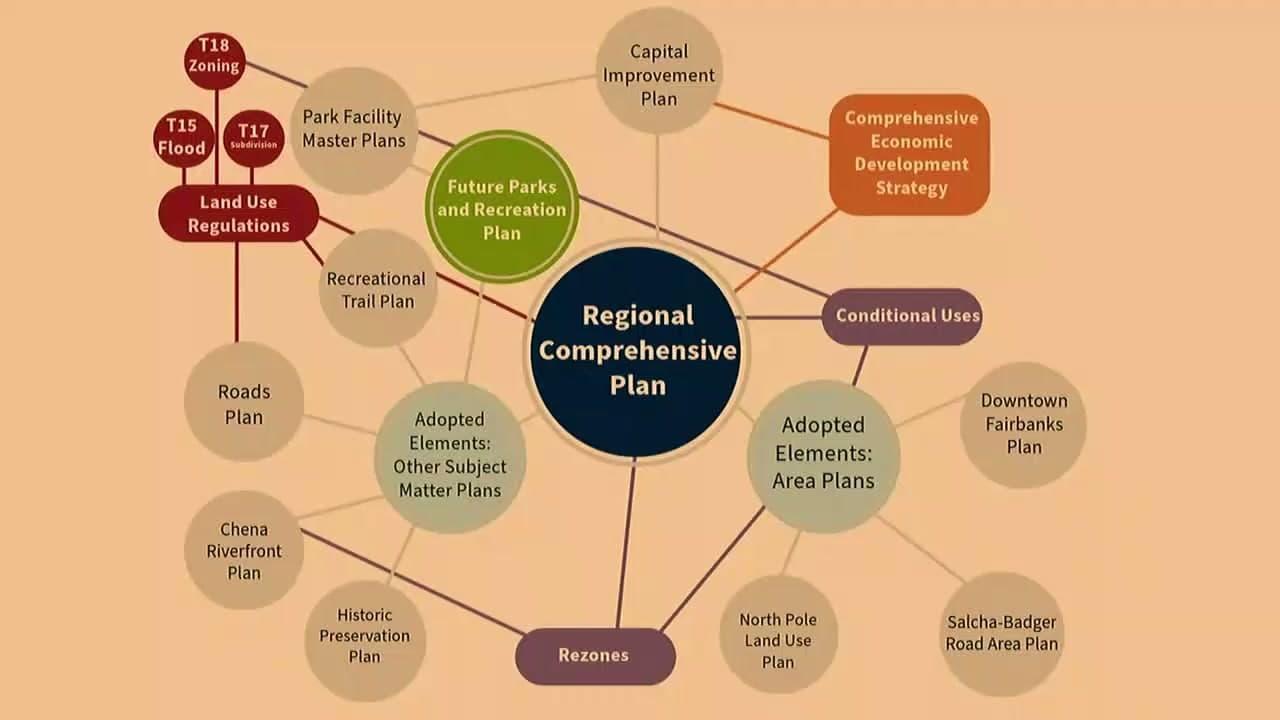
And I do like this graphic. It's a little hard to see, but it's everything that plays off of the comprehensive plan. Almost every regulation we have as a borough plays off the comprehensive plan. Every master plan we have, the Pioneer Park master plan when we adopted it, Tanana Lakes master plan when we adopted it, it all plays off of this foundation document of the regional comprehensive plan. So again, you can see how important this is, and you'll see this later with the ordinance that we're talking about.
Every regulation we're proposing is calling to that Regional Comprehensive Plan.
Just some photos. I think this shows the process well. We had so many open houses, so many online comment periods, and honestly, some of our best comments were after we'd produced products. We'd produced draft products, draft goals, policies, and strategies to implement this plan. And we had the community put thousands of Post-it notes on these big kind of printed out goals and strategies.
And we incorporated a lot of that feedback we got. And I know you've experienced that as well. One of our meetings, every word of every one of these chapters was very analyzed by the commission. We incorporated all of your strategies, all of your recommendations you made through that, that process. Just a little bit of a review of the numbers.
I think this shows those 4,000 folks touching this. 1,500 People took our first survey, and I'll show you those results a little bit because that was the foundation of this planning effort, what we heard from the community. We had about 900 folks take survey number 2. We had 300 folks visit us at some of our booths around town. 108 Folks came out in the middle of winter during an ice storm during community meetings.
And again, just a significant amount of public involvement as part of this planning effort. And everything we were posting to our website, and we actually got a lot of comments through the website as well. So this whole process was very transparent in my opinion. All the survey results, a lot of this plan was driven by a comprehensive plan advisory committee that the mayor put together to feed some input into this. All of those meeting summaries were posted online.
And there were a number of different factors that we asked the community to give us input on. I'm not gonna go through all of them. I'm gonna show you a little bit of the results, but we asked the community many different things, housing, childcare, natural environment, parks and recreation, environmental issues, cost of living, many different factors they told us how we're doing well as a community, and where we need to improve as a community. So again, that very robust survey, the highest rated aspects of our community by the community itself were access to natural environment, our parks and recreation facilities, access to culture and arts. A lot of folks felt we lived in a very safe community and had a lot of community connections and engagement.
No audio detected at 1:43:30
They told us the number one important issue was education. Access to the natural environment, health and wellness, being able to access the medical services we need, a sense of safety, and parks and recreation. But they also told us where, as a community, we can improve. The two lowest scoring areas by a significant margin were housing— the housing facilities and housing options we have in this community— and childcare. Just childcare in general, access to childcare, existing childcare facilities was a very common thing we heard pretty loud and clear from, from the community that we can, we can play off of.
So you can imagine we had, excuse me, 4,000 people and many of those left multiple comments. So how do you try to put all of that into one document with actual action going forward. That's the challenge we embarked in. So working with staff, we did our best to try to analyze, okay, 4,000 comments, 4,000 survey results, put those into 10 talking points. So here's our best attempt to give you a summary of the 10 top talking points we heard from the community.
Cost of living, cost of living and housing, the rising cost of living. Roads, traffic, and specific to winter mobility.
Energy costs. It, it might be shown as number 3 here, but I would say maybe that was number 1 in just the amount of comments we got. Energy costs and energy security. Air quality and winter inversions. I know many of you are familiar with the PM2.5 problem we have as a community.
Housing availability, specifically to different sectors, workforce housing, seniors, and we heard a lot from either young families or folks looking to get into entry-level housing, which is a big challenge here.
And I want to really emphasize this, I don't want to underplay this because we heard a lot about this as well, maintaining this rural lifestyle that, that many of us in the Fairbanks, North Star Borough have come to really, I guess, respect and why we want to live here. And property rights. Property rights is something we heard, and that's something we always have to consider, weighing individual property rights with other community property rights when thinking about things like regulations or where we want to go as a community. Economic diversification and trying to keep jobs local. And then the military, we heard a lot of Positives about the military, some negatives about the military.
Obviously one of the largest employers we have here and just some of the growth pressures associated with that, that, you know, they can make basing decisions and we can grow in population. I think the F-35s was 1,500 in a 2 to 3 year period. So that can be tough sometimes for a local community to absorb. Again, the highest ranking thing we heard about our community is access to recreation, trails, and natural environment. That's what many folks said they kind of value and wanna make sure we maintain that as a local community.
And then kind of our catch-all, we didn't really know where to put a lot of things, protecting what makes Fairbanks unique. That can mean a lot of different things for a lot of different folks. But again, significant amounts of kind of work went into this. I'm going to turn the, the presentation over to Ms. Whiteside, who is the project manager on this, to talk a little bit about the Comprehensive Plan Advisory Committee and how much work they put into this plan. Yes, thank you.
So from the public surveys and open house data, staff worked with the administration's Comprehensive Plan Advisory Committee, or CPAC as we call them. To develop the draft plan elements over several meetings. Uh, these suggestions were also worked through the Planning Commission through work sessions. Uh, the CPAC was a group of community members and agency representatives chosen by the administration. Uh, Commissioners Muehling and Fischer served on the committee since its inception.
So the Planning Commission, um, met through a series of work sessions and regular meeting items, uh, throughout the plan process. So we try to keep you up to date, um, uh, as it was going and provided another opportunity for the public to, to attend meetings. Um, the public was also able to provide a comment at any planning commission meeting through the process.
The plan has 3 parts: its executive summary, the plan document, and the appendices. The executive summary is intended to provide a high-level introduction to The plan document itself holds the bulk of the plan's information, including the topic chapters, goal and strategy language, including the implementation table to help meet the plan goals through potential actions. Uh, the appendices are over 900 pages in length, um, which includes materials that help develop the goals, strategies, and background of the plan.
So what goes into a plan? So it has a shared vision through a vision statement. So it's a broad kind of forward-thinking It considers the physical, economic, social, and cultural fabric of the borough. So this is the vision statement of the plan. It says, the FNSB is the hub of Alaska's interior and the gateway to the Arctic, with thriving, innovative, and welcoming communities that provide for a wide variety of opportunities and lifestyles, where community well-being is prioritized and people of all ages, stages, and abilities can live, work, learn, and play in a spectacular natural environment.
So below that shared vision is a series of guiding principles. So they provide directions for the plan goals. And so we're always asking, is this suggested goal or action in line with a guiding principle? And those are around the formulation of live, work, learn, and play.
And then within that are the specific goals. So these are gonna be on those topics such as transportation and infrastructure and economic development.
And then under each goal is a set of strategies and actual actions that are specific, measurable, achievable, relevant, and time-bound.
So each of the topical chapters includes a narrative portion about the key drivers of that topic. Uh, this includes what the existing conditions were, what we heard from folks in surveys and open houses, and where are we going based on community needs. Each topic has its own goals, which then has more specific strategies which can be measured. So just kind of an overview of those key plan chapters. So community health, safety, and wellness, land use, housing, and small area planning, economic development, natural resources and environment, transportation and infrastructure.
And then, uh, chapter 7 is the implementation plan. So that can sit into more specific potential actions and potential partners.
And then we have the appendices. So, um, they are pretty lengthy, um, but there's valuable information there. So Appendix A is the Small Area Planning Framework that establishes, um, more, um, objectives and helps us with going forward on doing small area plans throughout the community like we've been able to do with Salcha Badger area and the downtown Fairbanks. Um, includes the existing conditions report. So that was a lot of, uh, background information that was helpful for the planning team to kind of set the base basis of where we are today.
Survey reports for both of those surveys that Mr. Spellman, uh, discussed are included within that Appendix C. Uh, public comments received are in Appendix D. Uh, area designations, land use categories for the future land use map are in Appendix E. And then our entire public engagement file, so that includes our social media posts, um, photos from, uh, open houses, Um, anything that we shared out and got feedback on and wanted to show the extensive, uh, public engagement that we had through this process.
So regarding impactful land uses like mining and data centers, the planning team heard from community members frequently about concerns around mining near residential areas. Data centers became a community concern later in the process. While the document was out for public comment, the plan provides the policy framework to begin work on both small area planning processes to manage land uses, as well as potential ordinances for new zoning designations and use definitions and standards. Uh, this finds itself within both the natural resources and environment goal A and land use, housing, and small area planning goal C. So you kind of show like a couple of ways of how a direct public comment found its way into goals of the plan.
So housing was a topic we heard about frequently by the community members, uh, often with regards to— excuse you— availability, quality, and affordability. Uh, through the planning process, we identified the need for more senior housing, more types of housing for the community, and support for the development of multifamily housing on existing infrastructure. Uh, these comments inform the strategies found in land use, housing, small area planning goal D. So the protection of private property rights was something commonly heard from many community members. In general, community members were more supportive of tax incentives and education to help with housing improvements. Um, ensuring public health, safety, and welfare while balancing private property rights is often a delicate and emotional process.
One this body knows very well, and this plan acknowledges this in land use and housing small area planning goal A.
Uh, through public meetings, concerns about water quality were very common, uh, whether it was concerns about PFAS, well contamination, well availability, and water impacts from industrial users. Community members were very interested in, in ensuring we maintain and improve our water quality. Uh, these policy-level strategies are identified in Natural Resources and Environment Goal B.
The 2005 plan asked us to recognize individual communities within the borough as unique planning areas. The plan builds upon this with the small area plan framework discussed at length in Appendix A. This idea was generally well received by the community. As a way to ensure more granularity in the planning process while recognizing unique parts of the borough. Uh, these parts may have different goals and community objectives than each other, but they want to help support and obtain the larger borough goals.
So this is directly supported by Land Use and Housing Small Area Planning Goal A, Strategy 30.
The current zoning regulations are supported by the updated plan. Although the plan provides recommendations to update the zoning code to support community goals, the overall intent of Title 18 to protect public health, safety, and welfare by managing land uses is supported by the updated plan through the following goal strategy in action.
So if this plan is adopted, an example of how it could be implemented following adoption is through a rewrite to our zoning code. To define and permit accessory dwelling units in relevant zoning districts while ensuring public health safety is met. Accessory dwelling units, or ADUs, were something we commonly heard from, from folks at our open houses. This plan directly calls them out as an item to incorporate into the zoning code. So this would directly inform a potential ordinance to rewrite code and to apply a definition, potential standards, and application within the zones.
No audio detected at 1:56:00
So as of 2 PM today, and we certainly received comments after that, but I just gave a summary of some of the comments we've received. Um, so some folks have asked for the plan to address impacts to area streams and villages outside of the borough, uh, asking for more emphasis on aquatics facilities and instruction. Other comments that supported the plan, uh, with regards to supporting downtown projects, including murals, infill development, and supporting volunteerism. Uh, wanting to add additional land use designations through small area planning and eventually potential development of a zoning designation to manage impactful land uses. Um, general support of the plan and how it supports trails and active transportation and improved health outcomes.
Uh, they had support for the process and the plan document and asking us to prioritize housing for residents.
And then I would just ask if, uh, Mayor Hopkins would like to provide anything. Of course. Thank you very much. And I got a mic in front of me, so I'll say some words. I want to— you know, the 4,000 people that were mentioned that gave input onto this is really remarkable.
While I'm sure there's some repeat commenters, 4% of this community is an incredible turnout when you think about the usual, you know, lofty goal of 1% for our community for many of our surveys that we put out there. So I think this is going to be more reflective than we could possibly have hoped hope for going into this process. And I really want to make sure, um, you know, I think the community planning staff, the work that all of you did on this over the last 2 years is going to really help shape our entire community for the next 20 years to come. And hopefully it can help grow our community faster so we do hit that 20% threshold faster than 20 years of a growth population, which would be a wonderful result of this. Because, you know, if we listen to what is in this document, if we listen to what the community members said, whether it's the 70-plus people that turned out in Goldstream or the work that was done through the online surveys.
And the very last batch of public testimony that was given just this summer, after nearly 2 years of work on this, we put out one last batch of opportunity for public testimony and received almost 200 comments, almost exclusively of which were about data centers. And that was the very first time we'd heard about that concern from the community during this whole 2-year process. That's how fast it can grow. Um, but the work that the staff did, that the two members here of the, um, the Comprehensive Plan Advisory Committee put in, as well as all the public community members and the, um, the, the consultants, is going to help make sure that, that we listen and put forward policies and ordinances that are reflective of what this community wants. We have already been working on some of these topics.
Um, but I think this document, uh, is going to help guide us on the next steps. We've been trying to make work on, on housing, uh, through incentives, through the next step of accessory dwelling units that we'll be working on this winter, through, uh, the data center moratorium ordinance that's coming up after this, through, um, education funding and support for education. You know, those are things we've already been working on, but this will help guide us on those next steps and what issues we need to work on next. The 2,000— we're expecting nearly 2,000 service members to be coming in in the next 5 years here in town. How do we utilize this document to ensure we have housing, recreation, and community support that wants them is going to be the big question.
Many times when we start listening to, you know, the commanders of these bases, it's not just how can we support the service members, how can we make sure they're housed, but what what we're looking at across the country and here as a military, uh, as a community with so much military here is how do we support the families when the service members are off training or deployed across the, the world. And that reflects oftentimes what our community wants too—better recreation, better schools, better child care, better opportunities to live a wonderful life. And I, I really see those two working together, and we'll see that in this plan, you know, protecting neighborhoods in the ways that they want to be developed, whether it's, um, you know, protecting lands from mining or, um, making sure that, you know, we can see more density for, for housing, um, can expand utilities. What do we need to prioritize for energy costs? Things like that, um, is going to be a wonderful opportunity.
So I'm looking forward to how this document can help shape our community for the next 20 years as we start it this January when this passes and the work that all of you get to do on this Planning Commission to put— to follow these rules. As Mr. Spilman said many times, what we do is driven by this document. Random ideas that we have that the community comes to us with can be backed up by this document. And it's—. It is a piece of law and it's a driving force of how we look into the future and take current steps.
So I'm really looking forward to it. I'm incredibly heartened by the 4,000 comments that we received from the community because I think those are going to be something we can fall back on. Um, and, uh, looking forward to the work that all of you do. So thank you and look forward to working with you on it as we grow our community for the next 20 years. Thanks.
Thank you. And then would, uh, Commissioner Muehling and Fischer like to speak? I'll go first. Um, Eric covered a little bit in his update at the top of the agenda on the update and talked about the composition of the advisory committee and the different sectors of the community that it represented. In the, I think it was 8 meetings that we had, it kind of cycled through with some public outreach and then the staff working on things and then the advisory committee and then it coming back to the commission starting really big picture with the vision and then starting to drill down into the themes and developing the goals and then getting down into individual strategies.
And having the breadth of people that we had on the advisory committee, there was a lot of, well, but what about this and what about this? And the commission had one of the activities that we had where there was— I don't know how big those sheets of paper were, but we had the big posters on the wall and we had our dots to vote on things. So what's in the plan is really what rose to the top out of hundreds, if not like 500 ideas, um, and trying to capture the, the biggest themes. There were bullets that we combined, things that we refined, um, and, you know, all over 2 years with a very iterative process. I really appreciate the staff and the consultant team taking all of the input from the Planning Commission meetings, the CPAC, and all of the public comments and distilling it into the document that we have in front of us today and, um, and all the appendices, um, going to the data centers.
One thing that we talked about here at the commission in our work session and CPAC meetings, um, when our current comp plan was adopted, nobody had legalizing marijuana on the radar, but there was enough material in the Comp Plan that the borough staff could develop regulations and zoning and land use. And data centers have kind of blown up as an issue in very much the same way. So while we don't have data centers outlined as specific strategies and actions, it is very much an example of the type of issue the plan needs to be able to address, um, through, you know, really looking at land use conflicts and there's enough material in here that we can use it for those kind of questions of balancing economic development and opportunity in the borough against quality of life and really having, having this be a place that we want to, we want to live in and all the things that we love about Fairbanks. And I'm assuming there's a few people in the audience that are here both for the comp plan and for the data center moratorium, so that's an umbrella for both of those.
Eric? Yeah, I'll just summarize what I said earlier. I strongly believe that one of the greatest benefits of this 2-year public process has been the public's increased appreciation and understanding of the necessity of zoning and community planning. And this document in many ways is a statement of our community's values. And with public involvement in this comprehensive plan, our residents have a better idea How community planning shapes our future.
Thank you. Thank you. Commissioners, do you have any questions?
Oh, Mr. McKinley, I just have 2 slides and then we can go to it. So I did prepare a draft motion, and then I just wanted to bring light to pre-filled amendments. I think we had 23 that got in before the meeting, and one of those is Amendment 20, which was offered by staff. So this has a bunch of what we call Scrivener's errors, so just some corrections to the plan in it, and then also an addition of a footnote on page 77 to direct people to the acronym list. But then that's that draft motion, and that concludes my staff report.
No audio detected at 2:05:30
Thank you. Commissioners, any questions?
I'll ask one quick question. Um, during, um, part of the report, one of the things I heard was, is protecting neighborhoods from mining. And I'm wondering if that goes both ways. I'm wondering if we're protecting mining areas also and being sure that we have mining in the future. I'd say absolutely.
That's one of the biggest industries we have as a community. So this document, in our opinion, is going to set the table for being able to have those discussions and ensure that we can still have this, you know, incredibly valuable economic opportunity we have in a community, but also, you know, neighborhoods have the right to quiet enjoyment of their property and being able to balance that. Thank you. Any other questions?
I'll have one more. Um, in the report it was commented that the growth in Fairbanks was decreasing, and what I guess what my big question is, is nationally for communities this size, um, are we seeing that same type of trend, or is Fairbanks kind of on par with other communities this size? So I would say in the last 15 years, Fairbanks has been relatively flat, depending on what numbers you pull. And we have had a number of problems with our numbers in the past, especially census data that we, you know, we challenged at one point. But I would say generally communities are growing.
That's not necessarily the case in Alaska. I think Alaska— I don't have the numbers in front of me. It's been relatively flat over the last 10 years or so.
With that said, if you look back at some of our past projections we've had, you know, 20, 30 years ago, there were projected some wild swings both up and both down. Alaska has been historically, and the Fairbanks North Star Borough really, really epitomizes that, a boom and bust economy sometimes. You look at some of the booms in the year 2010, Forbes declared us the fastest growing small community in the United States. So we had big booms associated with a number of things: mining, oil and gas, military. So it really just depends, and it depends on the organization making those predictions.
DOL basically predicts theirs based on past trends. So they do nothing kind of looking forward with huge opportunities like a gas line. There are other private companies, I think Woods and Pool is one of them, they look forward based on economic opportunities like a gas line. So that's my long way of saying I wanted to show you one projection, but there's a lot of kind of disclaimers with that, that we don't really know what the future holds and it could be wildly up or down based on kind of opportunities coming our way.
Okay, I'll just ask one more follow-up.
So, uh, Mr. Spillman, so with that comment that you made, would one be able to say then that a very well-written, produced, put-together comprehensive plan helps make a community grow? I mean, this is, this is kind of the foundation of what helps build this community for the next 20 years. Absolutely. And I'm going to just use one example— housing. Housing, housing, housing.
No audio detected at 2:09:30
One example, we met with the hospital, I think last year, and they said— they're generalizing, but we hire a doctor, we hire some nurses, we give them a big relocation package, they start looking for housing. Can't find either housing in general or the quality of housing they're looking for and turn the job down. So our housing has direct impact on employment and vice versa. And that's something we can do something about. Ms. Whiteside mentioned the one example of accessory dwelling units.
We can loosen our regulations pretty significantly to help out with the housing problem in those instances.
Thank you very much.
Um, let's see, next is a public comment. Clerk, do we have anybody signed up? First on the list is Lou Brown.
Lou? Is there a Lou Brown? Lou Brown?
Oh, she had to leave? Okay. Next we have Charles Simmons.
Charles, come on over here and have a seat right there. Yes, please.
In what, 3 minutes? My name is Charles Simmons. Oh, let's get the mic set there. So state your first name, spell your last name, and then your neighborhood. Is the light on on the microphone?
Yes, Simmons, S-I-M-M-O-N-S, and I live on St. Patrick's Road at the base of Esterdome. I've been there since 1969. I'm a lifelong resident of Fairbanks. As was— as were other members of my family, including my mother. I'm here to comment.
Well, first off, I'd like to thank the commission members for doing the nuts and bolts work that you guys do, because as I got older, I realized a strong civic investment by members of the community is really important. And so anyway, here I am. And I'm going to read this to you because I'm not a good public speaker, particularly.
We are very concerned about potential industrial mining on Esterdome. The Esterdome area, where I have lived since 1969, urgently needs a small area plan. Our homes are 15 to 20.
Minutes from downtown Fairbanks. Um, the resurgence of industrial-scale mining on the dome threatens many residents around the base of Ester Dome and in other areas. This is a classic example of an area experiencing immediate land use conflicts. A small area plan could be a valuable tool to help locals have a real voice in decisions and outcomes that affect quality of life and the ability ability to remain in the area. Mining companies and their stockholders should not dictate the conditions under which we live.
Land use evolved over the long period where mining was largely inactive. Communities grew on and around Esterdome, and they are now threatened with large-scale industrial mining. Yet virtually— I want to emphasize this— virtually no protections exist for landowners. This is especially aggravating because contrary to our state constitution, we get very little revenue from our mineral resources. And a mine's footprint extends far beyond its actual boundaries with lights, noise, dust, air and water pollution, road safety problems, and road degradation.
The ability to extract gold from low-quality ore raises concerns about hauling ore over inadequate roads through neighborhoods and onto Fort Knox. Having lived through a mine startup and ultimate failure in the 1980s, I can say it was an extremely ugly experience. 24/7 Roaring generators, speeding traffic, dust, backup alarms, road disintegration, and virtually no regard for the neighbors. In this era, mining may not be as egregious, but even best practices have big impacts. Residents must have a voice that matters.
As currently written, the area plan is simply referred to as Ester. We would like the commission to change that designation to Ester Dome to include the village of Ester, Olive Anders—. Charles, I'm gonna have to hit— you ran out of time. I'm out of time? Shocking.
Okay. I— well, to be fair to everybody else, I've got to keep them on a time limit. I apologize. Uh, no problem. Does anybody have any questions for Charles, um, before you go?
Jennifer? Yeah, thanks for your testimony. Um, because we're doing amendments tonight, can you just restate your question for us, or your request? Uh, the request, uh, yeah, um, The plan refers— the area plan refers to Ester, and that's a little confusing to us because there is Esterdome, the village of Ester, all of Henderson Road, Esterdome Road to the top of the dome, St. Patrick's Road, and residents along Sheep Creek who live at the base of the dome. And all of these areas could be heavily impacted by industrial-scale mining.
I personally hope that Esterdome will eventually be preserved as a park or a recreation area for the many Fairbanksans. Charles. Okay. That was good though. I appreciate that.
I just want to say— Charles, before you go, are there any other questions?
Uh, Mr. Rodriguez. Hi, Mr. Simmons. Um, have you reviewed the fold-out map that we have in the plan that outlines exactly what part we're talking about when we're talking about Ester? Well, you know, I couldn't make much sense of that map on our computer, so I'm not going to be much help for you. Okay, no worries.
I just wondering if you've seen it. Thank you. Yeah. All right, thanks. Any other questions?
Any last questions? Thank you very much for your time. Thank you. Thanks to the mayor and Kevin for being here. Everybody else?
Uh, clerk, next we have Sean McGuire and then possibly Darla Theusen. So Sean and then Darla Theusen. Darla.
So Sean, go ahead and have a, have a seat, people. Should we have Darla? Yeah, Darla, come on up and we'll have you right afterwards.
Sean, go ahead and state your first name, spell your last name, and then your residence. Sean McGuire, M-C-G-U-I-R-E. I live on Birch Hill, but I also have a bunch of property over by Ester on Gold Hill Road.
Um, you have 3 minutes. Okay, thank you.
So the people that really want to stay and live here, they want to plan. That—. These are the people that are planning to stay here and enjoy it. These are the people that want to have a plan just like we're talking about. So I really appreciate this whole effort.
I mean, it's— Fairbanks is a tough place to live in a lot of ways, but it's also an amazing place. And so I just really appreciate, you know, all the tedious hours that you guys have put into that.
As far as the plan, I agree with Charlie. I think it's real important that there be, you know, a small area plan of different regions where people have a say in their future. And I think we always considered— I had a bed and breakfast over there for 15 years, and we always told people it was Ester, even though it's not like downtown Ester. We always considered it Ester, and a lot of people in that area do. But I think it's real important that, you know, these small areas have some kind of a say in their future in terms of their small region.
So that's my pitch. Okay. Sean, before you go, one second. Commissioners?
Thank you.
Uh, it's Darla, correct? Uh, state your first name, spell your last name, and then your residence or area. Darla Tyson, spelled T-H-E-I-S-E-N. And sorry, I got a frog in my throat. And, um, did you get like your area? Yeah, my area, I live off of Amanita 1948 Coalition.
I'm an enderoder. You have 3 minutes. Can I have one of his minutes he left? Okay, so I wrote stuff, but I'm gonna go out of my order. I'm hearing about all the data centers have blown up as an action, and we've had mining really blow up because of the price of gold.
And because of how it's now developed, it's no longer panning or just this loose box or— well, there were some pretty other ways they did it in the past by blowing up, like blowing water into the hill. But anyway, I love on this plan, and I love everybody's work they did on it. I love that the SAPs are there, small area plans. It gives all our communities a chance to really be a part of it, and it gives us hope. Especially for these large industrial hard rock, the large mines that are going all around us.
And what I don't like is there's 14 areas identified, 2 years each. That takes 28 years till you get your SAP for your area. Are we all going to be fighting over, I want my SAP first. No, I want my SAP first. Mining is fast track.
They're warp speed. But I think we need more support and be able to do more than one SAP for 2 years. So that's a big input of mine. And I appreciate also my Amanita area. We have a great nature reserve there.
We have wonderful trails, and I love that the trails plan is connecting our trails with borough trails to give that continuity. And the whole community uses it, Arctic Audubon, the university, does nature research there. I wish there was a map in here that showed all the mining claims around all those SAP areas because it's amazing. And I can get it right on my phone. I wish there was one in here.
Another thing I wanted to say, there was a little talk about rail extensions. And I think partnerships with rails would be killer, especially if it could go all the way to the border. That would help get rid of the haul road using our state highways and roads and borough roads as haul roads. And I think you could do great partnerships, and I think the mines would have money to put into it. And even though they say they're done in 4 years, they're not, because they're looking for more— 300 to 350 miles around Fort Knox.
They want to mill your gold. Um, also, I appreciated the Fairbanks history that there was actually the very first part was Athabascan seasonal camps pre-mining. So Fairbanks history was not just started from Felix Pedro. It was started from Athabascan fish camps. And thank you so much, and come out to the nature reserve at Amanita.
We're 3 miles from Fort Knox. Thanks. Uh, before you go, yep, Commissioners, any questions?
Darla, thank you very much. Thank you.
Thanks, Kate, for my material.
Do we have anybody inside the chambers that wanted to speak?
Um, do you want to come on up?
You want to state your first name, spell your last name, your neighborhood? I'm Robin Dale Ford, F-O-R-D, and I'm on Amanita Road as well. Okay, and you have 3 minutes. And what was your first name again? What's my first name?
Yes, Robin Dale Ford. Thank you. 3 Names, pretentious.
And I want to say also a huge thank you to all you folks involved in the two 2026 Comprehensive Plan, and I'm particularly heartened to see how the idea of the Small Area Plans, or SAPs, has developed and expanded to include 14 unique neighborhoods, because Greater Fairbanks is a big place. Along with data centers, I'm extremely concerned with the fast-tracking of large-scale open-pit corporate mining in residential and recreational areas around Fairbanks. Knowing that there's only so much capacity for the borough to work on individual SAPs and that they take 18 to 24 months to complete, I'm here to advocate for the neighborhoods that are being or will soon be most impacted by these mining activities, which I actually disagree bring a lot of economic development. Um, and the ones most impacted to these, uh, and ask that they be fast-tracked for a borough SAP project. And I would say They were Esterdome, Goldstream, Fox, and my neighborhood, which they call Steele Creek.
I realize that the actual boundaries are still being determined, but I think of Steele Creek area as Chena Hot Springs Road from the Steese Highway to about Smallwood Trail. Huge area filled with people. I live on Amanita Road, and we are dealing with the prospect of a large-scale gold mine operated by Contango Silver Gold, the same people bringing in the ore haul, situated on a popular trail between the end of Amanita Road and the end of Gilmore Trail, just a few miles south of Kinross Fort Knox. If this mine materializes, it will be easily visible from Chena Hot Springs Road and will, among many other things, negatively affect watersheds like Steele Creek itself and onto the Yukon. This is a heavily populated area with mining leases butting up against private residential properties and the Arctic Audubon Rydell Nature Reserve.
There's a core group of at least the Steele Creek and Esterdome area residents that would be happy to begin working with you as part of an advisory committee starting now, as time is of the essence to, and I quote from the brochure, protect and promote the character and identity of the community while fostering orderly growth and future development. It will be nice to have some kind of a tool and a say in what's happening in our neighborhoods when they are that huge. I look forward to being part of this important endeavor, and thank you very much. Thank you, Robin. Before you go, Commissioners, are there any questions?
Chris? Yeah, so I'm not honestly not too familiar with this large-scale copper mine, so thank you for bringing it up. Um, and I forgot to mention this one, I think it's called— it's called the Amanita Project. And we were first alerted to the mine lease sales in 2021, in January. Now, is your concern the size of the mine?
What size mine would be your preference? Well, I just have the precedent of Fort Knox to go on, and that was to be a 5-year mine with, with recreational areas left. In its wake. And I've been here in Fairbanks for 53 years, so I remember all of that. About small placer mines?
Oh no, I'm not talking about small placer mines. I am talking about Felix Gold, Free Gold, Contango, Kinross. And I have a map at home where I have the picture of Fairbanks and I have Fort Knox shaped cutouts in all those places, and it's pretty dramatic when you see it. It's—. And there's nothing to say that these mines won't get that large.
Gold is way up, and now there's antimony, which is for national defense. So, but they are gold mines in the main. So is your concern, besides from— it sounds like ecology, but also public road use? So your preference would be that processing be maintained on-site? I'm saying almost a mine of any size where this one, the Amanita Project, would be is incompatible with the residential areas around it.
And also it's on a ridge where immediately anything from there is draining right onto Esrow Road, right back into the back valleys. It's—. And it's right into Steele Creek. Which goes right into China and out. So it's in a real sensitive place.
That's what I'm trying to understand is if you're against all mining or just large mines? No, I'm not concerned with the placer mining in the area. I'm concerned with these large, large corporate open pit hard rock mines. And do they own all the leases there? Is it one entity?
You know, we're trying to figure out who owns the leases there. A company called Avidian owned, was buying them from Alaska Mental Health Trust until we all got word of it and said, "What? What? You're gonna ruin our mental health by selling your land to this corporation?" And so the Avidian backed out, but now we're seeing some documents that show that they might still be somehow facilitating this. But it's Contango who just merged with Varden Silver and Gold, and they are the main ones for the Amanita Project, which seems to be slightly on hold now because they're busy working on Johnson Track in Lake Clark National Park.
Thank you. And Hatcher Pass. Lucky shot. So they've got their hands full, but I don't doubt that they are serious about its gold. I've got another question for you, Jennifer.
Yeah, thanks, Robin. We appreciate your testimony. Quick question. It kind of summarizes everybody's comments right now. Has anyone from your community, or Ester from Save Our Domes, has anyone approached the planning department yet to start discussing, um, starting a small area plan, or what that process, or how the priorities are?
I haven't. I don't know if Darrell has, but that's what I wanted to say tonight. I, I did want to go Pick us, pick us, you know, or Esterdome, because I see those two places as being the most populated and the mines are, you know, close to residential areas. It would also be Treasure Creek up off of Old Murphy Dome Road and then Ski Land, Cleary Summit. That area is, they're well on their way.
Golden Summit, that's free gold. So I don't know. But I would say that the Amanita Project and Esterdome are the ones where they're really impacting residential areas. Yeah, OK, I understand that. So this Figure 21 on page 42, you notice that all the colors are kind of fuzzy?
Yes, and that's why I said boundary. There's not real boundaries. So I think it's just an idea that the planners had that Um, you know, through all the public comments, it's like we really need to start focusing on these areas. So take that to heart, and I'd go talk to these guys. Yeah, no, that was the— that was— I'm ready to work with people.
Great, thanks. And can help get the neighborhood engaged. Commissioners, are there any other questions?
Robin, thank you very much. Thank you. Thank you so much. Was there anybody else?
Hello. Hi. State your first name, spell your last name. K-O-P-O-N-E-N, southwest of the university. You have 3 minutes.
Okay. The vision and outreach to and inclusion of local residents by planning staff and the commissioners has been very good and important. Thank you very much. I've already made numerous specific suggestions relative to each draft from the 1970s through today.
So I'll try to get through a few that— I apologize I didn't get them in before 2 PM. About Chapter 2, Community Health, Safety, and Wellness. Oh, and I so much appreciate the responsiveness of you folks to take in our comments that this is priority. Community health, safety, and wellness, put it right first. That is so important.
Okay, Goal F, need to add a strategy to research and address causes, impacts, and resolution of homelessness. Add a strategy to protect and enhance individual environmental and community health and well-being via supporting careers that solve local problems of food security, pollution, injustice, health, enhanced protection of ground and surface water, land, air, and against potential nuclear impacts that are not mentioned anywhere else. Chapter 3. Land use, housing, and small area planning. Land use does not seem to include incorporating small farms and community-supported agriculture into zones that now disallow or discourage these.
These are important for food security and are very compatible. It's like a big garden, and I don't mean in a SAP, I mean throughout the whole borough. We also need protection from military mega-business or other encroachments that deprive residents of the enjoyment of their property and deprive the community of enjoyment of its attributes. Chapter 4: Economic Development. Goal B and D, education and research at university, is part of what that wording, but add the wording prepare students for filling local current and future jobs, and create new economic opportunities.
Chapter 5: Natural Resources and Environment. Introductory explanatory sections ending in flooding, needs sections framing environmental pollution. There's history and current repercussions of significant and health-affecting land, air, water pollution on local military bases, industrial sites, including mines, airports, and firefighter training facilities throughout the borough from burning solid and other fuels and exhaust and more. Some ongoing and EIS cleanup strategies, I have a bunch. Protecting watersheds, land, air, local infrastructure, local residents from harmful impacts, and promote local production of food, consumer goods, And I have more.
Okay, Heather, before you go, um, Commissioners, do we have any questions for Heather?
Thank you very much for your time. I just have a quick one. Um, if— have you sent those comments into the staff, just not before the deadline? I did not realize that there was a deadline. Um, I read the, uh, you know, the thing that comes out in the Newsminer, this It says on November 10th at 6 PM Planning Commission.
Did it say deadline for comments in there? It says that 6 PM you have this hearing and the presentation and then, um, you had a lot of specifics and we tried to capture them, um, but I think if you could mail them into, um, the central Planning Commission address, um, we can get those on to or the staff can get them and possibly process more than we can tonight without having them written in front of us. Well, and hopefully the 23 amendments will include some of these anyway. Mr. Spilman, before we go to Heather. Yes, Miss Copeland, that was my request, if you could include me on that email as well, just so we have record of that.
So email to General Planning and Spilman. Is that right? Thank you. Thank you. Any other, uh, before you go, uh, Eric?
Yeah, uh, Heather, did you attend, uh, and comment in any of the public hearings? Yes, I did. Okay.
Any other questions? Thank you very much, Heather. Thank you.
Is there anybody else?
And then, Clerk, we don't have any else? Else signed up? Correct.
That concludes our public comment. Um, staff, do you have any response to any of the issues or questions raised? I'll just give a brief comment. Um, we are—. It is a little unusual for the Planning Commission to sponsor an ordinance.
That's our proposal with this. We did feel that that's most appropriate since state statute gives that power and authority to the Planning Commission and how involved the commission and the CPAC has been— have been throughout this, this process. Those—. So that's our intent. As a reminder, any comments submitted by a commissioner for a potential amendment are in the packet.
They're all, uh, they're all numbered. I just wanted to end with, again, we're proud of this document. A lot of work went into this. It's extremely difficult to consolidate all of the comments and opinions of a community, especially as large as our community, into a single document. There may be things we missed or could have written a little bit better, but again, I met with, planning directors all around the state and all around the country, and they're very surprised about the amount of public involvement we had in this plan.
I can't think of any other community other than a large one like Houston or LA that had more public involvement in a planning process, uh, than we did in something like this. So I believe that concludes our comments. We're obviously here as a resource to work through any amendments or questions you have while you're deliberating, but, um, we would appreciate your support of the ordinance and recommendation to Assembly. Just a minor note, uh, if the Planning Commission approves this tonight, the Assembly is final action, and that would likely take place in mid-January. And that concludes our comments.
Thank you, Commissioners. Um, do I hear a motion? I'd like to make the motion, if it could be brought up on the screen, please.
I have a question while we're bringing it up. Um, we have the motion, um, the amendments— will those be actual amendments to the plan, or are those recommendations to the assembly to amend the plan? Those will be changes that will be, uh, will actually change the document itself, and then the assembly will see that with all of your changes from tonight. Okay, thank you.
Trying to get this to show for you. Maybe it wants a different hole this time. Uh, the full motion— uh, sorry about the technology issues— the full motion is available in the staff report. I would also be happy to, to read it if a planning commissioner would like to make it while we're having this technology issue. I, I've got it up on screen, Eric.
It's page 15 of the packet. I, I have it now. Thank you, uh, Commissioner Ringstad. I move that the Planning Commission sponsor and recommend approval of ordinance number 2026-TBD adopting the Fairbanks North Starboro Recreational Comprehensive Regional Comprehensive Plan: A Greater Future for Greater Fairbanks to the Fairbanks North Star Borough Assembly.
I'll second it. Is that Jennifer? Is that you? Okay. So it was moved by Eric and seconded by Jennifer.
Eric, would you like to speak to your motion? I feel like I already have.
Yeah, uh, the amount of amount of work that went into it, the public comments that were incorporated into it. It's a full document that was created in an open meeting process. And I think we're really, really close, and we might perhaps even finish tonight, which would be my hope.
Jennifer.
Yeah, this has been an incredible process, and I really appreciate you guys and all the hard work in R&M.
Um, when I finally read through, or read through the final document, I was really pleased to see the way that all of those little sticky notes were incorporated in a coherent manner. Um, and to me, it really feels like it represents the community's needs and desires a lot more than the last plan. Um, and so I really appreciate that, and I think that especially once you get to figure out how to use this document, which takes a little time. I think it's a great tool to start making positive changes, so I appreciate that. Corinne?
I'm also really excited to see this come almost to fruition.
You know, in going through the whole process, there were challenges and opportunities that we know that Fairbanks is going to be facing, but there's also the great unknown, and I think we have enough of a framework for how to address those things that we haven't anticipated because we have the, the principles on what, um, what qualities in Fairbanks we really want to enhance and protect and encourage, um, and it gives us a tool for those unanticipated scenarios that we might face 15 years into a 20-year plan.
Thank you. Any other comments? Greg?
So when I came on the board just a little over 2 years ago, learning this process and then getting hit with this comprehensive plan was like getting smacked in the face with a fire hose. I mean, it was just— it was a lot of information. But the process itself has been amazing along the way. The community involvement, the, the way that the contractor and the Planning Commission reached out to the communities and didn't just focus on Fairbanks but reached out to all the communities in the area and got all of them involved was incredible. So I look forward to voting on this, and then I look forward to my bound copy being presented to us.
So thank you. Commissioners, any other comments?
Mr. Chair? Yes. Uh, just to kind of get things going, um, I would like to propose an amendment. Uh, I would like to make a motion to propose, uh, Amendment, it's listed as number 20 in the packet.
This comes from community planning staff. I'll read it. Amend the plan document for clarifying amendments in the attachment, including a footnote on page 77 as follows. Please see page 4 for a list of acronyms. I'm just going to quickly read through the— we're calling these minor clerical errors.
Page 47, list full paragraph, second sentence reads, uh, I borough residents are encouraged. The I at the beginning of the sentence is removed. Page 47, strategy 29 and 30, end sentence with a period. Page 53, capitalize Arctic in geographic region. Page 73, second paragraph, use double dash.
Page 79, strategy 6, some more support and promote, end with a period. Page 105, Goal B, capitalize Interior. Page 96, Strategy 36, Action D, capitalize Cottage Housing and Triplex. Page 100, Strategy 24, Action A, use comma between FNSB and Interior Alaska Land Trust. Second.
Was that seconded by Eric? Uh-huh. Uh, Kelly, you want to speak to your motion real quick? Just minor things we missed. I'd appreciate if the Planning Commission would support this.
Thank you, Eric. Yep, ditto. Minor, minor clerical changes. Any other comments?
Uh, quick comment. Sure. Verbally out loud, your last bullet point, you read strategy 24, but it's written as 42. Just verifying which one's correct. Sorry, 40, 42.
Reading fast. Thank you. Does that clear that up? Yes. Okay.
Uh, do we need a roll call vote, or can we— Corinne, what were you suggesting? Oh, um, because everybody is, is present in the room and we don't have anybody online, um, you could do it as a without objection, and then if somebody does object, then we would go through the roll call. But if there's no objections, then you don't have to read the list.
Or the clerk doesn't have to read the list. So just to repeat, um, do a verbal call. Um, yeah, you would say, um, you know, move to approve without any objection. Any objections? Seeing none, the motion passes.
Uh, move to approve without objection.
Hearing none, on to the next.
Oh, motion passes.
Forgot that part's important part. Thank you. This is why I have a vice chair.
Best vice chair ever. Um, we have some more amendments here. Should I take mine up since they're first in the packet? Yes. Okay, um, I just have a couple.
The first two, kind of clerical. Um, Amendment Number 1, I request that MPO and RPO are both listed as acronyms on page Roman numeral V. I'd second that.
Move without objection.
Chair, my only comment with respect to acronyms that are used throughout that are familiar to many of us but not familiar to the public, that on first reference we spell out the name of the organization and name the acronym, and then after that, the acronym only. And that it be included in the index.
I think that's where we're going with these edits. For clarity. Exactly. For the public's clarity.
To clarify, was that just Amendment 1 in the packet? Yes. Thank you. And that was made by Campbell and seconded by Fischer? Yes.
Thank you. Eric, were you just commenting on—. I was just making a comment, not Not— you were trying to amend the amendment. Okay, thank you, Eric. So move without objection.
Thank you. Motion passes. Great, thank you. Um, Amendment Number 2, um, that we add captions to the photos throughout the document. There's a lot of really good photos in here and there's no indication of who took them or where they are or what they are.
So I'm not really sure how we do that. A second. Okay, I have a question for the motion maker. Is it enough to say Esterdome, Chena River, or do you want to see a full caption description, noun, verb, action? Uh, can it be a simple identifier?
A short identifier is fine with me, Eric, um, where appropriate. You know, some, like there's some of blanket tosses, I think it might be nice to say WIOA 2026 or whatever, but in general, yes, just a short one because not everybody reading this plan is going to know where those are, and it helps locate um, you know, where it is and why it's there.
Any other comment?
Move without objection. Chair, actually, if I may really quick, I would just, I guess, ask staff, is this motion as made specific enough to be implemented? This is specific enough. We'll do the best we can with what we got. Okay, thank you.
Thank you. Sorry, Chair, question. Yes, Brittany. Um, just a question to the motion maker. I think you alluded to it, but it wasn't specified here.
Do you also mean attributions, like who took the picture? I think I heard you just say that. I did say that originally. Um, personally, if I took a photo and it was in a document like this, I guess I would want credit. So, um, I know most of these could be taken by R&M consultants and maybe there's a standard of practice that they don't put R&M on there.
I don't know. Katie and I have talked about it and we haven't come up with the best plan yet. Yeah, we can try to find attributes. But I think with this discussion that's also covered in the wording, so I'm not necessarily recommending an amendment to it. I just wanted to make sure that that was your intent with the motion.
Thank you. It is. Thanks.
Any other discussion?
Move without objection.
Hearing none, motion passes.
Great. Thank you. So in your packet, amendment number 3, it's found on 2 pages. Page 30 and page 77. And really, this is just a— as written, it says— oh, this is under Community Health, Safety, and Wellness.
Goal A: Promote safe, equitable, affordable, and convenient access to healthcare, etc. Strategy 2: Encourage essential services to be located near the transit network. So it states that on page 30, and then in the implementation plan it states it again on page 77, strategy number 2. Um, and I guess when I read this, um, I think it's important that essential services and non-motorized, uh, transit facilities, sidewalks, trails are co-located, and this doesn't say that, this implies that, uh, essential services potentially need to be built near existing transit systems, and I think that's kind of backwards, um, that we really need to make sure that the transit systems and way to get to the essential facilities exists. So that's what I'm trying to clarify here.
Uh, Jennifer, just a technical thing, I don't think we had a Second on that, did we? No, I'll second it. For which one? Number 3. She's still explaining.
I was still explaining it. Oh, but you're right, we had questions. We have to have someone second it, then you speak. So what I, what I would like it to say is ensure coordination between transit network, sidewalks, and trails for access to essential services.
And, uh, yeah, and I seconded it. Okay, any discussion? Uh, Miss Lunsford? Yeah, I just want to say I support this. Um, I, I think back to that rezone that we had that was a slam dunk across the neighborhood.
It was on a shared-use path, existing transit network, close to 10-minute walk from Fred Meyer, 10-minute walk from the airport. Um, I think if something like this had been a little bit more clearly defined, then the decision might have been easier for our assembly. So I fully support this.
Eric? Yeah, in my discussion with Jennifer, so the way it was written was, do we move infrastructure to transit networks, or are we saying move transit networks to infrastructure? And the answer is neither one. We're just recommending that the coordination between the two and they co-locate where possible.
Without preference for moving one or the other. Thank you. Chris? Yeah, I have no qualms with the intent here, um, but my concern is the wording. It says ensure coordination between transit networks.
How do we ensure? How is that functioned? Should— would it be better suited to say encourage? I'm just not certain how the plan would ensure it. And if it doesn't ensure it, are we not following the plan?
I guess that's the question.
Come on, Chris. Well, I'll just put forward a motion to amend. Okay. And then they could die on the floor if it's not.
Um, I will— I move to amend the motion on the floor to remove ensure and replace with encourage. I'll second it. That was seconded by Ms. Rodriguez.
I just spoke to it. I'm not sure that we have— we can force these entities to coordinate, but I think it's well within the planning department's purview to encourage that coordination.
So that's why I put it forward. Ms. Rodriguez? Ditto. Um, I just think encourage could be better suited than ensure in this instance. Any other discussion?
I agree, and I, I'm good with either, but I think the, the key thing is the, the coordination rather than the directive of, um, ensure might be a bit of a reach, but encourage is definitely attainable.
Uh, so we're, uh, voting on the amendment to the motion. So, uh, amendment to the amendment, right? The amendment to the amendment number 3. Um, all in favor by or without objection to the amendment of the amendment?
Hearing none, so that changed to encourage.
So now, uh, we're voting on the main motion. Now we're voting on Amendment Number 3 as amended.
Yes, that's what I thought I meant. I didn't say that, but that's what I thought I meant. Okay.
All in favor without objection?
Hearing no objection, the motion passes.
Can I go on with Amendment 4? Amendment 4? Okay, so Amendment 4, um, is basically the same. I'm not sure how we got 2 in a row. You need to make your motion and then— you make a motion.
Yeah.
I'm going to change Amendment 4 as written here. I would like Amendment 4 to say— amend Strategy 2, Action A on page 77 to add as one of the essential services emergency shelters.
Second. I'm sorry, can you— I know it was much shorter, but I was trying to read and figure out where the changes are. Can you just repeat that so I can jot it back down? Sure. Page 77, Implementation Plan, Strategy 2, Potential Action A, and there's a list of essential services.
I just want to add emergency shelters.
Would that be in the same bullet with warming shelters and food banks?
If you'd like to leave—. Do we have a second yet? Did I second it? You seconded it.
Brittany and Olivia both have their hands up. Yeah, thank you. I'm not necessarily opposed to it, but I'd like to understand and give you a chance to speak a little bit more to Corinne's point of having a bullet that seems similar. If you could kind of explain what your intent is on this so I can understand it. I'm going to defer to Eric because we were combining our two comments.
This was his Amendment number 13. Oh, I feel the pressure. Ha ha.
Warming— so I'd made a similar amendment, which I'm not going to put forward anymore because we're adding emergency shelters here to complete the list. So yeah, so my question is, so we already have some bullets that may allude to that, to Corinne's point, but specifically the food banks and warming shelters. Do you have a specific, um, I don't want to call you out on a specific definition of what you mean by emergency shelters, but could you provide some examples? Um, and could it, should it be included in that bullet, or is it, it's own standalone? Several compounded questions into one to help me understand what your goal and intent is with this.
No audio detected at 3:00:00
To be complete. And I can speak to that. There's, um, The Door, there's the women's shelters, there's, you know, many smaller shelters, um, that I would consider emergency shelters around town that aren't a food bank or a warming shelter.
Did that answer your question? It did, and I'm really glad I asked, um, because when I, when I was reading emergency shelter, I was thinking like an evacuation or a place if there's an earthquake or something like that. So, um, I don't have a suggestion for a change, um, but I think adding some clarity, um, uh, just to make sure that those distinctions are clear. And, or maybe we mean both. I don't, um, I guess when I read it, I, I thought that it was included, and the fact that it wasn't— so thank you for bringing that to my awareness.
But, um, I just want to make sure that we're being inclusive.
Eric? And then, uh, Ms. Rodriguez. Yeah, I would hesitate to start qualifying emergency shelters in a number of ways. Um, with those two words, uh, provides a broad definition, which I prefer. Ms. Rodriguez.
Um, I also was looking for clarity because when I read emergency shelter, I was imagining flooding or earthquake or something like that. Um, so I'm curious if anyone on the commission might know of a more specific term that we could use, to Brittany's point, um, or if there is a more specific term for those kind of overnight, like, personal emergency shelter or something like that.
Uh, Miss Lunsford? I'm—. I mean, potentially like a safe house or, um, something like that could speak at least to the door and the interior Center for Nonviolent Living. That's what they use in Canada generally. Brittany, do you have your hand up?
Yeah, so I do, I do recognize that these meetings do establish the record, um, so I am not opposed to keeping it vague and inclusive, um, as long as we're understanding that that is our intent to include all forms of emergency shelters. Um, I do still, uh, question whether it's its own bullet or whether we merge it with the others. Maybe that's just a minor grammatical thing. I'm fine either way, just making that point.
I just have a question. Is there a difference between like a rescue shelter and an emergency shelter?
A comment that based on the nuance of emergency shelter as a natural disaster type shelter, or you know, temporary emergency housing for domestic violence or unhoused teens, that might be the case to keep it as its own bullet rather than putting it in with the food bank and warming shelter that are more directly associated with lower income type issues. And the emergency shelters as a standalone could be vague to encompass both the social services aspect and the natural disaster.
So I led us down a rabbit trail and we ended up back where we started.
So just for my clarity, where are we now in this? Call the question.
Chair, I believe we're just adding as its own bullet, emergency shelter, is where we're at at the moment with the proposed amendment. And I think going round robin, that is where we're at.
Uh, to the maker of the motion, is that where we want to be?
Chair, to clarify, uh, in the making of the motion, uh, Jennifer added emergency shelters So it's part of the— it's part of the amendment. It's not an amendment to the amendment. It is part of the language of the original amendment.
And what I— all I did was ask her, is that— is that what her intent was, is it's reading how she wants? Yes, as its own bullet point. Okay, so it's been moved and seconded and discussed and Approve without objection.
Motion passes.
Chair, can we take another 5-minute break? Time now is 9:03. We're going to take a 5-minute break.
Since we've been going for an hour and a half. I don't know. Doing great, Kevin. Crush man.
No audio detected at 3:06:00
No audio detected at 3:08:00
Oh, cool. I mean, we went upstairs, downstairs. I get a tour. The time now is 9:10. We are back on the record.
Uh, Mr. Spillman. Yeah, I just, uh, I did want to mention, uh, can we get it quiet in here, please?
I did want to mention, uh, just the time. The Planning Commission does have an auto adjourn at midnight, and I, by my count, I think we have 19 more pre-filed amendments and an ordinance that we get to tonight on the data center moratorium. So not to sway any decisions, but I just do want to put notice of the time on the record.
Thank you. Did I hear somebody else? Uh, Ms. Rodriguez, am I allowed to ask Helen a question?
Am I allowed to? Yes. Um, are we allowed to approve multiple amendments at once? Or do we have to go one at a time? Yeah, I think nothing formally prevents that.
If a member wanted— you know, somebody moved a slate of amendments and then somebody wanted to separate one out to discuss, there's a motion called moving to divide the question that allows the body to sort of cut one off and discuss it as a main motion on its own. Gotcha. Okay, cool. Thank you.
Did everybody hear that? Your mic cut out a little bit, Rocky. Sorry, I'll try that again. It, it is feasible to propose, for example, a slate of amendments where we have them filed and pre-numbered, and then if a member of the body wanted to discuss them separately, you could move to divide the question, which would, if passed, have the effect of carving off that one question identified as its own main motion or its own amended motion on the floor.
Thank you.
Jennifer's turn. Yeah, I just have 3 very short ones and probably take us longer to add them together. So, um, Amendment Number 5, Page 78, I would just like to add Chief Andrew Isaac as a potential partner for Strategy 5, Actions A, B, and C. Second. Second. Jinx.
You said jinx. I did.
Any objections? Discussion?
Discussion? Who was the second? I was, Rodriguez.
Sorry, I was moving that way too fast.
Jennifer, do you want to speak to your motion?
No. Eric?
I think it explains itself, doesn't need discussion.
Any objections?
Without objection, so ordered.
Amendment number 6. Actually, may I make a motion really quick? I bet we can bucket the ones that are just adding partners or potentially spelling out an acronym into one larger— or like into one bucket, like Rocky said. So, um, I would like to move to make a motion to, um, move Amendment 6, which says, um, amend Strategy 21 and add potential partners UAF, City of Fairbanks, and the City of North Pole. And then, um, Amendment Number—.
Please hold. Number 11, um, to amend strategy 94 to spell out FAST as Fairbanks Area Service Transportation. Amendment number 12, to amend the number of IGU customers to spell out IGU, Interior Gas Utility, so that it reads number of Interior Gas Utility parentheses IGU and parentheses customers. Um, And then Amendment 14, to add ADA, Americans with Disabilities Act, acronym list on page V and spell out ADA on page 82 to read, provide Americans with Disabilities Act, parentheses, ADA, end parentheses. If I may, Chair?
Yes, Aurora. Can we change the language? Because we can only have 2 amendments on the floor, but if the these are proposals, then we can do a slate like this.
Oh, I don't know how to change into that.
Do I make a proposal? It hasn't been seconded, so you can— oh yeah, correct.
Yep. Okay, so do I need to reread everything? Well, you need to rephrase your proposal. I would like my proposal to have a slate.
So you propose to—. I propose to move forward with the amendments that I've already said, plus, um, uh, number 17, amend Strategy 65, Action C, to spell out CIP to Capital Improvement Program, and then I think that concludes all the ones that are kind of more detail-oriented on acronyms or partners.
Second. Ms. Rodriguez, do you want to speak to your motion really quick? Thanks for your patience. I've never made a proposal like that, but I think that those are all pretty low-hanging fruit. It's adding partners or otherwise expanding on what an acronym is.
So I think that we can move forward with all those as one slate in the effort of time. Okay, um, Kim, for clarity, can I have the numbers of those amendments? Uh, yes, I will, I will. Um, maybe while my person who seconds grabs them, I'll make a little list. So just for a point of order, um, Rocky, can I ask you a quick question?
So that was a proposal, so we still need a motion to—.
I'll defer to our parliamentarian. Who made the correction. I, um, yeah, she, she did state her intent was to, um, amend to combine these proposals, right? So that's— so that is the motion. Okay, and then it was seconded by me, Olivia Lunsford.
Okay, Olivia Gang.
Chair, I would have no problem voting to combine these as long as they are strictly doing— naming acronyms. And adding agency partners. And adding an agency partner. If those are the only two things that are in common, with those, I would, I would vote for that. I'd like the numbers.
Yes, that was number— am I allowed to tell them what it was? That was number 5. 6. Number 6. Number—.
Please hold.
I have them written down if you would like. Yes, Rocky, thank you. So I wrote down numbers 6, 11, 12, 14, and 17.
I'd also like to just— point of clarification, um, Commissioner Muehling mentioned, uh, he would vote in favor to combine. The motion on the floor is not to combine these. The motion on the floor is to pass a proposed bundle of the amendments, correct? Yes. Okay.
Just the, the language, because you can only have two amendments, so it's combining— it's to, to pass these proposals as one amendment. It's one motion with multiple components. Yeah, I just wanted to make sure that we weren't voting on actually combining them and then voting on the combination. We are just doing it in one fell swoop. My, my interpretation, the maker of the motion can confirm or deny, is that this is one amendment—.
Yes. —Binding provisions of the proposed amendments numbered 6, 11, 12, 14, and 17. Fantastic. Also known as a slate approval? That's what I called it.
I'm not sure if that's the, you know, parliamentary term, but I think—. You got it. —Understanding is that it's a slate approval. Yes, that is my intention.
So the motion has been made and seconded. Any objections?
Seeing none, without objection, so ordered.
So are we calling that Amendment 6 then, Aurora? I would keep with the numbers on our papers. Well, we started with 6 and then added all those, so number 6 combines them all.
Okay. Okay, I just have one last one, if I may. Amendment 7, on page 123 in the implementation plan, uh, strategy 89. Where is it? Um, potential action C, amend to read initiate and promote a program to eliminate orphan roads in coordination with FAST planning.
Uh, the word eliminate is the addition there. Okay, second.
Uh, Jennifer?
Um, the way it's written is initiate and promote orphan roads, um, and so I'm just saying eliminate orphan roads. That's all.
Um, would the maker Also spell out FAST? I think it was used earlier, Eric, and so we can use the acronym. Okay. I'll just—. Eric, is that okay with you?
Oh yeah. Olivia Lunsford. Just for clarity on the Commission's part, there is an existing road service area plan. There are planning actions already kind of put into place and dialogue that exists around this. Um, so it's totally reasonable.
I think that Jenny would, would offer that.
Any other discussion?
Um, any objections?
Uh, seeing none, uh, without objection, so ordered.
Okay, Amendment Number 8. I move to— it's a column. I move to resort the two columns with highest percentage at the top, the lowest percentage at the bottom. Second. And it's a second.
Okay, so the headline says most important, but you can't find most important until you scan all the way down to the— down, if they're sorted in order, then it puts the most important on top. That's it. Who seconded that? I did. I too like my percentages in order, so that would make me happy.
Any other comments? Yeah, I read through this and I was confused because like, oh, I didn't know that. And like, wait, these numbers got tricked. Okay, you guys all saw it. Okay.
Any objections?
Seeing none without objection, so ordered. Amendment number 9, amend Strategy 65 to read, encourage residential and commercial construction and renovation standards that have better insulation and improved thermal performance that save on heating costs.
Second. Thank you. Up until this point, we hadn't said anything about what commercial and— what commercial and construction renovation standards are we thinking about? And this adds thermal improvement, thermal performance. Ms. Lunsford?
Nothing to add. Objection. I have a question. Jennifer? So I'm looking at page 111.
And Eric, right now number 65 just says increase energy efficiency. Are you saying to put these words in place of that or as a bullet point? It's changing the name, uh, the words of the strategy. Okay, that's what the amendment is. Strategy 65 to read Oh, and this, uh, this is twice, uh, once on page 54 and once on page 111.
I'm not sure if we're going to see this again as a second. Yeah, so this strategy, this amendment, uh, is to change the wording on both 54 and page 111.
I'd like to amend the proposal.
Um, instead of, um, that save on heating costs, um, I would say save on energy costs because we could have both heating and cooling where we could be more efficient. Good call. That's energy use. That's friendly to me. Second, Mr. Spillman.
I'm not the parliamentarian, but we do need a second on the amendment to the Second. I just seconded. Yep. Yeah, I'm just fine replacing heating with energy as it's more broad. Reflects both heating and cooling.
So we have an amendment to the amendment? Correct. And Eric, you spoke to your amendment, or who made the amendment to the amendment? Brynn. I seconded.
Okay.
Any objections to the amendment to the amendment? Uh, Chris, do you got a question? Yeah, I heard two conflicting accounts of the amendment to the amendment. I heard, uh, replacing the word heating with energy, and then I also heard that replacing heating costs with energy use. So I wanted to clear— better understand which one.
Can we kill this amendment, like say objection, because I want to revise it again? Objection.
To kill it, you have to vote it down. Yep.
I object. Yeah, I guess—. So all in favor? Nobody says yes. All opposed?
Somebody opposes, so—. Can you speak to your objection so we know what we're objecting against? Um, I can appreciate where Eric is trying to get more specific in the increased energy efficiency, but I think we've gotten a little bit too granular here, um, by looking at the insulation and the thermal performance. I would like to keep the insulation in but take out thermal performance and just say improved performance that saves on energy use. Second.
Okay, I, I would Disagree. The word improve is— I think that's what we're trying to do. I'm keeping improve but taking out thermal. Okay. I think thermal is putting an exclamation mark on what it is, what kind of performance we're trying to improve.
Rocky? Chair, I'm sorry, I'm not sure procedurally where we're at here. We're still on the— What amendments are on the floor? What is the proposed amendment to the amendment specifically? What language are we discussing?
I thought we were on like the amendment to the amendment to the amendment. We are, but we can't do that low. So we need to vote on the amendment to the amendment. Yeah, we have to take a roll call vote because there was an objection and we're on the amendment number 9 to remove heating and replace with energy.
So are there— there's— so there was an objection. Correct. So roll call vote. Mr. Corbett.
That me? No. Mr. Stepovich. Yes. Ms. Smart.
Yes. Mr. Muhlen. Yes. Ms. Campbell. No.
Mr. Collier. Yes. Ms. Fischer. No. Ms. Rodriguez?
No. Mr. Ringstad? No. Ms. Lunsford? No.
Mr. McKinley? No. 4 To 7.
Okay, so I have a second amendment to the amendment to revise to read, encourage residential and commercial construction construction and renovation standards that have better insulation and improved performance that save on energy use. Second. So it was, uh, moved by Fishers—. Miss Fisher—. Rodriguez.
Okay, I understand you're diluting thermal— you're deleting thermal. Can the motion makers speak to their motion? I'm sorry, I thought we were—. Well, I was going to have Ms. Fisher speak to her motion. Um, just recapping the conversation we had a couple minutes ago, um, I think this, um, amendment to the original language in the draft plan gets more specific on, um, insulation as a function or a feature in better energy efficiency from a heating standpoint.
Um, and by saying improve performance that saves on energy use rather than limiting it to thermal, it keeps it open to other places that we can be more energy efficient also.
Um, Ms. Rodriguez, was that your second? Uh, yeah, it was my second. I agree because I think I just don't want to accidentally shut the door on something by being too specific. So that was my intent in removing energy and thermal as well. Eric, did you have a comment?
I like the changes. Let's vote. Let's vote. Any objections?
Seeing none, without objections ordered.
So now we're voting on the amendment. Um, as amended. Amendment number 10. As amended. Yeah, Amendment 9.
I move to amend the second paragraph. We're still on Amendment 9 as amended. Yeah, we're still—. I'm just trying to move it along. I appreciate you.
So now we're voting on Amendment 9 as amended. Correct. Yes. Do I hear a motion? It's already on the table.
It's already on the floor. Just call the vote. Oh, thank you everybody. Any objections? Without objection, or seeing none, without objection, so ordered.
Really quickly, who was the second on that? Olivia Rodriguez. Who was? Uh, Ms. Rodriguez. I was the second on the original motion and Lensford.
Amendment number 10. Amend the second paragraph to read: As a municipal agency, Fairbanks North Star Borough is tasked with its road service RSA model that includes 103 volunteer-managed RSAs across an area of more than 7,000 square miles. I don't remember what was wrong with the first one, but that's my amendment. I'll second.
Eric? I don't have my notes from me when I was marking up the comp plan, but, um, oh, I spelled out the road service area, I guess, and you remove— go ahead for me. So I've got it up here in front of me, and, um, because it says the Fairbanks Northside Borough is challenged and you replace that with task with road service areas. Yeah, challenge could be misinterpreted. Task is a much better word, I think.
It gets to who gets to do it. Great. Any other discussion?
Any objections? Real quick, sorry, I'm trying to flip real quick. Is RSA part of the acronym list already? It is. Okay, um, I, I do object to this one.
I, I think, um, the, the model that we have with the road service areas does present challenges, um, and I, I think it is the, the better word to have in, in this section.
Is that your only issue? Challenges versus tasks? Yep. Make a motion.
I thought we had the amendment. She can amend the amendment. I don't want to make the amendment because I prefer the original text and the RSA is defined in the list of acronyms.
So just to be clear, you, uh, Ms. Fisher, so I would not— original—. Yeah, like, I, um, because you did call for without objection, right? Correct. Okay. And I objected.
Yep. Call the question. So it's a roll call vote on this one, right? I was just wanting you to kind of state what your objection was. Like the original?
I, I think the original language is more descriptive And the RSA acronym is defined in the list of acronyms.
I would continue to say in an appendix where all the acronyms are listed, it's an inconvenience for a reader to jump back and forth between pages, and on first reference, acronyms need to be spelled out. It's on the previous page.
It's on page 66 in the second paragraph.
Okay, uh, so any other discussion?
Clerk? Mr. Ringstad? No. Ms. Rodriguez?
Uh, no. Ms. Kimball? No. Mr. Stepovich?
No. Mr. Collier? No. Miss Smart? No.
Mr. Corbett? No. Mr. Muhlen? No. Miss Fisher?
No. Miss Lunsford? No. Mr. McKinley?
No. 0 To 11. Does anyone wish to change your vote? Hearing none, motion fails.
Next item. I want for clarity, what we were just voting on, whether or not, uh, Ms. Fisher's amendment. I didn't make an amendment. I was speaking to— he called the question without objection and I objected, so that was the roll call vote. Okay, thank you.
Amendment number 11.
We're on 15. We get to skip 11. Thank you. Correct. But 13 was covered in Jennifer Campbell's—.
Amendment number 12. 12 Was also in the bundle. Okay, hold on. The numbers that were in the bundle were 6, 11, 12, 14, and 17. And I believe that 13 was covered in Ms. Campbell's, one of her first two.
Okay, Amendment Number 15: amend Strategy 14 to read: support for education, outreach, and regulations to increase safety related to unique— to unique risks in our environment. Add e-bikes and scooters to the Action A list.
Second. Okay, just this week, the Journal of American Medicine JAMA came out with a report on the rising risks and rates and severity of e-bike injuries and brain injuries. It's because especially young people don't have the experience to ride faster vehicles.
It's a category that didn't exist 20 years ago when the previous, uh, Comp Plan was written, and I'd like to see e-bikes and scooters added to the Action A list.
Um, I hate to do this, but I, I second it because I wanted the opportunity to amend this, um, to add e-motorcycles as well.
I second that. Thank you. Um, e-motorcycles are an addition to this growing list of concerns. There's talk statewide about categorizing them as an M3 motorcycle, implementing a licensing action, but as it stands, they are undesignated. They're using our shared-use pathways and our sidewalks.
The riders of them are typically people who are very young and have not even gone through a driver education training. So if we're gonna call out the other concerns of e-bikes and scooters leveraging these facilities that we need to add e-motorcycles. It's growing worldwide. So your motion is to add e-motorcycles after e-bikes? Correct.
And it was seconded by Campbell.
Okay, and I'll speak to that. Um, if you look at this or check the emergency room stats, um, emergency room visits from e-moto cycles has skyrocketed this summer. And so I think it's probably more of an issue than e-bikes and scooters, actually. So thank you. I was going to add that too, Olivia.
Uh, Ms. Rodriguez, um, similar to a previous comment I had made, um, just how a couple years ago we might not have been able to predict an e-bike or scooter, um, or any motorcycle, um, is there another phrase that we could use that could maybe be forward-thinking as well instead of listing something specifically? Like, Olivia, I believe you might have just used like an undesignated vehicle as like a term. Is there something like that that we could use that might encompass more generically? Yeah, a little bit more generic, um, or specific, like at the end, add or other. Like, you could say motorized device, but then you get into the— you get into the category of also talking about like assistive mobility devices, like e-scooters and e-wheelchairs.
And so given that there isn't even state legislation that designates the classification of e-bikes and scooters and their CCs and all of the things that encompass this, I think it's best that we not get into the territory of trying to form an umbrella for the things that aren't even defined in legislative code yet. OK, yeah, that's fair. Yeah. Well, I support the amendment. To the— to my amendment to add e-bicycles— e-motorcycles.
Thank you.
Uh, Brittany? Yeah, I have a clarifying question for the maker of the motion. So, um, based on the written description, it says page 31 and 83, but based on how things are written on page 31, I, I believe that this amendment will only impact page 83? Is that the only place that the Action A has a list, correct? Or am I missing something?
He's also modifying the strategy to include regulation.
Um, so I mean, that's not the amendment to the amendment that's on the table. Yeah, yeah. So I see that. So I guess I would just want everyone to recognize that on page 31, there's no actual list. So when we make this motion, the only list amendment would be on the page 83 one.
Yeah, okay, thanks. Thank you.
Any other discussions on the, on the amendment to the amendment?
Chris? Yeah, I'm not familiar with the term e-motorcycle. Is that a popular term? It is, yeah. And do we have regulations concerning four-wheelers and all that already?
We just don't have— these would be classified differently as an ATV? They'd be different? I believe it got vetoed. Well, yeah, that's also a gray area. Um, it, it did, but then certain cities, um, or municipal boundaries can opt into regulations regarding OHVs and ATVs.
The thing about e-motorcycles and the challenge that the transportation space is experiencing is that they are being marketed as like an e-bike, but they are actually not e-bikes. They're coming with non-functional pedals, they're coming with seats that can't be adjusted, and so the terminology is really relating to something that is, is putting it more in the box of like an e-bike but not legitimately. I hope that helps. Yeah, it does. I support the amendment to the amendment as put forward.
I have a question. Joe, doesn't a motorized vehicle describe both gasoline and electrically controlled vehicles? Yes, it does. Also a great question, and if anyone wants to come to the FAST planning Walk, Ride, and Roll Advisory Committee on Wednesday or Thursday, November 19th, to further learn and discuss this. I would highly encourage it.
But yeah, there's a lot of challenges in terms of codifying the language regarding this because it is a vehicle, but it's not being marketed as such. Thank you. That answer your question, Joe? Yes.
So, uh, we have any more discussion on the amendment?
So, to any objections to the amendment to the amendment?
Seeing none, without objections, so ordered. The amendment to the amendment.
Now, um, we're voting on amendment. Now the amendment, amendment, amended. Correct. I had to stop and think for a moment.
Any objections to the amendment as amended?
Seeing none without objection, so ordered. Amendment number 16, page 90. Amend Strategy 25, Action G, to read, support efforts to tell the story of the community's history through the built environment, including stories about pre-colonization, early settlements, gold discovery, and military efforts. I second it. So the original description began describing Alaska's— Fairbanks' history, I think, with gold discovery, and we clearly have a history that goes far back beyond gold discovery.
And so this is more inclusive wording. It just says including stories about pre-colonization, and that's, that's the key to this amendment.
I would just comment, when I read this one, you know, the early settlements, because it was it preceded the gold discovery in the list, I was assuming that to mean the indigenous settlements. Mm-hmm.
But it may not be the way others read it.
It was open to interpretation, I thought.
I have to admit, I have a kind of a question on this. So are you saying that Um, Fairbanks was Fairbanks before the gold settlement or the gold rush? It's the community's history, uh, that begins pre-colonization. So that's— so what you're saying is there was a community here before Fairbanks? No, there was a history here before Fairbanks.
There was a—. There were people who lived in the Tenenaw Valley.
I'm going to object to this motion.
So we'll call a vote on it. Yep. Okay. Well, before we do, is there any other discussion?
Yeah, I speak to my objection. I'm objecting. Ding. Simply because I believe the original language is adequate.
I don't— the notion of pre-colonization makes me think of Russian heritage or pre-Russian heritage. It's going far back. Also, it refers to built environment, and we know there was no built environment prior to the founding of Fairbanks.
Olivia? I'm inclined to hear Corinne and Chris's side of the story because early settlements to me that did call into mind the very earliest settlements that are on the land that we are. So I'm leaning towards that, the original statement.
Any other comment? I think, I think it goes to, if I may, Chair, One of the reasons we are making land acknowledgments at many of our public meetings is that because somebody else was here before this place was colonized. And so this puts the language in parallel with our land acknowledgments.
That's like everywhere, right? There's always somebody there before.
And I think land acknowledgments are very important. OK. Greg? So is there a word— I like the earliest settlements, yes, that gives us back to the natives. But we know that there was a history before that, which I think that's what Eric is kind of hinting at. Is there a better word for pre-colonization?
And I don't have it. Maybe somebody else does. Well, I'll say the original text says early settlements, and I think that pretty much describes it. Ms. Lunsford. Yeah, I was just going to say we did receive public comment tonight about the timeline that noted the Athabascan representation.
And so if we could figure out a way to just maybe line up the language to line up with the timeline that exists on another part of the document, which I don't remember the page. Um, and I'm wondering if Miss Copponen—. 15. 15. Okay, thank you.
Um, because that might, that might just kind of help everybody.
I might have given you the wrong page. No, that was right. I mean, we could say pre—. Says pre-mining. Pre-mining.
Pre-settlement, something other than pre-colonization. Yeah, because it says, um, pre-mining Athabascan seasonal camps. Yeah, which I think could be— or the settlements. Yeah, correct. Yeah.
Okay, maybe perhaps it's about time.
Perhaps we could say indigenous settlements.
Uh, Miss Smart. Yeah, I'm interested in the community planning team's thoughts on the intent on the original language and what the thought was with early settlements. Was it deemed to be all-inclusive with some of the indigenous settlements back when this area was first getting settled? That's how I took it. So I just am interested in your guys's intent.
Mr. Spillman? Just speaking to that, the intent was to include any activities that include— that predated gold mining, the riverboat getting stuck, etc., so as to include all Indigenous settlements prior to that. So I guess speaking to the amendment, it doesn't matter to us that much whether it passes or not. That's our interpretation of it. Okay, so with that, Chair, I guess I would second the objection in terms of that I think the original language is adequate, and I think that addition of pre-colonization could be unnecessarily inflammatory in a way that we don't necessarily mean or intend it to be.
No audio detected at 3:50:00
Eric? Chair, early settlements is implying, you know, that there was settlement, but there was early migration before there were settlements. And I think that's what I'm trying to capture here.
I would move to amend to say including stories about early Athabascan camps or Athabascan seasonal camps, early settlements. Let me, let me start over. Including stories about seasonal Athabascan camps, early settlements, gold discovery, and military efforts.
Second. Uh, Kering, do you want to speak to that real quick? Yes, um, I, um, and could you—. Would you mind rereading it too as you speak to it? Yes, um, including stories about Seasonal Athabascan camps, early settlements, gold discovery, and military efforts, I think, starts the Fairbanks population story with the original occupants of the land and then builds up in progression of timing without using— I think the pre-colonization language, while I appreciate the intent, could be rather polarizing and might might backfire on the final approval.
No audio detected at 3:51:30
How do you feel about the words early migration, early settlements, gold discovery? Early migration—. We already have two amendments on the floor, so we—. I'm asking, how do you feel about the language early migration?
May I just speak to a second one? Because that because that happened before settlements. Eric, I— yeah, we're kind of out of order here. I gotta go have, uh, Ms. Lindford speak to her second. Okay.
Um, I just seconded it because that is the exact language that I was envisioning when I brought up the timeline that, um, Commissioner Rodriguez noted. It's on page 15, and if you look at it, it just aligns the language with everything. And I think instead of making up additions that might confuse the story a little bit. It's important to be consistent with the storytelling, um, and so I wholeheartedly second, uh, Commissioner Fischer's amendment to the amendment. Any other comments?
Yeah, could I get the amendment to the amendment read back? Yes, Miss Fisher. Yes, it would be including stories about seasonal Athabascan camps, early settlements, gold discovery, and military efforts. I'm sorry, you have a timeline? Okay.
I mean, I— what I'm seeing, what was just shown to me by the clerk and what you said are different. Um, so what I'm understanding is you're just removing pre-colonization and replacing with, uh, Athabascan seasonal camps. Seasonal Athabascan camps. Seasonal Athabascan camps. Okay.
Greg, did you say you had a question? No, no. Oh, Eric, did you have any other comments? Are there any other comments?
So we have a roll call vote on this. Um, first the amendment to the amendment, right? Nobody, nobody—. Oh, nobody objected to the amendment to the amendment yet. Yeah, you have to call that question, right?
Okay, uh, are there any objections to the amendment to the amendment?
Hearing, seeing none, um, without objection, so ordered. So now we're— or now we are voting on the amendment as amended.
Amendment 16 as amended. Item 16 as amended. For the record. For the record.
Vice Chair, are there any objections to Amendment 16 Amendment as amended?
Seeing none without objection, so ordered. Okay, proposed amendment number 18, skipping 17 because that's been handled. I move to amend Strategy 66, Action A, and replace similar facilities with a future energy storage technology. Second.
I— thank you. I'm going to speak to it. I think that's what we really mean. Future energy storage facility, similar facilities, uh, kind of vague.
Oh, and oh, and my comment was the future may not be similar, right? So future energy storage technology, the unknown. So I apologize for not reading this, but what are they talking about here, Eric? I don't have the— I don't have the book in front of me. I do.
They're talking about increasing efficiency and resilience of local power supply. So identify appropriate locations for long-term battery energy storage systems and similar facilities.
And it's on page 111. Thanks. And that refreshes my— you know, they're talking about batteries and similar facilities. And I don't know that the future is going to have similar facilities to what the batteries are now. And so more broadly speaking, and future energy storage technology—.
Was that seconded already? Yep. Um, okay. Yes, who seconded it? Me.
Um, I have a question for the maker of the motion. Is the intent to keep the word facility after it?
No, it's not necessary. It's replacing similar facilities with what's in quotes.
Future energy—. There may be an assumption that a future energy storage technology is a facility.
Might be some bacteria.
I'm thinking on this one.
Are there any objections?
Seeing none, without objection, so ordered. For Number— Amendment Number 18. Amendment Number 19. Amend Strategy 76, Action B, to add "reduce" as such that it reads, "Support technologies and programs that reuse, reduce, and repurpose other waste materials." So before, it previously just said reduce and repurpose, and I thought reduce is a, is a strategy that we can work with. I'll second that.
No audio detected at 3:58:00
And I just stated my reason.
Reduce, reuse, repurpose.
No objection.
Eric, did you want to speak? Did you have anything else to say to your motion? No. Okay, any other comments? Any objections?
Seeing none, without objection, so ordered. That concludes my amendments. All right, I've got a few. We already passed through 20. Thanks Mr. Spillman.
Thank you. I was looking for 20. Where is it? Yeah, 20 is good. Amendment number 21.
I move to amend strategy— oh, on pages 31, 83, and 84. I totally had the— I think it was, um, Goal C. Um, amend strategy 15 to read sustain, protect, and expand expand local investments in parks and trails. And Strategy 16 to read: guide, maintain, protect, and expand the community's investments in public parks and recreation. I second it. Thank you.
Ms. Lindsford. Thanks. This was actually in direct response to an email that we received this morning, and so I apologize for the tardiness, but I just really appreciated the addition of the, the language, expand local investments and expand the community's investments, because I think it speaks, you know, 20 years out, who knows what's going to happen in terms of funding for our borough. And we heard at the beginning, in the middle, and at the end of the presentation from staff tonight just how high our community members value parks and recreation in this borough. And so I just, I've really felt that it was important to add this language in and thought So that might have just been one of those things where it's like, oh, just something that we missed.
But here, here it is. Jennifer.
Yeah, I was actually going to bring this amendment forward, and then I saw Olivia did it in direct response to a public comment. Thank you. Any other comment?
Any objections?
Seeing none, without objection. So ordered. Thank you. For Amendment 21.
Moving on to Amendment 22. 22 And 23 are kind of similar. I would be comfortable having discussion about this, but I'll just move to Amend 22. To the executive summary on page 10 and then plan page 76, add the following metric for measures of success. Percent of households living within a half mile of a public trail.
This one was blank, actually. I'm realizing that's my handwriting. So add the following metric: percent of households that are within half a mile of a public trail. I second that too. Thank you.
I'm trying to figure out, because I've got like 3 23s over here. Yeah, I tried to—. The packet that's stapled together is replaced by the 3 sheets that Aurora passed out at the beginning of the meeting. Okay, the 3-pages packet. Yeah, we got like 3 package pages that all said amend Strategy 15, so you can get rid of 2 of those.
And this one says add, add the following metric. Okay, and it was made and seconded by—. I made the motion, and I think Commissioner Campbell seconded. Okay. I have a question for staff, um, in terms of— well, actually, a question for the maker and then a question for staff.
Um, public trail, would that be, um— I am trying to think back to the trail plan. There were the A, B, and C trails. So a public trail, like, which category would that be? Oh, Corinne, that's a deep dive. Um, just for clarity in how we're defining the metric, and then the, the question for staff is how readily available that is from the borough mapping in terms of the overlay of trails and residential properties.
Mr. Spillman, I'd say with, with everything on this list, we're going to need to develop methodologies after the, after the plan's adopted. So I think there's enough guidance for us to craft methodologies that get really into the weeds, and I wouldn't want to kind of set the basis of really getting into the weeds right here. But from a technical standpoint, you think it's feasible? From a technical standpoint, I think we understand the intent and we'll have to develop a methodology to implement that.
Okay, I just wanted to make sure it was a feasible request. Great. May I speak to my motion? Yes. Um, yeah, so this again was in response to a public comment that we received.
Um, we actually received a document that pages of comments and this one just seems like a really reasonable— I'm all about having success measures as we like to call them in my line of work. But yeah, I think that this is just a really great way to say, okay, we can use some geoprocessing in the future whenever it is to determine whether or not people are accessing a quality of life that we hope to envision for 2050. Um, and yeah, it's kind of the same logic for both of these, so I'll stop there. Okay, I'm just trying to make sure that I'm, that I'm caught up here. So did we do 21 already?
We did 21 already. Okay, and then we're on— okay, just keeping me up to date. Mr. Spillmans, one quick clarifying question. Um, It's clear where it would go on page 76, but I'm, I'm unclear where this would go on page 10. Oh, they're talking about executive summary.
Oh, I'm sorry. Yeah, because metrics are also included in that document. I apologize, I was looking at the wrong page.
10. I have a question for the maker again. Okay, um, and looking at the existing list on page 76, and I might be getting into apples and oranges. Um, the current amendment on the table is living within a half a mile of a public trail. The last item on the list there is households living within a 15-minute walk of public park or green space.
Um, is your motion intended as public trail as recreation or transportation or both? I would say point of access. Whether that access is recreation or commuting or whatever. I would just say point of access to space, but it is separate from the park or green space discussion because it could, it could ultimately wind up being a connector for somebody, right? Like we have ski trails that then connect to shared use paths that connect to downtown.
So the idea is connectedness. OK.
Any other questions or comments? Eric? Right. As I was first reading this, within a half mile of a public trail, doesn't say point of access or where the trail begins or how we can get to the trail. I was imagining a trail running through, and at some point in the middle of that trail being within a half mile of a high-density work area.
What is this saying?
It's saying that you could potentially have access to it. I think the reason that this resonated so deeply with me is that it's very much like my house. I live at the corner of Iceberg and Chena Ridge, and there's access to a trail there that could then connect me to another one that could eventually connect me to an established non-motorized network to get into town. So the idea is really just access, and I— and, and it's not even really just access. The idea is, is using it as a metric of success for people having the access.
So I think we're focusing a little bit too much on like the half a mile of a public trail thing, when really what we need to be focusing on is like the number of households that are within an area that has access to that thing. Okay, so with all the trails in, in around the Fairbanks North Star Borough, the term trailhead doesn't capture it because—. Right, I mean, you could talk about access points too. I'm just talking about access too. So why don't, uh, where it says half mile of a public trail, insert access, public trail access, or other protected bicycle and pedestrian facilities I'm not— you're saying access, but the word access isn't in the motion.
Sure, I hear you. I just don't want it to— I don't want to pigeonhole the concept to be like you need to drive to a trailhead to then access this trail. What we're trying to— what I'm trying to say here is like, you live within an amount of space that's reasonable to just put your shoes on and walk out the door and access connectivity. So, I mean, I'm open to amendments. I, I just thought that this was a really great way to measure success because all you have to do is overlay homes with the trail.
It's GIS, it's easy.
Yeah, I can see just saying public trail as being general. If we start to add access, it's putting a fine point on it. And I guess public trail works.
It'll be interpreted.
Any other discussion? Chris?
Yeah, what is success here? That more people want to live next to a trail or that more trails are created? Created? Is it both? Is that what this is measuring?
I don't think it has to do with creation of a trail. It's just the percent of households that are within half a mile of one that is slated as a public option.
So I'm not necessarily saying let's call out development and prioritize within half a mile of a public trail when we don't even have a solidly established trail, um, plan, really. Um, I'm just saying it would be cool to know for future planning efforts just how many people have the access and number one use it, and number two might not even know that they have it, and number three ultimately use it in connectivity planning, right? Well, I'm just saying because let's say I live on a trailhead And for the borough's plan to be successful, you're telling me we need 5 more people to live on that trailhead next to me. I'm like, I want to live alone. Yeah, no, that's a good— that's a good point.
OK, this is getting too confusing. And I feel like we've wasted a bunch of time. So— but I think—. Jennifer? Thanks.
So I guess I would go back to something Kellan just said. Because if you look at the entire list on page 76, The title is Measuring Success, and when I was reading through this, I'm like, suicide rate, how do we measure success there? You know, homelessness rate. And I think to Kellen's point, success looks different for each of these, and we can't micromanage how the planning department or the borough or anybody, um, is going to measure success. And I think our role right now is to just put the things in here that we think are important to keep in mind.
And so I don't really think that we need to say an increased percentage of people living next to a trail or, you know, or, or do it down to that minute detail, you know, number of IGU customers. Is it better to have fewer or more? I don't know. That's their job. So I think adding to this list— and I had a number of people from the cycle club and the trails club ask for this to be put on here as well.
And so I think it's OK this way.
And so that's all I wanted to say is if we're going to start saying what success means for this, then suddenly we're trapping ourselves and we have to start saying what success means on the rest of the list. We'll be here past midnight. I was just kind of adding to what Jenny said. Um, you know, some of these, there are obvious— like, an increase in that is, is bad, a decrease is good. Like, the suicide rate, the homelessness rate dropping, that is a sign of progress.
Um, some of these could be neutral. The number of short-term rentals per year is a number If the number of housing units is also growing, then it's maybe a— it's actually a net increase in long-term housing, but it's also an increase in what would be available for tourism. And I think the percent of households living within a mile of a trail, I think as a trend line, as we're looking at it annually over the life of the plan, if that number goes up, um, I'd see that as a, a good thing, but it may not have a number attached to it. Like, if everybody is able to get to a bike path easily, or their, their neighborhood walk in the woods, you know, it keeps us sane in winter.
Any other comments?
Uh, are there any objections?
I'll object simply because I don't think we need to pigeonhole ourselves to what a metric of success is for this. I think the document allows success to be measured differently, so I don't think it's necessary.
Okay, thank you. Aurora? Is this 22 combined? With 23? No, just 22.
Okay. Mr. Corbett?
No. Mr. Stepovich? No. Miss Smart? Yes.
Mr. Meehling? Yes. Miss Campbell? Yes. Mr. Ingstad?
No. Ms. Fisher? Yes. Ms. Rodriguez?
Uh, no. Mr. Collier? No. Ms. Lunsford? Yes.
And Mr. McKinley? Uh, no.
5 To 6, motion fails. Okay, one more from me.
Um, add the following metric to measures of success on the executive summary, page 10, and plan page 76: percent of high-density work areas within a half mile of a public trail or other protected bicycle and pedestrian facility.
That was a motion. Is there a second? Second. That was so quiet. Uh, Brittany, okay, okay.
Made by Ms. Lunsford, second by Ms. Smart. Um, maybe this one will, will stick a little bit better just because it's in more of an urban context. Um, I mean, the example that I used when I was talking to borough staff earlier today is like the number of people that I see using the Chena River Walk in the middle of the workday almost every day. Um, there are groups all over our urban core that get together and work or walk during lunch hours, and I think that it just really contributes to the overall overall, uh, health, safety, and welfare of the community by having access to these facilities. And by putting in here that, um, we're maybe viewing it as a measure of success, whatever that looks like, however the community planning department eventually defines that, um, it shows that it's a priority not only in this planning sector but in, in other planning efforts throughout the community.
Ms. Smart. Yeah, we heard earlier today how one of the priorities in our community was access to a natural environment, and I think that this is, um, a key measure that we can track in terms of how we provide some of those, um, opportunities to our residents, um, even during the workday or even commuting into their places of work.
Any other comments? Chris? Yeah, I'm more favorable towards this amendment that's put forward, though I am— percentage of high-density work areas. So what is a high-density work area? As in, is it the entirety of downtown and there's one trail that goes through it, or like, is there proximity to each building?
It— that's the metric that I'm— because I think we're at 100 right now with that, with the downtown, uh, Riverfront Trail. Um, but maybe that doesn't cater to, uh to, uh, West Fairbanks. But, um, I'm just a little confused of what it means, but I'm more favorable towards this amendment. Olivia? Um, I would definitely say that like South Fairbanks, I mean, you have number one, I mean, the food bank and the amount of traffic that's generated there, having alternative options.
You have the medical district, which again is like southerly of Airportway. I think, I think that we're really lacking a lot of north-south connectors, um, in terms of this. And so I definitely hear you on the east-west aspect and downtown being a high-density work area, but we also have, um, like the big box stores over there. That's another like north-south, um, connection that really needs to be better established. And I, I wonder, you know, if, if we did prioritize that, um, in terms of high-density work areas.
So general, like traffic generators, I mean, what you would use in engineering.
Thank you. Uh, Mr. Walker, is this a metric that's already tracked in the downtown plan, just out of curiosity?
No. Eric, did you have a question? Um, I'm still working on work areas and a definition. Uh, is this, uh, are these commercial zones? Is this, uh, could this include, uh high-density residential?
Um, and if not, why not? I, I feel like if we get back into the residential conversation, then we're getting into percent of households living within a half a mile of public trail, which we just killed. So I would really like to just keep it as like, um, employment generators, high-density employment generators. And, and we're talking big box stores, hospital, retail, things and services and goods that we all access every single day when we are like coming into town as Fairbanksans.
Um, Brittany? Yeah, and I think we heard from staff earlier that this is, um, technically feasible and gives them some general direction where they can, um, figure out the nuts and bolts and in the weeds of how exactly that would be defined. So I think this is a, a good measure to, um, measure success, and we can leave it to staff to figure out some of the more technical details on how it could be implemented. Walker, did you have a question or comment? No, but I have thoughts.
Um, I feel like this is very— could be very area-specific, like the last amendment.
Okay, anybody else? Miss Rodriguez?
Uh, anybody? I preferred the, the other amendment. I feel like this one is a little bit more nebulous in terms of what's being— like, how we define the high density. Um, but I'm good with it.
I have the same question about, uh, high-density work areas. Just seems really vague, and I appreciate The examples given, the hospital zone, the Costco zone, Bentley Trust, I guess, are areas intended to be— those are the areas you intend to identify as high-density work areas. Is that right? Sure. I mean, we could amend it to say high-density trip generator— trip-generating areas or something like that, but It's less about the trip and more about the people in these work areas having the opportunity to access something within the area that they travel to.
No audio detected at 4:19:30
Is this as in, I've got a half-hour lunch and—. Yep. I want to go someplace within half a mile? Yes.
Do you have a question or are you just moving your pencil?
Greg's ready for a break.
Are there any objections? I'm ready for a nap. I heard something about a nap.
Hot mic. Are there any objections?
Seeing none without objections, so ordered. Time now is 10:19. We're going to have a quick 5-minute break. Thank you. I need that.
No audio detected at 4:21:00
No audio detected at 4:21:30
No audio detected at 4:23:30
No audio detected at 4:25:30
Oh, oh my God. All right, thank you everybody for that quick 5-minute break. Uh, Clerk Are we back on the record? Yes. Okay, so, um, next we got, um, Amendment— is it 24?
You can call it 24. I have some bonus amendments I wish to share with, with the Commission. Okay, um, can you start with page number? Yeah. Um, are these proposals or are you moving to amend?
Say that again. Are you moving to amend, or are these proposals? Moving to amend. Okay, okay, two at a time. Um, so I'll start with page number, Chapter 2, page 27.
I move to replace the title of subsection titled firearm fatalities located in Chapter 2, page 27, with the following: Suicide and firearm fatalities. I'll second that. May I speak to my motion? You caught me eating the grape. Yes, you can speak to your motion.
Suicide, it's a very— it's an ugly word, and I know why it's not in the title, because it's hard to say, it's hard to read. But to be honest with the community and to future commissioners, suicide is a Substantial problem. If you read this section, it's primarily about suicide in comparison to homicide and how suicide is one of our greatest problems in health and safety. And so I think it should be in the title.
Thank you. Uh, is it Jennifer? You seconded? Yeah, thanks, Chris. I completely agree.
And that's it.
Anybody else like to make any comments? I just want to make sure that I heard it. It was to retitle that suicide by firearm? Suicide and firearm fatalities. Okay.
Eric, did you have your hand up? Yeah, suicide's an important metric for our community. I support that.
Any objections?
Nope. I have a question, um, and I'm just rereading this section. Quickly, it seems like this one is firearms and suicide by firearms as a subset, but we don't have suicide by other forms in the statistics here.
Is that a question for me? It's a thinking out loud.
I, I support the, the direction that it's going in, but I'm not sure that's the right wording. But I don't have a suggestion to go with it because I'm still mulling.
Do you need a couple minutes to get together to see if you can come up with something? Maybe others have, have thoughts. I'm pondering. I, I understand what Commissioner Fishner is saying, and I also pondered it, and I've reworded it a few times.
I ended up with suicide and firearm fatalities because yes, it's suicide and it's firearm fatalities, and that's what's in this section. Um, and suicide by firearms. So I feel like it's encompassing it all. Chris, I have a quick question for you. All right, with your amendment, are you trying to say that there's the topic of suicide, then there's the topic of firearms, right?
Like they could be separate because like suicide doesn't have to necessarily be by firearm, but sometimes it is by firearm, right? Is that—. Well, uh, it would— I would say that, but this section primarily just solicits firearms as a suicide. Um, that being said, the entirety of the section is primarily about— the two paragraphs are primarily about suicide by firearm. So I just thought suicide should be in the title because that's the problem, and we need to I am just having had a second to process.
I did a quick flip back and forth in the section, and I don't see suicide as a header. So I think in that context, I'm totally good with this amendment. So, you know, it brings suicide as a— not just a— while that section is still largely about firearms, it raises suicide as community health better, right?
Um, Ms. Rodriguez, uh, I just want to point out for the commission that on the next page, page 28, it does also mention explicitly homicide by firearms. So, um, just wanted to make sure that was pointed out in case that clears up anything. Yeah, I have another motion coming for that one to move it. This sounds good.
So just, uh, repeat the question again. Are there any objections?
Seeing none without objection, so ordered.
Uh, do you have number 25? Would that be right? Uh, yes. Um, building on that motion, uh, I move to relocate Figure 17 from Chapter 2, page 27, or yeah, page 28 to page 27, to appear prior to the subsection titled Alcohol and Other Substance Use Disorders. Second.
Chris? Yes, this one's pretty straightforward. As I was moving through this section, it just seemed out of place. It's related to the topic that we just talked about, and so I thought it should be placed adjacent to the section. Oh, um, Ms. Farnsworth?
Um, yeah, all I can say is I just finished helping my wife get her thesis put together with like 165 graphics, and they move around, so this is a good catch, and it makes a lot more sense where Chris is proposing to put it. Anybody else have any comments?
Any objections?
Seeing none without objection, so ordered.
Chris, do you have 26? Yes, this is my final motion for the evening.
Page 57.
So I move to modify Chapter 5, page 57, Figure 28, Map of Interior Rivers so that it includes a borough boundary line, a north arrow, and a scale bar.
I'll second it.
Oh, who was that that seconded? I think Jenny got it first. Okay, so moved by Chris, seconded by Jen. Chris? Yeah, I think the motion speaks for itself.
If you look at this, you, you really have to look at to understand where you're at. Um, and just the extent of the borough size and the rivers, which one's in it, which one's not, which one's crossed the boundary. It just would be really helpful. Jen?
Yeah, Chris said it all.
Any objections? Oh, I don't have an objection. I just wanted to speak real quick. Okay. Um, a map is supposed to contain, um, 5 elements in order to be considered a map, and those elements include a, a boundary box and then a, a north arrow and a scale bar and a legend.
So anyways, it technically by GIS standards isn't— cartography standards— isn't technically a map yet. So if you want to amend the motion to add a legend, I, I had that in my list, but I was pushing it. We, we'll leave it as is. Okay, so no amendment to the Nope, but I support the motion wholeheartedly, and if the consultants decided to take it a step further and make it a whole map, that'd be cool. Is there any comments over there?
We understand the direction and we'll make amendments. Are there any objections?
Seeing none without objection, so ordered.
I do. Does anybody else have any more amendments?
I'm just double-checking. Joe? I saw that. You scared me.
Seeing no more amendments, so we have to go back to the main motion. As amended. As amended. 26 Times.
Yes. Do we go back to debate now? Discussion, yeah. Discussion, yeah. And it looks like Commissioner Smart— I will kick it off.
Okay. I kept looking this way. I apologize. I didn't look down here. That's okay.
I've gotten used to you. Your habit is to look that direction first. That's what I'm here for.
I just want to say, this has been an incredible process. I was just coming on board as this was kicking off. I've worked in the borough in the past. And thanks to the teachings of the community planning department, I've fully drank the Kool-Aid on one of the most important powers we have is land use and authorities. And this, I think Eric said all of it earlier.
This is such an important planning document, and when I read it, I was pretty pleased. It's been great to be a part of it, and I think that this— our community planning department really sets the gold standard of community engagement, and I think this is a shining star of that. That said, my goodness, folks, I am so impressed with the level of detail that you did for review. When I looked at it, I— there's always room for improvement, right? And when I, when I read it, I was pretty happy with where it was, but I was also pleased with the discussions and some of the fine-tuning edits that we had.
I will note that not a single one of them were substantive. This was just clarifying details, and I think that really speaks to the level of dedication and professionalism and hard work of the department and the community to, to make this plan as solid as it is. So I'm excited to be supporting this, and I look forward to having it move forward and being our new guiding document as we continue the work that we're doing on the commission. Any other comments? Uh, Miss Lindsford?
Um, sure. I echo, um, the sentiment and the positivity regarding this plan. Um, it seems like yesterday that I was a bright-eyed bushy-tailed intern in the planning department, and I think it was 2015, and I remember learning about this plan that we were referring to that was done in 2005 and being like, what on earth? Um, and so being able to see how much that plan has applied to our decision-making up until this point, and then knowing that we're voting on the next one that's looking out another 20 years, um, is really exciting. So thank you so much to the planning department.
I also really want to call out again the outreach efforts that were, were put into this. Um, I think that that's something that our community has really been starved for, um, in past efforts, just in general, not just borough-specific. Um, so I really appreciate all of that, you guys. Like, it was really, really huge. Um, I I might cry about public involvement, which if you know me well enough, you know that that's not abnormal.
And then the other thing that I wanted to say was I also wanted to acknowledge the consultants on this plan. R&M is an incredible team. And what many of you might not know is that they were also undergoing a long-range planning effort for another organization in town in tandem with this planning effort and the products for both of those. Are just like unparalleled. And so I am just so grateful to that team, even in the light of like a pretty critical staffing switch up at a certain moment in time.
I think that what they were able to pull off for this community is absolutely huge. And I can't thank them enough as well for their work. So thank you, Beth, for being online. And that's it for me. Any other comments?
Eric? Yeah, thanks.
I don't know if the public appreciates the importance of this plan in the sense that every decision that we make on this panel is based on the comprehensive plan, and every strategy that we modified over the last 2 years are the strategies that we are going to quote when we make a decision from this panel. I mean, this is our guiding document. This is, this is how we make decisions on this panel, and we had a hand in making it. And I want to thank staff and the consultant and all the commissioners for all the work that you put into reviewing it, into this guiding document, which is a value statement for our community.
Joe, are you raising your hand? Okay. Any, any other comments? Um, I'm just gonna make one really, really, um, quick, that when I, uh, made the decision to join the Planning Commission, I had no idea that work, the depth, the impact, just the amount of, yeah, work that was involved here and the people that I would get to work with is so impressive. And I get to say that I worked on something really, really cool.
So thank you for that.
The motion is— is there any other comments?
Okay, the motion is to, uh, that the Planning Commission sponsor and recommend the borough, uh, to the Borough Assembly adoption of the ordinance number 2026, uh, to be determined, adopting the 2026 Fairbanks North Star Borough Regional Comprehensive Plan, a Greater Future for Greater Fairbanks, and refer the ordinance to Borough Assembly for consideration.
As amended. As amended. As amended. Mm-hmm. 26 Times, 27 times, 26 times.
Um, Clerk, uh, I think we'll have a roll call vote, won't we? Yeah. I love those. Miss Smart? Yes.
Mr. Ringstad? Yes. Miss Fisher? Yes. Mr. Muhlenberg?
Yes. Mr. Collier? Yes. Mr. Rodriguez? Yes.
Mr. Corbett? Yes. Mr. Stepovich? Yes. Miss Campbell?
Yes. Miss Lunsford? Yes. Mr. McKinley? Yes.
11-0.
Does anybody— does anybody wish to change their vote? Hearing none, the vote passes 11 to 0. This ordinance will be scheduled at the borough assembly meeting for its consideration. If you have any questions regarding the assembly schedule, please contact the clerk's office at 907-459-1401.
Thank you, everybody, for that. Yes.
Oh, let's see. And we still have some time left.
I said that, I said that for you guys. Next item on the agenda is item G4, ordinance number 2026-42, an ordinance establishing a temporary moratorium on land use permits for large-scale data centers. Sponsors Uh, Mayor Hopkins, staff contact Kellen Spillman. This item was referred to the commission by the assembly on October 22nd, 2026, with a recommendation due back by January 21st, 2027. Community Planning staff will provide a presentation on behalf of the sponsor, Mayor Hopkins.
Yeah, thank you. I'll go ahead and open it up before I hand it off to, uh, the Community Planning Department. So thank you for bringing this up and taking this task on. It does dovetail pretty well with what you all just voted on and passed. Because like I said in my thank you comments and my comments at the last presentation on the comprehensive plan, this evolved remarkably quickly as we have all seen in the news.
It wasn't in any comments until July with the comprehensive plan. And that being said, as it continues to evolve quickly here and around the entire country, I don't know exactly what regulations around it should look like. I don't know exactly what— how we need to protect our neighborhoods or how we need to incorporate it into the tax base, how we need to ensure air quality is protected, and how we need to make sure that it supports our electric grid as opposed to impacting it for data centers to be developed here, if they are. We are also looking at the Enhanced Use Lease Program, the EUL, that, um, was— that Eielson is undertaking through the Department of the Air Force. Um, and we're looking at expecting to hear back on the results of that in December, if any of those will even involve the data centers.
They may, they may not. Um, and so, you know, we want to be able to say, hold on, let's put a stop to these right now, a pause rather. Let's put a pause to data centers in our community until we get these regulations put in place. And that's what this ordinance does. It's not a permanent, um, uh, stop, as it says, temporary moratorium for 12 months.
The Planning Department will come back within 6 months from the passage by the Assembly of this and give recommendations to the Planning Commission, um, and start from that process. There are many, many, many questions, as in, as Director Spielman and the staff at Community Planning will tell you. Other communities have lived this, um, as we all know, and, um, don't know what they could have done differently, or maybe they do at this point. So let's learn from what has happened around the country, listen to our community, look at the comprehensive plan that gets passed, and then come back and do this in a measured way. Additionally, the legislative priorities for policy from the Borough Assembly involves asking the state to put a moratorium until they can put regulations in place.
Maybe we see that quickly, maybe they can do that in the next legislative session that we can incorporate our actions into, or maybe not. But I think this is a really good step in the right direction, something we have heard overwhelmingly from the community that they want to see this similar pause. If you go back and listen to public testimony, this is what they asked for at the legislative priority hearing, um, and the, the comments for on the comprehensive plan. So I ask that you make fewer than 27 amendments, but if that's your desire, go for it. But recommend moving this on to the Assembly tonight so that we can move it in a timely fashion and dovetail the Assembly action with the adoption of the comprehensive plan in January as well.
So thank you for your work on this ahead of time, and happy to answer any questions after Mr. Spielman and the Community Planning Department's presentation. Hi, good evening. Madam Clerk, if you could just share my screen, please.
Just bear with me one moment.
So I'm going to get a little more into the nuts and bolts of this ordinance, and then I got to tell you our, our recommendation and our opinion on this. So right now, the zoning code doesn't address data centers. It's not in the zoning code. And so what this ordinance does, it's, it kind of does 3 distinct actions. It defines a large-scale data center, and if you meet one of three things, you would be defined as a large-scale data center.
A peak electrical demand of 5 megawatts or greater. I'll talk a little more about that and try to set some baselines. I'll preface this by saying I am not an electrical engineer. I've talked to some folks, but again, that's going to kind of lead into a little bit of the information on why a POS is a good idea. It occupies more than 50,000 square feet of floor area, or it includes on-site electrical generation facilities with a capacity of 5 megawatts or greater.
So these are all ORs. If you meet one of these, you would be a large-scale data center. Um, so what this does is it sets a moratorium, and that would be a moratorium on issuing any land use permits. So essentially no development of data centers through December of next year, December 31st of next year, or sooner if revoked by the assembly by ordinance. So if there were regulations put in place prior to that, that date could be sooner.
And then it requires our department to research and present a report to the commission within a 6-month time period of the ordinance being adopted.
I'm gonna talk a little bit about staff analysis, but I will tell you right now, we are not the experts on data centers at this time. We've done some preliminary research. I have spoken with the directors of several communities that have experienced this, spoken to the president of APA on the matter. There is significant research coming out in the next month or two from APA on this. Which will aid in development of regulations.
I'm trying to put some context to this, and again, I'm not the electrical engineer here, but 5 megawatts of power— I took some national numbers here— 1 megawatt of power or 1,000 kilowatt hours— kilowatts, not kilowatt hours— could potentially power 600 homes at a moment. Again, national numbers. So 5 megawatts could potentially be over 3,000 homes. I suspect that's a relatively high number for Fairbanks since our energy consumption tends to be quite a bit higher than the national average. I'm trying to set some baselines here.
In my opinion, and I mentioned this in the staff report, I see this very similar to marijuana facilities, that in 2014 there was a ballot initiative passed the state level, passed the voters to legalize marijuana facilities. But it wasn't overnight. It actually was about an 18-month period before they would issue the first license for a marijuana facility. So what that did is it created a use, so brand new use. We never thought about in our history that we had to come up with regulations for marijuana facilities.
And that 18 months allowed us to research there were two states that got a head start on us, uh, Washington and Colorado, actually visit some of those facilities, talk to those states about the land use impacts, do a big public process here, put together a working group, and actually adopt very well-thought-out regulations before the first marijuana facility came on board. I do want to just talk a little bit about moratoriums in the past. So the definition, the legal definition of a moratorium is pretty simple: to suspend suspension of a specific activity. Um, I could find 2 moratoriums the borough considered in the past. In 1972, uh, we issued a moratorium on any rezoning, any zoning changes until a comprehensive plan was adopted.
And then there was one considered by the assembly and the planning commission in 2016. There's a moratorium for on-site consumption for any marijuana facilities. Uh, that did fail by a single vote, so that did not go through. So the borough has done this in the past. Again, it's been quite a while, 50, 50-plus years since we've actually implemented a moratorium.
As you can see in the staff report, community planning staff is proposing two amendments to this, and they come to the size of the facility at this point. This may all change when regulations are in place, but our proposed amendments are to change the floor area from 50,000 square feet to 40,000 square feet and insert gross before floor area. Those two amendments are trying to bring this into consistency with, uh, our existing code. We do have a very specific definition for net floor area, and I analogize this to large-scale developments, which we already have in code. So this would bring the floor area and how we measure it in line with large-scale developments.
Seems like a minor thing, but this is actually an important thing for when we are talking to potential developers. And I will say we have had interest from, uh, folks out there, local and not local, on setting up data centers in the, in the community. There's a lot of challenges we have to work through with drafting an ordinance and obviously bringing a report back to you. Probably the primary is getting a handle on power generation of these and the capacity of our generation locally. As you may have seen, we are having, I think GVA called them rolling brownouts going through the community.
So we really wanna make sure we're thinking and considering all the impacts of potential data centers. They could range anywhere from very small facilities to— one of the communities I met with was, I think it was a 660-acre facility that was going into that community. So they can be especially large. Um, I can try to answer some questions. Again, not being the data center expert at this time, I have a draft motion and those two proposed amendments.
I will note a small change from the staff report. I incorrectly listed listed the line of one of the, one of the amendments. As you should have gotten in your email, we received 24 public comments on this, written public comments. 23 Were in either support of the moratorium or opposition of the data center, and one was in opposition of the moratorium and support of data centers. And that concludes our staff report.
I'm happy to answer any questions.
Um, yeah, uh, how did you land on the 5 megawatts power? I looked at other definitions of data centers and they arrived at 20 megawatts.
It was a, it was a best attempt, uh, in working with the administration and legal. Anchorage did recently adopt 20 megawatts. Our grid potentially has more concerns than that. So it was a best estimate at this point. I don't know if the mayor wants to add any more specificity.
That was pretty close to it. You know, we wanted to make sure we were limiting the size and capacity, especially with the grid concerns going into this winter.
Is this— may I continue? Yes, go ahead and follow up. You brought up Anchorage. Does Anchorage have a moratorium? I saw that they adopted regulations, but I wasn't sure if it's considered a moratorium.
No, they have, they have regulations already in place. They've been in place since last March. Um, I could talk a little more about that, but no moratorium, but again, pretty strict regulations in place. Okay. Um, is there data centers interested in moving or developing in Fairbanks, or is this a preemptive kind of—.
It's a bit preemptive, but with the lease is coming forward from Eielson, there could be something moving quickly. Um, other than that, you know, we don't know of any out there, but there's state land that can be looking at getting developed without us knowing it. There is the military land, there's, um, different aspects, and these things can move quickly. So we wanted to ensure we can get a moratorium in place, and that's not too long to prevent them in the long run, if it's a way we can come up with regulations. But also something that gives us the opportunity to take public input and come back with recommendations and pass an ordinance in a relatively concise timeframe.
I could just elaborate a little more. The Community Planning Department has had multiple specific inquiries by either property owners or companies looking to set up facilities in Fairbanks. I cannot speak to the size of the facilities. They were just general inquiries at point. Miss Rodriguez, Greg, do you have one too?
Okay, perfect. Um, thank you guys so much for bringing this to our attention and bringing it to us. Um, I know you guys always do a lot of research into it. Um, Mayor Hopkins, you mentioned the military facilities. Um, I'm aware that there's some military property that kind of butts up against potentially some residential property.
This ordinance wouldn't have any power over those particular lots of lands, is that right? Or do we actually have the ability to dictate what can and can't go on those lands? It's the military land that is outside of the fence line. So some of it that is over in the North Pole area, it is under our zoning power. So that would be impacted by this ordinance.
The data centers that are within the fence line on Eielson or Wainwright is much more of a gray area and has to do more with use and national security. So that's a gray area we are trying to figure out at this point. Gotcha, thank you. I have one initial question if that's okay. Okay, I noticed in the ordinance that it says that the assembly is able to shorten this moratorium but also extend it, and I was curious, um, if the assembly is able to extend it, would that be with or without this body's reintroduction into it, or would we be part of that conversation, or would that be pretty much up to the assembly?
I think that's also maybe a little bit of a gray area. I would recommend, since this is acting on this ordinance setting the moratorium, I would recommend any future extension of that also be referred to the Commission. Got it. Thank you guys so much for the answering the clarifying questions. Greg, a couple questions.
So you're talking about 5 megawatts. What if they are producing it themselves? Does that still create the moratorium on them? It is, yeah. It's covered in the third criteria, which includes includes on-site electrical generation facilities with a capacity of 5 megawatts or greater.
Okay, and then kind of piggyback on, on what, um, Miss Rodriguez, so do we have authority over federal land? Yes, uh, there's some asterisks to that, but yes, absolutely. We issue permits very regularly on federal land for them developing— BLM, Forest Service, etc. They have to follow our zoning regulations, our subdivision process, If it is inside the fence line, that's much more of a gray area. When I say fence line, I mean the actual military bases themselves.
So, but if they put it out on the range, if they were to build, so authorize and put it on one of the ranges, I mean, there's tens of thousands of acres out there that are federal lands that are not inside the borough. If they want to build outside the borough on, on those lands, we don't have the authority outside of our boundaries. Okay. All right. Uh, Joe, um, thank you, Chair.
Do we have any, um, companies or facilities here in, uh, the borough that are currently using 5 megawatts or more at peak, uh, aggregate What does it say? Peak electrical demand of 5 megawatts or more. Is there anybody else that's hitting that mark? I, I believe Fort Knox is at certain capacities, but, uh, again, I would have to— I'd have to do a little more research into that. Okay, is that the only one that you're aware of?
It's the only one that comes to mind right now. Okay, I don't know if the mayor wanted to—. I don't know, but we can certainly have that answer for the assembly when we bring this forward in front of them. Jennifer. Thanks, Chair.
Um, a couple questions. Just for context, the new UAF power plant is 17 megawatts, and it reaches capacity on a kind of regular basis. Um, so that gives you a scale. A third of campus is 5 megawatts, plus or minus.
I didn't hear you. You said that how much of campus? The new power plant is 17 megawatts and sometimes has to buy power from GBEA. So you said something like a third? So it's about a third of campus is 5 megawatts, plus or minus, just big numbers.
Okay.
So one of the big things, and I forget who asked, was— oh, Greg, if it's— if they generate their own power, you know, does it fall under this moratorium? I think the big issue obviously is the air quality, because most of these data centers, they're coming with a diesel generator, and that's just going to screw us over. Um, and so I know that certain senators in the state, they're looking at this bring your own clean energy as part of their conversation with data centers. So I'm hoping that we can look at that when you're doing your study.
And Kellen, I guess 6 months doesn't seem long enough to me.
You just said the marijuana facilities was an 18-month thing. I mean, this is a huge deal. And so my question to you is, is 6 months long enough? To me, I would— I'm tempted to make an amendment to make that 10 months so that you can do the research, you can really come up with a thoughtful process, probably a lot of community input. We just went through the comp plan, which was 2 years.
To me, I don't think 6 months is long enough to do a good job. I mean, you guys are so thorough. I think that's something we constantly say we appreciate about you. And I just don't know how we get our arms around such a complicated emerging question in 6 months.
So, so I'll just jump on that one. Sorry, were you done, Ms. Campbell? Yeah, close enough. On that one, I can take another one. Okay.
You know, we put in the 12-month limit in consultation with the legal department to make sure that we were not setting an arbitrary date too far out to make it look like we were trying to stop things from happening. Um, you know, as Mr. Spillman said, we've had moratoriums in the past that were longer than this as we worked on our, um, uh, our regulations. So I think that's— there's some evidence there. And if a legislative body like yourself or, um, the Assembly wants to extend that, I think that would be Which is perfectly within the reason for, uh, reasonableness for this. I— 6 months passes in the blink of an eye, um, with all the things that I put on the community planning's plate, um, which is in addition to everything else that they have to do by code.
So, um, I'll speak for them. I don't think that's a terrible idea, and more time is decent. So, um, you know, the assembly can change that as they want if they'd like that, but I think they would understand where you're coming from. Great, thank you. Um, I think that's it for questions.
Thank you, Eric. Yeah, thank you, Chair. Uh, the impacts that I'm hearing are sound, power, lighting, air, and water. I think citizens' concerns are the— over the unknowns, what we don't know. And I think that's what a 1-year moratorium does for us, is it helps us determine figure out what those unknowns are right now because I'm hearing anxiety from people over the AI in general.
But help me understand in context defining large scale. Occupies more than 40,000 square feet as nominal square feet is where we're at right now. Is that Costco? How does that— is that a Fred Meyer? Yeah, good, good question.
Yeah, so let me visualize it, uh, if I may, Mr. Chair. Yes, uh, 40,000 square feet is a nominal acre, so that's, uh, most subdivision lots in the Farmers Loop area, for example. Um, Costco's larger than 40,000 square feet. Uh, Fred Meyer, I believe both of them, definitely the one, are over 40,000 square feet.
So the best I can say is kind of a nominal acre, a standard smallish building lot in the Farmers Loop area would be a good example, or most in the Badger Road area as well. So, so if we're asking the public to visualize 40,000 square feet, we could say Costco, Fred Meyer? Uh, uh, yes, definitely smaller than Costco and Fred Meyer. I just really ballparking it, I'd say maybe slightly larger than half of Costco right now.
Okay. Gold Mines, they've got a GVA agreement to shut down. GVA cuts them off if there isn't enough power for residential users. Is that a— is that anything that the borough can legislate? Well, uh, the, the answer is going to be maybe, and we hope to figure that out.
I will say what Anchorage does is every facility has to have a specific, uh, letter and agreement with the utility provider prior to one of these going through their conditional use process. Okay. And in my experience with definitions what it is, what it does, and what it impacts. And if you can answer all three of those things, then I think you have a definition of a data center. What it is, what it does, and what it impacts.
And I think you're, I think you're getting close. I do appreciate a one-year moratorium because people are concerned and we have unknown impacts.
Um, Corinne, turn my mic on. Um, following up on Eric's question about size, um, would one of the Safeways, um, be closer to 40,000 square feet as a visual metric? Uh, Miss Keller, Miss Whiteside, while we're speaking, would you mind just measuring, coming up with a good building example of 40,000 square feet? And hopefully, I can get back with you in a couple of minutes on that. And then going to the power-related question and potential emissions from on-site power generation, do you know what our capacity for local generation for power is between Doyon, UAF, Fort Wainwright?
And I don't even know if the Fort Wainwright power leaves— the, the base, or if that all stays at Fort Wainwright. And I may be missing a source, um, but I think in, in the context of, um, the, the brownouts for Golden Valley, um, maybe, you know, hopefully that's a short-term thing, not long-term. But, um, I am fully in favor of being more conservative on use. And then the second question related to on-site power generation Is there a threshold for a diesel generator at which it would need to be permitted through DEC or, or some other body, um, just as another, um, another check and balance? Um, and it may not be a question or something that you can answer now, but I think definitely the kind of information that we would want looking long-term at regulations and criteria for conditional use permits.
No audio detected at 5:09:30
My answer would be, I don't have the answer right now on the local generation capacity. Uh, the mayor and I have spoken in our first meeting, if or when this passes, with GVA. And—.
A quick Google had about 300 megawatts of power for GVE alone. That includes like the best system, the solar farm, Bradley Lake, Eva Creek, and then Ilsen and Wainwright are about 30 to 40 megawatts apiece, and then the university is 17. Yeah. And I—. Second question, I don't know the answer on the diesel generation.
I know there's a threshold of size where the Clean Air Act comes in, but again, I hope that to be part of our research. Thank you. Chris, um, did AI power that search result?
It certainly did. Um, so let's say all things remain equal, this, this, this isn't in effect, and, uh, if this doesn't pass, what, based on our current codes and definitions, where could such a facility even be built? Like, it certainly wouldn't be residential, it would— wouldn't be light commercial. Like, what is it? What— without modifying our definitions, if someone came to town without getting a conditional use, where would this be built?
So there's a couple of different answers I can answer that. So the, the easy answer is general use. Anything goes in general use, and that's 97% of our borough. Uh, the slightly more complicated answer is we would have to figure out what the closest defined listed use we have in our zoning code is right now. On first blush, without doing a significant amount of research, I mentioned in the staff report it would likely be warehouses that could be permissible in the industrial zones, potentially both commercial zones.
And, uh, as accessory to other potential uses, but definitely not residential. I, I would just like to add to that, as, um, you know, we think of general use, and all of you are far more experts in this than, than I have dealt with. You think of general use as Goldstream, as Fox, as other places. Um, most of Shannon Park neighborhood is general use, so they can be just about anywhere. Yeah, a quick follow-up question.
General use has long been an issue for conflicting land use. Um, it's gun ranges, everything's ran into issues there. How are you going to carve out— I mean, I guess that's what the process will uphold, but without modifying or removing general use, how are you going to carve out data centers from application as a conditional use or something? I don't know. And I'd compare it to marijuana facilities.
We got very creative because we heard from the public. So marijuana facilities in general use, if you don't have any residential adjacent to you and you're meeting all the other buffer requirements— schools, churches, daycare facilities— you can build it outright. If you are not meeting the residential buffering requirement, you have to go through the conditional use process. And if you're not meeting the more intensive, the churches, schools, daycares, uh, it's just not an option. So it may be— I refer to those in the planning industry as use-specific regulations, uh, regardless of the zoning district.
Thanks, uh, Miss Lunsford. Um, Kellen, can you remind me, are nuclear power plants in our code? Are they named as a a use anywhere in general, general use? Nuclear power plants are a conditional use permitting process in general use. Okay, correct.
Thanks. Yeah, I just ask because I'm wondering if that might be a slightly more, um, if that could, if that could make a more logical comparison in some, some regard, just in terms of like environmental impact and stuff. It's really hard to compare this mentally to, like, a warehouse, like a Costco, and really the environmental impact could be so much greater. Again, things that we don't know. Um, but yeah, I just was wondering the thoughts on that.
Um, and if, if you've explored that, just in case this doesn't pass the commission tonight, um, in terms of comparison.
I guess to answer your question, no, we couldn't call this a nuclear power plant in the zoning code if there was no automort. Well, yeah, I guess I see what you're saying. Okay, so you have to find the most closely related thing and then name it as that thing. You can't say it's like that thing. That's, that's correct.
Okay, fun. Greg, so just, just after what Jennifer said about UAF creating 17 megawatts, so basically they have a data center on UAF. And I'm, I'm gonna guess that FMH is in the same boat because they are using AI in an incredible vast amount. How, how is this going to affect their capabilities? I mean, moving forward, are, are we going to hamstring them?
So, so right now the moratorium's just on new land use permits being issued for new facilities coming in. I hope to be able to answer those questions better. I know there are some smaller-scale data centers in the community. We plan on reaching out to some of those facilities. Alaska Connect is another one.
They have a small-scale data center in the, in the community. But again, with just everything moving so fast, we haven't had the opportunity to do that research. Okay, thank you. Brittany? Yes, thank you.
Kellan, is the intent to do this research in-house, or are there plans to gain some assistance to inform the development of the report and potential options? Primarily, the research is to be done in-house with professional, professional sources. We've already started to source professional papers and speak to other communities on this. There's a possibility we could bring in a consultant to, for essentially industry-level consultation similar to what we do with communication towers when they're coming in. But as far as bringing in a consultant to write and present the whole report, that's not the plan, and we don't have a budget to be able to do that.
Thank you.
Eric? Yeah, so there was once, and there may still be, a supercomputer center supercomputing center on campus. And I would wonder whether or not, as definitions are built, if any of the data centers on campus would fall within the definition of a data center. For this moratorium and going forward, it would only be for new construction. And, you know, as we look at What to come back with recommendations, size and capacity would be part of that, and we would look at what the AlaskaNet one uses, what the FMH one, and what is used on campus as well.
Yeah, and I appreciate you mentioning the marijuana because, because of the setback from, from schools and churches. And so if there were to be a setback from a data center? What would be the conditions that you would use to justify a setback? Sound, noise, lighting?
Does it— an industrial— and it's not— does it seem comparable to some of the industrial uses in our industrial zone?
So I'm going to answer that two different ways. The first way is— is we don't know right now. We need more research. We need a public process associated with this. Uh, the second is just in the limited conversations I've had with other planning directors, uh, the biggest impact that was conveyed to me was, was noise.
And there have been regulations from other communities about decibel monitoring and not being able to increase decibel levels over a certain amount compared to existing So at least what I've heard in my limited research is the land use impact that those communities were telling me were noise related. Okay, thank you. Joe, I have a question about the noise that a data center makes. Is it coming from power generation? Is it coming from— where's the noise coming from?
Is it from within the building? Is it— or is it just from Providing the power, is there a whistle, a bell, or what is the noise? Again, my limited understanding is it's kind of all of the above. It could be on-site power generation, but just the servers themselves and the cooling systems do require or do produce noise associated with that. Again, I can't speak too educatedly on the actual mechanisms that are creating the noise.
Noise, but, uh, that has been what's been conveyed to me by the communities that have experienced this. Okay, so there's significant noise coming from a data center. That's my understanding at this point. Okay, thank you. Craig, um, when you said you're, you're going to invest in a team or experts, are, are we going to reach out to some of our Nordic foreign countries, Norway and Sweden being two that have adapted to that.
Now I'm going to say they probably have the infrastructure in place that we don't, but they do face similar climates. We do have some of the same resources. Is that going to be on the table or something that you can look into? I think everything's on the table right now. I actually did have a surprising conversation that Apparently Ireland has a lot of data centers in it as well.
So again, we're kind of just scratching the level, scratching the surface right now. And our intention would be, if the moratorium's passed, would be about the January time period before the assembly. We would put together a project management plan and a work plan internally where we could explore all of these different options. But unfortunately, we've just we haven't done that quite yet. Ms. Lunsford, did you have a question?
Yeah, I was gonna just ask, would it be safe to say that, um, this moratorium is really a request for more time to answer the questions that everybody has here tonight? Yes. Yeah. In a response to that, as we're talking about more time, you know, if Ms. Campbell's recommendation goes forward to— or if there is an amendment offered and it says wait 10 months, or give the community planning and the administration 10 months to come back with recommendations, I would ask that a extension of the moratorium at the same time so that we have the time to be able to bring it back to you and the assembly, 'cause it takes months.
No audio detected at 5:21:30
I've got a couple questions.
You've got up there, and it says large-scale data centers, And then you turn around and say 40,000 square feet, and it was at 5— was it megawatts? But that's a small data center, right? Because when you nationally— when you compare data centers, a large-scale data center is around 100,000 to 200,000 square feet. So to me, what it seems like you're doing here is saying We want all data centers, right? That just large scale.
Well, Mr. McKinley, um, you know, allowing things under a certain square footage and under or under a certain power, um, demand, it means we are not putting a moratorium on all data centers by that definition. And we are saying within our ideas for where we sit today, larger than 5 megawatts, larger than 40,000 square feet, those sort of things would qualify for us in this community First Data Center as a large-scale data center compared to what we currently have in place that are much smaller than that.
Right, but as far as what is considered, um, out there on the market and data centers that are being built, um, for our technology needs nowadays, um, it seems like they're, I, they're much larger than that. Uh, Kellen, I was going to say it's all local context, and not to compare it again to marijuana facilities, but we have definitions in code on large-scale marijuana facilities that if you look at, you know, Oregon and California, like, they would laugh at what we're calling a large-scale marijuana facility. So I'd say these are somewhat conservative right now, but especially with the impact of the power grid, I think it's important to set these baselines. So large-scale wasn't meant to be nationally large-scale, it was meant to be large-scale for us, and whatever our definitions we put in the zoning code are really ours, and different communities can vary. I guess why I bring up that definition is because when people are coming up here and thinking about putting up a data center I would imagine them wanting to put up something large scale, like what is going on around the globe.
No audio detected at 5:23:30
No audio detected at 5:24:00
But I'm glad you brought up the marijuana topic.
When you start looking at the map around Fairbanks, North Pole, and our borough, and if we're looking at where to put marijuana or data centers, It's getting less and less out there. And so, um, as are the data centers looking at moving out outside and going further out, um, or they needed to stay closer to town because of fiber optic, or where, where, where is like the sweet spot that they're looking at? I think that sweet spot is going to be what we'd be looking for, for the recommendations to come back to the, um, to the Planning Commission from after we look at what's happened, look at what other communities have handled, look at what, listen to community and the public hear about what they'd want before we try to say exactly what that sweet spot looks like. Thank you. Um, Chris?
Yeah, uh, speaking pragmatically, just taking the context of Fairbanks, we have expensive energy. It doesn't seem very feasible for a super large data center to come here unless they're generating their own power. Which case it might provide some synergy and additional power generation to support our grid.
I guess what I'm trying to say is, given the fast pace that this market is moving, as well as potential opportunity for additional business and revenue sources to the borough and to the city of Fairbanks, is there a concern that this moratorium will produce a chilling effect on the industry? That might leave the borough behind?
I don't necessarily know the answer to that. I will say it's not uncommon for the permitting process in other municipalities to take a year, 2 years sometimes. So I think a year pause would be reasonable. Um, also kind of playing off of that, every kind of bigger national— not data center company, but companies in general are usually surprised with how simple and quick our permitting process is compared to other municipalities. Um, on, on top of that, if we're able to get something in place in the next 12 to 18 months, depending on this, I think that is a decent time frame to make sure we are hitting that sweet spot, at least in timeliness, for ensuring we have regulations in place that have listened to the community as well as something getting built in a time frame that it doesn't, uh, hurt our community and doesn't create that chilling effect that we have.
No audio detected at 5:26:30
I think it's important to listen to the community, um, for what they have, and that needs to be the priority versus, you know, bringing one of these into our community at all costs for whatever the community impact. So I think whether it's a chilling effect or whether it is listening to the community, I think this 12 to whatever, 18 months or so, if that's what the amendment looks like, is the right steps to take. And if we put those places, those regulations in place to protect the community, and we see AI continue to grow and grow and grow around the community, around the country, and around the world, well, then we do have cold weather. There are other things that, that can, you know, be literally a chilling effect in on the computers to help them moving forward. So, you know, if this is an international phenomenon that continues to grow, 12 to 18 months is not going to be a thing that— the timeframe that, you know, takes us off the market for all eternity on these to develop where they can within our regulations.
Brittany? Yeah, Chair, recognizing we've got 36— 34 minutes before we automatically adjourn, and the fact that we are very closely teetering on discussion that I'd like to move us in that direction. And in that sense, I move to recommend adoption of Ordinance Number 2026-42, an ordinance establishing a temporary moratorium on land use. We need public comment. Yeah.
Ah, okay. Sorry, I was ready to move us along, but I'm sure the people waiting would appreciate getting to public comment. Um, we may have to have an emotion to to extend our meeting time. That may happen. Yep.
And I think that our clerk pre-planned a possible date for that in case that happens.
Kind of a— so, um, yeah, Brittany, did you have any other questions besides that? No, I want to move us along to make sure we can respect the audience here and we can get to the discussion and action on this item. Yeah. And of course, the chair's role is to make sure everybody is at on the Commission has had a chance, a full opportunity to discuss.
I'm going to geek out for just a minute here. Data centers are not islands. They have to have I/O, information in, information out, whether that's fiberglass cable or satellite connections. When you're doing research, I would like to I would appreciate it if you could explore if the I/O out of this data center is going to have any impact on our community. I don't know the answer to that right now.
I honestly—. But yeah, part of the research I would like to—. And I guess first I need to figure out what all those things are, but yes. And then could I make one more comment, Chair? Yes.
My comment would be it would really be our preference to have action on this this ordinance tonight, as, uh, we were hoping to get it to the January meeting. Uh, the, the Planning Commission does have slightly longer if they'd like, but would really be our hope to get it to the, the January assembly meeting, which we would need introduction in December at the next meeting.
Um, there's a couple different options that we do have. One, we can Was it postpone or for a time certain? That's an option. And then the other option is to suspend the rules and go later. But those are the two options for the meeting.
Or we could just wrap it up.
I appreciate your sentiment.
The one thing that I am going to say is that I want to make sure that everybody's questions are put out there. Um, I've got a couple more questions. If anybody else has got a couple more questions, we're going to cover them, and, and that's going to happen.
So, Chair, if you're looking for like preferred direction, I'd rather suspend the rules and get through this tonight. Um, I think there are— I, I forget, I think it was Olivia that mentioned that there are a So many questions that we have that, um, the staff don't have answers for because they are beginning the research on it. I would love to hear what the folks who have been waiting for 5 hours now, um, 5 and a half, um, have to say, um, because, um, they clearly— they, they wouldn't be here at 11:30 if they didn't want to be heard.
No audio detected at 5:31:30
And, uh, just to kind of comment off that, suspending the rules would be the only way to make it to where the assembly would be able to hear this, um, when, um, the staff is trying to schedule it for. Okay, would you, uh, take a motion to— I'd like to make a motion to suspend the rules. Second. Uh, we have a second already. That's Greg's, uh, motion was made by Eric and seconded by Greg.
Yeah, um, the purpose is so that we can continue, hopefully, uh, finish tonight, give the public an opportunity to comment, and then move the process forward to the assembly. Greg? I, I agree. Um, there's still— I still have numerous questions, and I know the audience They waited patiently to make their concerns known and let us hear their voice. Does anybody else got any discussion?
Can I ask a question? Point of order. Point of order. This is not a debatable motion. You need to just take your vote.
You cannot debate and question it. Okay. Um, is this a motion to suspend the rules in order to complete just this item or the entire agenda? That wasn't, uh, my intent was just this item, if that works. So then after this, if we go over after this agenda item, then we would be done, correct?
Correct. Chair? Yes? This is the last item because we didn't have a fast planning meeting, and so literally it's the last item on the agenda, right? We don't have a report.
So it would finish out the agenda as well. We're back to wrap it up, right? Yep. Uh, we do a roll call vote real quick, and that was seconded by Corbett. Yep, Greg seconded.
Motion made by Eric. Okay, Mr. Corbett. Yes. Mr. Stepiovich? Yes.
Ms. Smart? Yes. Mr. Muhlenberg? Yes. Ms. Campbell?
Yes. Mr. Engstad? Yes. Ms. Fisher? Yes.
Ms. Rodriguez? Yes. Mr. Collier? Oh, yes. Ms. Lunsford?
Yes. Mr. McKinley? Yes. 11-0.
Okay, does anybody else got any other questions?
Greg? Sorry. No, no. So one of the things— and we definitely need to be responsible for this.
The possible infrastructure that this could bring into our community.
Another, as Chris was saying, possible generation of electricity. Right now, we're held hostage by Gold Valley. I didn't say that, but that is true. Would they be acceptable to having an alternative source of power coming in and disrupting their community? As we undertake the figuring out what the recommendation is gonna be for to come back to the assembly meeting with GVEA and asking them those questions will be certainly part of that process.
And that's what— trying to get that on the record, too. A couple more, if I may. Yes. OK. So I mean, the local impact, what would be tangible benefits to us?
Obviously, they have to be built. So we're going to bring in construction crews. They're going to have to be manned. So that would possibly be a job source. I know it's— once they are in place, it's minimal.
Some of the drawbacks for us up here, I do know, though, are going to be the fiber optic lines. I think we in the interior have the capacity to push out data through what we currently have in place. That may be another industrial. The need for power and fuel. Might be a reason to have that natural gas pipeline brought through.
And just, you know, I'm just throwing out ideas here, things that I definitely hope that the Bureau and the Planning Commission will look at in the future. So that's my thoughts. Question? Yeah, point of order. We're doing discussion.
We need questions. Are we going to look at those items as possible income-generating sources of revenue for the future of the borough? As we look at, through the chair, as we look at regulations on how to handle it, you know, this moratorium is not permanent. And if we're coming back with regulations on how they can be built and where, that is not a no, that is a yes, this is how. So we'll have to certainly take into consideration what those positive benefits potentially could be as we look at the regulations.
Thank you. I'm going to raise my hand really quick. I'm going to kind of go off of Greg's question. Actually, Chair, I feel like we're getting into discussions of what would be looked into by community planning. So if we have questions related to the moratorium and the ordinance, I would— I think we should be focusing on that now and getting to public testimony.
I'd like to get my question out, to be honest. I feel like I've been really patient and made sure that everybody got it related to the moratorium and the ordinance. I'm going to ask my question. Thank you, I appreciate your patience. My question is, is, um, is, is, is the positive, like taxes or something?
You're like, why? Like, we're wanting to do data centers, we're looking at it. That is again the kind of thing that they would be looking at in their research.
Please let him ask his question.
Yeah, I guess I'm just, um, is when we're looking at this and there's, there's a lot of negatives I'm just wondering if the positive is part of that taxes or something, you know.
Mr. McKinley, through the Chair, you know, this is— to the Chair, again, this is not a permanent moratorium, and regulations that we'd be coming back would be how to do it. Okay. That would allow the development to happen, which would involve taxable revenue if it's a private sector and not for state and federal use. So on those notes, you know, we can't put in regulations that would say you only have to property tax this or that. It would be regulations on how and where and under what circumstances that would allow the development to happen.
And those would be the things we look at. But as we look at how to develop it, that would involve— the resulting construction would be property taxes. Thank you. Are there any other questions?
Yeah, final question for me. As far as you're— I understand that you're still looking into things, but as far as regulation and permission, the grid can't handle it. Would it— could it be a regulation that they have to provide their own power? Is that a regulatory power? Those are some of the things that we're trying to figure out and have been in internal discussions with.
So that's some research we'll need to come back with. Thank you.
Thank you. Any other questions?
Uh, hearing none.
Um, sponsor, do you have any questions of staff?
Um, We ready for public comment? Yes. Do we have Mike Garza here in person? Okay, I would need to call out for Mike Garza first.
I think they're up. Maybe he's watching online. Do we want to call who's in the—. We prank calling people now?
No audio detected at 5:41:00
I got his answering machine. Next is telephonic testimony by Diane Darnell. So I will call her next.
Hi, um, this is Hello, Miss Darnell. Yes, thank you. This is Diane Darnell. Hi, hello. Hi, can you hear me?
Yes, we can hear you. Hi, did you say Diane? Diane, D-I-A-N-N Darnell, D-A-R-N-E-L-L. N-A-L-L. And, uh, your area of residence? Aurora subdivision.
And Diane, you have 3 minutes. Thank you very much. And I also tell you, I, uh, never stayed online so long. Been here since 6 o'clock, and I want to thank you all for your patience and your time on these issues.
I just wanted to encourage the Planning Commission to pass the ordinance establishing the temporary moratorium on land use permits for large-scale data centers. It's smart to take this time, and if the— if the government and the borough mayor's staff needs more time, I say give it to them. These data centers are going to determine The effects on human beings and our environment in the future, in addition to just lots of noise, are going to use a lot of energy and resources and will affect our quality of life. We need to make sure those are all protected. And I encourage that we all need to know more before approving data centers, and this moratorium makes sense.
So thank you. I'm not going to use all my 3 minutes, and best wishes. Thank you, Commissioners. Do we have any questions? Thank you, Diane.
All right, thank you.
Who do we have next? Alan Batten followed by Crystal Lapp.
Alan, is Alan here?
Is Crystal here? Hi, Crystal.
Do you want to come up to the chair right there? And then who's, who's after Crystal? Bernie Hoffman.
Yeah, Bernie, come on and have a seat real quick. Crystal, state your, um, name, spell your last name, and, uh, your area Residents, my name is Krystal with a K. My last name is Lap, L-A-P as in Paul, P as in Paul. I'm, uh, recently a townie actually, just moved in from Murphy Dome, and now I live on Farmers West, or Farmers Loop West. Also, it's almost midnight, I'm exhausted, it's been a day, um, so I just thank you guys for listening to my shenanigans back there.
I won't take full 3 minutes because I am tired. Um, so good evening, Commissioners. My name is Crystal Lapp. I serve as the interim executive director for Northern Alaska Environmental Center. We were founded in 1971 to basically make sure that the public process is not gutted and that we do things in a correct way.
Um, I want to thank the borough mayor, Grier Hopkins, for introducing this ordinance, and the Planning Commission. One, I'm really, really impressed with all of the discussion and insightful conversation that you guys had tonight, the questions that were brought up, not just for this ordinance, but for every other ordinance that you guys saw. I attend a lot of other commission meetings, and again, just really impressed. Uh, I did want to talk about large-scale data centers, mainly because today, just today, ADA got 6,800 acres in Willow. They originally asked for 20,000 acres free of charge.
Yes, it is going from public lands to a public, uh, or sorry, a state corporation, but for no money. They haven't even released all of the plans that they plan on doing with that. It has been adamantly opposed by all of the people that literally live around that parcel of land. And again, their borough threw out an ordinance that was similar. People are upset.
People are very angry. In fact, I've been getting phone calls all night from Matsu residents saying, hey, is Fairbanks North Star Borough going to be the leader in this? Because we're getting screwed. The second that dropped today was the Stacked Data Energy Center. So that's up 26 miles south of Prudhoe Bay.
715 Acres. The state just signed a 50-year lease that does not have a set amount per year that the state will get for money. It's based on their consumption. They just signed a 15-year agreement with ExxonMobil for LNG. They did all of this before they had everything rubber-stamped as of today, which was that lease.
So I am all for making sure that our borough has our residents in mind, not just for the short $1 or maybe I have that mixed up right now. Let's invest long term and let's do things in a right way. Let's make sure that when we are long gone and we do have a data center here, that our children don't have to clean up that mess and/or they don't benefit in any way. So that is my testimony. Um, I know I sound really spicy right now because I am tired, but I'm very, very supportive of this.
And I want to thank staff and I want to thank all of the amazing people that either listened online or hung out with us for the last almost 6 hours. So other than that, thank you. Commissioners, do you have any questions?
Greg? So you mentioned— I was about halfway— you said Wasilla Palmer, AIDA. Yeah. So Alaska Department of Natural Resources just handed over 6,800 acres of public land to a state corporation. Whose acronym is AIDA.
Have you heard of them? The Alaska Industrial—. Okay. Okay, yeah. So, and that was handed over without— there was public involvement after some pressure, but yet they still failed to say exactly what they planned to use that for.
And there was no pre-assessments before that was handed over. And there was also no financial benefit to the local borough. It was just— hand it over. Okay, thank you.
Yeah, uh, Chris, did you have a question? Uh, yeah, you stated that you're the interim direct executive director for— did I get that right? Or who do you work for? Um, I work for our membership, but I, uh, the organization is Northern Alaska Environmental Center. We're also known as the Northern Center.
Oh yeah, thank you. Uh, Jennifer, did you have one? Nope. No, Greg asked my question. Okay, any other questions for Crystal?
Thank you very much, Crystal. Thank you.
Can I get your name again? Oh sure, uh, Bernie Hoffman. And you want to spell your last name? H-O-F-F-M-A-N. I'm out in the Goldstream area.
You have 3 minutes. Thank you. All right, I want to thank you for this opportunity to share thoughts and I want you to reflect on the comment that we give. Let me get closer because I am a sound person so I understand, get close to the mic. Okay, so I don't know if you guys are aware of this.
This is about data centers and what's going on with public lands in our country and it's probably going to affect here and you probably, some of you guys know about it. In the Congress today and Senate, they moved forward on BAAJA, B-A-A-J-A. It's technically complex and it's the public's, uh, let's see, and the public has been largely focused on midterm— look at my time— midterm elections. And, um, there is, uh, this is something that's going to be so destructive and is being sped towards law. Um, and this is really bad since it's unlikely that this will be This, this is the— to be the most harmful legislation that'll be attempted over the next 2 years.
Okay, so what is it? Okay, I'm quoting something from the post here because— or from my Substack because, um, it'll be more fluent, easier for you to understand. Okay, great. Are your ears burning? Because Senator Mike Lee, the, and the Trump administration, the Trump administration, Big Tech, and American Petroleum Institution institutes are thinking about you right now.
Specifically, they are— they can take away your chance to say, uh, to have your say over infrastructure projects in your own communities, rip apart key environmental safeguards, all while billionaires reap the benefits. Uh, what's at stake in the Senate permit reform bill is no less than a massive transfer of power from public over to private interests. Senate Bill SB 53, deceptively titled the Bipartisan Affordability and Jobs Act, Once again, this is masquerading as an efficient— efficient solve to— for projects and developments— developmental delays, yet rather than dialing in on substantive clean energy commitments and proper funding. The agency is responsible for managing permits. I kind of put my own little comments in there.
I'm going to skip through those because they're kind of, you know, kind of my own opinion. During the federal administration hellbent— this administration is hellbent on blocking renewables. Way ahead of doing tons of renewable products, which in a way the U.S. is losing the race to China. That was my comment. Bajop stacks the decks for fossil fuels, strips states and tribe rights, reducing National Environmental Policy Act to a mere check— ooh, I'm almost over— check the executive without accountability.
This is going to gut Clean Air, it's going to gut NEPA, it's going to gut the Endangered Species Act. I want you guys to check this out because this is moving through Congress really fast. It's going to affect us. They can put an environment— they could go out in a national park. They're doing it in Yellowstone right now.
Um, check it out, investigate it, because it's going to affect us. Uh, yes ma'am. We're allowed to ask you questions. My question for the record is, do you support or oppose the ordinance before us tonight? I would support the, um, yes, the, the moratorium.
The moratorium. Yeah, more investigation. I mean, I'm not against this because it's, it's happening. Thank you. You answered question, but let's find out.
All right, does anyone have any other questions? Sugar? I would take the brown. You want the brown one? You ready?
You ready, kiddo? All right, anybody want this one? Okay, be careful. I can't have anybody get injured. Okay, folks, thank you very much.
Thank you so much. Aurora, who's next? Do we have Susan Coltero?
And then who's after Susan? That completes the sign-up list.
Okay. Oh, we'll get you, Susan. Have a seat. So my name is Susan Coltellaro. That's C-O-L-T-E-L-L-A-R-O.
Um, I'm a resident, uh, since 1959. I live in the College Road area. That all you need? Yep, yep. And you have 3 minutes.
I really want to support the moratorium. I'd like to see it go longer rather than sooner. I have some real serious concerns about what they're doing. The military— here, the military is proposing 12 data centers. The Air Force, they want them at Eielson, I'm sorry, I'm not a good public speaker.
And I left the one paper I needed. But anyway, they've got them all over there. Eielson has 5 spots it's going to put out. And it was a push from our government. They put out in their Air Force magazine soliciting people to put in for these data centers.
I'm sorry, I'm just really not good at this and I'm tired. The thing that really I was worried about is I read that communities that adopt noise standards, setbacks, and sitting rules before a data center proposal arrives have far more leverage than those who negotiate after. Chandler, Arizona wrote the nation's first data center noise noise ordinance after years of complaints. Nothing stops an Alaska borough from writing one before the first complaint. And that's the preemptive shot that we need to take.
I really commend you. I think you did a great job on standing up for prolonging it rather than just pushing something through, because it needs to be studied. None of us know what these data centers are. The AI centers are even exponential. If AI centers are so great, why do they need so many of them?
That doesn't make any sense at all. And why is there so much occult knowledge around it? Why don't we know what these things are? Why don't we know who's supporting them? And why don't we know who's funding them and who the businesses are?
Why, why are there so many NDAs? There should not be NDAs. We shouldn't put up with that at all. That's ridiculous. We need to know what's going on, why it's going on.
There's no big war happening right now. I think what they're trying to do is make one, and we have to get some clarity. And I'm done. Thank you. Uh, one moment.
Uh, yeah, I'm sorry. Uh, Commissioners, any questions?
Thank you very much. I brought a few informational things I'd like to leave with the parties that are—. Um, you can—. Can it be submitted for the record? What's that?
She's— can we submit it for the record if she wants to leave something? Um, is that okay? Or I know you could probably leave it at one of the tables out there. I don't know about— yeah, sorry. Thank you, and thank you all for your, um, community.
Aurora.
Hold on, give me a sec. Do we have anybody around the words?
Okay, yep. Um, you had your hand up, you wanted to speak? Yeah. And then come to the table and then, uh, state your name, spell your last name. Yeah, my name is Sarah Hollister, H-O-L-L-I-S-T-E-R, and I'm from Salcha and Fairbanks.
Fairbanks, Alaska. Sarah, you have 3 minutes. Thank you. Um, so I have been following this data center development in Fairbanks since June 1st. On June 1st, I woke up and I read an article that they were putting data centers at Eielson potentially.
They were shopping them out. I have a third-generation family home by Eielson, right in Salcha, in the Eielson Farm Road community. Literally a few hours later, after digging and digging and digging, I found the lease parcels. There are 5 lease parcels right in our area. They're next to homes, they're next to schools, they're next to farming communities, they're next to businesses.
I mean, if you don't know about this, look it up. It's horrible. The 5 parcels that they have in our borough are, are just right in people's residences. Um, You know, what goes through someone's head when you find out there's actually two data center parcels stone's throw from my house? You think, do you want to move?
You know, do you— are you— is your water going to be damaged? Are you going to, you know, suffer from the noise? There are so many things that goes through someone's head. Like, Chris, if you had a data center— because if you live on general use, you could have a data center tomorrow popped up just like me. I don't know if they're going to build a data center by me.
I know that they're allowed to. I know there are no regulations on sound. I know there are no regulations on how much water or electricity they can use. So that's what you guys need to do. Pass the moratorium so that you, or you, or you don't wake up like me and wonder, should I sell my house?
Should I move? You know, are my kids going to be able to inherit the house, my, my family's house? You know, are the Farms that the agricultural community that they put these things by that, that are in the 5 parcels, are we going to have poisoned water from the PFAS? We don't know. This is all an unknown.
So what we need to do is put regulations up so that people like me or people like you don't wake up like I did and find out after the fact that the government wants to put a data center next to you. So I thank you guys for moving quickly on this and, um, and protecting, you know, just, just so we can get these regulations so we don't have this problem. You know, one of the data center parcels right next to North Pole High School where I went to school, North Pole High School, North Pole Middle School, the Lawrence community right there, the Lawrence Road community in North Pole, hundreds and hundreds of homes will be like as close to you and me, a data center. There are no regulations against it, and we need to do something about that. Thank you.
Oh, hold on. Commissioners, any questions? Uh, Mr. Rodriguez. Hey, Sarah, thank you so much for your testimony. I was curious, um, when you were talking about the parcels next to your family home in Salcha, um, when Mayor Hopkins and I were talking earlier about like what we can and can't control military land, do you happen to know if those parcels are like They're off base.
So there's two parcels on base. One of the parcels on base is within the— is next to the officers' homes. So soldiers' homes, they're going to put a data center next to. The other parcel is about 3,000— over 3,000— 3,400 acres. And that parcel is between Moose Creek and Ilesum, but that one is the one that's on base.
So the two parcels that are on base, one is next to people, the other one is less next to people. But the 3 parcels that are super, super concerning for people who live off base are the ones that would be protected by this. Got it. Thank you so much. Any other questions?
Chris? Yeah, I live downtown. I live next to a power plant. It's pretty loud. Yeah.
Do you like it? No, I'd like to see it move. All right, there you go. Like, don't do that to somebody else, then don't put a data center next somebody else. Nobody wants that.
Let's plan it. I don't think anybody planned well with that. I'll get to my question because that wasn't much of— that wasn't a question, that was a statement. Um, understand there's potential for synergy into the development of power and these centers. There could also be potential for environmental improvement.
Um, you mentioned PFAS. If it was regulated that these facilities had to filter PFAS out of the water table, which is a problem, would that be How did they—. They can't. There's a stream with PFAS in it down the, down the street from my house. You can't get the PFAS out.
Once it's in, it's in. Like, there's no— PFAS is a forever chemical. There's no going back from it. So no, I want support. That can filter PFAS?
Well, why aren't they filtering out of the stream by my house? It's a good question. Exactly. That's what the military did. They did that.
Thank you. Any other questions? Jennifer?
I've heard you speak a few times. Thank you. Briefly, since Chris brought up PFAS, or you did, we just had that conversation. My understanding is that even in closed-loop systems, there's leakage, and it's the PFAS are what they're using to cool in those systems, and then more is actually being seen to get into the water system. Is that My question is, is that correct?
Uh, and something that this body needs to research? Yes, and Salcha, the area where they have the data centers, the water table is very, very high, about 5 to 10 feet below the surface. So any construction runoff, any leakage, anything goes right into our wells, and we all are drinking well water out there. Thank you. Any other questions?
Sure, thank you.
Do we have anybody else out there that— I can't remember your name, I'm sorry. Come on up.
I know you got to speak earlier. Southwest of the University. And I am speaking also for Alan Batten, Charlie Simmons, Cherie Donner, Darla, Robindale Ford, and Sharon Alden, who had to leave. Because it was past their bedtimes. Um, and they all say, yes, please pass this moratorium.
And, um, they say that they doubt they're needed, questionable benefit to locals, possible detriments. We do not— we do not have the electricity to power them. And they include— to include data would increase rates and decrease electric service to us, and the water excessive— yeah, you— water use would be excessive, and PFAS concerns. And, um, they agree with the staff amendments. I am interpreting that from what they told me their concerns were.
And also that at least several of them says No, don't use nukes for power. And please refer to we in Alaska, whoever was here in 1986, we passed a statewide referendum against nuclear use in Alaska. The nuclear use in Alaska currently is illegal.
That's all. Heather, hold on one second. Has anybody got any questions?
Thank you very much.
Hello, Randy Griffin, uh, PO Box 73653, Fairbanks, Alaska 99707. Live in South Fairbanks. Spell your last name for me. G-R-I-F-F-I-N.
I'm all for building AI data centers, and I recently visited Phoenix just a little bit ago. And on September 8th of this year, I went and visited a data center while I was down there. I thought, I want to hear what those things sound like. I kept hearing that they had sound, so I looked up on Google and found an address, and I went. And I have a picture— I have a bunch of these flyers that I've made that And if anyone wants any, I'll pass them out or whatever.
But there I am standing in front of that data center. It's the Edged. That's the company that builds it, like the edge of a table, except you added the Edged. That's the name of it. And it's at 8811 East Warner Road in Mesa, Arizona, which is the southeast portion of Phoenix.
So you can Google it and find out all about it. But anyway, when I went there, I tried to see what it sounded like, and I couldn't hear a thing. It's totally silent. And, uh, I got up to the fence, and then a lady, a worker there, night worker I guess, came in and parked. And I called out to her through the fence.
I said, is this an AI data center? And she said yes. And I said, I said, I can't hear anything. Is it running? And she said yes.
And so, uh Later I looked up at, uh, on Google, looked it up, told Google, you know, when I was there and everything, all the information. And they explained— Google AI explained to me that that Ajid Center is built specifically to be quiet. It also doesn't use any water. It has a closed-loop system, just like a car has a closed-loop system. You don't have to keep putting water in it.
And, uh, it uses 37 megawatts, so that's a lot of power that it uses. It doesn't have its own generator except it has an emergency auxiliary generator in case the main power supply— but basically the power is brought in through wires. So that's that. And the reason I'm for data centers in Alaska is because it's, you know, brings in outside money and helps our economy. Every little bit helps.
As far as the moratorium, I guess if I had my druthers, I'd rather them not use that word. I'd rather they just pass an ordinance that says Proposals welcome, but it may take a while because we're unfamiliar with this to study it and get back with you. It may take a year. You know, we can't promise that we'll even approve it, something like that. But I would welcome proposals.
I think the borough should welcome them. And as far as a moratorium including Ilsen, I think we just leave them alone, let them do their thing. It would be wonderful if they build a data center. I mean, I don't want to put right next to some poor person's house. But like I say, we might want to specify that they should be quiet, just like the EdgeID data center is, so it won't disturb houses.
But that way it would answer a lot of questions. We could study the experience of Ilsen. And so I say bring them on. We need them. That's wonderful.
Randy, thank you. Just hold on. OK. Does anybody have any questions? Chris?
Uh, yeah, what's your professional background? Just curious. Uh, I'm not working right now. I left my company I was working for last year in March. I had worked for a trucking company.
I have a—. I was a hustler. I had a CDL, uh, Class A CDL, but I'm— I kind of went retired, sort of like. So one thing, if I may say, in today's Fairbanks—. Well, I I got to just have you answer his question.
All right. Hold on, Randy. Is there anybody else got any questions for Randy?
Ms. Rodriguez. Hi, Randy. Thank you. Are you aware of any, like, restrictions or limitations that the City of Phoenix has that maybe encouraged that data center to go silent and closed system, or do you think they did it of their own fruition? I have no idea.
They have over 100 data centers in the Phoenix area. So it just so happens I hit one that was specifically designed to be quiet. Gotcha. Thank you so much. Anybody else?
Randy, thank you. Is there anybody else out in the chambers that wanted to speak today?
Hearing and seeing none, public testimony is now closed.
Um, next item is the staff and mayor response. Um, staff, mayor, do you have any response to questions raised? I think a lot of them, um, centered along the, the discussions that we had before about these are the exact sort of things that we want the time to be able to look at and to address, um, to ensure that we're putting regulations in place that can have data centers quiet, that can protect property owners And that's what we heard from the public and what we want to make sure we take into account over the next period of months to ensure we can come back with regulations that can allow these things to be built in a way that does not impact the community and landowners. You cut out right there. Does not negatively impact the community and landowners, but allows it to get built, if that's what we desire and the assembly passes.
No audio detected at 6:10:00
Thank you, Mayor.
Any other staff?
No. Commissioners, well, I've— Miss Lunsford, I seen your hand up first. I'd love to make a motion. Okay, that's what I'm going to do. If I may, um, I move to recommend adoption of Ordinance Number 2026 -42, an ordinance establishing a temporary moratorium on land use permits for large-scale data centers.
Um, can I include the amendments in here? They're, they're separate lines on here, but yeah, you could say move to adopted center with, with the amendments of line 60 to add gross before floor area and line 60 to change 50,000 square feet to 40,000 square feet.
Second. Um, aye. Uh, would you like to speak to your motion? Um, sure. Uh, I am looking at this as a moratorium.
Moratorium. That is where we're at in here, but I think that's the best way to put it. The research process begs that the planning department have the opportunity to ask the questions of the people who already have some of the answers, and we just need the time. I think that this is really responsible planning, and this is a really responsible use of our second-class borough powers, and I fully support it. Who seconded it?
Brittany. Brittany Smart. Yes, thank you. Um, I also support this. Um, moratorium, I think we just had a, uh, just an incredible example of the outreach and the work that our community planning does.
Um, we already talked about the importance of our land use powers. If we don't get this right, we saddle generations with bad decisions. This is not a topic that we want to determine from the dais or from application to application. It deserves thoughtful, um, and methodical approaches to figure out what works best for our community and set us up for success. So I recognize and appreciate that there's a lot of questions around data centers, which is exactly why we need to move this moratorium forward and really look forward to seeing this put in place and encourage the community planning department and the borough team to use all resources available to them, including other organizations such as NACo, international partners, whatever, to learn best practices and see what we can bring and adopt here.
So I look forward to seeing their report, and I look forward to this moratorium moving forward.
Uh, Eric? Thank you, Chair. I heard the public's concern over the known impacts, and but especially concern over the unknown impacts, and we heard quite a bit of testimony tonight about what we don't know I guess that we don't know what we don't know, and we need time to find out. That's why I would support this.
Um, I'm gonna go Jen first and then, um, Corinne. Thanks, Chair. Um, I have 3 amendments I'd like to propose. Um, I understand I can do 2 at every— any given time. Okay, but I think you could do them as a package.
Can I do them as a package? Okay, you just can't make amendments to amendments to amendments. Gotcha. Okay, I have 3 amendments I would like to make to this moratorium language.
Amendment number 1 is on line 33.
Line 33 starts with the words generating noise, and I would like to add generating noise and impacting water quality from cooling and power equipment. It's the first part.
Part 2 is line 65. I would like to change the effective date of the moratorium from December 31st, 2027 to June 30th, 2028. Okay. And I would like to change line 73 Giving the planning department from 6 months, changing that to 10 months. Second.
Uh, would you like to speak to your amendments? Uh, sure. Let me speak to the time frames first. Um, I think we've heard how much we don't know, and I think to give the planning department enough time to talk to different entities who have already gone through this, municipalities who are dealing with it, to really come up with, um, it's going to take months to gather this information, and then it's going to take months to figure out how that applies to us. And as Brittany said, and our public testimony has said, this is going to affect us for generations.
And so taking an extra few months to try to get it right the first time, I think, is well worth it. Um, and I'm hoping that there will be a public process as well, which takes time. Um, and so it sounds like maybe from 6 to 10 months would be adequate at this point. Um, the other part about water quality, it's mentioned in here somewhere about water usage. But water quality is, in my mind, much more important than water usage.
We have pretty high water tables, and where they're talking about potentially putting some of these, I don't think water usage is our concern.
Um, even closed-loop systems, which, you know, are supposed to be the, um, sort of end-all be-all, they leak. And they use PFAS to cool. It's what those are for. And so anything we can do to stop the contamination of our water table, I think we need to be doing it. That's what we owe the next generations and the earth.
So, um, I know that water quality is something that planning department will study and have recommendations on, but I think it's really important that it's in this ordinance language as well. Corinne, um, I will also start with the timing, um, and 2 elements of it. Um, beginning of every meeting when Kellen does his staff report and he gives us the rundown of what what's coming in the pipeline for our meetings. He's looking 2 months out, and that's based on what they have for fairly routine processes with our existing code. And those are things that are already kind of in development, and they have a— I would say maybe a minimum 3-month process start to finish.
This is a huge undertaking, not just because it's a fastly evolving regulatory regulatory landscape in other parts of the country, but because our, our building environment is so unique. Jenny mentioned the high water tables. The data centers in Mesa are not dealing with high water tables.
The data centers throw off a lot of heat. Talk about the PFAS for cooling. There are large parts of the borough that are not suitable for a facility that throws off a lot of heat. They will— they could melt the ground under them. You're going to have to be very selective in where these things can go.
And I think it is in our best interest to take the time to do it right. With the growing use in AI, the demand for data centers is not going away. So we have time to learn from mistakes that have already been made in other parts of the country, um, and still have a demand for space to build data centers. So I think a 10-month turnaround time for the staff to prepare the report is more than reasonable, and I expect that there is still going to be some back and forth before it goes before the Assembly. So extending the moratorium, um, through, um, through another 6 months, I think, is a great idea.
I'm not going to propose an amendment for it, but I think there are also impacts, um, on, on light, both for neighbors, for the data centers. But we just passed a comp plan that has us looking at tourism and night skies for aurora watching, and that's something that also needs to be considered. Um, so I wholeheartedly support Jenny's amendments. I am fully behind the moratorium and the initial amendments that Olivia proposed.
Anybody else? Greg? So just, just in the discussion there. Is your microphone on? Oh, I'm sorry.
No, it's not. So just for the discussion, to get information out there, like Corinne said, AI is here. I guarantee that you cannot go through the day without using some type of AI. On a daily basis. I mean, if you pick up your phone, you've already touched artificial intelligence, and it's just growing.
Things that we definitely need to consider is the infrastructure, you know, and what those AIs are—. Factories. That's basically what we're looking at in the future. Is it going to affect our national security? Yes.
So that needs to be a topic of discussion when we go in here. That's, I mean, like I said, you already told us that the Air Force is planning on building these and they'll probably get them pushed through. I know Eielson and I believe Clear Air Force Station were two of the top candidates. So we need to be ahead of this. And I praise you guys for looking at this and making sure that we're getting that information and being able to make sure that we're making the right decisions.
Could there be economic benefits and social benefits? Very possibly, but only if we do it responsibly.
So that being said, I know I did a lot of digging. Once I read this, and for about the last week and a half, I've dug into what data centers mean and what they're doing. There are success stories, obviously the ones in Arizona, but there's also in Georgia that are creating havoc in the rural communities. So us being prepared, the noise, the pollution, the temporary generation is one of the things that I think we need to make sure that we address also. In Georgia plants, Elon Musk brought in temporary methane turbine generators, and no regulation whatsoever.
It was supposed to be temporary. Well, they've been there for a year and a half now. So those are things that I definitely think we need to look at. Go to the flip side. As I said, Norway and Sweden.
Some of them have actually fish hatcheries that are attached to them. That's, I mean, so they're helping the environment as well. So I think there's a good and evil on both sides. Do they scare me? They scare the hell out of me.
And if I wanna use a Hollywood movie, Terminator, what do you think Sarah Connor got arrested for the first time? She was trying to blow up a data center. So just, That's my take on it. We, we're looking at being responsible, and I applaud you, and I will move forward this motion. Brittany?
Yeah, thanks. I do want to note that we are on the amendment, and I did hear earlier that one of the comments about the original date being set was not to have an arbitrary date that made it look like it was being extended out. So building off of Corinne's comments, I also want to note that the The amendment proposed brings the, the proposed date into alignment with other moratorium efforts that the borough has taken on and really gives the staff time that it needs to do a thorough, uh, report and recommendations as it relates to our zoning code. It also gives time for the comp plan to fully get adopted, and this is coming from some of those efforts. So I just wanted to get some of those points on the record very specific to the amendment on the table regarding, uh, the dates.
Thank you. Uh, actually, Chris is next and then Eric. Uh, yeah, as far as the amendment on the table, um, obviously water quality is a huge, huge part. I'm fully supportive of water quality efforts. Um, why someone run a closed loop when there's a high water table and they can run an open loop?
And clean the system could be a benefit. However, with regards to the time schedule, the way— the manner in which this ordinance is set up is that the assembly can come back in 6 months, or the planning committee or planning department can come back in 6 months and request an extension, uh, based on their findings or lack of findings. So I really don't think that it's necessary. It seems like we're speculating based off speculation right now, where they just are trying to get the time to maybe even produce such said time. So I don't think we have the understanding to even extend this duration.
Furthermore, I'd rather see those results in 6 months to a year and to then speculate if more time is necessary rather than wait a year to 18 months for that same result.
Eric, and then, um, Ms. Lunsford. Yeah, uh, thank you. Yeah, speaking strictly to this amendment I thought that I heard legal say that a 12-month moratorium was legally defensible and longer than that was problematic. And that's what I wrote down in my notes. Did I get that right?
As we were crafting the ordinance, the 12 months was something that would be just fine. It was not a— we would have concerns about this at 18 months, especially if there's a legislative body that wants to extend that time frame. It was our initial blush at it. Mr. Spellman said we've had 18-month moratoriums for marijuana, right? Was it 14?
Was it 18? Through the chair, that was kind of a de facto moratorium because the state had that time period for them to adopt regulation. Gotcha. I think Mr. Esposito can weigh in, but I think Miss Dolan's also at the assembly, but I think we could manage 18. Okay, thank you.
I want to be sure we were legally sound. Ms. Lunsford and then Corinne. Yeah, um, yeah, on the note of the timeline, I mean, I, I'll speak to two experiences so far, um, with work from and, and with the planning department. I was in the office when the zoning stuff and the code revision started occurring with the marijuana facilities and a year and a half went by in the blink of an eye, um, and that was like, wow, everybody had their heads down grinding away on pretty much one thing. Um, so I think that 18 months is, is super appropriate.
No audio detected at 6:26:30
And the other experience that I will highlight in, in regard to this timeline is the comprehensive plan that we all voted on tonight. Once again, blink of an eye. It felt like just Yesterday we were talking about the things that we want to see before us, and tonight we voted on it. Um, so the planning department has a whole bunch of work that they need to get done during, um, their regular work day, and then priorities within administration, and on top of that, priorities of the community. So giving them a little bit more time to, to truly dig in and actually answer the questions instead of just racing to an answer, I think is really appropriate, and I support that in terms of the amendment.
Um, and I also support the water quality because This is Alaska. The end. Corinne? Um, comment, and maybe the, the staff can weigh in on administration. Um, you know, 6 months to get a report back to the assembly is really less than 6 months because there is, um, public notice deadlines for materials that are going into the agendas.
So I think that's another case for giving a 10-month turnaround because some of that time is going to be taken up by process, um, that is part of borough code and borough operations that isn't active time for staff to be working on the research.
Uh, Ms. Lunsford. Yeah, and I also just wanted to add, in addition to that, the public comment stuff. I mean, there is also the navigating all of the code and proposed words with legal, and legal isn't just tied to the planning department. They serve all of our borough functions. And so you also need to consider that because even though it might be a priority, they might not be able to turn around in the amount of time that community planning is prepared to make an edit to their ordinance language.
So again, just thinking like big, big picture here, I think that, um, 18 months is great. Any other comments? Chris?
Again, 6 months is the deadline for an assessment on a recommendation. If more time is required, it can be asked in 6 months. I don't see why we're asking for it in 10 months.
Asking for an extension, um, I would throw this to the administration. When would that need to go on the assembly agenda to ask for an extension? If 6 months— like, you'd have to ask for the extension at 4 months to get it on the agenda in time to have them approve. Um, I, I agree with Director Spillman's comments before of if we're going to bring an extension back, um, you know, having it in front of this commission, um, to address that before the assembly votes on it would add substantial months. So it would be 4 months, so maybe we're looking at 8 months from now.
Um, uh, maybe 10 months if we're fortunate in timing to be able to get it back. And so that would certainly be a short time frame for that. And kind of piggybacking on that, from, from the comp plan, we did 25 amendments today, 26. Um, they were fairly, um, minor technical edits, not, not substantive. Um, and even with that, we're not looking at having that before the assembly until the middle of January.
That's 2 months from now.
Any other comments? Uh, Jen? I'll just speak to my motion again. Um, so I think what we heard the mayor just say was that legal— we call it a swag in my business— um, they just threw a number at it. And I think today, because of all the questions we heard and all of the concerns and the things that we want to make sure that planning addresses— I mean, we've all done projects, and I don't think the amount of information that we're going to expect out of this report is possible in 6 months.
I really don't. And so I think 12 or 10 months is still maybe not doable, but much more reasonable. So— That's why I support 10 months. Thanks.
Any other questions or comments? I got just a couple. Um, in general, I'm not a big fan of moratoriums, but when they make the comment, you don't know what you don't know, there's really a lot we don't know. And, and I mean that on like a really big scale.
Um, I, it seemed like every question that we asked, it was, I don't know, or we'll have to find out. Um, and, and honestly, you know, even when we asked what I thought was pretty simple questions, um, and so I, I do think a moratorium is, is, uh, something that's needed. My second comment is that, um, on the extension, I don't like going back to the well, and that to me is a risk because you— I'd rather have enough time up front instead of having to go back to ask again, um, to whatever, whatever it is, you know, I think that we should make sure that we give you enough time to begin with. Things could change in the bodies that may make it harder or difficult to get that extension. So I can see giving that— giving the moratorium the— what is it, 18 months?
Is that what it was? Uh, especially when one of my topics that I thought was interesting that came up, um, was the marijuana issue and that how much— how long that took. And, um, let's see this. I want to say that I thought it was an easy topic, but But I— this is— there's a lot of moving parts to this, and I think comparatively to marijuana, I think there's— I think this is going to be a lot more difficult, a lot more involved, a lot. And so, um, that is why I am supporting the amendment and the moratorium.
And I'll be honest, when I first came in here today, I wasn't going to That was a no vote, and, um, uh, I think the testimony about, um, all the I don't knows really changed my mind. And I said, these guys got to find out some stuff and get their ducks in a row and find out where they are going to be on this. And so, um, with that, is there any other Comments by the commissioners. We're still on the amendment. The amendment, I mean.
Sorry.
I'm just happy to know people support a moratorium. Mm-hmm. Um, um, would you mind restating the, um, motion with the amendment or the amendment? Yeah, a summarized version. I meant to change line 33, change line 65, and change line 73.
Thank you, Aurora. Uh, roll call please. Mr. Ringstad. Yes. Ms. Rodriguez.
Yes. Ms. Campbell. Yes. Mr. Stepovich. No.
Mr. Collier. Yes. Ms. Smart. Yes. Mr. Corbett?
Yes. Mr. Muehlen? Yes. Miss Fisher? Yes.
Miss Lunsford? Yes. Mr. McKinley?
Yes. 10 To 1. Uh, vote is 10 to 1. Does anyone wish to change their vote?
Hearing none, the amendment to the motion passes. Now back to the main motion as amended.
Um, do we already have a motion? Do we need to— are we ready to vote? Yes. Um, would you mind reading the motion for me? Move to recommend adoption of Ordinance Number 2026-42.
With gross before floor area and changing $50,000 to $40,000 in line 60 as amended. Mr. Muhlenberg? Yes. Mr. Corbett? Yes.
Mr. Wickstedt? Yes. Ms. Fischer? Yes. Ms. Rodriguez?
Yes. Mr. Collier? Yes. Mr. Stepovich? Yes.
Ms. Campbell? Yes. Ms. Smart? Yes. Ms. Lunsford?
Yes. Mr. McKinley? Yes. 11-0. Does anybody wish to change their vote?
The motion passes 11-0. Um, this ordinance will be, uh, scheduled at a borough assembly meeting for its consideration. If you have Questions regarding the assembly schedule, please contact the clerk's office at 907-459-1401. Thank you.
And since it is 12:35, bye! Happy Veterans Day! Kudos, Heather! That was not an easy meeting. What's that?
It's what day? It's Veterans Day. It's afternoon.
No audio detected at 6:37:30
No audio detected at 6:38:00