Fairbanks Borough: Regional Emergency Services Advisory Committee Meeting, 2026-11-16
Alaska News • • 135 min
Articles from this transcript
Firewise certification helped Keystone Ridge win a federal wildfire grant, state says
Firewise certification helped the Keystone Ridge subdivision near Fairbanks land over $200,000 in federal wildfire funds, state officials say.

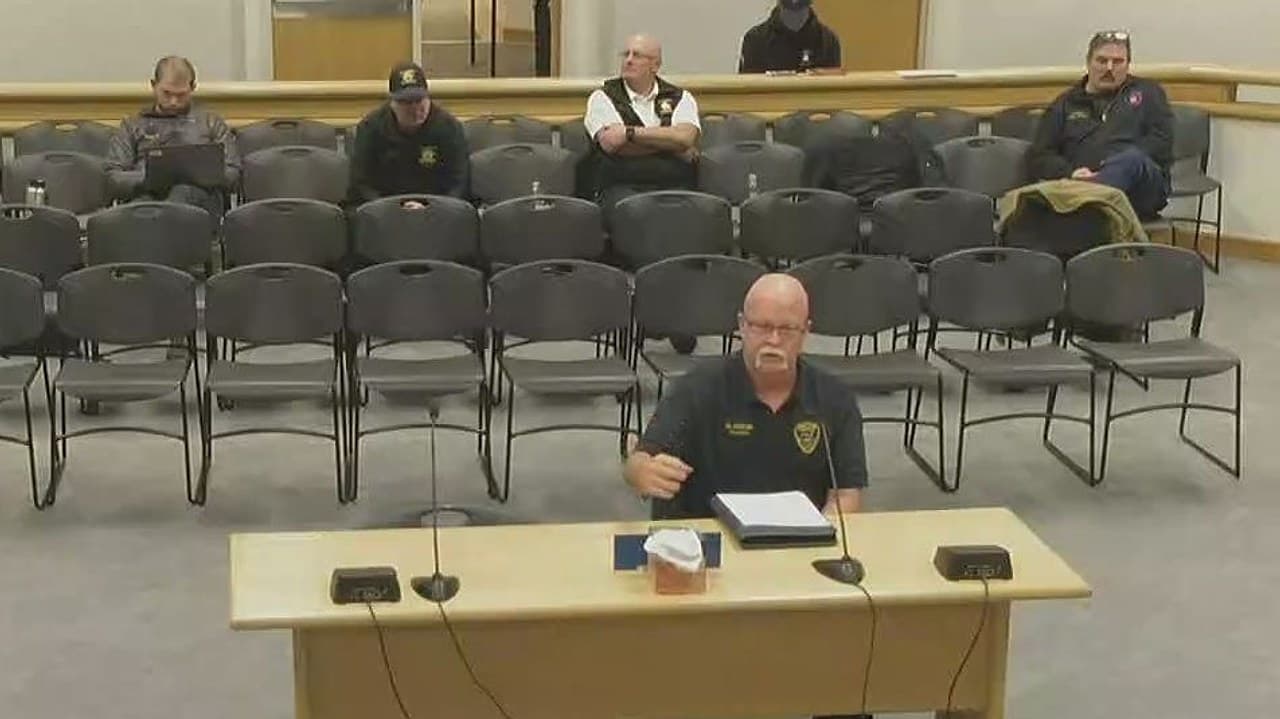
Both of them lit up, so now would be a good time. Now I actually go and I open up a tab and make sure that I can see us. Oh, okay. And then I will do that. FNSC.gov/meeting.
Oops. I might have a bookmark somewhere. I don't know if you've got that bookmark. I need to make that—. I need to put that on my— I call it the public portal is what I got posted.
Oh, I see. Is what I called it. So I know public side and my side. That's fair. Okay, and then I'll click on— and that's a good sign, we've got a red live button.
And then we'll just go to the meeting and make sure—. Totally, totally hear you. And you should see me hovering. Oh, actually it's that because that's what we're displaying. So like if we look at Civiplex stream, it says it's on the FNSB logo, right?
Oh, okay, that's okay, that's perfectly fine. Okay, do I control You do. Okay. Actually, the cameras are all— they go to wherever is speaking, so you're not going to have to go, oh, someone's speaking. Oh, I said I was—.
Okay. So it does automatic. I don't do anything with this yet, right? All that you're going to have to do is worry about when your presenters start talking. Okay.
And in fact, we can— anytime about 5 to 10 minutes, I take it off of the logo. Okay. So I'll go back to the chamber. So we want to see our So we click on Chambers. It says it's FNSB logo, and what we can do is we don't have anyone— if we had someone on Zoom, I would go ahead and hit that Zoom button.
Okay, so it would show their Zoom screen and start showing our cameras. Okay, we don't have anyone on Zoom. We don't have anyone presenting right now either. Uh-huh. So you basically kind of do your best option.
The best option we have on here is no staff input and no Okay, and then I would do that like closer to— you could do it right now. Oh, I could? Okay. Oh, do you? Okay, I will come to you about everything.
Talk to Gina. So there you go. Yeah, go round and round. Exactly. Go see her.
Go see her. Now if you wait like a solid 30 seconds, you should see the screen be us now. Oh, okay. Oh, because it's 30 seconds behind. There's a solid 30-second delay.
Is it okay that the live is— should I click off? Like, that's—. No, that's okay. What you do want to do though is make sure you're muted because you don't want any feedback. So I think you are muted.
Yeah. And then somebody's calling in, so I probably won't hear. They need to mute their device. Oh yeah, I remember that happened at the assembly meeting. Hi.
Hi, Gina. I don't think I've met you. Hi, Tony. This is Emily. I'm Emma.
Am I? Either way, it's fine.
La Cortilia. Okay, that's fine. Okay, okay, I'm gonna write it down just to make sure. Spanish ringing of the rolling of the R's.
L'Occitane is good.
Okay, you got that? I do, yes. Good, good, good. So you are— you're actually ready. Oh yeah, we are muted.
Okay, and then I will unmute the button that you Oh, thank you. I love it. It's the horse fair. I have some film camera pictures I took in Alaska that I was going to use. So you're a horse lover?
I was a horse girl. I'm from Texas. She's from Texas, Mom. I stole her from Texas. She drove up for this job.
I took one just for you. Oh, that's— oh, yeah. We go slow. Where did you go? The coast?
You did? Oh, so that's amazing. Was—. I don't know, the last time we called was like a few months ago. You didn't hang up and I heard part of your travel conversation.
It's like you guys were getting ready to go on a trip or something. Getting ready for this? Yeah, most likely. You, you told me go ride a turtle. Yeah.
Oh, is that what it is? Took it to heart. I wasn't on them. Okay, thank you. I feel like—.
Looks good. Yeah, they just— yeah, strict strategically place it so it looks like—. I said, David said I have to ride it, so do this. That's great. That's the favorite word, lucky.
That we walked into that place and it was a turtle ranch, and we walk in, it's just a giant field of like—. No, those are not boulders. That's the place. It was amazing. Most amazing place.
How long did it take you to Yeah, that's what I wondered. I flew to Massachusetts, and then it was 4 hours from Boston to Florida, then 3 hours from Florida to Whitefield. I spent a night in Whitefield, and then it was 3 hours. It's about 10 hours of travel. We've been going to Ecuador for many years.
Do they have accommodations on the island? Yeah, we did a cruise. OK. OK. Gotcha. That's funny. I just know it's such a, like, a protected island.
Very— you have to pay $200 just to get off the airplane.
That's some incentive to keep your— keep respectful. And, and yeah, don't mess stuff up. You do what they tell you to do.
Huh. So it took me a while to get banquet. But you did? Yes, I did. Okay.
And I talked with her, um, Alexis, and she's the only one. Oh, and Scott might be there. Yeah, yeah. And Garrett's not going to go, so, um, she might swing by banquet. I told her, I gave her the phone number because if she back and forth.
Yeah, and they'll just take your credit card right over there. So, uh, April had heard me tell you, keep your receipts.
What do you need to keep this receipt for? Oh, just keep it. It's always good to keep all your receipts. Yeah, right, exactly. That's what I should have said.
It's always good to keep your receipt. I got to tell you though, I could not think on the spot anymore, and I was just taxed today, and I'm just like She's retiring this next year too, so I've kind of, I kind of thought whatever, whatever I can't pass off, I'm just going to be like, you know, April, I got irons in the fire because you're retiring, just don't worry about it. I couldn't even throw that out there. All I could say was, April, let me have my secrets. And she goes, okay.
She just shut right up and goes, okay. So we, I, I worked at AAMC, or Alaska Association of Municipal Clerks this year in December. We're going to be honoring her as the Clerk of the Year. So I'm trying to get everybody down there and go and everything. I'm trying to be sneaky.
She's all, "What do they need to save their receipt for?" I'm like, "Just let me have my secrets." I'm just giving it away, but oh well.
All of us clerks do that the weeks before conference.
We always see who's buying up extra banquet tickets. Which councils buy an extra banquet ticket? She doesn't get to see none of that information this year though, so trying to keep it on the down low. Yeah, it's like, I don't want you to send a receipt to the borough. Don't send my receipt.
I can't tell you why. She sees everything. I couldn't even get it on the TA to get reimbursed. I was trying to tell everybody. I tried to be sneaky with our financial services.
The mayor's office even said, we're happy to pay and get it. They're just like, no, it's just too complicated. It's all too weird. Just get a receipt. We'll reimburse you.
I have to tell you, I'm so sorry, you are going to have to pay. So the problem I've had down there, and I've tried to go into some of the lawyer sessions and clerk sessions. No, they kind of cut you off. No, we don't want assembly members to hear what the lawyers are taking. We're pretty inviting.
We're, we can be. Yeah, you need to talk to people on the door down there. Yeah, it's kind of like our only chance. I go out and we're talking about them. We can't let them in the room.
Sometimes we share stories that are like, you're kidding me, what? Derek's the one that would have good stories. Oh, he's going to now, isn't he? I can't wait to, I can't wait to sit with him and his eagle now. North Pole.
Their meetings are an hour earlier.
Hi there, how are you? Real good, how about you? Real good. Firewise. Come on, you guys.
I had some extra time. Nobody asked to be on Zoom. The mayor doesn't testify. Nope. So it looks like you're Mr. Wilson.
Oh, really? I've never been there. Miss Wilson. Oh, I didn't really have to fire him like this. There's a trade-off.
I'll still do it, but I'll feel worse.
And she doesn't tell us that she's not. Nice. Did anybody see the article in the ADN today about the story about weather? So it was a young third-generation Fairbanks gal that lived in Anchorage. She asked her father— oh no, she asked what's his name, Thomas, who's the weather guy.
And so she's like the third generation. This was in the national news. If you're talking about what I think you're talking about, this was National News. Is it colder or not? And you know, his answer was sometimes yes, sometimes no.
But on the way in, they said the coldest weather for today was 60 below. Oh my gosh. So that's not what I thought you were going with, but that's okay. But you said every, every winter we've always had rain on snow, or happened to be there, always had rain on snow one day a year, always. Hello.
Hello. The other night I do. Yeah, good. My memory's bad, but not quite that bad. No, no worries.
I think she called or whatever, like, who, who? Well, Derek says, uh, your phone still— Derek? Oh no, I said, and I go, no, no, no, I go, you programmed it that way, David. That's right, you need to change your phone. Well, yeah, they call me before 4:30, it's all like oriented here, so that's what they call here.
He's talking about his phone number in her office, right? Her office. So that's that. Turn out. He's doing a translation.
Oh, I'm so mad. Big motions. Oh.
Chucks, you're fired. Next clerk. You're not letting us run amok.
Well, that's good. Yeah, so they were open to come in and get some training, or he just said you're going to do it? Oh, that's good. I mean, the mayor was only on the council for a year, right? David Skip's been on there for a while.
That would have been at the new election. Yeah. One second. As a retired guy, I didn't start. Yeah, they were all committed in at 5:30.
Right, we should have called. So I would love it. He would love that. That would set his retirement back. He should have had an emergency Cal Poly meeting at least an hour early.
Between him and Mike. Tell me what you really—. Oh dude, that just motivated him. Somebody else— well, he wouldn't fake it first. When I'm going— when I'm—.
And we used to hear that our assembly was the best reality. They even made our worst days look not as So somebody—. I'm completely unfamiliar with who it is. I watch Gavel Gavel. You hate one of those guys who likes to—.
He does it himself. With Ro Rhinebolt's uncle, he shared it. It was hysterical. Gavel Gavel's line in the program, the legislative assembly. The state legislature, right?
Yeah. Is it just Alaska? Yeah. Okay. Every state has a version.
Okay, it gets one thing, it gets on the presentation of the RFP. I mean, it's actually on the things in your agenda packet. It's online in the agenda packet, like online as in online in my email. You have to get help. Well, since we made it in the packet, we should print it.
Uh, so just go ahead and do it. I don't know if you can recommend I just want to know, like, what's the significance of the fact that we met?
Hi, I'm Gina. Good to meet you. Hi, I'm Emma.
I brought Manuel with me.
Yeah, I did. Doing some—. I survived a foot of snow and still got out. That was—. Yeah, just back to the bus.
Yeah, I said one month. Troublemakers. I haven't seen you forever. I'll find out. Hi, I'm Gina.
Gina, hi. Richard. Cynthia, hi. We were just wondering who, who everybody is. I'm training Emma to night.
She's taken Derek's place. Wonderful. Come on in and have a tea.
We do have a forum. Well, we do welcome you. We do welcome you. We were— sorry, we're getting punchy already.
That's just—. That way we know that you're the one writing it. We just wanted you to feel special. I can bring it over to you. Oh, pull it out.
Don't you just pull it out of the drawer?
Oh, thank you.
We have more people in the room afterwards. We're soft. You keep going. Okay, so I'm gonna sit down here. I don't think that's one of the things I might.
Don't be surprised if you see me jumping up and running over there to help navigate.
Okay, and then I need to go ahead and get into the call.
To click this button. Okay, just click right onto all calls and hit that. That.
Okay, okay, so hold on, hold on. Click it, say we're ready. Right here. Yeah, we're ready in the chambers.
Ready? Yep, you're ready. Call the meeting to order. Mic's not on, so I'm not here.
Call the meeting to order. Roll call vote, please. Okay. Mr. Bones?
Did he say he's not here? Okay. Ms. Curry?
Mr. LaCortiglia? Here. Ms. Carroll?
Not here. Mr. Prasenti? Present. Ms. Wilson. Here.
Mr. Guttenberg. Here. So for all you—. We have a quorum. So for all you safety bugs, there's a problem, straight out and to the side.
Thank you all. First order on the agenda is citizen comments. I have one person signed up. I thought I would discuss it after I see the president.
Okay, yeah, that's fine. We can do that. Yeah. Right.
The first presentation is from Nate Zawalski. Zawalski. Okay, thank you. So— Can you hit the green button on your microphone or make sure the microphone's green? All right, how's that?
You're up there. Great, and my name is Nathan Zaleski. I'm the fuels coordinator, statewide fuels coordinator for the state of Alaska Division of Forestry and Fire Protection. And I brought my friend Daniel here with me as well to help present, and I'll let him introduce himself.
My name is Daniel Owen, and I'm new to the role of helping coordinate Firewise on behalf of the state. And my background is wildland firefighting, so this is somewhat new to me, but this is the perspective from which I approach the Firewise question, kind of as a firefighter first, but yeah. And then I guess just for a little context, Tony was kind enough to extend an invite out, and Mr. Guttenberg, to just kind of come in and talk about Firewise program in general. I would really encourage everybody here, if there's questions, follow-up, anything else that we can help provide. I'm pretty sure seeing all of the chiefs here and all of the fire rigs out in the parking lot that some of this is going to be a review to some of us, but certainly happy to help enrich any of the information here that we have for you guys.
So. With that, we'll get started unless there's anything else. Go right ahead. Thank you. Great.
So really, Firewise, you know, we've had obviously quite a few fires in our rural and urban areas in Alaska, long history of that. And always the main priority on those fires is, you know, life safety and protecting property. And regardless of how capable and adequate our resources are, it's always putting us at a disadvantage if we're defensive and reactive in those efforts as opposed to being prepared and proactive. So that's kind of the lens that Firewise adopts. And Firewise is part of a larger program that kind of starts with the CWPP, a Community Wildfire Protection Plan level, a broad regional overview of 5 or 6 different factors that we use for a risk analysis and assessment, an action plan based off of that risk analysis, and then sort of a systematic means of implementing those actions to help reduce the risks and address them proactively so that we don't have to do it reactively in the fire scene like you see in this picture here.
That's a picture from the Mukluk Fire in Tok this last fall.
So maybe just a quick show of hands, how many of us are familiar with Firewise or have at least heard of it before? Okay, great, that's awesome.
So this is probably, if you have been exposed to Firewise, what you've seen is the Firewise Alaska Implementation Booklet or Guide. This is a product that comes out of the Alaska Wildland Fire coordinating group. This is a collaborative effort between State of Alaska, the BLM or AFS, which has now transitioned to the U.S. Wildland Fire Service, and several other entities including municipal and agency fire organizations. So this booklet really kind of covers what we look at when we're talking about Firewise and how to implement it. To be most effective.
And really, I think most commonly what we see or what people think of when we talk about Firewise implementation is removing vegetation from around our homes. That's certainly a great place to start. It's kind of the low-hanging fruit, the easiest target. And then we can sort of build complexity into that. Whether that means new construction using fire-resistant materials, not only landscaping around homes, but if we do wanna have vegetation near homes using vegetation types that are fire-resistant, having adequate resources on scene as far as water and suppression efforts go, adequate access and egress.
You know, there's multiple layers here to really enrich the efficacy of this program, but At its root, what we're trying to do is keep homes from catching on fire. And to do that, we remove the flammable fuels from around the homes, right? That's kind of it in a nutshell.
Yeah, just to jump in, two terms are defensible space and home hardening. So that's kind of a way to separate the two things. The vegetation obviously being the making the space itself defensible and then all the ways to prevent the house from catching on fire from embers that are windblown from beyond that defensible space.
So there's a number of different guides out there as to how best to implement these practices. There's, uh, kind of zones around the home pre-identified where we completely eliminate fuels. As we move further from the home, we then sort of maximally thin the fuels And as we get further and further away from the home, we can sort of dumb down our thinning application until we sort of transition back into a natural fuel stand or the wildland.
These principles are all great in and of themselves, but without a way to sort of formally address— one, recognize the risk, and then two, address it— we're all just sort of operating individually and we're not very effective as a community. So these principles, although it's great to apply them on a case-by-case and home-by-home basis, really where the strength of this program is, is if we have whole communities or even regions that have adopted these practices. So reverting back to what I referenced at the very beginning there, the CWPP, the Community Wildfire Protection Program or plan, excuse me, is really like the broad overview of what that looks like. And then at the home level, individually, in a neighborhood, in a community is how we build that out. Of course, the CWPP addresses much more than just the Firewise implementation itself, but I, I do really want to highlight the connection those two have.
And I'm gonna use I'm gonna skip this slide and we're gonna talk about the Keystone Ridge community real quick because it's a, it's right in our backyard and it's really a great illustration of sort of how we can connect the dots with these programs to come up with a product that really does provide a lot of benefit for fire protection. So the Keystone community is in a relatively high-frequency fire area. The fuel regime there is very receptive to large aggressive fire growth. And we have a number of folks living out there who are kind of at the end of the road. They have one main route of access and egress into their residence.
The roads are not very well developed. They're kind of narrow in some areas. The fuel bed, as you can see in these pictures, is pretty tall and prominent right up to and along the roadways. And many of the homes in that area have that same fuel loading like directly up to the structures.
So there was an initiative started by Bill Witte up there, and Tony and other members of the community jumped on board rather quickly to explore and go through the process of developing their community to implement these Firewise principles and, and get certification as a Firewise community. And I'll go back one slide and show you guys some resources you can check out to sort of enrich the understanding of that process. But essentially, it takes a community of concerned folks to stand up and say, hey, we would like to be proactive about this and take some onus in our own fire protection and get the effort underway. There's actually an application process to go through to do that and some contributions to be made by the community. Those contributions are really minimal.
Like basically 1 hour of volunteer work or resources in kind. So if you have an excavator or a chipper or a truck you can use to haul brush, that can certainly fill that requirement.
Essentially, it's an initiative to organize the efforts and go from 1 concerned homeowner protecting their own property to a bunch of like-minded folks pooling their resources and getting that synergistic effort to be able to protect a whole community. And stepping out of the homeowner perspective and into a fire suppression personnel perspective, that makes our response efforts so much more effective. It really, one, it gives the firefighters a safe place to engage the fire. It gives us a much more advantageous sort of environment to operate in where our efforts are kind of magnified and we're much more likely to see success with the limited resources that we often have in initial attack. Um, so it's really kind of a, a, a two-way relationship there of the homeowners are doing what they can to put themselves in the best environment for success, but that is recognized and, and sort of mirrored with our response efforts.
And so it really does benefit, um, not just the responding agencies, but the homeowners. So going back to my narrative anyway about Keystone, they were able to get certified as a Firewise community. That certification led to a greater likelihood of us being able to acquire a grant for them, which we did. With their effort and some help writing that grant, we were able to come up with a little over $200,000 of federally awarded funds. And then through a series of community meetings, we've been able to sort of strategize and tailor how we want to spend those funds.
And in that community, what the community as a whole decided that the main priorities were, one, to open up that one-way access and egress and really try to make it two ways in and out of that community, which is highly advantageous for both evacuations and responders. We can't use the grant funding to build a road, unfortunately, but we can use it to clear back the full right-of-way. Portions of the road that we're planning on addressing were kind of four-wheeler trail at best. So working with the community, we decided that was gonna be the main priority. And then we followed that up with the location of one shaded fuel break, opening up a really tight corner for visual clearance and for reduced fire behavior, 'cause it's kind of a pinch point.
And then we've also been able to address implementing Firewise on individual lots through the mechanism of not being able to go onto those private properties and do the treatment ourselves, but provide a means of disposal of those hazardous fuels. And that's what these, these pictures here are. Our first chance to actually get up there and do some work was to work with the homeowners to have them bring brush off of their lots up to their driveways. We were able to get a chipper and some of our folks that were looking to do a little bit of extra work up to the neighborhood. Um, if it kind of fits the Chipper Days model, if that's something you're familiar with.
If not, um, basically bringing, uh, some strong arms and a chipper up there to get rid of some of that brush and dispose of it for them. They had also, uh, taken the responsibility to widen out some of the narrow roads already. Which had left, I believe it's the picture on your right there, a number of brush piles just directly along the road that were basically jackpots of hazardous fuel. So we were able to address right around 20 piles in about 6 hours. And that was just the first little bit of our effort, but we really wanted to get something done in good faith this year before the conditions got too bad.
And so this was what we got done this year. We're still working with the community to assess how to spend the rest of those funds, whether we use agency crews to get up there and widen out the roadway and put in the shaded fuel break. Maybe it goes out to contract through an RFP or an ITB, one of the two. But we're looking at implementing that this next year coming up here. So I just think that's a nice illustration of the CWPP identifying areas of concern and sort of a broad action plan the community being vested in really looking out for their own best interest, and then the agency helping support to connect the dots between identifying a risk and then really helping to reduce that risk to everybody's benefit.
I'll stop there real quick and see if Daniel has anything he'd like to add.
Um, well, There's sort of two things I'm interested in increasing our participation in, and it's just for more people to reach out and request the individual assessments of their homes. And, you know, the bigger goal is to create new Firewise communities. So we have a good distribution of people that are able to do the assessments on individual properties, so we can pretty much cover the state. With that. But what I'm interested in doing moving forward is to provide more support for creating, for applying for recognition as Firewise communities and kind of being able to not only benefit that one member of the community benefits, you know, their neighbor by all kind of helping each other to prevent fire from escaping property if it happens to happen on someone's property, um, but also, uh, like what Nate was talking about, potentially being able to access funding, um, by having that community recognition.
That goes quite a long way to getting funding. So there's kind of two different projects. One is just to help individual people make their property more safe, but the big goal is to link that all together to where the resilience is better because there's just more properties that are Firewise and getting more benefits. Like what you said also, Nate, about once there's a community involved, then it makes sense to come in with equipment and with some horsepower and dispose of the material and stuff like that.
So one of the complexities with Firewise implementation is that it's, for those of you that don't know, the Division of Forestry and Fire Protection is broken up into forestry, like the resources side of the house, timber sales, using our natural resources to the benefit of the population, and fire protection, right, suppression and putting fires out when we do have them.
Firewise has kind of blurred the line on those two taskings and where it really should live. Hence, part of bringing Daniel on board is to help organize that effort and make it make a little bit more sense. The homeowner appraisals that Daniel just referenced, that's something that's carried out by our stewardship foresters. They're on the resources side of the house. That's the second link I have on the slide here.
There's a number of different ways that There's a number of different resources we can access through Stewardship Forestry. They do have some cost share programs to come up with a stewardship plan for private property and, and provide some funding to support those.
Unfortunately, that's typically for what most people consider larger plots of land. I think 5 acres is the minimum for some of that funding, and 7 Depending on the source of funding. So if you, if you sit on a 1-acre or a 2-acre lot, um, you've, you're kind of excluded from that funding source. Um, that is something that they're currently working on, on addressing through some, uh, additional grant funding opportunities. And, and that's in the works.
But, um, I, I wanna make it known that they've done a lot of work in, um, coming up with some very well thought out home assessments. It's a pretty simple process to go through. You can submit a request. They'll find some time to come out to your property and kind of look at some things with you, discuss what that looks like, kind of fill out a nice form that gets generated into a report along with a mapping product. And where, where we sort of fall on our faces a little bit is how do we take that plan and implement it?
So again, that's, that's one of the strengths of the Firewise community and rounding up everybody's resources and being able to then appeal to a broader or score better on the same grant funding sources through that application. So stewardship forestry, and I do have a signup sheet in the back if anyone's curious, wants to get a hold of them for general questions or to set up a site evaluation. We do have that resource here.
I also threw the Firewise link up, that top link on that page there. That is for a more broad exploration of what it takes to become a Firewise community, sort of that same process that the Keystone Ridge community went through. I'll let you talk about [email protected] since that's your new email. Yeah, so it's a new position to try to coordinate across the state what we do with Firewise. So if anyone wants to reach out for anything really, just please use that [email protected] email.
I just created that to kind of consolidate all the information.
And to be honest, I'm very new to this position, and I'm also a new resident in Fairbanks. In the Butte. I just bought a property there myself, and so I'm getting started to try to set up a Firewise community there. And I'm at the beginning stages of that, but I'm hoping that my experience I gain with that process will help me to guide other people that are interested in getting recognition for their community to actually, like, kind of go through all the steps myself.
I'm admitting I'm at the beginning of that, but I'm going in that direction for sure. So hopefully that'll enable me to identify strategies that'll be helpful for other people.
And that last link there is— A direct link to that Pam Flitter brochure that I had on the second slide there, the Firewise Alaska, AWSCG booklet. These resources are all great. I would, as much as I like putting web addresses up for people to copy and paste, I think really the strength of this program is disseminating this information and making sure that everybody knows that we are very available to help, as I think Tony could probably attest to, with all of these efforts. If you have a question, if you don't know, you can reach out to myself or to Daniel. I think all of our fire chiefs, although I won't volunteer to speak for them, are in that same boat.
We're all very proactive about these efforts and pretty passionate about making them happen. And it can be a little bit of a convoluted system. So I would just really encourage anybody who's interested in trying to connect the dots to reach out, and we can certainly help facilitate that for you.
Um, and whether it's, it's you or constituents or the community at large, that, that goes without saying for everybody. So, um, you have any other comments?
Um, just please reach out if, uh, if you're interested at all in, you know, either an assessment of a property and individual assessment, or to try to get the ball rolling to get a whole community effort going.
Any questions for us? Wilson, you've been chomping at the bit. You keep talking about community, so what would define a community? Like, it's so many acres, or—. I believe the minimum number is 8 separate homeowners.
And part of applying for community Firewise recognition involves defining the community.
So it kind of has to make sense, I guess, that it's not too spread out to where one property doesn't really benefit the next one. But that's something that needs to be defined in the application. So there's at least 8 people need to get together, and then you need to kind of define the risk that that community is sharing and, you know, define the, the size of the community, how many properties are interested in participating. But minimum number is 8. Yeah, thanks for that question because that's, that's kind of tricky.
It's not what I don't think we would traditionally consider a community. There's no city boundary or borough boundary or anything like that. And again, I'll just reference Keystone. You know, that's, uh, essentially a neighborhood, right? It's a series of roads off of, off of Murphy Dome Road that wanted to band together as a community.
So we're not really relying on a traditional definition. As Daniel said, it could be 8 people at the end of a road. That have adjacent lots. It could be, you know, 100 people around Harding-Birch Lakes. You want them all to be connected and kind of— I'll give mine an example.
So the road I live on dead ends there. I mean, there's no other way to go. But so that area kind of— it's outside of another subdivision. And I could see— I'm pretty sure we have 8 people. But you wouldn't want to pick like 5 or 6 there and then like 2 or 3 over here.
You want to kind of be all together. Correct. Yeah. And then would you have like an assessment, ask the homeowners to kind of like do the assessment and then determine the benefit once you found out like maybe the road needs to be, you know, back further because you only have access one way and, you know, in and out, you know, or how much is affected by their homes?
'Cause we're just trying to figure out process. The process is highly variable, but once the, I guess, the certification has been granted of a Firewise community, then we kind of really lean into the process of getting together with the homeowners as subject matter experts and explaining what we can do. Do we wanna do a big linear fuel break? Do we wanna mow down a swath of trees to make sure that fire can't get in or out of the community? Does it make more sense to do a shaded fuel break or some sort of hybridized fuel treatment?
Is the main priority access and egress, or is it to reduce the fuel loading? And we can have those discussions with local protection agencies, with the first responders, with the stakeholders in the community and the landowners, and make sure that sort of everyone's vision is in alignment to take all of those inputs in together and come up with kind of the best way to, to go about protecting that area. Perfect, thank you. Sorry to also try to answer your question a little bit more. So the terminology Firewise communities comes from Firewise as an organization, which is sort of a, you know, big organization with multiple stakeholders, and they've, they've just outlined what they believe are the best practices for making properties safe.
So as an organization, they don't really get involved with individual properties. So we're sort of using the word Firewise. We're using their practices to help people by assessing properties and giving recommendations. But once a community gets involved, then Firewise as an organization actually gives a stamp of approval once their criteria are met. And so the concept of community is something that is coming from Firewise as an organization.
And so we, you know, it's a little bit confusing because we go out and we do assessments and we give recommendations and we follow Firewise protocol. They're not really actually involved in that until a community applies with them for recognition.
Okay. Thank you. Besides the safety to the home, what does the person get for being a Firewise-certified community? Like lower interest— lower insurance rates or anything, or just the recognition?
I'm very curious to know more myself about relationships with insurance companies. And it's something actually that's come up that some people are worried about, that some people don't want to even have their insurance company catch wind of the fact that they're doing an assessment because then they don't want their insurance company to be like, hey, what's going on over there? Why are you guys so scared about fire? So I'm not really sure. It's different in Alaska.
No audio detected at 46:40
In California, for example, it's actually required to get insurance in a lot of places.
So yeah, sorry I don't have a better answer for that. But it's something looking to the future that I definitely hope benefits people financially when you've reduced the fire danger to your house and you're paying for fire insurance. Be taken, should be taken into consideration. But, um, you know, hopefully if we just put in good work, then eventually that'll catch up. There's a large financial benefit when they watch the fire go by.
Yeah, the big benefit. Yeah, I would just echo that the insurance is really kind of a variable thing, and state to state and insurance company by insurance company, that there's, uh, it's really hard to define. We don't have, uh, a standard practice for Alaska as far as insurance and reduction in rates or anything like that. I would say the benefit beyond the fire protection of the home, I think there's a lot of that— this is my own humble opinion, and I'm going to take off my State of Alaska hat and put on my private citizen hat and just say that bringing a community, a group of like-minded individuals that live in the same area together, with a common purpose toward the betterment of their situation is a highly valuable thing. Putting my State of Alaska hat back on, I would say that if we look at the Mukluk Fire in the immediate fire footprint there, that 800 acres that kind of went through the residential area north of the Alaska Highway, several hundred structures were impacted.
50 Primary structures were lost. In that fire. Implementing Firewise in a strategic manner— and I'm not saying this is what happened, but in a theoretical framework— could delineate you and your neighbors from being folks that lost their structures.
So, and in Alaska, there are definitely some of us who like to live in the middle of the woods with trees right up against our house. Not have a well-marked driveway. And if you do find the driveway and you look down it, you definitely can't see my house and what I have parked in the driveway and all that kind of stuff, right? Um, and that's, that's a wonderful freedom, and to each their own, but there are risks that come along with all of the choices we make in life. And I think even just advertising the benefits that the program has could help people make some better decisions when it comes to, um, it's never an emergency until it is, right?
Um, and that's usually too late to do anything about it at that point. So Benefits out of having a community recognition. Also, what Nate mentioned earlier about accessing funding and grants, it's not guaranteed that you're going to get X amount of money if you achieve recognition, but it definitely helps tip the scale to show that you've already had that achievement. And like I said earlier, I look at it from a firefighter perspective. So I also just think there's a big benefit to firefighters.
No audio detected at 50:00
Because it's— I think sometimes the reality is that firefighters have to make these split-second decisions about what property can be saved and which one can't. And it's kind of a horrible thing to have to let somebody's house burn because it's just too much chaos going on in that property and it's not safe and it's not doable and better just go move on to something that is defensible. That's just a bad situation. For everyone, you know, like obviously for the homeowner, but even for a firefighter to have to kind of just make that split-second decision to skip a property, you know, like that's not, it's not cool.
So the, um, the borough's in the middle of a, of a land sale out in West Chatanika, right? Um, the property's all laid out, there's trails all around it, it's surveyed where the roads were going to be, where all the property lines are. Is there any program that's available for the borough to cut back fire? I mean, timber's amazing out there. So is there any program that would allow the borough to participate in cutting the brush back?
You're talking about during the development of the subdivision out there? Right now. I mean, people are already buying lots. Yep. I don't know that there is a program.
I can look into it. Certainly, but there's none that pops to mind, and I don't know that there is that I would uncover much. I do think, again referencing the CWPP, there are some things we can write into those plans that might dictate, you know, instead of using a 15-foot utility corridor right-of-way, we want 30-foot because the chances of getting a tree on the line in a power storm is is— or excuse me, a tree on the power line in a windstorm is greatly reduced by having a bigger PUE in there. Um, I think we can draft some intelligent language in access and egress routes and not having, uh, one-way in, one-way out, dead-end roads. Um, but that— I guess I don't know enough about particulars of platting and layout and approvals in the borough and how that where those authorities fall in terms of weighing a CWPP versus a property development project and trying to get one more lot at the end of the road versus putting in bigger right-of-ways and having a, you know, fully accessible two-way and two-way out sort of layout.
I'd be more than happy to discuss that with you further if we can do some research on it first. Yeah, right there. Yes, sir. Yeah. It's a community now.
So we often get phone calls. The fire's bearing down on my property. Where are those guys, or where are you guys? So how much cooperative effort goes between Division of Forestry and our local fire departments? Yeah, they'll talk to us later.
Yeah, I'm sure they'll correct me if I— They think I'm misspeaking, but especially during initial attack, we're working shoulder to shoulder. Our incident commanders typically, if not physically located with theirs, then we're in heavy communications in a unified command structure. So we frequently work with the volunteer departments, the municipal departments on unified command in those initial attack environments.
Well, I live on Murphy Dome Road, and I certainly have appreciated the fire break up on Old Murphy Dome Road at times when it's like, get ready. It's like, well, the fire break's up there. You took care of it. I really appreciate it. And you guys just redid it again last year.
It got retreated not last year, but a couple of years ago, yeah. And those fire breaks are fantastic. We've used that one a number of times. Shovel Creek being the most recent in 2019. But even something as robust as that, that 300-foot clearcut really needs to be staffed and have responders be able to get out there and do work for it to hold.
Otherwise, it's kind of like what I call a chronological feature, right? It buys you some time, but it's not going to stand on its own. So to your point, we do need to make sure that we have well-organized and thought-out responses to help sort of shore up the investment that we've already made through those fuel breaks. Okay. Anybody else have any questions?
Well, let me ask questions. When Tony first got in touch with me, he talked about what you did up there in Lincoln Creek, right? So could you talk about that? Is that the same thing you did in Keystone? Very similar?
It is Keystone. Oh, did it? Oh, I always thought it was Lincoln Creek. It is Lincoln Creek. Okay.
All right. Lincoln Creek is the subdivision Okay, all right, took care of that. Yeah, same, same. Yeah, thank you. Great.
Um, these guys have come in and done several— these guys have came in and done several community meetings with us and gotten everyone on board for this program. It's been really good to see the community kind of come together around this finally. It has definitely been a battle. We first thought we were getting the cleared fuel break at the top and Nobody wanted that in their, in their viewshed, and it didn't seem as if it was going to be effective. So now we've switched to focusing on the evacuation route for Reconstruction Road.
I said these guys have been marvelous getting this program going, and I don't understand why more subdivisions aren't involved in these. Thank you. No other questions? Questions? Thank you.
Thank you for coming, and we appreciate it. Yeah, our pleasure. Thank you. You need a couple minutes?
No, she's just going to go set up the next one.
So the documents we're going to see, the briefings, are on the computers.
Do you have an address?
Oh yeah, yeah, you're there.
So the— no more questions for our Firewise folks. We'll move on to New business, which is a presentation by the administration discussing the proposed request for a proposal for evaluating borough EMS and fire. I don't intend to pass this out today. Remove this. We have a— I don't know who's going to be the new chair, and I want to make sure the committee understands or has a really good understanding of what we're actually going to be voting on.
So, um, ready for the presentation, Luke? All right, let's go. Thank you.
Okay, um, so, uh, this is— this topic, um, originated with, uh, former RESAC member John Anderson's request He was interested in having us look at and evaluate different ways to deliver fire and EMS, whether there was some potential for more revenue sources like SEMT, and that's what brought us to where we are today.
The reason we should be studying fire and EMS together is it's got separate authorities and boundaries within our borough, but is, in effect, delivered by the same providers, crews, stations, and equipments across our borough.
The—. We did do a review in 2011 of the EMS system, but this is— it only focused in on the EMS system. The, the concept really comes down to the idea that we are really needing to look at both of them together because they function together. So when we really dove into this, we got down to 4 different study objectives. We need to look at what our current system is and what it would take to maintain this service the way it is for the next 5 or 10 years.
The next one is evaluating taxes and the supplemental emergency medical transportation reimbursement. We need to see what the taxpayer impacts are and what our potential net SEMT reimbursements would be. The third thing would be to evaluate a new emergency services power. We would want to assess what it would take for a new non-area-wide power And I am looking this direction. Everybody's tracking the difference between area-wide and non-area-wide?
The reason it would be non-area-wide power is because the service would still not be supplied within the city of North Pole and the city of Fairbanks. That's why it's not area-wide. Sorry, part of my presentation style is I rely on direct feedback from you guys. So if you have a question, please interrupt. Me as we go.
I do have a couple question slides between sections, but please, please don't be shy. It helps me do a better job for you all. And the fourth piece being looking at our ambulance delivery models. We currently operate ALS ambulances, but this would be an excellent opportunity for us to see if that still is the model that makes the most sense, or maybe we want to switch to basic life support ambulances with paramedic intercepts. In our area.
So this is a map. Real fast before we move on to that, the reason we picked these 4 was sort of, you know, if we're gonna look at one small thing, like how do we deal with the SEMT, the number 2 there, the supplemental emergency medical transport, you know, we can get some additional tranche of that federal funding to offset tax dollars or to reimburse tax dollars if we just do emergency EMT transport. If we're just looking at that, we might be able to get a substantially more— substantial larger tranche of federal dollars if we look at providing both EMT and fire to the non-area-wide. So is that a way that we can help offset tax dollars, reducing the tax burden and providing a better service to the community almost that large for almost everybody. And looking at number 1, we have a system that we've had in place for a long time.
No audio detected at 1:01:20
And in some ways it works pretty well. In other ways it provides gaps in what we're giving, but that's not anybody's fault. That's just the way the system is set up. Would there be ways also of making that more efficient? Do we want to figure out how to plan better for our fire station improvements and fire station maintenance?
Where they're located? Do we want to be able to order all a more standardized set of fire trucks and apparatus so that we can save dollars on those independent purchases? Those are sort of the things that we want to look at through this RFP process and want your recommendation as the RESAC committee to how to move forward on it. The emergency— the new emergency services power number 3 is a question that follows up on number 2. A lot of my understanding, and Luke can correct me if I'm wrong, and you on the board that know better, we might need to implement that new power, of course, which would be through a vote of the people.
We can't do that, and the assembly can't do that without a vote of the residents of the borough. And that would be the non-area-wide vote of all the residents if they wanted to do that. And that would be one of the recommend— that could be a recommendation or not. From an independent evaluation. And then number 4 is similar in number 1, is there a way to create a better, more cost-effective service to save people dollars and provide a better service for what they need?
So that's sort of what we're looking at. And that number, the historical baseline of the 2011 TriData EMS Review showed that, you know, 15 years ago, If we do do this by bringing the, creating the new emergency services power, we very well might be able to reduce everybody's taxes, almost everybody's taxes in the service area, almost everybody's, and provide better service to more people. So that was just looking at EMT back then. And this new, If we move forward with an RFP to evaluate this, that would be the hope, that we'd be able to see a similar, better service for a better price.
Ms. Wilson. So I read somewhere, and I can't— I'll be honest, I can't remember exactly where it was. So if we were talking about just combining all of the fire service areas in a new power versus the entire borough, would that be a different type of vote?
If you're talking about, you mean like the current, can you go to the next slide, Luke? That one. So like if you combine just what is in that colored area versus the full area, I would imagine you'd have to structure that vote differently, but Rocky, as the legal person, might know better. Yeah, that would just be creating one sort of macro service area as opposed to a non-area-wide or area-wide. But if it went to a new power or a new vote, I mean, would it have to go to a new vote?
—Go to a vote if you were talking about combining what currently exists into one? Yeah, that would be— that would be—. You'd be consolidating the service areas essentially. So it would be, I believe, a service area election of all of those service areas to determine if they want to combine into one. So I think what you're asking, Ms. Wilson, is there a combination of the two where, like—.
I think it's two different votes. I think if you decide that everybody would be part of the EMT fire service, everybody in the borough, then it would be my understanding everybody would get to vote. If you're looking to combine the fire service areas because it would change the mill rate to some of them, I would assume if it can be one, then the only people that would actually get to vote would be those in that particular fire, in the colored area. That's correct. Yeah.
So what you're saying is if it wasn't, if we're not creating a new power and we're just making one service area to unify them together, That's— yeah, that would just be at the vote of the people in the service area. Because it would really be about the mill rate at that point. Yes. Because you can't change the mill rate without a vote, right? Correct.
And the boundaries of the service area as well. So part of the discussion on this when we started, when Mr. Anderson was here, um, was, um, the discussion that there would be potentially more federal or state money coming in. And I understand, I understand with the, um, the SMPT that mostly deals with ambulance service, but if we were on— if, if we had extended it— so the big picture is just the colored area voting, which would be a consolidation of these guys But if we went to a vote to expanded power, that would be the entire borough, which me— and my understanding way back when was if it's a borough function, then there are different funding sources available besides just supplementing additional ambulance service and ambulance service structure. If I have that right, if the borough took on a power of EMT, emergency medical transport, we would get this much of the SEMT. If the borough took on EMT and fire, we would get this much for SEMT.
No audio detected at 1:07:00
Yeah, and, and I get a little bit deeper into this, and I think it might help a little bit, um, as we move through the presentation a little bit further, um, if I can keep us kind of moving forward and then circle back to your questions as we get to it in those particular sections, if that's okay? Yeah, we can mix it up. But yeah, go ahead. Please. Thank you.
So this map, I know it's zoomed out, but I really wanted to capture the major roadways and where residences were, but also really illustrate what is covered currently right now. So we would want this RFP to take a 5- and 10-year look at maintaining our current staff, our current service levels, be that staffing, be that operational costs. Um, it's important that we're looking at capital needs as well because it's not enough just to be able to pay the bills. We have to be able to capitalize things as we go through and make sure the funding that we're receive— doing right now, um, meets that. Um, we would look for some kind of recommendations about whether what future mill rates might need to look like.
If we were to sustain the system, we might have to, we might get a recommendation that they might need a different mill rate in order to maintain the level of service with the cost of everything going up. But also we really wanna look at those opportunities for potential savings if we do stay in the same system, like the mayor said, be it common fire apparatus specs, joint equipment purchases or supply purchases. To figure out ways that we can help those different service areas make the best bang for their buck, truly, out of that. So when we talk about the service areas, and if you remember, fire service areas and EMS are funded separately with different jurisdictions and authorities. These are what the operating costs were for the current fiscal year.
No audio detected at 1:09:20
That we're under, and it totaled for operating costs at $12.68 million that we're spending for the different service areas. And obviously there's a gambit of cost between the different service areas, and that's going to kind of factor into the whole thing. So this is what we've spent on contractual funds for EMS since fiscal year '21 up to this current year. There's definitely been growth there. Part of that growth is the previous administration instituted a formula in the way that we calculate all that, and I'm locking eyes with the fire chiefs because it's been mixed success.
It definitely did a good job accounting for distances traveled, address points that are within the different regions that the different ambulance providers and everybody works in. But it definitely is challenging. It ends up being a negotiation every year as to what section of this formula gets a raise to make ends meet. But we are doing a good job investing in the system, but it is definitely growth.
So I laid it out by costs for this current year.
And if you remember, we have ambulance contracts and we have first responder contracts. The major difference obviously is the ambulance contractors work with us. Those fire departments operate ambulances for us. And then the first responders, respond within their districts for specific types of medical calls depending on the department. So we're talking about the current system.
What kind of questions would we need— do you think we should be thinking about when we're evaluating the current system that we didn't talk about? Ms. Wilson. So one thing I heard about the fire part of it, but with this also, one thing I've heard is that the EMS contracts really don't keep up with the cost because they're taking up space, they're taking up people, just all the different things. So we've heard that you're going to compare the fire service areas. Are we comparing whether or not the borough's paying their fair share?
I would think that would make sense, yes. I'll make sure that's—. Yes, the EMS provider would be part of that current system, and EMS is a Currently a non-area-wide power. So everybody does pay for that even outside the fire service areas currently, but not in the cities. No, but you— but we pay them.
That's what I'm asking is whether or not the contracts that the Bureau has with the contractors, are they paying, you know, what the cost is or more? Because what's been in the past has been that every fire service area actually is putting their resources and money into it because the borough won't. It's not—. I'm not saying they do, I'm just saying that's what they claim. EMS does not pay for itself.
How much money the different fire department, fire service areas get for EMS does not cover the cost of fire, of that EMS being provided. And they all dip into their fire revenue that they bring in, forest fire specifically, to help supplement the cost of EMS. They wouldn't function separately and there's not enough to fund that the way that it's set up right now to, I guess, so—. It doesn't make sense because we, first of all, we could raise the mill rate for EMS if it's not paying what it needs to and we have millions of dollars sitting in a savings account in the EMS. So I guess what I don't understand is you're saying that we can't pay for the value, pay what's necessary when we have avenues to do that.
We increased the amount by several hundred thousand dollars this past year. Oh, it was a 10%— right here, 10%— 10% raise over this last year. And we are moving that ball, it seems, every year. But I think that, you know, part of the discussion that led us to this point is we need to be looking at the future for that. And I hear— I feel I hear what you're saying.
Ms. Wilson, on making sure that we're paying for the EMS service with the EMS funds that we have. And I agree with you, and that's definitely— we've done a better job over these handful of years.
But future-proofing that is really where this study would be helpful. The mill rate for EMS has been the same since it was established, and it definitely could be— it one of those recommendations that that should be addressed. So I guess, yes? That's definitely one of the reasons why we wanted to keep sustaining the current system on here. So what is the formula?
How can we provide EMS at a better cost? What would be a mill rate that could provide sustainability?
Thank you, well, you know, I don't have, any irons in this fire. I think it's healthy to periodically, and this is 11 year, or 12, 15 years, to ask this question. And I think the first question is, what's broken? If anything's broken, doesn't have to be broken to ask this. The big question could be, what can we do that's more efficient to deliver better service for our residents, whether it's EMS or fire?
And I think that's part of this process that we're going to.
And I know part of the discussion I've had with people is, and I think it's the rationale of being able to charge some of, when EMS is underfunded, I hate to, I'm not going to use that term, but costs more than delivery of that, some of that, if I'm not right, can be charged off on the fire station because a little bit of that money is used there. Is that it? Somebody else might go out on a— an employee or a piece of apparatus might go out on an EMS run. So how do you cover that? Because they're different functions and theoretically they're different tax bases.
And at this point, that under the current system, we do not get really great cost recovery on that because it is separate. If they were a combined jurisdiction, combined funding stores, different— a different model could have a much better cost recovery at that point.
Well, yeah, for who, right? So where does the cost recovery come from? Non-area-wide? If it was a non— if it was a And I guess not wanting to pause this and jump ahead, but the next section being focused in on taxes and SEMT might help color that just a little bit. Let's just jump ahead.
If you're okay with that. The only thing I like that, Ms. Wilson and the Mayor, is the only meeting I've ever been at where we can point at other people in the audience. So please, Ms. Wilson. Okay, so, um, we— when we talk about the Section 1, we're really talking about, um, what residences are paying and what services the residents are receiving. Um, we're talking about what the current tax burden is.
Then we would like to investigate what a new levy would look like if it's necessary. Um, but then we also really want to talk about what reimbursement scenarios mean for us with the supplemental emergency medical transport money.
So right now, all the different— and the reason that it's broken up there is each of the different mill rates for the fire and emergency services that we have right now are broken up. You can see that there's quite a spread between them.
The—. I did put it by $100,000 worth of value to kind of make it understandable. For residents. So for every $100,000 your property is worth, that's the tax that you pay on it. And then the final one on there at the bottom is what EMS charges at that mill rate.
So what is the differences between all the mill rates and all the fire services area? Is it economy of scale? Is it distance between service, between, between apparatus, how they're funded? I think it's how they were set up. Okay.
When they were originally started, that drives that. Okay. Ms. Wilson. Just because I can't remember, so the senior exemption, veteran exemption, and the homeowner exemptions, do they for that amount of money, does that exempt out of this money or does everybody pay into the fire service area equally? I don't—.
I do not believe that those exempt fire and EMS taxes. It's just the general government one? Yes. Well, yeah. Okay, so everybody— so like if my house was worth $200,000 someday, then I would pay the same— I would pay these percentages.
I'm a North Star 1.374, but as if I didn't have an exemption on there, or is that our exemption first and then the mill rates? It exempts the area-wide, um, mill rate, or the area-wide taxation gets paid on the full value. I'll just hop in here. I'm looking at our revenue and taxation code. It's not usually my area, so forgive me, but The provisions of our general purposes of exemptions is that exemptions apply to area-wide taxes, so that would apply to non-area-wide or to mill rates for service areas.
Okay, because I was just thinking if that had part of the process that the revenue lost because of the exemptions, you know, could cause problems depending upon where all those homes happen to be. I see what you're saying. So if your house is worth $150,000 and you're a senior, your $150,000 is exempt. You still pay pay these taxes, these mill rates. Okay.
In addition to that. Yeah. I thought so, but I wasn't positive. That is my understanding. Okay.
So when we, while we're doing this, we wanna kind of study a comparison across the board with the different rates. I mean, I think that's some of the challenges that exist right now is the fact that the rates are so different. Different because they have not shifted in unison. So it's, it's definitely something we'd want the study to, to weigh in on for sure. For the SCMT cost recovery, we, we budgeted $325,000 in cost recovery for this calendar year.
Last year we, we received $650-ish thousand dollars, but it did cover 2 fiscal years in that reimbursement. But that definitely is tied to how we are currently set up when it comes to our cost recovery. We don't— because we contract out this service, we are not eligible for a lot of the cost recovery that is tied in with SEMT. So that definitely has brought our price that we can recover down. But we do want the study to look at it in a couple different ways, particularly if we brought— we want to see what our cost recovery could look like with the current model, make sure that we're on track there.
We want to look at what it would be if we brought EMS delivery in-house. And what that could do, and then also do a cost recovery estimates for if we brought fire and EMS inside the house. There's possible shares of staffing, utility, and supplies that could be applicable at different quantities based off what is inside the house versus being contracted out, if that makes sense. Is that why you talk about being able to have more, more cost recovery because there's more billable items. Is that basically what we're talking about?
Yes. It's not that the fire service would be eligible, it's just that more things are shared costs? Yes. Okay.
And we, uh, we really need to dial that number of what that net cost is to the borough as best we can with this study. We want to be able to, after we receive back results from this study, be able to answer some of these questions that are kind of hypothetical at this point.
Okay, so when it comes to taxing an SMT, you know, we talked about mill rates, we talked about SMT reimbursement. What other topics kind of jump to mind on that specifically?
Ms. Wilson. I kind of step back to what Mr. Guttenberg said in the beginning is what do people want? I mean, the mill rates were all based on the service level that individuals wanted, and that's what you see, you know, from one area to the next. To assume that they didn't all move together was for any other purpose that the people weren't interested in giving any more than they did. So where does their opinion come into any part of this study?
You could include it in the study for them to go out and do focus groups, which as you've seen from the Comp Plan and how much input they took can certainly increase the cost. After that, it could be be done through internal surveys after we get the study back to see what people do want, to public testimony for the feeling of the assembly to fund an appropriation or what's included in it, or afterwards when you get the answer back. So the, where the public input comes in can happen at any stage, everywhere from if there's an independent review happening or if you have the vote later on and it passes or fails. So there's your different places that you can have public input. Where would you like to see the public input?
In the beginning, because if people are happy, then I wouldn't want to put any money out to— I mean, we're assuming people would even want to— well, I'll tell you the area I live in. If they were charged 3-point-something, they would have— I don't see— when I talk to people about the fire service areas and stuff, that's one of the very few areas I get no complaints. About at all, you know, not the ambulance service portion of it, that the fire service area. So before, I would want to see money put out. I would, you know, but kind of like with Joyce Elementary, kind of like put the question out there and it's like, are you in, you know, just are you satisfied with your current fire service?
And maybe the second one on your ambulance service, since I know some of them are mixed together. But I think doing it after spending the money is kind of making it seem like we have a problem when I kind of— I'm trying to figure out what the problem is myself. That's fair. I live in one that has 2.959 as my mill rate, um, and Mr. Guttenberg lives in one that has 2.2. So if we are able to provide better service for less money, and that's the question we put out in front of people, or less mill rate because that way we could all bring it down to 1.98 or lower, maybe that's what people want.
Sorry, I'm not the chair, I can't recognize you. Maybe people want left alone, I guess is my question. So, Edie, go ahead. I have a couple questions. Is your mic on?
EMT? Can you turn your mic on? Oh, sorry. On this SMT, it's from what I'm reading, it comes from State of Alaska Medicaid. How stable is that the way things are going?
I mean, you're putting a lot of money into getting out of this thing, and I'm just wondering how long it's going to be around and how much you really can get from it. I feel like it's pretty— it's one of the more stable pieces of grant funding that's out there and reimbursement funding that's out there at this point. Okay, and if this program goes out as far as study things, I think one of the things that concerns me is right now we have the borough having the EMS, and I was actually shocked on how little EMS costs when it's probably 85 to 90% of the run volume and we're not giving the departments enough money to do the job. So seems to me that could go up a little bit and the people wouldn't complain, but that's a side thing. Um, but are they going to include the maintenance of the vehicles?
Because right now I can see if something went through that it was a non-area-wide power that there's going to be quite an upfront cost because right now it's— or it used to be, I won't say from when I was in the fire department, um, that it was— it's difficult to get everything you need just keeping the ambulances going. And that's no reflection, you guys are dealing with that limited sum, but, uh, you know, that turnover of the ambulance as far as getting the new ones. And when you start talking about fire trucks and fire equipment, that is a whole different ball game. And I know we used to put, uh, joint bids out for stuff like that with the departments and going for things to save money. So I'm really concerned that this other part of it, not just the, the gas and the supplies and stuff like that, you know, what shop are you going to build to maintain all these fire trucks, especially if you go borough-wide?
Because there's going to be more stations. And I mean, I think the way we have right now works well. It's economical, and I'm not saying saying it can't be improved because most things can. But I want to make sure that all those type of things go into this report because that's going to be a big cost and a big one to keep up with. Let me, let me add on that question because that was my next question also.
So this committee goes out to Salcha, Two Rivers, Chatnica, Haystack, way out this way out the Alaska Highway And we're putting this proposal in front of them, and they're going to say, what do I— what is it going to cost me, right? What is it— what is the delivery time of service? Which means you're going to have to build fire stations, like lots, like 3 or 4 new brand new fire stations just to do maintenance and staff them. So when we're reaching out to have those conversations, and maybe that's the next move is somebody's going to say, okay, I don't have fire service now, but what's it going to cost me? Right?
You're going to build a new fire station, you know, and everybody in the borough is going to cover the cost because it's not area-wide, but it's everything outside. So what is it going to cost when building 4 or 5 new fire stations? That's a question. No, and I don't have a number for you what 4 or 5 new fire stations are gonna cost. But one of the limitations that we have right now is all the fire service areas, fire stations have to be completely funded within that fire service area.
And if we potentially had a new power, which I'm gonna get to in the next section, is a, if that was the case, then it becomes a CIP deal. Broader based and can have economy costs of scale when you're doing that stuff. And, you know, I think that, I don't think that anybody is saying that we're not receiving good service from our providers at any point. And I definitely, part of the reason the first scope topic is sustaining the current system is we do have fire service areas that are close to the edge of, at their, they're taxing at their tax cap or are having to pull out of fund balance to do different things. And it's not a criticism, it's a cost of doing business without us changing mill rates.
But when you are taxing at 5 different mill rates across the entirety of the bulk of the population of the borough, some folks are paying more taxes than other folks. And if you spread that out, you're probably just by average is gonna end up in the middle and some people are gonna be paying less taxes even before you start talking about reimbursements to even potentially bring that lower. And I definitely agree with you, Ms. Curry, that that EMS mill rate is too low. And it definitely is concerning that it's so far below the other portion, and it does cover 80% plus of calls is involved in that. But, you know, this study conceptually hopefully looks at the whole thing.
And that's why they're so broad, is we're trying to get a grip on what the whole thing is so that we have something that we can talk about from this RFP to see what the future looks like. It doesn't mean that we're going to do one thing or another. It just— we need information gathering at this point to help drive that, I guess, is our hope. Okay, well, Ms. Curry. Get this back on.
Yeah, I think part of the reason for the disparity in the service areas, fire service areas, is the people of those individual areas voted for the level of service they wanted. So the ones that are paying more are very happy with the fact that they have fully responding fire stations and quick times and things like that. So I don't think I think that in and of itself is the thing. We have the same thing in the road service areas. I mean, they have mill rates that go from hardly anything to, you know, 2, 3.
So I think that's always gonna be a problem until such time as the borough actually becomes a Class 1 or whatever it takes to have the full powers of everything. So I mean, I don't see a problem with that being addressed in there, but I'm more interested in, what a true cost would be, including maintenance, servicing, supplies. And the other thing is manpower. Mm-hmm. You start adding on to this, and I mean, the volunteers in Fairbanks, I think, are phenomenal.
Oh yeah. The number ones we have. When you consider the requirements that are necessary to become a firefighter, to become an EMT, a paramedic, or whatever else they have, the rescue work, everything they do, So, you know, you need to keep in mind, are you gonna get to the point where you're gonna have to fully pay department in order to keep up with those types of calls? So I think this report needs to be fairly encompassing if you're gonna look at that. One of the things we've talked about before this meeting was how do we make sure we incorporate the volunteers that we currently have in these fire service areas and possibly grow it and spread them around if this goes forward to ensure that we have that real gem of our system, absolutely.
And then the upfront cost of the infrastructure of what that would need is something I've got written down. And so yeah, that's something to include as well. Yes, thank you.
Let's move on. Okay. So scope area 3 is investigating a new emergency services power, This is definitely investigating a potential change. It would be a broader non-area-wide authority replacing the existing non-area-wide EMS power. Services to consider within emergency services power would be fire protection EMS, off-road EMS, hazmat, all that kind of falls into the scope of an emergency services power.
The— Delivery options would definitely need to be investigated, be it continuing the contract-based model that we're doing but with a different power to fund it and back it, be it one service area would be one of the options that would be investigated, or direct borough delivery, or maybe a combination of those.
The things, the things that make us strong, be it our volunteers, be it our student firefighters, all those things are definitely things that we don't want in any way to see go away. So I, before anybody says that that is going away in any of this, that is absolutely not true. We want this study to consider those programs and how that can grow as well. It definitely would need to be thinking about what transition would look like if that did become a thing. And what those costs are.
Definitely those ones that you mentioned, Ms. Curry, would factor into that portion of it.
I only have one slide on this section, so before I go to the question, I'll leave this one up. But the question really is, is what, what does looking at that as a new power mean? And beyond the fact that it would take a vote of the people if it was something that was decided something we wanted to to move forward on. So it's not, I don't think that it's meant to be limiting. It's meant to address some of the fallacies, in my opinion, within the system right now that we fund fire and EMS and their money doesn't touch and it's completely different services when really we're delivering emergency services through our fire departments locally right now.
But because how everything is divided, It doesn't play well between the two. So on this slide, you bring up hazmat, which hasn't been talked before. Is that a separate function? Is there a different funding source, or hazmat work with DEC? Hazmat right now functions with our volunteer hazmat team, and we do have a couple of small line items within my department's budget to help fund some of the pieces, but a lot of that is grant funds and some very dedicated volunteers.
We do have one of two state-recognized hazmat teams here at the borough. But if you're talking about what a new power would look like that's broadly scoped as emergency services, that would definitely fall into the purview of whatever we're building if we built something different. A hazmat truck turns over. What's in it? It might just something out past Fox, right on the way up the Hall Road.
Who deals with that? Who funds that? Is that area-wide, non-area-wide? Does DEC come in?
The cleanup stuff, they're a response, not a, like, mitigation and cleanup agency. So they'll respond to stabilize the incident. The funds would come through D.C., I believe, with the rest of it, and then they would go for the private entity that owned that hazmat truck funding cleanup efforts at that point.
So in this scope, are we talking about what would it look like that everybody would have equal amount of fighter surface area throughout the entire borough? Outside of the cities. Outside of the cities. It would look at, um, yes, no, Miss Wilson? Well, that's how people feel now, you know.
Yes, yes, no. Um, right now everybody outside the cities, um, has EMS response, kind of. Yes, someday it'll get there, right? Yeah, I, and I absolutely agree with you, um, and definitely potentially with changes, it could be an expanded program to put more ambulances more places. But right now, not everybody has any kind of fire response.
Right. So, so are you talking with Scope Area 3 that this part of the study would be what would it cost as a borough-wide, a borough service, as non-area-wide fire/EMS for everybody to have equal amount of EMS and equal amount of fire service? Well, I think that equal, unfortunately, is a misnomer in this system. Everybody receives an ambulance, but it might take longer depending on where you've chosen to live to get there at this point, and that's been how we've operated forever. So to say that they're going to get equal service, they're going to receive service equally to the neighbors within the neighborhood that they live in.
But I'm not going to pretend that if you live at the far end of Pleasant Valley, you're going to get the same response time that you get living on Hagelbarger right next to one of the STEE stations. So this study would be basically saying that we're going to have the same fire service area we have right now, they'll just have to go out further. So you won't really get any more protection than you have now? No.
This Scope 3 is— that would be the whole borough. So it wouldn't be just the colored areas on that map on the early slide. No, but what question would be for the whole area? And then in order to— then it would also look at how you would get them better service. So, you know, I grew up next to a station that wasn't manned.
It had an ambulance, a fire truck in it, but it wasn't manned. I think it had an ambulance. It wasn't manned. So you would be able to, you know, use the— this would look at how you could do— and as Ms. Curry's question was— how you could build those unmanned stations in different places to be staffed by then volunteers and other staff to be able to show up and get them service faster would be part of that plan. And it would be for the area-wide power that the voters would have to vote for.
And then it would be the entire gray area to provide everybody a flat mill rate to get all of them fire and EMT, EMS. But the service wouldn't be, might be a little bit different, might get there a little bit fa— well, fire service obviously, 'cause we don't have it now. But the potential of the ambulance service may be getting there quicker, but still not as quick as where the colored areas are on the other map. And we definitely have addressed that when we talked about like response time standards where we've got the core has a response time, and then outside the core has a separate response time for what we found— this body found acceptable. And I cannot remember the numbers off the top of my head, and I'm sorry for that.
But it would definitely be a topic of discussion, and we'd be trying to figure out what the future looked like for that.
I just want to be fair to people because there's a lot of people think we have this same ambulance service when they move here to find out that they don't, but they're paying the same as those who do. I just want to know whether for fire service we're kind of doing that same type of, you know, program. Well, I think they might be putting other stations or thinking about putting other stations. I think Mr. Burch's point was if you live out past Chatanika, you're going to have or Pleasant Valley, you might have it, but it's going to take longer to get there versus living, living in College, right? I mean, that's really the nature.
What's that? But you'll have to pay more now if we go to an area-wide— non-area-wide bill rate for fire. Well, that's—. Mr. Mayor, that would be one of the questions in this. You might have to pay less because if you're paying anything now, you'll be paying more, so that will be more.
Well, not if you're not paying anything now for it. I live in Two Rivers now. I'm paying zero. And now you're going to provide some type of service. Oh, that would be one of them.
But you could also look at the people in, you know, the fire service area that is the bulk of the area that could all be paying less.
Yeah, but somebody will pay more. Correct. Math, it just works that way. Some people pay less, some people pay more. Please continue.
Okay. I'm done. So the last portion of the scope, Scope Area 4, is really looking at what different ambulance delivery models are. Part of that conversation about what is adequate funding for the delivery of EMS and figuring out what that balance point is for how we do things. So right now we have the ALS, Advanced Life Support Ambulance model, and we have them scattered throughout the different fire departments in the area.
No audio detected at 1:43:00
We have a whole scope of EMS providers, and I have a list that it's going to be on the next slide for everybody to see. The other option that we'd like to look into just to see how it would function within our borough would be a BLS ambulance with paramedic intercept. Now, when I say that, I'm kind of looking this direction, and do you guys need more details on what that means, or do you understand the— what I'm saying conceptually on that? Okay. I think you should give it a quick brief explanation.
So, you would have EMTs, basic EMTs on the ambulance, and then you have a group of paramedics that when a medical call that requires a paramedic comes in, the paramedic responds to the ambulance and then brings elevated level of care, but not, the bulk of calls do not require that elevated level of care at this point. And so we're curious what that would look like as a model for our area. We definitely would want to be looking at what staffing, what the costs are, definitely be looking at what coverage during simultaneous calls and some of the long transports that we do, and just kind of see how that works, and really hopefully dive into that issue. For our current providers right now, the Chena Ridge, Goldstream, Steese, City of North Pole, University, Salcha Fire and Rescue are ambulance providers at this point. Northstar and Ester are first responders And Fort Wainwright Fire and Emergency Services actually provides a no-cost ambulance to a small portion of the borough as well that you can only get to through Fort Wainwright.
So it's really win-win for us. So I'm going to ask you the question, which I already know the answer for.
The state is so diverse, right? And so is there— I mean, When I was in Juneau last year, we were talking about service areas, and one of the legislators says, "I don't know what a service area is." Right? So is there anybody else in the state gone through this or in this situation where there's some comparative process or model? Do you know?
I don't think that there's an intercept model in Alaska at this point.
I know that there are some BLS ambulances that operate, but I'm not aware of this model being in place within Alaska at this point. It's fairly common in big chunks of the lower 48, so I guess I'm curious. We're looking and seeing if it would be something that would be applicable here. I mean, one of the challenging pieces of being an EMS provider is maintaining your skills. And going on enough calls that require the advanced skills to keep up on those skills.
And by changing scope and model, we might end up with really good patient outcomes by having folks that are handling those calls at that volume, if that makes sense.
We definitely would be talking with, you know, same as all these, it's the whole RFP is definitely tied deeply into working— having the contractors doing the RFP, working with us, working with the fire departments, working with the commissions, talking with you guys, talking with community. Like, all those pieces are stuff that's tied up in what we would bring forward as an RFP. And we definitely want to make sure that that, as a whole, holistically across all 4 subjects, is being talked about. By all these different people.
Okay. So, is anybody— so, if we're talking about different ambulance models in the scope of this RFP, do you guys have any questions about that?
Okay. What is the difference between the FNSB ambulance contract and the FNSB first responder contract? It is, if you're an ambulance contract, we, well, for everybody but the City of North Pole, we provide ambulances and you staff and respond with an ALS ambulance. First responders contracts respond to medical calls without ambulances because of distances away from where the fire, where the ambulances are. So out in Ester, if you had a medical call, Ester would show up and then Chena Goldstream would also show up with an ambulance, or University if it was a mutual aid situation.
Does that make sense?
Yeah, but aren't we in some ways all mutual aid across, I mean, if something happens somewhere, somebody else will respond if there's a call? Yeah, mutual aid is utilized for a whole host of calls. Okay. But if I get a call in North Pole, the city of North Pole has the ambulance. Yeah.
So they're the ones that the ambulance respond, but North Star would respond as the first responder. These are one of the biggest areas that don't have an ambulance service. That's why the city's on here.
Okay.
Okay, so looking at deliverables, We're looking for side-by-side comparison to the current model with feasible alternatives.
Definitely financial forecast and tax impacts by area for 5 and 10 years from now. We definitely would like with the— we want with the financial piece to model what no SMT money, moderate SMT money, and high SMT money money would do to those financial impacts. And then we want to talk about what's feasible. What are our priorities? Do they identify would be very important?
What we can do with our current authority and what would require a new change? Be that an adjustment to a mill rate, be it a new non-area-wide power. We need to really identify those different pieces.
And that brings me to the last slide of the presentation for this. So that is—. I think what we're looking for and why we wanted to come to this Commission first was, you know, if we want to look at improving any level of this, what does the menu say? What do those options look like so we can know how those different options are going to be baked in, how they might improve service, how they might reduce costs, what are everything from the current system that we have and can manage finances. And some of our fire service areas are having to dip into their general funds to sustain their operations each year at this point.
What does that look like? How do we manage a new mill rate? How could we manage a new mill rate for our EMS service alone and tap into the millions that's in there? But making sure that it maintains, it's sustainable also. And while we're at it, let's look at a big picture change and make sure that, you know, we have a host of options that we can go out to the public and ask them about and make sure we can go to the assembly and ask her about.
So, you know, this doesn't spend any money and we have to have a motion to even move forward to the assembly to ask the assembly if they'd like to from here. So love to, you know, are there other things that we want? And even when we go forward for public testimony, as we craft that, if there is an RFP and a recommendation to move forward, then that those ideas that you have and that come from public testimony can be incorporated as well.
Okay.
So any debate? Any further debate? Any further questions? Or— So do we have any idea what the cost is for this study? Um, as we've been doing, um, uh, different comprehensive plans and different evaluations, it, it'd be a couple hundred thousand dollars, like $200,000 or so is a ballpark guess.
Contractors are not getting cheaper. So does that go up for a bid? Uh, yeah, we would need, uh, if the assembly approves that appropriation, for it than it would be a competitive RFP. Okay, all right. So not going to take a vote, but I'd like to keep having input from the administration, maybe have a discussion about having a public comment going out to the public and asking them what they think.
No audio detected at 1:52:20
And at this point, I'd like to open it up for Comments from the peanut gallery.
You know the drill— name, address, neighborhood. Yep. Last name. I'm Jeff Kuhn, and, uh, I'm from North Pole. I'm representing North Star Volunteer Fire Department Incorporated.
I have been— give a little introduction is I have been involved in 3 different departments in this borough that contract to the borough for 37 years, starting back in 1984 with short, very short breaks in between. I was a fire chief at North Pole Fire Department, an assistant chief at Fairbanks Fire Department, and now the fire chief at Northstar Volunteer Fire Department. I worked extensively on SEMT when I was with the state chiefs, and I will say that I'm not opposed to this RFP. I think it will show things that we're not prepared to see, probably. And I do agree, there are savings to be had in all of the models.
I think we could all recognize that. I'm very proud of the EMS that's provided out in North Pole area, with North Star being the first responders and North Pole being the EMS. I think if you have a heart attack in North Pole, your chance for success is very well. North Pole responds with nearly an entire staff of paramedics, and we respond out of Badger Road and the other stations that are that are staffed. I'm happy to say that all of our stations are staffed at this time.
We, uh, 4 of our 5 stations are, uh, have live-in quarters, and we have 2 live-ins in Moose Creek, 2 on Hearst Road, 2 on Dennis Road, and you just couldn't put a cracker in North Star Station 31. It's completely full. All beds are full. It's not that way all the time, but we're doing well, so we're doing a good job. We maintain automatic aid agreements with the City of North Pole and the Eielson Air Force Base and the Fort Wainwright Fire Department.
Now, we're not required to do any of those things, but we do it. We're also very good partners with them. If they need anything at all for an air show or a presidential landing or anything, we send as much equipment as we can, even at great cost to our overtime budget. It's just good to be a good partner. And the hardworking men and women that live in our Northstar Fire Service area kind of are expecting a high level of service for us.
And I'm happy to say that when we have a structure fire, we respond with 12 to 24 firefighters from Northstar. So that's without mutual aid. And it's not always that way. Depends on the time of day. We participate in the scholarship program.
Where we have 6 scholarships that attend UAF and get their degree. We also have live-ins. So after they do their rounds of picks for scholarships, we say, good news, you weren't picked up as a scholarship, but we'd like to offer you a live-in position. And they're still going to UAF. They're still getting their degree.
It's just a cheaper option, and they get a place to live. Thank you. So what would you like to see built into this RFP? Yeah, I'd like to see really good transparency built into it. I have come to this body several times asking for help with buildings and garage door openers and alarm panels and sewer systems.
And then the other chiefs come here asking for help maintaining our buildings and our fleet. And the borough has said over and over again they don't have the capacity to help us. So I don't know how this RFP is going to help that capacity. We just saw a terrible attempt out in Two Rivers to start up a fire service, and overwhelmingly they said no. There's just not enough people out there.
It would be so expensive that it can't be done. Um, there might be more opportunities out in Salcha to go with that, uh, third or fourth model because there are more structures out there on Harding Lake and Birch Lakes. But it, it's a tough sell. And so the one thing I wanted to take away, and I brought up to emergency ops, is A fair amount of this work for this RFP is going to be the contractor asking this contractor questions. And I should be compensated for that.
It is a lot of work that goes into it. I was involved in the one in 2011. And it was basically the borough came up with an RFP and brushed their hands off. And then we had to do our best to read everyone's mind. And we put 100 hours into it per department.
And so any RFP that goes out should come with a funding model, not just for that contractor, but to have us, we are contractors, to participate in that study. I am not opposed to the study, though. And I want to be really clear on that. Based on the presentation, I'm not sure that the current model gets a real fair shot. But it was the best, cheapest model that we had in 2011.
I'm really proud of it right now and the way that the fire departments work together and the Interior Fire Chiefs Association works together. We bought a fire truck a few years ago. It's identical to the City of North Pole's fire truck. We're buying another truck. It's a corporate asset, not a borough asset, and it's identical to the one North Pole's buying.
So we already do a lot of these things that, that you know, might be a cost savings. But I also know that some of the other departments do the same thing. We have the same air packs, we have the same extrication equipment, we all mostly wear Globe. We did our best to standardize radios, it just wasn't— the funding came in at different times. So there's probably no way to do that because, you know, a lot of Northstar is flat and a lot of the other contractors have hills.
And it doesn't make sense to have us have all of the same ones. And then when you saw our funding out there at Northstar, it was, you know, we have a lot of people and we have a lot of houses, and that's why we have a lot of money despite having the lowest mill rate. Emergency Ops did come to me and ask if I was wanting to try to go for a larger mill rate, and I said no. I don't think it would go over well. It didn't go over well.
The first two times they tried, um, which was about 12, 14 years ago. I don't think it would go over well now, um, trying to get more money out of, uh, Badger Road and Northstar. But, um, and I don't think we need an RFP either, uh, to get most of the players that are going to make this decision or come up with a really good plan are borough employees. So risk, financial, uh, Legal, Public Works, Emergency Operations could all get in the room and answer most of the questions we had tonight, I think. And, um, and you don't need an RFP to do that.
Um, I, uh, I, I was glad to see that it would take a vote of the people to, to make some of these changes, because I've heard everything. When you work here long enough, it goes completely full circle where this is the only way it can be done. And then we get a new administration with a new borough attorney. They say, no, I don't need that. There's ways to do it.
I can get around it. And then we come back to now we're doing it back the way we were 14 years ago. So, and that's just not here, that's everywhere. If you stay long enough, you know, the conservatives become socialists, become liberals. It's fine.
Entitlements change, depends on how you do it. But I will say I'm really proud of what we do at North Star. We got 105 square miles. To take care of. And the only thing, and it's not a correction, but our $159,000 for the first responder contract, that's not an extra fund.
They don't pay extra in Badger Road for that. That money comes from North Pole's contract and Steece's contract because we go into their area. So they would get a little more money, but they choose to have us be involved. And to do that, they, they get some of theirs reduced in order to get us. So, and it works really well, and we work really well together.
And I know Chief Heineken would be here, but he has a council meeting tonight. Thank you. Ms. Wilson. So one of the benefits they said for the borough possibly taking over fire service was that they could help share cost or have it work together. From what I heard from you that you guys already work together on the things that make sense.
Is that true? Yeah, it is true. But there probably is— there is a way to save more. If we all wore exactly identical globe turnouts, they probably would be cheaper than, you know, we buy our globe and they buy their globe and they buy their globe. So we standardize because if I lose a guy to the city of Fairbanks, they can take their gear with them and City of Fairbanks can just order me another set and no one is upset about it.
And so that's one of the reasons we do it. It's also premium gear and we like it, but we do our best to standardize. When I bought radios, we bought $360,000 worth of radios since I've been at Northstar, and I called Chena Ridge and Steve's because they had just bought radios and we bought the identical ones. So just And then North Pole and North Star do everything together, so it just made sense. And that actually was in the works before I got there, so it's no credit to me that we standardized our trucks or our engines.
And they were really expensive. Well, the first thing I did in the borough when I was— first thing was Mayor Sampson put me on a Chena Goldstream. And I was amazed at the prices. I just admit I was just amazed, realized how expensive it is to operate a fire truck and pumps and turnout gear, the whole thing. Just one other question.
Right? And just from your vast knowledge, if we were going to try to service the borough, just estimate-wise, how many more firehouses do you think we would need to just even give the bare basics? Well, I think we would need a shop, number one, to work on, you know, the— I don't know how many rigs everyone has, but I know at Northstar we have 9 heavies. And then the— and so you would need a robust shop to take care of it. And then you would need Pleasant— like all the ones you said, Pleasant Valley, Salcha.
No audio detected at 2:03:40
But if we were going to do the full non-area-wide, I don't know how that would— I don't know how I would structure that if I was in charge because there's not enough resources out there. So you don't want to take resources that you currently have. So you and me, it's at Northstar and send them out. A structure fire takes 3 tenders and an engine. And all of a sudden, it's out at Birch Lake for an undisclosed amount of time.
And so it's— I don't know. I don't know if we would have to have 4 at a minimum, I would think. On the outskirts to even be able to look the taxpayers in the eye and say, you know, even though it's not staffed, you know, but it's hard to put the genie back in the bottle. If we start going down this road, you're not going to be able to back off and say, oh, it didn't work out, we're going to go back. And that is the scariest thing because, you know, once— it's very hard to manage volunteers.
And so to say that they could go to any fire department, that might be a benefit and it might not be. I don't know how it would work out. I know we have a really good system right now, and I would hate— I'm not excited about changing any system because it is just so amazing right now at Northstar. So the two questions, thank you. Is there a distance from a fire for distance delivery from a station, right?
It's got to be every 10 miles or every 15 miles. Is there a requirement like that in your world? No. You know, they used to, some places, say 5 miles because that's as far as a horse could run.
Ours, you have a plan. And so they had a plan on how they were going to structure the stations North Star, and if we knew the future, we never would have put some of them where they're at. Yeah. And actually, the city of North Pole is at a prime location because they can hit Badger Road or the highway, and they actually make it on an ambulance call to McPeeks all the way around taking the highway that it takes us. You know, we get there very close to the same time.
And so any plan that takes North Pole out of the equation is a deterrent for a lot of reasons. And because we have such a good automatic aid, mutual aid, and the EMS contract is working so well. So a question you might not be able to answer, but if we did expand services, would the university be able to expand their fire service program? Oh, I wouldn't know. But luckily, if I had to ask, Chief Kuiper is here.
So, from Chief. Yeah, thank you. Any other questions? Thank you. Anybody else?
Yeah. Any other comments before we close? Mr. Mayor, um, are we— is public testimony closed? Yeah. Yes.
Okay. You know, I think as Chief Coons brought up, you know, the scholarships that they have, the fantastic program, the volunteers that they have is a fantastic program, the live-ins that they have is fantastic. And those are the things that we were talking about is how do we look at keeping those there? The things that we're trying to find to be able to do better, and could we do it internally and dedicate one person to 2 or 3 years of interviewing everybody and coming with their own work. I guess technically I could ask for that FTE in a budget and put it in there, but in terms of getting, you know, a third-party review that is unbiased, they can ask the different people in the different positions and the different contractors what they're— how they operate, what they can do, you know, that, that doesn't come from internal.
It doesn't come internally, especially when you've got a shiny object that, you know, needs to take priority over here. Being able to, you know, it's the same thing when we look at volunteers of our own. If we want accountability to get the right, get a result, we usually want to hire somebody. Um, the carpenter's house is never finished until they either have to pay for it or they hire somebody to get to finish it. So I don't think, you know, there's a person on the staff today that I could say, hey, go figure out all answers, and you wouldn't have the— you wouldn't have the history of those relationships with that employee, with the contractors, with their other employees, with the time that they'd be able to need to dedicate to get these answers and to understand what the full menu would be.
So I think, you know, looking at just moving this forward to the assembly is the right move, and looking at consultation how we consult with the different fire departments that we have is going to be really important. And that's, as Chief said, that's one of the main efforts is going to be those dialogues that they can have. And I can guess pretty well that, you know, a third-party person is going to get a different answer than if I went in there and started asking the questions myself. I think that's the value of looking at this and This is not the— this is only the first step of this process. And asking the assembly to look at it and vote up or down, I think is important.
Along that process, we can do a public survey and ask sort of what people would want out of it. We can do that internally through our own efforts. We can look at having the contractor run that. Those are things that can happen at the next step. Next step, but I don't think should stop us from looking at it here.
And so, you know, I think the assembly should have that opportunity to discuss it, to see what they want to move forward with it. And so with that, you know, I'm going to make a motion.
Yeah. I'm an ex officio member. I can make a motion. We're on community comments still? Oh, okay.
So, okay, as an official member, you can, you can make it a moment. So I have a comment before that. Okay.
I guess, you know, I'm with Chief Coon. I mean, at this point, it's not that it's bad to look into something, but there's very few things, at least in my community, that people don't want to gripe about, you know. And this is one of those things they just don't, you know. I don't care if I'm on the university side, if I'm on the North Pole side, or Salcha, they— people seem to be content with what they have. And I think to take something to the assembly, I would want to be able to justify, and I don't feel like I can, why we need to do this now.
I think at least sitting on it till the next meeting, you know, and, and making sure we reread through things since we just got it. Um, but if he came up for a vote today, I would be an absolute no because I don't think we have enough justification to take it to the assembly, um, on it. And I think it's worth asking more questions out there. If this is something we're seriously thinking about doing, we should ask our friends or neighbors maybe even go to some of the meetings that the fire, you know, have since their boards or whatever, um, and just see if this is something that the community wants to spend $200,000 on. And it's not because I'm afraid of the answers, I just don't think it's broken.
Anybody else? Ms. Rudy? Yeah, I was just wondering if we can get a copy of this email presentation. Would that be possible? It should have been emailed on Friday to you.
Okay, thank you. Yeah, the presentation— were the other documents emailed also? Okay, so, and so who's— would her name be on it? Might not have been looking. It came from Emily.
Yeah, you might not be looking for emails. We can— yes, I can do that. I recognized it. All right, any other committee comments? If Mr. Mayor, you want to make an amendment or a motion, I've got to go back to new business.
Sounds like members want to be able to review it and see if they have more questions. Okay, um, so a question for the clerk: if our next meeting is scheduled for February, what does it take to have a meeting sooner than that?
The assembly or the mayor? The assembly or the mayor needs to have you guys call a special meeting. Okay. All right, so we theoretically, we can meet before February, which sounds like a nice month. Yeah, the next meeting.
I just need to double-check the caveat on the mayor because you guys are under Title 3, not—. Or the presiding officer. I'm wondering. I think the presiding officer needs to tell you guys. Okay.
All right. It's not broken again. Okay. So if there's no more comments, I want to also thank the chiefs for always coming in, paying attention. We, I think we're trustworthy, but it's good to have the oversight.
Just in case we're not. Just in case we're not. With that, no more comments. Thank you. We are Um, wait a second.
Yeah, we are done. The next scheduled meeting is February 16th at 6, right here, and I don't know who's going to be the chair. So thank you, and with that, we are adjourned.
No audio detected at 2:14:20