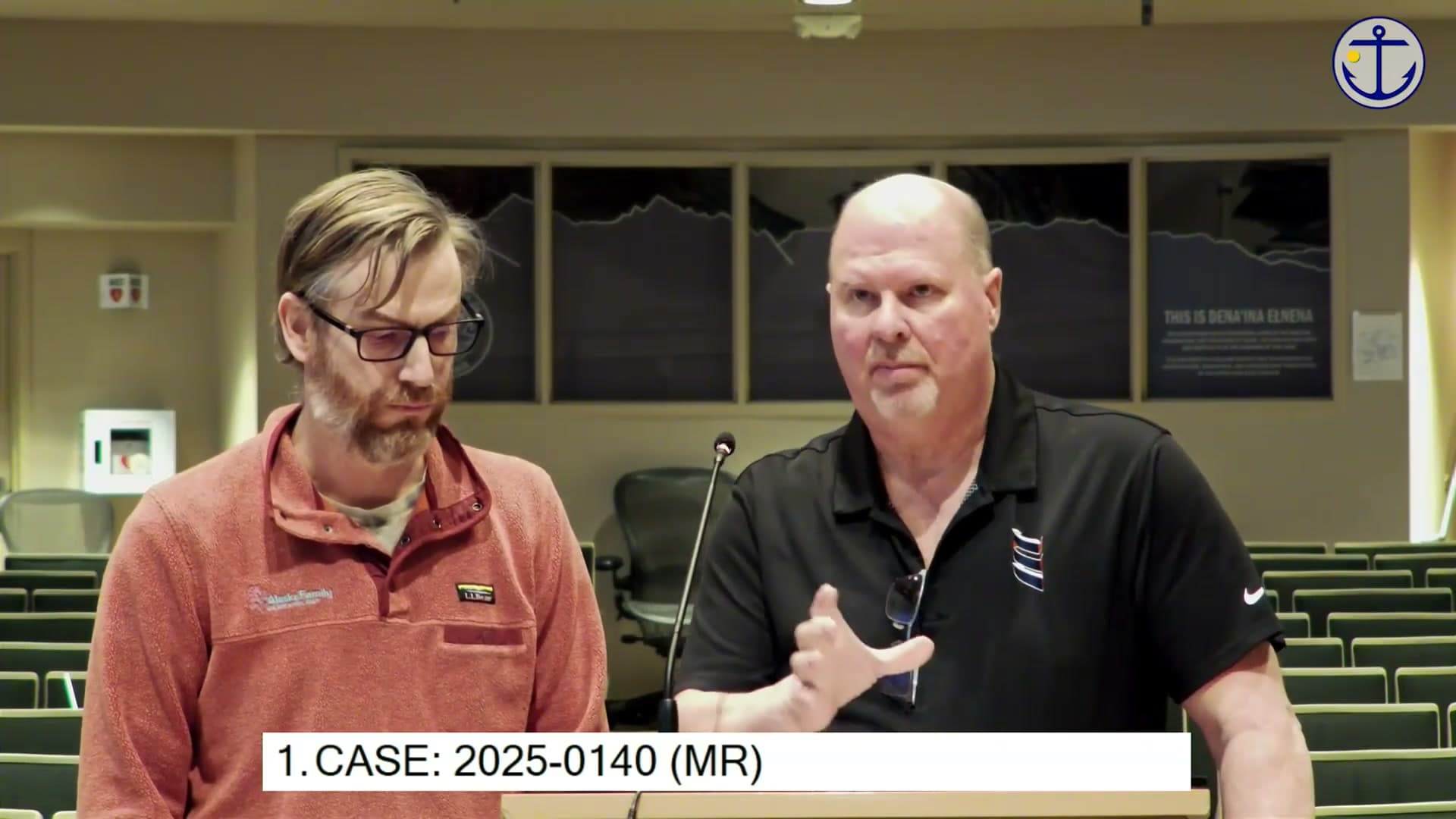
Frame from "Zoning Board of Examiners and Appeals - February 12, 2026 - 2026-02-12 18:30:00" · Source
Zoning Board Approves Variances Despite Municipal Errors on Canyon Road Property
The Anchorage Zoning Board of Examiners and Appeals voted Thursday to grant two variances for a Canyon Road property after the municipality acknowledged it had issued an erroneous nonconforming determination 12 years earlier.
Rob and Gina Brown, owners of 13688 Canyon Road, received approval to allow their existing home to encroach 10.4 feet into the required 25-foot rear setback and a proposed shop with accessory dwelling unit to encroach 9.9 feet into the same setback. The board approved both variances 6-0 for the existing structure and 5-1 for the proposed building.
A variance is a modification of the literal provisions of a zoning ordinance that allows an applicant to do something that would normally violate the ordinance. To establish the necessary "unnecessary hardship" for a variance, the property owner must show the property cannot reasonably be used consistent with existing zoning, the hardship is due to unique circumstances not general neighborhood conditions, the authorized use will not alter the essential character of the locality, and the hardship is not the result of the applicant's own actions.
The case centered on a 2013 nonconforming determination the municipality issued when the Browns purchased the property. Planning staff discovered in 2025 that the determination contained several errors, including incorrectly identifying the applicable zoning district setbacks and misidentifying the rear yard as a side yard.
"This 2013 NCD contains several errors. First, the letter of nonconforming determination incorrectly identified the zoning district setback and lot coverage requirements," planning staff told the board.
The Browns said they relied on the official determination for more than a decade, spending money on design work and permits based on the incorrect information.
"When we purchased this property in 2013, the municipality issued a written non-conforming determination. In 2025, 12 years later, that determination was found to be an error, both as to the applicable zoning district and by misidentifying the rear yard as a side yard. We relied on that official determination for more than a decade," Rob Brown said.
Ron Thompson, representing the Browns, expressed frustration that municipal attorneys had promised support but the staff report recommended denial. He said the property owners met with municipal attorneys twice, most recently the week before the hearing, and were assured staff would acknowledge the municipality's mistakes.
Planning staff recommended denial of both variances, finding that review standards A and B were not met for the existing structure and standards A, B, C, D, and H were not met or only partially met for the proposed structure. Staff argued there were no exceptional physical circumstances on the property and that the proposed structure could be redesigned or relocated to meet setbacks.
A planning department associate planner clarified she was not present at meetings where higher-level officials made assurances to the property owners.
"I am an associate planner with the planning department. I was not in any meetings where individuals in higher positions were making assurances that I cannot be accountable for. It is my personal pride and moral responsibility to treat every case equally, ethically, and by the code," the planner said.
Board members focused on the recorded nature of the nonconforming determination and the property owners' good-faith reliance on it.
"Unlike a lot of documents that the municipality generates, non-conforming determinations are recorded in the District Recorder's Office. As it was mentioned by the petitioner, anyone doing due diligence would see these documents in the record, and we should be able to trust that what we have been given can be relied upon, especially when it is a recorded document like that," board member Jonathan Lang said.
Lang argued that the municipality's change in position created the hardship, not the property owners' actions, addressing one of the key legal standards for granting a variance.
"The reliance upon the nonconforming determination is not a hardship. The city's change in their position to walk back what was decided in the 2013 nonconforming determination is a hardship that was not created by the petitioner," Lang said.
Board member Jason Norris said it would be difficult to hold residents to a higher standard than the municipality itself when they relied on a recorded document.
"I also believe that it is very difficult to hold a resident relying on a recorded document and hold them to a higher standard than we would the municipality itself," Norris said.
One board member suggested the property owners could subdivide their land to resolve the setback issues, since they also own the adjacent property. Thompson responded that the Browns were advised by municipal attorneys that the variance process was the best solution and that forcing them to subdivide would unfairly encumber their land because of a municipal error.
The property is zoned R-8 but the 3.03-acre lot does not meet the minimum lot size for that district. Under municipal code, it defaults to R-9 setback requirements, which are the same as R-8. The 2013 determination incorrectly stated the property would be held to R-7 standards.
The Browns plan to replace a collapsed 50-year-old barn with the new shop and accessory dwelling unit. Thompson said the proposed location is constrained by a gabion wall used for wind protection and agricultural purposes, overhead power lines, well and septic separation requirements, and topography.
The variances are subject to recording a notice of zoning action and final as-built survey within one year with the State of Alaska Recorder's Office.
This article is based on a public meeting — Zoning Board of Examiners and Appeals - February 12, 2026 - 2026-02-12 18:30:00 ().
AI-assisted. How we use AI Transcript byLucas Brown
Stay informed. Support what matters.
Free, permanent access to local news you can verify. Subscribe to support Alaska News and go ad-free.
Related Coverage
Zoning Board Approves Two Variances, Denies Girdwood Deck Request
Alaska News · 5mo ago
Anchorage zoning board approves setback variance for Chandalar Drive home
Alaska News · 2w ago
Anchorage zoning board approves deck variance despite staff concerns
Alaska News · 4mo ago
Anchorage weighs a variance for a 1998 setback encroachment
Alaska News · 3w ago
Anchorage zoning board backs letting director approve bigger setback fixes without a hearing
Alaska News · 2w ago
Comments
Sign in to leave a comment.
No comments yet. Be the first to share your thoughts.