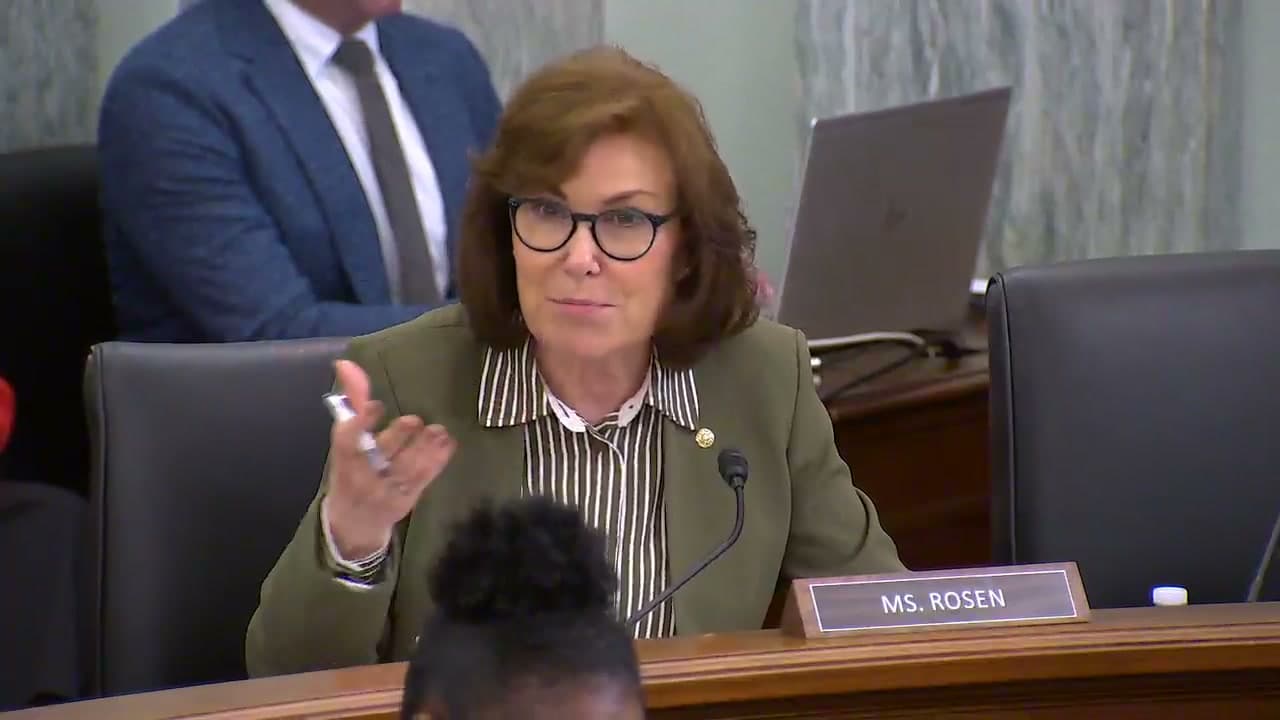
Frame from "Senate Commerce, Science, and Transportation Subcommittee on Telecommunications and Media (Sullivan): Hearings to examine intelligent networks, focusing on powering artificial intelligence and transforming communications." · Source
USTelecom tells Senate panel permitting is top barrier to rural fiber
Permitting, Not Funding, Is the Bottleneck for Rural Fiber
The binding constraint on rural fiber deployment is federal permitting, not funding or technology, Jonathan Spalter, president of the broadband trade association USTelecom, told the Senate Commerce, Science, and Transportation Subcommittee on Telecommunications and Media on Thursday. Other witnesses stressed that money still matters: Nebraska Public Service Commissioner Dan Watermeyer said, "We must continue funding rural buildout or this technology simply won't be available for all who need it." The question carries added weight in Alaska, where federal land accounts for roughly 60 percent of the state and the BEAD program (the federal Broadband Equity, Access, and Deployment program) has allocated more than $1 billion for broadband infrastructure.
Spalter said the barrier to AI-ready connectivity "isn't technology, it isn't investment, nor is it our will. We're ready. It's government, specifically permitting." He said one member company waited two years for a permit from a federal land agency in Big Bend during a dispute over whether a forest existed in the Chihuahuan Desert. He asked Congress to pass three permitting bills: the Close the Gap Act, the RAIL Act and the Accelerating Broadband Permits Act. Senators from states with large federal land shares pressed the same point.
Sen. Ben Ray Luján said changes to the $42.5 billion BEAD program have steered investment away from fiber and "injected significant delays." All four witnesses answered no when he asked whether AI can be transformative for Americans who lack broadband access. Asked whether member companies with full access to the $42.5 billion would be able to build more fiber, Spalter said they obviously would.
Permitting was not the panel's only concern. Witnesses on both the industry and policy sides called for modernizing the Universal Service Fund, which Watermeyer noted is supported today through surcharges on voice service, so that rural networks can be maintained for AI-era demand. Asad Ramzanali of the Vanderbilt Policy Accelerator warned that the FCC rescinded the cybersecurity rules adopted after the Salt Typhoon breaches of US telecommunications providers, and urged Congress to require network security measures and pre-deployment testing of leading AI models. Witnesses also described fiber, wireless, Wi-Fi and satellite as complementary, with fiber serving as the backbone the other technologies hand traffic to.
Spalter said USTelecom had heard from colleagues at NTIA that guidance on BEAD non-deployment funds "will be forthcoming," adding, "We hope in September."
AI-assisted, reviewed by editors. Spot an error?
Related Coverage
Small Alaska telecom warns FCC 'land rush' favors big carriers
Alaska News · 1mo ago · 77% match
Cordova carrier tells FCC spectrum hoarding blocks rural broadband
Alaska News · 1mo ago · 77% match
Alaska school boards to FCC: don't make us choose internet over teachers
Alaska News · 2w ago · 73% match
The federal autonomous vehicle framework Congress is debating would apply to Alaska's roads — but Alaska wasn't part of the conversation
Alaska News · 1mo ago · 72% match
Cordova Wireless challenges FCC broadband maps, says waterways and islands missing
Alaska News · 2mo ago · 72% match
Comments
Sign in to leave a comment.
No comments yet. Be the first to share your thoughts.