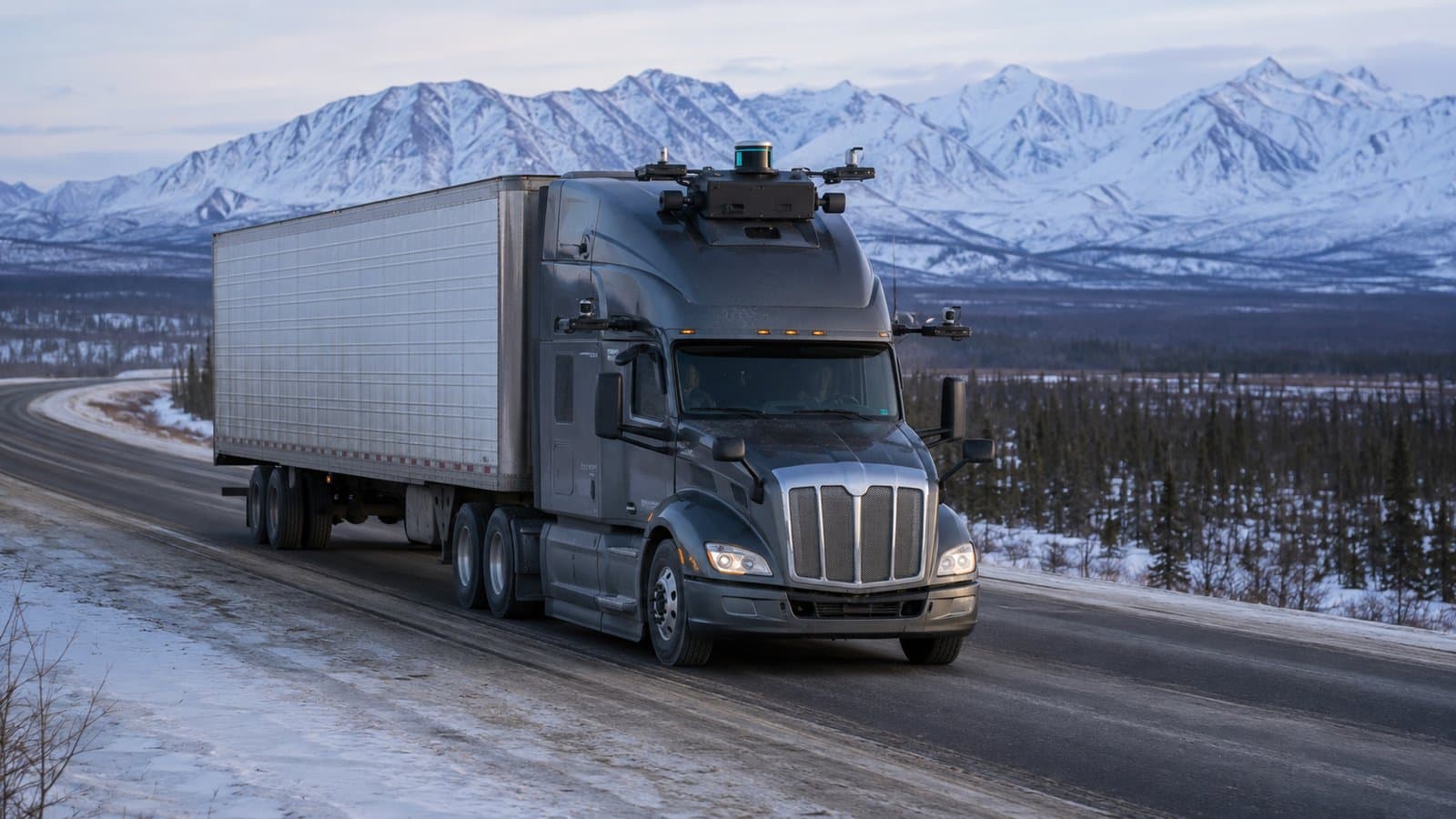
Photo by Cale Green
The federal autonomous vehicle framework Congress is debating would apply to Alaska's roads — but Alaska wasn't part of the conversation
Whatever Congress decides about autonomous trucking will apply to the Dalton Highway and the Anchorage-Fairbanks freight system — even though none of Alaska's actual operating conditions came up Tuesday at the Senate Surface Transportation Subcommittee hearing, where trucking and tech groups urged a unified federal framework and the Teamsters pushed for binding safety standards first.
The basic split before the subcommittee was straightforward. Trucking and technology groups want one set of federal rules to prevent state-by-state patchwork and speed commercialization. The Teamsters want binding premarket safety standards from the National Highway Traffic Safety Administration before deployment expands.
Chris Spear, president of the American Trucking Associations, told the Senate Commerce, Science and Transportation Committee's Surface Transportation Subcommittee that Congress should solidify the National Highway Traffic Safety Administration's role as the primary authority over motor vehicle safety standards and create a clear national strategy for autonomous commercial vehicles. Spear tied his comments to the Build America 250 Act and urged Congress to repeal the 12% federal excise tax on heavy-duty trucks — a tax that hits every Alaska trucking operation buying new tractors, which already costs more in Alaska because of shipping markups before the federal surcharge.
Cole Scandaglia, of the International Brotherhood of Teamsters pushed back, saying the federal government has failed to meaningfully regulate autonomous vehicles beyond requiring crash reports. He called for "robust premarket standards" at NHTSA and "substantial oversight tools" at the Federal Motor Carrier Safety Administration to monitor deployed vehicles. The Teamsters have a significant Alaska presence — including representation of drivers who run the Dalton Highway haul road serving the North Slope oil fields, a corridor where automation would replace some of the highest-paid driving jobs in the country.
Subcommittee Chair Sen. Ted Cruz has argued the absence of a federal framework is itself unsafe. Prior bills — the SELF DRIVE Act and AV START Act — would have clarified NHTSA's authority but stalled in Congress. Laura Chase of the Intelligent Transportation Society of America warned that without federal leadership, the country will see "fragmented, uneven deployments." For Alaska, the fragmentation risk cuts in a specific direction: autonomous trucking companies have so far concentrated commercial deployments on Sun Belt corridors with warm weather and continuous cellular coverage — neither of which describes the Alaska Highway, the Glenn Highway, or the Dalton.
Ian Jeffries of the Association of American Railroads added that rail needs a regulatory system to keep pace with innovation and called for a mode-neutral federal approach. That conversation matters in Alaska too. The state-owned Alaska Railroad runs about 470 miles from Seward to Fairbanks and is one of the few U.S. rail systems with no track connection to the Lower 48 — a structural isolation that has historically meant federal rail policy reaches Alaska on its own terms.
What the federal debate did not center on: Arctic operations, sensor performance in blowing snow, moose and caribou on roadways, or the cellular dead zones that cover much of Alaska's highway system. But the framework Congress adopts will determine when — and whether — autonomous trucks ever appear on Alaska roads, and under what rules.
This article is based on a public meeting of Senate Commerce, Science, and Transportation Subcommittee on Surface Transportation, Freight, Pipelines, and Safety (Sullivan) — Senate Senate Commerce, Science, and Transportation Subcommittee on Surface Transportation, Freight, Pipelines, and Safety (Sullivan): Hearings to examine how technological advances are driving transportation innovation. ().
Made by our human newsroom with AI. How humans and AI work here · Grow with our newsroom Transcript byLucas Brown
Watch key moments from the source meeting. Click to expand.
Stay informed. Support what matters.
Free, permanent access to local news you can verify. Subscribe to support Walter AlaskaNews and go ad-free.
Related Coverage
Alaska considers ban on driverless commercial trucks amid safety debate
Alaska News · 6mo ago
Alaska bill would require human operators in autonomous freight trucks
Alaska News · 5mo ago
Alaska Senate panel advances autonomous vehicle restrictions despite industry opposition
Alaska News · 5mo ago
Senate panel hears autonomous vehicle bill requiring human operators
Alaska News · 6mo ago
Alaska Senate panel hears bill requiring human operators in commercial autonomous vehicles
Alaska News · 6mo ago
Comments
Sign in to leave a comment.
No comments yet. Be the first to share your thoughts.