AI image
UAA patents insulation grown from Alaska birch sawdust and a native fungus
A University of Alaska Anchorage team has patented an insulation you can grow — from Alaska birch sawdust and a mushroom already living in the state's forests.
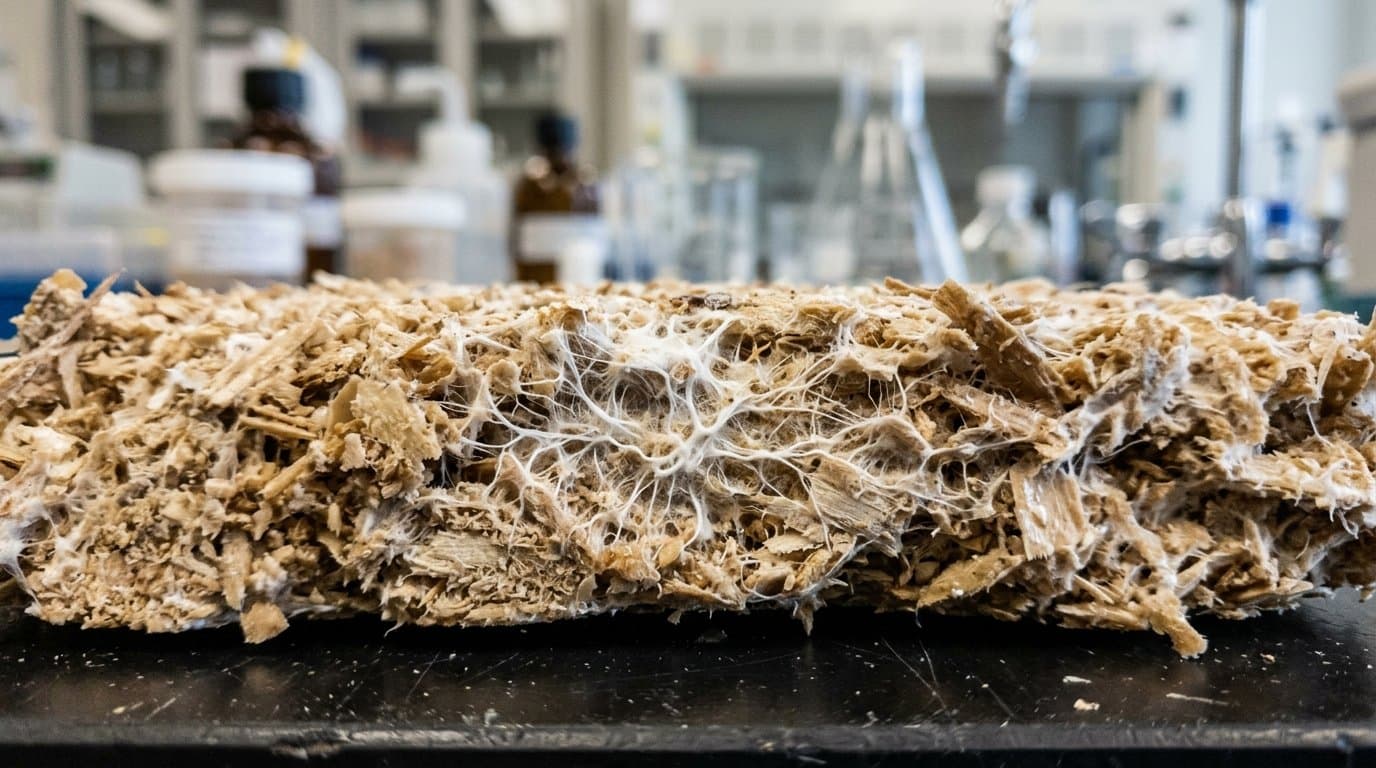
The patent, granted Aug. 25, covers a material made by turning a native wood-decay fungus, Irpex lacteus, loose on pasteurized birch sawdust and other forestry scraps. Sealed in a mold, the fungus threads its root-like fibers — its mycelium — through the wood particles and knits them into a solid block. Dry it out and the fungus dies, leaving a firm, biodegradable material behind. It's the same basic method behind a fast-growing class of "mycelium composites"; the New York firm Ecovative has been growing mushroom-based insulation and packaging this way for more than a decade.
Most of that field leans on a few domesticated species like oyster or reishi. The UAA team — led by public-health professor and mycologist Philippe Amstislavski — went looking in the woods near campus for a fungus that was already here: one that grows fast, shrugs off the cold, and wouldn't seed a fragile Arctic with a foreign organism if it got loose. The patent makes that a selling point, noting that a local species avoids introducing exotic fungi to the North.
This material is dense and heavy. In the patent's tests it matched or beat common polystyrene foam in compressive strength, but insulated somewhat less per inch and weighed far more — about 220 kilograms per cubic meter against polystyrene's 16 to 48. The patent lists underlayment beneath oil-and-gas pipelines and roads, backfill, and building insulation — load-bearing jobs common across the Arctic.
It could also be made close to where it's used. Alaska ships in the pink and blue foam boards that never break down and, by Amstislavski's estimate, burns through more than a million foam seafood boxes a year — discards that shatter into marine debris and work into the food web. His lab, which has also built prototype mycelium seafood coolers and won nearly $2.5 million from the U.S. Department of Energy to develop "carbon-negative" cellulose-mycelium building panels, frames the work as a public-health response to that pollution. Grown from local waste wood with little energy, the material locks up carbon for the life of a structure and, at the end, composts back into soil.
Mycelium materials are generally non-structural, though, can absorb water, and almost none are sold at scale; the patent describes laboratory samples and says nothing about how the material would be manufactured in quantity. The same inventors hold an earlier patent from 2020, so this has been years in the making. For now it's a proof of concept — demonstrated in the lab, not yet made at scale.
Source: THERMAL INSULATION MATERIAL FROM MYCELIUM AND FORESTRY BYPRODUCTS.
Made by our human newsroom with AI. How humans and AI work here · Grow with our newsroom
Stay informed. Support what matters.
Free, permanent access to local news you can verify. Subscribe to support Melinda Communities.News and go ad-free.
Related Coverage
Anchorage company wins patent for adjustable pipeline support
Alaska News · 1mo ago
Fairbanks inventors patent an ultra-light meal for the backcountry
Alaska News · 2mo ago
Alaska won up to $160M to hunt critical minerals with AI and microbes
Alaska News · 3mo ago
Can a bacterium pull rare earths out of coal waste? Alaska researchers just got $4.7M to find out
Alaska News · 2mo ago
The University of Alaska owns the look of a Fairbanks man's pliers
Alaska News · 1mo ago
Comments
Sign in to leave a comment.
No comments yet. Be the first to share your thoughts.