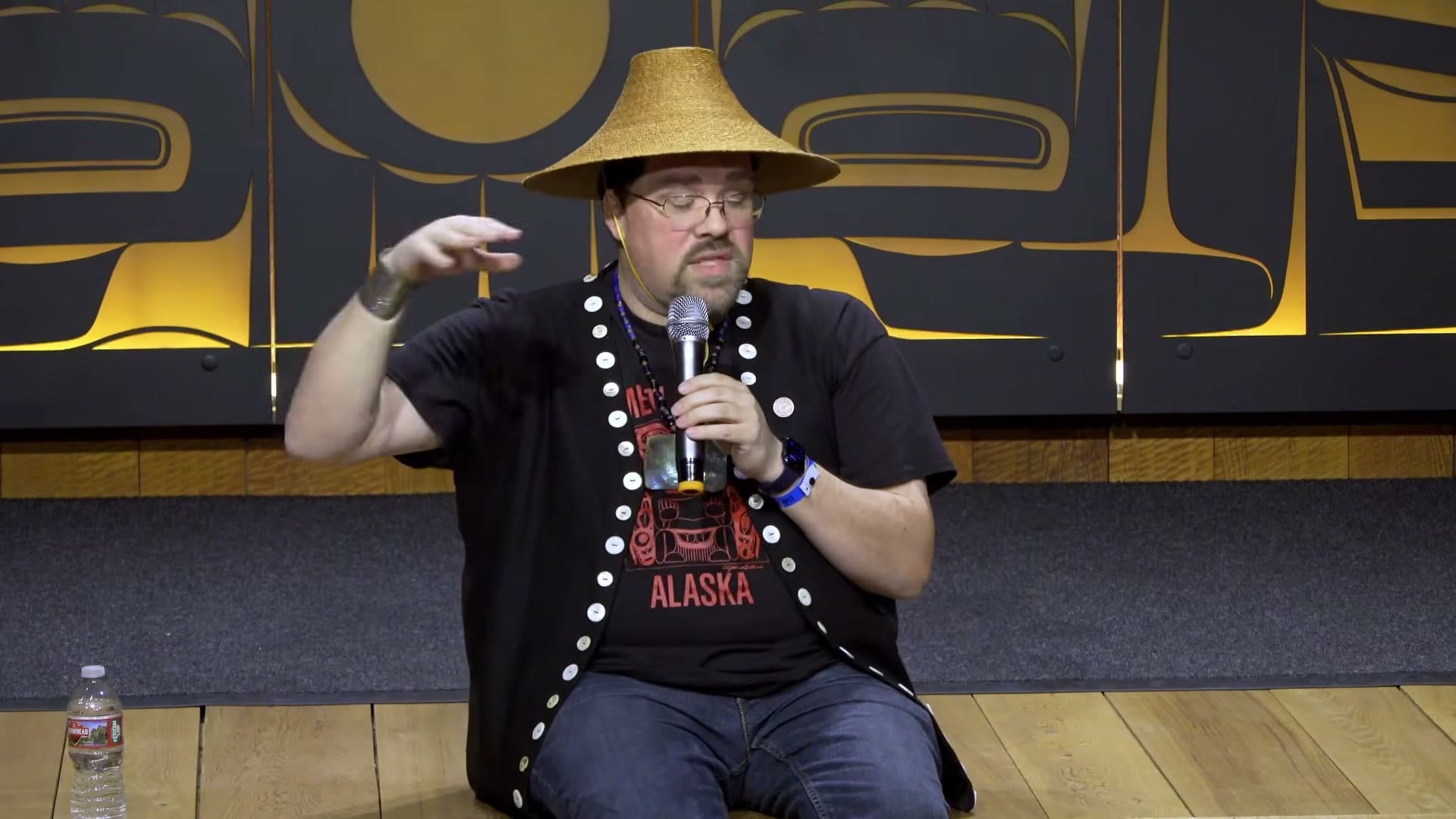
Frame from "Sealaska Heritage Institute: Laxgyibuu Clan Crest with David R. Boxley | Sealaska Heritage" · Source
Tsimshian carver tells Juneau audience his people predate the Duncan mission in Alaska
Tsimshian carver David Boxley said people in his own community have accused him of making up the clan migration stories he has begun telling in public.
He told a Sealaska Heritage Institute audience in Juneau that the accusation is the direct result of what was lost. Generations of Tsimshian people were taught a history that begins with the missionary William Duncan and the move to Alaska.
"We are defined by William Duncan and being colonized and moved to Alaska," Boxley said. "And that's all most anybody knows, including our own people. About being who we are. And I, the more I've learned, the more that kind of infuriates me."
Boxley framed the talk around his own clan, tracing the migration of the Laxgyibuu, the wolf phratry, from a plateau in the interior of British Columbia between the headwaters of the Skeena and Nass rivers before turning to the clan's crest stories. The oldest stories describe a conflict between the wolf people and raven people that forced a move down the Stikine, he said.
Six canoes reached a glacier during the escape, by his account. Two turned back over the mountains and settled on the Nass. Two went north toward Whitehorse. The last two sent a log downriver with its branches intact, and when a man climbed over the glacier and found the branches still attached on the other side, they knew the passage was wide enough for canoes.
Those canoes came through and the people settled for a time near the mouth of the Stikine. Boxley said a name still carried in Laxgyibuu lineages there will sound familiar to anyone who knows Wrangell.
Much of the lecture was given over to the wolf crest itself. Boxley told two origin stories, each surviving in several versions. In one, a chief who killed a wolf prince was taken to live among the wolves and returned with their helmet, tunic and wealth. In another, a chief pulled a bone from the throat of a starving wolf and was repaid with game left at the edge of the village. Boxley said the multiple versions and multiple chiefs' names are a sign the stories are old enough to have traveled with lineages that split and moved.
He also described how crests establish kinship across the groups now called Tsimshian, Tlingit and Haida. When wolf lineages that had been separated for generations met again, he said, they recognized one another as relatives on the strength of the shared crest alone, even where there was no blood connection. Some crests, such as the crane and the black bear, belong to all Laxgyibuu, he said, while hundreds of others belong only to particular houses. Some are not images at all but obligations, such as a crest requiring a feast at the first snow.
By Boxley's account, the suppression that followed the move to Metlakatla, Alaska, was thorough. Tsimshian people signed paperwork barring potlatching, secret society dances and face painting. He said the community also gave up the chief system that organizes the house structure, but he was careful to describe that as a choice made under uncertain pressure rather than a single imposed order. "Whether it was because we'd become Christians or whether it was because it was safe there, he had medicine that could help us from smallpox, whatever it was," Boxley said, "we voluntarily gave up our chief system, which is how our house system runs."
"We gave up potlatching," Boxley said. "That is devastating to try to maintain these kinds of stories and things."
One generation was enough to break the chain. Boxley said descendants told him their grandparents spoke Sm'algyax but refused to teach it, or laughed when children tried, because they were protecting them from what they had endured.
A Wrangell Raven clan leader stood during the question period to respond, saying Tlingit protocol requires the opposite clan to answer when something of that weight is shared. He said his clan tells the same stories, and that recordings in his clan's archives of elders who have since died affirm the Stikine River connections Boxley described. He said his own clan name is of Tsimshian origin.
Boxley said the record he is working from survived because Tsimshian people helped document it, and because an anthropologist organized those handwritten materials in the 1970s in a form he can now search.
"I want you all to wish me well in trying to overcome William Duncan's shadow when it comes to talking about Tsimshian people," Boxley said. "We are not some foreign transplants that never saw Southeast Alaska before 1887. It's just not true."
He said the work does not stop at recovering stories. What he wants, he said, is for his people to speak the language, know the histories and potlatch in their own communities rather than reserve cultural life for periodic public gatherings.
The lecture was hosted by Sealaska Heritage Institute, which was founded in 1980 to perpetuate Tlingit, Haida and Tsimshian cultures and regularly hosts public lectures on clan history, art and language. Alaska News previously covered a lecture by Jasḵwaan Bedard, who spent about two years retranscribing a 1901 Haida migration story into modern orthography and taught it to 10 students.
Boxley said he figures he has about 40 years left to do the work.
AI-assisted, reviewed by editors. Spot an error?
Watch key moments from the source meeting. Click to expand.
Stay informed. Support what matters.
Free, permanent access to local news you can verify. Subscribe to support Maggie AlaskaNews and go ad-free.
Related Coverage
A Haida class spends two years recovering a 74-line migration story
Alaska News · 1w ago · 80% match
Haida class returns a 1901 migration story to its own language
Alaska News · 2w ago · 78% match
A Juneau artist beads a warrior, a relative, and a record
Alaska News · 1mo ago · 76% match
SHI book documents the fraught origins of three Juneau totem poles
Alaska News · 1mo ago · 76% match
A Tlingit robe turns a warrior's last stand into sacred clan property
Alaska News · 1mo ago · 75% match
Comments
Sign in to leave a comment.
No comments yet. Be the first to share your thoughts.