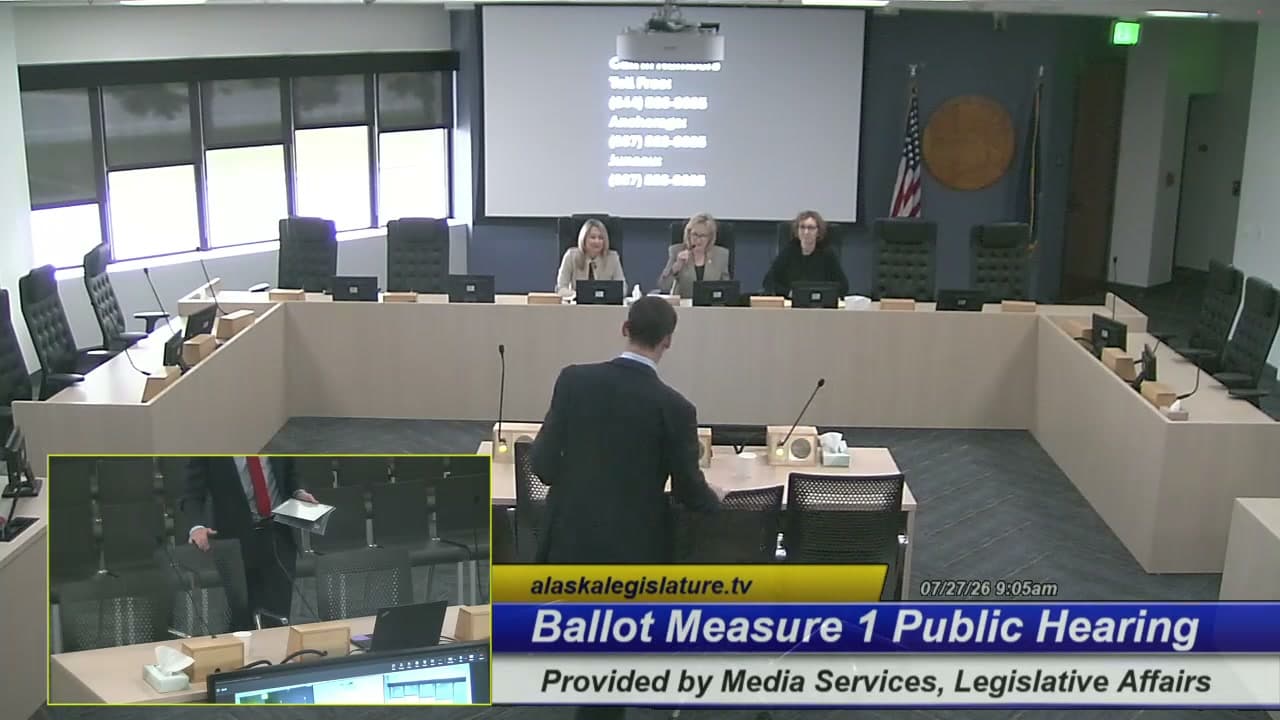
Frame from "Alaska Legislature: Primary Election, Ballot Measure No 1, Initiative Hearings" · Photo source
The sleeper on Alaska's August primary ballot: money, turnout and Measure 1
For the first time in 12 years, Alaskans will decide a ballot measure at a primary election — and this one asks the broadest question in politics: does money need a cap? Ballot Measure 1 lands Aug. 18 with the power to shape not just campaign finance law, but who shows up to vote on everything else.
And no, it isn't the ranked-choice repeal — that separate initiative waits for the November general.
Since a 2021 court ruling, there has been no limit on direct giving to Alaska candidates — any amount, from anywhere. The measure, backed by Citizens Against Money in Politics, would cap individuals at $2,000 per candidate each cycle and groups at $4,000, restoring the framework voters approved by a wide margin in 2006.
At Monday's hearing in Juneau, roughly 18 Alaskans split over it — most in favor, four opposed. Sponsor Rep. Calvin Schrage argued cycle-based caps level the field for challengers against incumbents who raise money years ahead. Amy Demboski of Palmer countered with the opposition's math: individuals get capped at $2,000 while PACs and unions can give $4,000 each — enough, she said, for ten union PACs to stack $40,000 on one candidate.
What the measure doesn't touch may matter as much: independent expenditures. Direct contributions get capped; unlimited independent spending continues. Supporters call the caps a first step; opponents like Kelly Nyberg argue they'll simply push money into less transparent channels.
The question may also decide who shows up. Primaries draw a fraction of Alaska's general-election turnout, and the high-water marks come when the ballot offers more than the usual races: the 2014 oil-tax referendum — when more than 7,000 Alaskans requested a measures-only ballot — and 2022's special congressional election produced the strongest primary turnouts in two decades, while the measure-free 2018 primary dipped hard.
It's on the ballot at all because of a veto: lawmakers passed the same limits this spring — which under state law would have canceled the vote — and Gov. Mike Dunleavy vetoed the bill in July. The next statewide call-in hearing comes Aug. 5.
This article is based on a public meeting of Alaska State Legislature — Alaska Legislature: MSC2-20260727-0900 2026 Primary Election, Ballot Measure No 1 23RCF2, Initiative Hearings ().
Made by our human newsroom with AI. How humans and AI work here · Grow with our newsroom Transcript byLucas Brown
Watch key moments from the source meeting. Click to expand.
Stay informed. Support what matters.
Free, permanent access to local news you can verify. Subscribe to support Walter AlaskaNews and go ad-free.
Related Coverage
Alaskans vote Tuesday on restoring campaign contribution limits
Alaska News · 2mo ago
Two former colleagues split over whether Ballot Measure 1 curbs big money or just reroutes it
Alaska News · 2mo ago
Alaska ballot measure to restore campaign contribution limits heads to August 18 primary
Alaska News · 3mo ago
Most political money reported before Alaska's primary is aimed at a November ballot measure
Alaska News · 2mo ago
Ballot Measure 3 would add one word to Alaska's voting law, with most money from one donor
Alaska News · 6d ago
Comments
Sign in to leave a comment.
No comments yet. Be the first to share your thoughts.