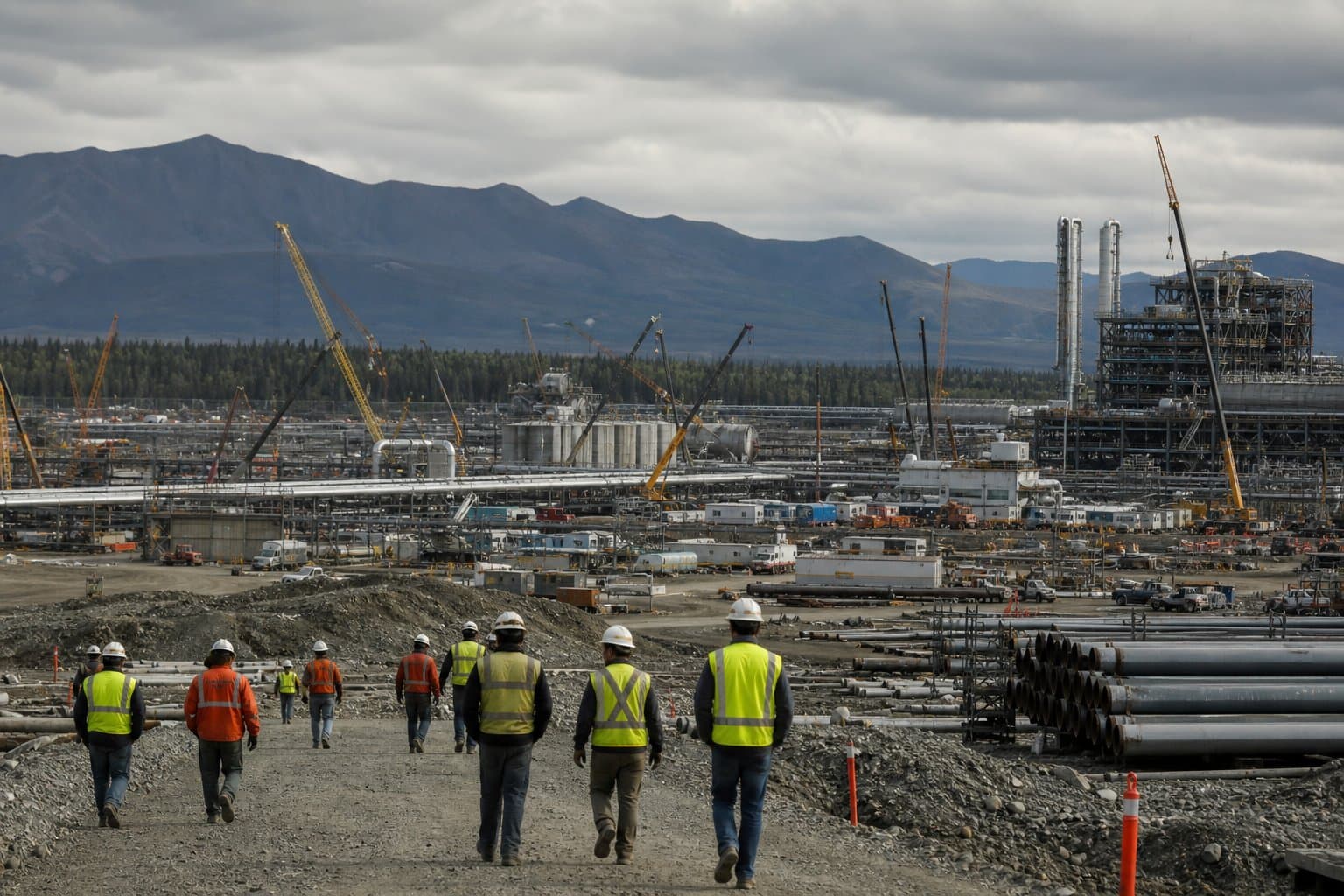
State revenue model shows $9.99/mcf LNG break-even if AKLNG costs rise 20%
A 20 percent rise in Alaska LNG construction costs would push the project's export break-even price to $9.99 per thousand cubic feet, the Alaska Department of Revenue told the House Resources Committee in a July 7 letter responding to questions legislators posed in May about higher-cost scenarios.
The department's baseline assumes $46.2 billion in real 2026 capital costs. At a 20 percent increase, Acting Commissioner Janelle L. Earls wrote, the project would need "an estimated nominal LNG break-even price in 2033 of approximately $9.99 per mcf" and would yield "estimated cumulative total state revenues through 2062 of approximately $25.4 billion." The source matrix shows the baseline at approximately $25.1 billion at the same $1.50 upstream gas price assumption, a difference of roughly $336 million over four decades. The same scenario produces an estimated nominal in-state break-even price in 2033 of approximately $5.28 per mcf.
The $9.99 figure matters because LNG futures prices for Asia delivery have been running in the $8 to $9 range. Chief Economist Dan Stickel told the House Finance Committee in May that "futures market prices indicate something in that $8 to $9 range," placing the higher-cost scenario above that range.
The July 7 letter also included a separate Phase 1-only analysis, an in-state pipeline scenario without LNG exports, showing an estimated nominal in-state break-even price of approximately $12.65 per mcf in 2033.
The letters also detail a production tax complication. Earls wrote that "incremental AKLNG production tax revenues are negative because upstream producers are assumed to incur additional lease expenditures at fields expected to supply gas to the project, primarily Prudhoe Bay and Point Thomson." The state's total production tax receipts remain positive but fall below the Spring 2026 forecast from 2029 through 2032. The department notes that the cumulative net impact of AKLNG on production tax is positive over the next decade under baseline modeling assumptions, while cautioning that dividing production and costs among individual companies and aggregating with each company's other North Slope fields could result in revenues that differ materially, and that oil prices and costs remain uncertain.
Independent analysts have raised broader questions about the baseline itself. A Public Citizen review of North American LNG terminals found average cost overruns of roughly 60 percent, suggesting actual costs could reach $87 billion or more, well above the 20 percent scenario the department modeled.
The conference committee continues to work through HB 381, the Alaska LNG tax bill. The sensitivity matrices the department provided cover capital cost increases up to 100 percent above baseline.
AI-assisted, reviewed by editors. Spot an error?
Comments
Sign in to leave a comment.
No comments yet. Be the first to share your thoughts.