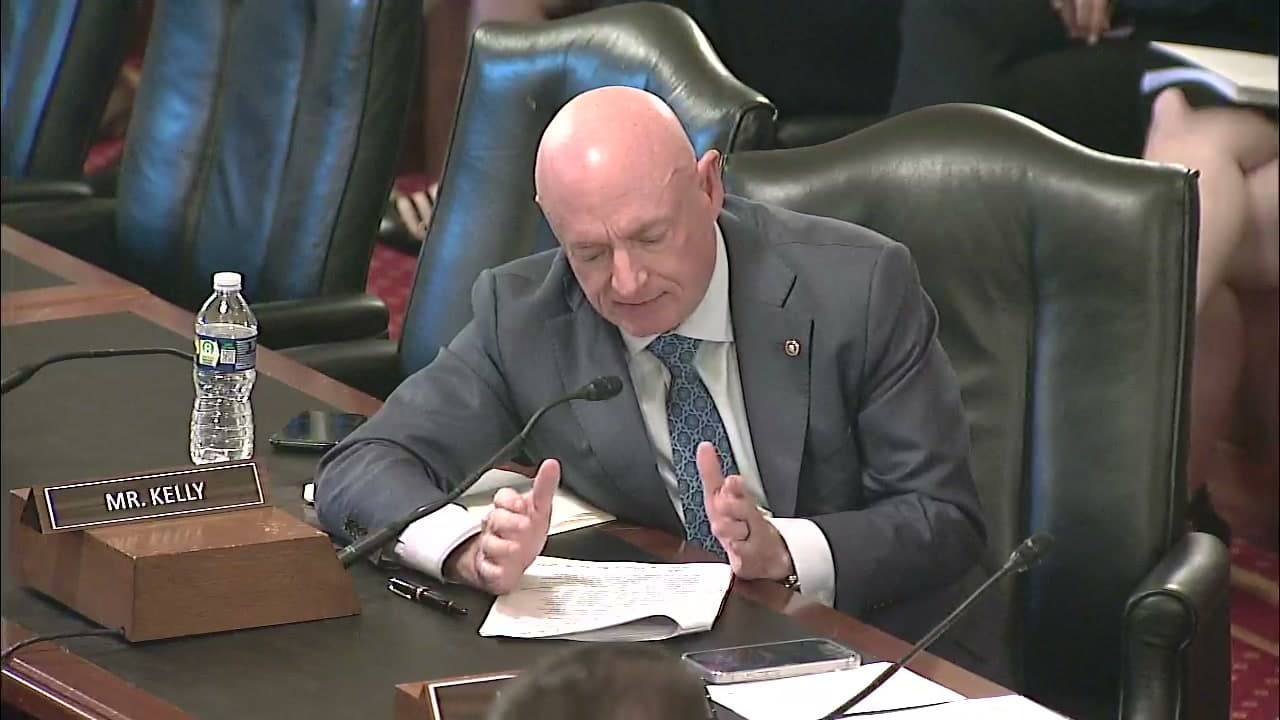
Frame from "Senate Armed Services Subcommittee on Strategic Forces" · Source
Senators question Golden Dome's $185 billion price as budget office puts full shield at $1.2 trillion
Congressional budget analysts put the cost of a national missile-defense system with capabilities broadly consistent with President Trump's executive order at about 1.2 trillion dollars to develop, deploy and operate for 20 years. Building it would account for just over 1 trillion dollars of that, more than five times the Pentagon's public target of 185 billion dollars for Golden Dome. Senators pressed witnesses on that gap Tuesday, September 29, 2026, at a hearing of the US Senate Armed Services Subcommittee on Strategic Forces. No administration official testified.
Trump introduced Golden Dome through Executive Order 14186 on January 27, 2025, directing an integrated homeland shield against ballistic, hypersonic and advanced cruise missiles from any adversary. Congress later provided 24.4 billion dollars for related efforts through the FY2025 reconciliation law. The program director has testified that the 185 billion dollar figure covers deployment only through delivery in 2035.
The only homeland interceptors in place today sit in Alaska, at Fort Greely, and in California. Subcommittee Chair Deb Fischer of Nebraska said there are 44 of them. "Those are not geared to defend against China and Russia. They are for defense against North Korea," Fischer said.
David Mosher, the Congressional Budget Office's director of national security analysis, said the president's order marks a break from that approach. Recent policy focused on small numbers of missiles from countries like North Korea, he said, "and the system we have in Alaska sort of reflects that, that focus." Mosher said his office's estimate covers a notional system, a hypothetical design based on the capabilities the order calls for, since the Pentagon has not released its plans, and carries "considerable uncertainty." A smaller or phased system would cost less, he said.
Fischer said the estimate rests only on the order's language. She said it does not reflect the program director's later decisions on design, cost per shot or sequencing.
Senator Angus King of Maine cited 8 billion dollars to defend Guam and asked how many cities could be covered the same way. "This $185 billion to me is not a realistic number," King said. "Who is being protected and who makes that decision?" he asked.
David J. Trachtenberg of the National Institute for Public Policy said he could not answer that. "I don't have insight into the current architectural plans, but I think it would be deployed probably in phases or in stages," Trachtenberg said.
"I think all of you have essentially conceded that this will be a phased development. It will not be a duplication of the president's initial executive order," said Senator Jack Reed of Rhode Island. Witnesses split on whether the program has been rescoped. Thomas Karako of the Center for Strategic and International Studies said it has not necessarily been, because the order names types of missiles but not numbers.
Separately, the Missile Defense Agency's SHIELD contractor list, tied to Golden Dome and worth up to 151 billion dollars over ten years, includes the state-owned Alaska Aerospace Corporation and 12 subsidiaries of Alaska Native Corporations.
The design remains classified. Fischer said the committee will be formally briefed in November.
This article is based on a public meeting of Senate Armed Services Subcommittee on Strategic Forces — Senate Armed Services Subcommittee on Strategic Forces: Hearings to examine an update on Golden Dome. ().
AI-assisted. How we use AI Transcript byWalter AlaskaNews
Watch key moments from the source meeting. Click to expand.
Stay informed. Support what matters.
Free, permanent access to local news you can verify. Subscribe to support Walter AlaskaNews and go ad-free.
Related Coverage
Space Force nominee warns China's counter-space buildup is moving at 'breathtakingly fast' pace
Alaska News · 2mo ago
The Air Force wants $7 billion for fighter recapitalization at Elmendorf — but Alaska's military investments are riding on a partisan bill senators don't think will pass
Alaska News · 3mo ago
The Air Force wants a $338.8 billion budget — a 34% jump that includes a 130% Space Force boost that flows to Clear
Alaska News · 3mo ago
A Record Alaska Defense Bill Clears Its First Hurdle
Alaska News · 3mo ago
Murkowski presses Interior on who's paying for Trump's Smithsonian signs
Alaska News · 1mo ago
Comments
Sign in to leave a comment.
No comments yet. Be the first to share your thoughts.