Senate advances software licensing bill, food dye ban to third reading
The Alaska Senate advanced two bills to third reading Tuesday, moving forward legislation on software licensing contracts and school meal standards.
Senate Bill 258, which addresses contracts for licensing software applications, passed second reading without amendments and will advance to a final vote. The bill had received mixed committee recommendations, with some members signing no recommendation and others supporting passage.
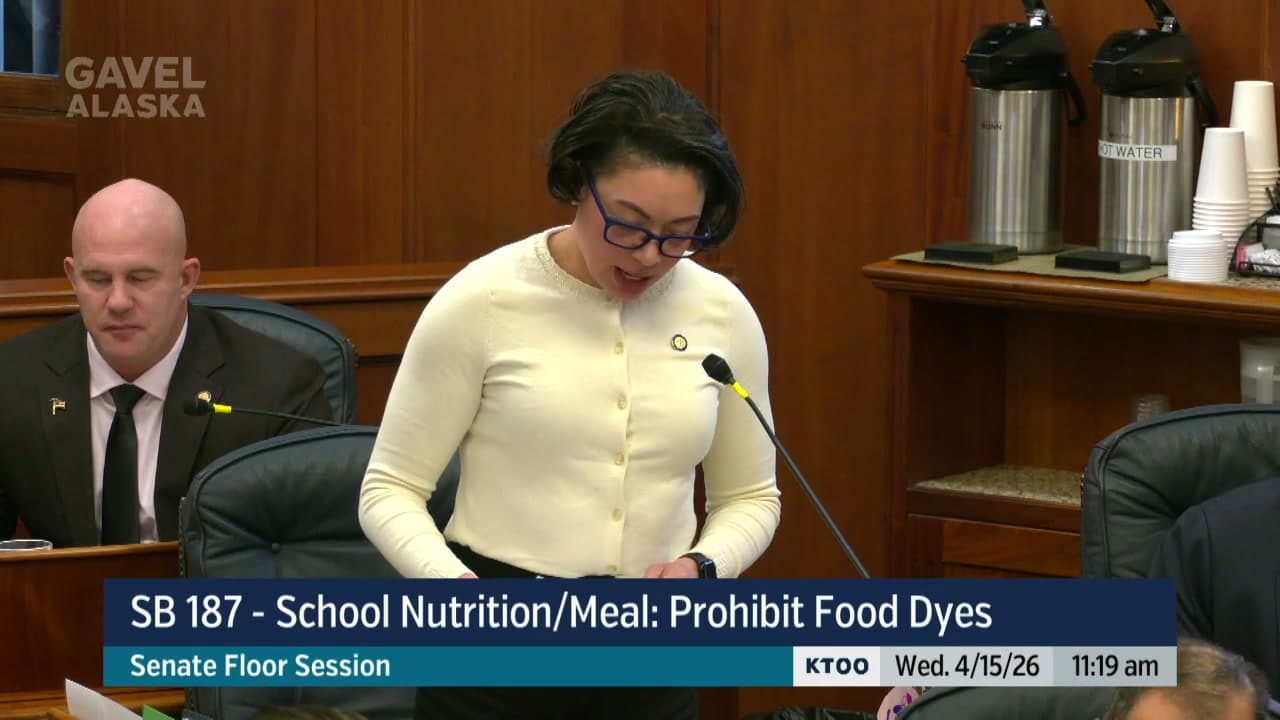
The Senate also adopted a committee substitute for Senate Bill 187, introduced by Senator Bill Wilikowski, which prohibits certain food additives in public school meals. The legislation targets seven synthetic dyes: Red 3, Red 40, Yellow 5, Yellow 6, Blue 1, and Blue 2 in public school breakfast and lunch programs during the school day, with an effective date of January 1, 2028.
The Education Committee had narrowed the original bill's scope after initial testimony to address concerns about its impact on school activities. The Senate Health and Social Services Committee heard testimony from Wilikowski and advocates before the bill advanced to the floor.
"We did find that this prohibition was too limiting and would have made it nearly impossible for school districts to provide snacks to athletes during competitions, potentially impact cultural programming or extra services," said Senator Tobin, who chairs the Education Committee.
The committee substitute changed the legislation to ensure the prohibition on certain food dyes applies only to breakfast or lunch provided by the school to enrolled students during the school day. The change allows schools to continue providing snacks for athletes and other activities without running afoul of the ban.
"We believed that this change would allow for the use of snacks for athletes and for other activities, and also ensure that we did not impede on any cultural programming that was happening at the school during or after school hours," Tobin said.
The Senate adopted the Education Committee substitute without objection. The bill had received mixed recommendations in committee, with some members signing do pass and others signing no recommendation or do not pass.
Both bills will appear on the Senate's next legislative calendar for third reading and final passage. Senate Bill 258 carries a zero fiscal note. Senate Bill 187 also carries a zero fiscal note from the Education Committee, as the Department of Education and Early Development reported no fiscal impact since food procurement occurs at the district level.
The Senate also advanced Senate Joint Resolution 28 to third reading. The resolution recognizes workers serving in Alaska under the J-1 Exchange Visitor Program and H-1B specialty occupation program. The Labor and Commerce Committee had adopted a substitute version that added the H-2B program for temporary non-agricultural workers and updated the name of the Secretary of Homeland Security.
The resolution passed without objection and will advance to a final vote at the Senate's next regular session.
This article is based on a public meeting — Alaska Legislature: Senate Floor Session, 4/15/26, 11am ().
AI-assisted. How we use AI Transcript byLucas Brown
Stay informed. Support what matters.
Free, permanent access to local news you can verify. Subscribe to support Alaska News and go ad-free.
Related Coverage
Alaska Senate panel considers banning synthetic food dyes from school meals
Alaska News · 5mo ago
House advances bills on autonomous vehicles, nurse training, interior design
Alaska News · 5mo ago
Alaska House panel advances free school meals for reduced-price students
Alaska News · 5mo ago
Alaska House passes bill aimed at software vendor lock-in
Alaska News · 4mo ago
Alaska Senate passes special education funding and Palmer judge bills
Alaska News · 4mo ago
Comments
Sign in to leave a comment.
No comments yet. Be the first to share your thoughts.