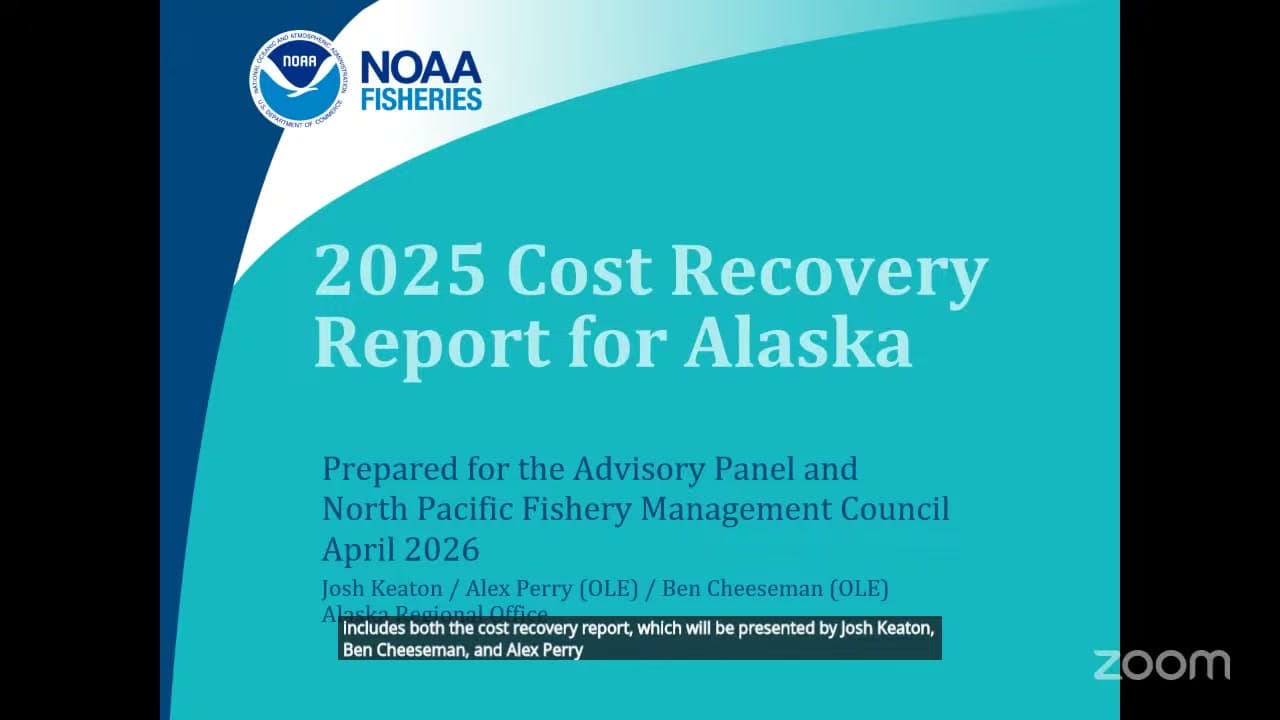
North Pacific council demands OLE justify enforcement fees billed to Alaska catch-share programs
The North Pacific Fishery Management Council passed a motion without objection directing NOAA's Office of Law Enforcement to provide documentation of the specific regulation under investigation, cost apportionment across programs, and a breakdown by division or partner agency for costs billed to Alaska's catch-share programs. The same motion also directed the regional administrator to consult with the council before establishing recoverable cost categories. The motion passed without objection under the council's C4 agenda item on cost recovery report and program improvements.
A Dispute Years in the Making
The dispute has been building for years. The Magnuson-Stevens Act authorizes cost recovery only for actual incremental costs: those that would not exist but for the catch-share program itself. Industry representatives and council members have argued that NOAA OLE has not clearly established that link for the fees it charges Alaska programs. Heather Mann, Executive Director of the Midwater Trawlers Cooperative, put the structural problem plainly during public testimony. "Cost recovery was never intended to be a mechanism for allocating general agency overhead or broad fisheries enforcement activities, like transferring through a rookery, for example, to a relatively small group of participants simply because they operate in a catch share," she said. Mann also raised a concern about how the council created these programs: "During the development of Amendment 122, I do not recall the council ever developing or debating a methodology for identifying recoverable costs, allocating those costs among participants, or determining how OLE costs would be attributed to the program."
Whether the Agency Can Show Its Math
Council members and industry witnesses argued throughout the day that OLE's current practice of allocating costs using predetermined fixed percentages of personnel and travel, rather than tracking time by investigation, does not satisfy the statute's but-for standard. Critics said the lack of itemized billing makes it impossible for participants, the council, or the public to independently evaluate whether billed costs are truly incremental and directly related to a catch-share program. Regional Administrator John Kerwin acknowledged the scrutiny, saying the agency is committed to working on transparency and that progress has been made through the consolidated cost recovery report, while noting that further work remains. The motion is intended to require that level of documentation starting with the current billing cycle; council members warned that a formal regulatory amendment remains an option if the agency does not meet the council's expectations.
This article is based on a public meeting of NPFMC - Council & SSC Meetings — NPFMC 279 Day 3 - June 6, 2026 ().
Made by our human newsroom with AI. How humans and AI work here · Grow with our newsroom Transcript byLucas Brown
Watch key moments from the source meeting. Click to expand.
Stay informed. Support what matters.
Free, permanent access to local news you can verify. Subscribe to support Bill AlaskaNews and go ad-free.
Related Coverage
NPFMC directs NOAA to update pollock roe rules after seizure highlighted regulatory gap
Alaska News · 4mo ago
Bering Sea crab fee drops by half, but the itemization fight remains
Alaska News · 2mo ago
North Pacific council moves toward enforceable pelagic trawl gear standards
Alaska News · 4mo ago
Council votes 8-3 to study halibut bycatch rules for Golden Fleece replacement vessel
Alaska News · 4mo ago
Bering Sea cod trawl fee drops to 2.09% after fishery value jumps
Alaska News · 2mo ago
Comments
Sign in to leave a comment.
No comments yet. Be the first to share your thoughts.