AI image
Museums have cleared 46 Alaska Native ancestors to come home
Tom Ukas said the cap was made of old scalps taken in war. He said it in his own oral history, about his own regalia. Beloit College bought the cap in 1963, and this summer it published the notice that clears the way for it to go home.
Ukas, whose Tlingit name was Ghunaaneistí, was Kiks.ádi from the Sun House in Wrangell and lived from 1879 to 1973. The cap is cloth covered in matted tufts of hair, which the law treats as human remains. The museum's consultation identified a top knot of bound hair among them, worn by warriors going into war, which supports what he said. It is affiliated with the Central Council of the Tlingit and Haida Indian Tribes, and Beloit may return it on or after Sept. 23.
His cap is one of a set. Federal notices published since late May have cleared at least 46 Alaska Native ancestors and 14 cultural belongings for return from museums and federal agencies outside Alaska. The National Park Service published fourteen notices between May 28 and Sept. 9, naming fourteen tribal governments from the Sitka Tribe of Alaska to the Native Village of Mekoryuk. Twelve of the dates on which return could begin have already passed.
The one still ahead is Princeton's. On Sept. 9 the university published for one man taken from a grave in Sitka, along with the snuff box and drum buried with him. A Presbyterian missionary, John Green Brady, took them and gave them to Sheldon Jackson, who acknowledged receipt in a letter dated Feb. 2, 1880, calling him "the Medicine Man." That letter makes him the oldest removal in the fourteen notices. The affiliation is to the Sitka Tribe of Alaska, and the date is Oct. 9.
The largest single holding is at Case Western Reserve University: 29 people, nearly two-thirds of the 46. A professor at its dental school, Dr. I. Lester Furnas, donated them in 1931 after traveling to Alaska on a Public Health Service expedition to study Inuit dentition. Thirteen came from Nunivak Island, eight from Point Hope, four from Point Barrow. Four of the 29 were children.
The rest are scattered. A ship's captain took a man from Point Hope in 1884 and gave the remains to the Smithsonian; they moved to the Army Medical Museum in 1886 and sit today with the Defense Health Agency. The Bureau of Land Management reported at least ten people from Kachemak Bay and 21 objects buried with them, held at the University of Pennsylvania Museum, in the fourth notice on those sites since 1993. Two ancestors taken from Unalaska Island in 1973 by an unknown person passed through an archaeologist's hands to Arizona State University, where the notice says nothing more is known about them.
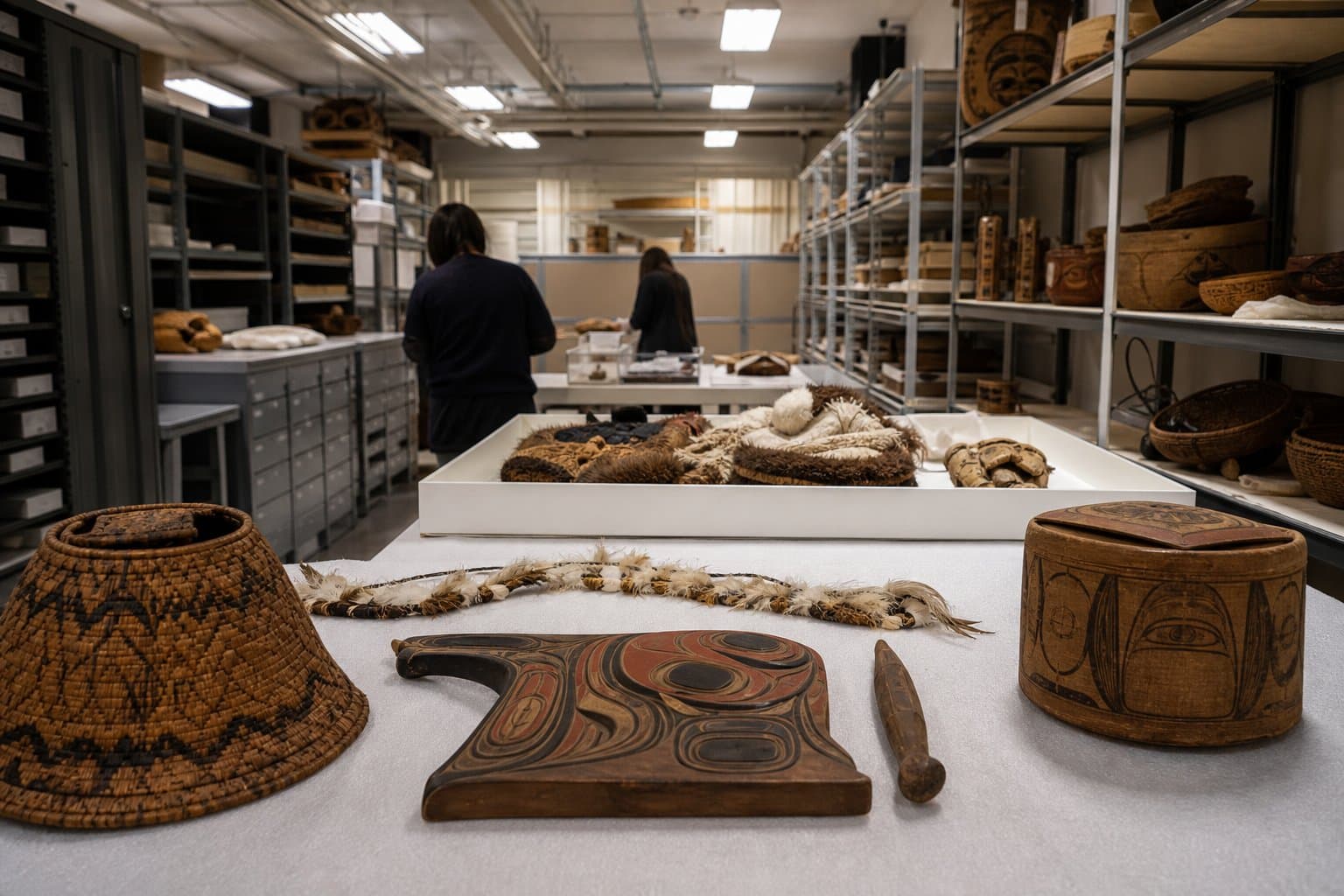
The belongings carry names too. A Chilkat shirt at the University of Maine is attributed to the Tlingit weaver Annie Klaney or to Jenny Thlunaut. The Santa Barbara Museum of Natural History holds a Tsimshian amhalaayt, a chiefly headdress, that consultation identified as made for and worn by Sm'oogyit Niishluut, Chief Sidney Campbell, a founding leader of Metlakatla; a wealthy buyer picked it up at a curio store in Wrangell in 1939. The Eiteljorg Museum reported four Tlingit and Haida objects removed in the nineteenth century and called its own records of how it got them scarce. The San Bernardino County Museum reported a twined bowl whose paper tag reads "Eyak Ind., Alaska."
Under the repatriation law, the duty to tell the tribes rests with the institution holding the remains, not with the government. A rule that took effect in January 2024 rewrote the regulations and requires museums and agencies to defer to tribal traditional knowledge, giving them until January 2029 to finish consulting and updating inventories. Alaska notices are not coming faster for it: sixteen so far this year, against nineteen by the same point in 2025.
The 46 is a floor, summed from eight notices that each state a minimum rather than a count. And the notices are written by the institutions. None of the fourteen tribal governments named in them is quoted anywhere in the record.
Source: Fourteen federal notices since May have made 46 Alaska Native ancestors and 14 belongings returnable. Twelve of the dates have already passed ().
AI-assisted, reviewed by Cale Green. Who is accountable.
Stay informed. Support what matters.
Free, permanent access to local news you can verify. Subscribe to support Walter AlaskaNews and go ad-free.
Related Coverage
Wrangell elder's headpiece cleared for return from Wisconsin museum
Alaska News · 6d ago
BLM Alaska to repatriate Native remains and cultural items under three federal notices
Alaska News · 3mo ago
A Tlingit infant, held for years in a Seattle museum, is coming home to Petersburg
Alaska News · 3w ago
Kodiak Island artifacts set to leave Maine museum under NAGPRA
Alaska News · 2mo ago
Army plans to return four Alaska children's remains from Carlisle
Alaska News · 1w ago
Comments
Sign in to leave a comment.
No comments yet. Be the first to share your thoughts.