House Finance hears divided testimony on $95M West Susitna road allocation
The House Finance Committee heard nearly two hours of public testimony April 29 on Senate Bill 214, the capital budget appropriations bill. Testifiers addressed multiple funding priorities, including a proposed $95 million appropriation for the West Susitna Access Road, restoration of homeless assistance program funding, support for the Arctic Winter Games, and municipal infrastructure needs.
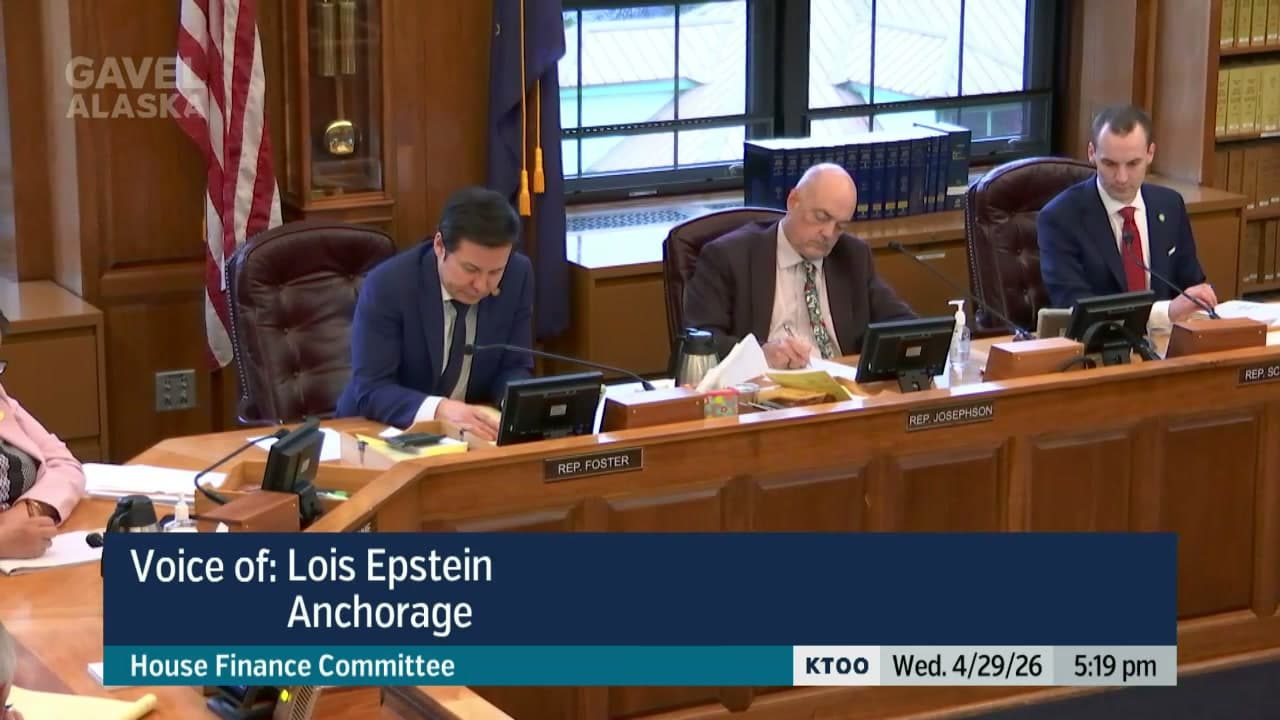
The West Susitna road funding drew the most divided testimony. The appropriation would cover the first 22 miles of a planned 100-mile route from Big Lake to the West Susitna mining district. Lois Epstein, an Alaska-licensed engineer, told the committee she analyzed a 2014 state reconnaissance study and inflated its per-mile cost estimates to 2025 dollars using recognized indexes. "This means that the cost for the full 100-mile road, largely intended to subsidize mining companies that pay the state relatively little in revenue and offer few long-term jobs, would range from $800 million to $1.26 billion," Epstein said.
Opponents said the road would primarily benefit mining interests while threatening salmon habitat, indigenous cultural sites and an existing recreation-based economy. Karen Garvey said the project would cross 182 streams, with 171 having culverts and only 83 designed for fish passage. "Many, many streams out there are designated as fish salmon rivers," Garvey said. "And there are lots of wetlands, which of course would have critical habitat."
Thane Piscoia, vice president of Alexander Creek, told the committee that federal environmental reviews remain incomplete. "The environmental assessment has not been released. The Section 404 wetlands permit has not been issued. Section 106 historic preservation review is still in programmatic consultation," Piscoia said.
Angela Wade, tribal historic preservation officer for Chickaloon Village, said her team documented nearly 700 culturally modified trees within a 20-foot corridor of the proposed route. "I walked the whole 22-plus miles of the corridor," Wade said. "Even though DOT will claim it is unwalkable, and I know there are landforms and features out there that need protecting culturally."
Several testifiers emphasized the economic value of the region's existing uses. Adam Cuthrell, owner of Fishhound Expeditions, said sport fishing alone generated over $50 million for the Mat-Su Valley in 2019, compared to $7 million from mining. "People choose to travel and spend money in the West Zoo because it is wild and free from massive industrial mines," Cuthrell said.
Bob Butera, a civil engineer who worked on the 2019 reconnaissance study, described the project's engineering challenges. The route would require 11 bridges, including a 2,200-foot span across the Susitna River that would be 700 feet longer than the Glenn Highway's Knik River crossing. "Every dollar spent on the West Susitna Access Project is money taken from construction operations and maintenance of the basic transportation needs that serve the majority of local residents," Butera said.
Supporters said the road would unlock resource development and provide public access to 6 million acres of state land. Andrew Traxler, chairman of a local road service area board, said the project is essential for jobs and recreation. "The West Susitna Access Road is essential to our community for us to have jobs and for future jobs," Traxler said. "The increased access for hunting and fishing would be very important to us. And it should not be accessible to just a few."
In response to a committee question, Traxler also said the road would benefit Port MacKenzie and the railroad spur. He noted that 80 percent of Mat-Su Borough firewood currently comes from West Susitna.
Terry Gorlick, a former business owner, said the road represents strategic investment in Alaska's economic future. He compared opposition to the project to early resistance to the Alaska Highway. "This is not a simple road project. It is strategic investment in Alaska's economic future, resource independence, and long-term security," Gorlick said.
Michael Bowles, a Mat-Su Borough Assembly member testifying on his own behalf, said the borough wants the project. "We want to grow. We want strong infrastructure. We want economic development," Bowles said.
Representative Allard noted during testimony that the funding comes from federal receipts authority, not state general funds that could be redirected elsewhere. "This is federal receipts. This is not funds that are just state dollars that we are not allocating properly or where they might want us to shift around," Allard said. Committee Chair Schrag added a clarification: "This is federal authority. Small distinction there, but an important one in my view."
Pamela Nolsini, a resident of Alexander Creek village, said the road threatens subsistence resources her family has depended on for generations. "I am a Native Alaskan who was born and raised here at Alexander Creek, which is directly affected by the access road, and I depend on the food resources to live here, as my father and grandfather before me did," Nolsini said. "I cannot have those things jeopardized by mining practices and construction, which will undoubtedly damage the delicate area we rely on."
The committee also heard extensive testimony on the Homeless Assistance Program. Multiple service providers from across the state testified about HAP's importance in preventing homelessness and supporting vulnerable populations in communities including Anchorage, Bethel, Cordova, Fairbanks, Juneau, Kenai, Ketchikan, Kodiak, Nome, Sitka and Unalaska. Committee Chair Schrag noted during the hearing that the Senate Finance Committee had approved an amendment restoring HAP funding to $10.15 million in the mental health budget.
Several testifiers spoke in support of $1.75 million in funding for the Arctic Winter Games to be hosted in Fairbanks in 2028. Leah Farzin, who coached Team Alaska figure skating in 2026, said delaying the games by a full year could be a huge loss for athletes who might miss their only opportunity to make Team Alaska. Anne Weske and her son Drew Weske testified about the life lessons and connections Drew formed while playing volleyball for Team Alaska.
Other testimony addressed tourism marketing funding, with business owners from Sitka and Valdez emphasizing the economic importance of state-led marketing programs for small communities and businesses. Kristen Smith, mayor of Cordova, testified in support of harbor facility grants, school major maintenance and construction, and water and wastewater funding.
Public testimony was scheduled to end at 6:30 p.m. The committee took no action on the bill. The meeting adjourned at 6:40 p.m. Written testimony on the capital budget was due by 5 p.m. April 30.
This article is based on a public meeting — Alaska Legislature: House Finance - April 29, 2026 4:30pm ().
AI-assisted. How we use AI Transcript byLucas Brown
Stay informed. Support what matters.
Free, permanent access to local news you can verify. Subscribe to support Alaska News and go ad-free.
Related Coverage
House Finance Hears Sharp Divide Over $95M for West Susitna Road
Alaska News · 5mo ago
House Finance cuts West Susitna road funding from capital budget
Alaska News · 4mo ago
House Finance hears divided testimony on pharmacist prescribing bill
Alaska News · 5mo ago
Alaska House Finance Rejects Cemetery, School, Energy Amendments
Alaska News · 4mo ago
House Finance begins review of Alaska LNG tax bill with competing rate proposals
Alaska News · 4mo ago
Comments
Sign in to leave a comment.
No comments yet. Be the first to share your thoughts.