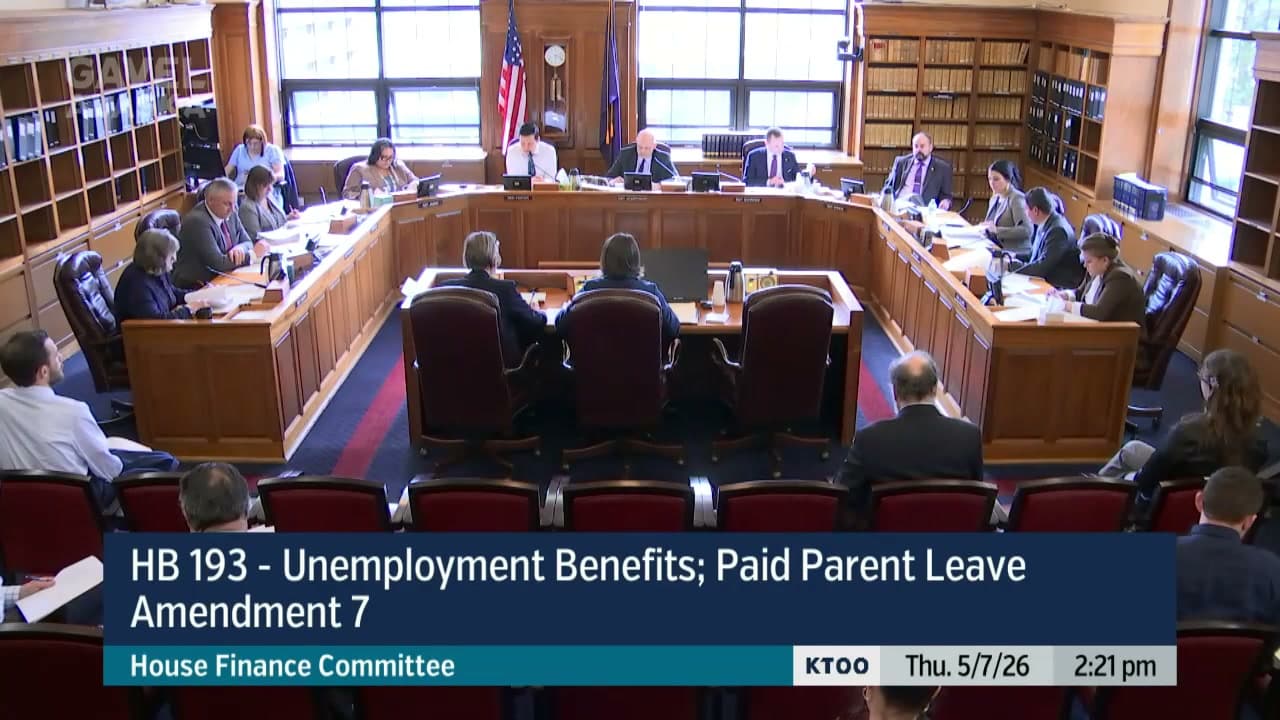
House Finance cuts paid parental leave to 12 weeks, reduces benefits to $524
The Alaska House Finance Committee voted Thursday to cut a paid parental leave proposal from 26 weeks to 12 weeks and reduce weekly payments from $817 to $524.
The changes came at the recommendation of the Alaska Department of Labor and Workforce Development to protect the long-term solvency of the paid parental leave fund. The committee adopted the amendments to House Bill 193 during a Thursday afternoon session. The House Labor and Commerce Committee had previously advanced HB 193 with the broader 26-week design.
"Amendment 3 reduces the number of weeks available to receive paid parental leave benefits from the original span of 8 to 26 to 8 to 12 weeks," said a committee member who sponsored the amendment. "I am offering this amendment at the suggestion of the Department of Labor to best ensure the solvency of the paid parental leave fund."
Representative Carolyn Hall, the bill's prime sponsor, said the reduction came after conversations with business groups and economic development organizations concerned about fund sustainability and the practical challenges of managing longer employee absences. She cited recommendations from the Disability Management Employer Coalition, which told lawmakers the national average for such programs is 12 weeks.
The committee also reduced the weekly benefit amount from $817 to $524, tying it to the state's taxable wage base rather than the Consumer Price Index. Hall said the Department of Labor recommended the change because wages fluctuate at a different pace than inflation. The $524 figure is derived from the FY26 taxable wage base and matches the current average weekly wage base. The bill would set both unemployment insurance and paid parental leave at $524 per week, up from the current UI cap of $370 that has been in place since 2009.
"This amendment comes in coordination with the Department of Labor, and yes, even though there is a reduction in the weekly benefit, this also is important to ensure that we have the two things," Hall said. "It is protecting the long-term solvency of the PPL trust fund, but additionally it matches what the current average weekly wage base is today."
The committee voted 8-3 to exempt businesses with fewer than 25 employees from the program, down from an initial threshold of 50 employees. Representative Sharkey proposed the lower threshold as a conceptual amendment, saying he managed a company with about 20 employees and understood the burden on smaller employers. Employees at firms below the 25-employee threshold would not be covered unless their employer voluntarily opts into the program.
"I wonder if the amendment sponsor and the bill sponsor would be amenable to maybe 25 instead of 50," Schrage said. "And maybe I will just make that as a conceptual amendment to change it from a threshold of employer of 50 or more employees on line 2 to instead be an employer of 25 or more employees."
A committee member opposed the exemption, saying a 50-person company in Alaska is large and that employees at smaller businesses still need time to bond with newborns. "If you have a newborn baby, you want time to bond with your baby," the member said. "That is the essence of it, I think. And if you are in a small gift shop you still have that need."
Another representative said she appreciated that smaller businesses could opt into the program voluntarily. "I do appreciate especially part 3, where those who are in smaller businesses may opt in," the member said. "So my guess is that if they wanted to attract young workers, they would find a way to opt in."
The amendment also exempts seasonal employees from participation in the paid parental leave program at the request of seasonal employers who said they cannot afford to allow short-term employees to take several weeks off during peak season. Seasonal employees would still have unemployment insurance coverage but would not be required to contribute to paid parental leave.
The committee adopted another amendment allowing employers with existing leave programs that are at least as generous as the state program to opt out if they provide proof through a collective bargaining agreement, employment contract or employment policy. The Department of Labor would monitor compliance.
The committee also delayed implementation from January 2027 to January 2029 to allow more time for setup, and increased the minimum employer unemployment insurance tax contribution from zero to 0.3 percent to help fund the program. The committee voted 6-5 to adopt the employer tax increase.
A committee member explained that Amendment 1 creates a separate parental leave fund account in the state treasury to protect contributions from the annual budget sweep. "Amendment 1 creates a parental leave fund account as a separate fund in the state treasury in which to deposit and capitalize the employer and employee contributions to the paid parental leave program," the member said. "This will allow the fund to avoid the sweep so that the paid parental leave fund can grow and provide for the benefit for which it is being collected."
House Bill 193 would also update unemployment insurance benefits, which have been capped at $370 per week since 2009. The bill would set the maximum at $524 per week for both unemployment insurance and paid parental leave.
The committee set the bill aside to allow legislative legal staff to incorporate the amendments into a committee substitute. The chair said the committee would review a clean version before moving the bill forward. The bill has not yet advanced out of the House Finance Committee.
This article is based on a public meeting — HFIN-260507-1330 ().
AI-assisted. How we use AI Transcript byLucas Brown
Stay informed. Support what matters.
Free, permanent access to local news you can verify. Subscribe to support Alaska News and go ad-free.
Related Coverage
House Finance Advances Paid Parental Leave Bill
Alaska News · 4mo ago
Alaska lawmakers review paid parental leave bill funded by payroll taxes
Alaska News · 4mo ago
Alaska House Passes Paid Parental Leave, Exempts Seasonal Workers from Sick Leave
Alaska News · 4mo ago
House Finance sets amendment deadline for police, firefighter disability bill
Alaska News · 5mo ago
Senate panel advances compromise on fish processor sick leave
Alaska News · 4mo ago
Comments
Sign in to leave a comment.
No comments yet. Be the first to share your thoughts.