Alaska lawmakers review paid parental leave bill funded by payroll taxes
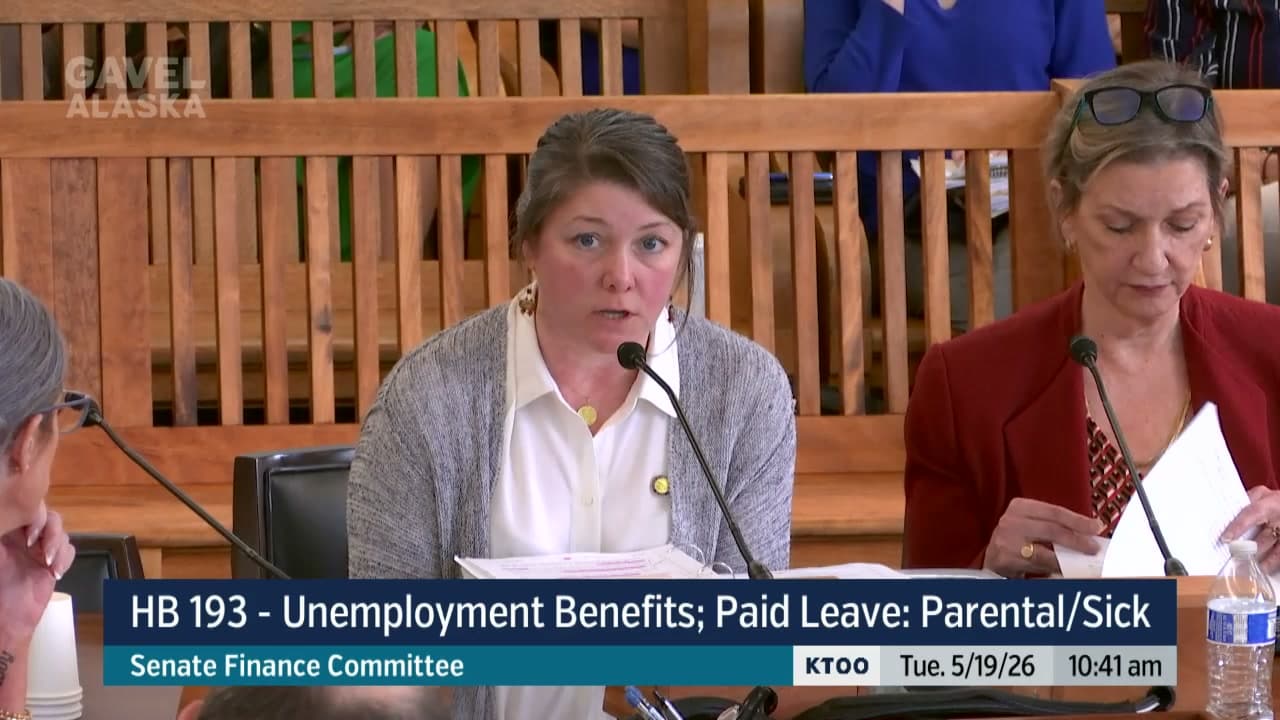
The Alaska Senate Finance Committee heard testimony Tuesday on a bill that would create a paid parental leave program funded by redirecting portions of existing payroll tax contributions from employees and employers.
House Bill 193 would establish benefits of 8 to 12 weeks for childbirth, adoption, and legal guardianship, with the duration determined by the Department of Labor and Workforce Development based on fund solvency. The program would be funded by a 0.15 percent employee contribution and a 0.20 percent employer contribution, with weekly benefits capped at $524 for workers earning up to $54,500 annually.
Representative Carolyn Hall told the committee the paid parental leave benefit would not begin until January 1, 2030.
Hall said the program would allow one qualifying event per 52 weeks and would run concurrent with the federal Family and Medical Leave Act, the Alaska Family Leave Act, and short-term disability benefits. The bill exempts seasonal employees and employers with comparable or better paid leave programs, though Hall noted those exempt may opt in. She also said the fund is protected from the sweep.
The Paid Parental Leave Program Trust Fund would be capitalized from current payroll tax contributions already collected by the Department of Labor and Workforce Development for unemployment insurance and for the State Training and Employment Program (STEP) and the Technical and Vocational Education Program (TVEP).
Employer contributions would be diverted to the unemployment insurance trust fund when the department determines it necessary to protect fund solvency.
Hall told the committee the fund would remain solvent through 2084 under current projections, though the balance would decline after 2040. The benefit duration of 8 to 12 weeks would be set at the discretion of the Department of Labor and Workforce Development based on fund solvency.
When asked why adoption of an older child would qualify for leave, Hall explained the logic was to allow time for the new child to be integrated into the family and to spend time with the parents in order to develop a bond.
The bill also includes a mandatory paid sick leave provision that applies to employers with 10 or more employees but exempts seasonal workers. That provision was added by floor amendment Saturday in response to concerns about implementing Ballot Measure 1, where businesses have found it difficult to implement a paid sick leave provision.
A senator questioned the complete exemption of seasonal employees from the sick leave requirement, noting that seasonal workers in food service and hospitality interact with the public.
Hall said the exemption addresses concerns from tourism and seafood industry employers about maintaining staff during critical high-peak periods.
The same senator acknowledged concerns about potential abuse at the end of seasonal employment but expressed reservations about eliminating sick leave entirely for those workers, particularly in settings where illness could spread to customers.
The bill also restructures unemployment insurance contributions. Under the proposal, employees would contribute 0 percent to unemployment insurance, while employers would contribute a minimum of 0.30 percent. The changes would take effect January 1, 2027, with an annual inflation adjustment based on the average taxable wage base to prevent the fund from becoming overcapitalized again, as it has since 2009.
Hall said employers would pay 0.2 percent less under the bill than they currently do.
Paloma Harbor, Director for the Division of Employment and Training with the Department of Labor and Workforce Development, confirmed the department would have discretion to set the duration of paid parental leave anywhere from 8 to 12 weeks depending on the solvency of the paid parental leave fund.
The committee heard the bill for the first time in Senate Finance on Tuesday and set it aside for further consideration. Four fiscal notes accompany the legislation, including one from the Department of Labor showing costs of $1.5 million in fiscal year 2027, rising to $11 million in fiscal year 2030 when benefits begin paying out and reaching $21 million by fiscal year 2031.
This article is based on a public meeting — SFIN-260519-0900 ().
AI-assisted. How we use AI Transcript byLucas Brown
Stay informed. Support what matters.
Free, permanent access to local news you can verify. Subscribe to support Walter AlaskaNews and go ad-free.
Related Coverage
House Finance Advances Paid Parental Leave Bill
Alaska News · 4mo ago
House Finance cuts paid parental leave to 12 weeks, reduces benefits to $524
Alaska News · 4mo ago
Alaska House Passes Paid Parental Leave, Exempts Seasonal Workers from Sick Leave
Alaska News · 4mo ago
House panel advances income tax on large pass-through businesses
Alaska News · 5mo ago
Alaska bill would penalize state for late payments to contractors
Alaska News · 4mo ago
Comments
Sign in to leave a comment.
No comments yet. Be the first to share your thoughts.