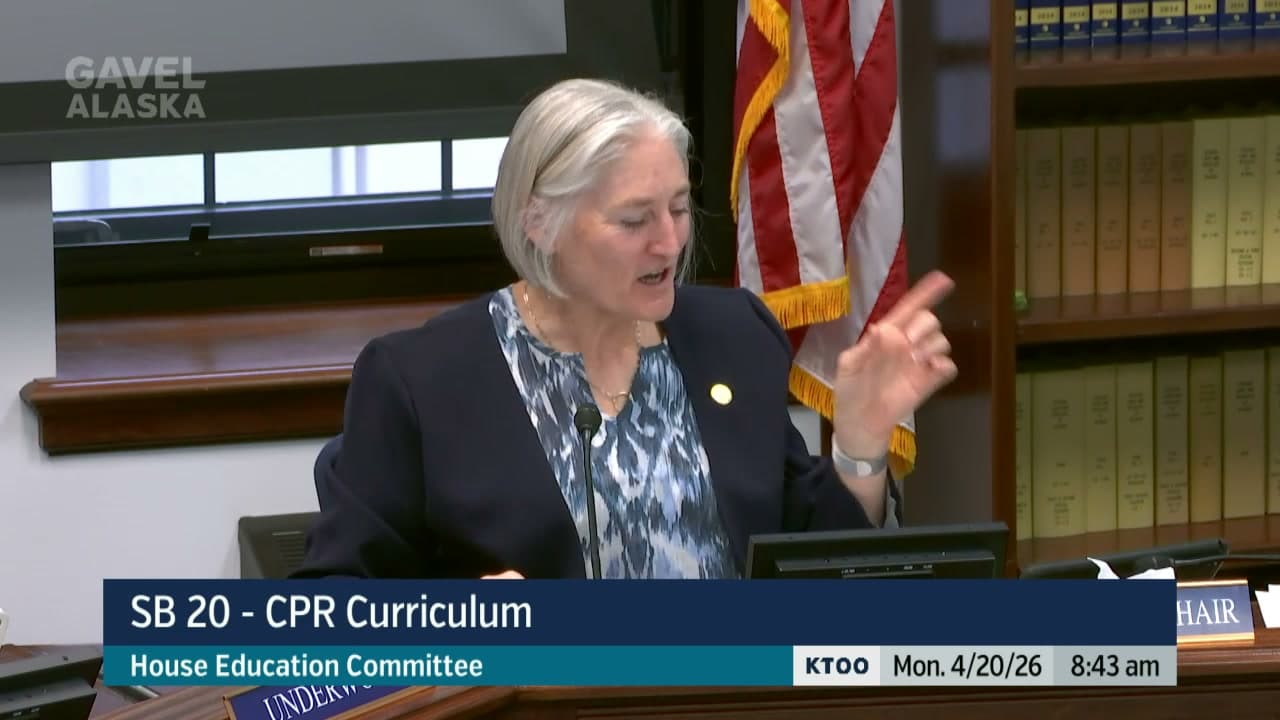
House Education Committee advances CPR training bill with rural flexibility
The House Education Committee voted Monday to advance legislation requiring cardiopulmonary resuscitation instruction in Alaska public schools, adopting three amendments designed to ease implementation in rural and under-resourced communities.
The committee approved Senate Bill 20 without objection after adding provisions that soften the mandate's requirements and delay its effective date to allow time for grant funding. The bill now moves to the House floor.
The legislation requires public schools to provide CPR instruction to students, equipping them with potentially life-saving skills and emergency preparedness. The amendments adopted Monday give districts significant flexibility in how they deliver that training. One amendment changed the requirement from "each" student to "a" student and added the phrase "if practicable," allowing schools to opt out based on staffing or resource limitations.
"This amendment gives schools more discretion and reduces enforceability, but it does not remove the expectation of CPR instruction," said Co-Chair Jamie Storey, who introduced the first amendment. "It just softens to allow some adjustments for mostly rural, smaller schools who may have trouble implementing this."
A second amendment removed the requirement for hands-on practice with mannequins, instead allowing schools to use virtual or blended simulations where equipment or instructors are not available. The change defines hands-on practice as simulated CPR using mannequins or similar tools aligned with national guidelines while permitting alternatives where needed.
"It may reduce training rigor in some cases, but it makes compliance more realistic," Storey said.
The third amendment pushed the bill's effective date to July 1, 2027, more than a year away. The delay allows the American Heart Association to apply for a Rural Health Transformation grant of up to $100,000 to support CPR training across the state.
Leah Van Kirk, healthcare policy advisor for the Department of Health, told the committee the Rural Health Transformation Program will accept applications in late July or early August. The American Heart Association plans to provide free CPR kits to all Alaska communities with 20 or more residents by 2030, meaning grant support would likely be needed for only about three years.
"Once you have instructors trained, they can keep instructing the future health providers of our great state," said Representative Eischeid.
Senator Elvie Gray-Jackson, the bill's sponsor, said the amendments do not change the bill's intent but provide flexibility and reassurance for implementation in more remote communities.
"It has never been our intention to place a burden on Alaska's educators, and this funding opportunity may help address the concerns that some of you may have," Gray-Jackson said.
The committee heard the presentation shortly after Kenai Peninsula Borough School District's College and Career Readiness Coordinator Analea Caron described CPR training already underway in that district. Caron told the committee the district has partnered with Alaska Safe Drivers and other organizations to offer CPR and first aid certification to students across the peninsula.
"You either figure out that you love medical and want to be in that setting or realize that that is not the career for you," Caron said of hands-on health training opportunities.
The bill requires the Department of Education and Early Development to develop guidelines for CPR instruction but does not mandate specific curriculum or certification requirements. Schools will have discretion to determine how best to meet the requirement based on their resources and student populations.
The House Education Committee meets next on Wednesday, April 22, at 8:30 a.m. in the Betty Davis Committee Room.
This article is based on a public meeting — Alaska Legislature: House Education, 4/20/26, 8am ().
AI-assisted. How we use AI Transcript byLucas Brown
Stay informed. Support what matters.
Free, permanent access to local news you can verify. Subscribe to support Alaska News and go ad-free.
Related Coverage
House Education Committee advances CPR training bill with rural flexibility
Alaska News · 5mo ago
Alaska House panel advances free school meals for reduced-price students
Alaska News · 5mo ago
House Finance Advances Education Funding Bill Despite Fiscal Concerns
Alaska News · 4mo ago
Senate Education Committee advances teacher loan repayment pilot program
Alaska News · 5mo ago
House Finance Advances Mental Health Education Guidelines for Schools
Alaska News · 5mo ago
Comments
Sign in to leave a comment.
No comments yet. Be the first to share your thoughts.