AI image
Fairbanks Labor Ordinance Copies Anchorage, Minus Review Clause
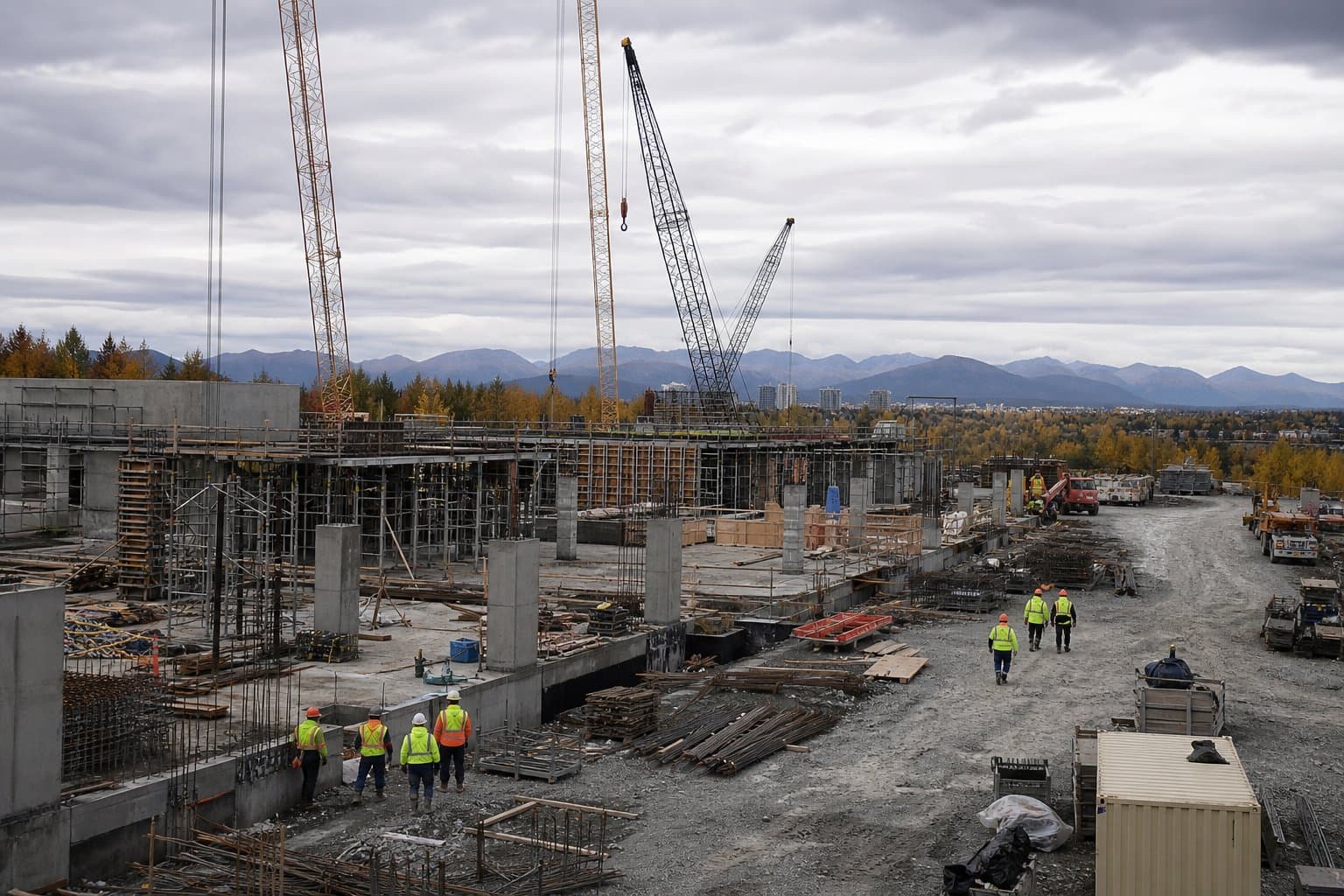
Fairbanks North Star Borough construction projects estimated above $3.5 million would face review for a community workforce agreement. Where a five-person team decides one is needed, every contractor and subcontractor on the job would have to sign it. The ordinance heads to a public hearing on Sept. 24.
Assembly members Patrick Roach, Garrett Armstrong and Nick LaJiness introduced the measure at the borough Assembly's regular meeting Thursday. It went to the Committee of the Whole on Sept. 17. The public hearing is set for 6 p.m. in the Assembly chambers at 907 Terminal St., 12 days before the borough's Oct. 6 regular municipal election. If adopted, the ordinance takes effect 90 days later.
The threshold covers any borough construction, renovation, expansion or demolition estimated above $3.5 million, excluding contract management and design costs. The review team would be chaired by the public works director. It would also include the chief of staff or a designee, a project department representative, a trades council representative and a contractor representative chosen by mutual consent of the Associated General Contractors of Alaska, Mechanical Contractors of Fairbanks and the Alaska chapter of the National Electrical Contractors Association. The team would decide by simple majority.
The borough would not be a party to the agreements it required. The parties would be the contractor and the trades council. Every contractor and subcontractor on a qualifying job would have to become and remain signatory for the duration of the work. Projects could not be divided into smaller phases to avoid the policy. Required terms include apprentice hours amounting to at least 15 percent of total contract hours and open out-of-work lists at trades council hiring halls, with encouragement to hire veterans, disadvantaged residents and people leaving incarceration through those halls. The ordinance states that the borough's policy is to use the agreements "to the fullest extent allowed by law."
The recitals cite a shortage of skilled tradespeople, a duty to secure best value for borough funds, and other Alaska governments including the Municipality of Anchorage and the City and Borough of Juneau.
A word-by-word comparison shows the operative provisions of the Fairbanks ordinance and Anchorage Municipal Code 7.15.045 match at about 82 percent. Nearly every difference is a name substitution, such as borough for municipal and chief of staff for municipal manager. Anchorage adopted its version in September 2018 and amended it in April 2019.
Anchorage changed the section again this year. Assembly Chair Christopher Constant introduced AO 2026-9 on Jan. 13, and the Anchorage Assembly approved it Feb. 3. Its one substantive change struck a subsection requiring the Assembly to review the section and its efficacy every three years, citing few qualifying projects on which to base an evaluation. The Fairbanks ordinance contains no efficacy review, no sunset and no report back to the Assembly. Fairbanks also drops an Anchorage clause requiring employer contributions to apprenticeship training programs targeting youth and unskilled adults. It puts the 15 percent apprentice target in that clause's place. The Fairbanks version omits Anchorage's stated interest in securing meaningful labor concessions. Where Anchorage tracks "minority" hiring, Fairbanks tracks "underrepresented groups."
Reading this? Tell us what you make of it. (no account needed)
No fiscal note accompanies the ordinance, which appropriates no money. Neither the ordinance nor the packet states how many borough projects exceed $3.5 million in a year.
The policy Fairbanks is borrowing has drawn open opposition elsewhere in the state. Associated Builders and Contractors of Alaska and Associated General Contractors of Alaska have opposed community workforce agreement requirements on public projects generally. In a 2022 joint lawsuit against the Anchorage School District's own such policy, the associations argued the requirement restricts competition and creates unequal hiring preferences. That is the associations' documented position on the policy type, not a response to the Fairbanks ordinance specifically. Building trades councils, by contrast, have signed onto similar labor agreements on other Alaska projects, including a memorandum of understanding covering the Alaska LNG project.
The record contains no statements from the Fairbanks trades council, the contractor associations, Mayor Grier Hopkins or the borough administration on this specific ordinance.
Source: Fairbanks is about to adopt Anchorage's construction labour policy almost word for word. Seven months ago Anchorage deleted the clause requiring it to check whether the policy works ().
AI-assisted. No editor review is on record for this article. Who is accountable.
Stay informed. Support what matters.
Free, permanent access to local news you can verify. Subscribe to support Walter AlaskaNews and go ad-free.
Related Coverage
Fairbanks votes Sept. 3 on a $699,500 indoor playground contract
Alaska News · 2w ago
Anchorage Assembly unanimously passes veteran-owned business preference ordinance
Alaska News · 2mo ago
Fairbanks would spend $1.2 million more to defend the pipeline's value in court
Alaska News · 2w ago
A union-labor fight is breaking out over who builds Alaska's gas line
Alaska News · 2mo ago
Alaska's LNG tax break now hinges on a gas line to Fairbanks
Alaska News · 2mo ago
Comments
Sign in to leave a comment.
No comments yet. Be the first to share your thoughts.