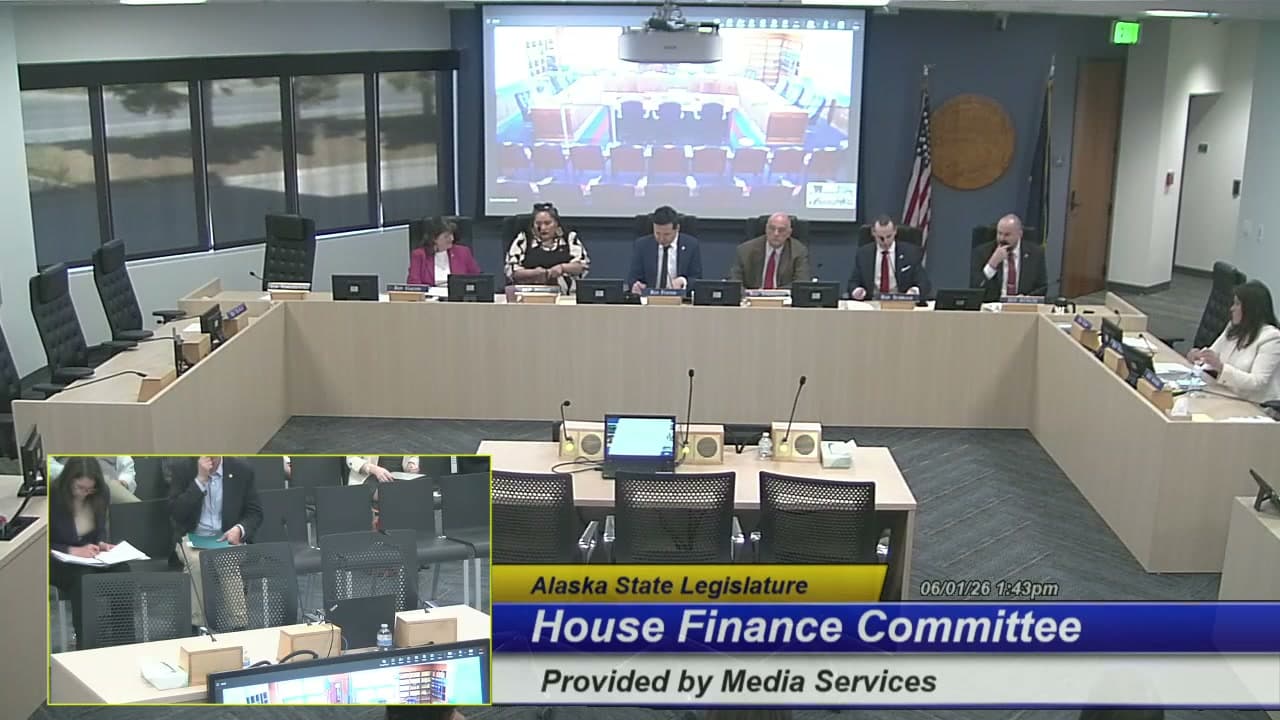
Frame from "Alaska Legislature: House Finance, 6/1/26, 1:30pm" · Photo source
ENSTAR says it locked in a price for Alaska LNG
Alaska's largest natural gas utility has locked in a $16 per thousand cubic feet commodity price for North Slope pipeline gas, ENSTAR president John Sims told the Alaska House Finance Committee Monday. The figure undercuts imported LNG alternatives but still represents a 48% increase over current Cook Inlet supply costs before distribution charges.
The contract price, negotiated with pipeline developer Glenfarn, is fixed regardless of construction cost overruns and drops to $10 then $5 per MCF as export volumes increase, Sims said. The price is subject to an annual inflation factor, though Sims said it is capped. By contrast, LNG import pricing tracks the Japan-Korea Marker, currently at $18.30 per MCF, plus $3 to $5 in terminal infrastructure costs; that yields nearly $20 gas or potentially $22 to $23 and above at today's market prices, Sims said. ENSTAR currently pays $10.80 per MCF for Cook Inlet gas under contracts expiring in 2033.
"This is the only project that has the potential to reduce the price of energy in the state of Alaska," Sims said. "Everything else has increased pricing."
ENSTAR consumes 33 to 38 billion cubic feet annually. The utility's Hilcorp contract, which supplies 162 million cubic feet daily at peak winter demand, expires in 2033. ENSTAR needs replacement gas starting in 2031, Sims said. No Cook Inlet producer can replace that volume, he added.
Representative Alyse Galvin (D-Anchorage) pressed Sims on whether the $16 price includes all costs to the customer. Sims clarified that ENSTAR's $3 per MCF distribution charge and $1.50 to $3 in storage costs would be added, bringing the total delivered price to roughly $20.50 to $22 per MCF. That compares to $13.80 per MCF today, including distribution.
Matanuska Electric Association and Chugach Electric Association face earlier deadlines. Chugach's Hilcorp contract expires first quarter 2028, while MEA's runs through April 2029. Both utilities told the committee they must decide by third quarter 2026 whether to proceed with LNG import facilities if the pipeline does not advance.
"We have to make a decision third quarter this year of which way to go," said Brandy Baker, senior manager of government affairs at Chugach. "We are running out of runway to have enough time for an import facility to be built in time to meet our gas requirement."
MEA testified that its Hilcorp contract extension came with about a 15 percent year-over-year gas supply cost increase. If forced to rely on diesel backup, MEA could face rate increases of about 50 percent, the utility told the committee.
The testimony comes as the Legislature debates tax structures and economic assumptions for a North Slope gas pipeline in multiple committee hearings examining whether the project can deliver competitive prices to Alaska consumers.
This article is based on a public meeting of Alaska State Legislature — Alaska Legislature: House Finance, 6/1/26, 1:30pm ().
Made by our human newsroom with AI. How humans and AI work here · Grow with our newsroom Transcript byLucas Brown
Watch key moments from the source meeting. Click to expand.
Stay informed. Support what matters.
Free, permanent access to local news you can verify. Subscribe to support Bill AlaskaNews and go ad-free.
Related Coverage
ENSTAR Caps the Price. Stedman Eyes the Debt.
Alaska News · 4mo ago
Alaska LNG nears Enstar supply deal as Cook Inlet gas declines
Alaska News · 4mo ago
Enstar faces 2033 supply gap as Hilcorp contract expires, no Cook Inlet producer can match drilling scale
Alaska News · 4mo ago
House Finance writes a $16 gas-price cap into Alaska LNG bill — even if Enstar's contract isn't signed
Alaska News · 4mo ago
The $16 Gas Promise Comes With Fine Print
Alaska News · 3mo ago
Comments
Sign in to leave a comment.
No comments yet. Be the first to share your thoughts.