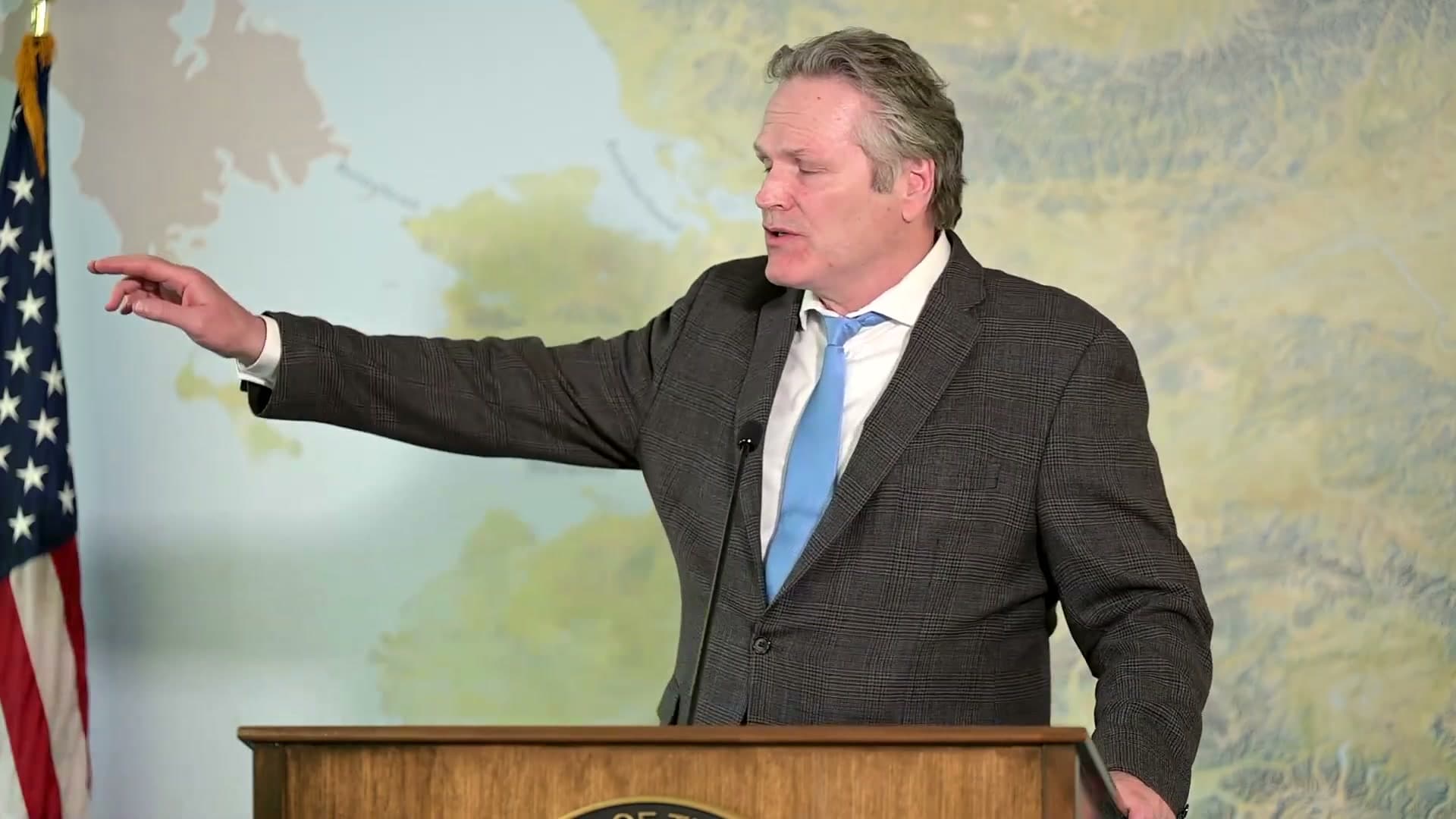
Frame from "Governor Dunleavy: Press Conference: LNG Gas line Update" · Photo source
Dunleavy warns of 45-cent power without gas-line tax deal
Governor Mike Dunleavy told reporters Friday that Alaska has three weeks left in the legislative session to pass a tax bill he says is critical to financing the North Slope gas pipeline. Without it, he warned, the state could face electricity costs of 35 to 45 cents per kilowatt hour within five to 10 years.
On February 28, 2024, Dunleavy announced SB 280 and HB 381 to replace the existing oil and gas property tax on the Alaska LNG Project with a payment-in-lieu-of-taxes structure based on gas throughput rather than pipeline assessed value. The bill would exempt the project from property taxes during construction through first gas, then hold property tax in abeyance during a ramp-up period until the project reaches an average of 1 billion cubic feet per day of throughput over 30 consecutive days, or 10 years after first gas, whichever occurs first. Once the project reaches that threshold, the state would impose a volumetric tax starting at six cents per thousand cubic feet of gas, with the rate increasing 1 percent annually.
The governor said the property tax conversion is essential to make the roughly $40 billion project financeable for investors. Without it, he said, Alaska will be forced to import gas at prices that could quickly climb from $10 per unit to $18 or higher.
"You might go from $10 a unit gas in the Lower 48 or Canada quickly to 12, 14, 15, 16, $18 gas," Dunleavy said. "And what does that mean? You're looking at 35 to 45 cents a kilowatt hour five to 10 years from now on the rail belt, especially in places like Fairbanks, Alaska."
The current Power Cost Equalization base amount for rural communities is 20.38 cents per kilowatt hour.
Dunleavy also argued that higher urban power costs would drive up rural electricity subsidies. "You drive rates down in urban Alaska, you will drive rates down in rural Alaska," he said. The Power Cost Equalization program, managed by the Alaska Energy Authority, provides economic assistance to eligible rural communities with extremely high electricity costs by paying part of residential and community facility power bills. The Regulatory Commission of Alaska adjusts the PCE base amount through a formal docket process using the weighted average cost of residential energy sales in Anchorage, Fairbanks, and Juneau.
Andrew Jensen, policy advisor for the administration, joined Dunleavy at Friday's press conference to discuss a recent PCE adjustment. Jensen explained that the PCE formula is weighted, with about 80 percent of the rate driven by costs in Anchorage and Fairbanks. On May 1, the RCA raised the PCE rate by nearly 10 percent, from 20.38 cents to 22.11 cents per kilowatt hour. Jensen said every one-penny change in the urban rate translates to a $1.5 million impact in PCE communities, meaning the approximately two-cent increase would reduce support for rural power rates by $3 million.
Dunleavy warned that without a gas line and with continued reliance on importing gas, the legislature would need to create an urban power cost equalization program costing $2 billion to $5 billion to build renewables, batteries, wind and solar infrastructure, and to import gas.
The Alaska State House and Alaska State Senate are working on competing versions of the legislation. During the press conference, a reporter noted that the House bill includes a 20-cent throughput tax, while the Senate version carries a higher rate. Dunleavy said throughput taxes much above 10 cents per thousand cubic feet would likely make the project unfinanceable. "You go above $0.10, ideally you're within the $0.06 range," he said. "If you go above, much above that, you're probably not going to get a project that's financeable."
Dunleavy said he will remain in Juneau for the rest of the session to work with legislators on the bill and is willing to call a special session if the legislature does not pass a workable version.
This article is based on a public meeting of Office of the Governor — Governor Dunleavy: Press Conference: LNG Gas line Update ().
Made by our human newsroom with AI. How humans and AI work here · Grow with our newsroom Transcript byLucas Brown
Watch key moments from the source meeting. Click to expand.
Stay informed. Support what matters.
Free, permanent access to local news you can verify. Subscribe to support Alaska News and go ad-free.
Related Coverage
Dunleavy says Alaska gas pipeline depends on property tax overhaul
Alaska News · 5mo ago
Gas Line Developer Warns Tax Hike Would Delay Project, Jeopardize 2029 Deadline
Alaska News · 5mo ago
Dunleavy to Call Special Session on Gas Line Property Tax Within Hour of Adjournment
Alaska News · 5mo ago
Alaska Senate panel hears gas line bill with $900M annual tax break
Alaska News · 5mo ago
Alaska LNG Tax Bill Stalls as Lawmakers Demand Project Cost Data
Alaska News · 5mo ago
Comments
Sign in to leave a comment.
No comments yet. Be the first to share your thoughts.