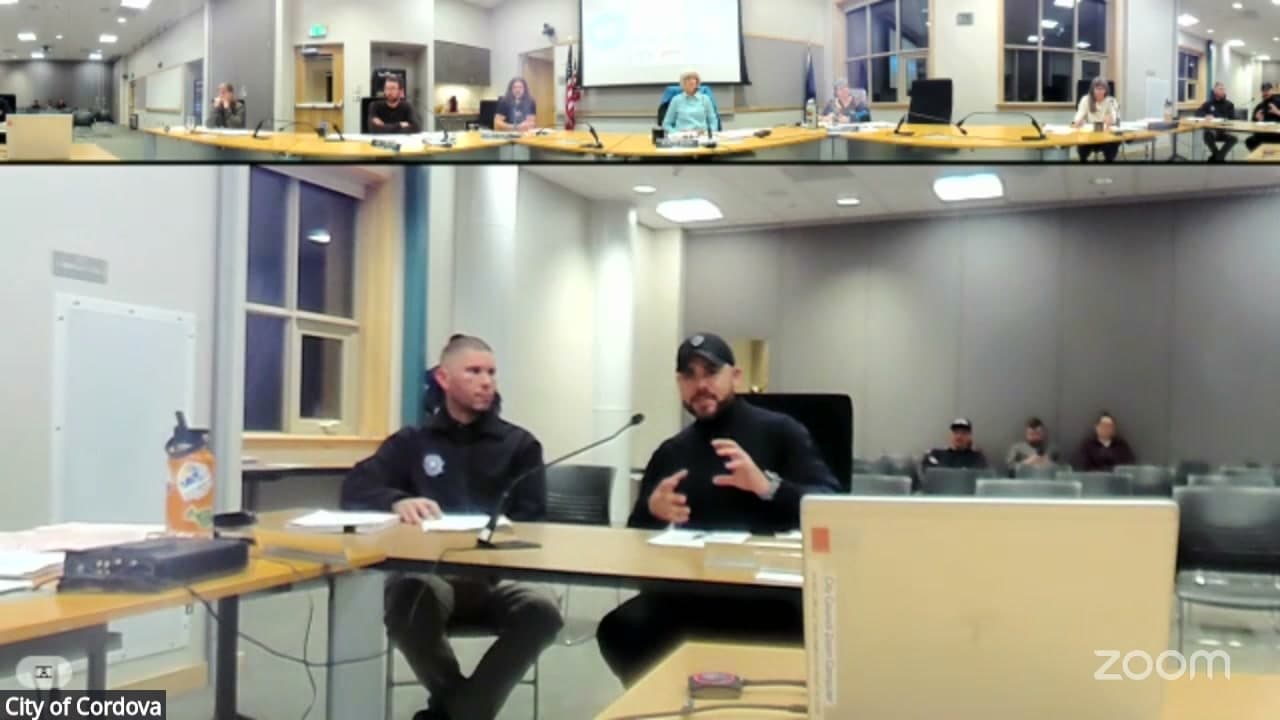
Frame from "Cordova: October 21 Council work session, public hearing, and regular meeting" · Photo source
Cordova council brings back $2 monthly 911 surcharge to help dispatchers find callers
The Cordova City Council voted Wednesday to bring back a $2 monthly surcharge on phone lines and wireless numbers to pay for an enhanced 911 system, which gives dispatchers a caller's number and location. The charge applies to billing periods that start on or after Jan. 1, 2027.
The charge is per line, or $24 a year for each phone. A household with five cellphones would pay $10 a month.
In memos to the council, Police Chief Cameron Hayden said 423 of the 536 open-line and hang-up 911 calls the department got from June 16, 2023, through Aug. 26, 2026, about 78.9%, had no usable location. Open-line calls, where the line connects but no one speaks, were the hardest: 268 of 304 had no location.
The council also approved a sole-source contract with CentralSquare Technologies for its Vertex 911 call-handling system, for up to about $212,000 over five years. The city did not seek bids. Dispatch Supervisor Brian Wildrick said he collected three quotes, and Hayden's memo calls CentralSquare's "by far the lowest cost" of the suppliers the department researched. The quote expires Dec. 31.
The contract also includes what the memo calls "Centerline AI capability," which CentralSquare markets as live transcription and translation of 911 call audio. It did not come up at the meeting.
The first year costs about $58,000. Hayden's memo says that will come from the $63,734 left in the city's E911 fund from the old surcharge. The memo estimates the new surcharge will bring in about $72,000 a year, enough to cover yearly costs of $33,000 to $44,000 for the rest of the contract.
Jeremiah Becker of Cordova Telecom said the company supports the system but told the council that only local carriers, Cordova Telecom, Cordova Wireless and Copper Valley, can collect the charge, not AT&T, Verizon, GCI or FirstNet. He counted about 2,570 local lines, which he said would raise about $62,000 a year. "You're basically taxing people to shop local," he said. State law says wireless companies must collect the surcharge from customers whose billing addresses are in the 911 service area.
Becker said the charge would triple bills for Cordova Telecom's roughly two dozen Lifeline customers, low-income subscribers who pay $1 a month. Council Member Wendy Ranney, who moved the resolution, wants them exempted. "When you pay $1 for a service and you're taxed $2 on top of that, I do have an issue with that," she said. Ranney is president of Cordova Telecom's board, according to the cooperative's website, and mentioned her board seat during the discussion.
The resolution as passed sets $2 per line with no exemptions. State law caps the charge at $2 and requires the same rate for wireless numbers and landlines. Wildrick said the council could set exemptions or a lower rate, but he'd like to see $2 "for the majority of people." Council members agreed to work out exemptions later in the city's fee schedule.
Becker also said Cordova Telecom hadn't discussed the system with the city and is in the middle of an accounting and mapping migration that won't be done until the middle of next year. "I don't even know if we can actually provide you the data to map a phone number to an address or a cell phone to a location at this time," he said. Hayden's memo says local carriers "have been contacted" and are ready to provide wireless location data.
Wildrick said location data for wireless calls "should be plug and play," while landlines will take more work with Cordova Telecom. The system also includes RapidSOS, which he said finds wireless callers no matter their carrier. "They can be from out of state, from Canada, and they could be lost in the woods, and we would get their ping if they were able to call 911," he said.
Cordova first imposed the surcharge in 2010 and suspended it in 2012 while it waited for an E911 system. The new resolution requires the council to review the rate every year.
Editor's note: This story was updated Oct. 22 with more on who will pay the surcharge, what the contract covers and when the system could be working.
This article is based on a public meeting of City of Cordova — Cordova: October 21 Council work session, public hearing, and regular meeting ().
Made by our human newsroom with AI. Reviewed by Cale Green. How humans and AI work here · Grow with our newsroom Transcript byWalter AlaskaNews
Watch key moments from the source meeting. Click to expand.
Stay informed. Support what matters.
Free, permanent access to local news you can verify. Subscribe to support Walter AlaskaNews and go ad-free.
Related Coverage
Cordova council weighs charging nonprofits for city recreation facilities
Alaska News · 16h ago
Cordova council votes 4-0 to negotiate hillside lot sale instead of taking bids
Alaska News · 1mo ago
Cordova Council debates mill rate hike as school funding deadline nears
Alaska News · 5mo ago
Cordova council backs carrying $1 million in unexpected revenue into 2027
Alaska News · 16h ago
Cordova Council approves $181,000 school funding increase, defers payment decision
Alaska News · 5mo ago
Comments
Sign in to leave a comment.
No comments yet. Be the first to share your thoughts.