Chignik King Salmon Meets Escapement Goal After Six-Year Drought
Chignik River king salmon reached the biological escapement goal in 2025 for the first time since 2019, raising questions about whether aggressive conservation measures should continue.
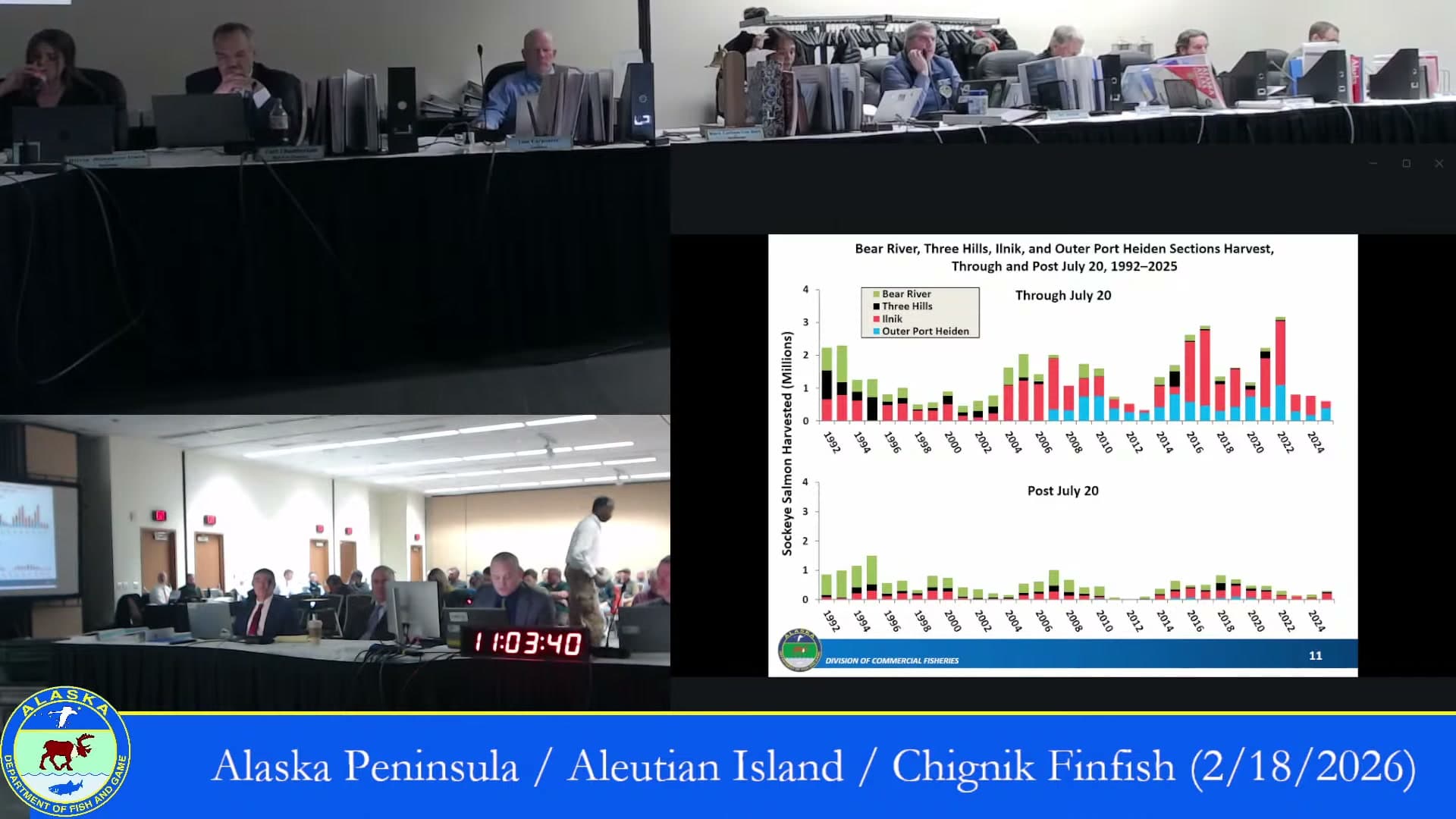
The Alaska Board of Fisheries heard Wednesday that 1,391 king salmon passed through the Chignik weir in 2025, meeting the lower bound of the 1,300 to 2,700 fish goal. The stock had failed to meet escapement goals for seven of the last nine years, including a record low of 267 fish in 2023. The Board of Fisheries designated Chignik king salmon as a stock of management concern in 2023 following the persistent escapement failures.
"I want to thank you and your staff for fighting for the funds for this, for producing the results as quickly as possible to try and get this before the board for this meeting," said Marit Carlson-Van Dort, board chair.
The department implemented unprecedented restrictions in 2024 and 2025 to protect the stock. The Chignik Bay District was limited to no more than 48 hours of commercial fishing time per calendar week throughout July. Following unusually high harvest of juvenile king salmon in the Western District in 2024, harvest caps were implemented throughout the entire Chignik Management Area in 2025. If more than 1,000 king salmon were harvested within a 48-hour window, a seven-day closure in the districts primarily responsible would occur. The harvest cap was never triggered during the 2025 season.
Subsistence and sport fisheries also faced restrictions. The department closed the subsistence fishery to king salmon within the Chignik Lagoon and Chignik River watershed before the season in 2024 and 2025. The sport fishery was similarly closed in those areas, and the saltwater bag limit was reduced in the entire Chignik Management Area in 2025.
Despite meeting the escapement goal, the stock remains designated as a stock of management concern. The department presented five options for commercial fishing, one option for subsistence fishing, and four options for sport fishing for the 2026 action plan. Statewide Chinook salmon declines are influencing continued restrictions on Chignik king salmon fisheries.
The first Chignik Bay District commercial action would keep the same restrictions the department used in 2025. The Chignik Bay District would be restricted to 48 total hours per week, with closed waters around the area known locally as the King Hole. Non-retention of king salmon 28 inches and greater would be implemented in the Chignik Bay District, Central District, and inner Castle Cape subsection of the Western District.
The second Chignik Bay District commercial action would trade additional fishing time for reduced area. The Chignik Bay District would be restricted to 72 hours per week rather than 48, and closed waters inside a line from Ollie's Point would be implemented rather than just the King Hole.
The third Chignik Bay District commercial action would be the most strict, incorporating time restrictions from Action 1 and the area restrictions from Action 2.
The first Chignik Management Area-wide commercial action would implement a harvest cap of 1,000 king salmon within a 48-hour period. If triggered, this would cause a seven-day closure of the statistical areas primarily responsible. Mandatory retention of all king salmon in outer districts would be in effect.
The second Chignik Management Area-wide commercial action would keep the same restrictions the department used in 2025. A harvest cap of 1,000 king salmon within a 48-hour period would be in place. If triggered, this would cause a seven-day closure of the districts primarily responsible rather than the statistical areas, a larger area. Mandatory retention of all king salmon would again be in effect for outer districts.
The department is recommending the same approach for the king salmon subsistence fishery. The department will likely continue to restrict the subsistence fishery to king salmon 28 inches and greater within the Chignik Lagoon and Chignik River watershed before each season until the lower bound of the goal is reached more consistently.
The first sport action for the king salmon sport fishery would match 2023 restrictions. The department will continue to manage the sport fishery through emergency order.
The second sport action for the king salmon sport fishery would match 2024 and 2025 actions. The department will continue to manage the sport fishery through emergency order. The department would continue to close the sport fishery to king salmon within the Chignik Lagoon and Chignik River watershed before each season and may continue to reduce saltwater bag limits. This is the most restrictive of the four sport action options.
The third sport action for the king salmon sport fishery would be to restrict the sport harvest of Chignik River king salmon. The sport fishery would be limited to non-retention of king salmon in the Chignik Lagoon and Chignik River watershed. Bait would be prohibited and gear would be restricted to single hook.
The fourth sport action for king salmon would be to close the sport harvest of Chignik River king salmon within the Chignik River. Additionally, the use of bait would be prohibited and gear would be restricted to single hooks.
The department also reviewed Proposal 112, which has three sections: tiered Chignik Bay restrictions, reduced fishing time at Mitrofania Island to a schedule of no more than 48 hours open followed by minimum closures of at least 72 hours, and harvest caps identical to those present in the Chignik Management Area-wide Commercial Action Number 1.
The first tier would be closed waters inside a line from Ollie's Point. However, no time restrictions would be in place. If the first tier is deemed insufficient, the second tier would be to have closed waters inside the spit line, effectively closing the entire lagoon. No time restrictions would be in place. If the second tier is deemed insufficient, the final tier would be to move to a restricted schedule, limited openings to 48 hours with minimum closures of 72 hours between. The schedule would be in addition to or instead of the area closures from the first or second tier.
The department is open to alternative solutions and is not opposed to Proposal 112, but highlighted some potential issues. While local knowledge has stated that more king salmon hold inside waters from Ollie's Point, such as the King Hole, it is ultimately unclear how effective area closures are in comparison to time restrictions, particularly if there are no time restrictions. Proposal 112 ranges from the least restricted option being closed inside of Ollie's Point line with no time restrictions to potentially the most restrictive, being closed inside the lagoon spit and on a limited schedule. However, Proposal 112 is vague on how to determine which tier is necessary.
Consistent with previous delisting criteria, if the lower bound of the escapement goal for the Chignik River king salmon is met in three consecutive years and expected to meet the goal in future years, or if the lower bound is met in four out of six consecutive years and is expected to meet the goal range in future years, the department will recommend removing Chignik River king salmon as a stock of management concern. In the event that two consecutive years of escapements are near the upper bound of the escapement goal range or above the range, management restrictions may be relaxed or set aside using emergency order authority.
Stock status, action plan performance, and escapement goal review will be updated and reported to the board at the 2029 Chignik meeting.
This article is based on a public meeting — Alaska Peninsula / Aleutian Island / Chignik Finfish (2/18/2026) ().
AI-assisted. How we use AI Transcript byLucas Brown
Stay informed. Support what matters.
Free, permanent access to local news you can verify. Subscribe to support Alaska News and go ad-free.
Related Coverage
Board Restricts Fishing Gear to Protect Chinook in Chignik, Area M
Alaska News · 7mo ago
Chignik fishermen get a five-day opening, but most of the area stays closed on weak runs
Alaska News · 1mo ago
Chignik Bay District gets 48-hour window before Chinook plan closes it again Monday
Alaska News · 2mo ago
Bristol Bay's Nushagak opened late this year to protect its king salmon
Alaska News · 2w ago
Aniak River closed to all king salmon fishing, including catch-and-release
Alaska News · 3mo ago
Comments
Sign in to leave a comment.
No comments yet. Be the first to share your thoughts.