AI image
Anchorage surveillance ordinance findings say $11.8 million Axon system runs on police policy alone
Anchorage police run their Real-Time Crime Center, license plate readers and drones under departmental policy that, by its own terms, "does not apply in any criminal or civil proceeding," according to findings written into a surveillance ordinance introduced Aug. 18 by Assembly Members McCormick and Scout and Assembly Vice Chair Volland.
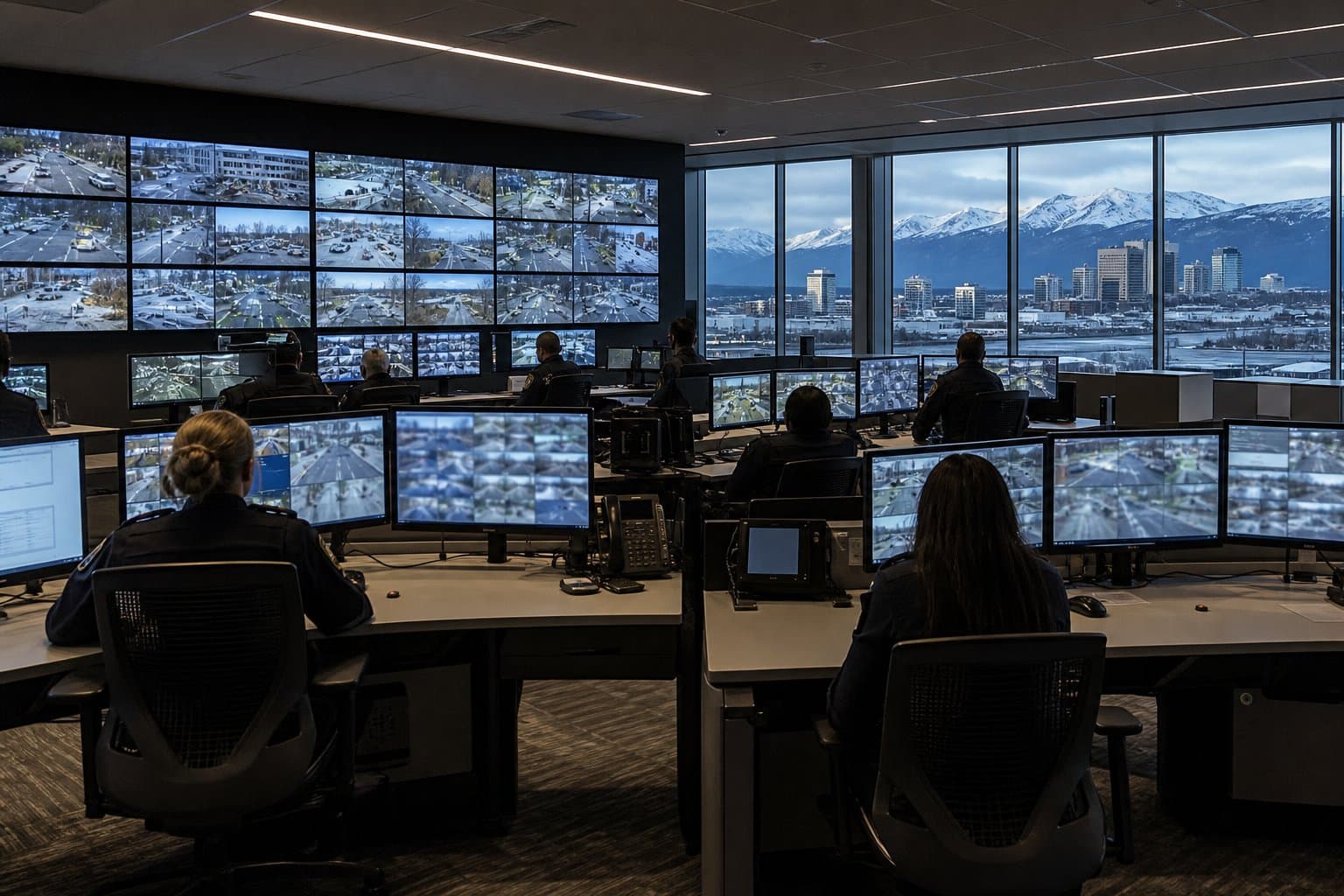
On Sept. 23, 2025, the Assembly approved a five-year contract with Axon Enterprise, Inc., in the approximate amount of $11.8 million, giving the Anchorage Police Department a crime center designed to receive up to 750 camera feeds, automated license plate readers, drones capable of remote deployment, and technology to detect drones and their operators. The Assembly approved that contract without any corresponding amendment to Anchorage Municipal Code chapter 3.102.
Materials presented with the contract identified the license plate readers, the drone-detection technology, and two additional unspecified tools as provided at no additional cost. The sponsors write that this shows surveillance capability can reach the municipality without independent procurement review or Assembly deliberation directed at that capability.
The chief of police adopted three policies effective Feb. 20, 2026, covering the crime center, Drone as First Responder operations and license plate readers. Under the findings, a violation of those policies is grounds only for departmental administrative sanctions.
The ordinance also cites jurisdictions elsewhere in the country where license plate data collected by municipal agencies was queried by out-of-state and federal agencies without local authorization, used to identify people attending lawful political demonstrations, and used to investigate conduct that was legal where the data was collected. In several of those places, the sponsors write, a written policy already prohibited what happened.
The findings grant part of the department's case, saying a real-time crime center serves a legitimate public safety function when it gives officers immediate situational awareness, a function distinct from keeping a searchable record of people's movements.
Axon's public FAQ for its camera-integration platform states that camera access is permission-based, that data is encrypted to CJIS standards, and that the system "does not currently employ any native facial recognition technology." Chief Sean Case told an Assembly work session Aug. 21 that policy already sets 14-day retention for plate reader data, limits search access to fewer than 10 employees, and directs him to weigh quarterly whether the benefits outweigh the risks to privacy.
The public hearing was held Sept. 1 at the Z.J. Loussac Library, with minutes not yet posted. If passed, the ordinance directs the mayor within 120 days to deliver an inventory of every surveillance tool the municipality already owns.
AI-assisted, reviewed by editors.
Stay informed. Support what matters.
Free, permanent access to local news you can verify. Subscribe to support Walter AlaskaNews and go ad-free.
Related Coverage
Anchorage weighs surveillance rules 11 months after buying the system
Alaska News · 4d ago
Anchorage ordinance would require Assembly approval for any surveillance purchase, at any price
Alaska News · 2w ago
Anchorage is considering expanding its surveillance network. The privacy rules are still a draft.
Alaska News · 1mo ago
Ordinance would make police ask before buying surveillance tech
Alaska News · 1w ago
As a crime center vote nears, Anchorage weighs whether its privacy limits should be policy or law
Alaska News · 1w ago
Comments
Sign in to leave a comment.
No comments yet. Be the first to share your thoughts.