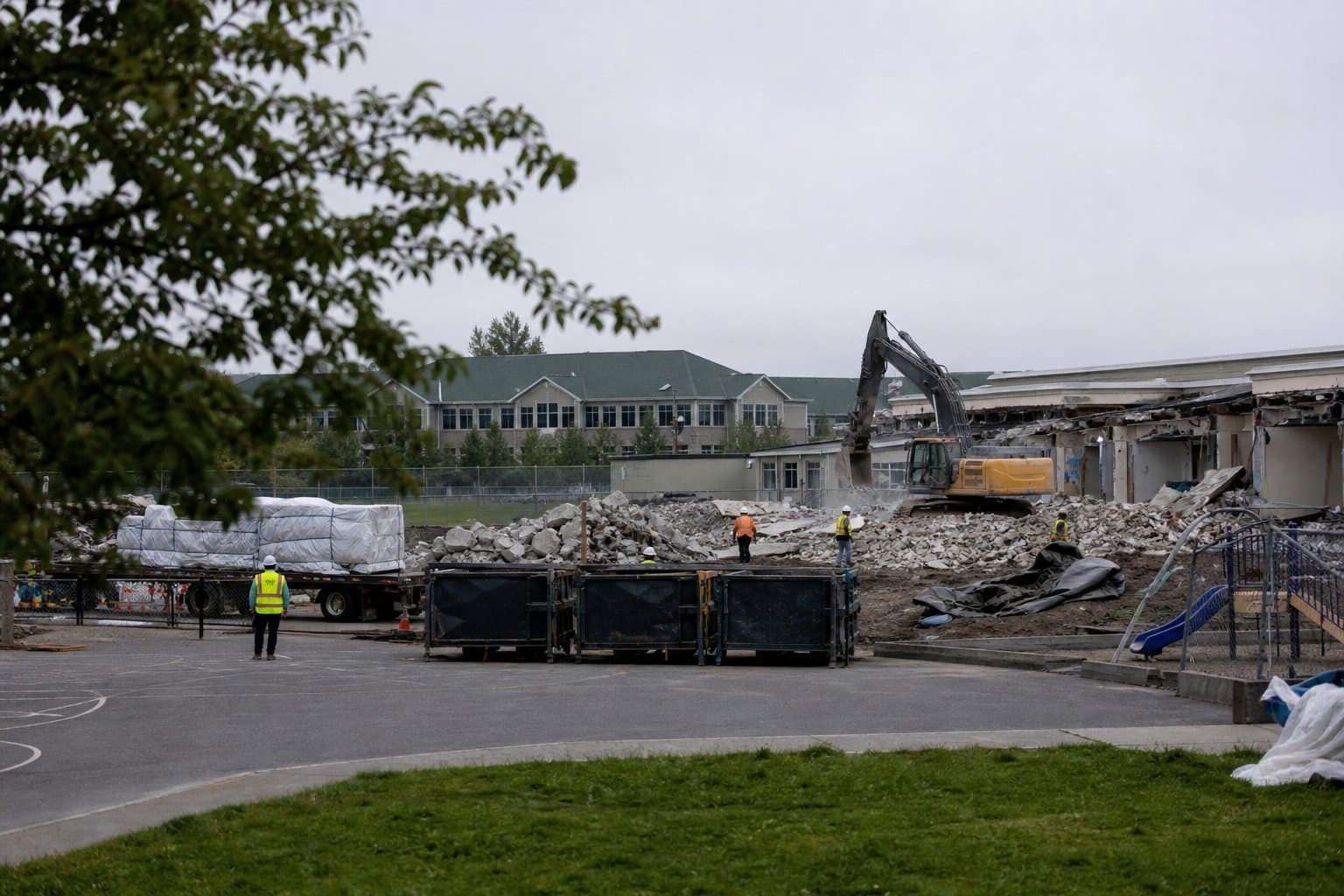
Anchorage School Board approves $849,673 to ship Inlet View PCB debris to Oregon
The Anchorage School Board voted 7-0 Tuesday to send contaminated concrete from the old Inlet View Elementary School to Oregon for disposal, adding $849,673 to the district's replacement contract with Cornerstone General Contractors.
The change raises the project's contract value to $42,744,256. Facilities official Jim Anderson told the board the project remains about $9 million under budget.
The added cost traces to a change in disposal rules from the Alaska Department of Environmental Conservation, which Anderson said reflects the agency's interpretation of the standard rather than a statute. "A little over a year ago, The Alaska Department of Environmental Conservation changed the disposal protocols in Alaska to a much, much higher standard," he said. Polychlorinated biphenyls, banned in 1979, were used for decades in caulks, paints and sealants. "These materials, now that the new disposal protocols have changed, are not allowed to be sent to the Anchorage Landfill," he said.
The district hit the same problem at the closed Ursa Major building on Joint Base Elmendorf-Richardson, where an October 2025 school board recap put the added demolition and disposal cost at about $5.4 million. Between the two buildings, the change has added roughly $6.25 million. ADEC's own account of what it changed is not in the meeting record.
Member Rachel Blakeslee pushed for a cheaper option, citing ADEC guidance that material at low concentrations can be left in place under an engineered cap. "So while there aren't landfills to dispose of the PCBs, you could have a much cheaper option by leaving it in place, capping it, and burying it," she said. She added that it "feels very significant in a resource-scarce environment like the one that we're in."
Anderson said the district had no design, permits or cost estimate for on-site burial and could not say whether it would save money.
The board tabled the item so Anderson could gather more information. He returned with three findings: the current slab measures at 10 parts per million, over the ADEC limit; groundwater sits three to five feet down; and regulators are "somewhat doubtful that now that we have raised it and we know that it has PCBs, that they would allow us to bury it and leave it in contact with the groundwater."
She said the information resolved her concerns and she would vote for the change order.
The playground will be ready to occupy mid to late October if work stays on track, Anderson said. A delay of more than two weeks would push that to next spring or summer.
AI-assisted, reviewed by editors. Spot an error?
Watch key moments from the source meeting. Click to expand.
Stay informed. Support what matters.
Free, permanent access to local news you can verify. Subscribe to support Walter AlaskaNews and go ad-free.
Related Coverage
Anchorage School Board pledges no closures in 2026-27, rejects funding condition
Alaska News · 1h ago · 79% match
Anchorage School Board balks at a $2.8M curriculum buy members hadn't seen
Alaska News · 1mo ago · 77% match
Anchorage board won't reopen a school it may not have fully closed
Alaska News · 1mo ago · 77% match
Anchorage School Board adopts My Perspectives English curriculum for grades 6-10 on 6-1 vote
Alaska News · 1h ago · 76% match
Anchorage Assembly set to vote July 21 on nearly $3M landfill tipping building contract
Alaska News · 1mo ago · 76% match
Comments
Sign in to leave a comment.
No comments yet. Be the first to share your thoughts.