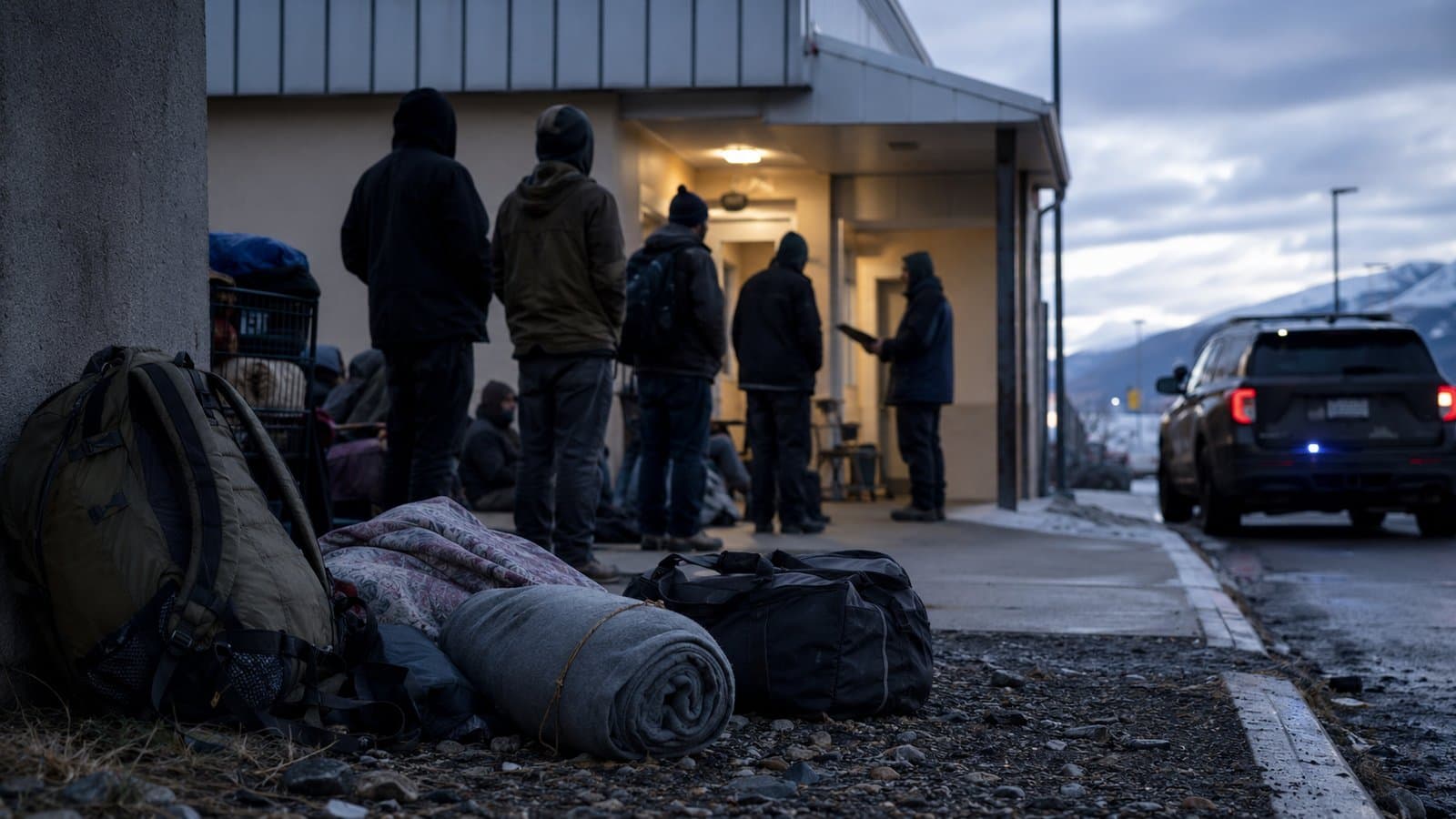
Generated image
Anchorage homeless residents tell Assembly: shelters worse than jail
People currently and previously experiencing homelessness told the Anchorage Assembly Housing and Homelessness Committee on Wednesday that the city's shelter system treats adults worse than a federal halfway house and that police enforce the camping ban even when no shelter bed is available.
Six people testified; four identified themselves as currently homeless. Their testimony lands inside a politically contested Anchorage conversation in which two sets of lived experience compete for municipal response: the experience of unhoused residents, and the experience of housed residents whose neighborhoods, businesses, and families have been directly affected by the encampment conditions the camping ban was passed to address.
Timothy Berner, who said he is homeless in Anchorage, drew a direct comparison between shelter intake and incarceration.
He spent six months in a federal halfway house after federal prison and was never searched going in. Shelters require everyone to arrive by 8 PM, stand in line until 9 or 10, and submit to a search. "I think that needs to be suspended until we can increase the capacity for the shelters," Berner said, referring to enforcement of the camping ban.
Keith Jackson said it took him 12 weeks to get into a shelter while police told him he could not camp anywhere. "They gave me absolutely no solution other than to go to the shelter that were at capacity," Jackson said. "There is no excuse for people to sleep on the street in Alaska. People die of exposure in the summertime."
Elias and Michaela Robinson said a landlord embezzled rent money paid on their behalf by a housing coalition, then told outreach workers they were drug addicts. The shelter system proposed splitting the family despite Michaela Robinson's medical conditions; at the Alex Hotel, she said she was wanded with a metal-detection wand without warning despite having a pacemaker. "We offered to do drug tests," she said. "We have income. We just needed help."
Adrian Tilden told committee members to spend a night outside to understand what people face. "The real shelter you're bringing us is jail," Tilden said.
The camping ban that Berner, Jackson, and others referenced was passed by the Anchorage Assembly following extensive public testimony from housed residents who described documented harms in their neighborhoods: drug overdoses and fentanyl exposure, property and violent crime including sexual assault, encampment fires, biohazards including human waste and used needles, and human trafficking concerns associated with some encampments. Residents across the political spectrum — from liberal to conservative — testified that they had watched encampments grow near their homes, schools, and businesses, that valuables had been stolen, and that the conditions had become incompatible with their families' safety. The ban gave the city legal authority to act on those concerns.
Anchorage's shelter procedures are set by providers operating under contracts with the Anchorage Health Department; providers cite resident safety, contraband control, and capacity management as reasons for the requirements testifiers critiqued. Shelter capacity has been a chronic constraint, with expansion limited by funding, siting, and staffing. Mayor Suzanne LaFrance's administration is operating under a broader response framework that includes shelter expansion, the "10,000 Homes in 10 Years" plan, and behavioral health investment.
Whether that framework can absorb both the homeless residents' needs and the housed residents' legitimate safety concerns remains the substantive open question — and the camping ban is the legal instrument the city has been using to navigate between them.
This article is based on a public meeting of Municipality of Anchorage — Anchorage Assembly: Housing and Homelessness Committee ().
Drafted with AI. Edited by Cale Green. No full editor review is on record. Who is accountable. Transcript byLucas Brown
Stay informed. Support what matters.
Free, permanent access to local news you can verify. Subscribe to support Walter AlaskaNews and go ad-free.
Related Coverage
Anchorage testifier says camping-ban service acceptance has fallen to 2.6%
Alaska News · 7h ago
Anchorage sees 28% drop in unsheltered homelessness as shelters reach capacity
Alaska News · 3mo ago
An Anchorage shelter contract has grown from $1 million to nearly $5 million in a year
Alaska News · 2mo ago
Anchorage's camping ordinance produces plenty of compliance — but few people taking services, and homelessness still visible
Alaska News · 1mo ago
Anchorage weighs who decides when cold-weather shelter opens
Alaska News · 1w ago
Comments
Sign in to leave a comment.
No comments yet. Be the first to share your thoughts.