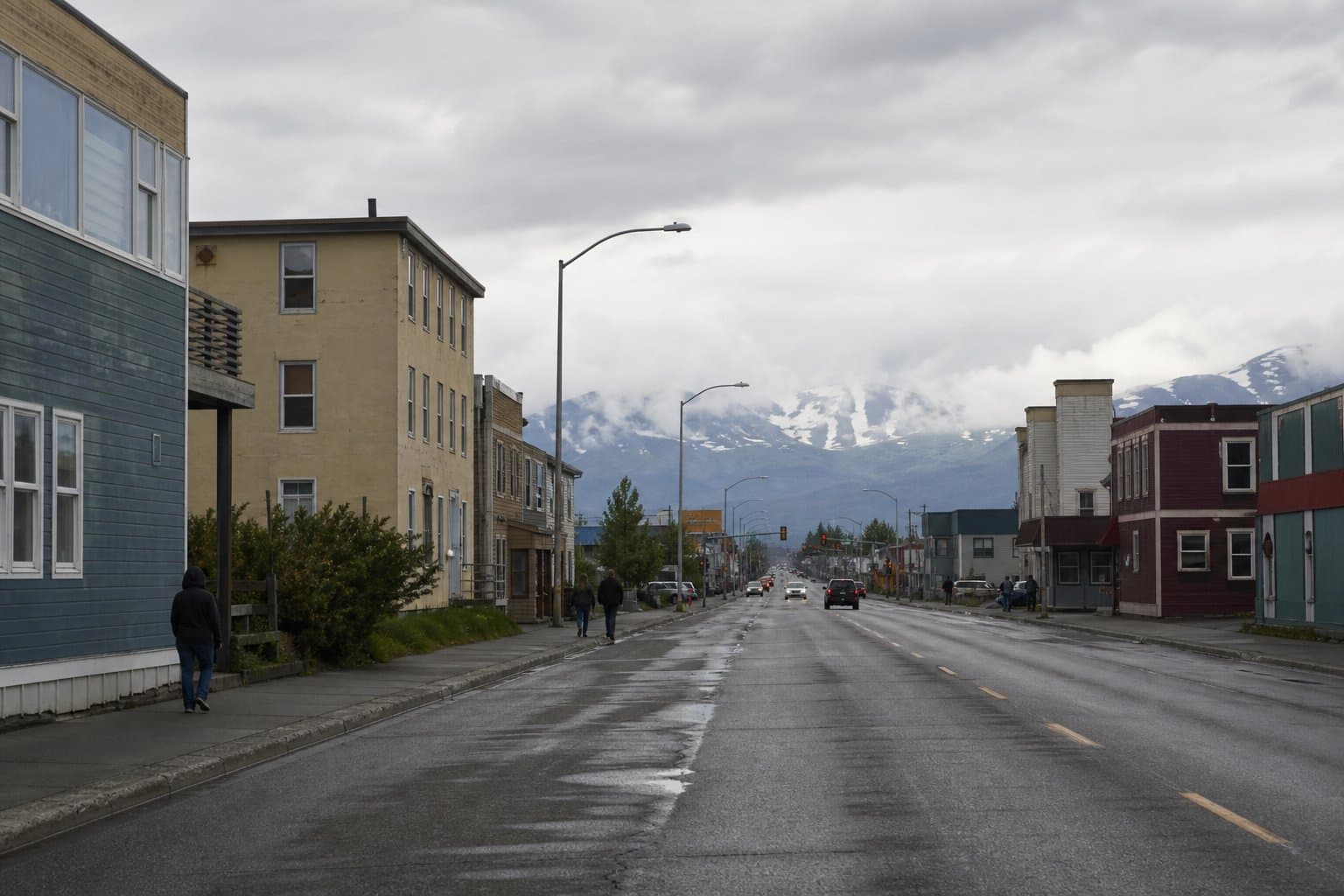
AI image
Anchorage Assembly members frame Fairview grant as a civil-rights question
Two Anchorage Assembly members put Fairview's history of racial exclusion and urban renewal at the center of a policy argument, casting a proposed $750,000 behavioral health grant as an equity and fair-housing question rather than a routine land-use decision.
Assembly Vice Chair Daniel Volland and Assembly Member Sydney Scout, both of District 1, submitted Assembly Information Memorandum AIM 111-2026 for the Assembly's July 21 meeting. The memorandum bundles their individual policy memos with external research on fair housing and civil rights. The grant, AM 295-2026, would award up to $750,000 in federal Community Development Block Grant funds to True North Recovery to acquire a building at 1217 E. 10th Avenue in Fairview for the Anchorage Launchpad Program, a behavioral health and navigation center.
Volland's memo recommends a no vote on the grant as proposed and draws on the Municipality's own historical record. Eastchester Flats, the Fairview-area district where Black residents were concentrated because of housing discrimination elsewhere in Anchorage, was targeted for demolition in the late 1960s as part of urban renewal. "Continuing to concentrate high-impact public services there risks repeating a pattern in which politically and economically marginalized neighborhoods are asked to carry burdens for the broader municipality," the memo states.
The memorandum attaches external research for the Assembly to read alongside Fairview's record, including a Poverty & Race Research Action Council analysis asking whether the District of Columbia government violated the Fair Housing Act and a MinnPost report on a civil rights complaint seeking to stop cities from concentrating low-income housing in high-poverty neighborhoods.
A local policy foundation
A resolution the Assembly adopted in 2018, AR 2018-167, found that downtown and Fairview hosted 82 percent of the Municipality's year-round emergency overnight shelter beds and declared a policy of dispersed placement for new services across the Anchorage Bowl. Volland argues the True North grant is the kind of siting decision that policy was written to redirect, and that a no vote is not a vote against recovery, behavioral health care, or True North's work, but a vote for a more equitable siting policy.
Volland's memo acknowledges the case for clustering services near existing shelter infrastructure. It concedes that "some degree of clustering can support coordination of care," but argues the current concentration "is not incidental" and instead reflects "decades of siting decisions that have placed region-serving services in the same neighborhoods."
Scout's community questions
Scout's memo, addressed to the Assembly's Public Health & Safety Committee, thanks the mayor for pulling AM 295-2026 from the April 28 Assembly agenda after Fairview residents objected, and for opening a community engagement process involving Fairview leaders, the Anchorage Police Department, True North Recovery, Access Alaska, and others. It relays resident questions, including why Fairview was chosen over Mountain View or Midtown, what offsite impacts the site would create and how they would be mitigated, and whether the facility's hours could align with those of the adjacent Fairview Recreation Center.
Scout also notes that Fairview is absorbing the loss of the Carrs on Gambell grocery store, which closed last year, and Crossroads Lounge, a neighborhood gathering place "now set to close on May 13th after 62 years in business." Community assets are eroding, the memo argues, even as service burdens grow.
Source: Anchorage Assembly.
Made by our human newsroom with AI. How humans and AI work here · Grow with our newsroom
Stay informed. Support what matters.
Free, permanent access to local news you can verify. Subscribe to support Walter AlaskaNews and go ad-free.
Related Coverage
Fairview grant dispute heads to Assembly with two members urging no vote
Alaska News · 3mo ago
Anchorage Assembly approves $750K True North grant after amendments fail and crisis-care dispute divides members
Alaska News · 3mo ago
True North dropped crisis services from Fairview plan after months of pushback
Alaska News · 4mo ago
Anchorage treatment facility debate exposes gaps in public process
Alaska News · 5mo ago
True North Recovery proposes Fairview behavioral health center
Alaska News · 5mo ago
Comments
Sign in to leave a comment.
No comments yet. Be the first to share your thoughts.